Åland marks centenary of autonomy agreement with a year full of events

The Åland Islands, located between southwest Finland and the east coast of Sweden, are something of an anomaly.

Autonomous within the republic of Finland, the archipelago has its own legislative assembly. It’s something of a wonder that this autonomy, along with the islands’ demilitarised status, has endured for a century in a turbulent and changing world.

The archipelago’s population of 30,000 residents has geared up for a year of celebrations to mark this centenary. June 9 is Åland Autonomy Day, recognising the anniversary of the first meeting of the autonomous assembly in 1922. The agreement to secure that autonomy was signed a year earlier under the auspices of the Council of the League of Nations, the forerunner of the UN. The “Åland solution” was probably the Council’s biggest triumph, and the Åland Example remains a globally acknowledged reference for conflict prevention and resolution of minority disputes.

It’s complicated

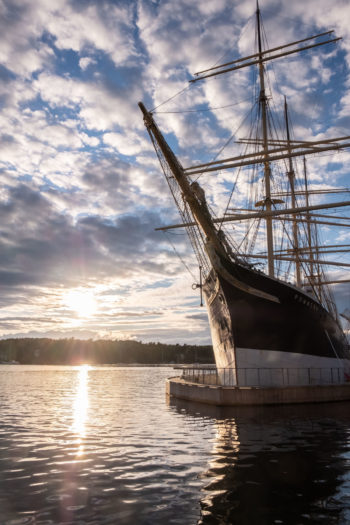
A wooden ship with several masts is docked with a shoreline visible in the background.

During the Tall Ships Race scheduled for July 2021, dozens of vessels are set to appear and join the museum ship Pommern, which is moored in Mariehamn, the capital of Åland. [Editor’s note: Corona-related concerns have led to the cancellation of Mariehamn’s 2021 Tall Ships event. However, Åland will still host a maritime event with refreshments, merchants and entertainment.]Photo: Tim Bird

The problem was complex and potentially incendiary. Åland, like the rest of Finland, had been part of the Russian empire. (Finland was a grand duchy in the Russian empire from 1809 to 1917.) However, Åland’s culture shares close ties to Sweden, and Åland was and is overwhelmingly Swedish-speaking. For context: In the early 1920s, Swedish was the native language of well over 10 percent of Finland’s total population, and it remains one of the country’s official languages.

When Finland declared independence from Russia in 1917, a preference among the majority of Ålanders for alignment with Sweden became more vociferous. They expressed this to the Swedish king in written format. Understandably, Sweden welcomed that idea, but the new Finnish republic was reluctant to relinquish any part of its recently hard-won sovereignty.

In the long term, the compromise has proved satisfactory to all parties, but that wasn’t the case at the time of its signing. “It was decided that Åland should get as much independence as possible without being an actual state,” says Roger Nordlund, Speaker of the Parliament of Åland and member representing the majority (as of spring 2021) Centre Party. “All three parties – Finland, Sweden and Åland – saw the agreement as a loss, because Finland didn’t get total sovereignty, Sweden lost its case for sovereignty, and Åland didn’t achieve union with Sweden.”

Idyllic identity

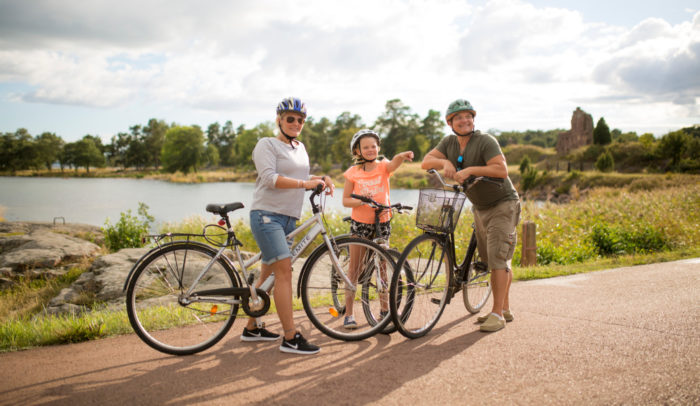
A woman, a child and a man are standing with their bicycles on a coastal road on a summer’s day.

Biking is a favourite way for locals and tourists to see Åland’s countryside and coastal views.Photo: Visit Åland

It wasn’t until after the Second World War that Ålanders took autonomy to their hearts, says Nordlund. “In the 1950s and ’60s, sea traffic between Finland, Åland and Sweden began to grow, and this contributed to development, and now we have tax-free exemption status within the EU. The laws passed here on education, environment, traffic and culture are at the same level as those passed in Helsinki’s Finnish Parliament. Only decisions on issues of defence and foreign policy rest with the Finnish Parliament.”

Åland’s culture, local customs, autonomy and Swedish language are guaranteed as part of the arrangement. These guarantees ensure an enduring and friendly stability, in which the relationship with the mainland to the east poses no threat to the Ålanders’ own distinct identity.

Visitors to Åland see a pastoral idyll, a delightful patchwork of red barns, windmills and villages, fortress ruins, meadows, apple orchards, deciduous woodland and rugged shorelines, connected by shuttle ferries, cycle paths and bridges. It’s impossible to imagine that the islands could ever have been a potential source of conflict. That’s surely worth celebrating in itself.

100 years of willfulness

The centenary celebrations take willfulness – a kind of perceived determination and constancy in a changing world – as their theme. (The Swedish-language word is egensinne; its connotations seem to make it a cousin of the Finnish word sisu.)

At the time of writing, the centenary programme highlights below are scheduled to go ahead, but they could be subject to change if required by Covid regulations and restrictions.

  • June 9, 2021: Autonomy Day is celebrated with the world’s longest line of picnic tables in the centre of Åland’s capital, Mariehamn. There’s also a special issue of Åland stamps and coins.
  • July 22–25, 2021: The Tall Ships Race calls into the harbour at Mariehamn, joining the main feature of the town’s award-winning Maritime Museum: the magnificent conserved Pommern sailing barque berthed in the harbour. [Editor’s note: Corona-related concerns have led to the cancellation of Mariehamn’s 2021 Tall Ships event. However, Åland will still host a maritime event with refreshments, merchants and entertainment.]
  • August 28–31, 2021: ReGeneration Week brings together young people and influential leaders from across the Nordic and Baltic Sea regions to make progress towards the UN Sustainable Development Goals. The theme this year is #ReThinkingTheSystem.
  • September 17–19, 2021: Harvest Festival, with events across the archipelago.
  • June 9, 2022: The programme culminates with the inauguration of the new Bommarsund Visitor Centre at the historic fortress of the same name, one of Åland’s prime historic tourist attractions.

By Tim Bird, May 2021

Excitement mounts as Finland’s men’s football team makes its Euro debut

The Finnish men’s national football team play their opening game of the European Championship 2020 tournament against Denmark in Copenhagen on June 12, 2021. That was an easy sentence to write, but many Finnish soccer fans might still be pinching themselves when they read it.

This is the men’s team’s first appearance in any major international tournament, ever, and for the fans it’s the culmination of decades of hopes and expectations.

Delayed by a year because of the pandemic, the Euros tournament was originally scheduled to take place in 2020 across 13 European cities in celebration of the event’s 60th anniversary – the first time it’s been planned for more than two host countries. All but two of those venues – Dublin and Bilbao – are still on the schedule. London’s Wembley Stadium hosts the semifinals and, on July 11, the final. The organisers, UEFA, are confident that at least nine of the host stadiums will be able to welcome spectators to varying degrees – a relief when one considers that most matches across the continent have had to be played with no spectators over the Covid pandemic period.

Strong opposition

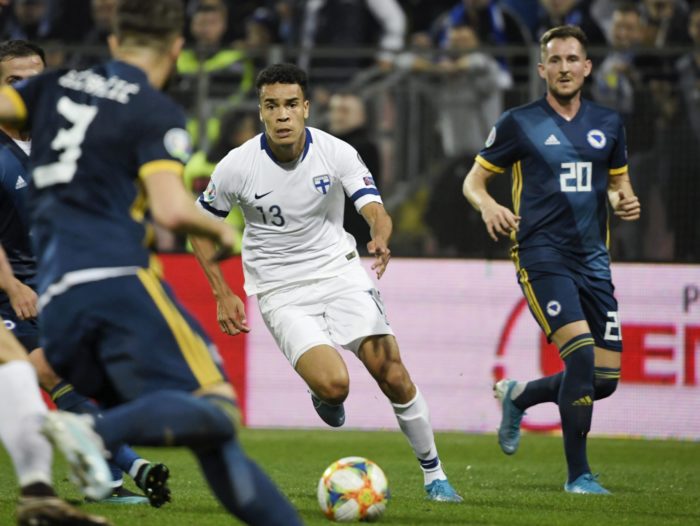
A Finnish player dribbles the football between several opponents.

Pyry Soiri (13) of Finland manoeuvres against Bosnia and Herzegovina in a Euro qualifying match in October 2019.Photo: Markku Ulander/Lehtikuva

One of those is Copenhagen’s Parken Stadium, aiming for a 12,000-strong crowd when Finland kick off their opening Group B match on June 12 (a full house would have been 38,000). Whether present on the day or watching at home, fans will be simply delighted that Finland have finally made it to a tournament after decades of near misses and frustrations. So they’ll also be undaunted by the strength of Finland’s opposition in the group, consisting of Belgium – currently ranked by FIFA as the best national side in the world – and Russia, as well as Denmark, champions in 1992.

Those Finnish fans who do attend the games (Finnish health officials recommend watching the tournament at home) won’t have far to travel, since the Belgium and Russia matches will both be played at the Krestovsky Stadium in Saint Petersburg, just across the eastern Finnish border. Helsinki’s Nordic neighbour Copenhagen is a mere two-hour flight away.

Under the management of head coach Markku Kanerva, the Finns ensured qualification with second place in their qualifying group behind Italy, gelling impressively as a team as the campaign progressed, spurred on by the group’s top scorer, Teemu Pukki, who had ten goals. Finland fervently hope that a late-season injury Pukki suffered in a match for his English Championship–winning side Norwich City will heal in time for him to participate in the Euros.

Team spirit

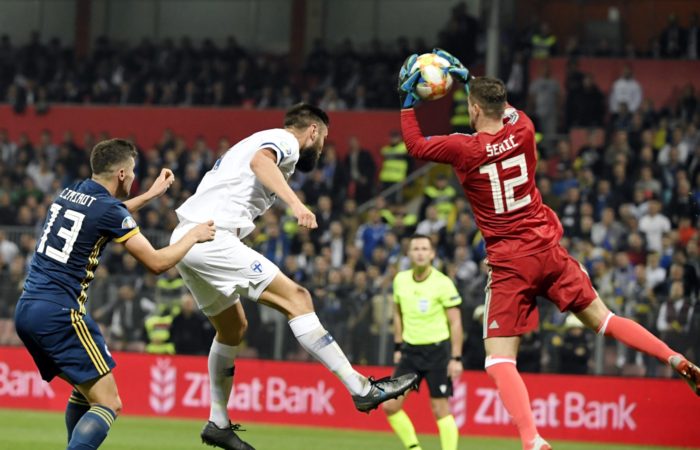
A football player has jumped into the air and the opposing goalkeeper has jumped and caught the ball.

Finnish player Tim Sparv (in white) tries to put the ball past goalkeeper Ibrahim Šehić of Bosnia and Herzegovina in a Euro qualifying match in October 2019.Photo: Markku Ulander/Lehtikuva

Pukki is an undoubted goal machine, but this is no one-man team, and its cohesive team spirit counts as one of its strengths. When Finland’s Glen Kamara, who plays for Scottish champions Glasgow Rangers, experienced racist abuse in a club match against Slavia Prague, his Finnish teammates appeared shortly afterwards with “We stand with Glen” T-shirts. Finland’s captain, Tim Sparv, made similarly supportive media statements.

On a lighter note, the joke in Ireland is that Finland has the only Irishman in the tournament. Ireland did not qualify, but Finnish defender Daniel O’Shaughnessy has dual citizenship by virtue of his father, who is Irish.

We conclude with a note of colourful football trivia: The game against Belgium will bring back memories of a Euros qualifying match between the same two teams at Helsinki’s Olympic Stadium in June 2007. The referee had to stop the game for several minutes when a giant eagle-owl, later dubbed Bubi, swooped in and landed on the Belgian goal, much to the mirth of the Finnish supporters. Ever since, Finland’s men’s national team has gone by the nickname Eagle-Owls (Huuhkajat in Finnish). Finland won that match, 2–0.

By Tim Bird, May 2021

Inventors of next-generation DNA sequencing receive Millennium Technology Prize in Helsinki

British professors Shankar Balasubramanian and David Klenerman, both of the University of Cambridge, receive the 2020 Millennium Technology Prize, announced on May 18, 2021 after a one-year delay because of the Covid-19 pandemic.

Technology Academy Finland awards the biennial one-million-euro prize to “highlight the extensive impact of science and innovation on the wellbeing of society.” The 2020 edition goes to Balasubramanian and Klenerman for their invention of next-generation DNA sequencing (NGS).

NGS enables fast, accurate, low-cost, large-scale genome sequencing. Genome sequencing refers to determining the complete DNA sequence of an organism. Klenerman, a physical chemist, and Balasubramanian, an organic chemist, started collaborating in 1994. “We were searching for something exciting to explore,” says Balasubramanian. At that time, they were “researchers looking for interesting scientific adventures.”

By 1997, they were focusing on a sequencing system, but it took until 2005 to become “a system that worked,” says Balasubramanian. Even then, it wasn’t yet commercially viable.

Transformative impact

“We had to redesign the way that DNA sequencing was being done,” says David Klenerman in this video, which explains the method and significance of next-generation DNA sequencing.
Video: Millennium Technology Prize

NGS has had, and continues to have, an enormous, transformative impact in genomics, medicine and biology. It is a million times faster and cheaper than the first sequencing of the human genome, which took a decade and cost more than a billion dollars. Now it takes a day and costs 1,000 dollars, and a million human genomes are sequenced each year.

The system that Balasubramanian and Klenerman invented and developed has helped predict, identify and understand diseases, leading to more personalised treatments.

“In relation to the Covid pandemic, it was rewarding to see the technology was being used to track the mutations of the virus,” says Klenerman. “It is also being used as a method to identify why some people respond much worse to the virus infections than others.”

Balasubramanian notes that NGS may be used in clinical tests to find certain cancers early enough so that the emphasis can be on preventing them, which is better than trying to cure them later. “I think we’re moving towards…routine blood tests to detect cancer,” he says.

Successfully failing quickly

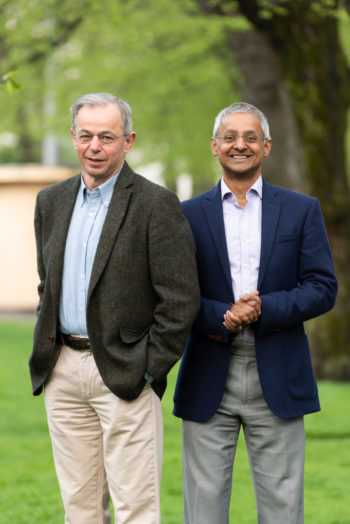
Two men stand in a green park.

David Klenerman (left) and Shankar Balasubramanian enjoy a fine spring day in the Finnish capital.Photo: Millennium Technology Prize

“Health is one issue,” says Klenerman, “but we’ve also got many manmade problems like global warming that we have to deal with. And so, whilst potentially we might be able to live healthier lives, we’re also causing ourselves all sorts of problems with the way we’re behaving.” He hopes that the way scientists collaborated “in a short space of time” to counteract Covid-19 can also help solve climate change.

NGS works by breaking DNA into fragments and giving each one of the many millions of fragments a place on a silicon chip. “Then you decode them all in parallel at the same time,” says Balasubramanian. “That’s what achieves huge capacity and economies of cost.”

Like athletes after winning a big game, Balasubramanian and Klenerman mention that they have had a great team behind them in developing NGS, and that the Millennium Technology Prize belongs to everyone who participated.

“There were many, many failures along the way, of course,” says Balasubramanian. “I was saying to my research group from time to time that the secret of success is to fail quickly. And failure is actually when you start to learn about what the right pathway might be.”

By ThisisFINLAND staff, May 2021

Ideas for a better life: Millennium Technology Prize livestream and online innovation forum

The Millennium Technology Prize is Finland’s prestigious tribute to innovations for a better life. The prize, one million euros, is awarded biennially for groundbreaking technological innovations that create new markets and benefit millions of people around the world.

Delayed for a year by the Covid-19 situation, the 2020 Millennium Technology Prize award ceremony was rescheduled for May 18, 2021. The ceremony, including the announcement of the winner, will be livestreamed and is open to everyone. Presenting the prize to the winner is President of Finland Sauli Niinistö.

The following day, the Millennium Innovation Forum takes place as a virtual event, with renowned speakers onsite and participants online. It celebrates the Millennium Technology Prize as an award for innovations that improve the quality of people’s lives. The Forum focuses on how research, knowledge and innovation can impact the wellbeing and future of human society.

The Millennium Innovation Forum provides a unique platform for discussing and exchanging ideas at the interface of revolutionary future technologies and innovations.

Let’s take good care of tomorrow

The Millennium Technology Prize is awarded to groundbreaking technological innovations that create new markets and benefit millions of people around the world.
Video: Millennium Innovation Forum

Finnish society places value on family time and inclusivity

Finnish people tend to take Mother’s Day and Father’s Day pretty seriously. Or rather, they tend to take celebrating them rather seriously. They’re holidays for the whole family, even though they’re named after the parents.

Most Finnish families with kids – and many families whose children have already grown up – clear their schedules so they can do something special on Mother’s Day (the second Sunday in May in Finland) and Father’s Day (the second Sunday in November). If you contact a friend to suggest a get-together on one of those days, they may tell you that it’s not possible. The implication is that you really ought to have known.

Something about everything
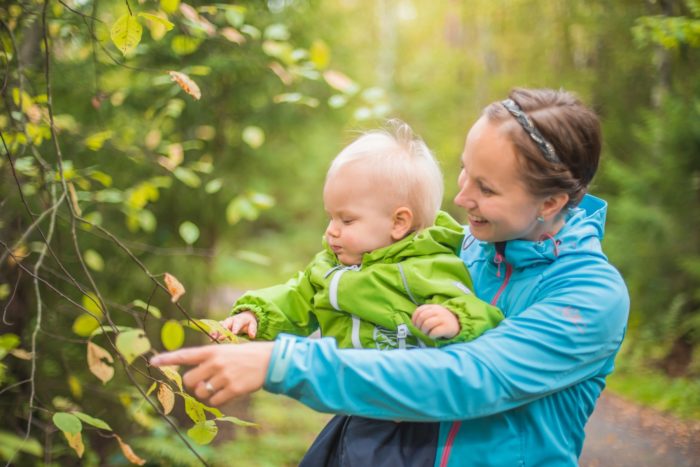
A woman and a baby are pointing at tree leaves beside a forest path.

A mother and a child explore the Maatialanharju Nature Trail in the town of Nokia (yes, that Nokia), near Tampere.Photo: Laura Vanzo/Visit Tampere

Finnish society’s attitudes towards families are visible on other days of the year, as well.

Anu Partanen is a Finnish journalist who has lived in New York, where she spent a decade before moving back to Finland with her American husband and their child. In her book The Nordic Theory of Everything, she examines many aspects of living in the US and the Nordic countries, including healthcare, work-life balance, education and raising a family.

She touches upon aspects of Nordic society that also help explain the way Finland regards parents and families. In a chapter called “Family Values for Real: Strong Individuals Form a Beautiful Team,” Partanen mentions the many benefits parents of young children receive in the Nordic countries. In Finland, they include generous amounts of parental leave with an allowance, very affordable daycare and a maternity package (famously nicknamed the “baby box”) full of clothing and other items parents need for their new baby.

Partanen points out that such benefits grant parents and families more independence. While raising a family is never simple, parental leave and the availability of daycare give parents more flexibility to arrange their lives, families and careers in a manageable, fulfilling way. Perhaps most importantly, they can spend additional time with the kids during their formative first months and years without taking an unbearable economic hit or falling off the career ladder.

The benefits aren’t free – Finnish people often mention that they have paid for them in the form of taxes (in another article, ThisisFINLAND asks if taxes make Finnish people happy). And the system has changed over time, with the newest update, made in August 2022, bringing additional months of parental leave; terminology that is more gender-neutral; and increased inclusivity for various family constellations – more about that later. (The families in this article were interviewed before the 2022 changes.)

Accommodating family life

We talked to several parents of small children to get a sense of how families in Finland organise their parental leave and how such benefits make a difference in their lives. (We’re using “parental leave” to cover various categories. More info appears in the box at the end of the article.)

Ann-Mari and Jaakko, a Helsinki couple in their late 30s, have a boy who is more than two years old at the time of writing. “Pretty early on, when I was still pregnant, we discussed things, and Jaakko said that he wanted to share the parental leave,” recalls Ann-Mari.

Maternity leave begins a month or more before the due date, and after their son was born, both parents were on leave for the first two weeks. “It was really nice that we were able to share that wondrous time together for a couple weeks,” says Jaakko, who works in architectural restoration.

After that, Ann-Mari stayed home for nearly nine months before they switched places, with Jaakko taking care of their son and Ann-Mari going back to her job in publishing. “The thinking was that the child would get used to having both parents around,” Jaakko says.

When his parental leave was over, he chose to work six hours a day for several months. This option, available to families with children less than three years old, is known as flexible care. It gave Jaakko the leeway to help their son transition to attending daycare a month after his first birthday.

Through all this, their employers were accommodating – they’re required by law to grant the time off without repercussions to employees’ career status. The children benefit, and therefore so do their families and the whole society.

Twin technicalities
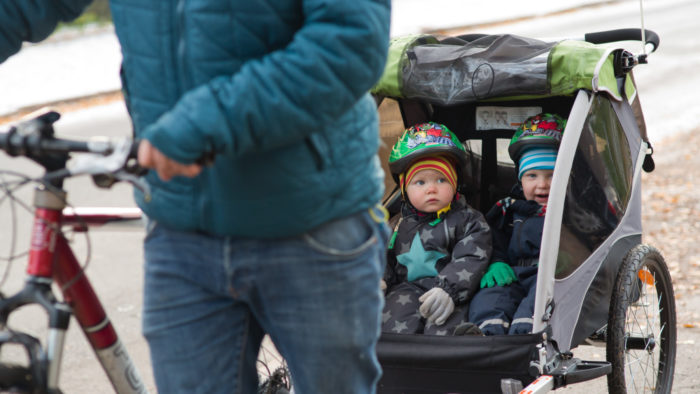
A man walks a bicycle that has a trailer with two toddlers sitting in it.

Parents of twins receive a significant extra period of parental leave.
Photo: Riitta Supperi/Finland Image Bank

Aseidas, a transplanted American and the father of two-year-old twin boys, is married to a Finn and works for a Finnish company as a technical architect. He got no parental leave from the Finnish system, since he moved to Finland only shortly before the kids were born and therefore didn’t qualify. Luckily, the international company he was working for at the time granted him three months of leave.

“Having twins is a bit more challenging,” he says, clearly understating the case, as the boys merrily spill food on the floor in the background. “Both parents kind of needed to be off from work at the same time.”

The family receives a child allowance (approximately 100 euros per month per child under 17), as all Finnish families do, and the twins have been attending daycare just up the block since they were 18 months old. Aseidas’s wife took parental leave, which was ten weeks longer for families with twins. After more than a year away, she returned to her job at a nongovernmental organisation.

Later, he was able to take a flexible care period and work 80-percent weeks for four months. He intends to do so again for six months when the kids turn two and a half. “The system in Finland kind of takes care of you and the kids, and makes sure that you have at least the minimum that you need,” he says.

Finding the time
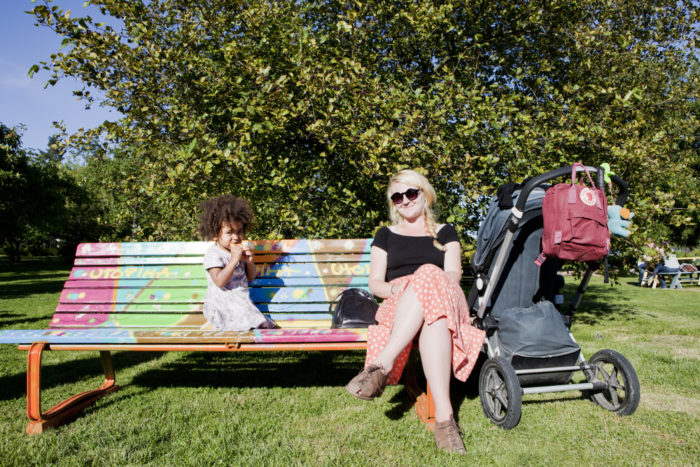
A mother and child sit on a park bench in the sun.

Parental leave allows families to increase the amount of quality time they spend together.Photo: Heli Sorjonen/Finland Image Bank

Virpi and Aki have a two-year-old daughter and live in a Helsinki neighbourhood about ten kilometres (six miles) from the city centre. Both work in healthcare-related professions. “When our child was born, I happened to be temporarily unemployed,” says Aki. “So I was at home for a month, and then I returned to work, but I took parental leave later.”

Virpi was on leave for nine months, and when she returned to work, Aki took a couple months of leave. When that was over, he stayed home with their daughter for several more months, during which he received a small allowance for child homecare.

Several practical considerations made it more logical for Aki to stay home during this phase: Virpi was completing graduate-school studies that were partly integrated with her job, and her salary was also greater than Aki’s.

When their daughter reached 18 months, she started going to daycare. At that time, Virpi and Aki both worked 80-percent weeks for three months, in order to make the family’s transition to the daycare routine smoother.

Always changing
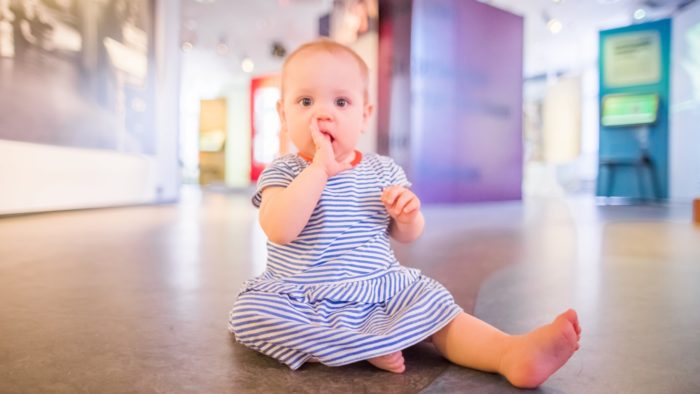
A baby sits on the floor at a museum.

It’s never to early to get your kids interested in reading, but we’re not sure if this one knows they are in Tampere’s Museum of Finnish Literature.Photo: Laura Vanzo/Visit Tampere

Over the decades, Finland’s system of benefits has changed with the times, allowing fathers to take an increasing proportion of the parental leave.

The 2022 update increased the amount of leave and revised the terminology, using the term “parental” instead of “maternity” and “paternity.” It also equalised the time allocated to each parent. These changes encourage equality and inclusivity for all parents, regardless of gender, and keep up with developments in how people perceive and define a family.

But what about Mother’s Day and Father’s Day, which are important days for Finnish families? Are they truly equal?

Let’s look at outside factors that might influence your reply. Here are the stats: On Mother’s Day, in May, Helsinki typically receives more than 16 hours of daylight, and the average high temperature for that month is 14 degrees Celsius (57 Fahrenheit). Meanwhile Father’s Day, in November, usually receives just above seven hours of daylight, with an average high of only four degrees Celsius (39 Fahrenheit).

You can make your own decision on this one, but we believe we may have found one aspect of being a parent that no amount of benefits can affect.

Benefit renaissance

For most of the history of the parental benefits system, mothers have been able to take longer parental leave than fathers. A regulation passed in 1917, the same year Finland achieved independence, specified a minimum of four weeks of maternity leave. Its length gradually increased, and an allowance was added in the 1960s, but the introduction of parental leave, which either parent could use, didn’t occur until 1982.

The system has seen many updates since then. A new revision came into effect in August 2022 – the total amount of leave increased, and it is divided equally between the partners (except for several weeks of pregnancy leave for the birth mother just before the due date).

The total length of time is greater – about 14 months compared to about 12 months. The terminology is more inclusive and gender-neutral – there is no longer maternity or paternity leave, only parental leave. Adoptive families and multiparent families also receive the same total amount of leave to share among the parents. Children in all families can benefit in equal measure from time spent with the adults who are closest to them.

Parental leave

Pregnancy leave for the birth mother, total about 6.5 weeks (starting as the due date approaches)
Parental leave, for each parent about 6.5 months (one recipient may transfer 10.5 weeks to another; Adoptive families, one-parent families and multiparent families receive the same total parental leave of about 13 months)
Total: more than 14 months
(The allowance for maternity, paternity, parental or pregnancy leave is based on, but not equal to, the parent’s salary, and it is capped at a certain amount.)

Other types of leave for parents

Flexible care leave (a parent may work 80 percent or less and receive an allowance, while the child is less than three years old)
Child homecare leave (a parent may stay home full-time to care for a child less than three years old and receive an allowance, although it is typically much smaller than the allowance for parental leave)

By ThisisFINLAND staff, May 2021 (updated March 2023)
A whole bunch of brunch for May Day: Finland’s festival of spring arrives

“May Day, or Vappu in Finnish, has always been a celebration of spring, as it is halfway between the March equinox and the summer solstice,” says Lepistö. The day has had associations with rites of witchcraft and fertility.

Later on, May 1 became International Workers’ Day, which, in Finland, evolved into a two-day carnival that surpasses New Year’s Eve in terms of merrymaking. “Unfortunately from a chef’s point of view,” Lepistö says, “not much is growing in Finland at that time of year, so we need to use a few spring veggies from more southern parts of the world.”

Lepistö has worked at several top restaurants in Helsinki, and served as head chef at Finland’s permanent mission in Geneva and then its embassy in Moscow.

“For me, the most celebrated and anticipated thing about Vappu is the brunch, traditionally a picnic with friends and family,” says Lepistö. “It’s served on May 1, which is actually the second day of the May Day celebrations. The main items on the menu are cured fish dishes like gravlax [cured salmon] or pickled herring, along with frankfurters and potato salad. For the sweet tooth, there is tippaleipä [funnel cakes], munkki [a kind of doughnut] and sima [a low-alcohol mead].”

By ThisisFINLAND staff; recipes and descriptions supplied by Timo Lepistö

Fresh recipes for Vappu brunch

For ThisisFINLAND, Lepistö has chosen recipes that can be prepared in advance and work well for a picnic or for spring celebrations at home.

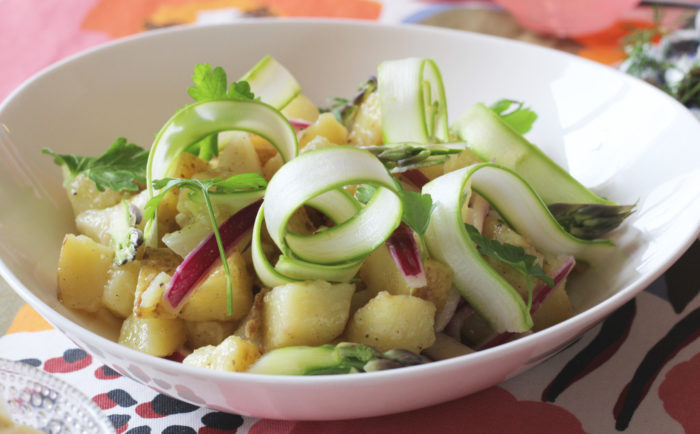
Potato salad with asparagus and vanilla

A bowl of potato salad contains potatoes, onions and asparagus.

Thin slices of green asparagus top this potato salad, which is made with a light vinaigrette befitting the season and the May Day celebration.Photo: Piritta Kaartio

Potato salad is the cornerstone for May Day brunch settings. There are many types of potato salads, from mayonnaise-based to crème fraiche to vinaigrette. Potatoes can be quite heavy by themselves, so I’m using a vinaigrette sauce for variation and for its light feeling. For the potatoes, use the best you can find. I usually use a quite firm variety of organic potatoes. Cutting the potatoes into similarly sized pieces helps them to cook evenly. For best results and for convenience, prepare the salad almost completely the day before. You can vary the ingredients depending on your location and what’s in season.

  • 500 g potatoes
  • 1 bundle of white asparagus
  • 1 bundle of green asparagus
  • 1 small red onion
  • 2 tbsp of small capers
  • 1 dl olive oil
  • 1/2 dl of white balsamic vinegar
  • 1 vanilla pod (or extract)
  • Salt, black pepper and flat-leaf parsley

Wash the potatoes or peel them and cut them into similarly sized pieces, cubes of about 2 cm (less than an inch). Peel the white asparagus and cut into 2-cm pieces. Bring a litre of water to boil and add a tablespoon of salt. Add the potatoes to the boiling water carefully. After five to seven minutes, add the white asparagus to the kettle and cook for four minutes. Once the potatoes are cooked, pour them into a sieve to remove the water, and leave them until the excess moisture disappears from the potatoes and asparagus.

Mixing the vinaigrette: Pour olive oil and vinegar into a mixing bowl big enough to mix the whole salad. Add a teaspoon of salt. Split the vanilla pod and scrape the seeds into the mixture. Put the pod into the vinaigrette, too, but remove it just before serving. Mix in the freshly ground black pepper and the capers.

Add hot potatoes and asparagus and mix well. It’s important to mix the potatoes into the sauce while they’re still warm. Peel and cut the red onion into small pieces and add it to the salad. At this point, cover the bowl with cling film and place it in the fridge. Use a vegetable peeler to shave strips off the green asparagus. Put the peels in a container, add cold water to cover them, and store it in the fridge.

On serving day: Let the potato salad stand at room temperature half an hour before serving. Drain the green asparagus strips and cut parsley leaves from their stems. Add to the salad. Always check the seasoning before serving.

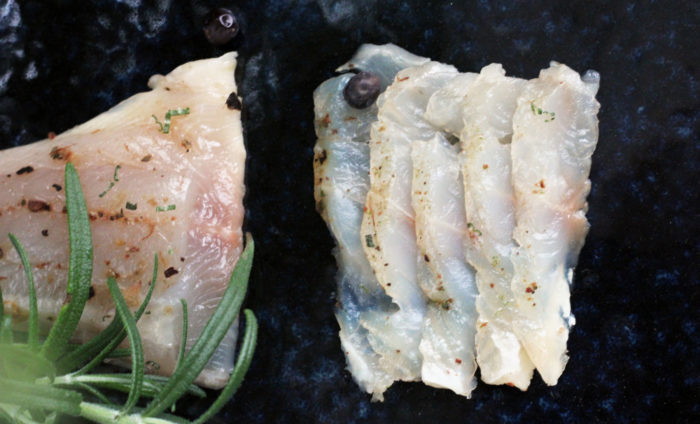
Cured whitefish seasoned with juniper

Thin slices of fish are arranged on a board.

This cured whitefish is topped with smoked sea salt and juniper berries for a foresty taste.Photo: Piritta Kaartio

There are many side dishes that are served with the potato salad, for example steamed frankfurters, marinated shrimp and fish dishes such as smoked fish, gravlax or cured herring. For this recipe, I am using whitefish, but you can also use salmon or any other fish that is suitable for curing. The important thing is to use very fresh fish and adjust the salt, sugar and spices according to the fish weight. I wanted to have a bit of a smoky, foresty feel to this dish, so I am using smoked sea salt and juniper berries to achieve the desired taste profile.

  • 300 g whitefish fillet with skin and pin bones removed
  • 12 g smoked sea salt (4% of the fish weight)
  • 6 juniper berries
  • 1 small sprig of rosemary
  • 1 tsp white caster sugar

Check that all the pin bones have been removed. If the fish is in one piece, cut it into two. Put all the ingredients except the fish into a mortar and make a paste. Spread the mixture evenly over the fillets, then place the fillets on top of each other, with the meat sides facing each other. Wrap in cling film, making it nice and tight, and place in the fridge. Let them cure in the fridge for two to four days, turning the package occasionally. Slice the fish thinly, separating each piece from the skin as you finish the slice.

Pink rhubarb mead

A bottle and a glass contain a pink beverage, while a platter of doughnuts and a vase of red tulips are visible in the background.

Pink rhubarb mead suits the general mood in early spring, when the days are getting longer.Photo: Piritta Kaartio

Modern Finnish mead has a very low alcohol content and is usually made with lemon and brown sugar or light muscovado sugar. I wanted to do a rhubarb version for two reasons: First, rhubarb is one of the first ingredients available in the spring. Second, it’s pink! For pink mead, you need to use a red-stemmed variety of rhubarb. Mead takes a week to mature, so it’s not suitable for an extemporaneous brunch. Make sure the bottles are clean and sterilised before filling, and remember to open the bottles a few times during the fermentation.

  • 500 g rhubarb
  • 2 litres of water
  • 2 pcs star anise
  • 3 dl caster sugar
  • 1 small piece of ginger (3 cm)
  • a pea-sized piece of fresh baking yeast

Wash and cut the rhubarb into pieces. Peel the ginger and slice it thinly. Put water, rhubarb, ginger and star anise in a pot and boil for 15 minutes. Sieve the juice into a mixing bowl or a large jug, add sugar and mix gently until all the sugar has dissolved. Wait until the juice is at room temperature, then take a few decilitres of juice and dissolve the yeast into it. Mix it back into the whole batch. Cover and place at room temperature for one day. After making sure that the bottles are clean, add 1 teaspoon of caster sugar for each one-litre bottle and fill with rhubarb juice. Do not close the bottles too tightly. Store them in the fridge and remember to open and reclose the bottles a few times during fermentation. The mead is ready in approximately one week.

Oven-baked munkki (doughnut)

A close-up of a pile of sugar-coated doughnuts.

We’re getting hungry just looking at this picture of fresh, oven-baked Finnish munkki doughnuts flavoured with cardamom and cinnamon. (Yes, that’s the real photo caption. Well, aren’t you getting hungry, too?)Photo: Piritta Kaartio

The classic Finnish munkki is made with cardamom-seasoned dough deep-fried in coconut oil (the same dough as the korvapuusti cinnamon buns and cinnamon-roll cakes shown elsewhere on ThisisFINLAND). I wanted to avoid all the hassle of kneading the dough, letting it rise, and deep-frying in a home kitchen. You can easily make these oven-baked doughnuts within an hour. Of course, it’s not the same thing, but it’s close enough and much simpler. For this recipe, you need a doughnut baking pan, but in a pinch you can use a muffin pan, although of course the resulting shape won’t be the same. The batter can be seasoned in many ways, and so can the topping. Here I’m using cardamom in the batter and cinnamon sugar for the topping.

  • 1 egg
  • 1 1/2 dl whole milk
  • 250 g butter
  • 3 dl all-purpose flour
  • 1 dl caster sugar or cane sugar
  • 2 tsp baking powder
  • 2 tsp ground cardamom
  • 1/2 tsp salt
  • (vanilla extract)

Topping:

  • 2 dl caster sugar
  • 2 tbsp cinnamon

Preheat the oven to 200 degrees Celsius (390 Fahrenheit). Put the butter in a small pot on medium heat, whisking frequently until the butter is light brown, then pour it to a small bowl. In a mixing bowl, whisk together the milk, 40 g of browned butter and the egg. Mix all the dry ingredients together separately, then add them to the milk mixture and stir until combined. Grease the doughnut pan and spoon batter into the forms until they are a little more than three-quarters full. Bake for eight minutes. Let the doughnuts cool for five minutes before tapping them out of the pan.

For the topping, gently warm the rest of the brown butter. Combine the sugar and cinnamon in a small bowl. Dip each doughnut first in the butter and then in the cinnamon sugar, on one side or both sides, and enjoy!

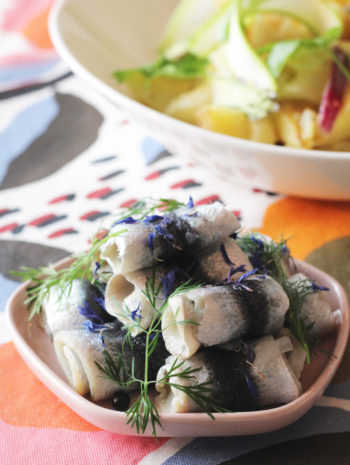
Pickled fresh Baltic herring (known as suutarinlohi, shoemaker’s salmon)

Fresh dill decorates a bowl of small, rolled fish fillets.

One of the most traditional ways to prepare Baltic herring is to steep it in a mixture of seasonings for several days before serving.Photo: Piritta Kaartio

This is one of my favourites, and one of the most traditional ways to serve Baltic herring. It can be made from fresh or salt-preserved Baltic herring. If using salted fillets, rinse well to remove excess salt.

  • 500 g Baltic herring fillets
  • 1 1/2 tbsp fine sea salt

Pickling brine:

  • 1 dl water
  • 1 dl distilled white vinegar
  • 1 dl caster sugar
  • 10 allspice berries
  • 1 red onion
  • 3 bay leaves

Lay out the fish fillets, skin-side-down, and sprinkle salt evenly over them. Peel the onion and slice it thinly. Put water, sugar and vinegar into a saucepan and bring it to a boil, then remove it from the heat. Add onion, bay leaves and allspice to the hot brine and let it cool to room temperature. One by one, roll up the salted fillets and layer the rolls in a clean glass jar.

Once the brine has cooled to room temperature, pour it over the rolled herring fillets, then place in the fridge. This “shoemaker’s salmon” can be enjoyed the following day, but a few more days in the fridge makes it perfect.

Finland’s carbon handprints and roadmaps show path to carbon neutrality by 2035

Government organisations and private-sector businesses in Finland have produced a number of roadmaps – another name for strategies. They chart possible ways to fulfil the bold 2035 goal set out by the government.

“Roadmaps can have a catalysing role when all stakeholders are included,” says Oras Tynkkynen, senior advisor on sustainability at the Finnish Innovation Fund Sitra. Once a goal and timeframe have been set, the government, the business community and citizens can work together to reach that goal. “It comes through the millions of decisions that are made every day at all levels.”

Tynkkynen believes carbon neutrality is achievable faster than is commonly expected, and he becomes more animated as our conversation continues. “For example, take the law to phase out the use of coal for energy by 2029,” he says. “Most energy companies will have phased out coal long before that.”

There are two basic types of roadmaps in Finland concerning carbon neutrality. The first is government-initiated and comes from the top down to society’s many sectors and citizens. There is a danger, says Tynkkynen, that these long-term roadmaps will outlive the short-term political cycle without necessary but difficult decisions being made.

Replicable around the world

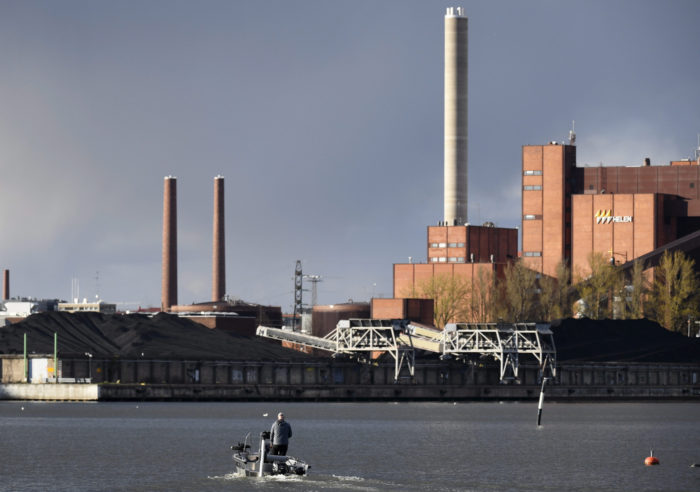
A small boat passes a waterside power plant that has several smokestacks.

Helsinki power plants in Hanasaari (pictured) and Salmisaari will discontinue use of coal by 2024 and 2029, replacing it, in part, with additional heat pumps that recover thermal energy from wastewater.Photo: Vesa Moilanen/Lehtikuva

“A roadmap as such isn’t worth much,” he says. “Something has to happen. When voters demand action, politicians can say, ‘We made a roadmap!’ It can be like a get-out-of-jail-free card.”

The second kind of roadmap is sector-specific and comes from below instead of from the top, when business sectors themselves take the lead. Industries maintain ownership of their goals and come up with a plan. They can then invite the government to help them clear up any challenges that impede them. Sector-specific carbon neutral roadmaps with government endorsement are a rare phenomenon internationally, and Tynkkynen is hopeful that they could be replicable elsewhere in the world.

“There has been a dramatic change in tone,” says Tynkkynen, who was a member of Parliament from 2004 to 2015. For part of that time he also served as a climate policy specialist in the prime minister’s office. “When I told industries, ‘You have to do this,’ they said, ‘Forget about it.’ Now that they’re in charge, they are saying ‘Yes, and here’s how!’”

On the way to surpassing expectations

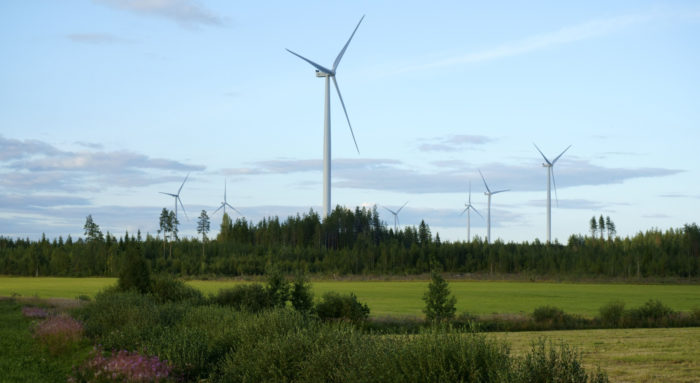
In a landscape of fields and trees, half a dozen wind turbines stick out above the forest.

Sustainable energy sources, such as these windmills in central Finland, form part of the solution as the country moves towards its goal of carbon neutrality by 2035.Photo: Santeri Viinamäki/Lehtikuva

Helena Soimakallio is executive director of sustainable development at Technology Industries of Finland, an association representing Finland’s largest economic export sector. I talked with her about what the tech industry is doing about carbon neutrality.

Soimakallio has had the task of creating a technology assessment and feasibility timeline for reaching the government’s carbon neutrality goal. All major industries in Finland have drafted similar roadmaps. They show that the combined industrial sectors could actually outdo their allocated reduction targets by two to four million tonnes of CO2 equivalent within the stipulated timeframe.

“It is doable,” says Soimakallio, “but to get the industry interested, we ask the government for a favourable business environment and support in R&D and in maintaining a competitive global business perspective.”

The industry has leverage that may result in not only carbon neutrality but also in improvements to the economy, if innovations can be jumpstarted quickly and exported to the rest of the world. A new law gives companies a 150-percent tax deduction for joint research and development projects between 2021 and 2025 – it’s part of the government’s policy goal of raising the share of R&D to 4 percent of GDP by 2030.

Handprint versus footprint

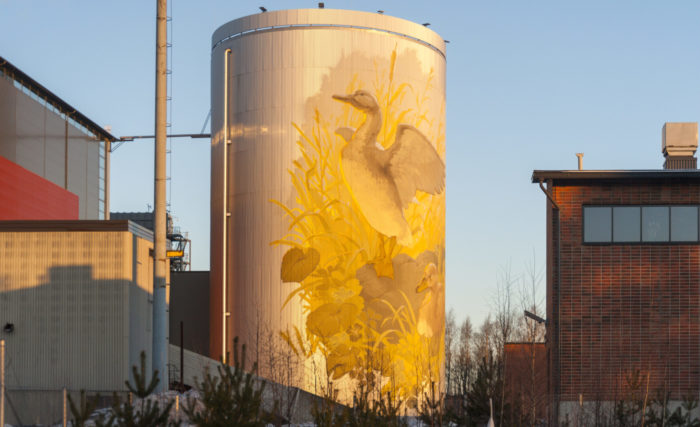
A mural showing two ducks is visible on the side of a tall cylindrical building.

Two ducks in the grass, a mural by Anetta Lukjanova and Taneli Stenberg, decorates the wall of a building that houses a thermal energy battery at a power plant in the municipality of Espoo, just west of Helsinki. It commemorates the decommissioning of one of the plant’s coal-burning units in 2020; the other will be discontinued by 2025. Photo: Eija Tervo/Lehtikuva

In practice, one of the things the tech sector is looking at is its carbon handprint. In contrast to a carbon footprint, which refers to greenhouse gas emissions caused by a product, the term “carbon handprint” refers to the positive environmental impact a product makes throughout its life cycle.

The idea of a carbon handprint originates in Finland. It was developed by the VTT Technical Research Centre of Finland and Lappeenranta University with support from the Climate Leadership Coalition.

Making tech products 10 to 15 percent more efficient, for example, adds up to huge carbon decreases globally, as well as a massive business opportunity. As Finnish tech strives to be synonymous with quality, sustainability measures such as these help the country’s tech sector keep its prominence on the global map.

Perhaps the most important effect of Finland’s 2035 carbon neutrality goal and of the multiple roadmaps is that they provide a common direction. Action can occur much faster than expected if all the key stakeholders buy into the idea and work towards it together.

The goal is in place, and roadmaps show the way. Now the situation calls for continued ambitious action, enthusiastic cooperation and the sharing of solutions around the world.

By Eric Bergman, April 2021

Trams roll into Tampere, Finland in time for the city’s carbon neutrality goals

With its industrial heritage and its red brick mills lining the rapids that cascade between two enormous lakes, the central western Finnish city of Tampere is known for its down-to-earth, working-class culture.

The area also has a distinctive dialect and slang. The name of the city transportation company, Nysse, is the perfect example. It’s a nod to a colloquialism used by people waiting at bus stops: In the phrase Nyt se tulee (Here it comes), the local accent compresses nyt se into nysse.

Citizens of the most populous inland city in the Nordic region are now using this expression as they glimpse any of 19 new trams at either end of the main street Hämeenkatu. It remains to be seen if the new transport system earns a local nickname to abbreviate its official Finnish name, Tampereen Ratikka (Tampere’s Tram). One thing is certain: the opening of its first phase for public service in August 2021, following the completion of tests and staff training, represents the biggest civic and economic development in the city for decades.

A strong case

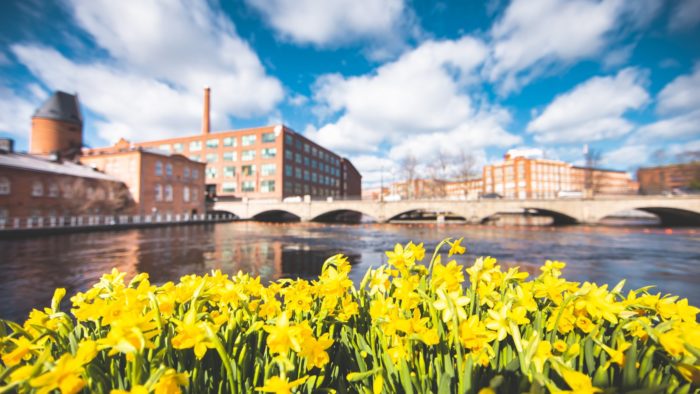
The foreground shows a row of daffodils in front of a river, with brick buildings on the far shore.

Daffodils bloom on a crisp spring day, with the red brick of Tampere’s landmark former industrial buildings in the background.Photo: Laura Vanzo/Visit Tampere

The main track extends from the southeastern suburb of Hervanta, home of an extensive university campus and various tech businesses, to the Pyynikki district in the west, with its fabulous pine-lined ridge and sprawling lake views. A subsidiary line connects the city’s main bus station to Tampere University Hospital and the university’s Kauppi Campus, and the second phase, due for completion in 2024, will extend the track from Pyynikki to the suburb of Lentävänniemi.

“Studies into the feasibility of the tram line have been going on over a long time,” says Pekka Sirviö, CEO of Tampereen Raitiotie, the company tasked with delivering the system and supervising its operation in cooperation with Nysse. “It was recognised many years ago that there is a huge need for higher capacity for public transportation in Tampere. There is also a strong case in terms of city development.” A fixed-rail transport system, he adds, has been a strong driver for attracting investment.

A positive view

Check out aerial footage of Tampere accompanied by dramatic music as the new tram goes on a test drive in September 2020.Video: Tampereen Ratikka

Prolonged discussions preceded the decision to go ahead, and the four-year construction period involved significant disruption, but the majority of Tampere’s inhabitants now take a positive view of the project.

“We have held a number of surveys, and the latest, in November 2020, told us that 70 percent of citizens were positive or very positive,” says Sirviö. “It helps that we have been able to keep within budget and stick to our planned schedule, neither of which is so common for this kind of project. Now that people can see what sort of system it is, they have accepted it.”

Tampere becomes the only Finnish city other than Helsinki to boast a tram service, but additional urban areas are expressing interest. Tampere carried out its preliminary studies in cooperation with the southwestern city of Turku, and a decision on building a comparable system there is forthcoming. Similar discussions are ongoing in Vantaa (just north of Helsinki), Jyväskylä (in central Finland) and Oulu (a northern city on the west coast).

Meanwhile, Helsinki is supplementing its existing tram network with its own 25-kilometre (15-mile) Jokeri Light Rail line arching through the northern suburbs, set to open in 2024.

Carbon neutral by 2030

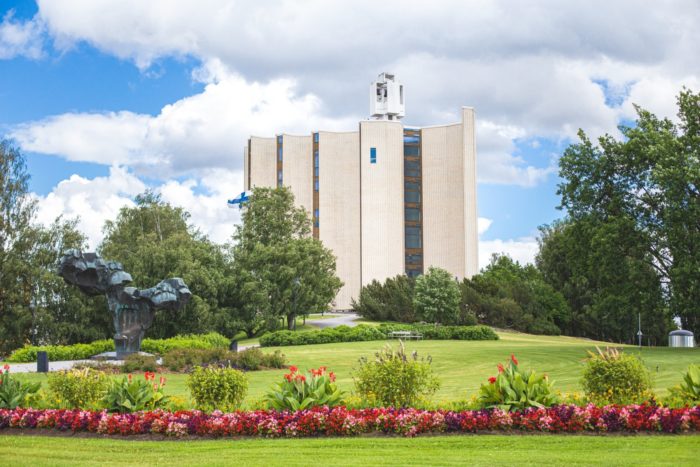
A broad, tall white building stands in the middle of a park.

Kaleva Church, built in the mid-1960s, has a stop named after it on one of Tampere’s tramlines. The bell tower offers an expansive view of Tampere and the surrounding countryside. Photo: Laura Vanzo/Visit Tampere

Cities are increasingly favouring light rail and tram systems to help reach carbon neutrality targets. Rail services reduce bus traffic and decrease car use in central urban areas. In Tampere’s case, the Ratikka will support the city in achieving its goal of becoming carbon neutral by 2030.

“Another big advantage is that 11 of our 15 kilometres [6.8 out of 9.3 miles] in the first phase consist of segregated tracks,” Sirviö says. On those sections, the trams do not have to share their path with cars or other traffic. “So we can maintain a higher average speed with a high degree of safety. We also have sophisticated digitalisation to assess passenger numbers.”

Tourist visitors to Tampere will also benefit. They might jump on the tram outside the railway station on arrival and enjoy a tour past some of the main attractions, such as the Tammerkoski rapids, the eye-catching architecture of the Metso public library, and the Tampere Art Museum.

The inhabitants of Tampere are happy about the new service opening and relieved about the conclusion of the necessary construction. As the project progressed, the sight of the trams gliding through the city on training runs became a familiar one, whetting people’s appetite for the day when they could get onboard.

By Tim Bird, April 2021