Into the Finnish wild

Explore the wild, stroll along forest pathways, put up a tent, pick mushrooms and wild berries – no matter who owns the land, there is no charge for enjoying it.

Nature is never far away in Finland. The country’s serene forests and crystal-clear lakes encourage everyone to enjoy their splendour. See the beauty of autumn as the world changes colour. Fill your lungs with fresh air. Cycle along a curtain of evergreens. Paddle down a lazy river. The forests are dotted with cottages, where city dwellers unwind and recharge. Nature is a cure for all ills – it is guaranteed to fill your mind with positivity and calm.

By Tiia Rask, ThisisFINLAND Magazine 2018

Presidential dialogue in the Finnish capital

Helsinki’s role as host of the meeting between US President Donald Trump and his Russian counterpart President Vladimir Putin is a natural continuation of Finland’s advocacy of dialogue in international relations.

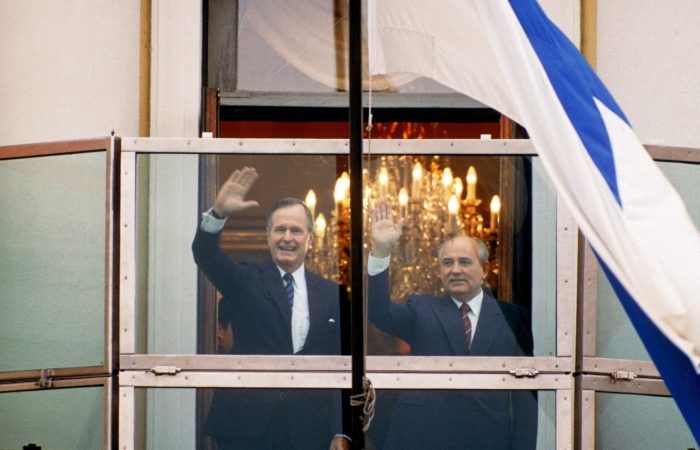
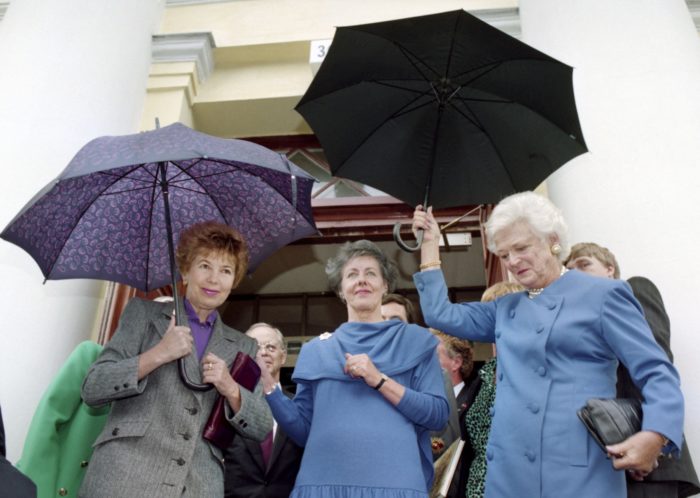
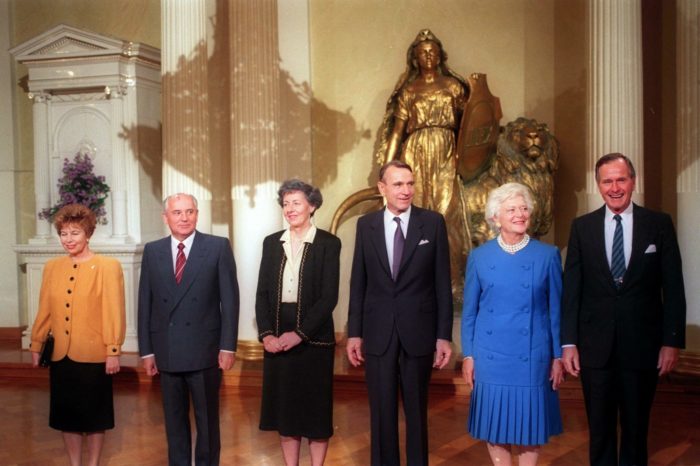
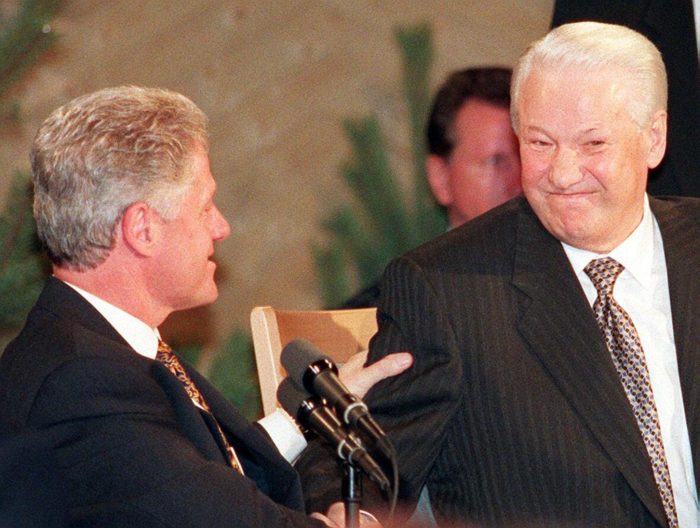
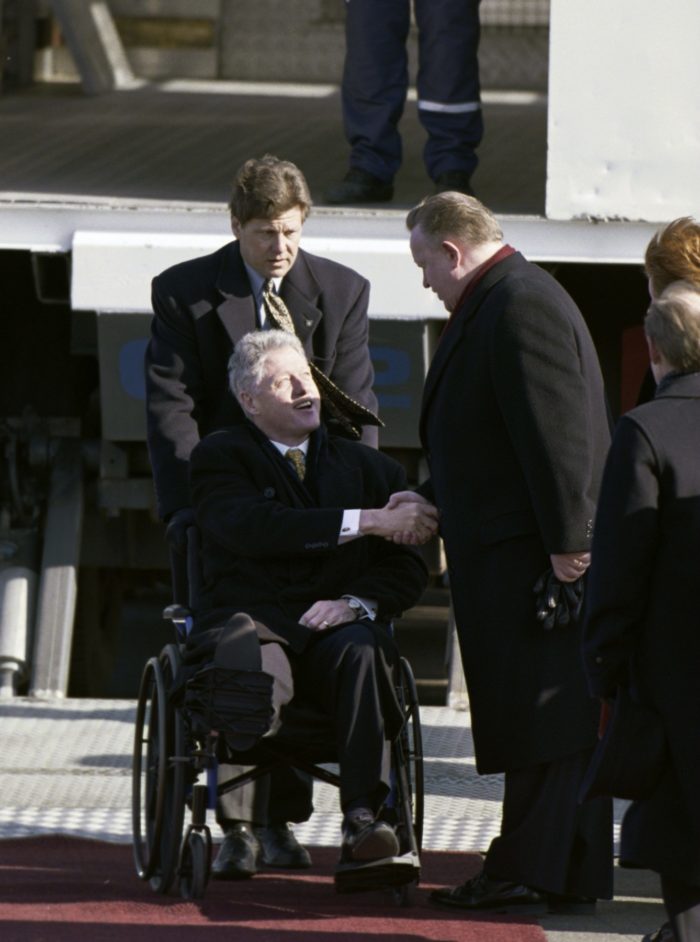
Previous meetings in Helsinki between the leaders of the two countries happened in 1990, between Presidents Bush and Gorbachev, and in 1997, when Presidents Clinton and Yeltsin came to town.

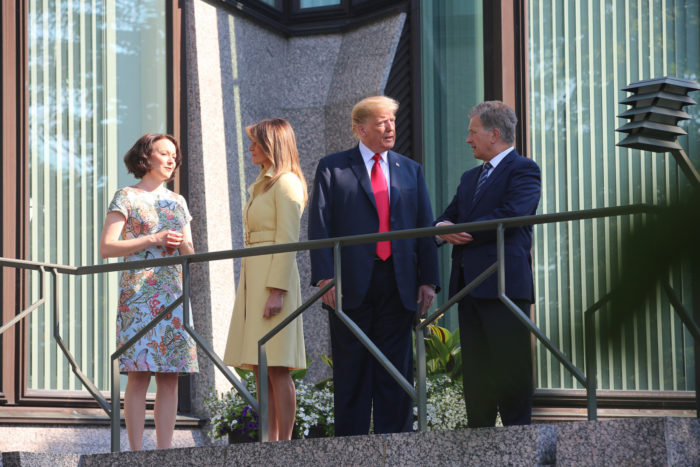
Finnish President Sauli Niinistö, who described the talks as a welcome opportunity to reduce international tensions, welcomed the leaders to the meeting at the Finnish capital’s Presidential Palace. He also stated his own intention to raise Finnish and EU concerns about tensions in the Baltic Sea region and environmental issues in the Arctic.

Niinistö received the preliminary inquiry from officials of both countries about a meeting in Helsinki just a few weeks before the actual meeting date of July 16, 2018. Even on such short notice, Finland was able to swing quickly into action, harnessing their talkoohenki, a Finnish word that implies both team spirit and everyone chipping in.

“One of the reasons for holding the meeting in Helsinki is the fact that Finland has a reputation as a well-organised country where everything works,” says Meira Pappi, country branding expert at the Ministry for Foreign Affairs of Finland [which also produces ThisisFINLAND]. “People know that we are able to put something of this scale together in such a short time.”

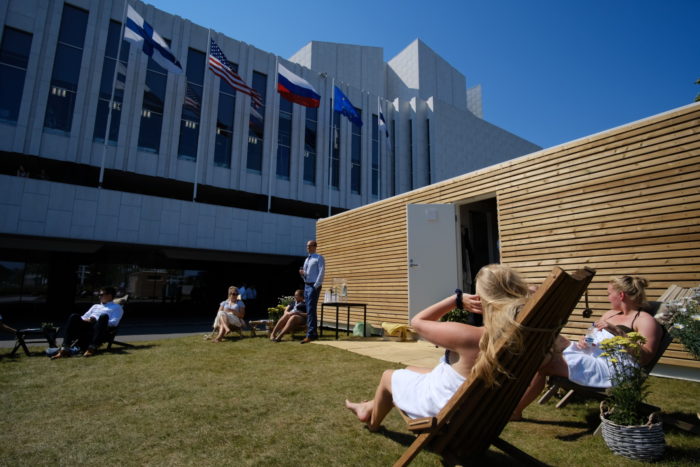
Media representatives visiting the press centre found the same sort of efficiency. “We wanted to live up to our ranking as the happiest country in the world and make the working experience fun, as well,” says Pappi. The press centre was set up in Finlandia Hall, a Helsinki landmark. “Journalists could watch the World Cup final at the media centre, visit a sauna installed in the park behind the building, and enjoy Finnish delicacies.”

Demonstrative citizens

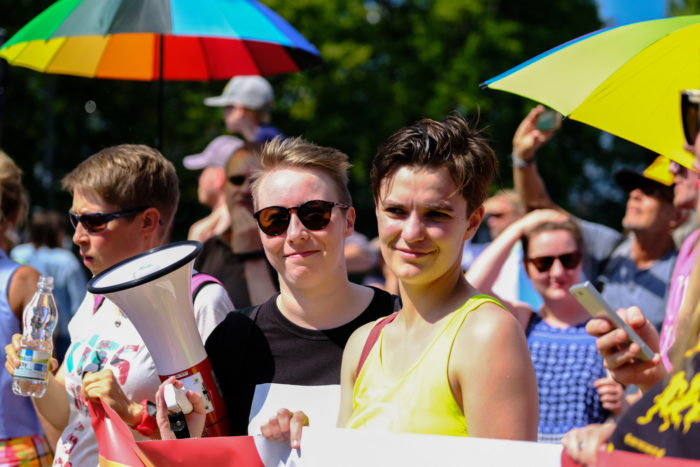
A crowd of demonstrators, a couple of them holding rainbow-coloured umbrellas.

Viima Lampinen (black shirt and sunglasses), chair of Seta, Finland’s advocacy organisation for LGBTI rights, says, “We needed to show solidarity with the people who have been harmed by the politics that the two leaders represent.”Photo: Tim Bird

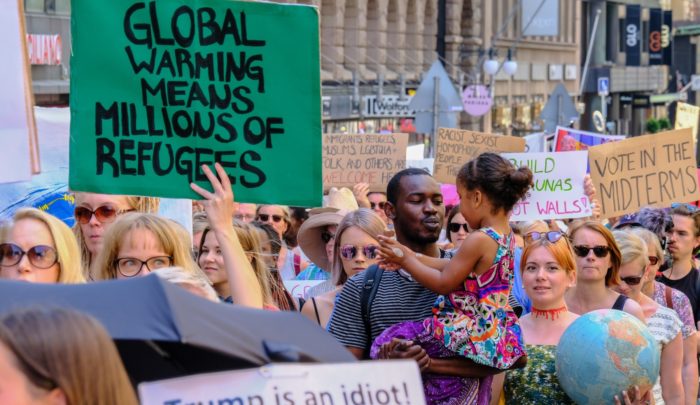
Meanwhile, in the midst of a heatwave, Helsinki’s streets were turned into a shifting platform for 16 demonstrations as citizens took the opportunity to express their feelings towards the high-level visitors. Demonstrations took place on Sunday, July 15 and on the day of the meeting, Monday, July 16. The biggest one belonged to Helsinki Calling, a coalition of concerned citizens representing all shades of the political spectrum.

“We’re a very broad network of academics, journalists, civil society and others that has come together to talk about issues that Trump and Putin choose not to address,” says University of Helsinki lecturer and Helsinki Calling activist Nely Keinänen.

Those issues include human rights, press freedom and the environment. “For me the turning point came with the election of President Trump, whom I have been watching with both fascination and fury,” says Keinänen. “I don’t agree with anything he says or does. When we heard he was coming here I thought, now I have the opportunity to make my voice heard.”

Viima Lampinen, chair of Seta, Finland’s advocacy organisation for LGBTI rights, and a speaker at the Helsinki Calling march, makes it clear that the focus was on both leaders: “We needed to show solidarity with the people who have been harmed by the politics that the two leaders represent. The meeting attracted more than 1,400 media people from around the world and we want our protests to be widely covered.”

Talking dialogue

Serious-looking Trump and Putin standing by podiums saying 'Helsinki 2018', American and Russian flags behind them.

American President Donald Trump and Russian President Vladimir Putin adjust their simultaneous interpretation earpieces at a press conference in the Finnish capital on July 16, 2018.Photo: Jussi Nukari/Lehtikuva/#Helsinki2018

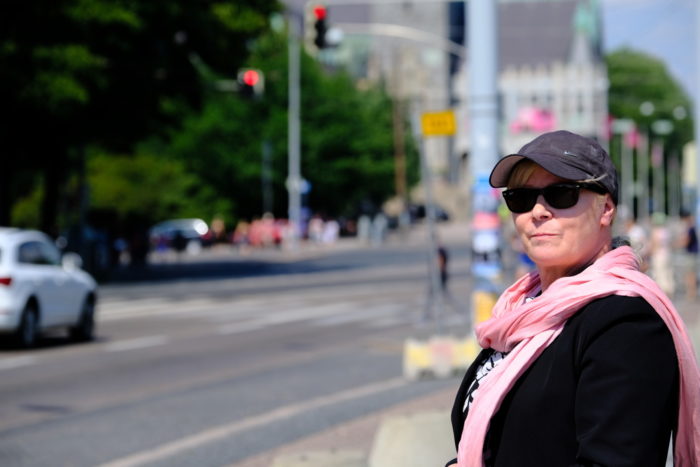
Elisa Saikkonen was among a crowd of locals gathered along Mannerheim Road to catch a glimpse of the presidential motorcades. “I think there is a good chance they’ll have a successful meeting here,” she said. “I don’t expect them to make any big decisions but it is a good thing for the world for different countries to meet and talk in peace.”

The Russian and American presidents talked with each other, and also with Niinistö. At the end of the day the Finnish president talked to reporters who were still trying to sort out what Trump and Putin had said at their press conference.

“The main message from Helsinki seems to be that those two leaders are prepared to continue their discussion on several different difficult issues,” said Niinistö. “And if that is the case, well, then I consider it as a positive. We all have been pointing out that, in spite of everything, dialogue is needed.

“Now there’s dialogue. I hope that it continues, and hope that they also find some answers to those difficult questions put forward today.”

By Tim Bird, July 2018

Presidents cross paths in Helsinki: A look back

When rumours of a meeting between the US president and his Russian counterpart started circulating, Helsinki was the number one bet to become the host city.

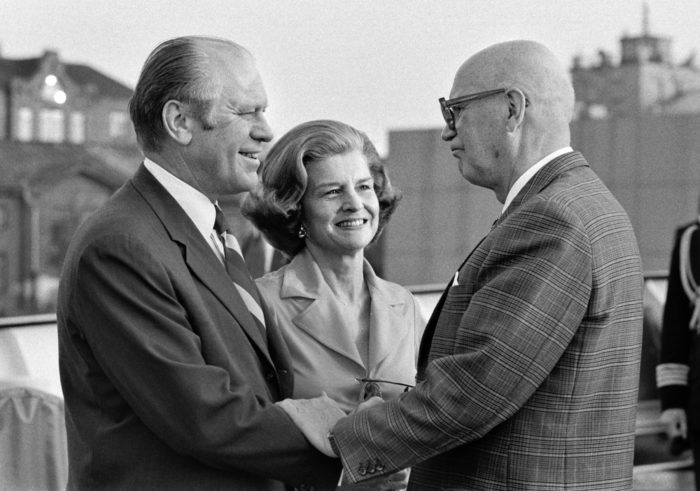
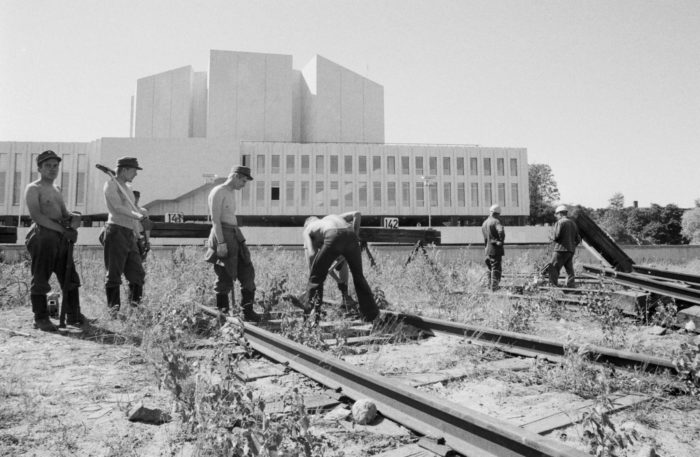
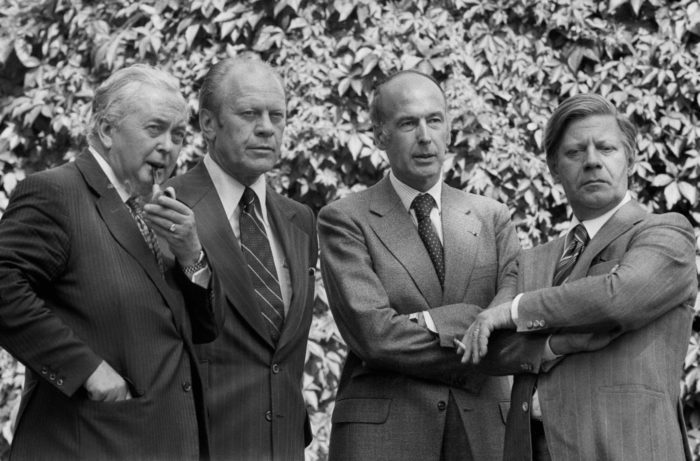
The Finnish capital has a lot of experience welcoming leaders of the West and the East to its meeting venues and presidential residences. The first was the 1975 Conference on Security and Cooperation in Europe (CSCE), where US President Gerald Ford, Soviet leader Leonid Brezhnev and the heads of state of both East and West Germany gathered under same roof in Finlandia Hall. The meeting resulted in the Helsinki Accords and stronger cooperation between Eastern and Western countries.

The Persian Gulf crisis 15 years later brought Soviet leader Mikhail Gorbachev and US President George H.W. Bush to Finland in September 1990. “Here in Helsinki, President Gorbachev and I meet, hopefully to strengthen our common approach to this unjustifiable act of aggression,” President Bush told the New York Times upon his arrival at Helsinki Airport in 1990.

US President Bill Clinton and Russian President Boris Yeltsin held negotiations in 1997 in Mäntyniemi, one of the official residences of the president of Finland. The political hot potato at the time was NATO enlargement to Poland, Hungary and the Czech Republic. “Agreed to disagree” was the outcome.

Our slideshow brings back moments from previous presidential meetings in Helsinki.

By Laura Suihkonen, July 2018

Smart people build smart machines in Finland

Oğuzhan Gençoğlu is one of three cofounders of a unique Helsinki-based startup specialising in machine learning. Their solution is able to analyse data and make specialised predictions; uses range from increasing productivity at a forestry factory to finding out if a patient has prostate cancer.

Born in Ankara, Turkey, Gençoğlu came to Finland to pursue a master’s degree at Tampere University of Technology, where he extensively studied machine learning and deep learning.

“Machine learning is a subset of computer science, where algorithms analyse data, learn from it, and apply what they’ve learned,” he says. “Deep learning is a subset of machine learning which uses artificial neural networks.”

Gençoğlu explains artificial intelligence as “machines mimicking the cognitive functions of humans.” He comments that “people say ‘AI’ too much when they are referring to pseudoscience or science fiction.”

Machine learning can identify objects in images, or even recognise individuals. It can be taught to play games or chat with people. Gençoğlu’s doctoral dissertation deals with using machine learning to predict influenza epidemics based on social media posts.

Diverse advantages

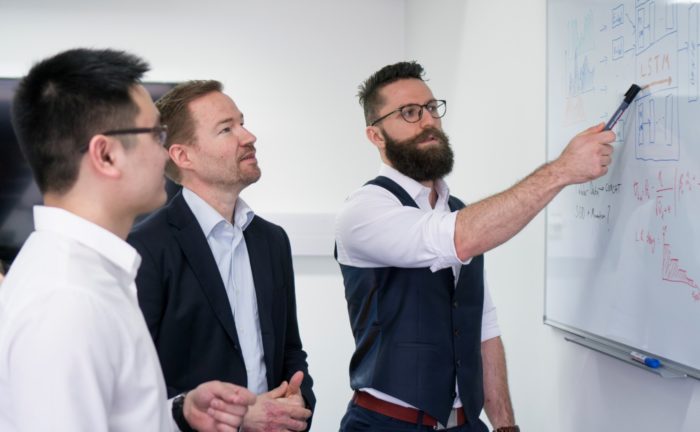
Three men looking intently at whiteboard with markings on it; one of the men pointing at something on the board.

From left: Hung Ta, Timo Heikkinen and Oğuzhan Gençoğlu draw up a plan.Photo: Hoang Minh Trang/Top Data Science

In 2016 Gençoğlu teamed up with Hung Ta, a Vietnamese mathematician with a PhD in biotechnology, and Timo Heikkinen, a Finnish entrepreneur with a background in software, to found Top Data Science, which specialises in machine learning. Now Gençoğlu is the head of data science for a company that has ten employees from six different countries.

“It’s definitely an advantage to be so diverse,” Gençoğlu says. “We work with many international companies, so if we are talking to a Chinese corporation it is a plus to have a Chinese speaker on our team.”

The company uses the multicultural background of their staff as a chance for team building. Every month they have a meeting with events, games, stories about their cultures, and food from their home countries.

“We offer AI as a service: tailor-made solutions to specific challenges,” says Gençoğlu. “If you go to one of the big companies in this industry, they will simply offer one of their plug-and-play products. We spend time to understand the client and the issue.”

Top Data Science has worked with a variety of industries, including forestry and imaging. It is based in GE’s Health Innovation Village in Helsinki, a home for dozens of health and wellbeing startups. Top Data Science’s ties to the health industry paid off when doctors at Helsinki University Central Hospital wanted to minimise biopsies and asked the company to develop software to diagnose prostate cancer from MRIs.

“We trained the algorithm using examples of MRI images and biopsy information,” Gençoğlu says. “Now when it is presented with new data, it is able to make predictions.”

Things we need to understand

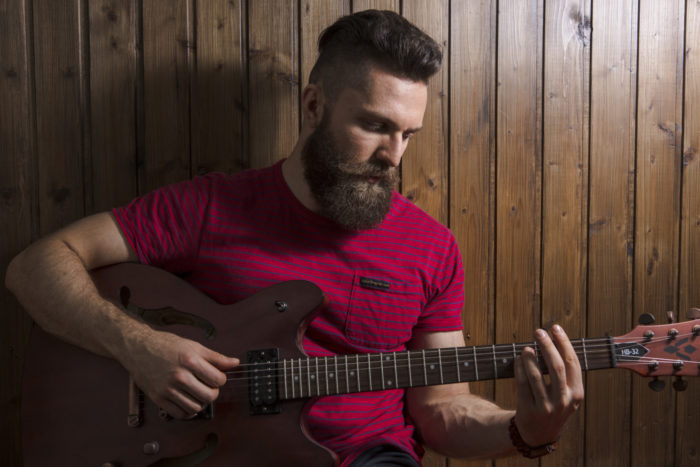
A bearded man playing the guitar in front of a wood paneled wall.

People aren’t machines – humans learn differently. They need hobbies and work-life balance. Playing the guitar is one of Gençoğlu’s interests outside the office.Photo: Tiina Hautamäki

Another testing project involved discerning which patients were at risk of getting worse and which could be released from the intensive care unit. Top Data Science’s solution could be a valuable tool for doctors making these decisions.

Gençoğlu is pleased with the status of machine learning in Finland, but concedes there is work to do.

“Finland is a little behind the United States,” he says. “China is also very strong. We have lots of AI talent in Finland, but businesses are conservative and late to embrace it. Sometimes experts in Finland go to work in Silicon Valley or stay in academia.”

Yet some recent activities have increased the status of machine learning in Finland. For example, the University of Helsinki and consultancy company Reaktor have offered a free AI class called Elements of Artificial Intelligence, still available online at the time of writing.

“Elements of AI was a great idea,” says Gençoğlu. “It is important for the public to know how tagging people in pictures has trained Facebook’s facial recognition software, or how identifying spam in Gmail has trained Google’s algorithms. The public needs to understand how this works so they can have an impact on public policy.”

So does he worry about what social networks are doing with his data?

“I don’t have any social media accounts, except for LinkedIn,” he says. “The main reason is that I’m just not interested, but maybe I’m also a bit more conscious of privacy and how data is used.”

By David J. Cord, July 2018

Tiny Finnish town wins World Capital of Metal crown

The race ran for most of May and June 2018. Metal bands and their fans could add bands to the Capital of Metal website and increase the numbers for their hometowns.

Two frontrunners eventually emerged, both of them eastern Finnish locations. Joensuu or Lemi, which one would win the Capital of Metal? It was tight until the very end, with both contestants encouraging their local bands and fans to go online and participate.

Joensuu went so far as to create cat memes to promote the cause. But in the end it became clear that the winner was the tiny municipality of Lemi, located 50 kilometres (30 miles) from the Russian border.

The World Capital of Metal contest is based on Finland’s fame as the country with the greatest number of metal bands per capita in the world (53.2 bands per 100,000 inhabitants). Lemi won the competition with 13 bands and a theoretical ratio of 422.6 bands per 100,000 inhabitants, whereas Joensuu (population: 75,848) came second with 177 bands and a ratio of 233.4 bands per 100,000. In absolute terms, Joensuu has the greatest number of bands of any Finnish municipality.

The capital of Finland, Helsinki, came up with 123 bands, equivalent to just 19.4 bands per 100,000 inhabitants. During the campaign Helsinki requested help from Tallinn, the capital of nearby Estonia, but even this double metal metropolis, nicknamed Hellinn, still had only 154 bands – fewer than Joensuu.

Lemi loves metal
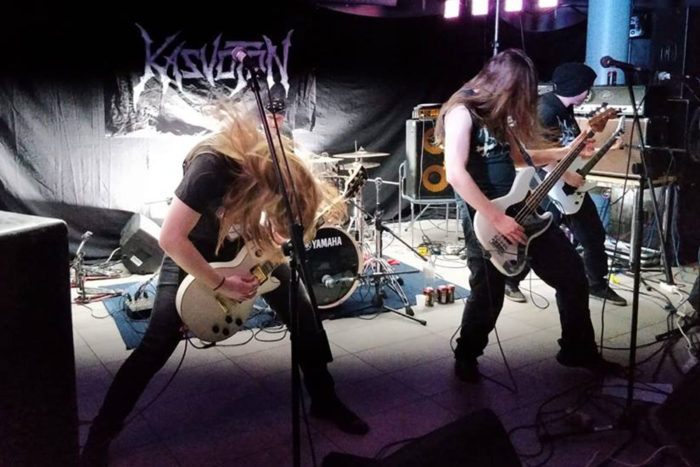
A heavy metal band on a small stage; the guitarists are moshing.

Guitarist Rolle Hirsimäki (left) of Lemi band Kasvoton (Faceless) says, “Stam1na has shown that it’s possible to make good music and become popular even if you come from a small town.”Photo: Simo Sairanen

So how did the rural municipality of Lemi become the World Capital of Metal?

“Music has always played a big part in peoples’ lives in Lemi,” says Jussi Stoor, the town’s mayor. “For example, people here have sung four-tone hymns for ages.” Stoor received the honorary title Mayor of Metal at the official Capital of Metal award ceremony on the main stage of the Tuska Open Air Metal Festival in Helsinki on June 30, 2018.

“I was really surprised, although I knew lots of people in Lemi make music,” says Rolle Hirsimäki, a guitarist from Lemi. “Maybe there’s more room for music in the countryside, since there are not as many other activities there.” His band Kasvoton (Faceless) plays extreme death metal. It was formed in 2010, while the four members were still in school in Lemi.

Both Stoor and Hirsimäki name one metal band from Lemi that has set an example for youngsters for more than two decades: Stam1na. “There is lots of music other than heavy metal, but maybe Stam1na being so famous explains why people from Lemi are so into metal,” Stoor says.

Hirsimäki agrees: “Stam1na has shown that it is possible to make good music and become popular even if you come from a small town.” Lemi has worked closely with Stam1na, even before the Capital of Metal campaign.

Granting support to music
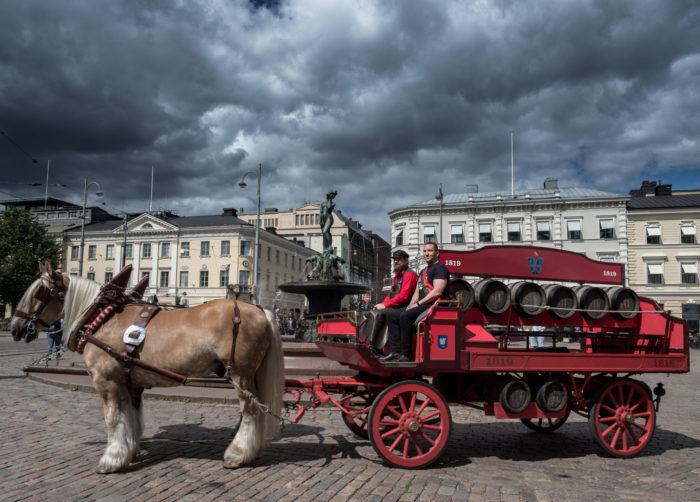
A red horse-drawn carriage in front of Havis Amanda statue in Helsinki.

Mayor of Lemi Jussi Stoor, a.k.a. the Mayor of Metal, traversed downtown Helsinki in style on his way to the Tuska Open Air Metal Festival to accept the World Capital of Metal award on behalf of his town. The weather cooperated, despite the ominous clouds.Photo: Miika Storm

However, Lemi didn’t win the competition just because of Stam1na. Lemi has invested in music and young people, for example by providing band rehearsal spaces to young musicians. According to Stoor, at least half a dozen bands have municipal rehearsal spaces in Lemi. That’s also where Kasvoton started playing. Stam1na still has a rehearsal space in town, too.

Whereas Lemi has Stam1na, Joensuu holds an annual rock festival, Ilosaarirock, which started in the 1970s – so it has also built a tradition. In Joensuu up-and-coming bands can apply for grants to fund their first European tours. “I have to congratulate Joensuu,” says Stoor. “It’s quite a mecca for metal music. There are lots of bands there. The competition was tough but honest, and I’m glad we all promote this culture together.”

Stoor and Hirsimäki think winning the competition has something to do with Lemi’s strong community spirit. “The bands were active and joined the campaign,” says Stoor.

He participated enthusiastically, even shooting a video in response to Helsinki’s call for help from Tallinn. “Because we are small we can’t afford fancy video equipment,” he says in the clip. “But still, we don’t need any help from abroad with metal bands, like some others do.”

Stoor enjoyed the process: “Helsinki did their video with humor, and so did we.” He says he’s been a metalhead since he was a teenager. “This fits my genre quite well. That’s probably why I got so excited about the competition.”

Next stop: Lemi
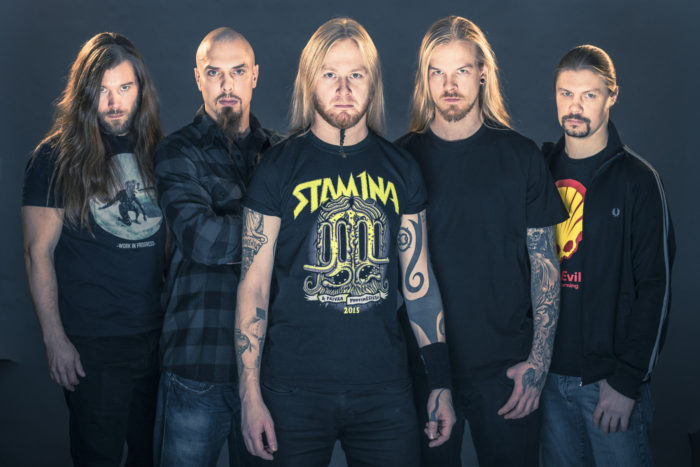
The band Stam1na posing for the camera with serious looks on their faces.

Stam1na, a metal band from Lemi, has achieved great popularity. “Maybe Stam1na being so famous explains why people from Lemi are so into metal,” says Mayor Jussi Stoor.Photo: Teemu Leinonen

“Winning this competition is a big deal for a small community,” Stoor says. “It has brought us a lot of publicity. I’ve seen people say on social media that their next destination is Lemi.”

Lemi hosts two annual music events, both in late July: Lemin musiikkijuhlat (Lemi Music Festival), with mostly classical, jazz and choir music, and KontuMetal, “the only metal festival in Southern Karelia,” as Hirsimäki puts it. Stoor promises that the municipality is planning more metal. [Editor’s note: Lemi has also announced plans for a special one-day metal festival on September 8, 2018 to celebrate winning the Capital of Metal honour.]

If you’re planning a trip to Lemi, it’s worth noting that you can rent a summer cottage there, but for a hotel you’ll have to travel to the city of Lappeenranta, a 20-minute drive away.

By Anna Ruohonen, July 2018
A Finn in America ponders the luxury of enjoying life

When an American friend of mine moved from New York City to Helsinki, he knew what to expect. He had visited Finland often, he enjoyed Helsinki’s manageable size, and he knew that the winters can be tough. Yet there was one thing that worried him: the low level of Finnish salaries.

The annual median wage for full-time workers in Finland is only 36,000 euros (about 43,000 dollars). This might not seem low in many places in the world, but for an educated professional hailing from one of the world’s big financial centres, it means a serious pay cut. My friend was used to salaries in New York City, and while New York certainly has its share of minimum-wage workers earning much less, corporate professionals such as lawyers, financiers and sales executives usually make at least 100,000 dollars a year. Finnish salaries can’t really compete. Yet my friend from New York soon discovered that the income loss was less dire than he’d expected. The reason was simple: in Finland, he didn’t spend any money.

He laughed as he said this. Of course, he did have to spend some money. Housing in Helsinki can be absurdly expensive, and food is costly compared to many other places. But there was a deeper truth to what he was saying.

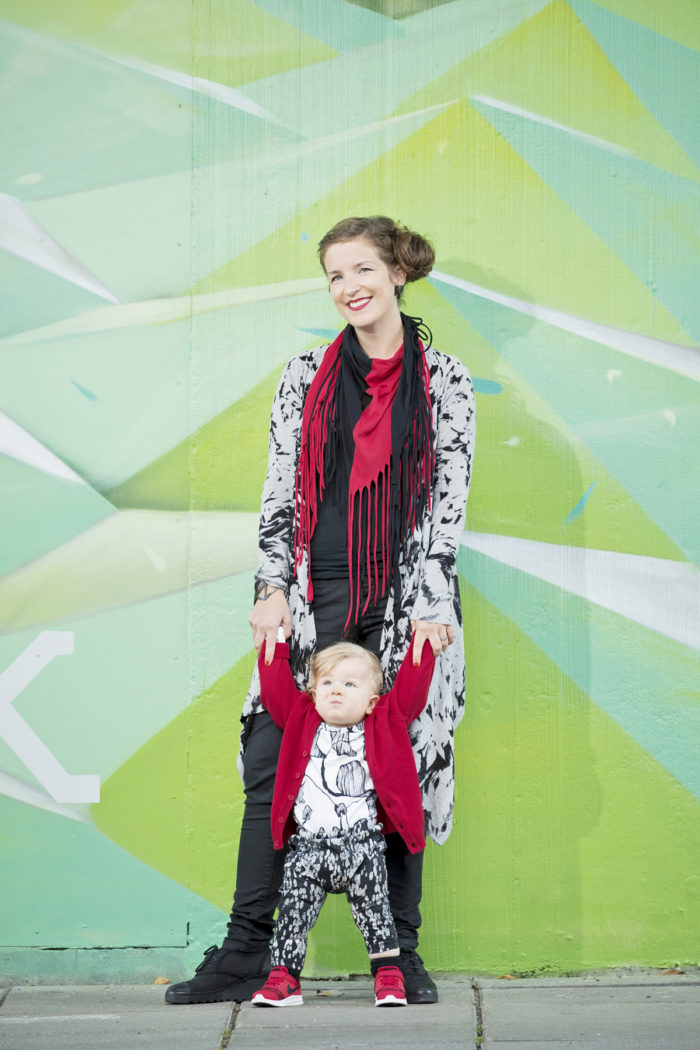
For example, in New York City the average annual cost of childcare for an infant is 16,000 dollars. That’s above-average for the US, but in more than half of American states, the cost still tops 10,000 dollars, and in Washington, DC, it’s even higher, at 22,000 dollars. In Finland, every child in the entire country is guaranteed a spot in a high-quality, public daycare centre, where children play outside most of the day supervised by expertly trained and well-educated staff. Families pay for this service on a sliding scale according to their income. The maximum amount anyone – no matter how wealthy – has to pay comes to 3,480 euros (approximately 4,100 dollars) per year.

In the US, new parents must not only pay for expensive daycare, but must also start saving for the future education of their child. Average tuition fees plus room and board at a private nonprofit four-year college in the US will come to about 45,000 dollars a year. In Finland, a university education is free of charge for all Finnish and EU citizens, and the government grants students a monthly stipend to help with living costs.

Falling in love with Nordic ideals

In the US, healthcare is one of the biggest expenses for families. In Finland, healthcare is funded through taxes, with patients paying only small contributions. Care for children and pregnant women is mostly free. Annual out-of-pocket costs are capped at 690 euros (815 dollars) per year. Once a patient reaches that limit, most care is free.

My friend was discovering that, while educated Americans may earn salaries that appear high at first glance, securing these basic services can cost an American family tens, if not hundreds, of thousands of extra dollars per year in after-tax money. In a country like Finland, such services are just like the fire department; you pay your taxes and you’re done. Finnish taxes are proportional to income, and income tax also tends to be lower than most outsiders assume. (A Finnish median wage earner can expect to pay about a quarter of their income in taxes.) As a result, even a seemingly small salary in Finland will take you far.

People around the world have fallen in love lately with a Nordic ideal that is often referred to by the Danish term hygge – spending cosy time with family and friends, and not working yourself to death in pursuit of higher salaries. [Editor’s note: Even more recently, the Finnish word sisu has been attracting renewed attention abroad.] It is often left unsaid that Nordic people can afford to enjoy their lives this way because their societies have chosen to provide some of the more complicated, expensive, and essential needs of life – daycare, education, healthcare, and the like – as universal goods. This means that people don’t have to spend their own time researching and securing such services, and everyone can receive these basic goods regardless of their income level. It also means the same services are used by the wealthy and the middle-class alike, which helps keep quality high.

Now that my friend is settled in Finland with a job and a new-born child, he considers it a great deal. It’s not about how much money you make. It’s about what that money will buy you.

Top three things that work great in Finland

  • Biking
    In Finland bike lanes are usually separated from cars and often run along waterways or through patches of woods, even in cities. Commuting doesn’t get much better than riding your bike along the seashore.
  • Daycare
    Finns are known to be quick to complain if public services don’t live up to their standards, but most praise their children’s joyful, activity-filled days in public daycare centres as sources of true happiness.
  • Winter traffic
    Driving in sleet, hail, and snow is difficult everywhere and Finns suffer accidents and delays under such conditions like everyone, but returning to Finland after years abroad, I’m always amazed by how well Finns handle winter traffic. Life goes on, just like it does in the summer.

By Anu Partanen, ThisisFINLAND Magazine 2018

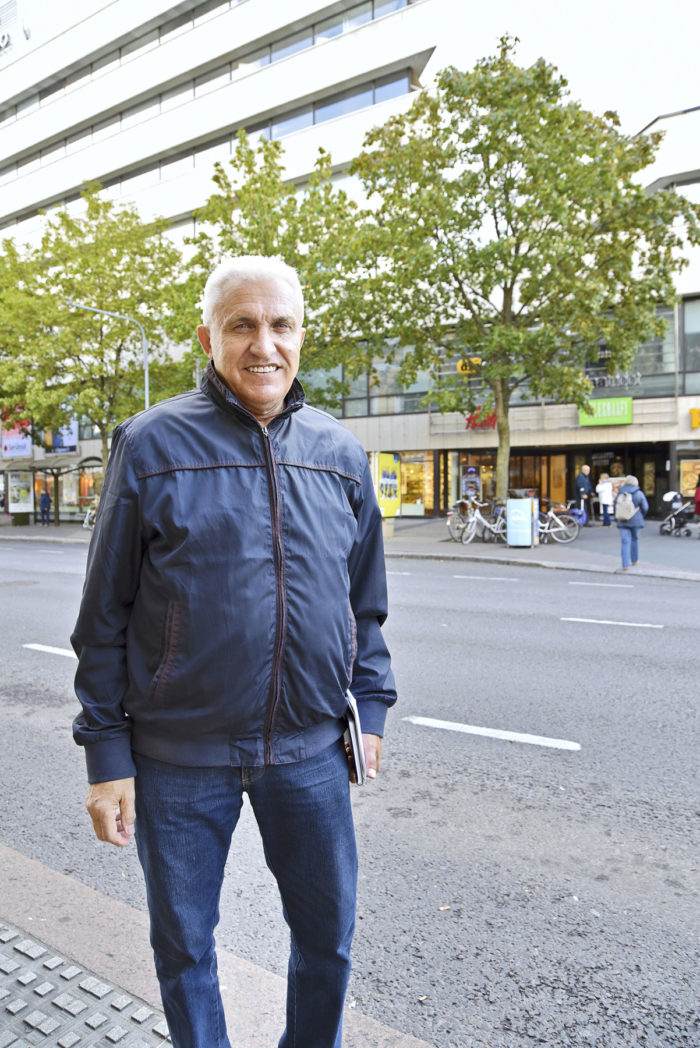
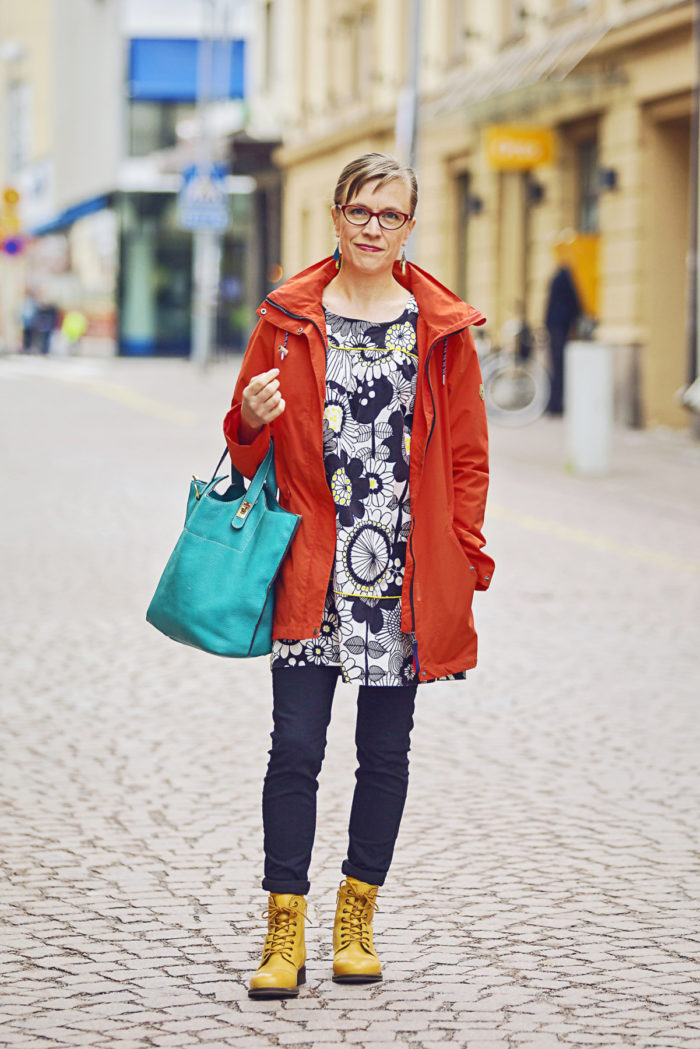
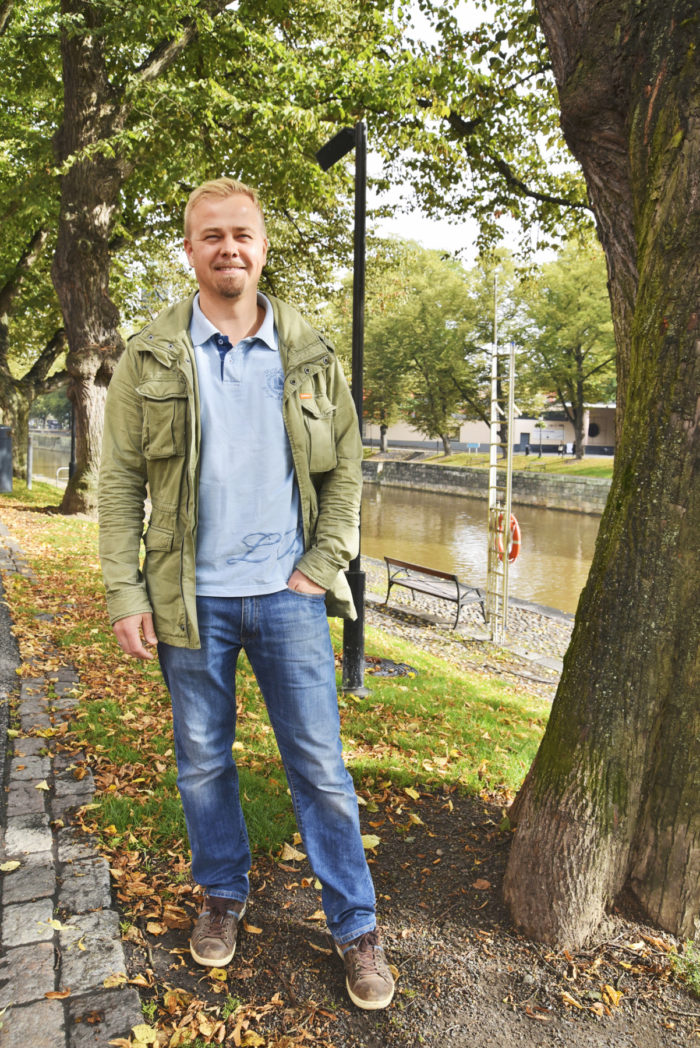
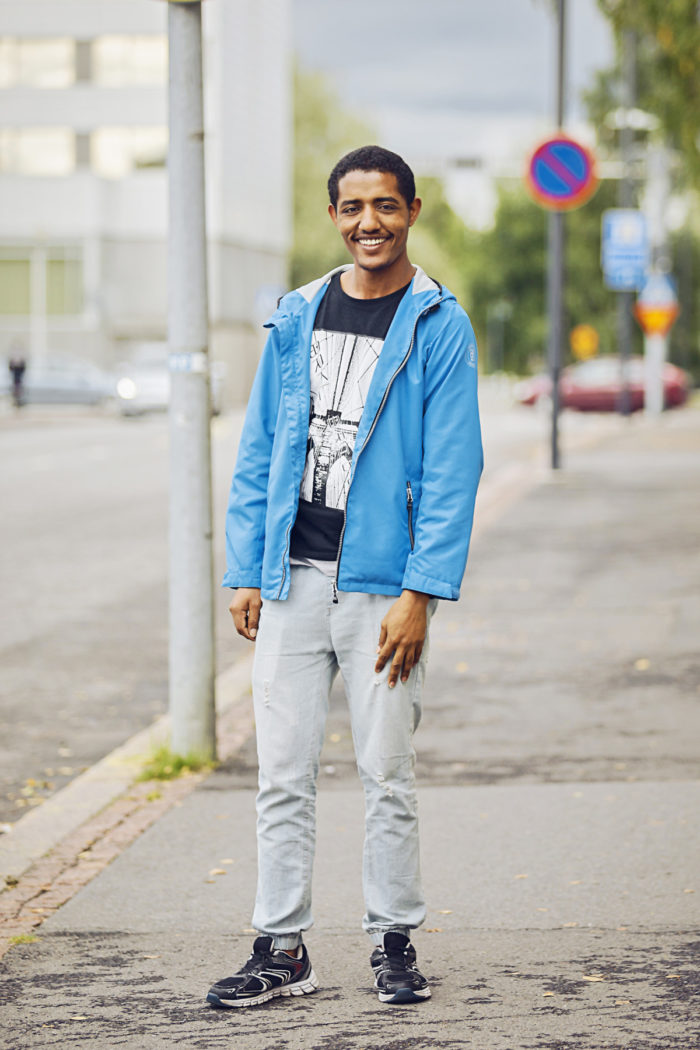
On the streets of Finland

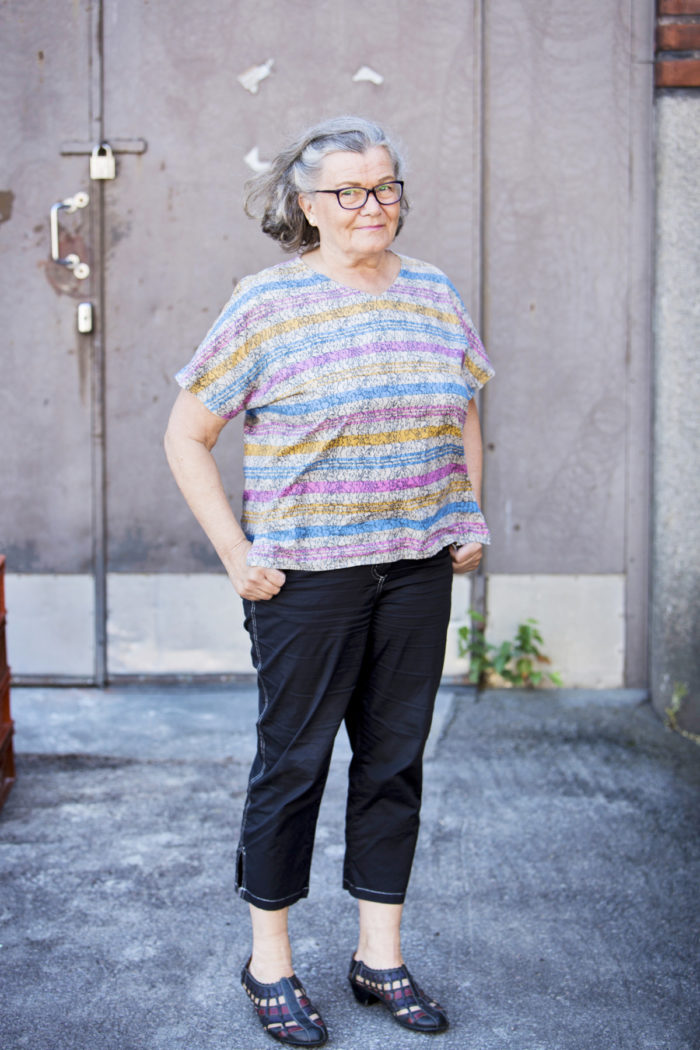
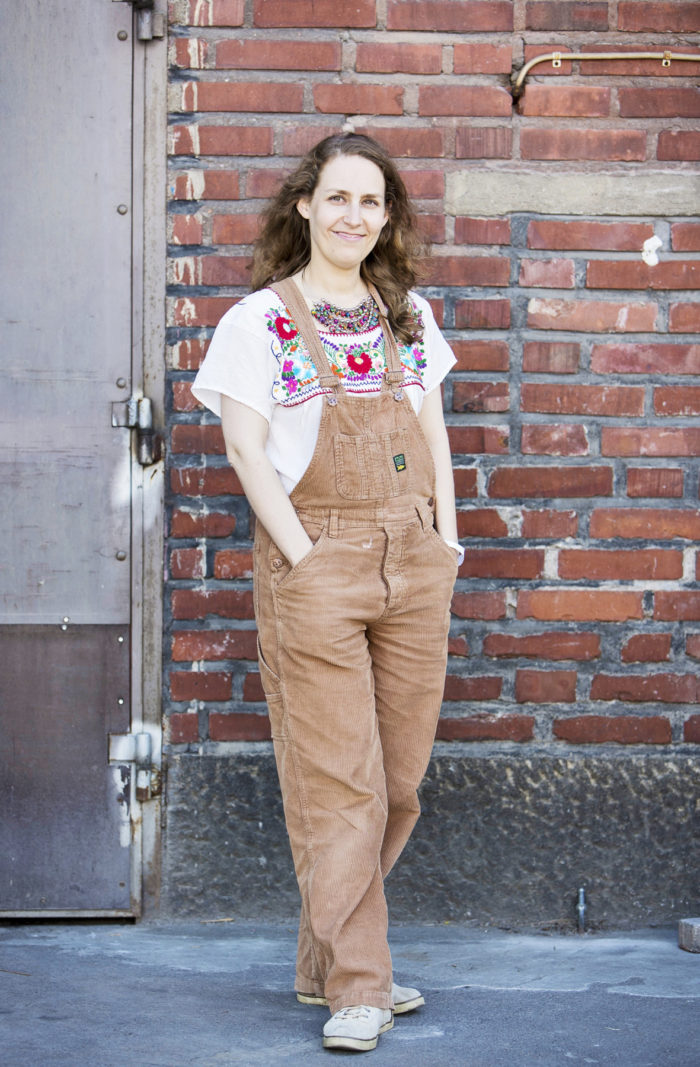
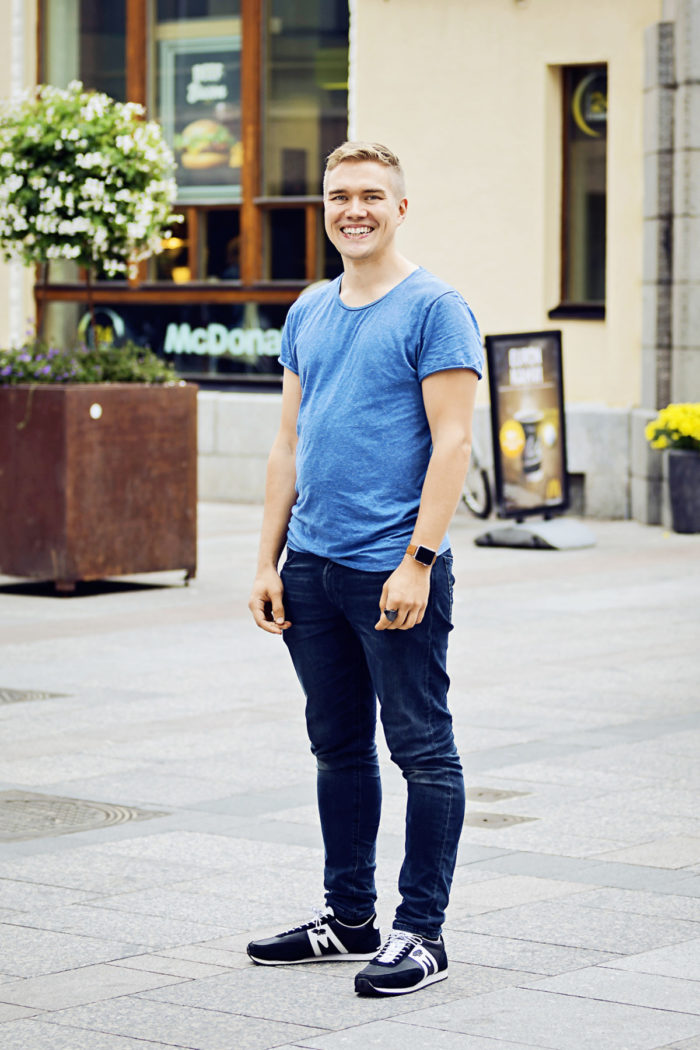
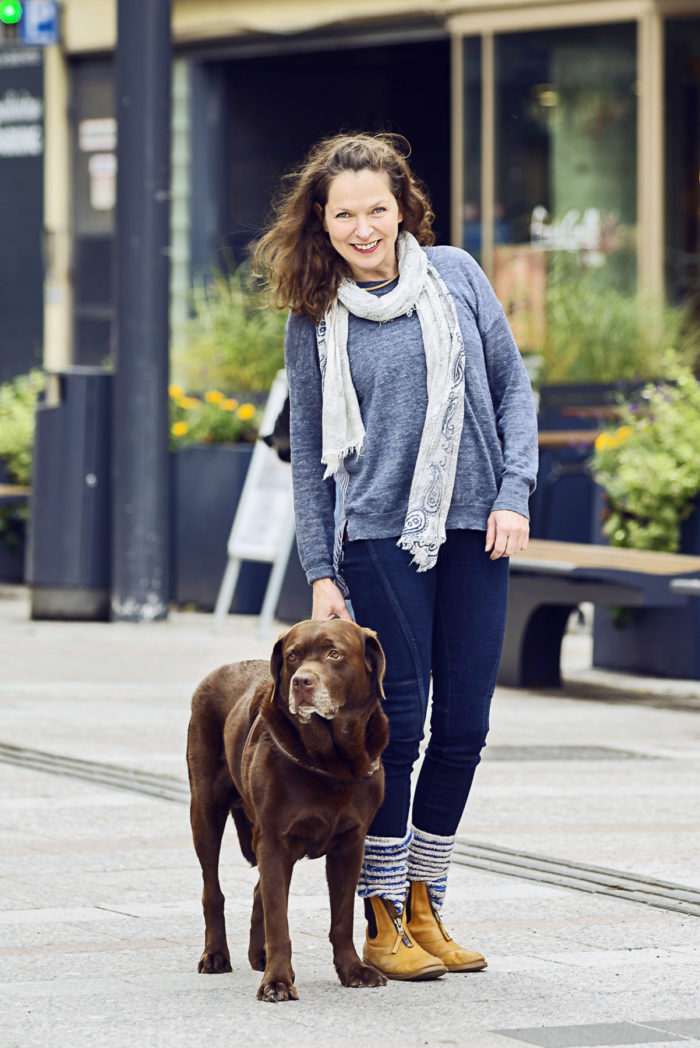
What makes everyday life in Finland good? We ask people in three cities what they like about Finland.

By Päivi Leinonen, Marjo Linnasalmi, Kati Valjus and Taru Virtanen, ThisisFINLAND Magazine 2018

Young Brazilian wins trip to Finland in Capital of Metal contest

The Capital of Metal website opened in May 2018, aiming to find the Finnish municipality with the most metal bands per capita. (It is already known that Finland itself has more metal bands per capita than any other country.)

Finnish metal bands could tag an online map of Finland to help their hometowns win the title of Capital of Metal. When the result was announced on June 21, the winner was Lemi, a town of only 3,076 inhabitants, located in southeastern Finland.

An additional contest on the Capital of Metal site invited musicians and fans from all nations to enter a draw for prizes ranging from music store gift certificates to a trip to Finland, just in time for the Tuska Open Air heavy metal festival in Helsinki from June 29 to July 1. The prize includes transportation, accommodation and VIP festival tickets for two. (See more about Capital of Metal in our article.)

“I read about the campaign on Facebook”, says Vieira. “It caught my attention and I decided to participate, but I didn’t think I could win. When I checked my email, I couldn’t believe the message saying that I’d won the prize.”

An executive secretary student at the Federal University of Sergipe in Brazil, Vieira, 20, has been a metal fan since the age of 11, when he fell in love with the music after his big brother Victor Gonçalves introduced him to it. Now Gonçalves is joining Vieira on the trip. (Follow their Instagram feeds here and here.)

Gonçalves, 30, is a musician and music producer and has visited Finland before. “I used to work on sea cruises and my route passed through Helsinki, so I had the opportunity to see a little,” he says.

From northeastern Brazilian to southern Finland

A long-haired man playing the cello on a stage, a drummer in the background.

Apocalyptica is one of João Vieira’s favourite Finnish metal bands. Here they are performing at Tuska Open Air 2017 during the Metallica by Four Cellos Tour in celebration of the 20-year anniversary of the album that made the Finnish cellists famous worldwide (Perttu Kivilaakso in the foreground and Mikko Sirén on drums).Photo: Cristina Ornellas

Vieira and Gonçalves are fans of bands such as Iron Maiden (UK), Blind Guardian (Germany), Death (USA) and Carcass (UK). The two have already attended festivals held in Brazil, but are excited about Tuska. “We will see bands at Tuska that I never thought I’d have opportunity to see, like Kreator, Europe and At the Gates,” says Vieira, naming a German band and two Swedish groups. “It will be really exciting for us, moments that we’ll remember for the rest of our lives.”

The brothers come from Aracaju, the capital of Sergipe, a small state in the northeast of Brazil. Although relatively small (about 650,000 inhabitants), Aracaju is a tourist city of beautiful beaches, famous for the hospitality of its population. It is also said to be the city with the healthiest living habits and the lowest percentage of smokers in the country, according to the Brazilian Ministry of Health.

Vieira says that the local metal scene in his hometown is “very small.” He believes that this may be because bands get little in return for their efforts, leading to a situation that lacks incentives.

The trip from Aracaju to Helsinki takes 17 hours, but that doesn’t seem to faze Vieira. “It’s my first trip abroad,” he says. “We’ll stay in Helsinki for five days. I hope to see as much as possible.”

Finnish metal is different

Alexi Laiho playing his guitar on a stage, keyboardist Janne Wirman in the background.

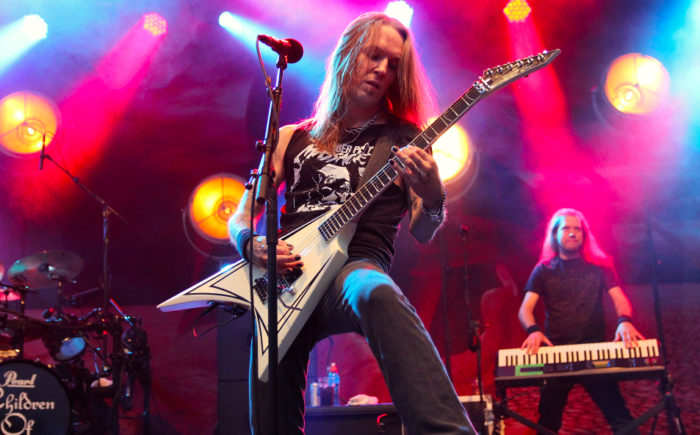
One the Finland’s most famous metal bands from Finland, Children of Bodom is also among the favourites of João Vieira and his brother Victor Gonçalves. This picture shows frontman Alexi Laiho and keyboardist Janne Wirman playing at Tuska Open Air 2017.Photo: Cristina Ornellas

Vieira’s interest in the Finnish metal scene started many years ago, while watching the famous German festival Wacken Open Air online. “I found the high number of Finnish bands in the lineup curious, and I decided to dig in. I’m a big fan of Children of Bodom, Lost Society, Turisas and Apocalyptica.”

Asked what sets Finnish bands apart, he says, “Finnish metal is different. The lyrics of the songs are usually very interesting and the sound is heavy but joyful.”

Besides his passion for heavy metal, he’s also a skateboarder and a surfer. He also likes to read and play the guitar. Through reading he has learned a lot about Finland and expresses his admiration for the education system. “I admire the way that in Finland, the taxes paid by the population return in the form of education, health and quality of life,” says Vieira.

By Maila-Kaarina Rantanen, June 2018