Magic in the Finnish summer air

Summer in Finland is definitely one of a kind: intense and eagerly anticipated, so beautiful that it takes your breath away. It is worth celebrating, and that is exactly what Finns do: they gather to enjoy the long daylight hours and the freedom of summer festivals throughout the country. The cities, islands, lakesides and even fells host events packed with happy people, lovely food, live music and art spectacles.

There’s certainly magic in the air. Festival organiser and contemporary artist Aki Roukala has captured it in alternative boutique festivals such as Bättre Folk, held on the picturesque island Hailuoto, and Festivaali in Tampere. As the creative director of both festivals, he’s in charge of curating artist lineups that both satisfy and surprise music enthusiasts. That’s what keeps the scene fresh and original, he thinks.

“Finland is not globally well-known for big pop stars,” Roukala says. “We don’t have to abide by the pressure of the global pop music industry. We’ve had time and space to cultivate alternative musicians and bands, which to me are much more interesting headliners than some of the more famous artists.”

Location, location, location

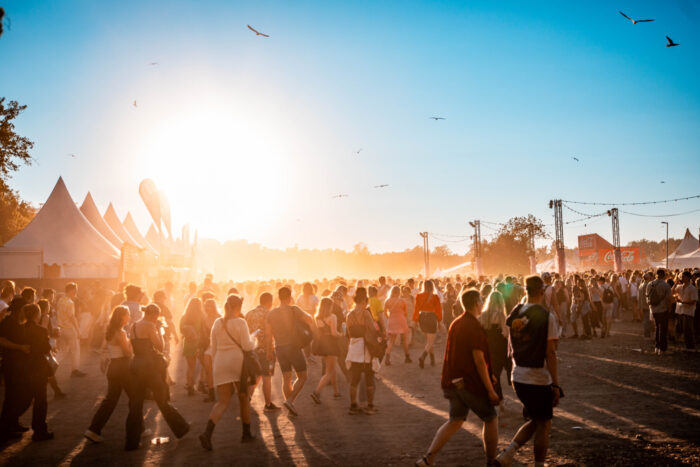
A large crowd in a festival area as the sun shines.

Ruisrock, TurkuPhoto: Riikka Vaahtera

Alternative festivals remain marginal in Finland, where more mainstream events attract larger audiences and generate more profit. As the more intimate Bättre Folk draws around 3,000 daily attendees (and is sold out nearly every summer), Ruisrock in Turku’s Ruissalo island attracts over 100,000 visitors each year. It’s the second oldest rock festival in Europe and has been running since 1970.

You could call Ruisrock mainstream based on its lineup, but the setting is far from ordinary. The main stage is located on a sandy beach surrounded by open waters, and there’s something unique about thousands of people smiling and waving to greet the massive cruise ships that pass by on their way to Sweden.

“People spend full days within an enclosure at festivals. You need to respect festivalgoers: everything from location to food has to add value to the experience,” Roukala says.

As illustrated by the beaches of Ruissalo, location plays a crucial role in creating the magical and even peculiar vibe of Finnish summer festivals, ranging from rocky gorges and medieval castles to urban areas surrounded by DIY skate ramps and ice rinks to parking lots.

Original acts you won’t find elsewhere

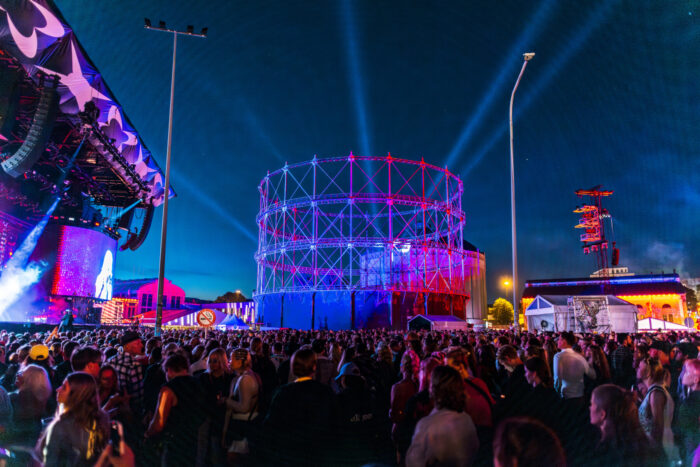
A large crowd enjoying festival music in an urban setting at night.

Flow Festival, HelsinkiPhoto: Samuli Pentti

While bigger and more traditional festivals have established themselves, there’s always room for new ones to emerge. New festivals pop up every few years, sometimes just for one summer. Some festivals only book artists who perform in Finnish. That’s what Aki Roukala tends to do.

“To foreign festival-goers our language sounds exotic and interesting, adding to the overall originality of Finnish cultural events. I don’t see why you couldn’t take over the world while performing in Finnish.”

At the end of the day, though, there’s one main secret ingredient to Finnish summer festivals: the people. Communality and ambiance make or break an event, Roukala says.

“The creative director curates the programme, the programme determines the audience, and the audience creates the atmosphere,” he sums up.

And it’s not hard to create a magical atmosphere under the midnight sun – or the smooth haze of dusk turning directly to dawn – when the only place you have to be is right where you are, in the middle of people, who are all here to enjoy.

By Kristiina Ella Markkanen, ThisisFINLAND Magazine

5 reasons to love potatoes like a Finn 

Their versatility is off the charts 

How many different dishes can you make with just one root vegetable? When it comes to potatoes, the possibilities are nearly endless. Spuds originate from the region of modern-day southern Peru and northwestern Bolivia. They found their way to Finland in the 18th century, brought by German tinsmiths. Thanks to the educational efforts of early potato enthusiasts and a few priests, they won the hearts of Finns. The idea of potatoes conquering Finland has been so intriguing that a comedy film (Peruna) was made about it in 2021.

Nowadays Finnish potatoes come in many shapes, sizes, and compositions; flaky, floury, and starchy potatoes with their incredible capability to transform into a silky-smooth mash; firm little ones for a hearty soup or stew; or big and bold ones that can be cut into fries. With the right toppings, a humble baked potato can be transformed into a complete balanced meal. They are amazing in cheesy gratins, boiled with good butter and a pinch of salt, or potato soups.  

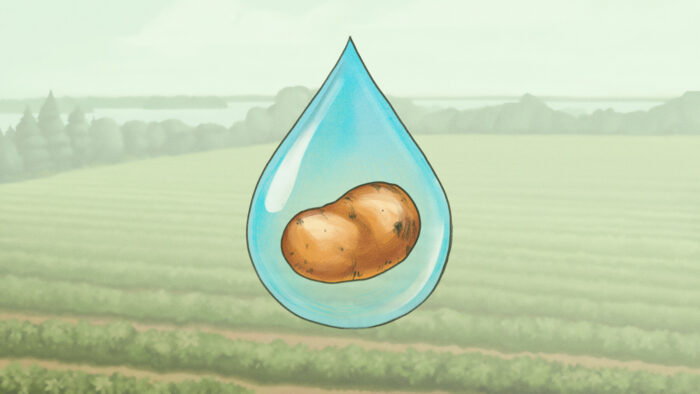
Illustration of a single potato suspended inside a large water droplet.

Potatoes are a climate-smart choice: they use less water, land and energy compared to many other staple foods.Illustration: Hilla Ruuskanen

They are a reliable source of food in the changing climate 

In a world in desperate need of climate-friendly options for food, potatoes are one of the most sustainable choices. International research has recently shown that potatoes are more environmentally sustainable than pasta or rice. They are in the top ten of the most land- and water-efficient crops with the lowest carbon footprint, and are easy to grow.  

Potatoes are hardy and adaptable and thrive almost everywhere, making them the ideal plant to grow in different climates. With enough water and nutrients, they grow easily without much maintenance all over Finland, from the lusher, greener south to the harder, less nutrient-rich terrain of the north. You can also grow them in a raised bed or even in a bucket.  

They carry comfort, tradition and joy 

Finnish potato dishes are the ultimate soul food. They bring a sense of togetherness to happy occasions and a touch of comfort and familiarity to sad ones. The taste of potatoes carries us through life. Potato purée is often the first solid food a Finnish baby tastes. 

Including potatoes in the feast on celebratory occasions is so rooted in Finnish culture that it’s become almost intuitive. On the First of May holiday, Finns celebrate the arrival of spring with picnics and potato salad. At Midsummer, the first new potatoes of the season adorn the spread. And at weddings, many people opt for an entrée with boiled potatoes and salt-cured fish. Potatoes are also present at funerals, as a main ingredient in delicacies such as Karelian stew, salmon soup, or reindeer soup. 

They — deservedly — have their own festival 

Every spring, Finnish potato lovers wait eagerly for the first potatoes of the summer. In 2011, potato enthusiasts from Turku in southwestern Finland decided to give new-season potatoes the recognition they deserved and founded the New Potato Festival. The event highlights that potatoes are not just a reliable everyday staple in the kitchen, but also a unique gastronomic specialty.

At the festival, celebrated chefs prepare a range of dishes, from stir-fried and cold-smoked potato delicacies to potato desserts. According to the festival’s founders, potatoes deserve the same sort of attention as wine.  What potatoes and wine have in common is that terroir — the combined effect of soil and climate — creates their distinctive flavor profiles. As one looks at the potato selection in a Finnish supermarket, you have to agree. There’s a potato with unique characteristics for everything and everyone – as there should be.  

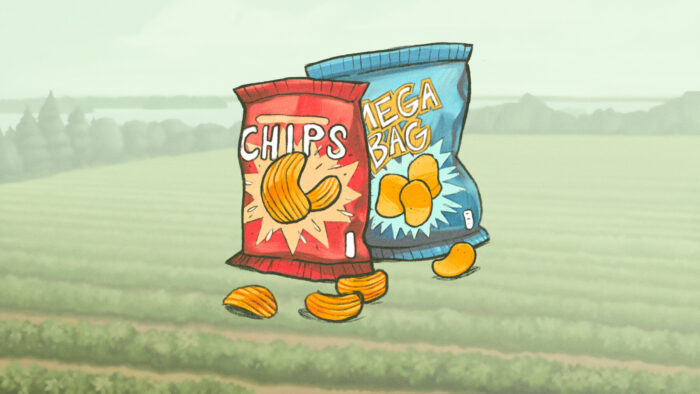
Cartoon-style illustration of two colorful potato chip bags, one red labeled “CHIPS” and one blue labeled “MEGA BAG,” surrounded by loose chips at the base.

From artisanal chips to new gourmet varieties, Finnish potato innovation keeps on growing.Illustration: Hilla Ruuskanen

They spark innovation 

The many possibilities of potatoes have inspired Finnish food enthusiasts to develop new products. For a great example of potato genius, we need only look as far as the Åland Islands, an autonomous, Swedish-speaking archipelago that is part of Finland. The area also happens to be the unofficial potato chip capital of Europe. If a flavour exists, you can be sure that a matching potato chip is already manufactured there.  

One of the best-known potato innovations of recent years is the Frex potato. What started as a one-man mission to develop the perfect potato led to potato varieties appreciated by Michelin-starred chefs and home cooks alike. The Frex brand emphasizes natural and sustainable agricultural practices, aiming to produce potatoes with a genuine, rustic look and a delicious, authentic flavour. These potatoes are part of a broader initiative to return to the roots of genuine taste and ecological farming, combining modern technology with traditional methods to enhance soil health and nutrient circulation. At the moment, three different Frex potatoes are grown in Finland. The innovator of Frex, Tapio Knuuttila, has stated that one of Frex’s goals is to create more jobs in rural Finland while respecting traditions and natural values.  

By Veera Kaukoniemi, ThisisFINLAND Magazine

7 surprising things that Finnish companies are making out of wood

Batteries from trees

A charging cord is plugged into an electric car.What? Stora Enso’s Lignode is a battery material made from trees.

Why? The rise of electric transportation and devices spells an increased demand for batteries. Almost a third of a lithium-ion battery consists of graphite, a material with a high environmental impact. Lignode could replace synthetic graphite in vehicle and consumer electronics batteries, making battery production more sustainable. Lignode is based on lignin, a common by-product in the production of cellulose fibre with numerous applications, from bioplastics to food and even asphalt.

Where and when? Pilot production of Lignode started in 2021 and development work continues with customers.

Dental implants from cellulose

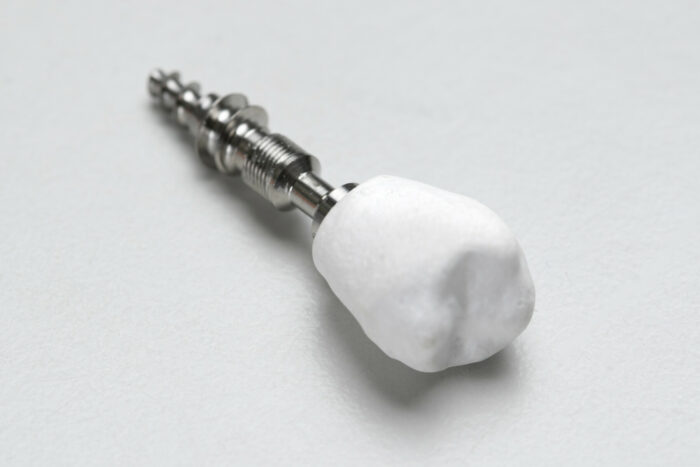
A tooth-shaped piece is attached to a metal screw.

What? VTT has produced dental implant crowns from nanocellulose.

Why? Before modern dentistry and material science, many people wore dentures made of wood. Now, the researchers at VTT (Technical Research Centre of Finland), have developed a nanocellulose-based material that could be used in dental implant crowns. The material’s structure is inspired by the exceptionally strong legs of a mantis shrimp, and is significantly lighter and harder than the ceramics used in traditional dental crowns. Other potential applications for the material include sporting equipment, bulletproof vests and aircraft hulls.

Where and when? Research and development is ongoing.

Wood composite for washbasins

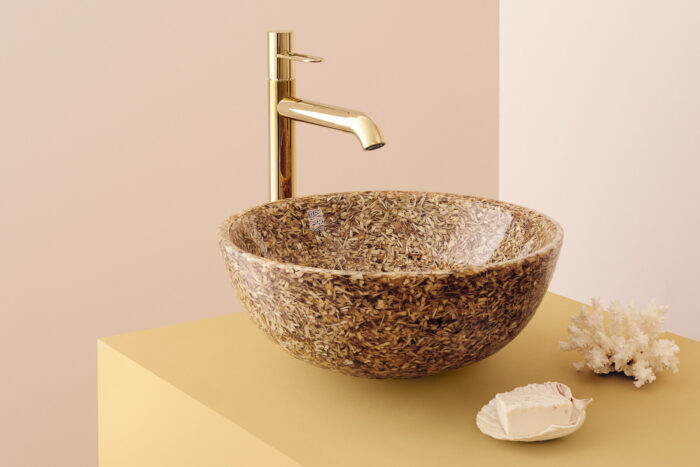
A round washbasin is on a countertop, under a faucet.

What? Woodio is the world’s first 100-percent waterproof solid wood composite material.

Why? Most of the world’s millions of sinks, toilets and other bathroom furnishings are made with ceramic, a material with a big carbon footprint and a tendency to fracture. Waterproof wood composite offers a durable, lightweight and visually attractive alternative. Woodio’s sinks, bathtubs, toilet seats and interior panels are made from aspen and birch chips sourced from the side streams of the Finnish forest industry. While in use the wood chips store carbon, and at the end of their life cycle they can be used for energy production.

Where and when? Available online and from retailers across the world.

From sawdust to fish feed

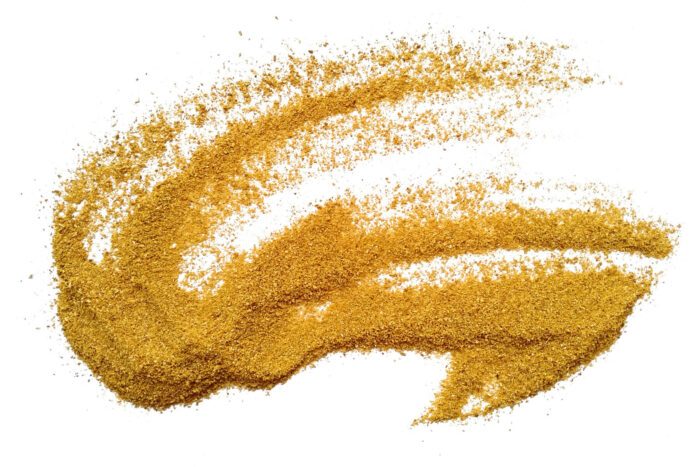
A pattern of granular brown powder on a white background.What? MonoCell  is a single-cell protein made from sawdust.

Why? Sawdust is an ample byproduct in the woodworking industry. While a big portion goes to pulp and energy production, new applications are needed to maximise its use. Scientists at the Natural Resources Institute of Finland (known by its Finnish abbreviation, Luke) have used sawdust to produce a high-quality single-cell protein. One of the many possible uses for MonoCell is fish feed, in which it could replace fish or plant protein, saving valuable fish stock and land areas.

Where and when? Evaluation and development continue as part of Luke’s CellFood project.

Lighter car parts

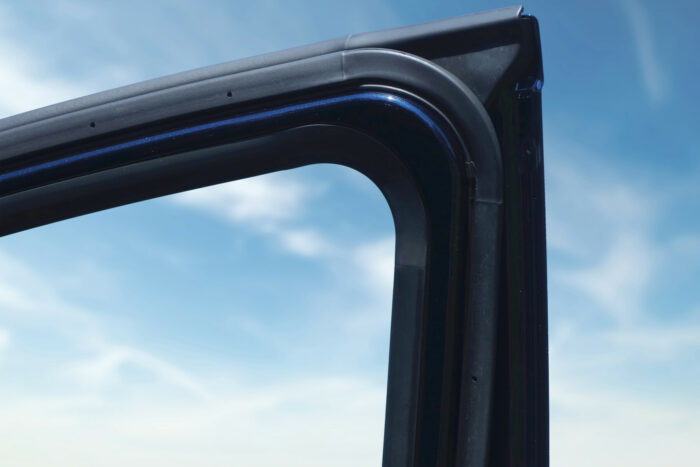
Part of a car door is viewed from the inside, set against the background of a blue sky.

What? UPM’s Renewable Functional Fillers can make plastic parts lighter.

Why? Many rubber and plastic products include functional fillers, small particles that augment the product’s properties. UPM’s BioMotion Renewable Functional Fillers, made from hardwood, could replace oil-based functional fillers in all kinds of plastic and rubber car parts, such as panels, door seals, tyres and hoses. They are not only a more sustainable option – they’re also lighter than traditional filler materials.

Where and when? Production of Renewable Functional Fillers begins in late 2024 at UPM’s biorefinery in Leuna, Germany.

Biodegradable fashion

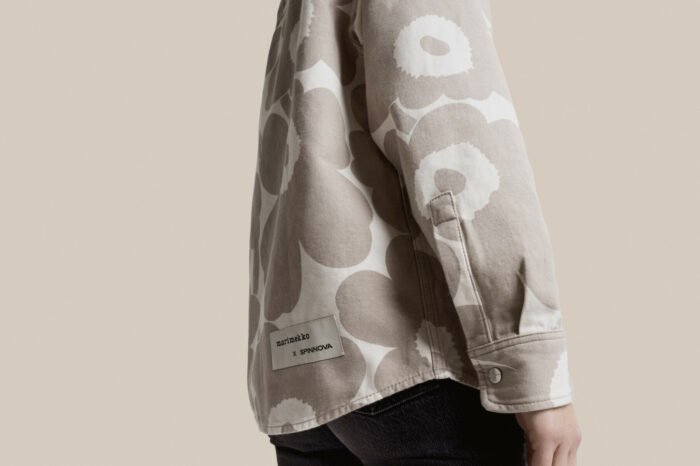
A person is wearing a shirt with a grey and white floral print.

What? Spinnova is a textile fibre made without chemicals from the same cellulose as paper.

Why? The fashion industry produces around 10 percent of global carbon emissions and uses large quantities of water and chemicals. Spinnova’s technology turns cellulose into a versatile textile fibre that uses 99 percent less water than cotton. The textile can be recycled without loss of quality or the addition of virgin fibres, and is entirely biodegradable. Brands like Marimekko, Adidas and The North Face have released their Spinnova collections.

Where and when? The first commercial-scale factory opened in Finland in 2023.

Alternative to plastic

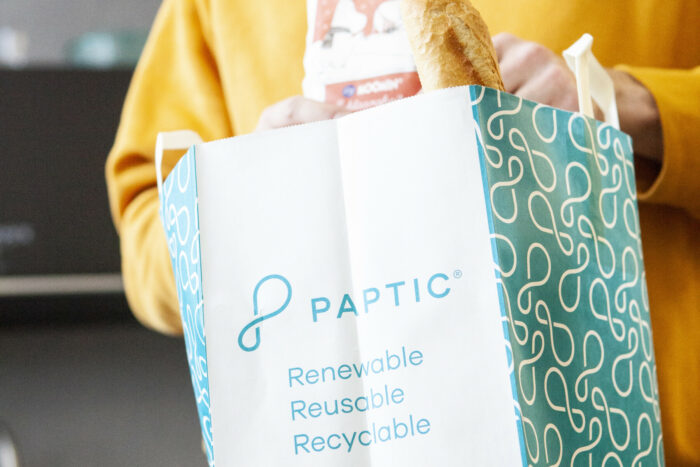
A person is holding a shopping bag full of groceries.

What? Paptic aims to replace plastics and other single-use materials in packaging.

Why? Packaging is often needed, but can burden the environment. Paptic, a wood-based, moisture-resistant material, can be used for bags, packaging and more. It has a distinctive, textile-like feel and can be recycled with packaging paper and cardboard. Scalability is why the technology really stands out: Paptic can be produced using regular paper machines with only minor modifications.

Where and when? Paptic materials are in use in more than 50 countries.

By Lotta Heikkeri, ThisisFINLAND Magazine, May 2025

A secret kingdom of spring: Finnish stick forts come to life

In the pale light of a spring morning, a blackbird’s song drifts through the awakening woods – and somewhere among the pines and the budding birches, kids are building a fort out of sticks. For families in Finland, the forest is more than backdrop; it’s a playground, storyteller and sanctuary, all at once.

Can you hear that blackbird singing?

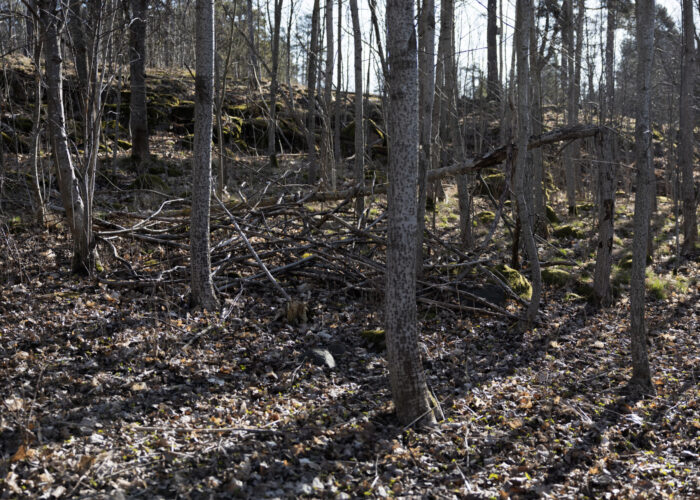
The spring sun shines so brightly that it almost hurts your eyes. The first flowers of the season unfurl, willow catkins gradually open, squirrels race along tree trunks and rabbits stop to groom their paws.

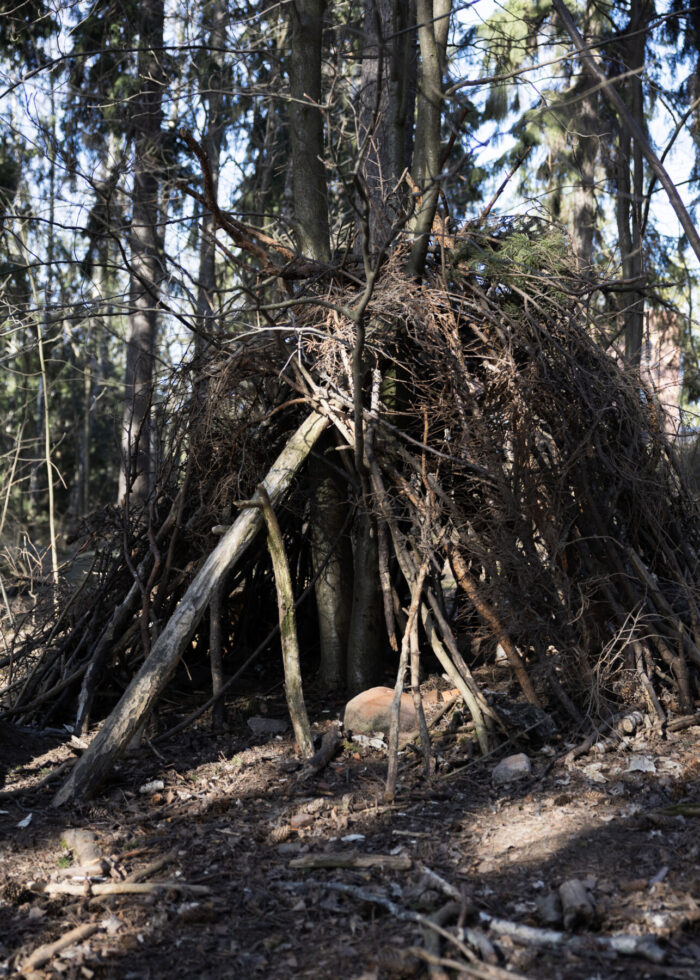
And then, just like that, they appear – forts made out of sticks, nestled in the forest. Each day they grow more elaborate: walls of interwoven twigs and roofs of spring leaves reaching for the sky – until one morning the forest floor lies undisturbed again.

They have vanished.

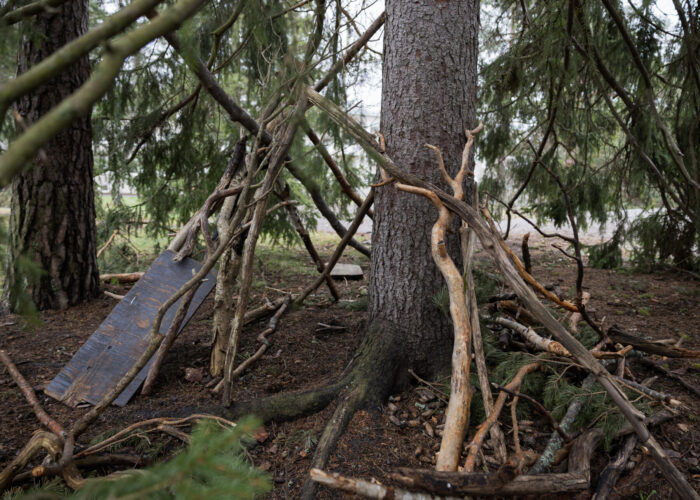
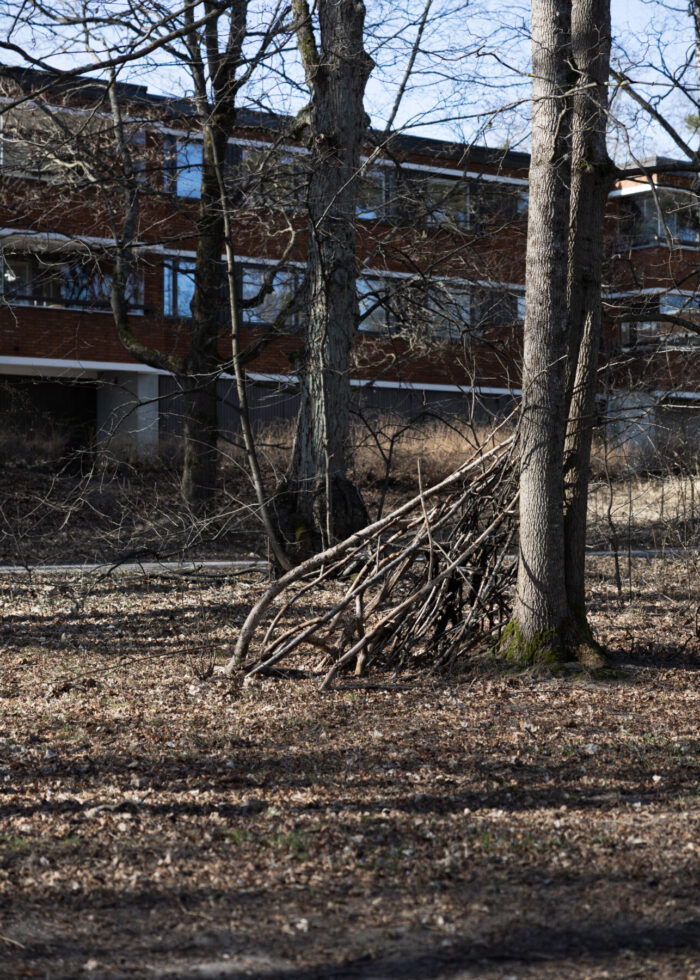
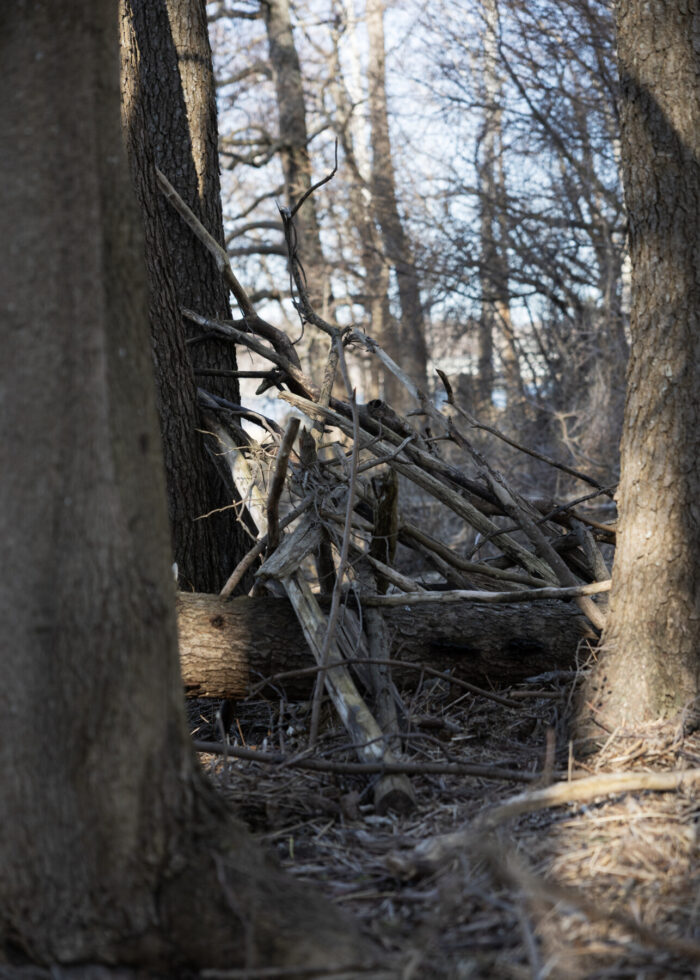
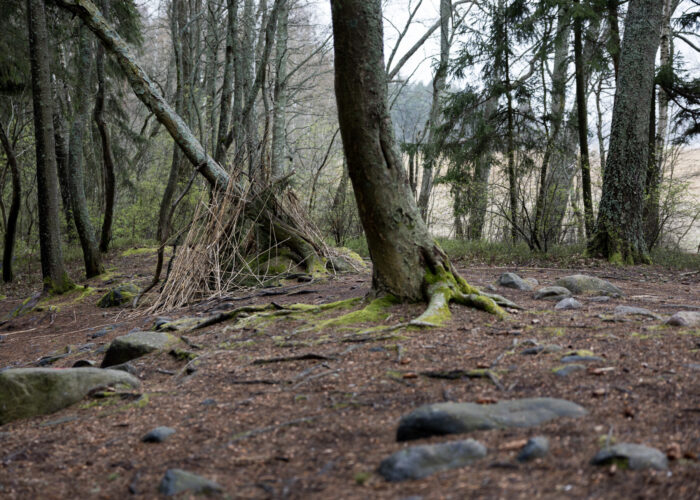
In a woodland area, a crude shelter made from branches leans against a tree.

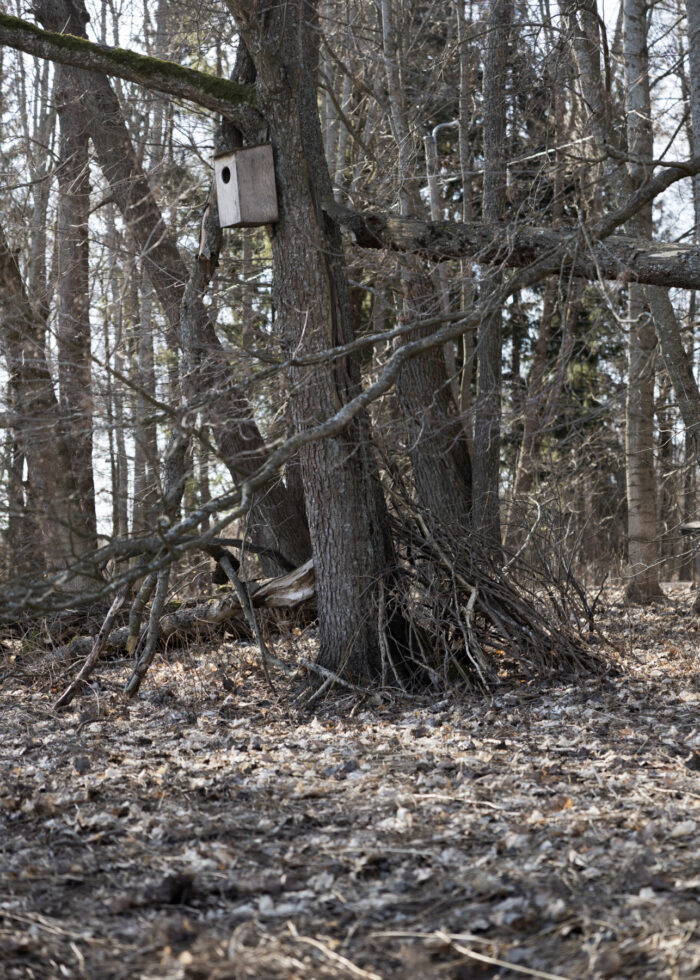
A crude shelter made from branches leans against a tree that also has a wooden birdhouse attached to its trunk.

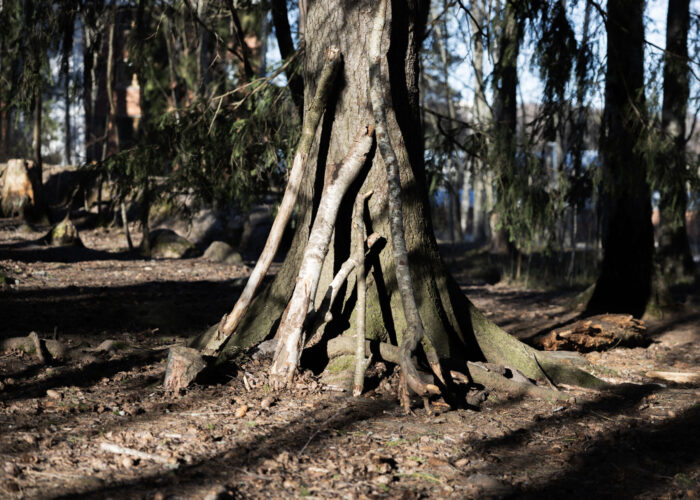
A crude shelter made from branches leans against a tree.

People in Finland highly value their bond with nature – a connection often formed in early childhood. After all, over 70 percent of Finland’s land area is blanketed by forest, and even in the largest cities, a green refuge is never more than a short walk away.

Urban green spaces deliver proven health benefits: they lift moods, ease stress and help guard against depression. Time among trees also supports physical wellbeing, lowering the risk of heart and cardiovascular disease.

In Finland’s living landscapes, everyone can take a moment to pause, breathe deeply and simply be.

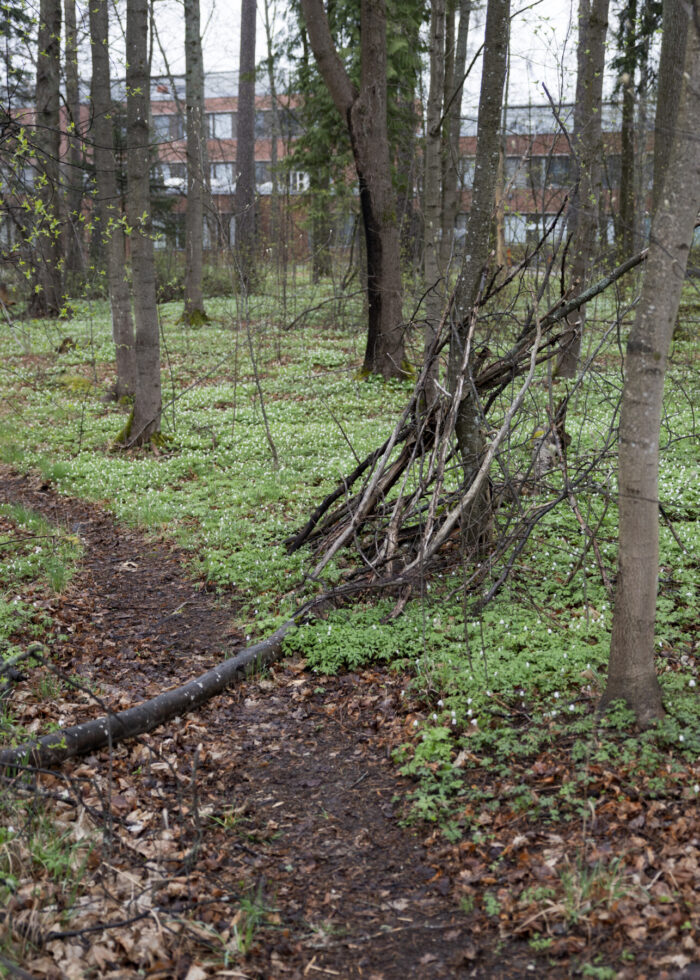
A crude shelter made from branches leans against a tree in a forest.

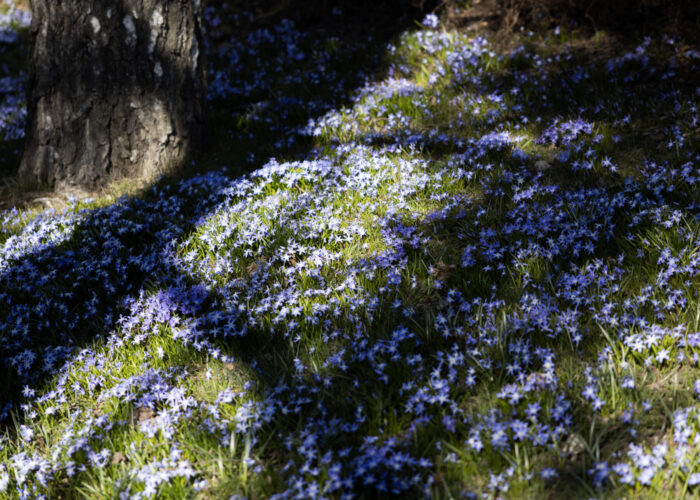
Small, star-shaped purple flowers grow in the grass beside a tree.

A crude shelter made from branches leans against a tree in a forest.

Did you ever build a stick fort as a child? If not, you may have missed out on pure magic.

If so, congratulations – you know that rush of freedom and endless possibilities when every fallen branch and leafy frond in the woods could become a pole or panel for your secret hideaway.

And when the perfect twig or board wasn’t there, imagination filled the gap. That is the stick-fort builder’s world.

A crude shelter made from branches leans against a tree in a forest.

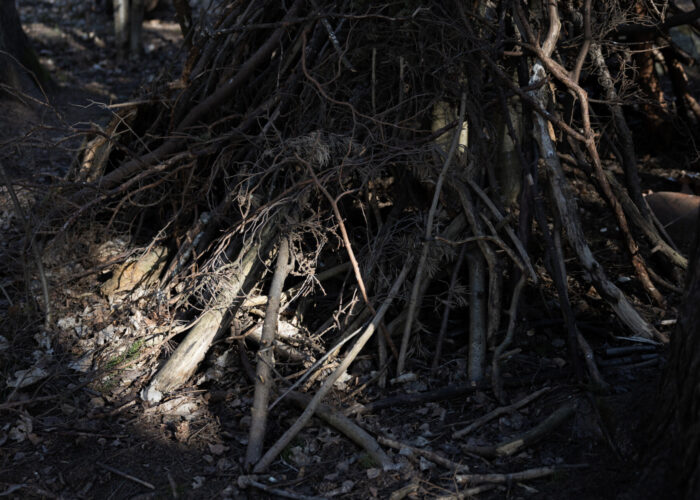
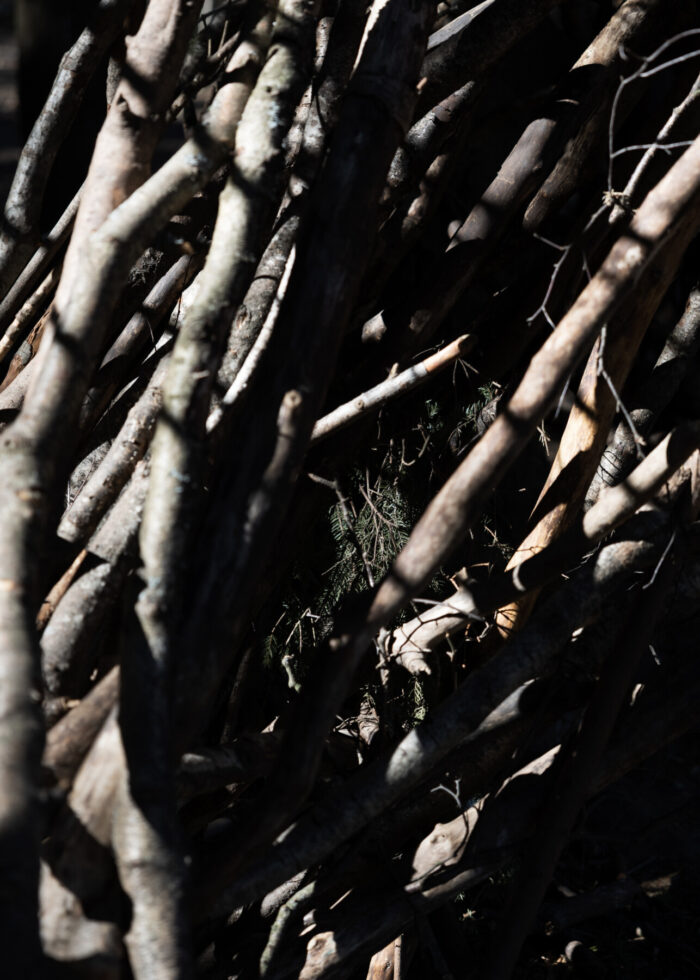
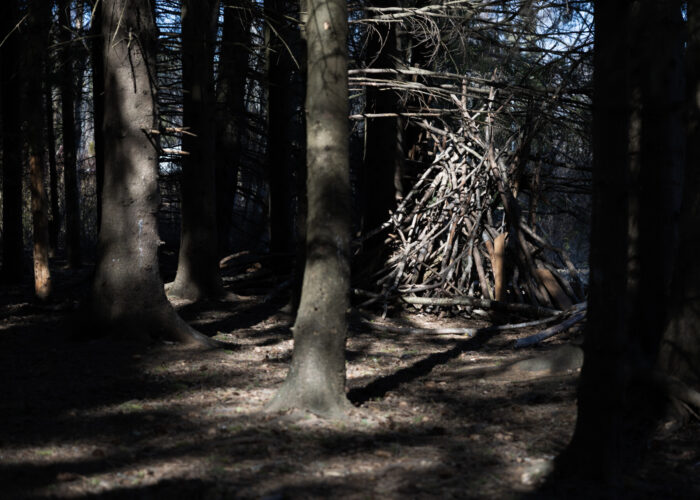
Shadows fall across a pile of branches and twigs.

A crude shelter made from branches leans against a tree in a forest.

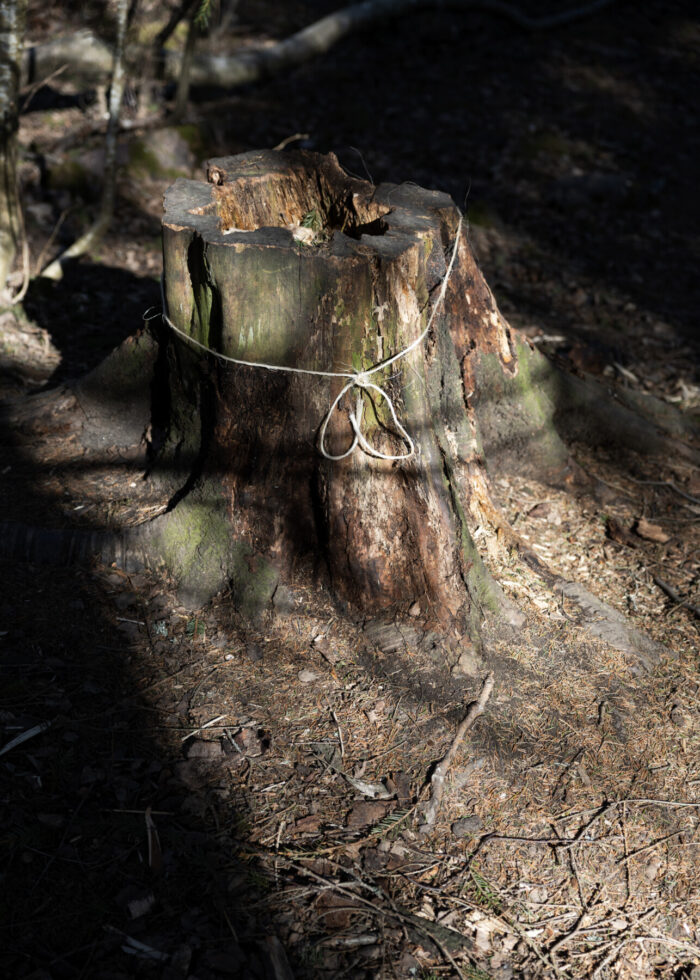
A piece of string is tied around a tree stump in the woods.

A crude shelter made from branches leans against a tree in a forest.

In Finnish families, spending time in the nature often comes naturally.

A quick day trip to a nearby lake, a weekend in a tent at a forest campground, berry picking along sun-dappled trails, the quiet joy of birdwatching – these little adventures are woven into everyday family life.

Daycare teachers even bring their toddlers to visit the woods regularly. The kids discover mossy clearings and fallen logs with wide-eyed wonder.

A crude shelter made from branches leans against a tree in a forest.

A crude shelter made from branches leans against a tree in a forest.

A crude shelter made from branches leans against a tree in a forest.

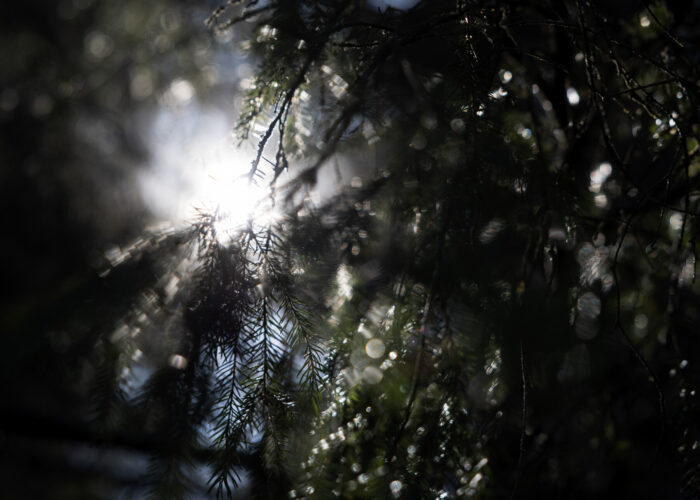
Sunlight shines and refracts through the needles of a coniferous tree branch.

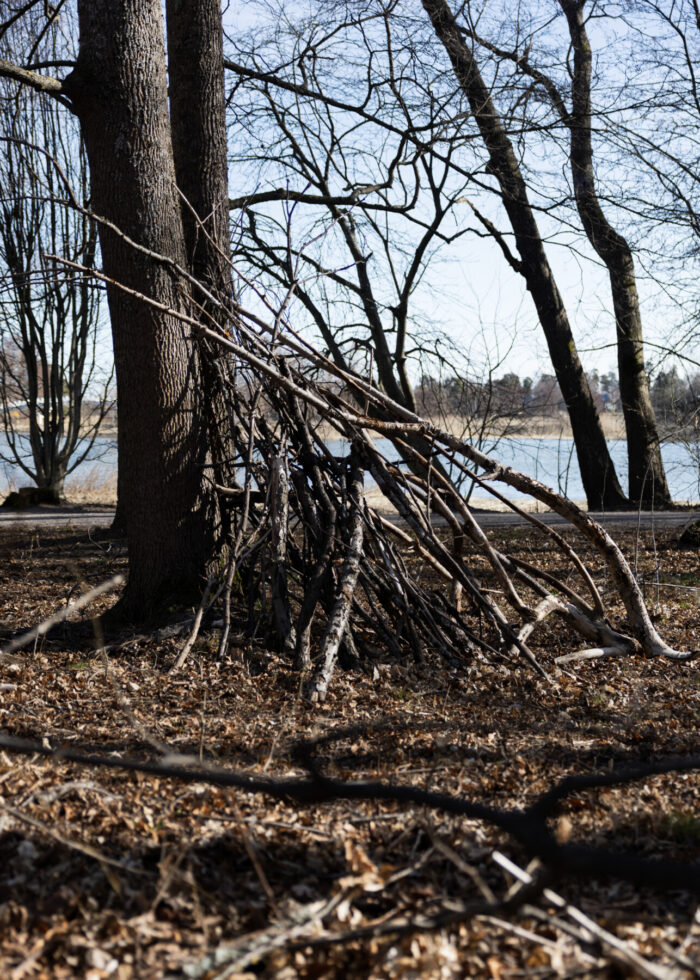
A crude shelter made from branches leans against a tree in a forest by the seashore.

The forest isn’t dark or forbidding; it’s a place of fairytale magic and homemade stick forts, where every child’s imagination can roam free.

Who lives within those twig walls? Even when empty, the stick forts feel alive, each one infused with its own secret spirit.

Are those curious eyes flickering in the shadows? Is that a gentle smile peeking through the branches?

Or is that summer itself, drifting in on a warm breeze to take its rightful place, at long last?

Text and photos by Emilia Kangasluoma, May 2025

5 Finnish saunas that show there’s a sauna for every taste

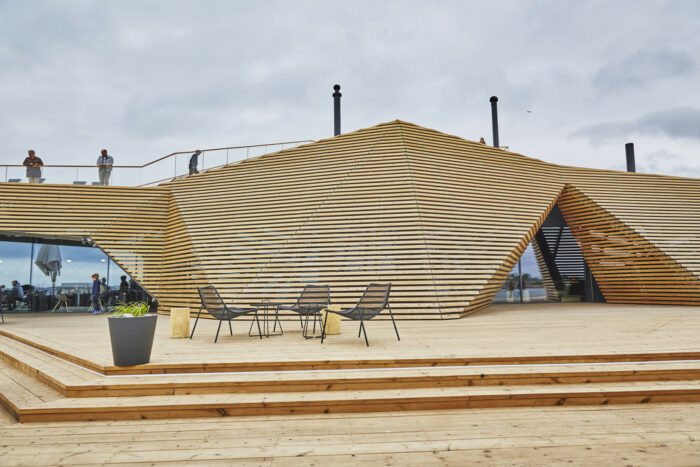
Löyly, Helsinki

Chairs are on a patio outside an angular wooden building.

In Finland, one does not have to stray far from the city to find a sauna. A perfect example of urban sauna culture is Helsinki’s most popular public sauna, Löyly, situated just a stone’s throw away from the city centre. Löyly’s saunas and lounging areas are gender-neutral, so friend groups and families can enjoy the experience together. After a relaxing visit to its smoke and steam rooms, visitors can cool down by taking a dip in the sea while admiring the city skyline.

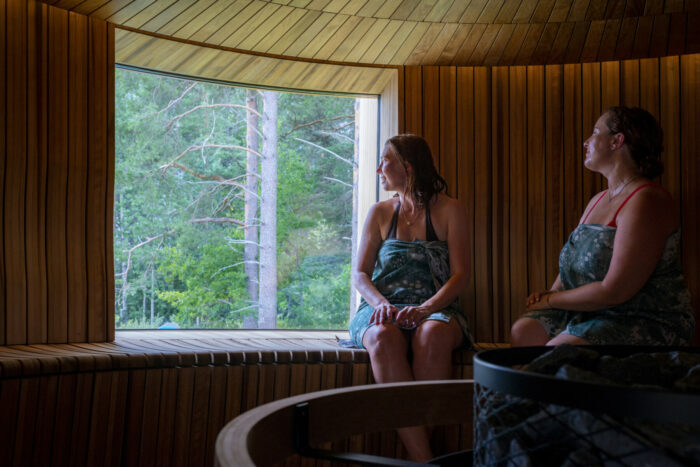
Serlachius Art Sauna, Mänttä

Two women wrapped in towels sit on a bench in a sauna, looking out the window at a forest.

Located on the lakeshore behind Art Museum Gösta, the Serlachius Art Sauna is a masterpiece of unique, modern architecture, with works of art decorating its lobby and lawn. Its circular steam room has a calming, timeless ambiance, merging skilled Finnish carpentry and contemporary design. Even the water pails, scoops and textiles in use are commissioned and designed specifically for Serlachius. A must-see destination for art lovers!

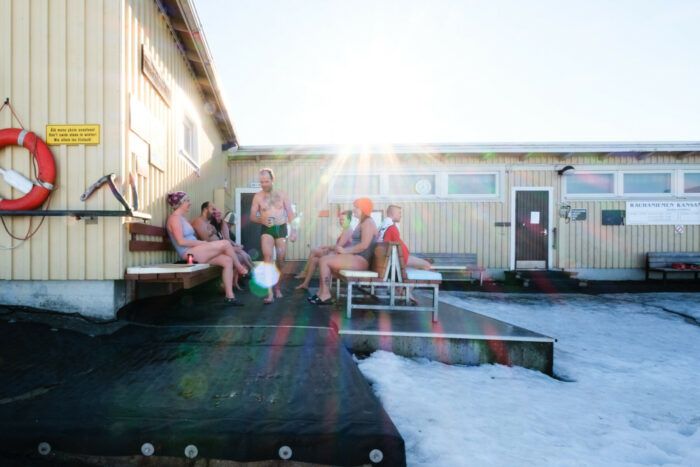
Rauhaniemi Folk Spa, Tampere

Several people in bathing suits sit on benches beside a wooden building, with snow covering the ground.

Tampere has been officially declared the sauna capital of Finland, and for a good reason. It has over 50 public saunas, dotted throughout the beautiful landscape of the lakefront city. One of its historic gems is Rauhaniemi Folk Spa, a traditional, atmospheric sauna complex that draws in people of all ages and backgrounds year-round. In the winter adventurous visitors can even have a go at ice swimming and reflect on the experience in Rauhaniemi’s tranquil yurt sauna, where talking is forbidden.

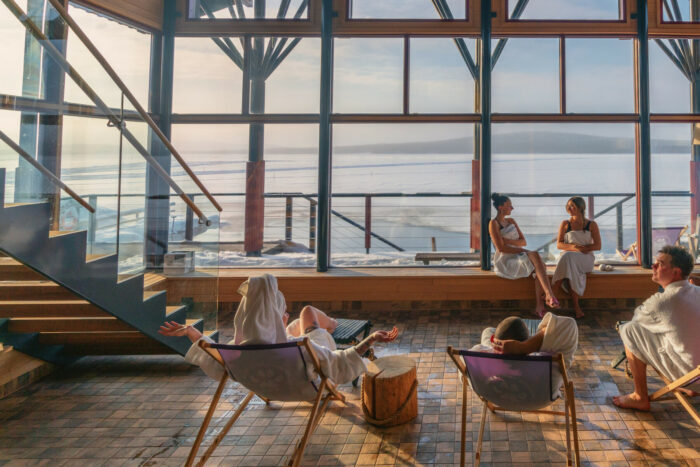
Arctic Sauna World, Muonio

Several people in bathrobes lounge at a spa, with a wintery landscape visible through the windows.

In Lapland, close to the Pallas-Yllästunturi National Park, lies Arctic Sauna World. The resort has five different saunas, four of which are named after elemental gods from Finnish folklore. First-timers may want to begin in the gentle infrared sauna, making their way to the old-fashioned, fiery smoke sauna. The resort’s crown jewel is a sauna specifically dedicated to watching the northern lights, with large panorama windows overlooking the nearby lake Jerisjärvi.

Lähde Forest Spa, Nilsiä

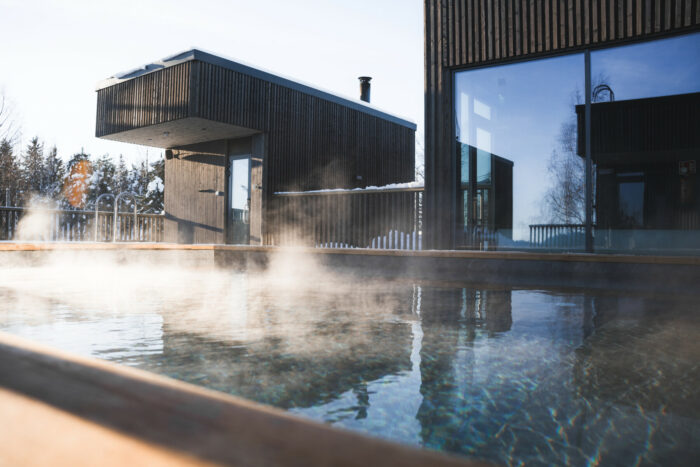
Steam rises off an outdoor pool in front of a modernistic wooden building.

True to its name (lähde means “spring” or “fountain” in Finnish), Lähde Forest Spa is a relaxing oasis in the middle of the woods near Tahko, one of the most popular skiing destinations in Finland. Its most impressive sauna towers high above the treetops, offering breathtaking views of the surrounding nature. The kid-free resort has both heated and cold outdoor pools, complete with a poolside pavilion for quiet relaxation. It also offers wellness courses to complement the sauna experience.

By Johanna Teelahti, ThisisFINLAND Magazine

Finland’s Eurovision story evolves from trials to triumphs

The Eurovision Song Contest (ESC) is one of the world’s biggest, longest-running pop-culture events, bringing together fans of all ages in more than 50 countries since 1956. The europop championship has spawned megastars such as ABBA, Céline Dion and Julio Iglesias.

Finland first entered the competition in 1961, eventually earning the dubious distinction of submitting the most entries without ever winning. It placed last 11 times and was never better than sixth until 2006.

“We always had this image of being the country cousin who could never compete with the cool city kids,” recalls Hannah Norrena, a radio host at Yle, the Finnish national broadcasting company.

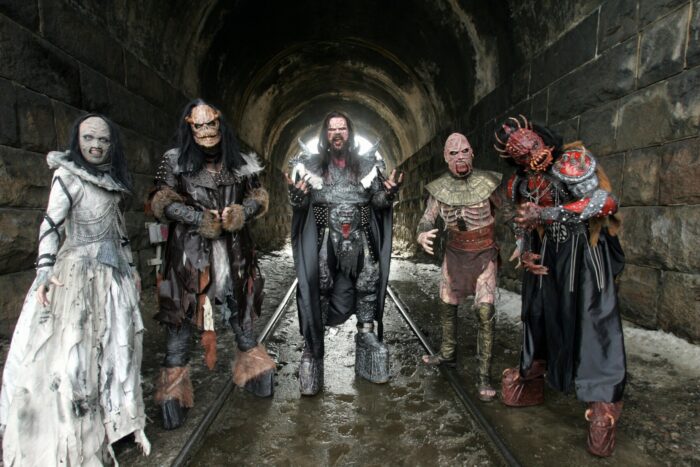
Then, the unthinkable happened: Lordi, a theatrical metal band in monster suits, won by the largest points margin ever, with “Hard Rock Hallelujah.” For Finland, this was a national triumph on par with winning its first world ice hockey championship in 1995.

Finnish talent wins in Sweden

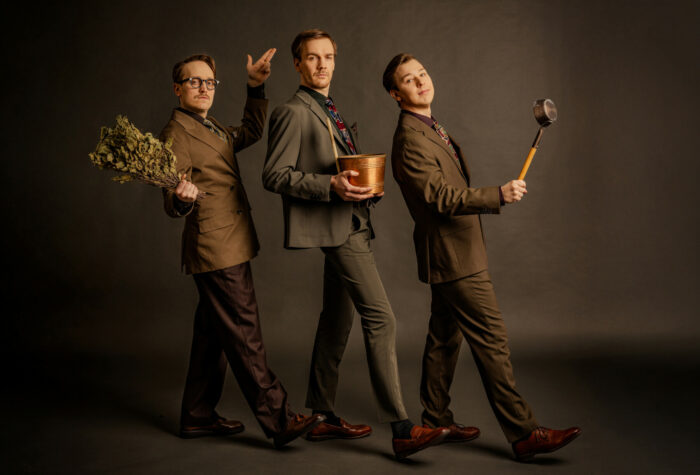
Three men in suits stand in a row, each with a piece of sauna equipment: a leafy bouquet of branches, a metal bucket, and a ladle.

Three guys from western Finland form KAJ, the Finnish band that Sweden picked as its Eurovision contestant in 2025. From left: Axel Åhman, Kevin Holmström and Jakob Norrgård.Photo: Erik Åhman

By 2025, Finland emerged as an exporter of ESC talent. Sweden chose KAJ, a comedic band from Finland, to represent it, with the tune “Bara bada bastu” (roughly “Let’s Just Sauna”). Meanwhile, a Finn cowrote the 2025 Estonian entry.

That followed Finland’s top-six ranking in 2021 with metal band Blind Channel, and a near-win two years later by Käärijä, a quirky Finnish-language rapper in a garish green bolero. He swept the largest number of popular votes, but lost out to Sweden in the professional jury vote.

The ESC is arranged by public broadcasters in nearly all European countries, with Yle formally selecting Finland’s entry each year.

Since 2012, Yle has hosted a series of public qualifiers called Uuden Musiikin Kilpailu (UMK, “New Music Competition”). In recent years, the UMK has attracted growing interest abroad, with thousands of ESC fans in other countries watching Finland’s national finals. That bodes well for Finland in Eurovision itself, when residents of the 56 European Broadcasting Union countries can vote for any country’s entry – except their own.

Lordi, hallelujah

Five people in fearsome monster costumes are standing in a row in a stone underpass.

Lordi, a Finnish metal band in monster costumes, won Eurovision 2006 by the largest points margin ever, with the tune “Hard Rock Hallelujah.”Photo: Markku Ulander/Lehtikuva

Lordi’s win was a game-changer, says Jouni Pihkakorpi, president of the Eurovision fan club OGAE Finland.

“We finally realised that we could send the kind of music that we’re good at – and that’s rock,” he says.

“The most important thing we learned is confidence,” says Norrena. “We had a tradition of being so mediocre at Eurovision and got used to losing. Then Lordi woke us up to the possibility of actually winning!”

Besides the monster rockers and Blind Channel, Finnish entries have included plenty of guitar rock, going back to Vicky Rosti in 1987. In 2015, that included an 86-second blast of raw punk by Pertti Kurikan Nimipäivät that startled the slick contest. It was the first punk band at Eurovision, and its members were the first Eurovision performers with disabilities.

Pops and flops

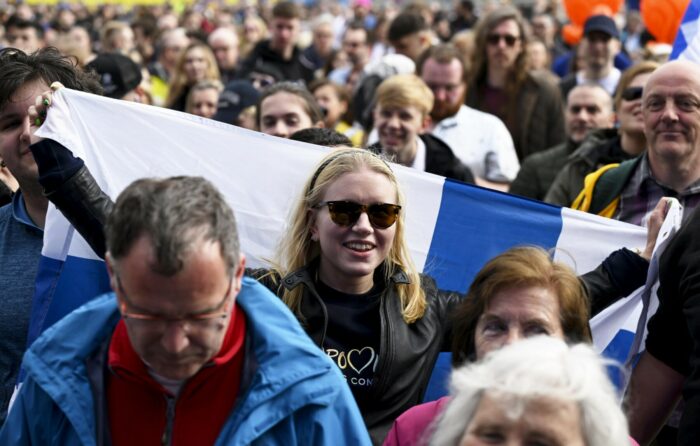
In a crowd of people, one woman is holding up a large Finnish flag.

Fans from all over Europe fly their flags when the Eurovision Song Contest is broadcast.Photo: Vesa Moilanen/Lehtikuva

Other Finnish tunes have ranged from bluegrass, folk and reggae to Anneli Saaristo’s flamenco-tinged “La Dolce Vita,” which placed seventh in 1989. Before that, many entries were endearingly homespun. Some now sound unintentionally kitschy – even cringeworthy – despite the efforts of domestic megastars such as Vesa-Matti Loiri and Katri-Helena.

“Being too modest or uncertain was always Finland’s sin,” says Pihkakorpi. “As a result, the songs were often bland and unsurprising, with a few exceptions. Now I’m proud that Finland dares to send songs that are unconventional and different, but that people still love.”

Until the turn of the millennium, the entries were almost all in Finnish – but the success of Käärijä and Saaristo showed that’s not necessarily a problem. However, past international popularity is no guarantee of ESC success, as shown by recent flops by electronic producer Darude and pop-rockers The Rasmus.

The social network

A man with short hair and a trimmed beard, wearing a bright green bolero, looks into the camera.

Käärijä, a quirky Finnish-language rapper in a garish green bolero, swept the popular vote in 2023 but lost out to Sweden in the professional jury vote.Photo: Malin Lövkvist/Aftonbladet/Lehtikuva

Norrena points to the growing importance of social media, noting that “Blind Channel, Käärijä and The Rasmus all did fun social content that lured in international fans. And Käärijä’s charm is what got him to second place. The juxtaposition of that arrogant song with his humble personality was magic.”

Eurovision blogger and event host Tony Latva (a.k.a. DJ Werneri) agrees, pointing out that “Käärijä put in a tremendous amount of work behind the scenes, which contributed to his success. He’s a fantastic personality, a great live performer and has other really good songs as well. Eurovision gave him an amazing launchpad for his career.”

In 2025, the ESC asked Käärijä back – some former contestants are invited to perform as part of the festivities.

Latva says that networking is crucial these days. “A good, unique and catchy song isn’t enough,” he adds. “Käärijä showed that vocal ability also matters, as the juries clearly value that. And nowadays a certain level of shock value is almost a requirement.”

He sees the UMK system as crucial for developing new talent.

“Käärijä’s success changed artists’ attitudes at home,” he says. “The UMK now produces hits for the Finnish singles chart and raises many artists to popularity even if they aren’t chosen. For example, Erika Vikman got a big career boost back in 2020 [when she placed second in the UMK] before being chosen to represent Finland in 2025.”

By Wif Stenger, May 2025

Vibrant legacy: How artist Reidar Särestöniemi brought out northern Finland’s colours

Reidar Särestöniemi (May 14, 1925–May 27, 1981), an eccentric artist from northern Finland, captured the untamed beauty of his home region in his bold, colourful paintings.

As a boy, he was a peculiar, lonely child with more friends among animals than people. He ran off into the forest to explore, and played mischievous tricks on the farm animals.

He wasn’t suited to working on a small family farm. He didn’t show any interest in learning how to do the chores.

He considered the fast-flowing Ounas River, which flowed past his home, to be his brother. That was his nature.

Northern origin
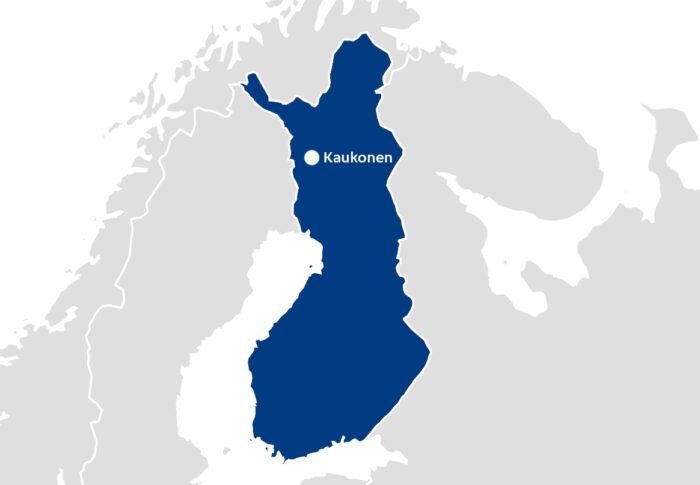
On a map of Finland and the surrounding area, a dot shows the far northern location of the village of Kaukonen.

Born in the village of Kaukonen, he was the youngest of Matti and Alma Särestöniemi’s seven kids. As a child, he mixed buttermilk and flower petals to create paint, and sometimes used ash to mix paint if nothing else was available. He had to draw and paint – he just had to. Nothing else could hold his interest.

It wasn’t easy to rise from such modest origins to the top of Finland’s cultural scene. Yet he did it.

A striking impact
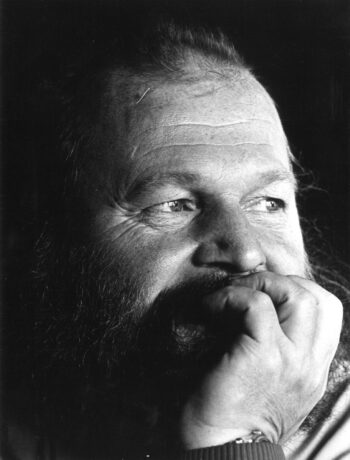
In a black-and-white photo, a man rests his chin on his hand.

Reidar Särestöniemi (1925–1981) felt a profound connection with nature, which greatly influenced his art. Photo: Unto Järvinen/HS/Lehtikuva

Helsinki’s Didrichsen Art Museum received record-setting amounts of visitors in the spring of 2025, as tens of thousands of viewers arrived to see Särestöniemi’s colourful paintings on display in On the world’s shore: Reidar Särestöniemi 100 years (until June 1, 2025).

The large, vibrant artworks attract attention, and people queue to get a closer look. Orange tundra and a red sun stand out on the museum walls. Delicate, frost-covered birch branches are frozen in time. Reindeer graze, and cottongrass seems to sway gently in the wind.

Museum director Maria Didrichsen believes Särestöniemi’s art is being re-evaluated today. “His artworks are not meticulously representational, yet they are surprisingly easy to understand,” she says.

She thinks the steadily increasing flow of tourism to Finnish Lapland has brought Särestöniemi’s art closer to people. While his colours were once considered too vivid, those who have visited the far north of Finland realise that they are true to life.

“There is power in his art, and the large scale of his pieces creates a striking impact,” says Didrichsen. “Many viewers find themselves absorbed in his artworks, drawing comfort and energy from them, especially in these unsettled times.”

Obsessive dedication
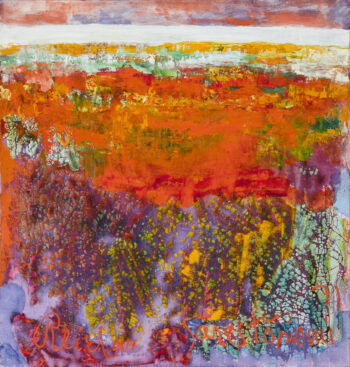
A painting shows various overlapping layers, one of which is a bright orangish red.

In one night the north wind filled the fen full of flowers (1971): In northern Finland, spring arrives late, but with great intensity. Särestöniemi believed summer there was so short that the first spring blooms already carried autumn shades of red. Photo: Rauno Träskelin

The boy from far above the Arctic Circle eventually ended up in art school and became a professional artist.

After the Second World War, Särestöniemi’s mother found him his first private teacher, who in turn enabled him to attend the Finnish Academy of Fine Arts in Helsinki, at the age of 22. Around the same time, he started studying at the University of Helsinki’s Department of Drawing.

Moving from the middle of the wilderness to the bustling capital of Finland was a huge change for Särestöniemi. His home in Kaukonen was at the end of a dirt road, and now trams and cars were whizzing by.

At school, Särestöniemi painted with obsessive dedication, starting at nine in the morning and continuing until almost midnight. He was restless, completely different from the other students. He couldn’t sit still; he hopped from one easel to another like a bluethroat, a songbird that spends the summer in the far north.

But the young man learned, at an astonishing pace.

Lasting impressions
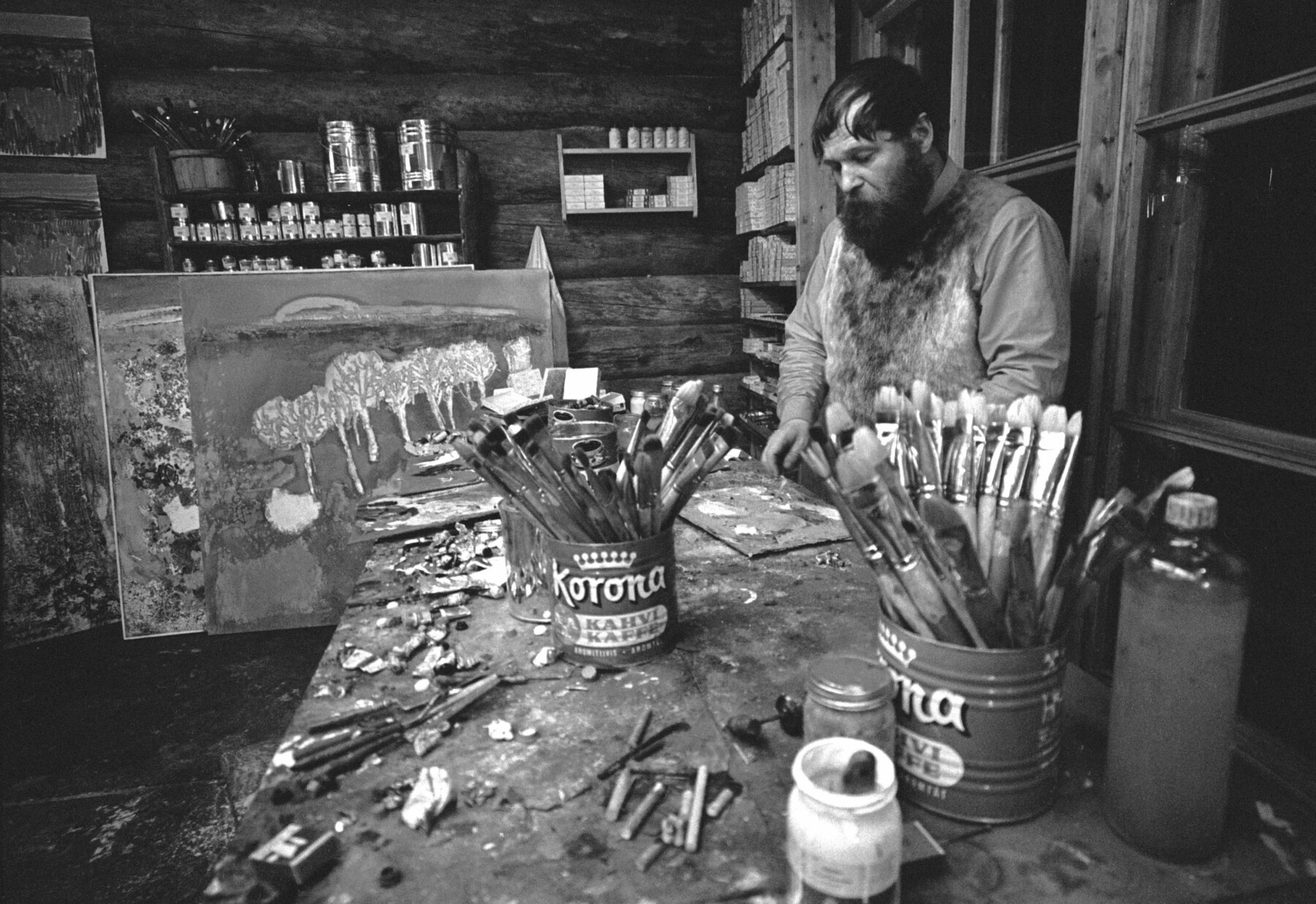
A man with a beard is working in an art studio, with brushes and other supplies on a table.

Särestöniemi chose to live and work on his family’s old homestead.Photo: Kaius Hedenström/Lehtikuva

In 1952, Särestöniemi travelled to Paris for the first time, for inspiration. The experience left a lasting impression on his output.

He visited the Louvre almost every day for a month, then discovered the works of Mexican artist Diego Rivera, and fell in love with the work of Russian-French artist Marc Chagall. Särestöniemi wondered how anyone could paint such fairytale-like pieces; it was as if images were being used to recite poems.

In Paris, Särestöniemi felt like he could truly be himself. He didn’t need to hide anything — he was free. The French capital was a metropolis with countless opportunities, whereas Finland seemed distant and removed.

When Särestöniemi returned from the Continent to his home in Kaukonen, it was time for a long, laborious winter. He had raised the money for his trip by promising to sell timber from his family’s land, and now he had to fell 300 trees in the forest.

Fragile northern nature
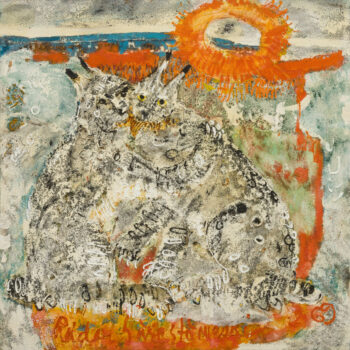
In a painting, two animal figures are discernable, and seem to be hugging each other.

Meeting of the Fugitives (1969): The love of Särestöniemi’s life was the poet Yrjö Kaijärvi. Särestöniemi often included subtle hints about his sexuality in his paintings or their titles.Photo: Rauno Träskelin

Nature conservation later became an important theme in Särestöniemi’s art. He was ahead of his time in criticising the use of plastic, and the protection of animals, forests, and rivers was a passion for him.

He couldn’t accept the threat of a dam on the Ounas River. He didn’t want to see the fragile northern nature disappear.

Särestöniemi portrayed himself as various animals in his paintings: When he wanted to depict himself as playful and powerful, he painted a lynx. The willow grouse represented his fragility.

When he painted a wolf, Särestöniemi wanted to emphasise its rarity. Perhaps he perceived himself as cornered like a lonely wolf at times. He was gay in an era when homosexuality was punishable by law in Finland.

He hid subtle messages in his paintings, such as bears with beards embracing one another. The allusions were visible to all but understood by few. He was hidden, and therefore he was safe.

Drawing attention
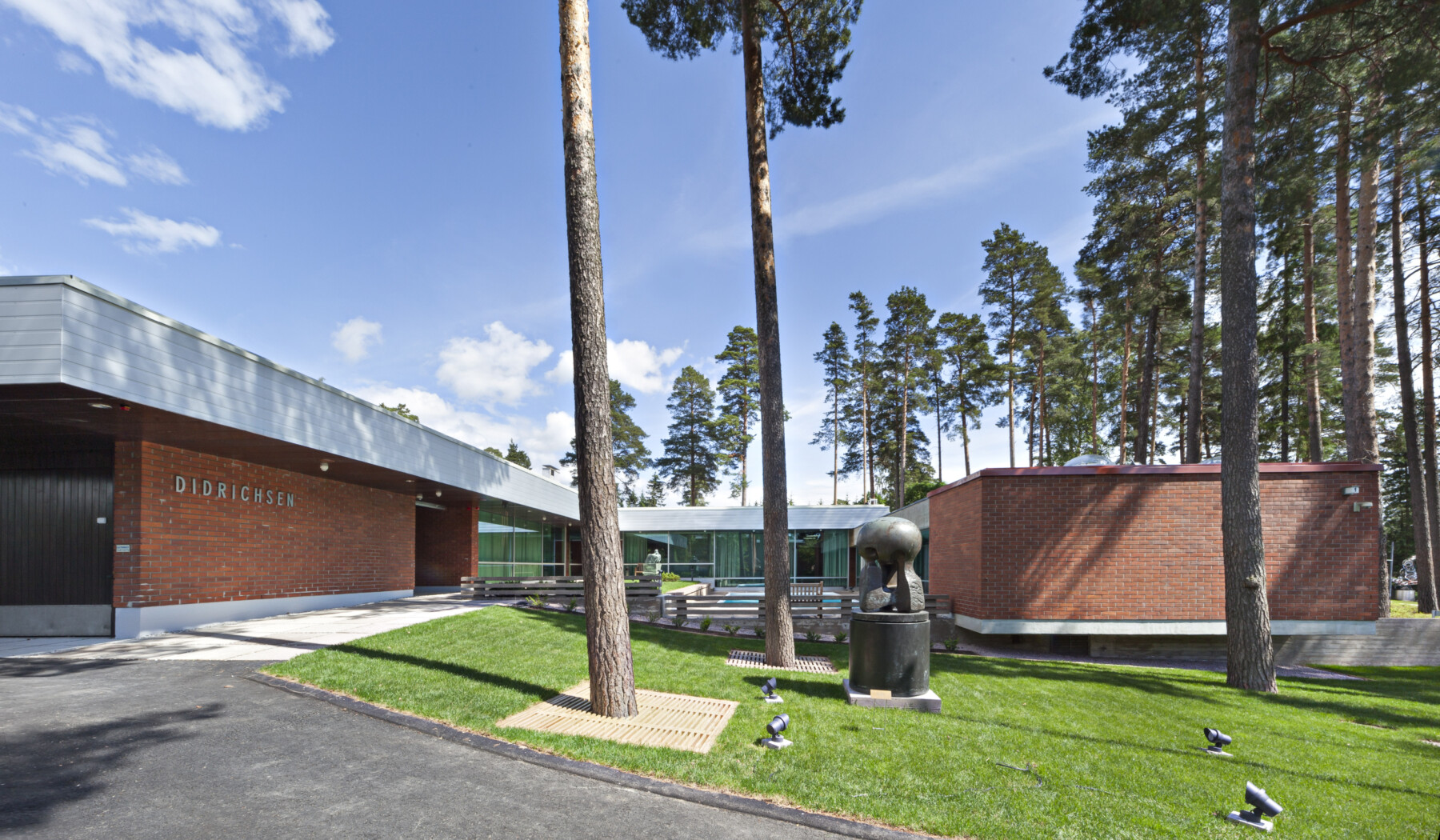
Trees and sculptures decorate the yard in front of a one-story brick building.

Marie-Louise and Gunnar Didrichsen, founders of the Didrichsen Art Museum in Helsinki, first met Särestöniemi in 1968, and later acquired several of his works.Photo: Rauno Träskelin

Särestöniemi dared to defend individuality. He was a unique man himself, too.

At a time when bearded men were viewed with suspicion in his home village, he grew a long black beard and proceeded to dye it bright red.

He walked down the village road in Kaukonen dressed in Spanish-style clothes together with leather boots made by the Sámi, the Indigenous People of northern Europe. The locals would comment that he wore summer clothes in winter and winter clothes in summer.

It was as if he enjoyed drawing attention to himself, being part of a big performance. He was large and colourful, just like his paintings.

He didn’t hold back
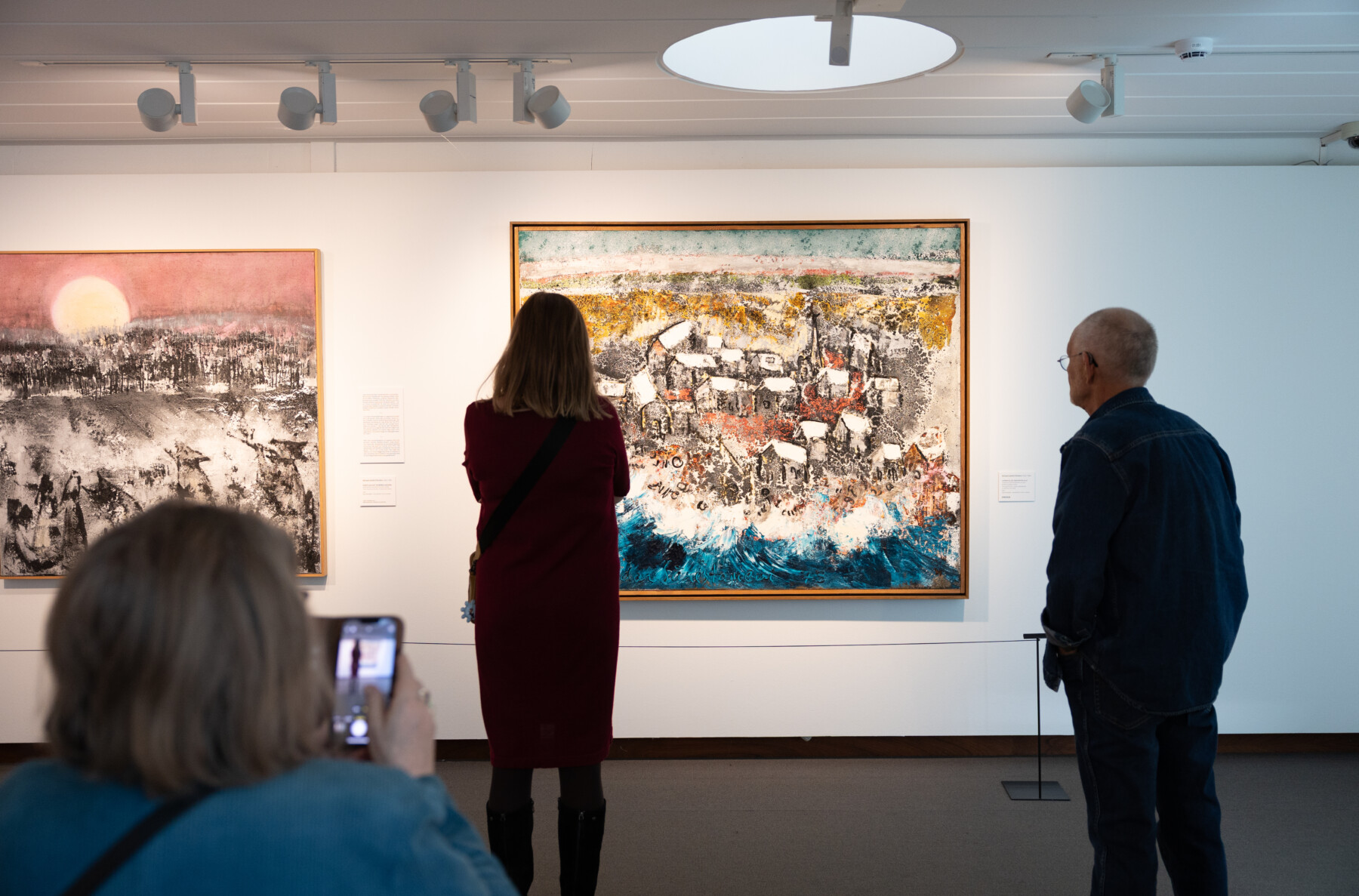
Several people are looking at paintings in a gallery.

The Didrichsen Art Museum’s exhibition celebrating the centenary of Särestöniemi’s birth attracted record amounts of visitors.Photo: Emilia Kangasluoma

Särestöniemi found his own unique, slightly naïve style when he returned from a study trip to Leningrad in the Soviet Union, in 1959. He had learned to find the colours of nature on his palette, and used bold, confident strokes.

He didn’t hold back on colours. He could pour an entire can of paint onto a piece, spreading, smearing and working it into a painting.

He always knew that his art would be recognised, that he would become famous. Popularity arrived quickly. People loved the exotic, eccentric artist, whose large-scale works seemed to blaze with intense colours.

And the artworks sold well, fetching record prices. When Särestöniemi went to deposit the money from his paintings at his tiny local bank office, a thankful and astonished bank manager shook his hand warmly.

Self-expression
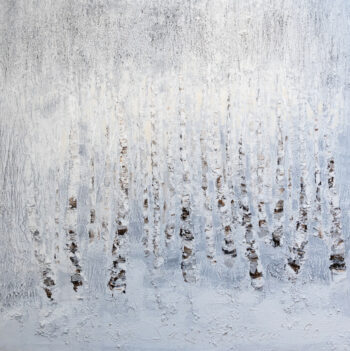
A painting shows white and grey tree trunks in a white, snowy landscape.

Heart of winter (1980): Särestöniemi despised the polar night of winter for most of his life, but in his later years he decided to make peace with it. He painted this bright birch grove amidst the snow.Photo: Emilia Kangasluoma

Some people thought Särestöniemi was arrogant. He was special, no one could deny that.

But perhaps his arrogance was really sensitivity? A way to express himself, to seek a path to freedom?

The Finnish media often portrayed him as a mystical figure who hosted royalty and other celebrities at his wilderness studio. However, Särestöniemi longed for the approval of the art-world elite, which he never truly received during his lifetime.

He travelled a lot, visiting Antarctica and the Norwegian Arctic outpost of Svalbard and everywhere in between. Särestöniemi sometimes journeyed as far as he could away from the long, cold winters of northern Finland, but he always returned.

The nature, fells and tundra of the far north meant everything to Särestöniemi. He felt a true connection with them, and expressed it in paint with great passion.

Särestöniemi died in northern Finland at the age of 56 in 1981. The Ounas River continued to flow freely.

By Emilia Kangasluoma, May 2025

This article is partially based on information from Noora Vaarala’s book Sarviini puhkeaa lehti (Gummerus, 2025).

The Särestöniemi Museum in Kaukonen includes Reidar Särestöniemi’s home and studio and a gallery.
For Finnish university students, May Day is the greatest time of year – here’s why

Hooray! It’s time for May Day (May 1)! What was once a festival dedicated to labourers evolved into a massive celebration among Finnish students, especially at polytechnic institutes.

Known as Vappu in Finnish and Valborg in Swedish (both are official languages in Finland), May Day marks the arrival of spring.

A typical Finn might celebrate by wearing their white high school graduation cap and enjoying sausages, potato salad and sima (a traditional Finnish mead) at a picnic on May 1. University students, however, have been preparing for Vappu for months. For them, Vappu isn’t just a break from the daily routine – it’s an exuberant, larger-than-life celebration.

Meet some Vappu devotees

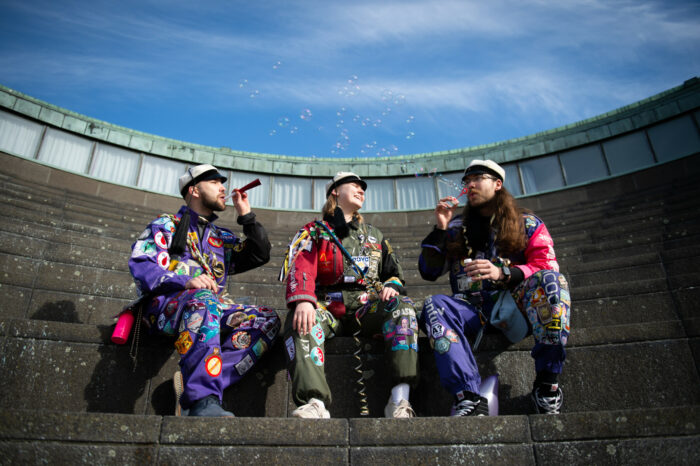
Three people in colourful overalls and white graduation caps sit in an outdoor amphitheatre, one of them blowing soap bubbles.

May Day is the highlight of the year for Sakari (left), Elina and Tuomas, who all study at Aalto University.Photo: Emilia Kangasluoma

Sakari, Elina and Tuomas are teekkarit (students in technical subjects) at Aalto University. We meet them a week before Vappu in Otaniemi, a vibrant student hub where the university’s main campus is located, in the municipality of Espoo, just west of Helsinki. Otaniemi is home to some 12,000 students from the university’s six different schools (Arts, Design and Architecture; Business; Electrical Engineering; Engineering; Chemical Engineering; and Science).

The festive spirit of May Day is palpable: a May Day radio studio is broadcasting a live countdown to Vappu and the trio are dressed in quintessential May Day attire: student overalls and the special teekkari version of the graduation cap. The sun is shining, and excitement is in the air.

These people are definitely ready for May Day.

Don’t overthink it

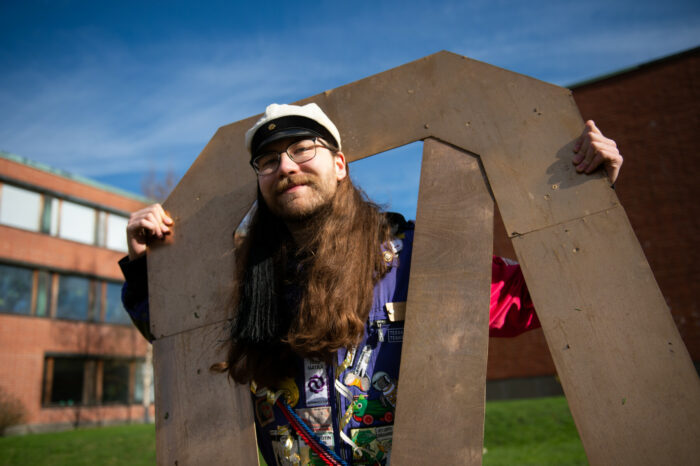
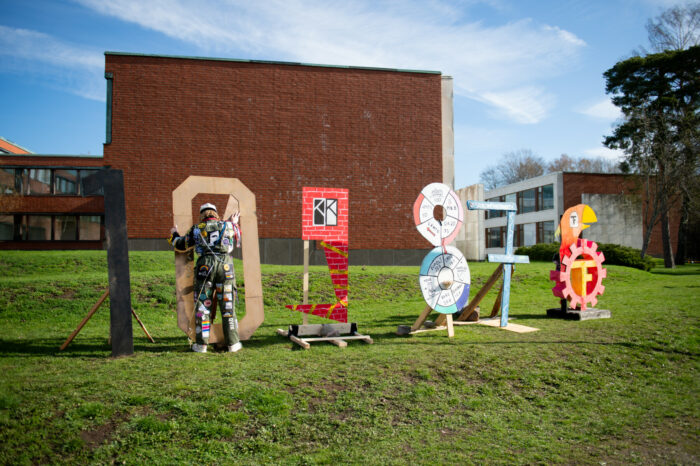
Outside on a lawn, a person in colourful overalls and a white graduation cap stands by a tall, homemade sculpture that depicts a number zero.

Tuomas can easily name the most important Vappu event for him: singing the “Teekkari Anthem” and donning the iconic teekkari version of the graduation cap.Photo: Emilia Kangasluoma

Tuomas, a student of real estate economics and a board member of the Aalto University Student Union, sees May Day as the perfect bridge to spring, with summer not far behind.

“The May Day events and traditions started weeks ago, but things really ramp up about a week before May 1,” he says.

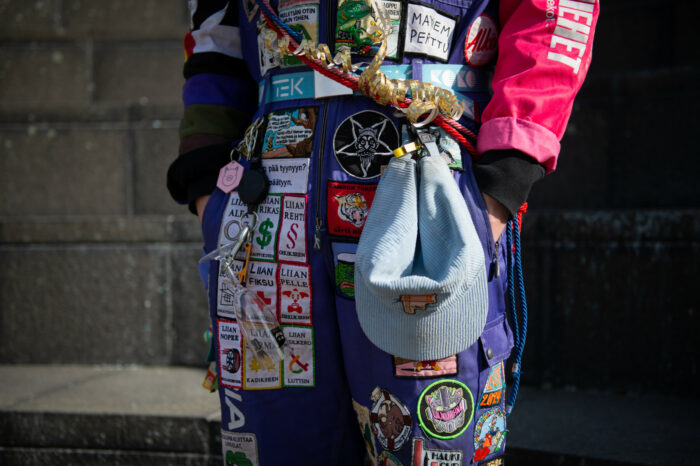
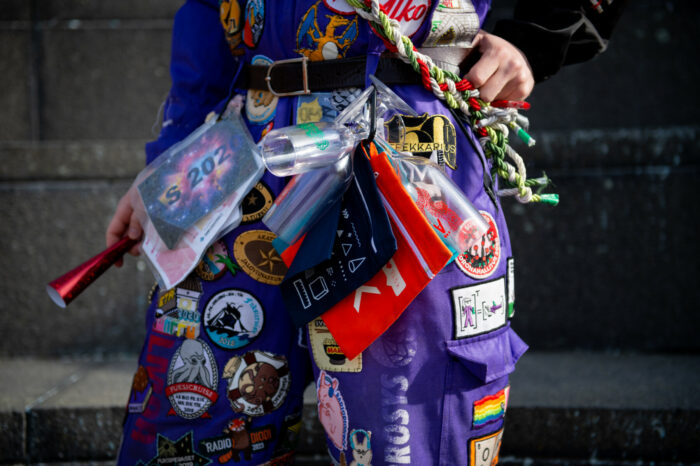
A close-up shows part of a person in colourful overalls decorated with patches and cords.

Tuomas’s overalls are adorned with event bracelets, mementos of active participation in student traditions. The colour of the overalls is based on the student’s major at university.Photo: Emilia Kangasluoma

“During May Day, you can just enjoy a couple of days without overthinking,” Tuomas says. “It’s pure fun.”

The freedom of Vappu

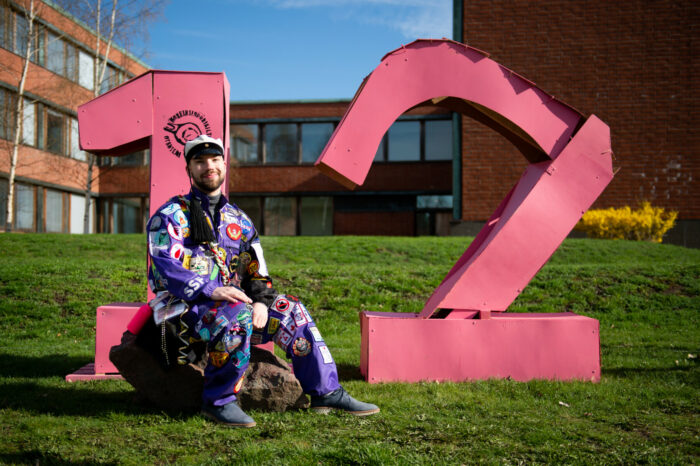
Outside on a lawn, a person in colourful overalls and a white graduation cap sits at the base of tall, homemade sculptures that depict numbers.

Sakari is an “Nth-year student,” meaning he has not hurried to finish his studies. For him, May Day symbolises everything that is good about student life.Photo: Emilia Kangasluoma

Sakari, chair of the board at Aalto University Student Union, sees May Day as the epitome of the joys of student life.

“It’s the moment when we can truly be free and bring happiness to people with a sparkle in our eyes,” he says.

He believes May Day brings out a different, more open side of people. “It’s definitely the time when you can count on someone to say hello with a big smile on their face.”

A close-up shows part of a person in colourful overalls decorated with patches and cords, with a couple plastic champagne glasses attached to the belt.

Sakari’s overalls feature several drinking glasses, perfect for impromptu toasts. The honorary cords from the Teekkari Guild add a touch of prestige.Photo: Emilia Kangasluoma

As Sakari gets closer to finishing his studies in electronics and digital systems, he reflects on the lasting impact of Vappu.

“The highlight of my May Day is the announcement of festivities from the roof of Servin mökki, an event space in Otaniemi,” he says. “I can imagine myself coming back to witness it for years to come, even in my retirement.”

A time of joy and creativity

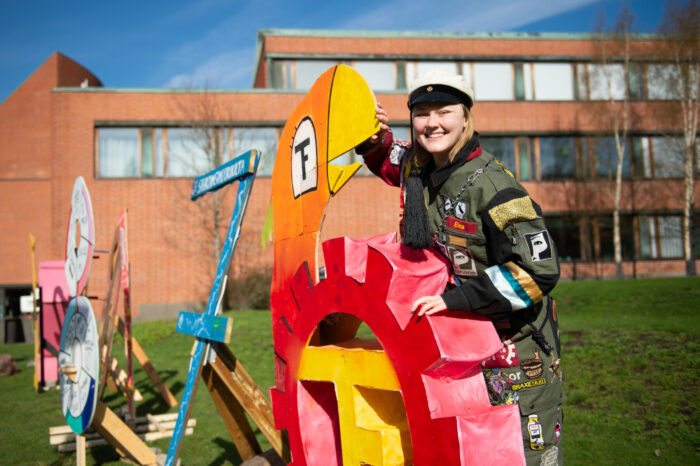
Outside on a lawn, a person in colourful overalls and a white graduation cap adjusts tall, homemade sculptures that depict numbers.

For Elina, May Day is such an important, happy celebration that when it’s over, it always takes a while to recover and realise it’s time to return to “normal life.”Photo: Emilia Kangasluoma

For Elina, a master’s student in information networks and the vice-chair of the Aalto University Student Union board, May Day is all about joy.

“The norms of everyday life and regular schedules take a back seat for a moment, and creativity takes over, manifesting in a wide variety of student events,” she says. “Everyone agrees that May Day is all about keeping the joy alive and laughing together.”

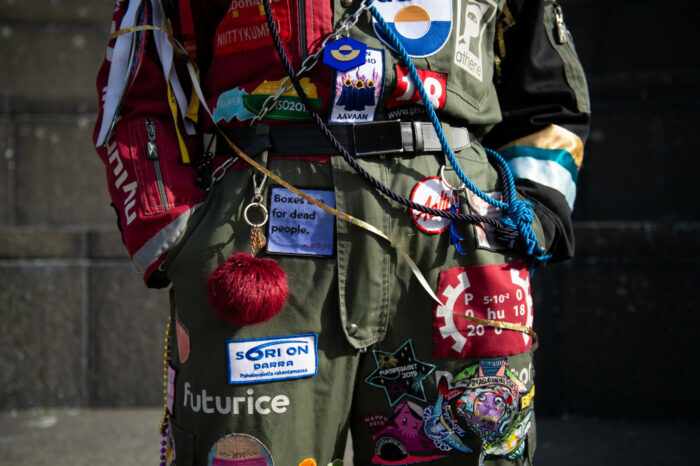
A close-up shows part of a person in colourful overalls decorated with patches and cords.

Elina’s red overall sleeve symbolises the Swedish-speaking community at Aalto University. The red tassel is a memento from her freshman year.Photo: Emilia Kangasluoma

Elina highlights the sense of safety and camaraderie in Otaniemi at Vappu. “We’re here among fellow students, and we all care about each other,” she says.

One of the most moving moments for Elina is midnight on April 30, when thousands of engineering students don their graduation caps simultaneously.

“That’s an incredible moment of togetherness,” she says. “Everyone is just happy, hugging each other and celebrating the joy of finally putting their caps back on after the long wait through winter and spring.”

By Emilia Kangasluoma, April 2025