Schools help keep Finland bilingual

Finnish youngsters can complete their entire education in Swedish, from kindergarten to university. For Swedish, the “other” language in this officially bilingual country, the generation now in school represents the future. Finnish Swedish Heritage Day is celebrated annually on November 6.

About 200 kids between the ages of 13 and 16 study at Sököviken School in Espoo, just west of Helsinki. At this public sector comprehensive school, all subjects are taught in Swedish, which is the first language of about 8 percent of Espoo’s residents.

Finland is officially bilingual, thanks to demographic history that stretches back about 1,000 years. Across the whole country, 5.4 percent of the population are registered as Swedish speakers. They’re known as Finland-Swedes, but don’t make the mistake of thinking they’re Swedish – they most definitely consider themselves Finns.

Sököviken deputy principal Henrica Donner explains that, outside school, the pupils live in a social environment where Finnish predominates. “About half come from families where both [Finnish and Swedish] are spoken at home,” she says. “We don’t worry about what language the pupils speak between classes or on the playground, but during the lessons the language is Swedish.

“Most of our pupils have a very strong Swedish-speaking identity, and the school system plays a big part in preserving this. They’ve typically been to kindergarten and primary school in Swedish, and nearly all go on to Swedish-language upper secondary schools.”

Swedish from the nursery to academia
2791-jesus_6279_550-jpg

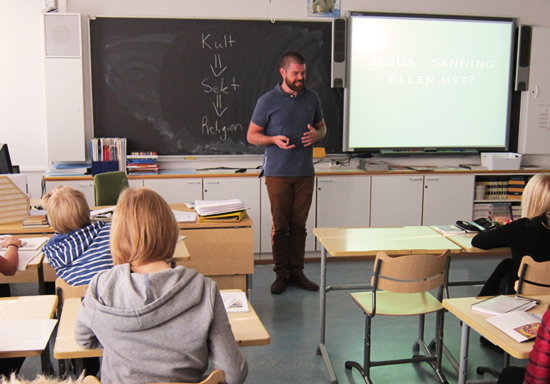
Elis Högnäs leads a lesson at Sököviken School. Photo: Fran Weaver

Ninth-grader John Nyholm, 15, speaks Finnish well, but feels that Swedish is definitely his first language and the best language for learning. “It’s very good that we have the chance to study in our home language all the way through school,” he says.

After attending kindergarten and primary school just a few hundred metres from his home, Nyholm travels about three kilometres (1.8 miles) to his present school by bike or bus. “I’ll probably go on to the nearest Swedish-language upper secondary school, just a bus ride away, though for university I might prefer to go abroad,” he says.

University-level tuition in Swedish is available in Finland at the Hanken School of Economics in Helsinki, at Åbo Akademi in the southwestern city of Turku, and in some subjects at the officially bilingual University of Helsinki. Swedish-speaking teachers are trained in Vaasa. This total provision of higher education is reasonable, considering that Finland’s total Swedish-speaking population only numbers some 290,000.

Legal right to learn in either language
2791-img_6310550-jpg

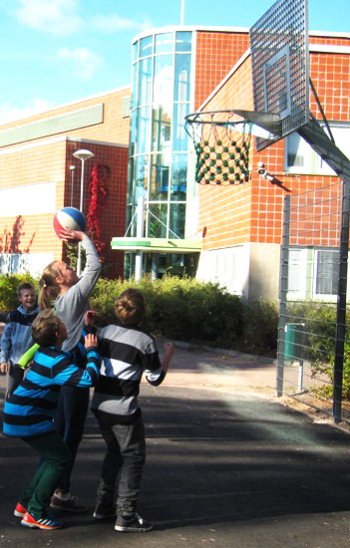
It doesn’t matter whether kids speak Finnish or Swedish while playing in the schoolyard, but inside the school, education takes place in Swedish. Photo: Fran Weaver

“The right to choose to receive schooling in either Finnish or Swedish anywhere in Finland is enshrined in our legislation,” explains Anders Björklöf, the education spokesperson of Folktinget, an independent but officially recognised organisation. Known in English as the Swedish Assembly of Finland, the group lobbies for Swedish-speaking people’s rights across Finland.

Björklöf reckons that about 99 percent of those who want to study in Swedish can also do so through the state school system, especially if they live in officially bilingual municipalities where at least 3,000 residents or 8 percent of the population are registered as Swedish speakers.

In rural regions of Finland, and especially farther away from the coastal regions where most Swedish speakers live, pupils sometimes study in small, separate Swedish-language classes on the local Finnish school’s premises, or they may have to travel some distance from home to reach their school. “The municipality where you live may have to find you a place in the nearest municipality with a Swedish school, and also arrange for free transportation to and from school,” explains Björklöf.

Pupils at Finland’s Swedish-language schools all study Finnish, too. Most of them will later have to cope in predominantly Finnish-language working environments. More controversially, their counterparts in Finnish-speaking schools are likewise obliged to study some Swedish, even in regions where it is seldom spoken. Björklöf feels this is essential as a question of equality between the country’s two official languages, though he would like to see Swedish taught in more motivating ways to improve its popularity among Finnish-speaking schoolchildren.

Upholding distinct Swedish-Finnish culture
2791-img_6296550-jpg

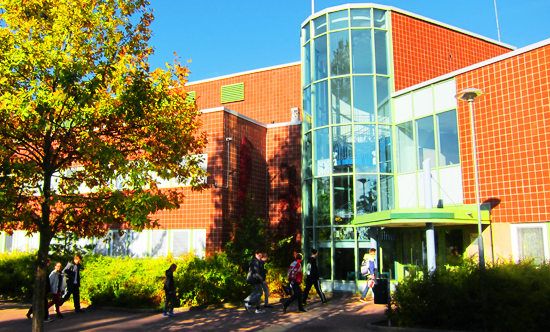
Swedish-language schools such as Sököviken provide a vital social focus for their linguistic minority communities within the officially bilingual country of Finland. Photo: Fran Weaver

Sököviken School’s Swedish teacher Monique Hult feels that maintaining bilingual education in Finland is also essential to upholding a whole distinct culture with its own social, literary and artistic traditions. “Ending the Swedish-language school system would probably ultimately lead to the end of the language here,” she says.

The teachers from Sököviken point out that Swedish schools also provide a vital social focus for linguistic minority communities in towns like Espoo. “Parents’ meetings, sports clubs and other activities arranged at school are one of the most important ways that Swedish-speaking families keep in touch with each other,” adds Henrica Donner, the deputy principal.

Members of this well-served linguistic minority clearly value and resolutely defend their official right to receive public services like education and healthcare in Swedish. Statistics show that parents are keen to send their kids to Swedish-language schools. Of the 59,115 first-graders who started school across Finland in 2012, more than 6 percent (3,663) were enrolled in Swedish-language schools.

By Fran Weaver, November 2013
Green transport flourishes in Finland

Finnish transport innovators are using modern communications technology creatively to provide flexible services that reduce eco-impact.

Transportation systems have long needed to fill the gap between the individual use of private cars and fixed-route bus and rail services for larger numbers of passengers. Two pioneering transportation schemes of this kind are being tested in Finland, with promising results.

Ten blue minibuses have been shuttling around inner districts of Helsinki since October 2012 as part of Kutsuplus, a pilot scheme that aims to complement bus and taxi services. “As far as we know, our scheme is the first in the world where vehicle routes are automatically changed to respond optimally to demand in real time, using a complex computer programme to update drivers’ instructions,” says programme director Kari Rissanen of Helsinki Region Transport (HRT).

Dial-a-bus

2954-_mg_4629_5616px-550px-jpg

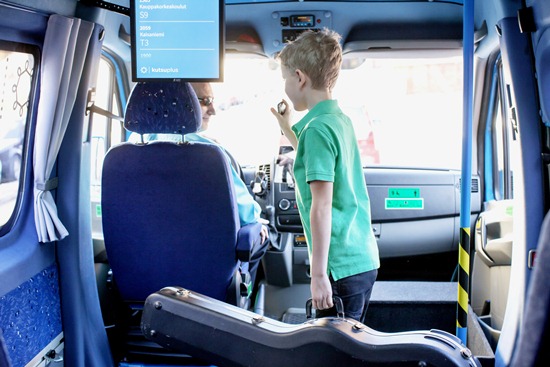
Kutsuplus riders pay online and receive ticket confirmation on their phones to show to the driver. Photo: Lauri Eriksson/HRT

Users can digitally summon Kutsuplus minibuses to any of more than 1,000 local bus stops, using a smart phone or computer to indicate location and desired destination, and to pay the fare. Digital confirmation arrives with a map complete with walking directions for the nearest bus stops at each end of the journey. Along the way minibuses may pick up or drop off other passengers whose departure points and destinations are logistically compatible.

The pilot scheme already has more than 4,300 registered users, who load funds into their personal virtual “trip wallets” to pay fares priced between taxi and bus fares. Fares are based on distances “as the crow flies,” not counting detours required by other passengers. “Feedback has been very positive,” says Rissanen, “though most of our initial users have been technophile ‘early adapters’ and we’re still trying to make the system more user-friendly for everyone.

“Resources are limited during this subsidised pilot phase, but the streamlined high-speed process enables scalability, and our aim is to expand into a viable service covering all of greater Helsinki. Such schemes require a critical mass of vehicles and users for cost-efficiency to take off as vehicle occupation rates increase,” says Rissanen, who hopes the Kutsuplus fleet will expand to 45 minibuses in 2014 and 100 by 2016.

HRT’s ground-breaking scheme has already attracted international interest across Scandinavia and in Russia, China, Singapore and Luxembourg. “We feel it’s a much more ecological mode of transport than private car use, but flexible enough to attract people who would otherwise travel by car,” adds Rissanen.

Free-riders welcome

2954-auto_pelto_oskar-raisaneni_p550-jpg

Great to be green: Oskar Räisänen, director of GreenRiders, plans to thin the number of vehicles in Helsinki’s rush hour. Photo courtesy of GreenRiders

Another scheme pioneered in Helsinki focuses on car-sharing. GreenRiders’ managing director Oskari Räisänen spotted the potential when he noticed how many of the cars clogging up the motorway into Helsinki during rush-hour had only one person in them.

About 100 companies have signed up so far. Nokia’s headquarters in Espoo, just west of Helsinki, forms one location where green-riding has proven popular. The best parking spots are reserved for GreenRiders as an incentive. Räisänen reckons that as more companies join, GreenRiders will significantly reduce peak traffic congestion and emissions.

Virtual hitchhiking

2954-greenriders_nokian-parkkihalli_wp_20130604_001-550px-jpg

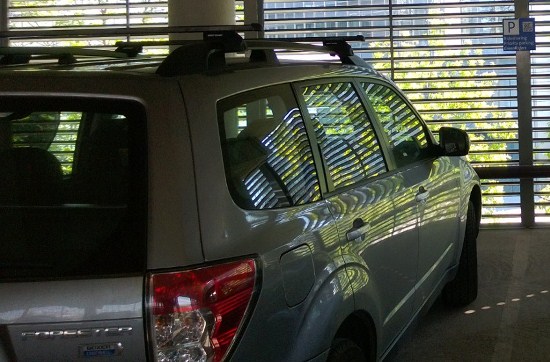
Big companies catch on: Nokia has put up special signs (upper right) in its parking garage to reserve the best spots for GreenRiders participants. Photo courtesy of GreenRiders

GreenRiders also runs a separate free scheme for people hoping to hitch rides to locations around Finland. “This has been most popular in connection with summer music festivals, when we’ve processed hundreds of ride requests and helped fill cars heading for events,” says Räisänen. “More than 8,000 people have registered so far.”

The GreenRiders system sends text messages to connect virtual hitchhikers with drivers offering rides. Users then agree on practicalities such as the possible sharing of petrol costs.

The GreenRiders system sends text messages to connect virtual hitchhikers with drivers offering rides. Users then agree on practicalities such as the possible sharing of petrol costs.

“Such recognition is very encouraging,” says Räisänen. “GreenRiders is about changing people’s transportation habits, which can be hard. But we’re already starting to replicate the scheme internationally, running another pilot in Slovakia in collaboration with the city of Bratislava.

By Fran Weaver, November 2013
Finnish apps share fitness online

We talk to a few Finnish companies that are way ahead of the pack in connecting fitness with apps and social media

Ever gotten halfway through a workout and wondered how you could possibly continue? Companies such as HeiaHeia and Golf GameBook offer users a virtual location to track and share their sporting achievements, and to cheer each other on.

4271-ruunaa_46_28-kristakeltanen-550px-jpg

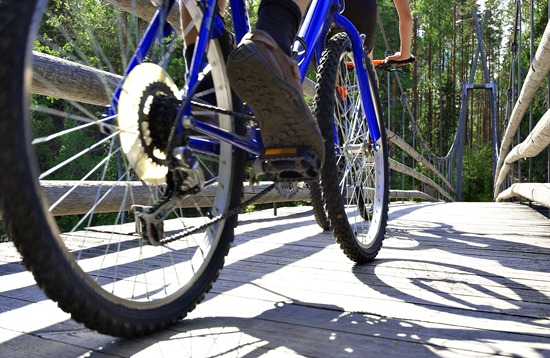
Finnish apps such as HeiaHeia, Golf GameBook, Moves and Fjuul let you track, share and cheer for your own sporting achievements and those of your friends.Photo: Krista Keltanen/Visit Finland

“I was living in Singapore when we came up with this idea,” explains HeiaHeia CEO Jussi Räisänen. “Cofounder Olli Oksanen was living in London and we wanted to exercise virtually together. The original context was very international.” They noticed that there was a demand for their idea, a gap to be filled.

Named after a Scandinavian sporting chant, the online social training diary service currently has users in more than 140 countries. Focussing on the positive effects of logging workouts online, and the resultant peer-to-peer support, these activities can also be shared on Facebook and Twitter.

Something to cheer about

HeiaHeia users cover a broad range of ages. They log some 400 different activities, with going to the gym, walking, skiing, running and walking the dog among the most popular.

4271-3-9110_4894-teakarvinen-550px-jpg

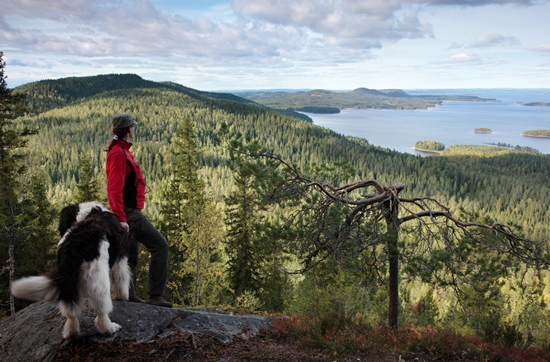
Walking the dog counts as exercise – even if you don’t live beside Koli National Park in eastern Finland.Photo: Photo: Tea Karvinen/Visit Finland

“We like to keep the threshold for joining really low,” Räisänen says. “It could be garden work or even chopping wood. It’s about getting people motivated to do something.”

Meanwhile, the company’s success has grown to include the participation of health professionals and insurance companies:

“We want to enable an ecosystem of wellness involving experts. Coaches, wellness professionals and even nurses all use HeiaHeia. Working with businesses, schools, rehabilitation organisations or even the Finnish military, each finds the product useful for maintaining the wellbeing of their specific personnel.”

Räisänen points out that some of HeiaHeia’s features were developed around the same time Facebook became a hit in Finland. “We introduced virtual cheering three weeks before they brought in the ‘Like’ button,” he says enthusiastically.

Teeing off globally

4271-dsc_0216oikealla_mikko_manerus-550-jpg

Kalle Vainola (left) and Mikko Manerus are intent on maintaining golf’s relevance in the digital age.Photo: Emilia Kangasluoma

The Facebook benchmark also surfaces in the story of Golf GameBook, with CEOs Mikko Manerus and Kalle Vainola deciding on the business name before Facebook arrived locally.

With over 20 years of professional golf experience between them, they set out in 2007 to reinvigorate the time-honoured game in an increasingly digital world.

“We thought that it would be nice that people finish their round the same way they started it: smiling and looking forward to playing again,” says Vainola.

Golf GameBook offers a virtual meeting place where users worldwide can share their real-time golfing experiences. While players keep score on their smart devices, their friends can receive this information instantly, share photos and comment on how things are proceeding.

The thwack of a golf ball cracks through the air. No need to duck, however, as the sound has come from Manerus’s iPhone, indicating that one of his friends has just teed off somewhere.

“Another thing is that if you are pro golfer Mikko Ilonen’s friend on Golf GameBook, for example, then you may also receive a comment from him when you are on the golf course,” he explains. “Previously, people would have gotten a player’s signature; nowadays they get a comment. It’s a great way to engage people.”

A tweeting sound fills the room.

“First birdie of the day,” Vainola announces, smiling.

Keeping track of things

Looking for up-to-date reports of your sporting activity? Nokia’s Sports Tracker isn’t the only noteworthy Finnish fitness tracking innovator we’ve seen recently. You can also keep an eye on things via your smart device using Moves, an app that is advertised as “fully integrated” into HeiaHeia and divides your daily physical activities into time segments.

With an app called Fjuul (pronounced “fuel”), tracking need not be confined to rigorous exercise. How about vacuuming, taking out the garbage or preparing dinner? Fjuul notes the light workouts you receive while performing everyday tasks.

By James O’Sullivan, October 2013

Finns design homes for extended families

When making lifestyle choices, Finnish families are increasingly turning to architectural innovation to bring together several generations under one roof for long-term living solutions. In one multigenerational family home in a leafy area of Helsinki, a soundproof floor and 83 years separate the house’s youngest occupant (8) from the oldest (91).

Elderly care in Finland is getting expensive. Medical care is expected to double by 2040, with 1.6 million Finns (27 percent of the population) living in retirement by 2040, according to the National Institute for Health and Welfare (THL). The amount of young pensioners (65–74 years old) will peak in 2020, and some say it is already difficult to find space and resources for the elderly.

Some people see sharing space with elderly relatives as burdensome, while others regard it as a way to bring the family closer together. A relatively new trend in Finland these days is families who share homes with grandparents, so they can help out with the kids and spend more time together. Finnish architect Tuomas Siitonen has designed an innovative home that shows how one family can live together under one roof while also allowing individuals to maintain their privacy.

Peek inside the tree house

2292-maija-luutonen_mg_6973a-550px-jpg

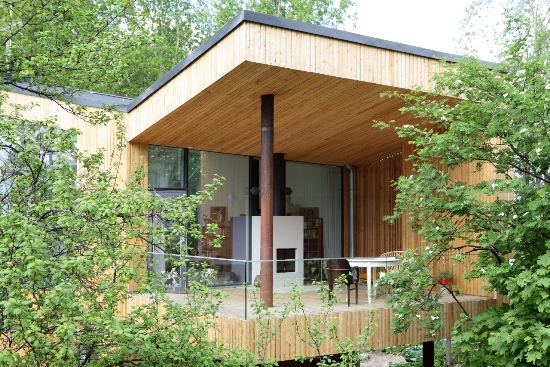
Off the main dining area, the second-storey patio makes you feel like you’re in an exotic tree house. Photo: Maija Luutonen

The angular wooden home, nicknamed House M-M, is set in the midst of a stunning forest, drenched in light from the northeast side, where the three bedrooms are situated. Outside, the home is covered in Finnish-grown Siberian larch on a pine frame. The windows are reflective, showing patterns from the nearby trees whether they’re in full leafy greenery or covered in sugary snow.

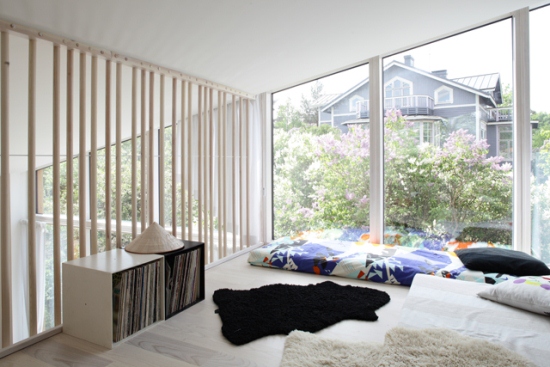
Inside, the main living room is built on an ash floor and lit by a chandelier on a slanted ceiling. A loft-like lounge overlooks the room, providing a chill-out space with cushions, records and a view of the forest.

With 170 square metres (1,830 square feet) of floor space, the home is designed for a family of more than four. Vilma and Juho live on the second floor with their two children, ages 8 and 13. Their great-grandmother lives in the wheelchair-accessible flat downstairs, while their grandparents live next door, on the same plot of land.

“Homes for the elderly are full,” says Vilma. “Some are expensive. It’s hard to find a place. Our arrangement gave us an escape from that situation.”

The garden boasts a big terrace adjoining the dining area. The entire building was designed to follow the contour of the surrounding forest and garden, which contains a number of apple trees. Since most of the rooms and windows are on the second floor, it has the feeling of a tree house – you can almost pick apples from the windows.

Building from the ground up

2292-tuomas-siitonen_2-550px-jpg

A loft-like lounge overlooks the main living room, providing a chill-out space with cushions, records and a view of the treetops. Photo: Maija Luutonen

The homeowners first approached Siitonen to build a home that would not only hold a multigenerational family but last for lifetimes, as well. “They wanted to build a flat that would include their grandmother,” says Siitonen.

Vilma and Juho were looking for a cozy, uniquely designed space that is ecological and practical enough to stand for many decades. With geothermal heating and lots of sun from the big windows, the rooms suit both adults and children. The generous amount of common space allows them to share family time.

“The best thing about this house is that it really belongs in its environment,” says Vilma, referring to how the house fits into the surrounding Finnish natural landscape. “It really feels like it has always been there. The house is heated by geothermal heating and the large windows allow a lot of sunlight in. The big balcony gives us some extra space. We get the wood for the fireplace from the site. We go to work by train; the station is just a few minutes away.”

“We truly believe these are the things we need for the rest of our lives,” she says.

By Nadja Sayej, October 2013

Finland makes multilingualism easy

Finnish schools provide welcome support to parents who wish to bring up their kids speaking other languages in addition to Finnish or Swedish.

Richard Berman from England and his Finnish wife Heidi have brought up their children Demi, 11, and Gabi, 9, to speak both English and Finnish at home. The girls switch fluently between the two languages, depending on which parent they are talking to.

Demi and Gabi attend the local school a stone’s throw from their home in Helsinki. Classes are taught in Finnish, and the girls initially learnt to read and write in Finnish. But the Bermans have taken advantage of a free scheme set up within the Finnish school system to give children of immigrant or mixed linguistic background extra lessons in any other languages they may speak at home.

To boost their daughters’ bilingualism they send them to extra classes in a nearby school – with help from Granny as a chauffeur. “Our class of about 15 kids meets for 90 minutes every Thursday afternoon after my normal lessons,” says Gabi. “We do reading, writing, some grammar exercises and games like word searches, and we get a bit of homework too.”

“I haven’t minded going on to extra English classes as they’ve been fun and I’ve made good friends there – though it’s best when the group is small and the teacher can help more,” says Demi. “We also talk about things like seasonal festivals, and the teacher recommends good books.”

Extra tuition on vital skills

2824-dsc_12401-550-jpg

The girls don’t mind the extra English homework they get, as their teacher finds enjoyable and motivating exercises. Photo: Emilia Kangasluoma

Finnish has very straightforward pronunciation and spelling rules, so learning to read, write and spell in another language such as English is a new challenge. “It was a good time for the girls to start on these extra lessons just when they were learning to read and write,” says Richard.

“The lessons really helped them – in fact Demi’s spelling is possibly better than her father’s now!” agrees Heidi.

Leena Nissilä, an expert in multilingual education from the Finnish National Board of Education, explains that the nationwide scheme provides funding enabling local education authorities to set up free classes in any language wherever they can connect suitably skilled teachers with at least four school-age children who speak the target language at home. Some groups also include Finnish children who have learnt a language while their family was living abroad.

Aside from acquiring a job here in their chosen profession, students at Työväenopisto have different motives for learning the language.

“Of course two hours a week isn’t enough to build up language skills to native standard, and families must still help their children, especially by reading with them and providing books,” says Nissilä. “The main goal is to give children tools to develop their own interactive language skills, but lessons also cover the literature, food and traditions of the culture behind the language.”

Polyglots an asset for Finnish society

2824-dsc_1155-550-jpg

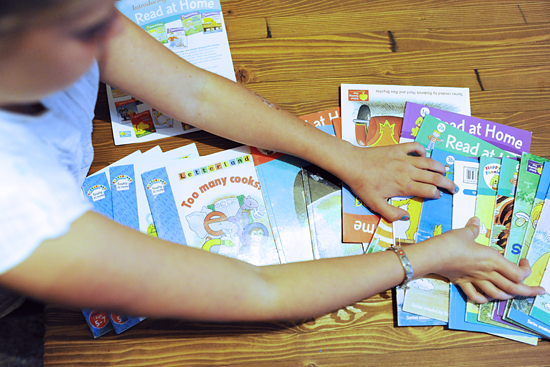
Parents are encouraged to make sure their kids have plenty of fun books to read in both of their home languages. Photo: Emilia Kangasluoma

The Finnish authorities recognise the value of children learning other languages than Finnish or Swedish to native-speaker standard. “In future Finnish society will certainly need skills in different languages, including smaller minority languages,” says Nissilä.

More than 50 languages are taught through the scheme. In autumn 2012 about 14,000 pupils attended such classes around the country. Russian, Arabic, English, Estonian, Chinese and Spanish are widely taught, as well as languages of significant immigrant communities including Somali, Kurdish, Albanian and Vietnamese.

“When it comes to immigrant families, the thinking in Finland is not to ‘assimilate’ them into Finnish society, but to ‘integrate’ them effectively. Countries whose systems don’t value the linguistic and cultural backgrounds of immigrant communities tend to have more problems with integration,” says Nissilä.

Bilingualism good for kids

2824-dsc_1228-550-jpg

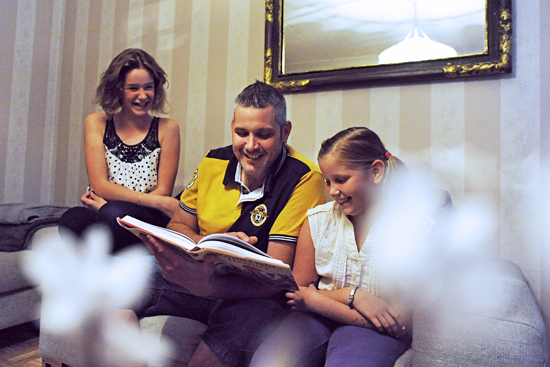
Richard Berman feels that reading English children’s books with his daughters over the years has been a great way to help them become truly bilingual.Photo: Emilia Kangasluoma

Given Finland’s long experiences of bilingualism involving Finnish and the country’s other official language, Swedish, the Finnish educational authorities are convinced of the benefits of bilingualism.

“Research shows that bilingual or multilingual children tend to learn additional new languages more easily than monolingual children, and there is no evidence that bilingualism hinders any aspect of learning,” explains Nissilä.

“Scheduling the lessons can be tricky, and we’re pleased that so many municipalities understand the importance of this issue and provide lessons,” says Nissilä. “We’re also happy that so many families take advantage of this opportunity, which doesn’t exist in most countries.”

The lessons are voluntary, so it’s important that both parents and teachers motivate the children and make learning enjoyable.

“We’re very glad these lessons have been offered, and it’s been worth the effort to get the girls to them,” says Richard Berman. Demi and Gabi are clearly proud to be bilingual. Demi has started Swedish at school and is doing well, and both girls are often asked by their friends and even their teachers to act as translators and interpreters.

By Fran Weaver, October 2013

The Finns revolutionise construction

When it comes to kilometre-high skyscrapers or inventive wooden buildings, Finnish companies are at the forefront of new construction technology.

By 2004 the Finnish company KONE had identified a problem. They had just supplied elevators to Taipei 101, then the tallest building in the world, and knew elevator technology was not keeping pace with other advances in architecture.

“While elevators have enabled the rise of city skylines, the technology had reached its height limit,” explains Giuseppe Bilardello, senior vice president of technology and research at KONE. “Elevator travel distances of more than 500 metres are not feasible as the weight of the ropes becomes so great that more ropes are needed to carry the ropes themselves.”

Carbon fibre elevator cables

3219-kone-future-high-rise-building-550-jpg

With KONE’s new technology, future elevator travel could reach heights of one kilometre, twice the current limit. Photo: KONE Corporation

In the little town of Hyvinkää north of the capital Helsinki KONE researchers got to work. They tinkered and studied and argued over prototypes. Finally, in the summer of 2013, the company announced they had cracked the problem.

KONE ditched the old steel cables and instead created one consisting of a carbon fibre core covered with a unique high-friction coating. They call it UltraRope and say with this technology future elevator travel could reach heights of one kilometre, twice the current limit.

“Carbon fibre has excellent strength properties and the coating is highly resistant to wear and abrasion,” Bilardello continues. “The new ultralight rope technology eliminates the disadvantages of existing steel ropes: high energy consumption, rope stretch, large moving masses and downtime caused by building sway. The lifetime of UltraRope is twice as long as that of steel rope.”

Wood City

3219-kone-ultrarope-in-elevator-shaft-550-jpg

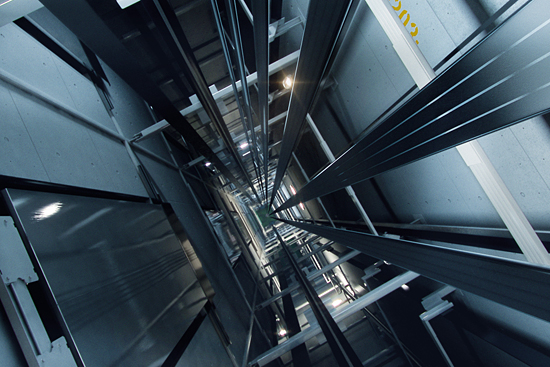
KONE created a cable consisting of a carbon fibre core covered with a unique high-friction coating. They call it UltraRope. Photo: © KONE Corporation

UltraRope has not yet been deployed in a skyscraper, but other construction technology is already gracing the inside of Finnish elevator shafts. Stora Enso produces cross-laminated timber (CLT), which was used to build a wooden lift shaft in the Finnish Nature Centre Haltia outside Helsinki. CLT is strong enough to be used in place of concrete in load-bearing structures.

Haltia was created to not only be a showcase for Finland’s natural treasures, but also to demonstrate ecological wooden construction techniques. Taking a step forward in this concept is Wood City, which will be an eight-storey block in Helsinki.

“Wood City will be the largest wooden quarter of its type in Finland, throbbing with residential, working and hotel life around its courtyard,” says Matti Mikkola of Stora Enso. “Upon completion, Wood City will be a masterpiece of the latest wooden construction that will raise expertise in this field.”

Parallels from Finnish nature

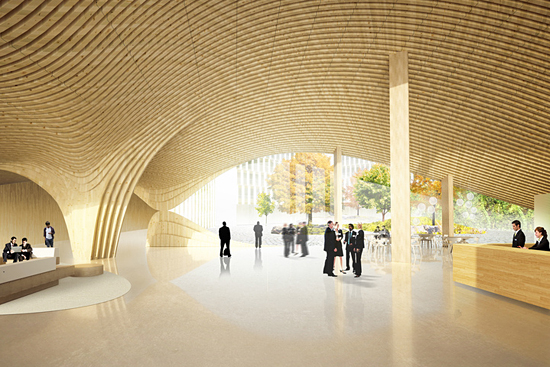
3219-woodcity_srv-550-jpg

The design vocabulary of Wood City’s ground floor draws parallels from Finnish nature and aims for a timeless, personal and striking atmosphere.Photo: SRV Woodcity

Building begins in 2014, and will be overseen by the Finnish construction and project development company SRV. Tuomas Rantsi of SRV says CLT has advanced to the state where it is cost-competitive and a fast solution for urban construction. Yet there are even more benefits to wood.

“Wood City is an ecological choice for its users and wood helps create pleasant spaces for the mind and body,” he explains. “A company located in wooden city quarters gains brand value and is regarded as a trailblazer.”

While interest has already been high because of the renewable wooden construction material, the design is just as striking.

“The design language of the ground floor draws parallels from Finnish nature and aims for a timeless, personal and striking atmosphere,” explains Vesa Oiva of Anttinen Oiva Architects.

Finnish companies’ expertise in cutting-edge wood construction is apparent far beyond Finland’s rocky shores. Mikkola says Stora Enso already has ongoing projects in locations ranging from continental Europe to Australia.

By David J. Cord, October 2013

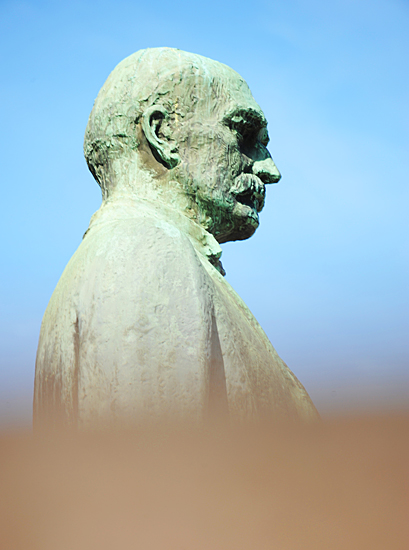
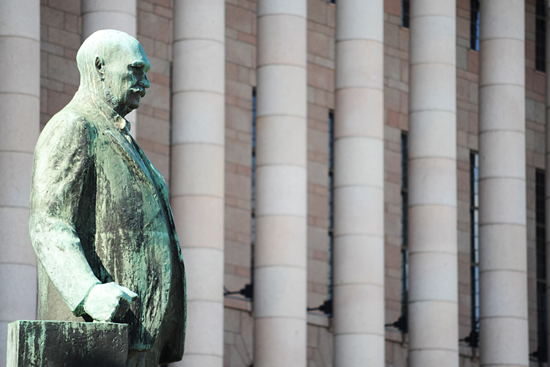
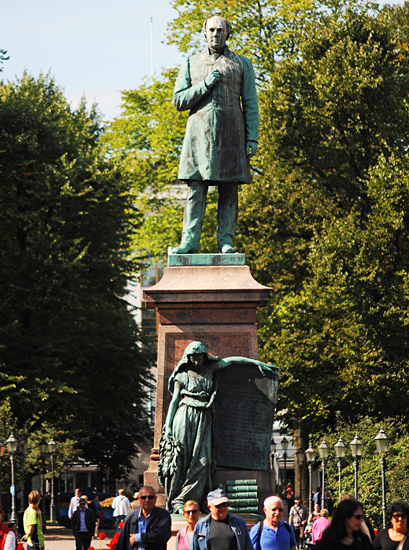
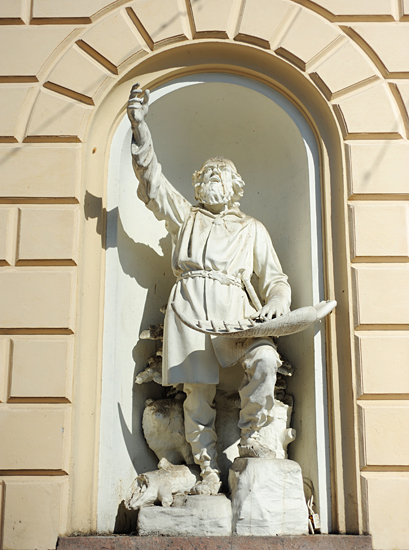
Bronzed, but not by the sun: the Helsinki Statues

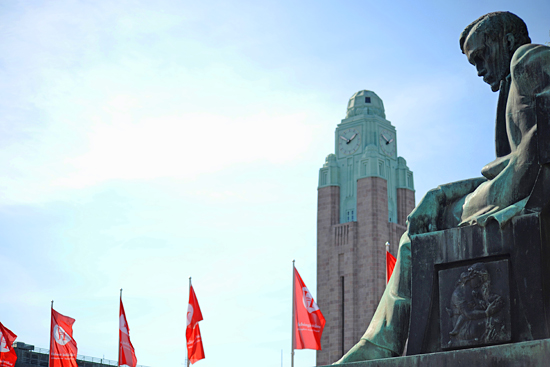
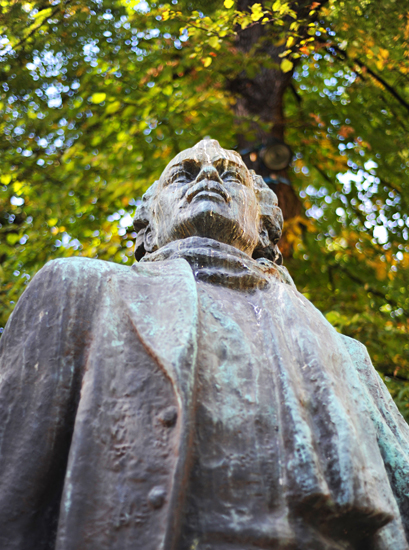
Despite the rumours, Finns are not cold and stone faced, yet we can’t deny the most famed Finns fill that description. Formed from bronze, stone and cement is Finland’s most influential people and the most beloved artists commemorated in statues, many of which are found in the centre of Helsinki. The statues themselves are works of art, also serve to remind onlookers of Finnish history, and introduce it to newcomers.

The statues prompt Helsinki sightseers and locals alike to clues of Finnish history and culture. Each sculpture opens a window into history reflecting on the style and atmosphere of epochs past: illuminating the viewer to periods of art and those who helped build the story of Finland.

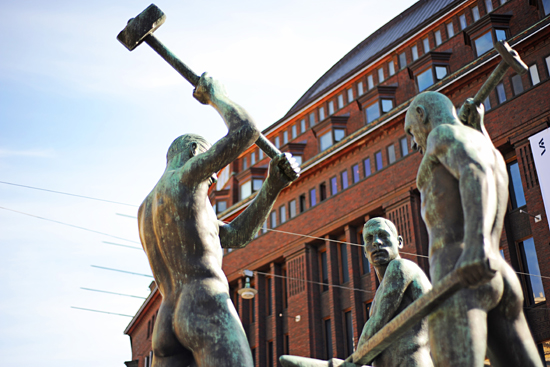
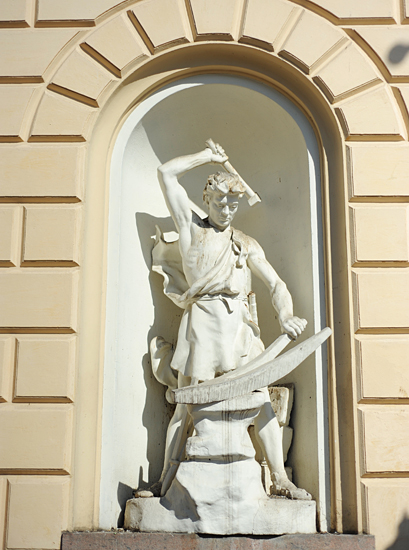
Statues play important role in Helsinki’s cityscape serving as familiar meeting places and landmarks. The Three Smiths Statue (Kolmen sepän patsas) situated in the intersection of Aleksanterinkatu and Mannerheimintie, is a popular meeting place, while also being an icon of Helsinki. It hasn’t always been this easy for the iconic blacksmiths. In the Second World War the base was damaged during a bombing, the anvil of a smith still has a hole from the shrapnel. Skaters and flatland BMX-ers often gather around the Statue of Marshal Mannerheim (known as Marski in Helsinki slang).

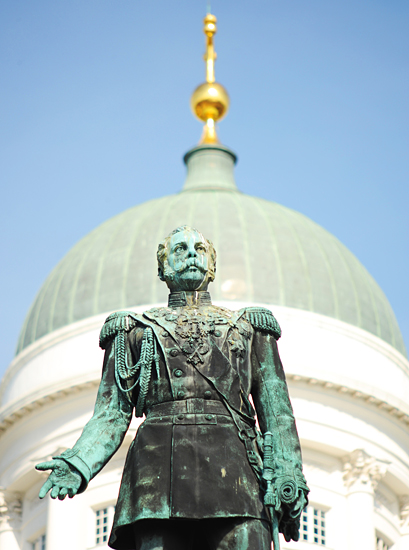
Some statues are centerpieces for traditions and holidays. Since 1921, in celebration of May Day, a delegated group of higher education students have the honours of placing a white graduation cap on the top of the Havis Amanda’s curly locks. The capping ceremony happens after the fountain is foaming with bubbles and the dear Havis Amanda has been bathed. Also, the Statue of Alexander II in Senate square served as a scene for political representation against the Russification of Finland under Tsar Nicholas II who governed in a different manner to his predecessor Alexander II.Proceed to the slideshow below to find out more.

The statues of Helsinki tell their stories

Photos by Emilia Kangasluoma, October 2013
Text by Katarina Lius and Pia Grochowski

The new edge of Finnish architecture

A lot has happened in Finnish architecture since the days of Alvar Aalto, regarded as the most influential architect of modern Finland. The minimalistic and aesthetic lines distinctive in contemporary Finnish architecture are ubiquitous in the country’s public and residential buildings.

Finland has now unleashed an environmentally aware and more global architecture with outcomes that are getting international praise and prizes. A striking example of new Finnish architecture is the Helsinki Central Library, open as of December 5, 2018. The new library has received the name Oodi (Finnish for “ode”).

The kids behind the library

When the results of the architectural competition for the Helsinki Central Library were announced in June 2013, ALA Architects had already earned recognition as a leading Nordic architecture firm.

Their first international breakthrough came in 2005 when they won the first prize in the open competition for the Kilden Performing Arts Centre in Kristiansand, Norway. “When we entered the Kilden competition we were just a bunch of kids working together,” says Juho Grönholm, one of the ALA partners. Nowadays that bunch of kids is a bit older, but going strong.

2289-tif0913_ala_550-jpg

ALA Architect Partners (from left to right) Samuli Woolston, Juho Grönholm, Janne Teräsvirta, Antti Nousjoki believe that architecture reflects a common will of an era. Photo: Tuomas Uusiheimo

The central library is a pioneer project selected by the Finnish government in celebration of the centennial of Finland’s independence, in 2017. It has been predicted that it will be a role model for the next generation of libraries. “Good architecture makes us tick,” Grönholm explains. “It’s about creativity, individuality and leaving one’s comfort zone.”

The decision to build the library’s façade from Finnish spruce is part of a new trend: ecological, local and energy efficient materials are increasingly guiding the construction industry. The building will be extremely energy efficient. “Architecture is a reflection of a common will of an era,” Grönholm says. For the architects of ALA, it’s important to, “act globally but think locally.”

The new trend, the wood edge

From 1970s-era prefabricated buildings, to the steady modernist ideas of the 1990s generation of architects, we have arrived in an era of cutting-edge wood architecture of the new millennium. According to Juha Ilonen, architect and author of several books on Helsinki architecture, climate change is currently adding pressure in favour of wood construction and design.

“Wood is related to sustainability, but, especially for Finns, it’s also related to our national identity,” Ilonen says. “Wood was here before Nokia and Angry Birds, so it is an essential part of our identity,” he says, and smiles.

2289-tif0913_ilonengrochowski-pia_550px-jpg

Juha Ilonen welcomes diversity in architecture, saying it is getting more acceptable to design avant-garde buildings. Photo: Pia Grochowski

In Finland, the most densely forested country in Europe, timber products have a very bright future. “It will probably be used more and more in Finnish architecture.”

In concurrence with this trend, Aalto University based in the Helsinki metropolitan region, is offering a one-year programme on wood and wooden architecture. Finland’s first public building made of prefabricated solid wood panels was opened in 2013, the new Haltia Finnish Nature Centre designed by Lahdelma & Mahlamäki Architects.

The ethics of sustainable development, new safety regulations, and the strong tradition that Finns have in the use of wood in construction “have enabled its comeback in architecture,” explains Ilonen.

Ilonen talks about “the wow effect” people are currently looking for in architecture. According to him, the Helsinki Central Library has it. “The real wow effect will be experienced in its breathtaking interior,” he says, rather than its wooden surface and curved lines. Multiculturalism and globalisation play a vital role in welcoming diversity in architecture. “It’s now easier to accept more original or avant-garde buildings,” Ilonen says.

By Carina Chela, September 2013, updated November 2018