Tapping into Finnish lakes

Finland boasts a staggering 188,000 lakes, which provide a focus for leisure activities all year round. We also look at how a tunnel connected to Finland’s deepest lake demonstrates a pioneering example of cleantech and environmental investment.

If one picture-perfect landscape is synonymous with Finland, it is the image of a vast blue lake disappearing into a horizon lined with brilliant green forest.

The Finnish dream involves having a lakeshore summer cottage, but lakes also play an important role in the day-to-day life of city dwellers.

“Lakes are culturally very important for many Finnish people,” says Seppo Rekolainen, director of the Freshwater Centre at the Finnish Environment Institute (known by its Finnish acronym, SYKE). “Even now, when most people live in cities, their roots are connected to the countryside, lakes and forest.”

Finland boasts a staggering 188,000 lakes. It is also a water-rich country in terms of water per person. “We have much more available water per capita compared to most countries in central and southern Europe,” Rekolainen states.

Fresh tastes from the lakes
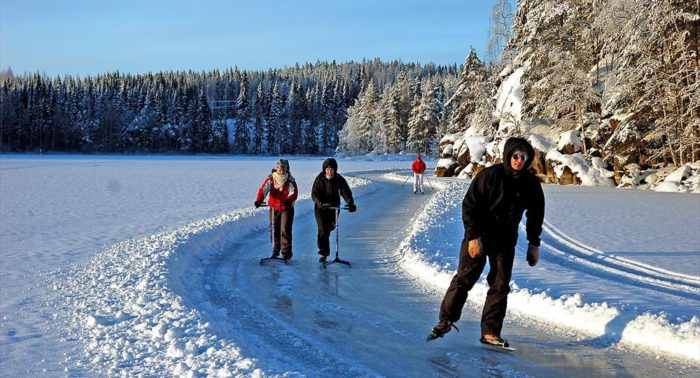
The winter brings skating, kick-sledding, cross-country skiing, snowmobiling and snowshoeing to frozen lake surfaces.

The winter brings skating, kick-sledding, cross-country skiing, snowmobiling and snowshoeing to frozen lake surfaces.Photo: Visit Finland

The largest lake in Finland is Lake Saimaa in the east of the country. At some 4,400 square kilometres (1,700 square miles), it is the fourth-largest natural freshwater lake in Europe.

The deepest lake in Finland, Lake Päijänne, reaches a depth of 95.3 metres (312 feet). Stretching some 120 kilometres (75 miles) between the cities of Lahti and Jyväskylä, it is a popular haven for Finns. Around 16,000 cottages line its shore, with fishing, boating and trekking popular pastimes. Furthermore, a wide variety of water transport connects cities along its length.

Lake activities are not confined to the warmer months; the winter brings cross-country skiing, skating, kick-sledding, snowmobiling and snowshoeing to the frozen surfaces.

Travelling to Helsinki
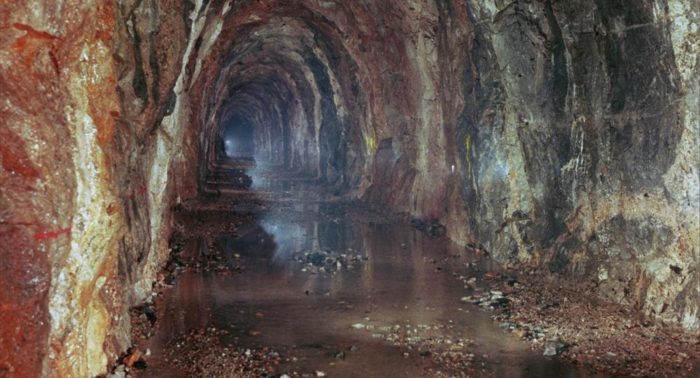
Water travels from Lake Päijänne to Helsinki through this tunnel in the bedrock (photo taken before the tunnel was finished).

Water travels from Lake Päijänne to Helsinki through this tunnel in the bedrock (photo taken before the tunnel was finished).Photo: HSY

Lake Päijänne also provides drinking water to the around one million residents in the capital region.

“The Helsinki area is a very water-poor region,” Rekolainen says. “Lake Päijänne is the nearest big lake with very good quality water.”

When it was decided in the 1960s to tap into this resource, one obvious question needed to be asked: How can the lake water be transported to Helsinki? The answer: Build a tunnel.

Located between 30 and 100 metres  (98 and 328 feet) underground, water travels at an average intake of 3.1 cubic metres (109 cubic feet) per second downhill from the lake to the capital region through a tunnel in the bedrock. At around 120 kilometres (75 miles) in length, it forms the world’s second-longest continuous rock tunnel.

“It was a great innovation of its time,” states Veli-Pekka Vuorilehto, director of the water treatment division at the Helsinki Region Environmental Services Authority (called HSY in Finnish). “It was a long-term solution to ensuring a water supply. We are now using only one-third of the tunnel’s capacity.”

Innovative flow
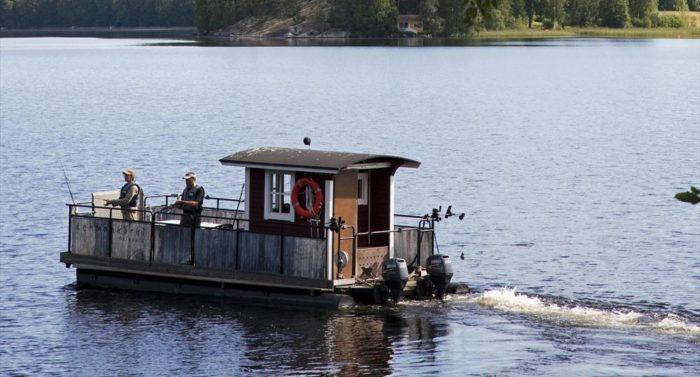
Fishing and boating are popular on Lake Päijänne and many other Finnish lakes.

Fishing and boating are popular on Lake Päijänne and many other Finnish lakes.Photo: Visit Finland

Some of the raw water is channelled elsewhere to help improve water quality, however the lion’s share goes through the HSY water treatment plants in Pitkäkoski and Vanhakaupunki. Given that the source water is of high quality, the several stages of treatment do not include the addition of many chemicals.

Aside from the practical purpose of transporting water, the tunnel’s flow is also utilised to produce some seven million kilowatt-hours of electricity annually at the Kalliomäki hydroelectric power plant. Other innovations are also being introduced.

“By decreasing the water temperature by 0.1 degrees Celsius, we can use it to heat our water treatment plant,” Vuorilehto says. “The idea is basically the same as geothermal heat: a huge amount of water contains a huge amount of warmth.”

With many companies now heavily involved in finding more environmentally friendly ways of approaching innovations, Vuorilehto sees the Päijänne tunnel as a pioneering example of cleantech.

“We get a sufficient amount of raw water that is relatively easy and light to handle, and the environmental impacts are much smaller than if we take water from elsewhere. We also create electricity and heat. The whole tunnel is an environmental investment.”

By James O’Sullivan, January 2015

Begin Finnish out loud now: 20 phrases

Jump right into the Finnish language with our audio list of 20 useful phrases. Learn one each day, or see how many you can master in one sitting.

Finnish (listen) English
Hyvää päivää

(literally: Good day) How do you do?/Hello
Mitä kuuluu?

How are you?
Hei!

Hi!
Tervetuloa

Welcome
Hauska tavata

Nice to meet you!
Hyvää huomenta

Good morning
Hyvää iltaa

Good evening
Hyvää yötä

Good night
Kaunis ilma tänään

Nice weather today
Anteeksi

Excuse me/Sorry
Näkemiin

Goodbye
Anteeksi, en puhu suomea

Sorry, I don’t speak Finnish
Puhutteko englantia?

Do you speak English?
Saisinko ruokalistan?

Could I have the menu, please?
Saisinko viinilistan?

Could I have the winelist, please?
Paljonko tämä maksaa?

How much does this cost?
Saisinko yhden oluen?

Could I have a beer, please?
Saisinko kupin kahvia?

Could I have a cup of coffee, please?
Saanko laskun?

Can I have the bill, please?
Kiitos

Thank you

By ThisisFINLAND staff

Sisu, sauna, Sibelius and heavy metal, too

Special events and concerts were scheduled in Finland and around the world during 2015, which marks the 150th anniversary of national composer Jean Sibelius’s birth. We asked two insiders for tips on how to soak up jubilee fever – and we find out what Sibelius and heavy metal have in common.

Finnish pianist Folke Gräsbeck is dedicated to Sibelius, having performed two-thirds of his approximately 600 works, including premieres of 90 rare and newly discovered pieces. Gräsbeck selected the soundtrack, including some of his own recordings, that accompanied Sibelius and the World of Art, an exhibition at Helsinki’s Ateneum Art Museum (through March 22, 2015).

In April, Gräsbeck released an album featuring Sibelius’s own piano, recorded at Sibelius’s home, known as Ainola and located about 40 kilometres north of Helsinki near the town of Järvenpää. The Steinway itself, a 50th-birthday gift to the composer, is now a century old.

“It’s a pure pleasure to play, with a warm, subtle, lyrical sound,” says Gräsbeck, “and there are certainly spiritual vibrations in the air of that house.”

Along with conductor Osmo Vänskä and the Lahti Symphony Orchestra, Gräsbeck plays on many tracks of BIS Records’ recently completed set of all known Sibelius pieces.

Five decades in 68 CDs

“One main feature in all [of Sibelius’s] pieces is a strong melodic presence,” says pianist and Sibelius expert Folke Gräsbeck.

“One main feature in all [of Sibelius’s] pieces is a strong melodic presence,” says pianist and Sibelius expert Folke Gräsbeck.Photo: Sinimaaria Kangas

“Now that we have this 68-CD box set, it’s possible to listen to Sibelius’s entire repertoire from 1883 to 1931,” says Gräsbeck. “One main feature in all the pieces is a strong melodic presence. Even in his youthful works, you have captivating melodies. He didn’t yet have the Kalevala romantic vocabulary that he reached in Kullervo and Lemminkäinen and the big orchestral works. But this sense of having an intense melody – it was there from the start.”

Gräsbeck champions Sibelius’s lesser-known works, many of which he believes to give true listening pleasure, perspective and depth in addition to the narrow selection of a very few “greatest hits” such as Finlandia, Valse triste, the Violin Concerto and the seven symphonies.

The pianist showcased both obscure gems and well-known works at his own festival on the island of southwestern Finnish island of Korpo. In July 2015, the event starred the Flinders Quartet from Australia. During 2015 Gräsbeck also played in Berlin, Tel Aviv and the Finnish city of Lahti, whose Sibelius Hall is “by far the best place to hear his music,” he says. “It has such excellent acoustics.”

Lahti’s Sibelius Festival featured the BBC Symphony Orchestra and Finnish star conductors such as Vänskä, Leif Segerstam, Jukka-Pekka Saraste and Sakari Oramo.

Gräsbeck has also recorded with Sibelius’s granddaughter, Satu Jalas. She inherited Sibelius’s own violin, bought by his sea captain uncle, Jean. Young Johan Julius Christian Sibelius, already known by the nickname Janne, adopted his uncle’s cosmopolitan name, and it stuck. Jalas’s sister Aino is a professional oboist whose son Lauri Porra is one of Finland’s leading film composers and bassists, with experience spanning pop, jazz and rock.

Sibelius the godfather of metal?

“If you’re interested in Finnish metal, then you should definitely check out Sibelius,” says Lauri Porra, Sibelius’s great-grandson.

“If you’re interested in Finnish metal, then you should definitely check out Sibelius,” says Lauri Porra, Sibelius’s great-grandson.Photo: Sinimaaria Kangas

Porra sometimes plays bars of his great-grandfather’s famous piece Finlandia when taking a bass solo with his best-selling heavy metal band, Stratovarius.

“If you’re interested in Finnish metal, then you should definitely check out Sibelius,” he says. “His style has influenced all Finnish music – metal especially, because it’s very harmonic and has a National Romantic side to it. Metal and classical are actually quite close. Sibelius used a lot of influences from old Karelian [eastern Finnish] folklore and Kalevala [the Finnish national epic] in his work. So do Finnish metal bands like Amorphis.”

“Everybody in Finland studies this runic tradition. It’s a flat key and it’s a bit melancholic. This is what you can hear in Sibelius as well as in Finnish metal. The bigger, more melodic bands like Stratovarius, Amorphis, Nightwish and Sonata Arctica are all influenced by Sibelius in some way. Most Finnish metal players have some kind of classical background, which of course includes playing Sibelius.”

Porra’s mother, who knew her own grandfather well, heads up the Sibelius family commission that  oversaw the 2015 jubilee year.

The building blocks of Finnish identity

“Visit Ainola [the house where Sibelius lived and worked], because it’s one of the best-kept home museums in the world,” Porra says.

“Visit Ainola [the house where Sibelius lived and worked], because it’s one of the best-kept home museums in the world,” Porra says.Photo: Sinimaaria Kangas

“The nice thing is that people are not just doing obvious Sibelius things in 2015,” says Porra. “For instance, the Avanti! chamber orchestra is reinterpreting some of his music for plays and ballets. I’m taking part in my own way: touring 150 schools in the spring, playing Sibelius songs and improvising.”

February 12, 2015 marked the premiere of Porra’s concerto for electric bass and orchestra with the Lahti Symphony at Sibelius Hall. Around the same time, he released his third solo album, Flyover, an instrumental project featuring a symphony orchestra.

“Even if you’re not interested in the music of Sibelius, you should visit Ainola, because it’s one of the best-kept home museums in the world, and there are lots of other artists’ houses nearby in the Lake Tuusula area,” he says. “We still have family events there, such as Aino’s birthday, or just go there and have a cup of coffee.”

Porra fondly remembers his grandmother, Margareta, who told him “lots of funny stories” about her father.

“Sibelius had a much bigger impact on the Finnish mentality than just music. After all, he and these other artists helped to create the national identity. There’s even a saying that Finns are defined by ‘sauna, sisu and Sibelius.’”

By Wif Stenger, January 2015

Beginning a new year in Finland

When office Christmas parties start to subside around the middle of December, things get relatively quiet on the party front. Maybe everyone is concentrating on the holiday shopping rush. Finns generally hang around with relatives on Christmas Eve and Christmas Day. In the days that follow, they pay visits to friends and gather energy for December 31.

In Finland, as in many other places, New Year’s Eve probably forms the biggest party night of the year, although some would argue that the Finns get even wilder on April 30, the eve of May Day.

On New Year’s Eve, people host guests at home, meet up in restaurants, attend special gala dances and enjoy lively concerts. Eating well is essential on this occasion, and can mean anything from a tasty home-cooked meal to a calorie-rich buffet dinner. Many people consume quite a bit of alcohol on this night, which sometimes leads to boisterous behaviour.

Fireworks and toasts

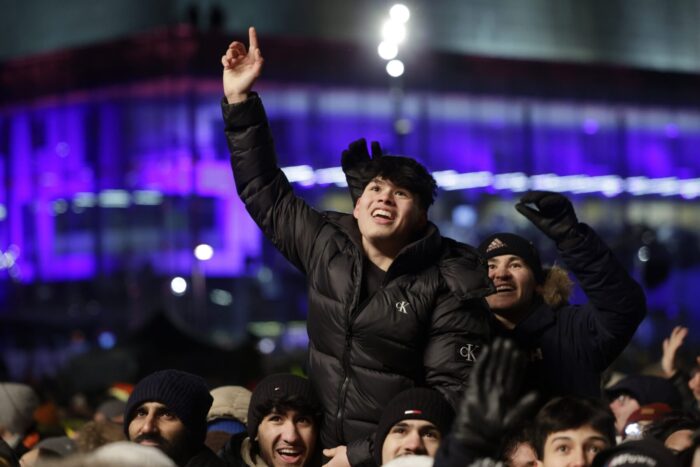
Boys celebrating in a huge crowd in the evening light of Helsinki

Helsinkians congregate to celebrate New Year’s Eve and make resolutions that they may or may not remember later.

An indispensable part of New Year’s Eve for many Finnish people is fireworks. Sold in stores between Christmas and New Year’s Eve, they can only be used from 6 pm on December 31 until 2 am the next morning. At six o’clock you’ll notice a few displays of roman candles, bottle rockets and firecrackers. The frequency increases during the evening until the grand finale at midnight, when a spectacular amount of private fireworks are set off. Various towns, organisations and companies arrange public pyrotechnic shows that light up the sky.

On several occasions, I’ve watched this magnificent spectacle from the roof of an apartment building or the top floor of an office building. The best view I’ve experienced was from the Atelier Bar at the summit of the Torni Hotel (torni means “tower”). I had to arrive very early and wait for over an hour outside in the cold on the large balcony. Fortunately, the show was worth it.

National celebrations often take place on Senate Square in Helsinki. However, in recent years the focus has been shifting to Kansalaistori (Citizens’ Square), the plaza between the Music Centre and the Oodi library building.

Huge crowds gather to listen to speeches by the Mayor, the Bishop and other dignitaries, although I’m not sure if people are actually listening. There are live performances, light shows and singing. Even though it can be extremely cold, people are very enthusiastic and happy to be there. The event is televised and finds its way into many households and bars throughout the country.

When the clock strikes midnight, people say, “Hyvää uutta vuotta!” (“Happy New Year” in Finnish) or  “Gott nytt år!” (in Swedish, also one of Finland’s official languages). They toast each other with champagne or beer, shake hands, hug, kiss and say nice things to each other. Of course, most people want to start the new year on the right foot. So they make the usual resolutions, which they may not remember later, or may pretend not to remember.

A future made of molten tin

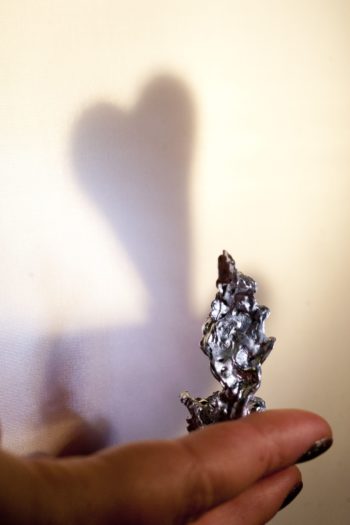
A person holding a piece of melted tin; the tin making a heart-shaped shadow on the wall.

In a Finnish New Year’s Eve tradition, melted tin is poured into a bucket of cold water. The resulting random shape is interpreted to predict a person’s future. Photo: Seppo Sirkka/Lehtikuva

One fun Finnish tradition is melting tin. Miniature tin horseshoes are melted in a pan and poured into a bucket of cold water. As the tin hits the water, it cools and instantly resolidifies. The resulting random shapes are then interpreted to predict a person’s future health, wealth or happiness. Whenever I’ve participated in this type of fortune telling, I’ve received only positive news. In fact, everyone else did as well.

All this partying is hard work and gives you a hearty appetite. Normally, those revellers who have continued into the wee hours of the morning eat potato salad, sausages or something salty. One popular snack is Jansson’s Temptation, a casserole made of potatoes, onions, sprats or anchovies, bread crumbs and cream. Delicious!

On New Year’s Day, Finns like to sleep in late. Many will wake with an urge to take a pain reliever. However, others are up at the crack of dawn spending the first day of the year skiing, strolling through the park or getting some fresh air in a forest. It goes without saying that coffee is consumed in record quantities this day.

Popular programmes on TV include the President’s speech, the Vienna New Year’s Concert, and vintage Finnish movies. Later in the day, many people like to have a good meal. This is a great time to savour traditional Finnish fare such as fish dishes or a meat stew.

Some Finns feel this is a fine day to take it easy, but others think they should start the year’s first evening with a bang. Let’s party some more!

By Russell Snyder

Finnish Christmas markets brighten winter

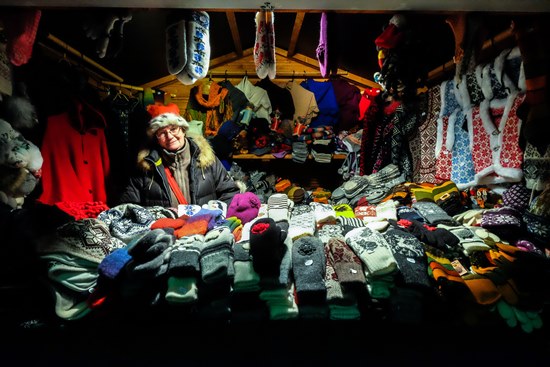
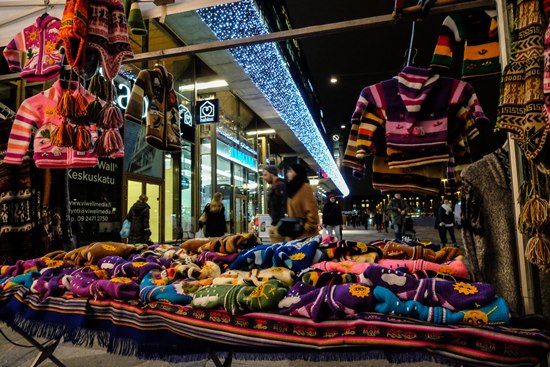
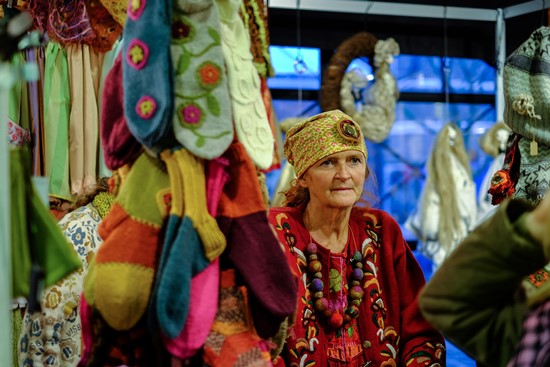
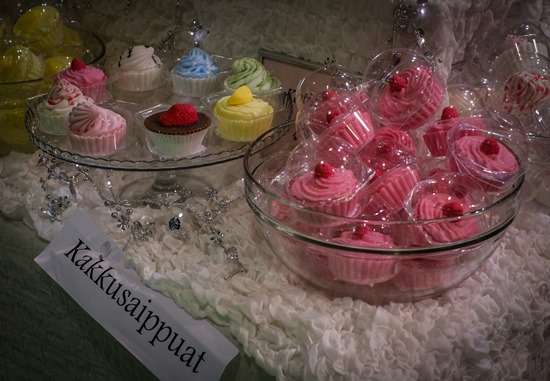
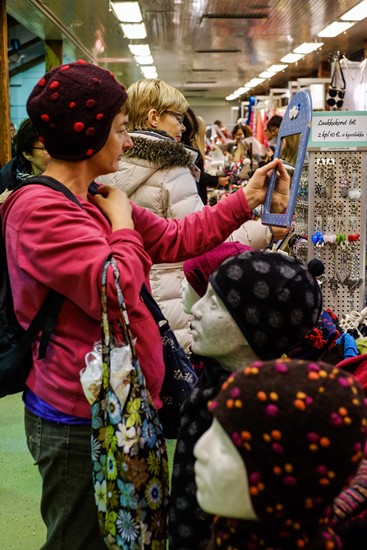
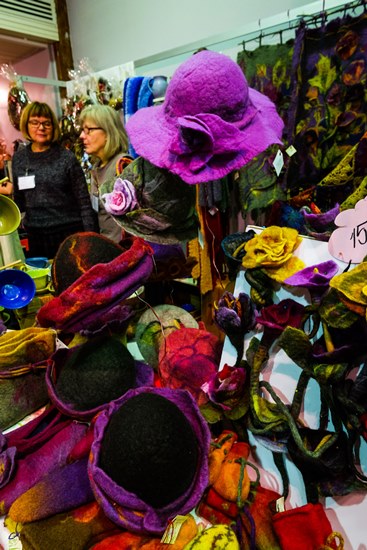
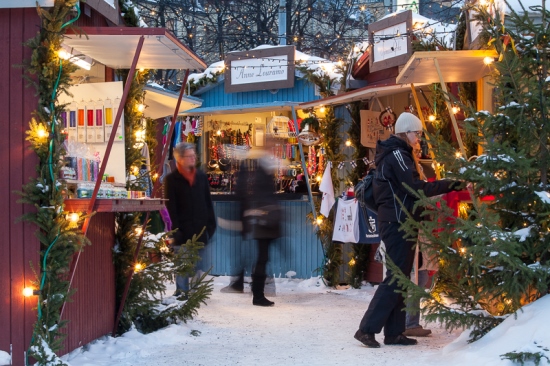
Christmas markets are in vogue across Europe, but in Finland they form a long-time tradition. It’s a great time for local artisans to brighten up the early winter with their brilliantly coloured handicrafts. (See our slideshow below.)

A visit to one of Helsinki’s various Christmas markets is one of the traditional preparations for the festive season in the Finnish capital. In late November the crowds gather on Senate Square, where the city has put up a massive Christmas tree, to watch the lights go on as the Christmas season is officially opened. A couple weeks later, food and crafts stalls open on the square itself for Saint Thomas’s Market .

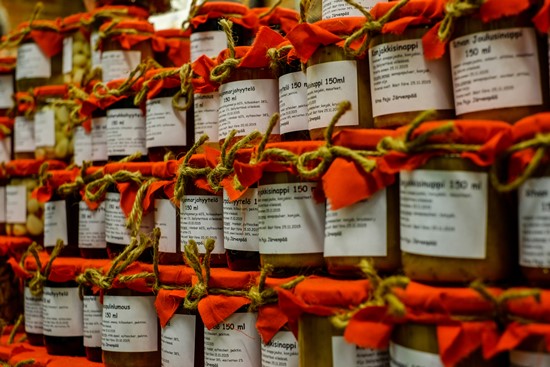
At the other end of Alexander Street, the stalls by the Three Smiths statue offer a daily fare of hand-knitted socks, felt slippers, hats and home-made conserves. The Women’s Christmas Fair at Wanha Satama Trade Fair Centre dates back a century to a time when women took what was a rare opportunity to make money for themselves.

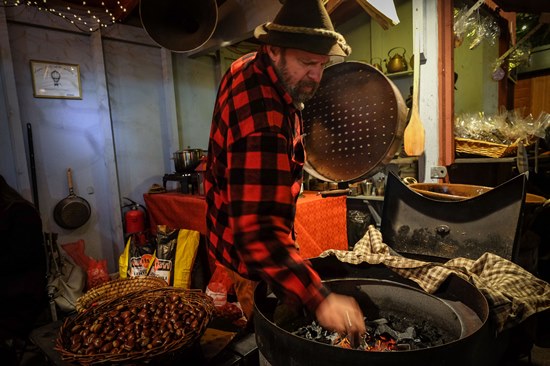
Christmas fairs and markets thrive in Finland’s other towns and cities, not only the capital. The aroma of glögi (Glühwein or mulled wine) fills the chilly air, brass bands play favourite carols and the flames of outdoor candles fill the town squares with the illusion of warmth. In these moments it’s easy to believe that Christmas was made especially for Finland.

Brilliant Christmas colours

Text and photos by Tim Bird

Top 5 Finnish Christmas foods

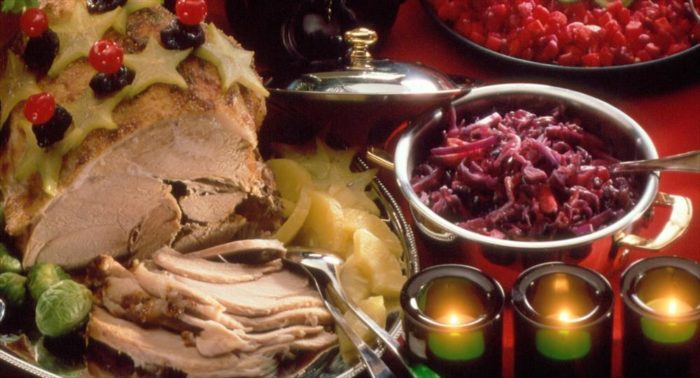
1. Baked ham (Kinkku)

A baked ham on a table with some sides and candles.

Photo: Visit Finland

The undisputed winner was baked ham, king of the Finnish Christmas dinner. Most Finns could not imagine Christmas without ham. Slowly baking the ham in the oven is one of a Finnish Christmas ritual. Ham tastes best with homemade mustard. Any leftover ham is usually added to pea soup after Christmas. Delicious!

2. Rutabaga casserole (Lanttulaatikko)

A rutabaga casserole with some salad on the side.

Photo: Visit Finland

Surprisingly, number two was rutabaga casserole. All the Christmas casseroles were popular, but this one topped them all. Casserole dishes, Finnish cuisine at its best, can easily be prepared a few days in advance.

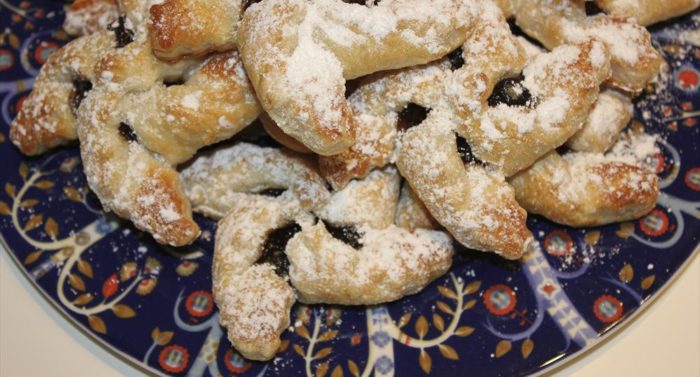
3. Christmas pastries (Joulutorttu)

A pile of pinwheel-shaped Christmas pastries coated with powdered sugar.

Photo: Jaana Rantala/Visit Finland

Who could resist these pastries filled with plum jam? Of all the Christmas desserts, these were the overwhelming winner among our readers. The aroma of freshly baked pastries goes a long way towards getting you in the Christmas spirit. Dust your star-shaped delights with powdered sugar when they have cooled off. Eat, enjoy and repeat!

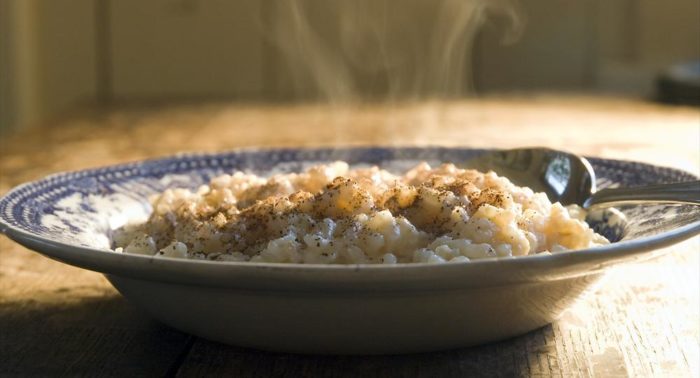
4. Rice porridge (Riisipuuro)

A steaming plate of rice porridge topped with cinnamon.

Photo: Päivi Niemi/Visit Finland

What could be more comforting than bowl of steaming rice porridge? Usually the porridge is served with sugar and cinnamon on top. Some prefer it with a fruit broth known as “fruit soup.” Traditionally an almond is hidden in the pot of porridge. Whoever finds the almond in her or his serving gets to make a wish. Sometimes rice porridge is served for breakfast.

5. Gingerbread cookies (Piparkakut)

Gingerbread cookies on a wooden surface.

Photo: Taru Rantala/Visit Finland

The scent of cinnamon, cloves and nutmeg is inseparable from Finnish Christmas. It comes from baking gingerbread cookies. The dough is delicious by itself, especially if you ask your children. How much of it actually makes it to the oven without getting eaten? Many of our Facebook readers mention that they drink warm glögi (mulled wine) with their cookies.

By Tiina Krook, December 2014

Toasting Finland’s Jean Sibelius at 150

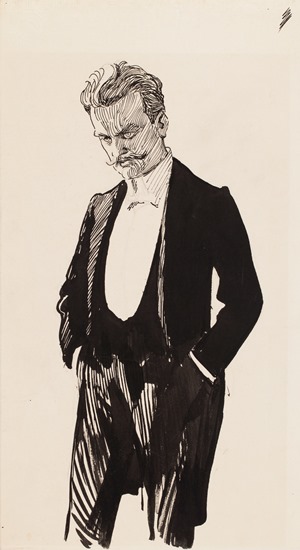
3541-1645-albert-edelfelt-saveltaja-jean-sibelius-yehia-eweis-550px-jpg

Albert Edelfelt’s undated work “Composer Jean Sibelius”. Photo: Yehia Eweis/Finnish National Gallery

Finnish Music Day is held on December 8, the birthday of composer Jean Sibelius. In 2015, the 150th anniversary of his birth is celebrated all year with events in Finland and around the world, from Iceland to Swaziland.

Born in 1865, Jean Sibelius lived a long and colourful life, surviving to the age of almost 92 despite a fondness for cigars and alcohol. He published no major works after the age of 61, and is believed to have burned his nearly complete Eighth Symphony in 1945. By then he had become the best-known Nordic composer – and the world’s best-known Finn. His status is being celebrated and revisited throughout 2015.

Cellist Jussi Makkonen’s “Return to the Landscapes of Sibelius’s Honeymoon” (premiere Jan 18, 2015) forms part of the celebrations in 2015, the 150th anniversary of Sibelius’s birth.

The jubilee year kicks off on New Year’s Day in Hämeenlinna, where he lived until he was almost 20. The town also hosts exhibitions, a festival (September) and an international congress (December).

Around the world, from São Paulo, Brazil to Melbourne, Australia, hundreds of Sibelius concerts, festivals, competitions and exhibitions are being held, and myriad books and albums are being published.

In Finland, events include cellist Jussi Makkonen’s Return to the Landscapes of Sibelius’s Honeymoon. It premieres on January 18 in Järvenpää, 40 kilometres north of Helsinki, near Sibelius’s former home, Ainola, which is now a museum. A Järvenpää Art Museum show focuses on the great man’s crucial partner, his wife Aino Sibelius (March–October).

In Turku, conductor Leif Segerstam leads a Sibelius Marathon (December). In Helsinki, the National Opera stages Tero Saarinen’s choreography set to Sibelius’s symphonic choral work Kullervo (February–March) and the National Museum unveils an exhibition (starting in October).

Notorious parties

3541-1780-enckell-magnus-musiikkia-1906-yehiaeweis-550px-jpg

Magnus Enckell’s “Music” (1906) forms part of Ateneum’s exhibition drawing connections between composer Jean Sibelius and the visual art world. Photo: Yehia Eweis/Finnish National Gallery

Helsinki’s Ateneum Art Museum displays Sibelius and the World of Art until March 22, 2015. The exhibition’s evocative multimedia experience includes famous Finnish paintings and music.

Sibelius formed close ties to artists such as Akseli Gallen-Kallela. In the 1890s, they held notorious parties at Helsinki’s Kämp restaurant, sometimes lasting for days. Between toasts, they discussed the budding Finnish nation and the essence of art.

“Inspiration went both ways: music inspired artworks, and art inspired Sibelius,” says Anna-Maria von Bonsdorff, chief curator of the Ateneum show. “Sibelius and Gallen-Kallela shared a new concept of art, Gesamtkunstwerk [a German term meaning ‘total work of art’ or ‘all-embracing art form’], which was a leading idea within symbolism. Both were particularly inspired by the Finnish national epic, the Kalevala, from the 1880s through the 1920s.”

Sibelius was said to be gifted with synesthesia – “seeing” his own compositions and other music as visual works of art in his mind. According to his close friend and biographer Karl Ekman, “every impression of sound was transferred and fixed as colour on the retina of his eye.” Appropriately, the artwork in the show is accompanied by a tailored soundtrack, selected and sometimes played by Finnish pianist Folke Gräsbeck.

By Wif Stenger, December 2014

Finns bring new twist to simulation games

“I was introduced to the man’s world at an early age,” jokes Mariina Hallikainen, CEO of Colossal Order. “Since I was the only girl in school who chose woodwork over knitting and joined the so-called ‘boys’ crafts’ class.”

A few years ago Hallikainen ventured into another male-dominated field: gaming. She now heads the game development studio that created Cities in Motion, a mass transit simulation game that allows players to build and manage transportation networks in different cities. Colossal Order’s next release is Cities: Skylines, in which players build their own cities.

Hallikainen’s team worked on a 100-year timeline for the first version of Cities in Motion in 2009. “We went back to history from 1920 and tried to make accurate settings in the limits of a game,” says Hallikainen. That effort paid off, attracting interest from gaming communities.

The company created a sequel, Cities in Motion 2, by upgrading technology in 2013, adding new features and integrating smooth navigation mechanisms based largely on feedback from public transportation and simulation enthusiasts’ forums. “I spend time every day on the forums, checking what players have to say,” says Hallikainen, highlighting the importance of consumer engagement.

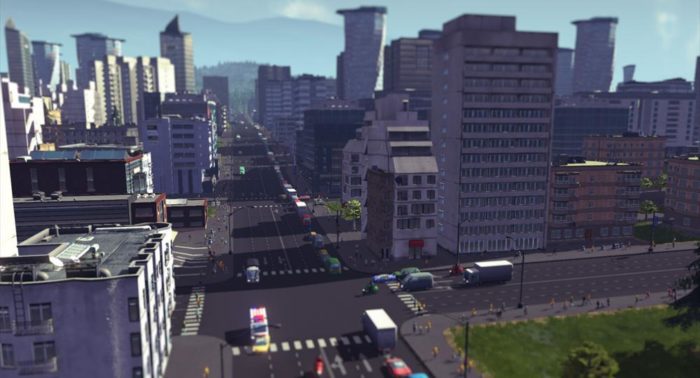
Screenshot: Colossal Order In “Cities: Skylines,” players build their own cities.

Screenshot: Colossal Order In “Cities: Skylines,” players build their own cities.By Asha Gopalkrishnan, December 2014

Created for the players

Meeting expectations isn’t child’s play, as many creative minds are working simultaneously. “Game designers want the games to be a particular way and programmers have to create it accordingly for the player,” says Hallikainen.

She wears many hats – marketing, sales, human resources and finance: “I’m really good with money and can make things happen with very small budgets.”

That’s a key trait for entrepreneurs who are constantly innovating. In the words of Elina Arponen, founder of Tribe Studios, “As an entrepreneur, you have to see the relationships between things and phenomena that you didn’t see before.

Driven by curiosity to understand how computers can be used to create human bonds, Arponen chose to study computer science and eventually came up with Dramagame – a technology for creating multiplayer learning and entertainment simulation games with social storylines.

The idea, Arponen says, is to encourage and enable people to interact in various social environments. Using gaming as a platform, she presents a mixed bag of social situations ranging from a fantasy spy tale to real, work-related events. “The subject matter of the game dictates the environment and the characters,” says Arponen.

A variety of talent

Just act natural: Players convene in the Dramagame creation Velvet Sundown.

Just act natural: Players convene in the Dramagame creation Velvet Sundown.Screenshot: Velvet Sundown

Her journey so far has had a few inevitable bumps. Arponen explains that while designing the game at first, the biggest problem was dealing with the complexity of multiplayer conversations. “If you have five characters interacting, it easily makes tens of millions of different variations and it’s not humanly possible to cover the whole spectrum,” she says.

To counteract that, Tribe Studios created a testing tool that ran through the story scripts and possible combinations before games were released. Arponen says that the current hitch lies in dealing with the long sales cycles of consumers in the training industry. But she is undeterred: “You have to get out of your comfort zone.”

For many women entrepreneurs, that comfort zone lies in stereotypical business ventures. As Hallikainen aptly sums it up, “We must break gender-defined roles to usher in a variety of talent in varied fields.”

 By Asha Gopalkrishnan, December 2014