Pop, rap, techno and yoik: Festival in the far north of Finland spotlights Sámi music, culture and languages

Every music festival is about more than just the music. The best ones also create a welcoming atmosphere for fans and friends who come from near and far to hang out with each other as well as see the bands. The event has a place in the local culture while also claiming attention on the world stage.

These things are even truer of Ijahis Idja (Nightless Night) than they are of most other festivals. It’s an annual Indigenous music fest that takes place in Inari, a town in the far north of Finland, almost 1,200 kilometres (750 miles) from Helsinki.

Inari is also located in Sápmi, the homeland of the Sámi, the only recognised Indigenous People in the EU area. (Sápmi is divided into four parts by the borders of the nation-states Finland, Sweden, Norway and Russia.)

Rising volume
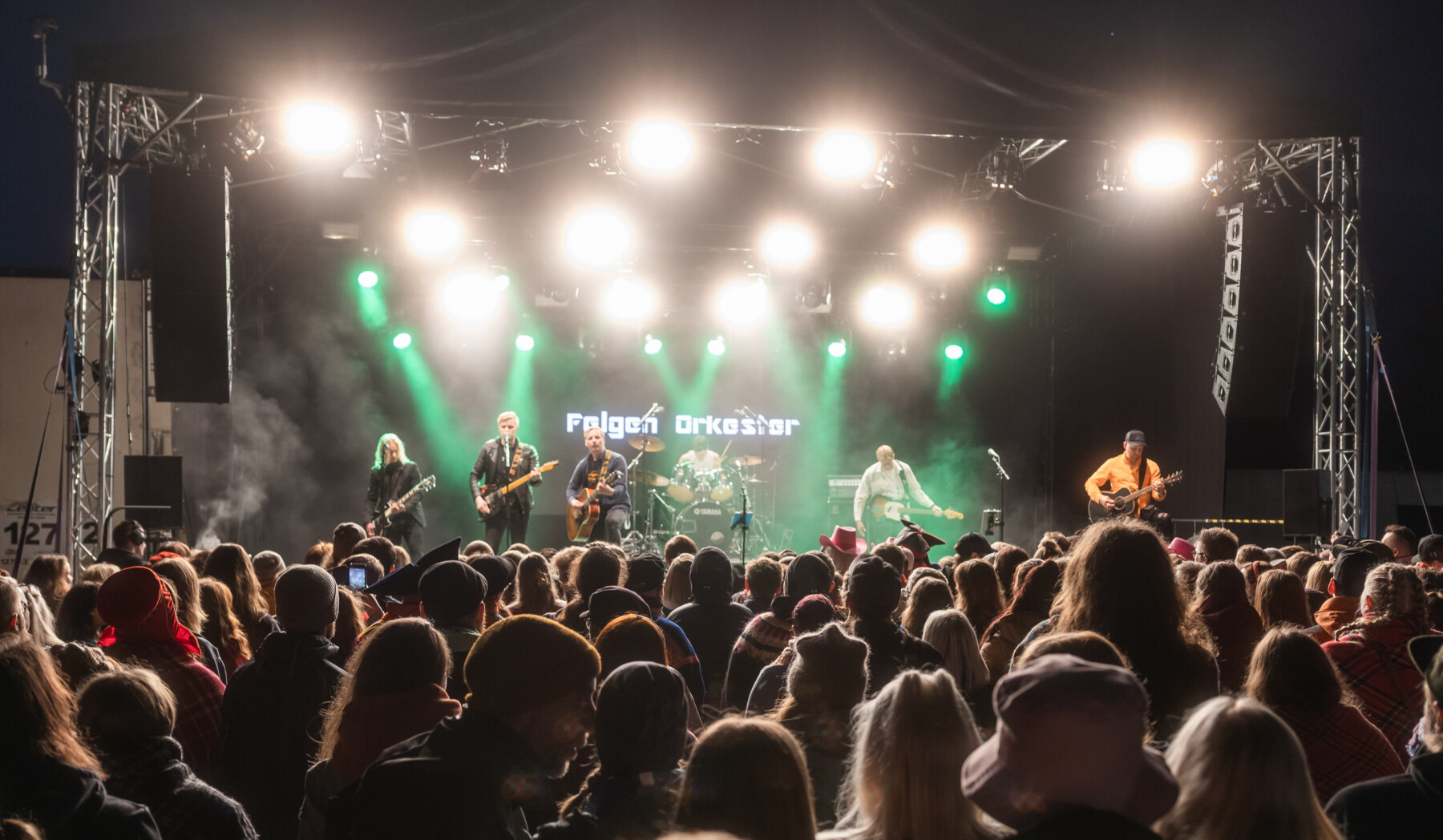
At an outdoor night concert, a crowd watches a band consisting of five guitarists and a drummer.

Felgen Orkester, a folk rock outfit from the Norwegian side of the border, performs an energetic set for the Ijahis Idja audience.Photo: Ville Fofonoff

Ijahis Idja features Sámi music in mid-August on an open-air stage in front of Sajos, the Sámi cultural centre. The midnight sun of midsummer has subsided, but the northern days still last long into the evening. The weather could be summery, but it is more likely to carry the chill of early autumn.

Since the festival’s inception in 2004, it has come to serve as a meeting point of cultural significance, attracting an audience from across Sápmi and from the south, too. (Just about everywhere is in the south when you’re standing in downtown Inari – even Ivalo Airport, the northernmost in the EU, is about 50 kilometres (30 miles) to the south.)

Festival visitors mill around between performances, greeting each other, shaking hands and catching up. There are young families around during the day. Later on, the volume level rises as the sky fades to twilight, and a crowd with everyone from teens to old-timers applauds the artists and dances to the music.

Musical crossroads
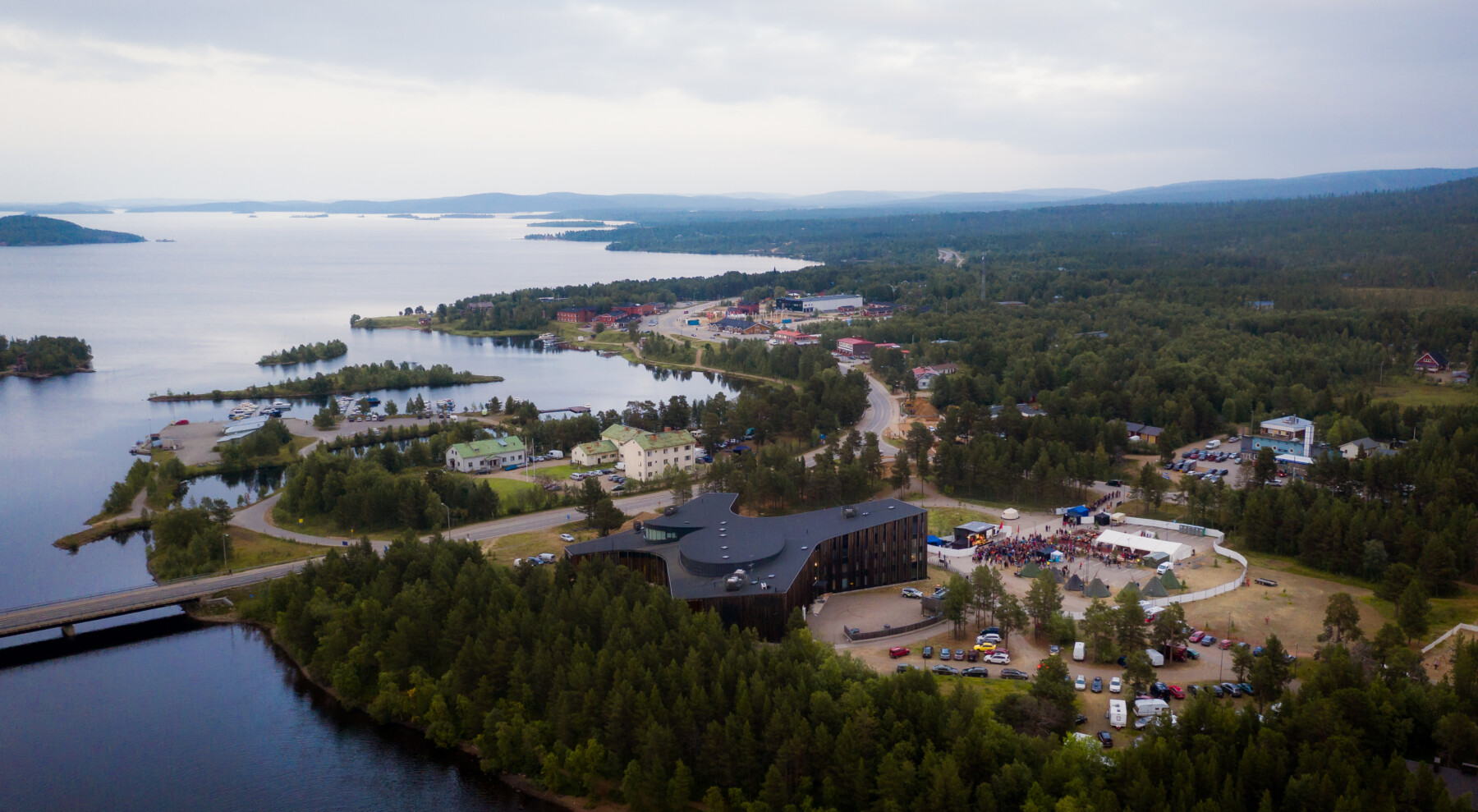
An aerial photo shows several clusters of buildings along the shore of a lake that stretches to the horizon.

The Sámi cultural centre Sajos (centre) stands on the outskirts of Inari, which is located on the shore of the vast Lake Inari.Photo: Ville Fofonoff

You’ll hear people in the audience speaking Sámi languages as well as Finnish, along with dashes of Norwegian, Swedish, English and others. The bands sing mainly in Sámi languages. (Ijahis Idja sometimes features Indigenous musicians from other continents, as well.)

In any given year, the lineup is likely to include Sámi rap, pop, folk rock, techno and more – there’s no single genre that encapsulates Sámi music. The traditional Sámi vocal music called the yoik is ever-present, in solo performances without instrumental accompaniment and in bands of all types. Most of the groups you’ll see at Ijahis Idja make use of yoiks or yoik-influenced vocals, creatively integrating them into their own modern sounds.

Communication between people
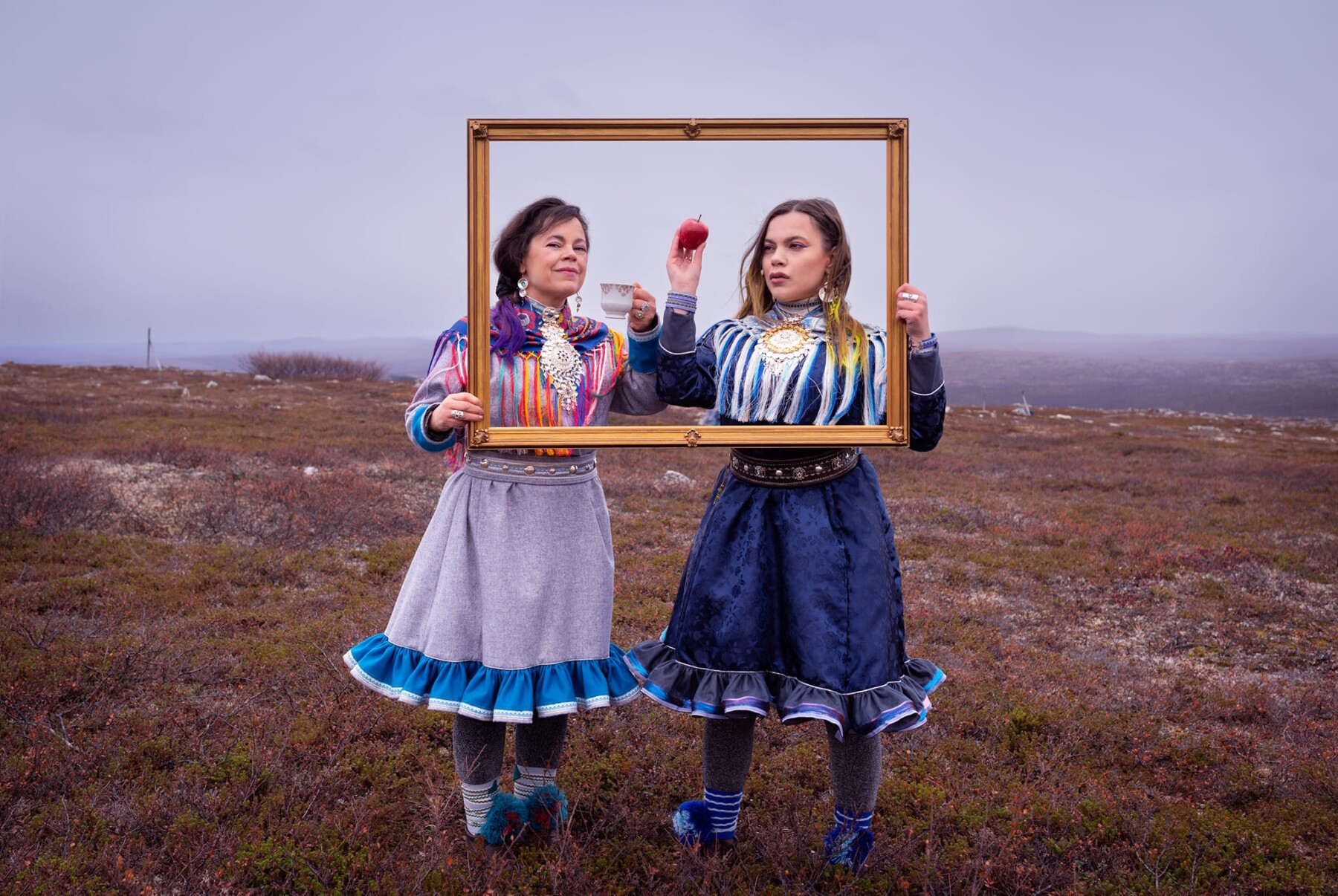
Two women in ornate dresses pose outside with mountains in the background, holding an empty picture frame up in front of their heads and shoulders.

Ulla Pirttijärvi (left) and Hildá Länsman connect traditional and modern Sámi culture with pop and global music influences in their band Solju.
Photo: Marja Helander

Ulla Pirttijärvi (born in 1971) and her daughter, Hildá Länsman (born in 1993), are vocalists in the group Solju, and Ijahis Idja veterans. Pirttijärvi even performed in the inaugural edition of festival in 2004.

Solju connects traditional and modern Sámi culture with pop and global music influences. Their album Uvjamuohta (powder snow) won International Indigenous Recording of the Year at Canada’s Summer Solstice Indigenous Music Awards in 2023.

Originally, “yoiks were not stage performances,” says Pirttijärvi. “It’s a form of communication between people. It’s strongly community-centred – a way of expressing your identity and fellowship with the community, the family and the region.”

Yoiks include words, but also other vocalisations. “You can also teach children various things through yoiks,” she says. They can contain history, for instance, or communicate sorrow or happiness, or convey the story of nature and weather on a certain mountain.

Diverse styles
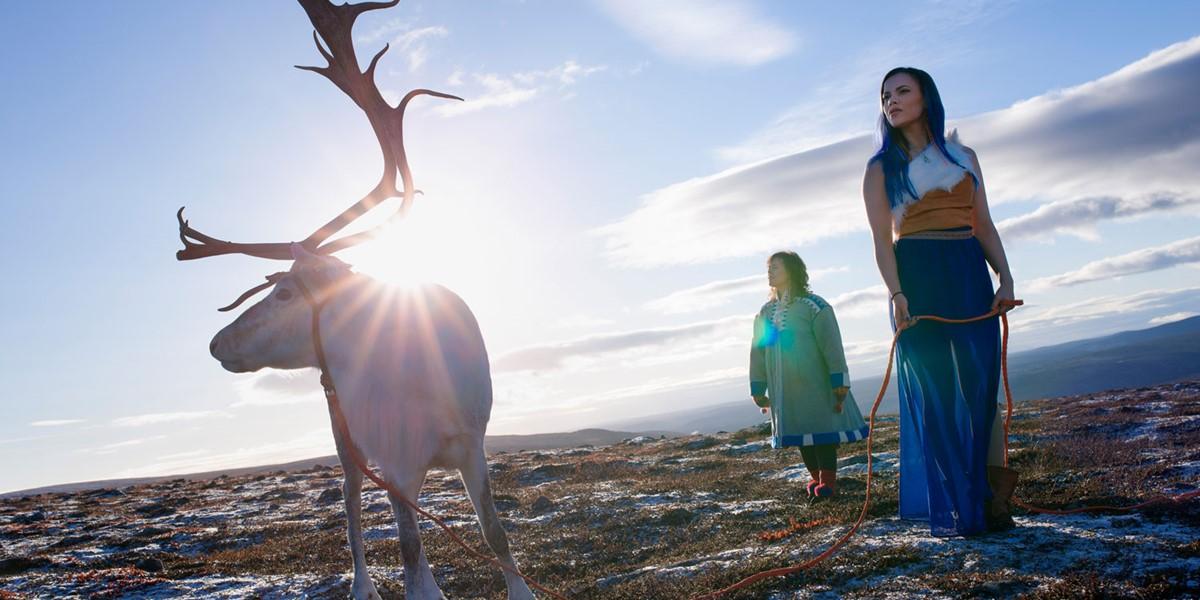
Outside with mountains in the background, two women in ornate dresses pose near a reindeer with large antlers.

For both Hildá Länsman (right) and Ulla Pirttijärvi, Solju is one of several musical collaborations. The reindeer is an animal that holds cultural significance for the Sámi.Photo: Marja Helander

Länsman and Pirttijärvi’s other musical endeavours also combine yoiking with diverse styles. Länsman appears in the prog-rock outfit Gájanas; with Finnish accordionist Viivi Maria Saarenkylä in the duo Vildá; and in a project with sound designer and electronic musician Tuomas Norvio. Pirttijärvi’s collaborations include the groups Ulda, billed as modern Sámi music, and Áššu, based on traditional yoiks but including African musical influences.

Pirttijärvi lives in Utsjoki, another 125 kilometres (75 miles) north of Inari, on the Norwegian border. Länsman grew up there and recently relocated to Norway. Northern Sámi – their family’s first language – is widely spoken on both sides of the border at those latitudes.

Feeling a connection
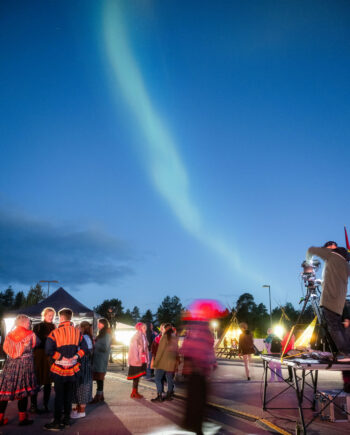
A green band of light is visible in the twilight over the festival, where a bunch of people are standing and talking.

The famously unpredictable Northern Lights sometimes make an appearance at Ijahis Idja.Photo: Ville Fofonoff

Pirttijärvi went to school near Inari, where they had “several lessons a week” in Sámi, and the rest in Finnish. In Utsjoki, Länsman attended school in Northern Sámi, although some high school subjects were offered in Finnish for lack of Sámi-speaking teachers.

Later, she spent a couple years in the global music department at the Sibelius Academy in Helsinki. It was an opportunity to explore various styles and get a feel for how she might adapt them to yoiks and Sámi music. “You grow as a person, of course, but it’s also a musical exploration,” she says.

One experience that stood out was taking lessons in Bulgarian-style singing. “I can feel a connection and relate to music that comes from far away,” says Länsman.

Like a dream
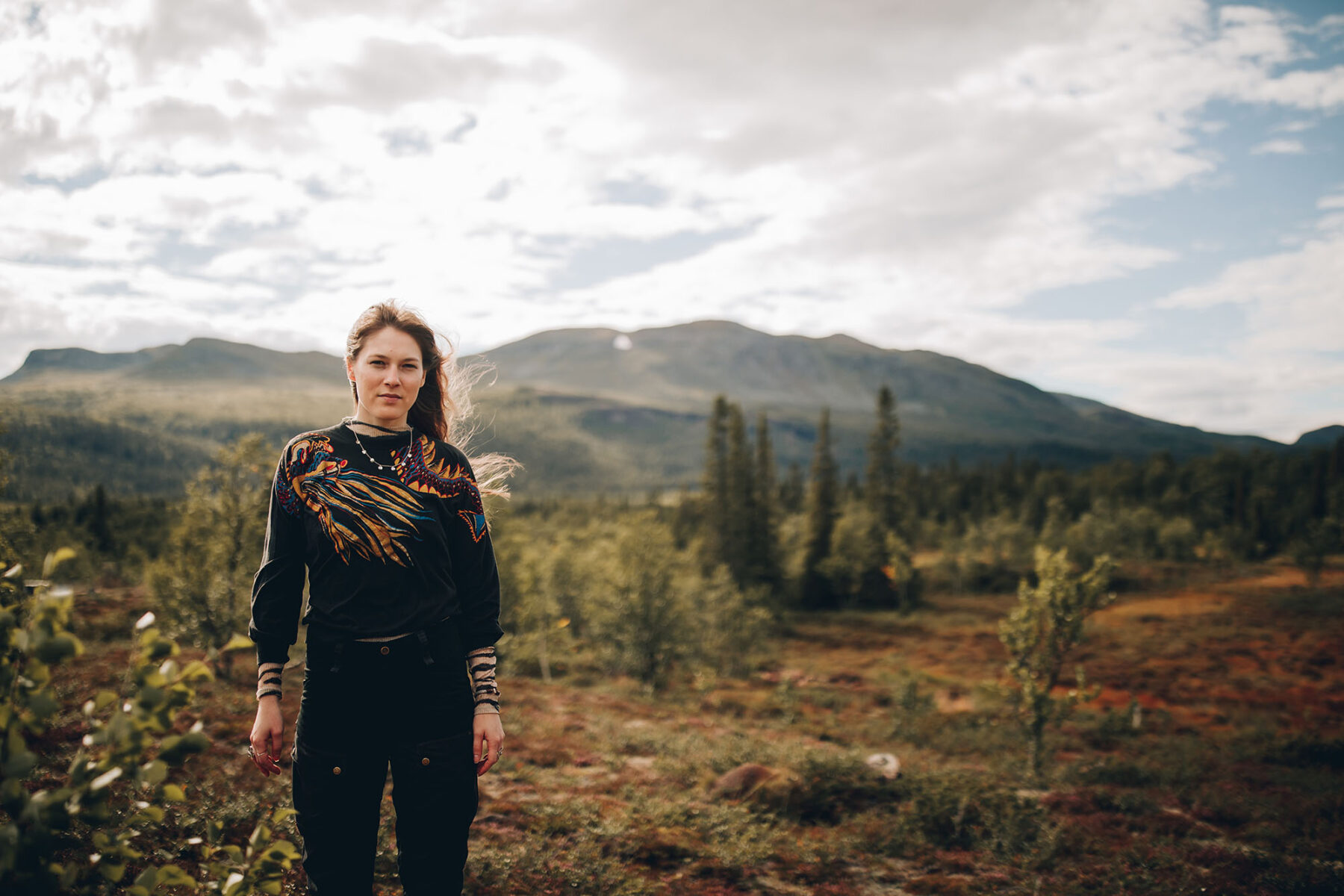
A woman poses in a landscape with mountains in the background.

Katarina Barruk grew up speaking Ume Sámi.Photo: Sara Berglund

Ijahis Idja is one piece of the continuing vitality of Sámi culture and languages.

About 2,500 speakers of Northern Sámi live in Finland, with some 25,000 more in Norway and Sweden. It’s the largest of the fewer than ten Sámi languages still spoken. The two others in Finland, Skolt Sámi and Inari Sámi, have several hundred speakers each.

Musician Katarina Barruk (born in 1994) comes from a family whose home language is Ume Sámi. It is spoken by an estimated 100 people in the area of northern Sweden where she grew up. Her songs combine elements of pop, improvisation and yoiking; she sings in Ume Sámi. She and her band have performed all over the Nordic countries, including Ijahis Idja, and in continental Europe.

Sámi languages are separate languages, not just dialects. Speakers of different Sámi languages can understand each other to varying degrees. That makes it even more poignant for Barruk when audiences learn her lyrics and sing along at her concerts.

“It’s really moving,” she says. “To hear Ume Sámi, and to hear it from others – it’s supercool. That was like a dream when I was little, that this could happen. There wasn’t anything like that for me to listen to when I was little.”

Distinct goal
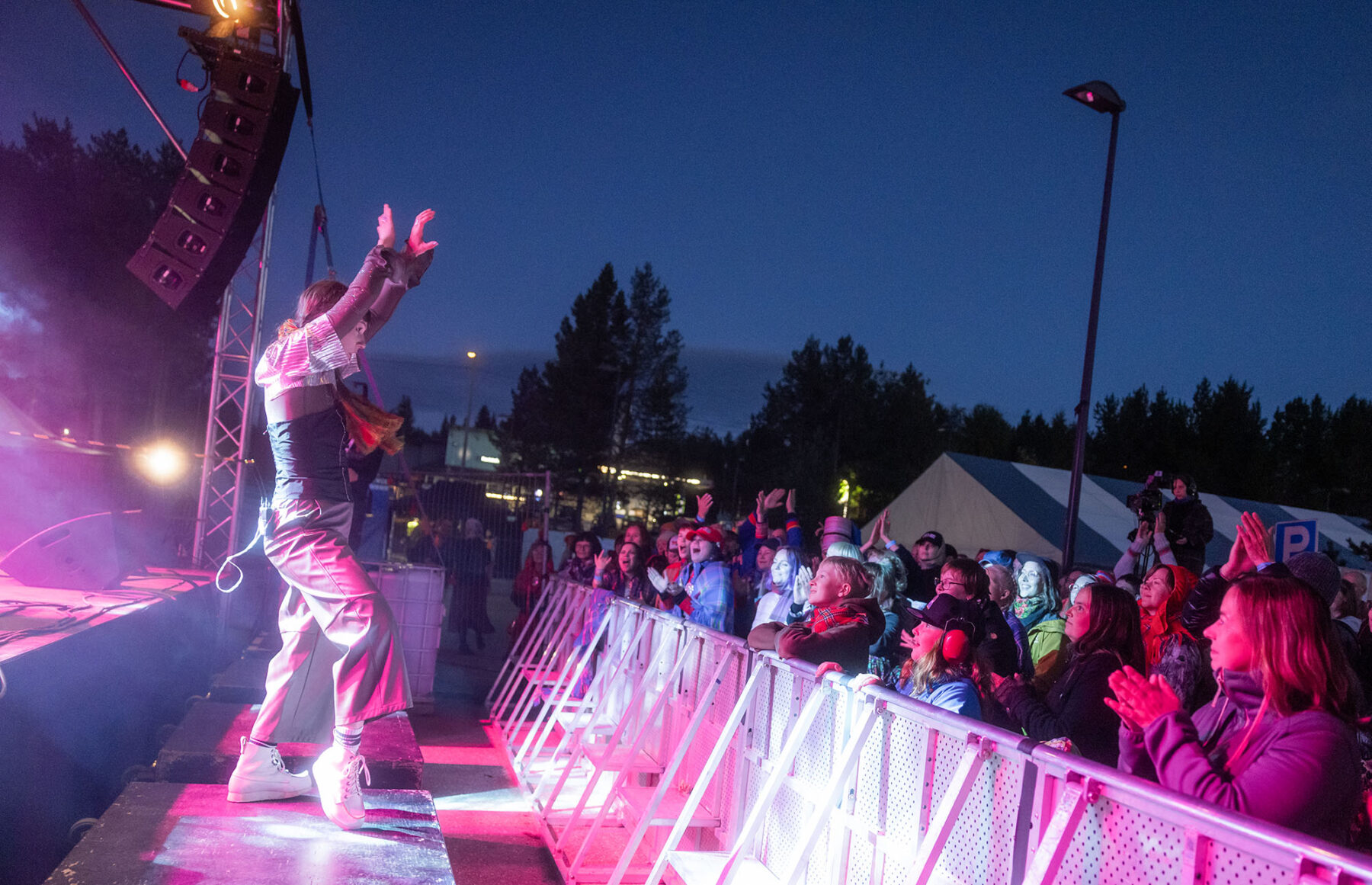
In dark twilight, a woman on an outdoor stage dances in front of an enthusiastic crowd of listeners.

Katarina Barruk celebrates with her fans during a concert at Ijahis Idja.Photo: Ville Fofonoff

How has her family managed to maintain its language in surroundings that are overwhelmingly Swedish-speaking? “My father was very persistent,” she says. “He just kept going. He and my mother had a very distinct goal.”

For them, the case was clear: “This is our language, and it has to keep living – period,” says Barruk. “So we have fought for it, every day.” Since her late teens, she has been active in various efforts to help Ume Sámi regenerate. She has been a leader at language immersion weekends where people get together and speak Ume Sámi – mainly families, but anyone is welcome. “It’s really great to see their skills develop,” she says.

She also has two “apprentices” in a language mentoring programme. They meet and speak Ume Sámi, with longer sessions becoming possible as the participants build up their knowledge. The same methods have been used elsewhere in Sápmi and the world. In Inari, a similar mentoring system exists for Inari Sámi.

Long journey
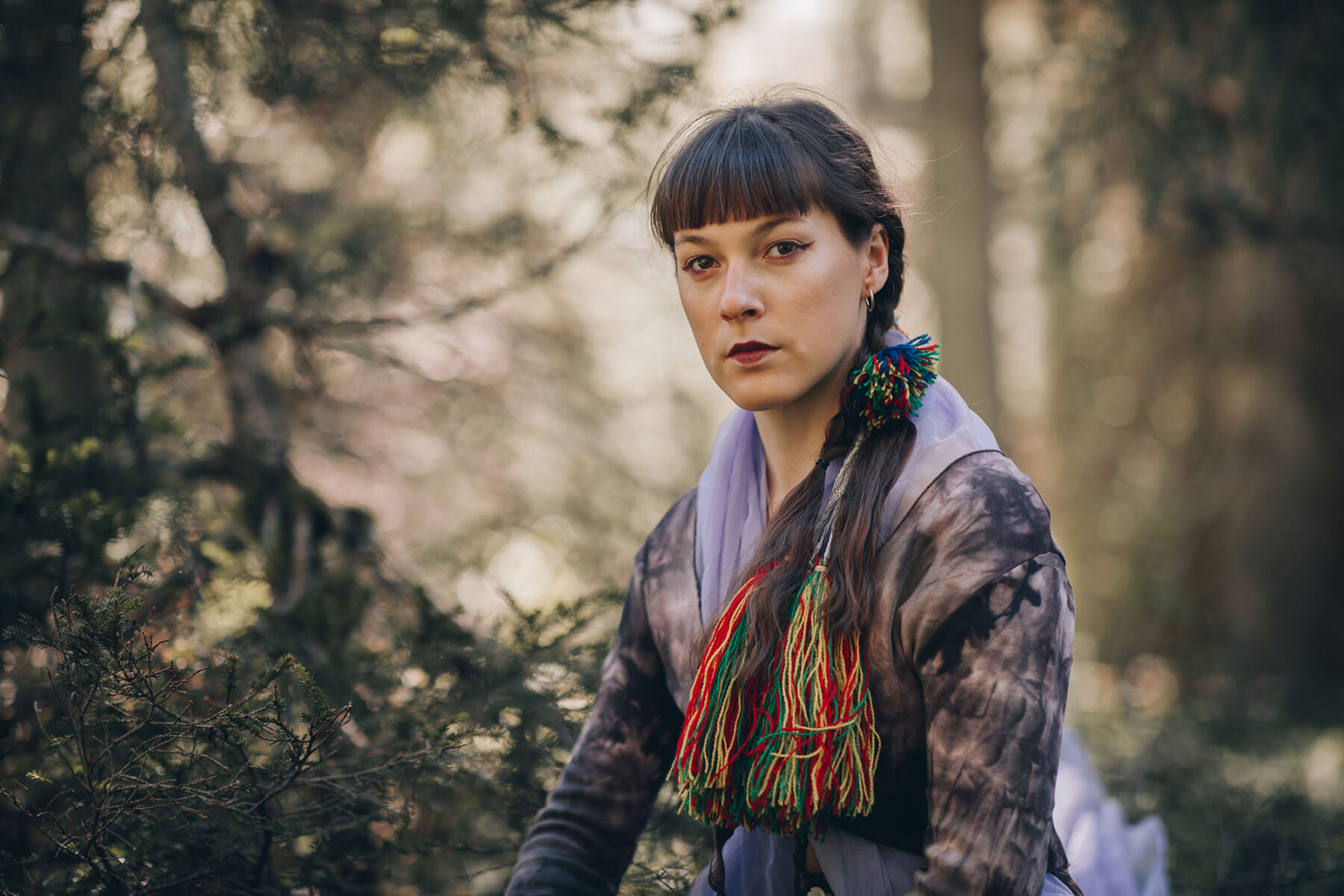
A woman looks into the camera with a serious expression, with a forest in the background.

Katarina Barruk sees her music as one way of helping revitalise the Ume Sámi language.Photo: Sara Berglund

Barruk sees her music as a major way that she is contributing to revitalising the Ume Sámi language. Her yoiking is informed by archival recordings, another path to recovering what might have otherwise become lost. “There are also tons of other influences in my music, because the music I make is not traditional,” she says.

“It’s been a long journey to where I am today. You constantly keep going and trying to make something new. It’s fun to experiment.”

The Ijahis Idja festival organisers do much the same thing. They show off traditional Sámi music and culture while simultaneously highlighting modern bands from across Sápmi that are constantly pushing in new directions – and attracting crowds of fans in the process.

By Peter Marten, August 2024

Finnish university project seeks to understand video game culture

Finland is home to one of the world’s leading hubs for game research, the Centre of Excellence in Game Culture Studies. This joint project between three Finnish universities aims to understand, anticipate and influence the effect games have on culture and society.

“People are spending more and more time on video games,” says Raine Koskimaa, professor of contemporary culture studies at the University of Jyväskylä and vice director at the Centre of Excellence. “They have become a prominent form of entertainment, but also of socialisation and self-expression. They are just as important to our society as other, earlier forms of culture, such as literature or cinema – and that is why we study them.”

Koskimaa has studied digital literature and video games since the 1990s. To him, the question of whether or not games are a form of art that everyone should at least try to experience is a no-brainer.

“When games are used as a form of expression and to depict meaningful human experiences and emotions, they absolutely do fulfil the definition of art,” he says. “Are all games objectively great art or somehow aesthetically pleasing? Of course not, but neither are all movies or paintings.”

To Koskimaa, the allure of video games currently lies in how accurately and observantly they depict today’s technology-obsessed world.

“In a video game, the player’s every move and decision is being tracked by technology. In that sense, games are the best way to represent the algorithm-driven era we live in, and as such, a great tool for reflecting on what it means to be a part of this modern society.”

By Johanna Teelahti, ThisisFINLAND Magazine 2024

Food first: Finnish festival cuisine emphasises sustainability and artisanal touches

While some festivals still rely on the familiar approach of fried food and hangover-friendly dishes, many are stepping up their game. Master chefs turn their award-winning restaurants into pop-up food trucks, and you can find festival food reviews in the news media.

Some of the venders at Flow Festival, for example, have been Michelin Guide restaurants such as Grön and Shelter. Some Finns even attend music festivals primarily for the food, seeking the perfect bite to eat.

“You can see that many festivals are paying more attention to the food they serve,” says sommelier Toni Feri. He is the cofounder of Let Me Wine, a Helsinki-based natural wine importing agency. “There are more artisanal dishes such as handmade burgers and fewer processed foods, with a focus on sustainable ingredients.”

Indeed, some festivals no longer serve red meat, including Flow Festival and Sideways in Helsinki. Many festivals already track their carbon footprints and invest in locally sourced ingredients.

Food and wine festivals, however, are a completely different ball game – and Finland excels at them too. Take, for example, the country’s largest food festival, Tamperrada, which specialises in pintxos, or bite-sized dishes. Around the country, there are also festivals for burger lovers, garlic enthusiasts and fans of Italian cuisine, as well as for wine connoisseurs.

By Kristiina Ella Markkanen, ThisisFINLAND Magazine 2024

My happy place in Finland

Video: ThisisFINLAND

Small-town magic

In a portrait photo, a sitting woman looks into the camera.

Photo: Outi Törmälä

Futsal star Neide Oliveira moved from São Paulo, Brazil to Imatra, Finland to make the most of her sport with like-minded people.

“I am a shy person but I’m open to the world. I like to experience different cultures and meet new people.

Futsal is my passion. I share tips and thoughts about the sport on social media and have over half a million followers. In 2022, the chairperson of River Vuoksi Futsal Club contacted me and invited me to Imatra, southeastern Finland to play and work for the team. I knew that the Finns were rated the happiest nation, but I also knew about the snow and cold weather during winter. After I gave it some thought, I felt the need to go and see what Finland is all about. It was the right decision for me. Here I can put my passion into making women’s futsal better known.

I live in Imatra, where the population is around 26,000. I literally live in the forest, and I’ve realised that I don’t need much to be happy. When I open the door, there are trees and fresh air. I am so grateful for that. I’ve also made new friends. To relax, I read books or write about my travels. Once a week I disconnect my phone, and sometimes I go to the nearby lake and just sit there. I am so happy I moved here, because I’m connected to nature. In São Paulo there were a lot more people, traffic and noise.

Finland can be cold and dark during wintertime, but people make the most of every day by going for a walk, spending time in nature or going to the sauna. I have learned that happiness doesn’t come by looking. It comes by living.”

Two sides of being

In a portrait photo, a sitting man looks into the camera.

Photo: Outi Törmälä

Vietnamese startup cofounder Jarvis Luong discovered that even running a business can be less stressful.

“I moved to Finland in 2016 to study computer science, and three years ago I cofounded Reactron Technologies. There are two sides to me. One stems from my Asian background, which puts a lot of emphasis on education and professional achievements. I’m always on the way to the next goal.

The other side of me, the personal one, is influenced by Finland. It means that I’m fully content with the current situation. I can sleep until eight or nine and enjoy a slow morning before I start working. I can travel when I want, and I have a loving life partner. I’m happy with my life as it is.

Back home in Hanoi, Vietnam, I followed social media and trends a lot more, which made me often feel like I was missing out. When I had time off, I would usually spend a whole day in a shopping centre with my friends. In Finland, my life is calmer than it was before. I like going on road trips with a group of five friends.

I have visited many remote places, such as Kuusamo [in the northeast] and Kilpisjärvi [in the far northwest of Finland]. We just relax and enjoy a sauna or play board games. I feel peace in nature because I don’t have to think about anything.

Work here is relaxed because people are honest. As a matter of fact, this work environment makes me always feel ready for a new challenge.”

Creative comeback

In a portrait photo, a sitting woman looks into the camera.

Photo: Outi Törmälä

Author Mintie Das has travelled the world, but Finland is the place where her creativity blossomed.

“I was born in India and have lived all over the world. When I was two years old my mother died in a car accident, and my father took me and my brother to the US and raised us as universal citizens. We came to Finland when I was 13, and it ended up being life-changing. I’d never felt such a sense of community before, like I belong.

I love the Finns’ ability to laugh at themselves, and their humble but no-nonsense culture. Here it’s about simple things such as a walk in nature. Happiness is not forced, but true contentment.

I had a successful career in PR in the US, but 13 years ago I divorced, and moved back to Finland to see if it was as good as I remembered. My passion is writing, and here I met amazing editors through work. I learned the art of creative writing and found my voice.

It is a privilege to live here. Education, public transportation, free healthcare, all of these things work. Finns may not approach you, but I have approached everyone and made many friends that way. I also met my husband, a musician, here.

When you move to a new country you can be an outsider or let the culture shape you. When I came to Finland, I started questioning my own values and embraced my creative side. I always say that my heart is Indian, my spirit is American and my soul is Finnish.”

Discovering sisu

In a portrait photo, a sitting woman looks into the camera.

Photo: Outi Törmälä

Living in Finland has made Peruvian Vanessa Cueva Pastor De Valtonen more open-minded.

“I will graduate from nursing school next year. Back home in Lima, Peru, I studied dentistry and was very stressed. I was prepared to be under a lot of pressure here too, but studying is more relaxed, and the flexible schedule has allowed me to work part-time in a hospital.

When I moved here four years ago, it was winter and I couldn’t go outside for more than five minutes because it was so cold. By now, I have adapted to the weather and I go running outside even when it’s very cold. My favourite place is Lapland during winter – it’s amazing how silent and peaceful it is. I think the Finns are happy because of the quality of life, security and gender equality – everyone has the same opportunities. There is also a lot of nature, the work-life balance is good and you get paid vacations. All of those things contribute to happiness.

Living here has changed me in many ways. People are relaxed and always straightforward. I like that attitude. My partner is from Finland and we live in the capital city, Helsinki. The Finns love coffee and I’ve learned to enjoy it too. I often spend time with my friends in coffee shops or walking around the city, but I’ve also learned to appreciate time just by myself.

Living here has made me more open-minded. I find that people can be who they are. I’ve learned the importance of recycling and discovered sisu, the attitude of not giving up. I no longer let minor upsets get me down.”

By Laura Iisalo, ThisisFINLAND Magazine

Spending an idyllic week in a Finnish national park, on a shepherding holiday

One summer morning a few years ago, Tuija Kilpeläinen woke up early, slipped outside with a cup of tea, petted several sheep, went for a swim and then did her yoga routine on the dock.

If that sounds pastoral and idyllic, indeed it was. However, Kilpeläinen does not live on a farm. She and her family were on a Shepherd for a Week holiday in Isojärvi National Park in central Finland.

Metsähallitus, the state-owned enterprise that manages Finland’s national parks, has offered such holidays since 2008. The season runs from May to September.

Some of the locations are quite unique. You can spend a week as a shepherd on a small island in the middle of the Bothnian Bay, between Finland and Sweden. Another possibility is a 19th-century Sámi farm. (The Sámi are the only recognised Indigenous People in the EU area. Their northern homeland, called Sápmi, is divided into four parts by the borders of the nation-states Finland, Sweden, Norway and Russia.)

Sheep shape the landscape

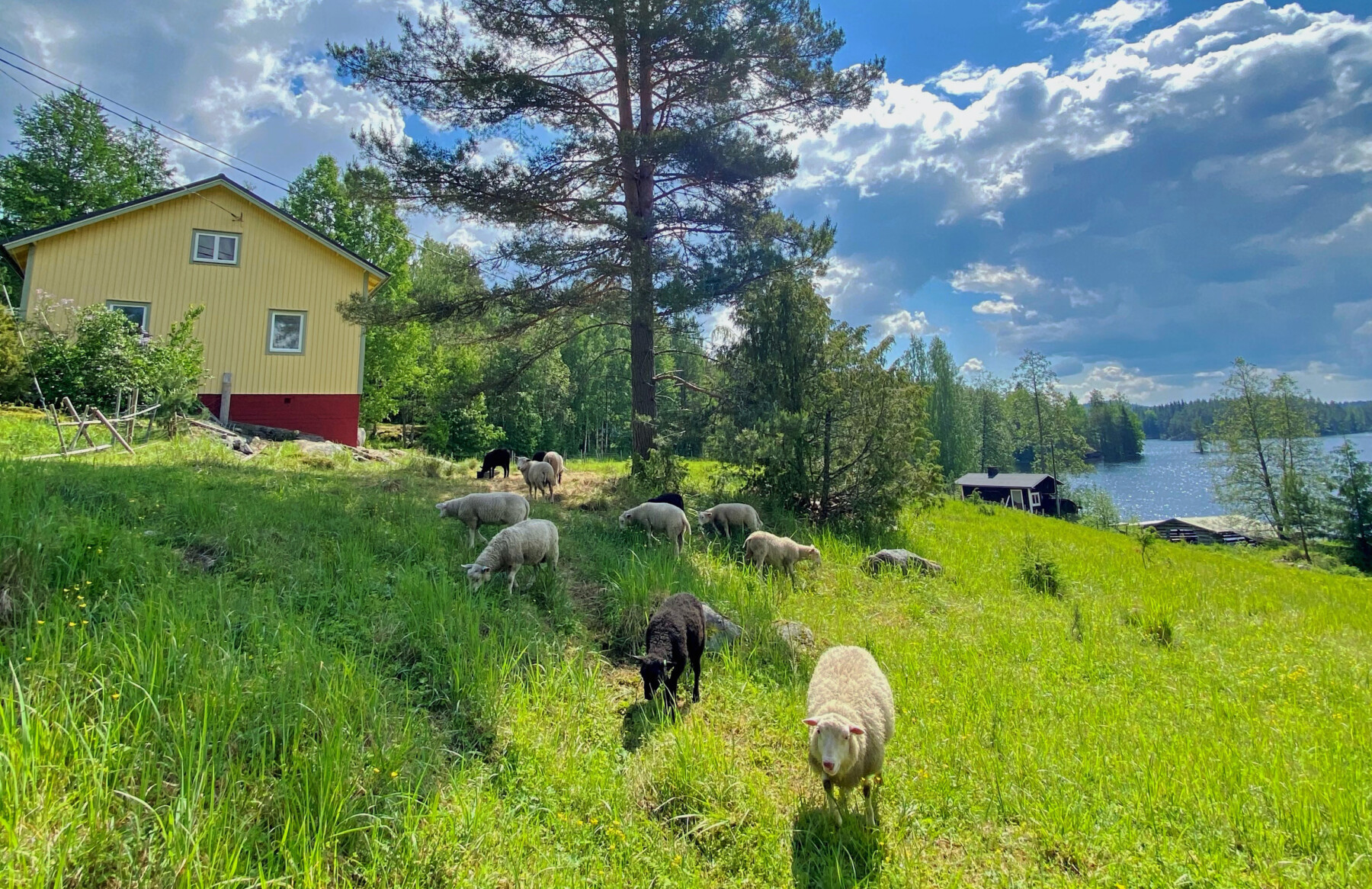
Several sheep are grazing in front of a lakeside house.

Isojärvi National Park in central Finland is one of the locations where Tuija Kilpeläinen and her family have stayed on a Shepherd for a Week holiday.Photo: Pekka Veijola/Metsähallitus

It’s more than just a nice holiday in the country. The greater significance is the maintenance of traditional environments, such as wooded pastures. The grazing animals do a valuable job by keeping the pastures open, providing habitat for many endangered species.

Deputising holiday-goers as shepherds reduces the workload required to ensure the animals’ wellbeing.

No specific skills are required to participate. Daily tasks include counting the animals, checking how well they are doing and making sure they have fresh drinking water. Should there be any problems, the shepherds report them to the animals’ owners.

The luxury of no-frills living

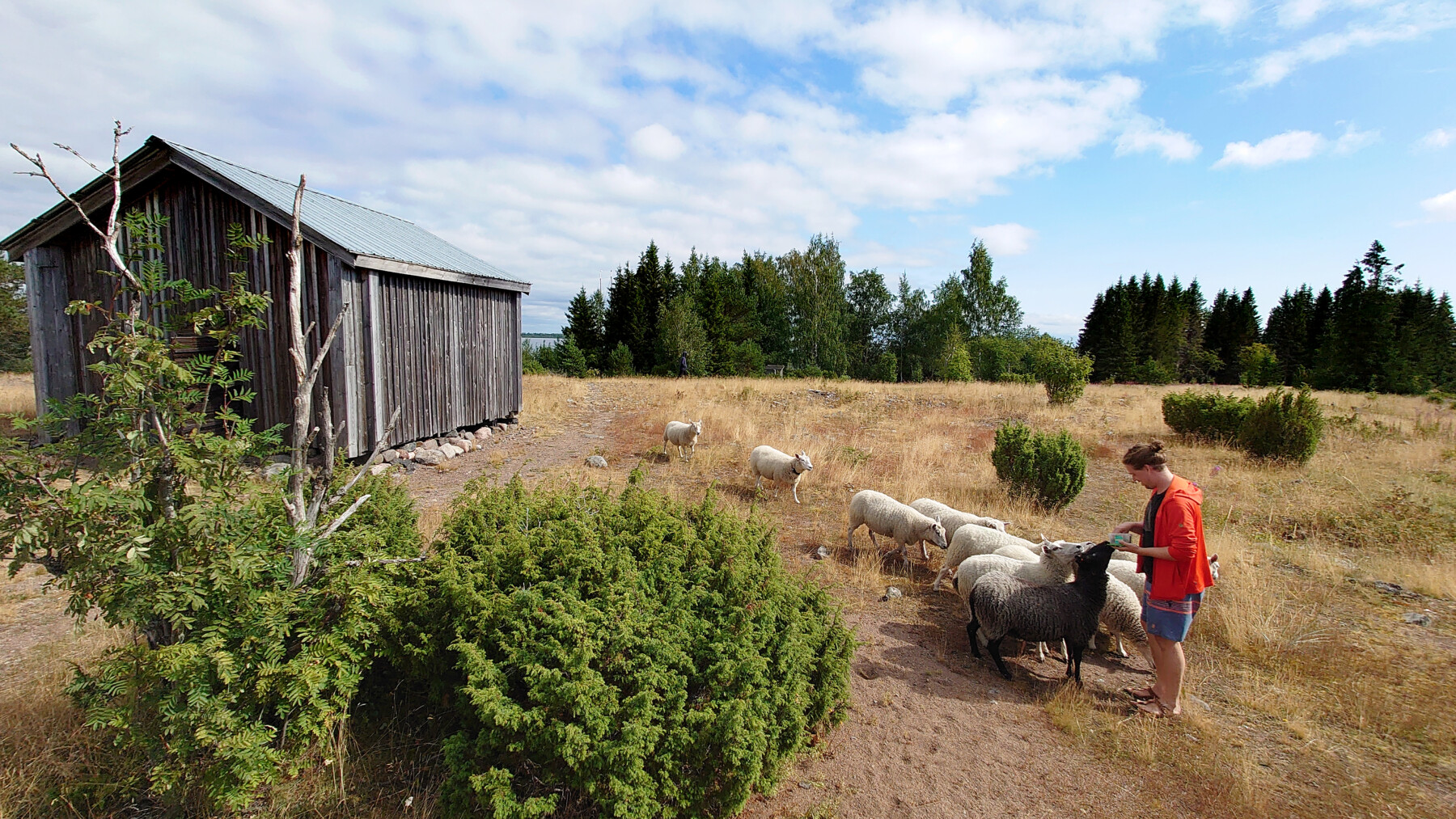
A person is standing near an old wooden shack in a meadow with a dozen sheep.

A shepherd vacationer tends to the flock on Pensaskari, an island in Bothnian Bay National Park in northern Finland.Photo: Jari Salonen/Metsähallitus

Adapting to a no-frills style of living is a must, since the shepherds stay on old farms, most of which don’t have running water. Some locations don’t have electricity. For Tuija Kilpeläinen, the limited luxury was an essential part of the experience.

“We all agreed that we could have stayed for another week,” she says. “I even think that everyone should be required to try this kind of experience.”

Shepherd for a Week has become very popular, and those wishing to secure a spot must enlist for a lottery held over the winter. This year, there were more than 2,200 applicants for the 169 weeks available in 15 different locations.

They keep coming back

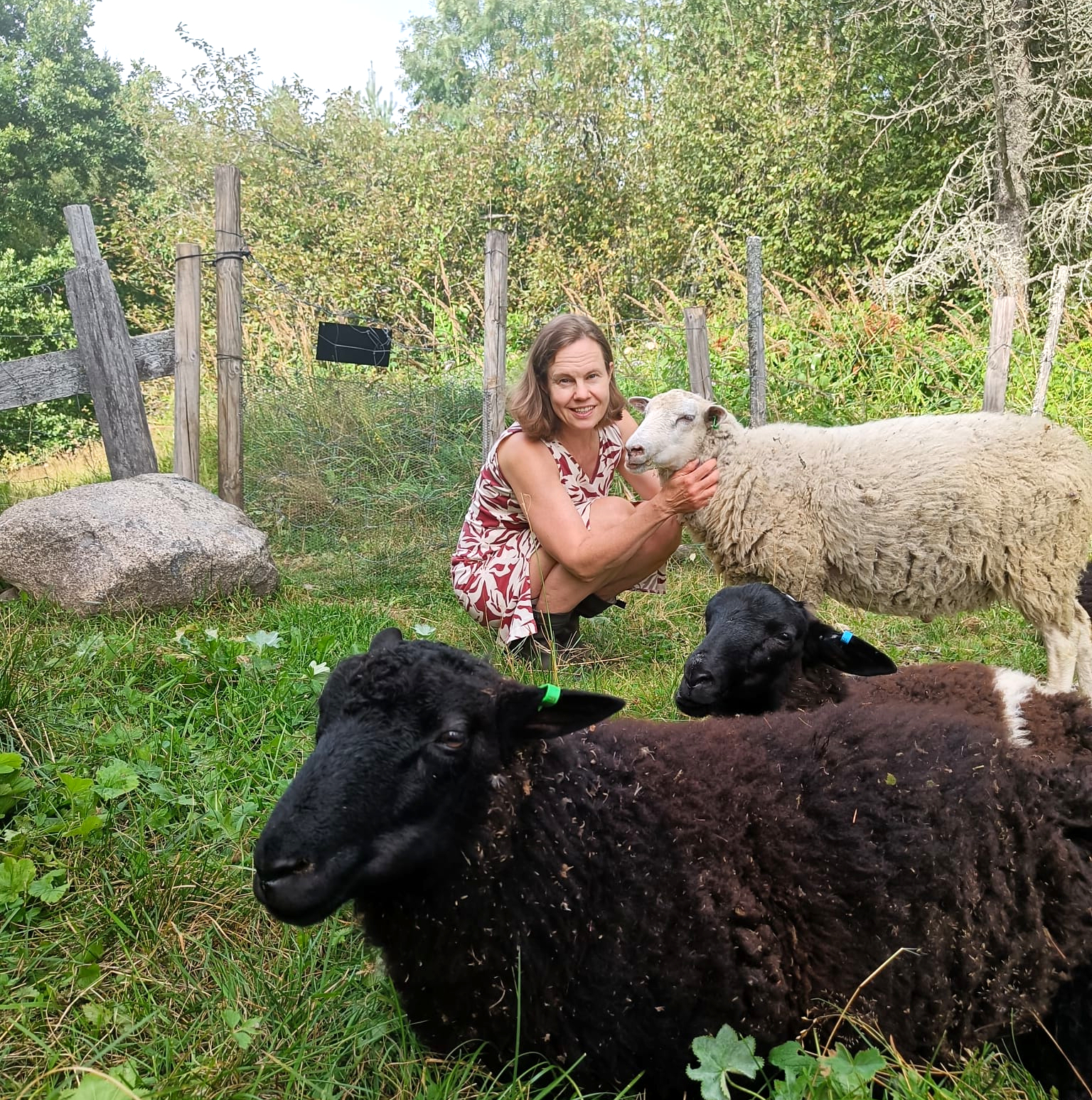
A woman in a summer dress kneels to pet one of several sheep in a pasture.

Tuija Kilpeläinen has participated in Shepherd for a Week several times over the years.Photo courtesy of Tuija Kilpeläinen

Since their first experience in 2020, Tuija Kilpeläinen and her family have gone on two other shepherding holidays, and at the time of writing they are about to embark on another one. This time, they’re keeping an eye on cows instead of sheep.

“My partner has a dairy farm, so he agreed to come along on the condition that he doesn’t have to take care of any cows on our holiday,” she says. “He does enough of that anyway.”

By Juha Mäkinen, July 2024

Visit a scenic Finnish lake essential to the country’s cultural legacy

In southern Finland, roughly 35 kilometres (20 miles) north of Helsinki, lies Lake Tuusula, one of the country’s approximately 188,000 lakes.

Its mirror-like expanse reflects the changing seasonal hues of the Finnish sky. It is fringed by rugged pine forests. Its surface area of six square kilometres (2.3 square miles) creates an atmosphere of timeless tranquillity.

While it is strikingly beautiful, the reasons for its significance might not be immediately apparent. Lake Tuusula’s surroundings are extraordinarily steeped in Finnish art and culture.

Cultural icons

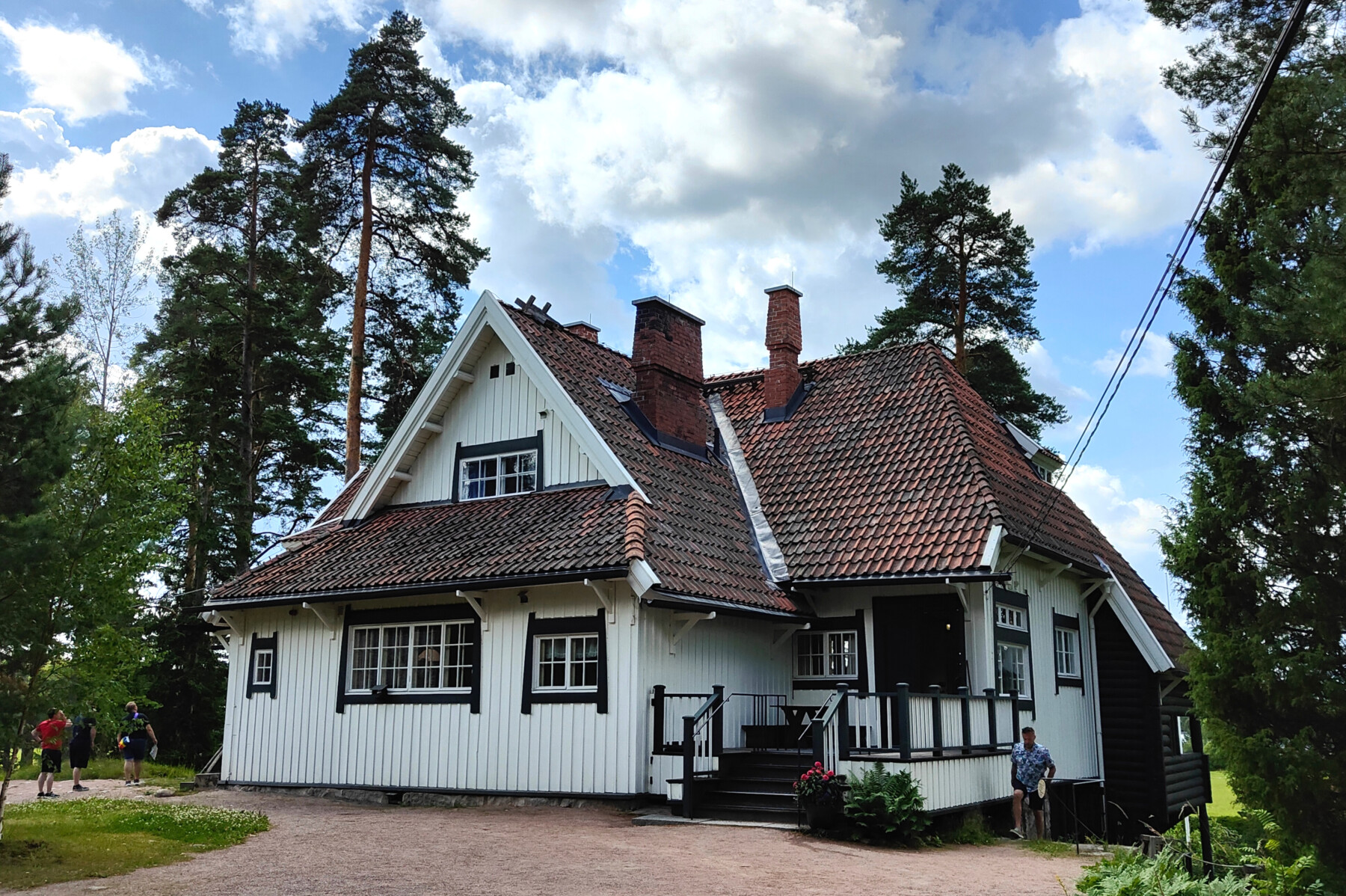
A stately white house stands among tall trees.

Composer Jean Sibelius and his wife Aino completed their lakeside home, Ainola, in 1904.Photo: Sanjoy Narayan

The area was the epicentre of a movement in the early 1900s, nurtured among a community of gifted writers, artists and musicians. They had a lasting impact. The cultural icons who made their homes on the lakeshore included composer Jean Sibelius; painters Eero Järnefelt and Pekka Halonen; and author Juhani Aho and his wife, painter Venny Soldan-Brofeldt. More than a century later, many of their houses are open to visitors as museums.

Entering these carefully preserved homes transports you to an exciting era, when the artists, writers and musicians living in a close-knit and often collaborative community found inspiration in the idyllic surroundings. It was part of the Golden Age of Finnish art, which refers to the period between 1880 and 1910, when art reflected and nourished a developing sense of national identity.

Ainola

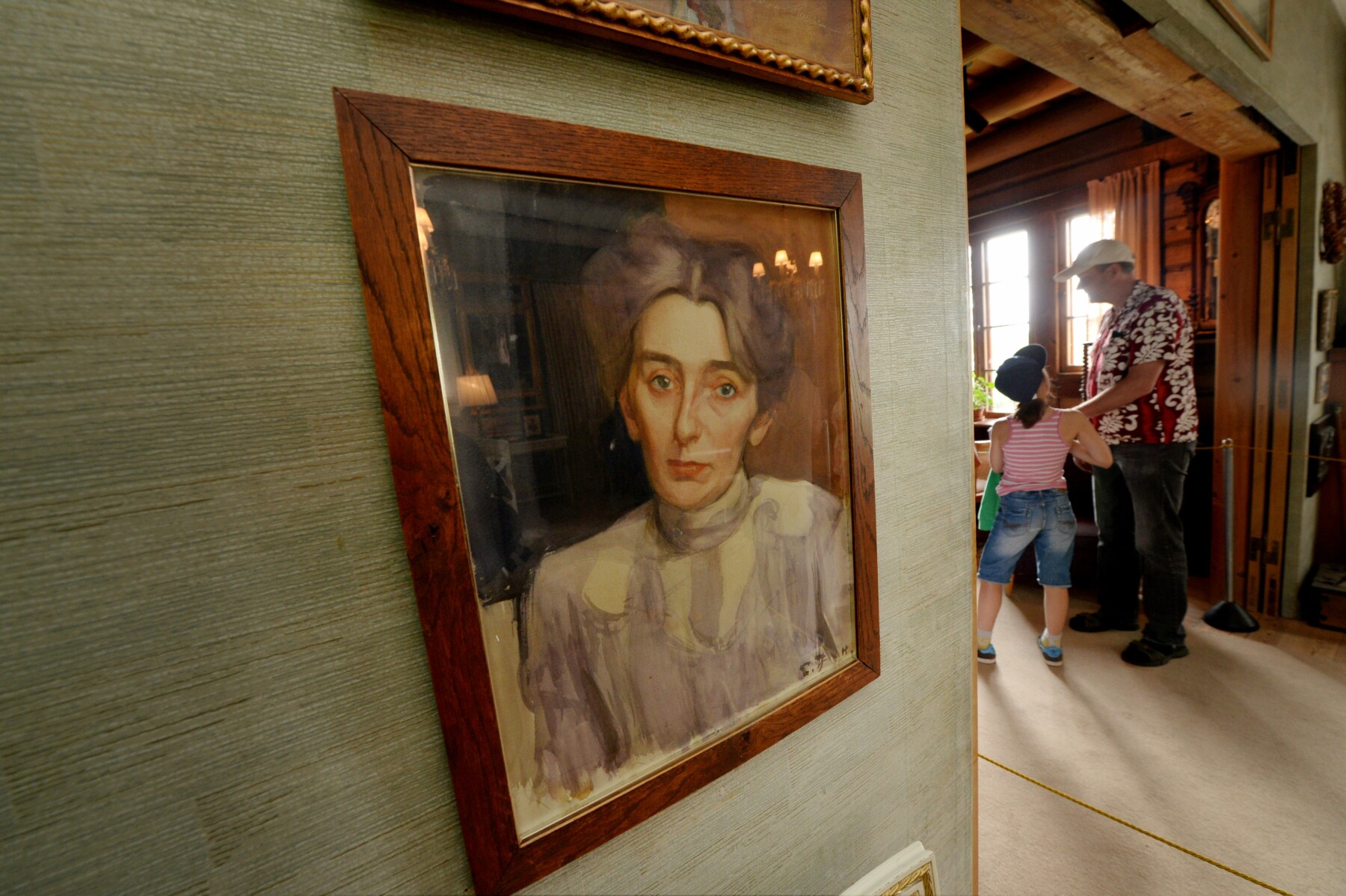
A painting hanging in a house shows a woman’s face and shoulders.

Visitors to Ainola can view a 1908 portrait of Aino Sibelius by Eero Järnefelt, who also lived in the area.Photo: Mikko Stig/Lehtikuva

By the time Sibelius and his wife Aino built their home, which they called Ainola, on the banks of the lake in 1904, the composer was well known at home and abroad. Several years earlier, he had composed one of his best-known works, Finlandia.

Stepping through the gates of Ainola is like a dive into the heady past. The rustic wooden villa, nestled amidst a canopy of birch and pine, exudes a sense of calm seclusion – a sanctuary in the Finnish countryside for the great composer. The rooms are simple yet full of character, and it is not difficult to imagine the maestro hunched over his desk in one corner, working on his immortal scores. Aino grew vegetables, flowers and fruit in the garden outside. The apple trees still stand, as does a perch uphill where the composer is believed to have spent summers basking in nature’s inspiration.

Suviranta

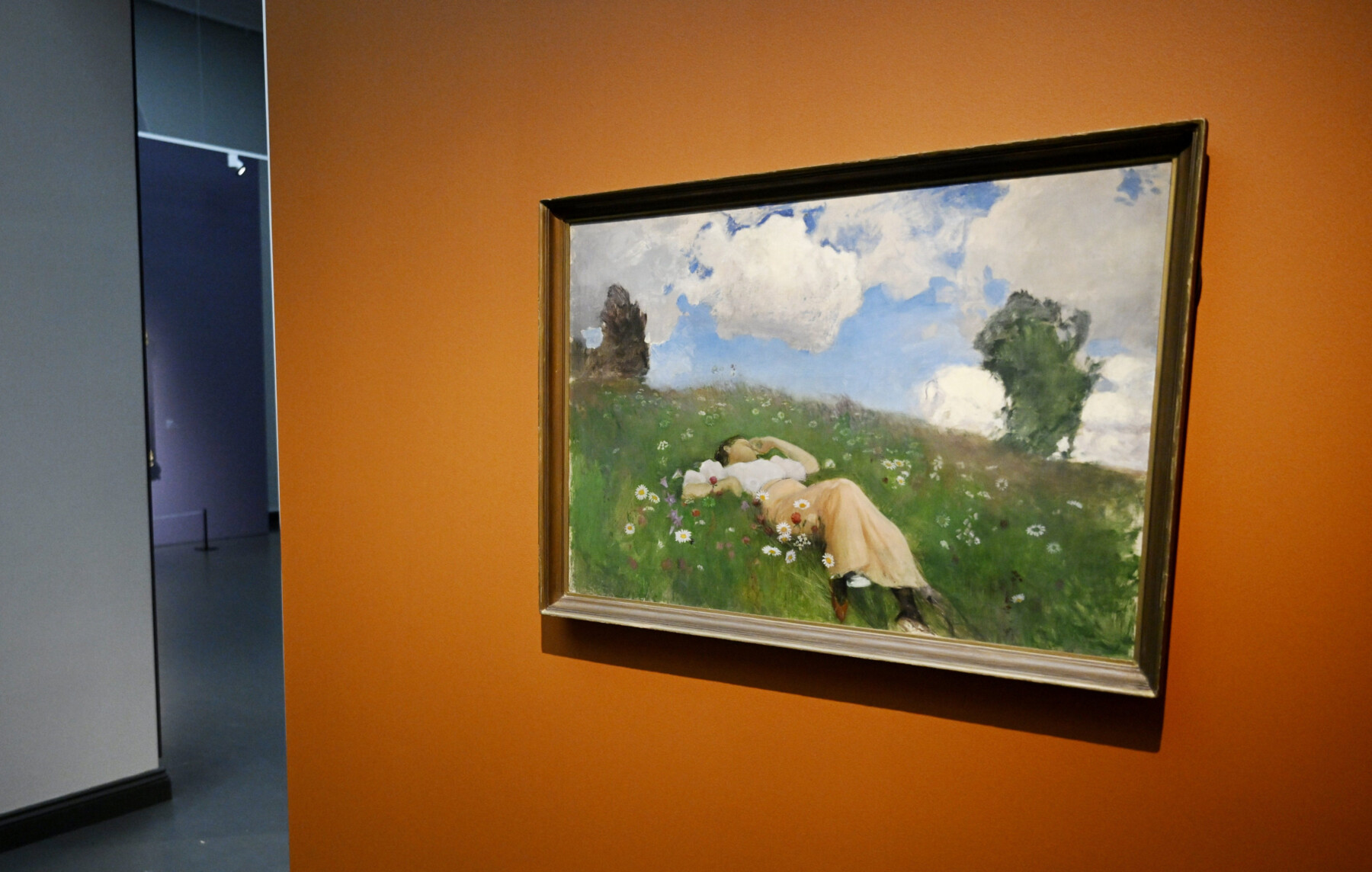
A painting hanging in a gallery shows a woman lying in a field of flowers under a blue sky with scattered clouds.

Eero Järnefelt’s 1892 painting Saimi in the Meadow, shown here hanging at Helsinki’s Ateneum Art Museum, portrays his wife on a summer day.Photo: Antti Aimo-Koivisto/Lehtikuva

Not far from Ainola is Suviranta (Summer Shore), the stately manor of artist Eero Järnefelt, who was also Aino’s brother. Inside, Järnefelt’s canvases adorn the walls: landscapes and portraits that demonstrate his style of realism. His wife, Saimi, a key member of the community, was an actor who also translated literature into Finnish, including works by Charles Dickens and George Eliot.

Halosenniemi

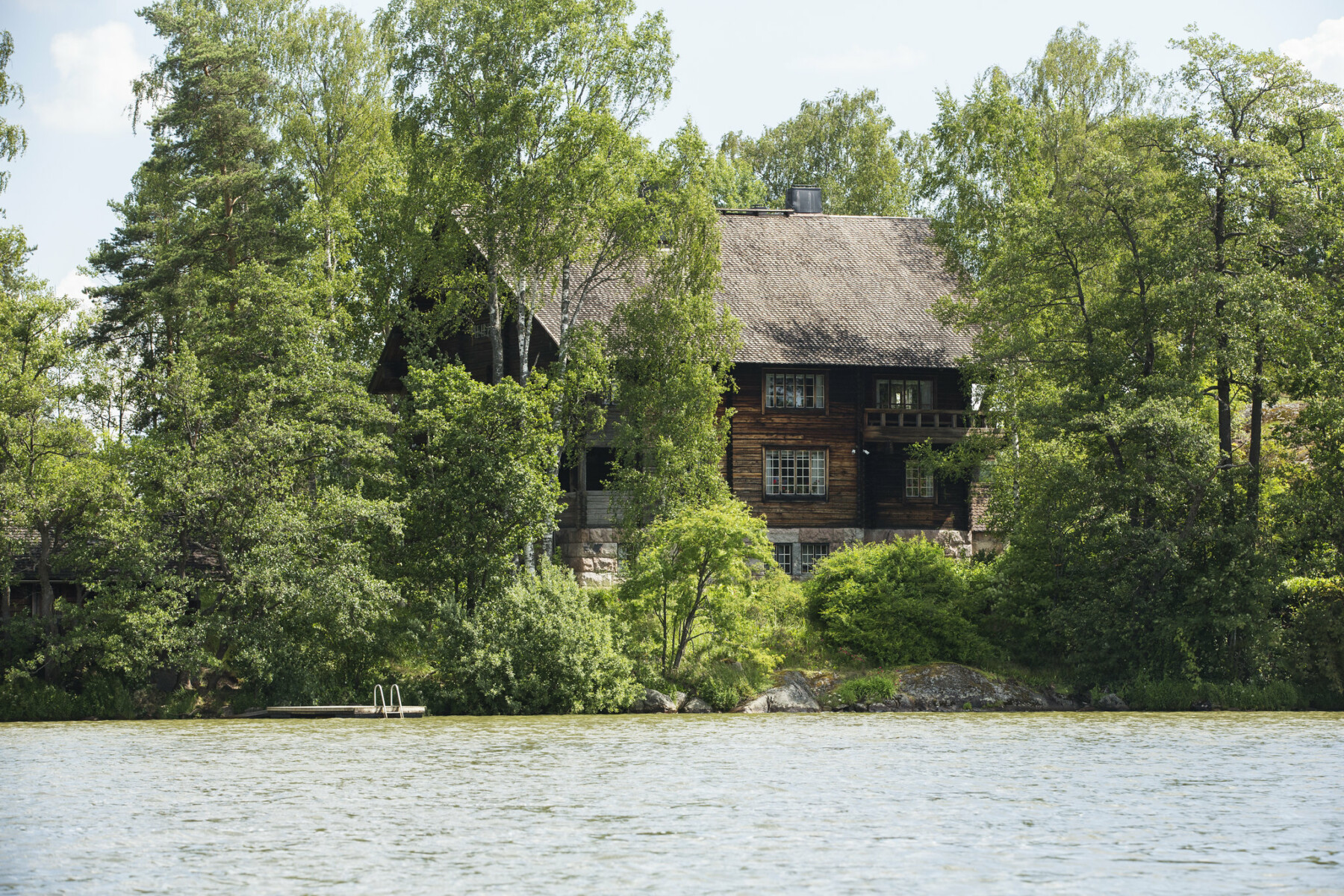
A view from the middle of a lake shows an expanse of water and a shoreline with trees and a brown wooden house.

Photo: Kari Kohvakka/Tuusula Municipality

Artist Pekka Halonen settled in the area around the same time. His home, Halosenniemi (Halonen Point), is also a museum today, with paintings by him and his contemporaries. Halonen’s works, especially those depicting winter landscapes of Lake Tuusula and its surroundings, are simple yet striking.

Ahola

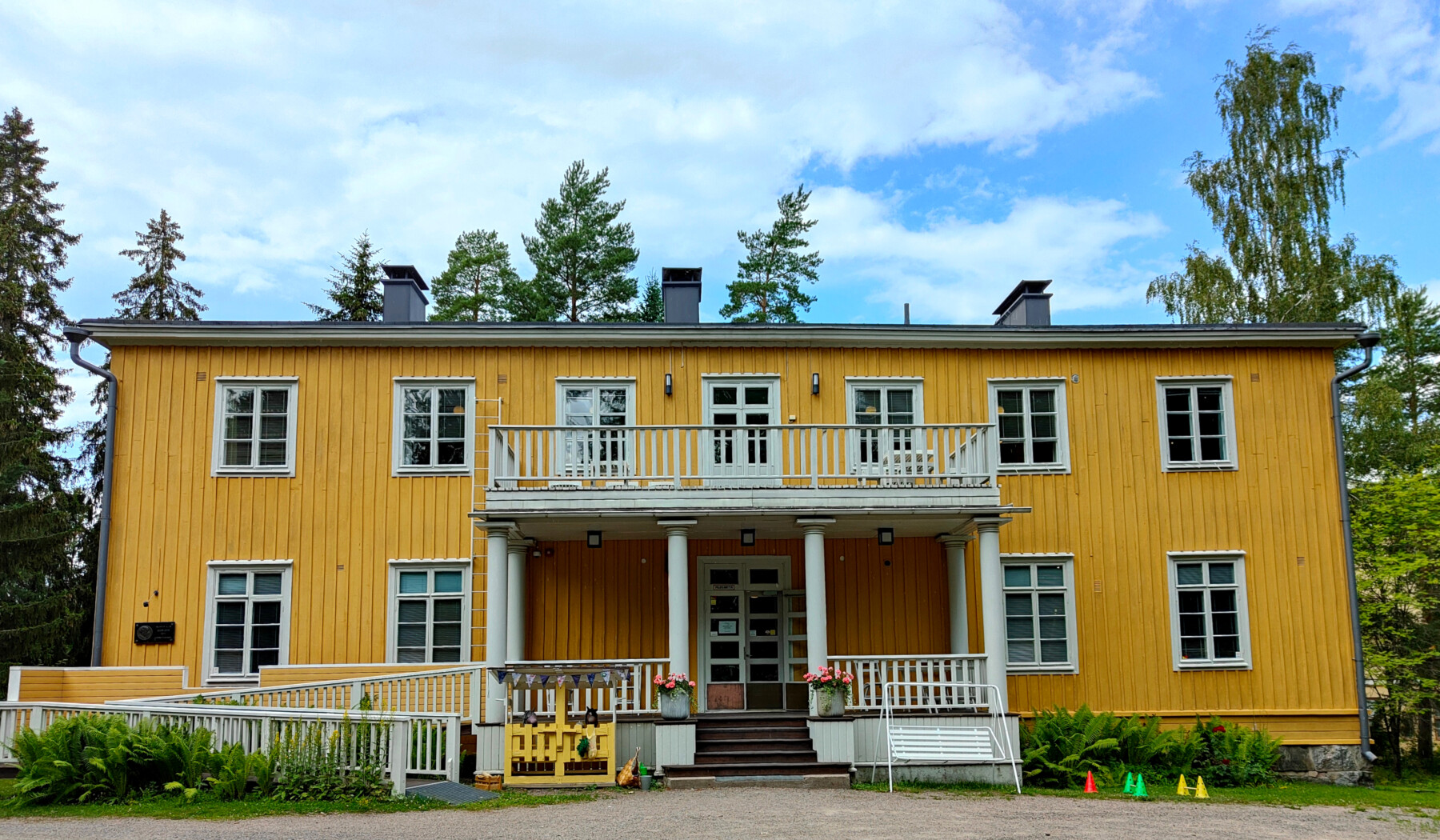
A long, two-storey yellow wooden house with a veranda is flanked by trees.

Photo: Sanjoy Narayan

A 15-minute bicycle ride from Halosenniemi takes you to Ahola, the home of another creative couple of that era, writer Juhani Aho and his painter wife, Venny Soldan-Brofeldt. They arrived in 1897. Step into Ahola and it is like an immersion in their family’s life and artistic endeavours. Aho’s short stories and novels, such as Rautatie (1884, The Railroad), depicting an elderly couple’s first railway experience, are classics of Finnish literature. Soldan-Brofeldt was a versatile artist, talented in multiple genres – painting, graphic art, illustration and jewellery making. Her bohemian spirit and lifestyle – she was known to smoke a pipe, ride a bicycle and wear trousers – may have startled some people back then, but it also influenced the local community of artists.

Erkkola

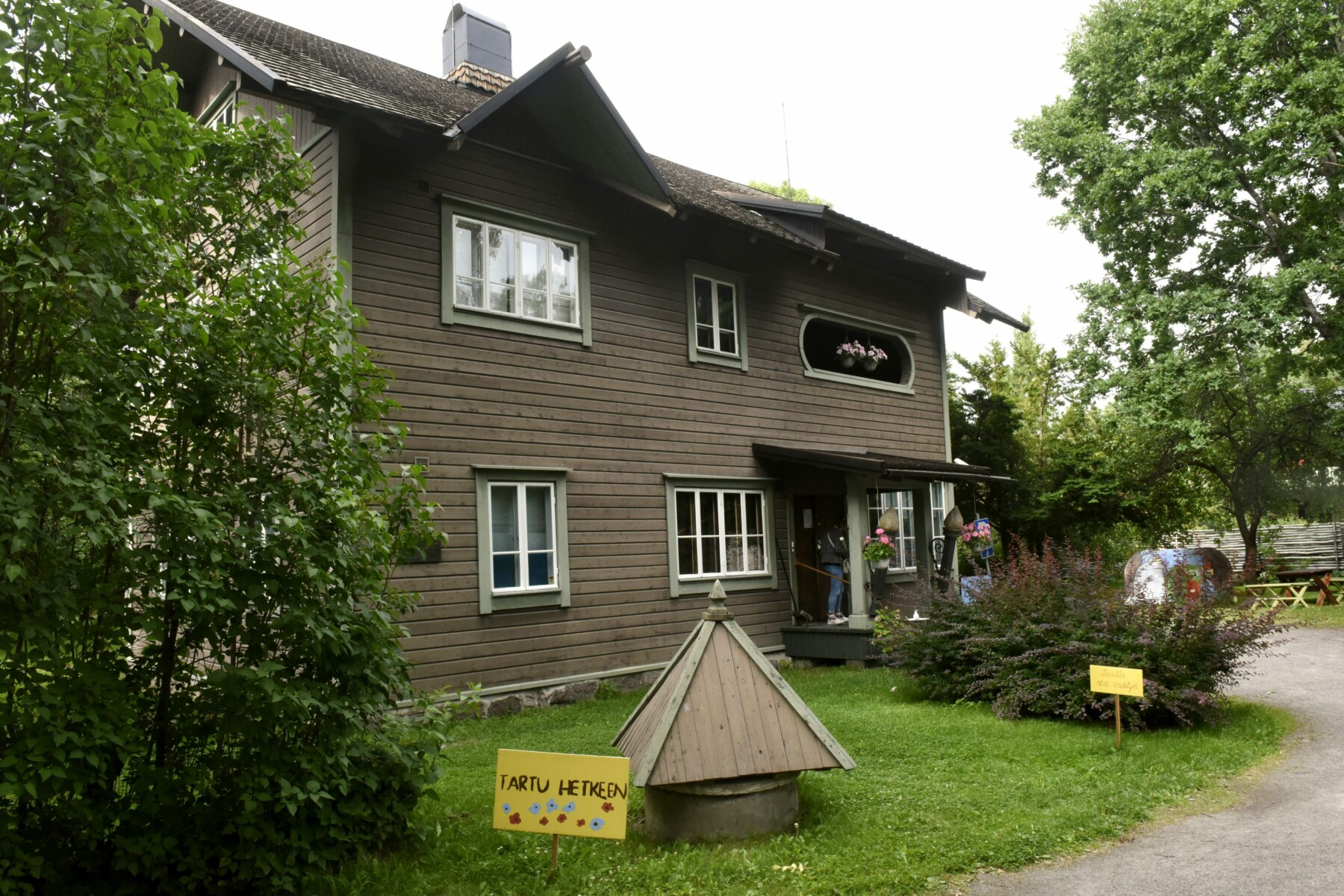
An old-fashioned brown wooden house is flanked by trees.

Photo: Timo Jaakonaho/Lehtikuva

Others also belonged to that community. It is considered to have been at the forefront of the national cultural awakening of the Grand Duchy of Finland, which was still part of the Russian Empire but would gain independence in 1917. J.H. Erkko, a popular poet and playwright, who played a key role in Finnish language and education, also had a home by the lake, Erkkola. Pioneering Finnish poet Eino Leino often spent time at Halosenniemi and Erkkola.

Enduring impact

A blue lake and a blue sky are visible beyond a large boulder and several trees.

Lake Tuusula continues to be known for its scenic views and its place in Finland’s cultural history.Photo: Antti Kallio/Tuusula Municipality

Even before Erkko, Järnefelt, Sibelius and others moved there, the Lake Tuusula area was part of Finland’s cultural history: Celebrated author Aleksis Kivi (1834–72), who wrote the first Finnish-language novel, Seven Brothers (1870), spent his last months in a cabin near the lake before dying at the age of only 38.

The artists and writers who settled on the banks of Lake Tuusula inspired and influenced one another, and their lives were intertwined. The community played a pivotal role in the development of Finnish national romantic art and the birth of Finnish modernism. While most of the artists also travelled to other parts of Europe, the community’s emphasis on capturing Finland’s landscape and way of life left an enduring impact on the country’s cultural identity and inspired subsequent generations of Finnish artists.

By Sanjoy Narayan, July 2024

NASA and Finland’s Nokia get ready to test 4G networks on the moon

NASA’s Artemis programme intends to land humans on the moon for the first time since 1972. NASA has recruited help from around the world for this huge project. Organisations such as the European Space Agency and private companies are involved.

Nokia of America Corporation, a subsidiary of the Finnish company Nokia, was selected in 2020 to join the NASA Tipping Point programme, which develops technologies for use in space. Nokia’s idea is to test 4G/LTE communications equipment on the lunar surface. The mission is called IM-2 (IM stands for Intuitive Machines).

Building a lunar communications system

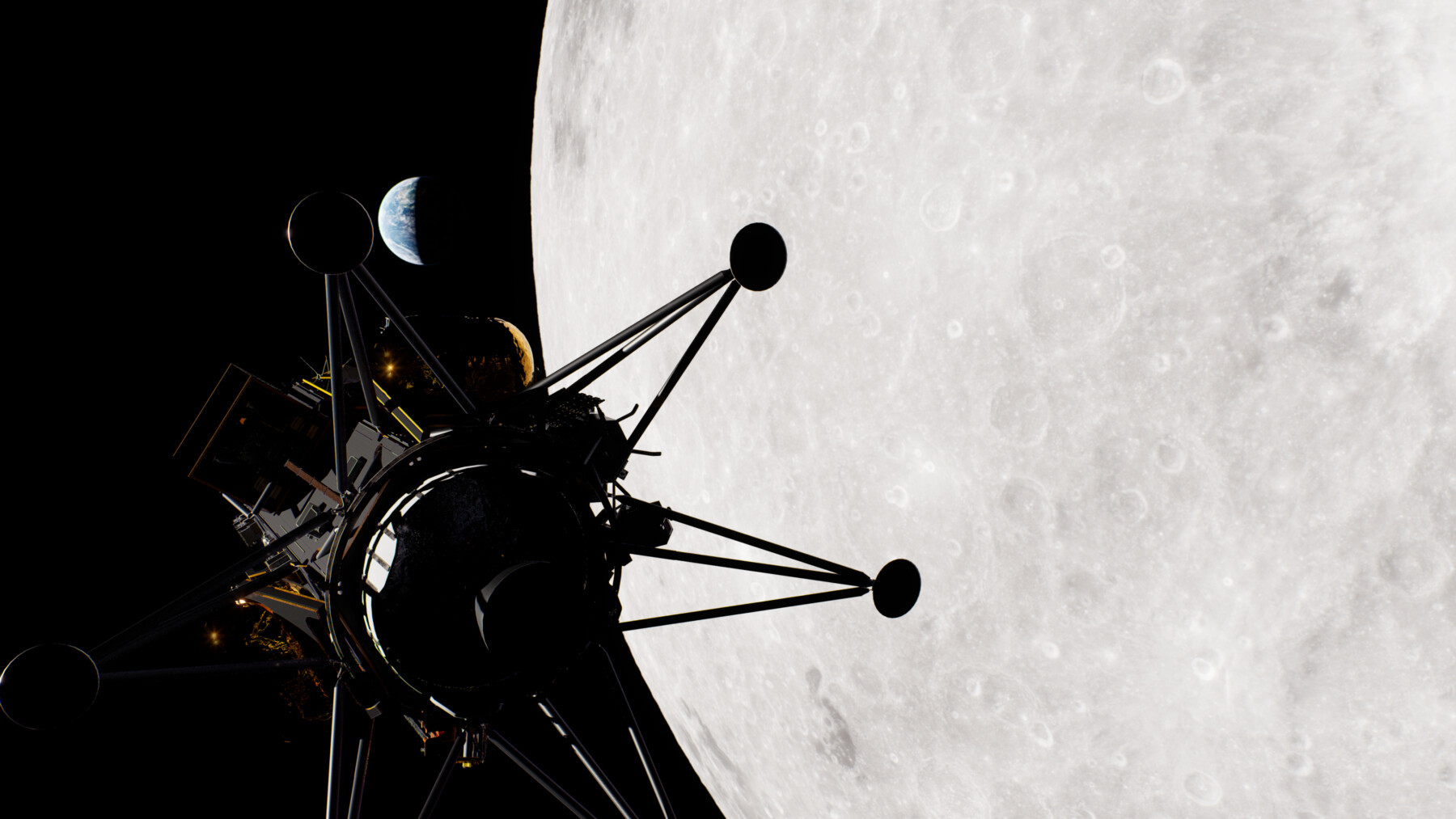
A flying spacecraft is silhouetted in front of a grey planet.

The lander’s approach to the moon will look something like this.Photo illustration: Intuitive Machines and Nokia Bell Labs

NASA wants a lunar surface communications system to support sustained human presence and large-scale activity. People and connected devices will need to send information to each other. Astronauts will communicate with voice and video, rovers will receive commands and transmit sensor data, and scientific instruments will send information they collect. Other technologies, such as the planned LunaNet, would handle earth–moon interactions, but communications on the moon could be done with a 4G system.

“While this probably will take some time before it becomes a reality, the idea is to develop lunar infrastructure with this vision in mind,” says Bernie Edwards, deputy principal technologist for communications and navigation within NASA’s Space Technology Mission Directorate.

The Apollo astronauts communicated with Very High Frequency (VHF) and S-band systems when they were on the moon, but these technologies won’t be good enough for Artemis.

“Legacy radios don’t have the necessary data rate and data throughput required to support video, image and data transfers on the lunar surface,” explains Edwards.

“Unlike any cellular network on earth”

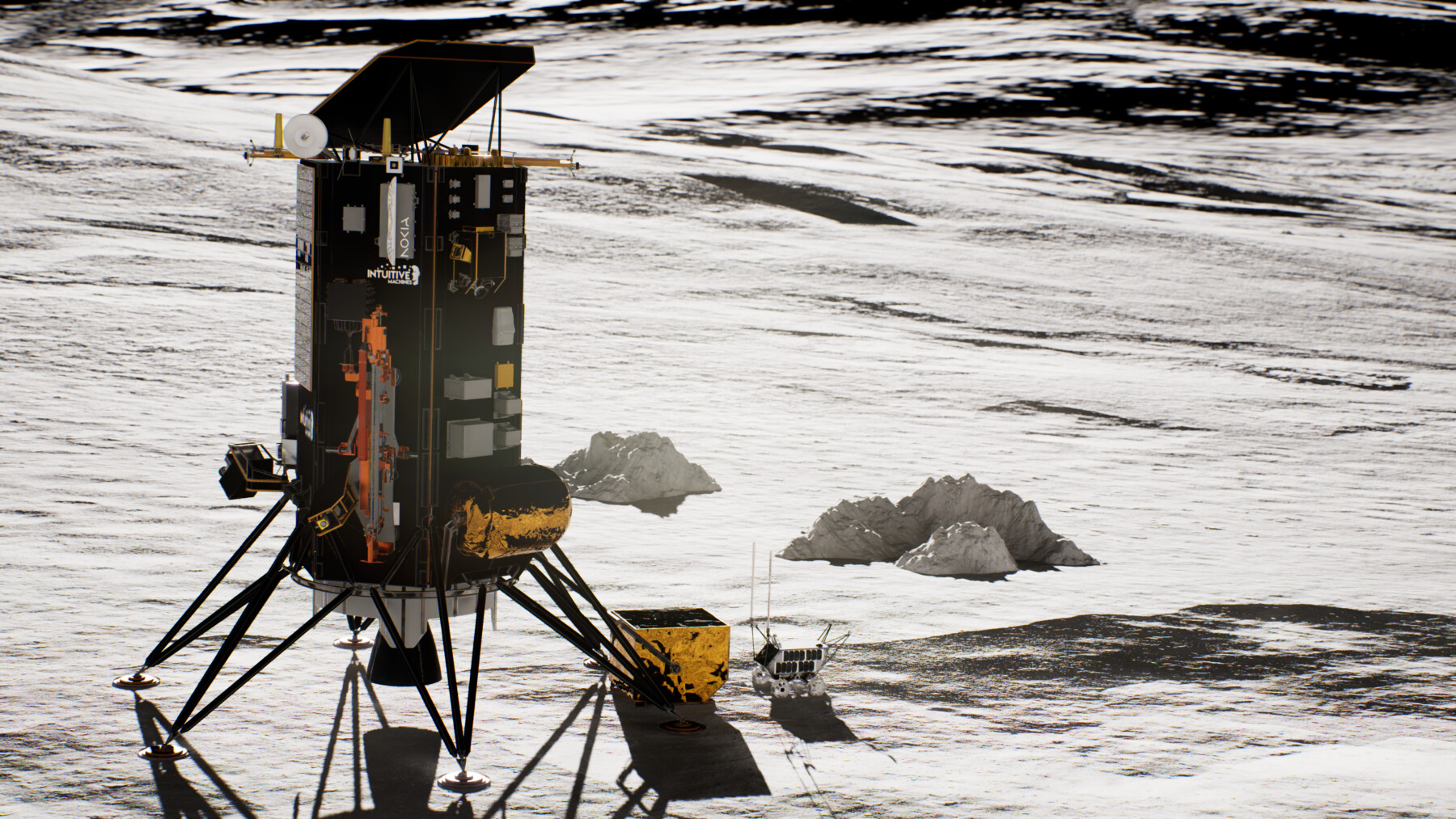
A small robotic vehicle moves away from a spacecraft on a grey rocky surface.

At the centre of this picture, the Lunar Outpost MAPP rover has exited the lander and raised its antennas.Photo illustration: Intuitive Machines and Nokia Bell Labs

The first step is scheduled for late 2024. A SpaceX Falcon 9 rocket will launch from Florida carrying the IM-2 mission that will land close to the lunar South Pole, where NASA plans to land astronauts. The Intuitive Machines lander will have Nokia’s 4G/LTE “Network in a Box” and antenna, while rovers will have Nokia user equipment and omnidirectional antennas.

“While it is a 4G/LTE system at its heart, it is unlike any cellular network on earth,” says Thierry E. Klein, president of Bell Labs Solutions Research, Nokia. “We have optimised the network system’s size, weight and power consumption for operations in space while carefully engineering its network elements to withstand the harsh conditions on the moon’s surface and the extreme dynamic stresses of spaceflight.”

You might be thinking, who is going to be there to install the network? “This network will deploy, configure and operate itself autonomously, and it will be remotely monitored and controlled,” says Klein.

Edwards explains that they chose 4G instead of 5G because lunar infrastructure should closely parallel developments on earth.

“Today, 5G is still being deployed, and network providers are still gaining knowledge and experience with the best way to do that,” he says. “We have a lot of experience on earth with 4G, and the upgrade path from 4G to 5G is fairly straightforward.”

Lunar rovers will use 4G

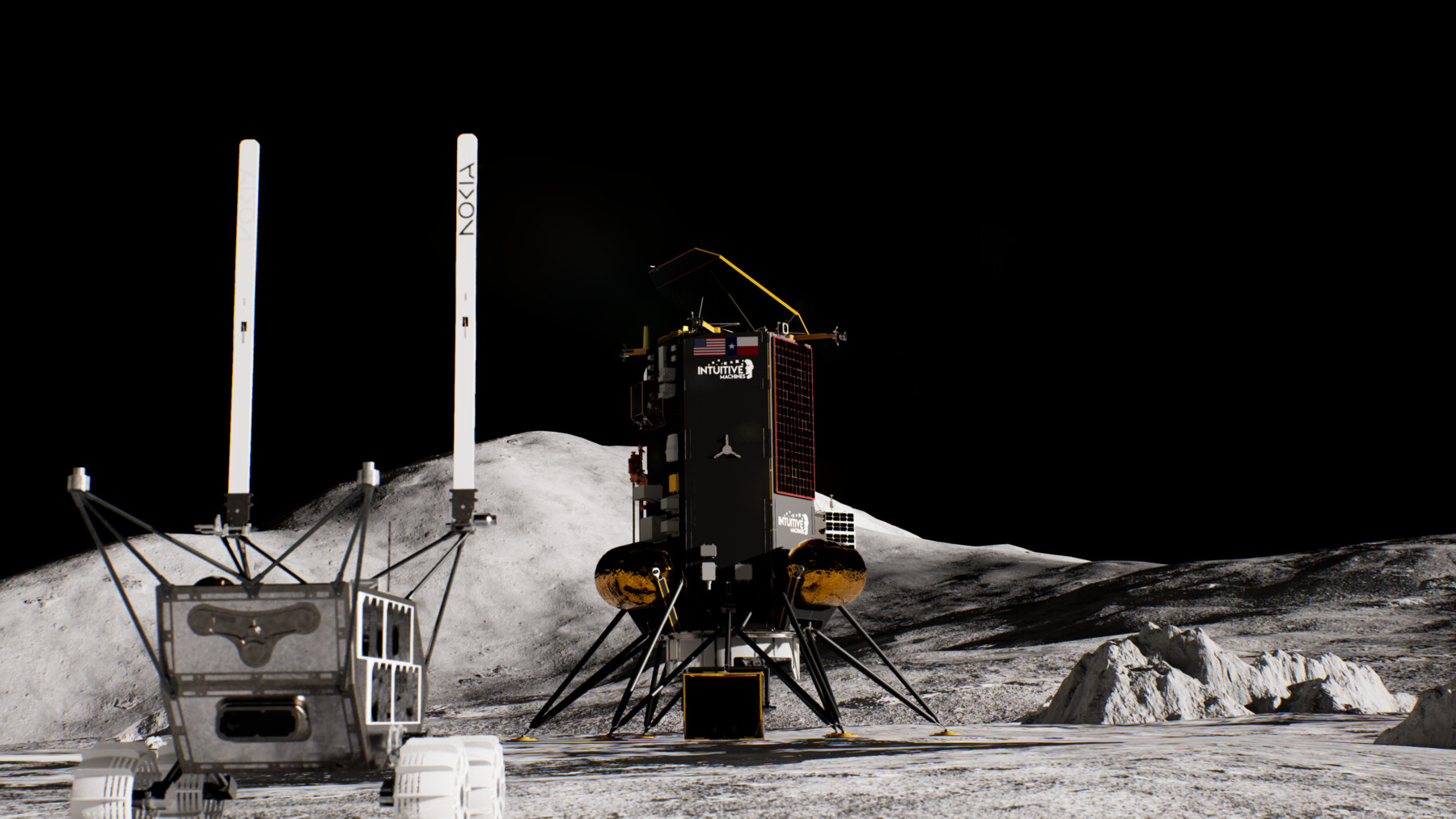
A small robotic vehicle moves away from a spacecraft on a grey rocky surface in front of a black sky.

The Lunar Outpost MAPP rover (left) moves out from the lander to explore.Photo illustration: Intuitive Machines and Nokia Bell Labs

Once they make it safely to the moon, the two rovers will get to work. The Lunar Outpost MAPP (Mobile Autonomous Prospecting Platform) rover will move autonomously to map the surface and to collect and examine samples.

The Intuitive Machines Micro-Nova Hopper will use rockets to hop into hard-to-reach areas such as craters to search for water ice. The plan is for the rovers to transmit their data back to the lander using Nokia’s technology. It is just like how the Internet of Things works here on earth, but this is an important test and demonstration that it could work in space, too.

“The Nokia 4G Tipping Point Demonstration will demonstrate the suitability of using 4G communications standards and technologies on the lunar surface,” says Edwards. “The demonstration will validate predictions on performance made with radio frequency models.”

It’s all part of a learning process. “We will learn how well the system operates in the unique multipath environment of the moon,” Edwards says. “We will gain experience setting up and controlling a lunar 4G network remotely from earth.”

Nokia’s role in the future lunar economy

This video shows what it will look like when a rover is deployed on the surface of the moon.Video: Nokia Bell Labs

The IM-2 mission is only one part of Nokia’s lunar ambitions. Together with NASA, it conducted a study for a 3GPP-based (Third Generation Partnership Project) lunar surface network for future Artemis missions, and Nokia has been working with the U.S. Defence Advanced Research Projects Agency to design an integrated multiservice architecture to support a future lunar economy.

“Humanity has always been fascinated by space, and that interest has only intensified in the 21st Century,” says Klein. “We are sending more humans and more machines into space to explore, study and even pursue new business ventures.

“Wherever these humans and machines go in the solar system, they will need communications. Nokia is prepared to make that journey with them.”

NASA’s schedule for returning to the moon

2022 Artemis I, uncrewed lunar flyby test flight
2024 Uncrewed landings of scientific instruments, including IM-2 with Nokia 4G equipment
2025 Uncrewed landings of scientific instruments
Uncrewed support missions to deliver equipment
Artemis II, crewed lunar flyby
2026 Uncrewed support missions to deliver equipment                                                                                Artimis III, crewed lunar landing
2028 Artemis IV, crewed lunar landing
2030 Artemis V, crewed lunar landing
2031 Artemis VI, crewed lunar landing

Did you know? Finland is no stranger to space exploration

Finland has a rich history of space science and exploration that continues to this day. Geomagnetism, the ionosphere and space weather studies have historically been Finnish strengths. Finland has also embraced collaboration, providing a plasma analyser for the Soviet Union’s Phobos 1 Mars probe in the 1980s and joining groups such as the European Space Agency in 1987.

Bell Labs, which became part of Nokia with Nokia’s acquisition of Alcatel-Lucent in 2016, also has extraterrestrial experience. Bell Labs worked with NASA to launch Telstar 1, the first communications satellite to transmit TV signals, in 1962, and assisted with the Mercury, Gemini and Apollo programmes. Bell Labs researchers Arno Penzias and Robert Wilson discovered the background radiation left over from the Big Bang in 1964, garnering the 1978 Nobel Prize in Physics.

By David J. Cord, June 2024

Made in Finland: Meet the designer of the iconic Snowflake reflector, which popularised a life-saving innovation

What displays a bright, instantaneous light that makes pedestrians and cyclists visible to motorists in the dark, yet requires no batteries or charger?

This describes the pedestrian safety reflector, invented by Arvi Lehti in Pertteli, southwestern Finland in 1963. Reflectors have long been ubiquitous in Finland, across the other Nordic countries, and beyond. People attach them to dangle from a jacket sleeve or hem or from a backpack.

It’s impossible to know how many tens of thousands of lives pedestrian reflectors have saved over the decades, how many collisions have been avoided. According to the Finnish Road Safety Council, a person is normally visible in a car’s headlights at a distance of 50 metres (54 yards), and using a reflector increases visibility to 350 metres (380 yards), giving drivers additional time to react.

Designer and technician Kalervo Elias Suomela is a key figure in the story of how reflectors became popular. Lehti brought him onboard in 1968.

Suomela’s design of the now iconic Snowflake reflector, along with improvements in the manufacturing process, helped catapult pedestrian reflectors to wide commercial success starting in the early 1970s. Suddenly they were not only beneficial, but also much more fun and attractive than the previous rectangular models. The innovative new shape appealed to kids and adults alike.

Call back as soon as you can

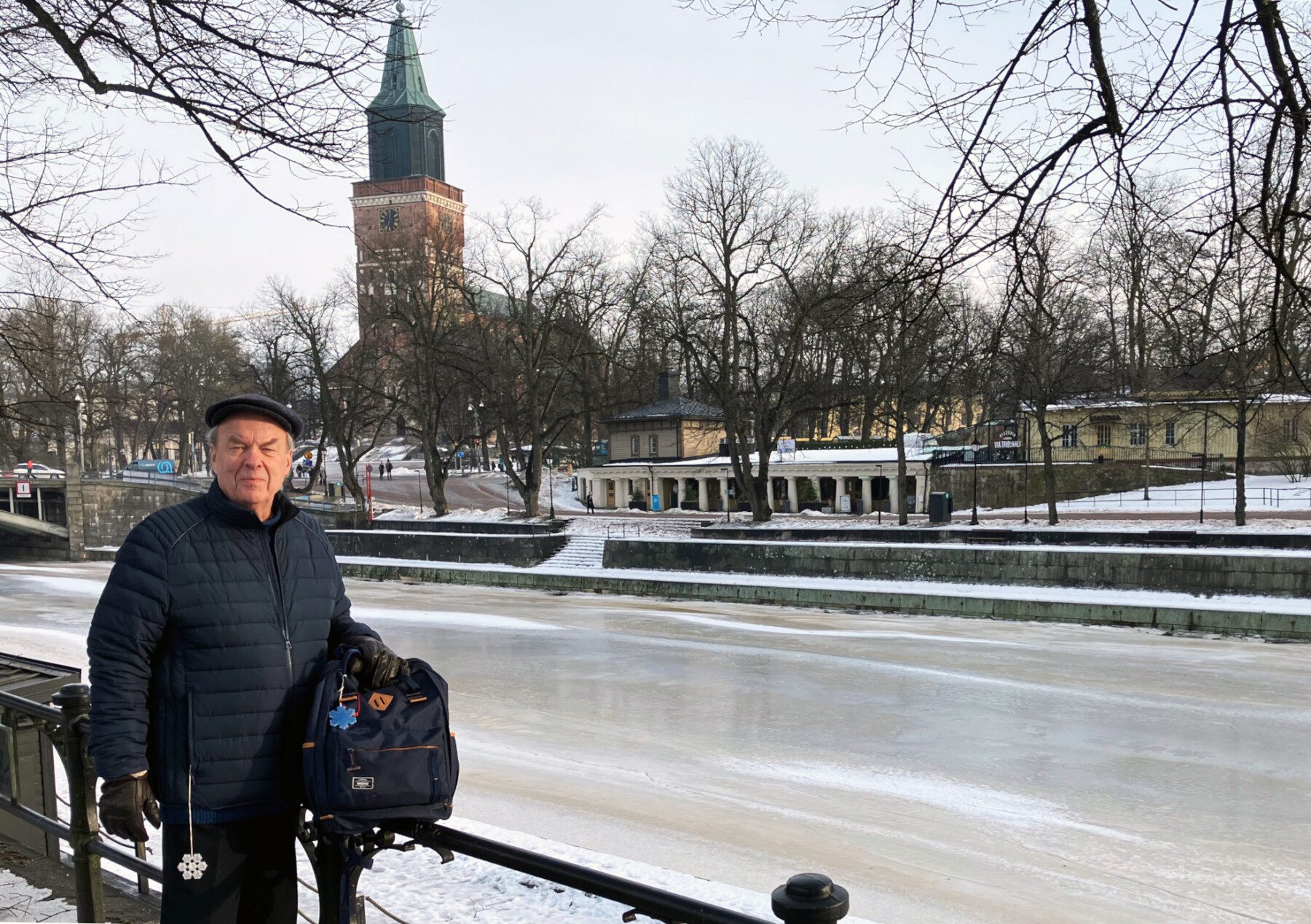
A man in winter clothing stands in a town beside a railing overlooking a frozen river, with a church tower in the background.

Kalervo Suomela wears one Snowflake reflector on his jacket and one on his backpack. In the background are Turku Cathedral, built in the 1200s, and the ice-covered Aura River.Photo: Peter Marten

The origin story of the Snowflake reflector is wrapped up in Suomela’s career path. Born in 1944 in southwestern Finland, he has lived much of his life in or near the city of Turku. We talked with him there, on a late-winter day when the Aura River was still covered with a thick layer of ice.

He recounts his personal history in an easy-going manner, covering each phase systematically, as you would expect from someone who has spent a lifetime designing plastic components for phones, cars, bicycles, TVs, computers and household appliances and troubleshooting factory machines.

In the late 1960s, he had recently finished a degree in industrial design in Turku. He had held a range of short-term jobs, including fixing refrigeration units at a slaughterhouse and repairing machines at a hospital.

Through mutual acquaintances, he met Lehti, who had not only invented the pedestrian reflector, but also owned Talmu, a small company that used injection moulding to make plastic objects. It was a relatively new field at the time.

“I was living in Turku, and we met in Salo [50 kilometres (30 miles) to the east],” says Suomela. It was early December. “I said, ‘I might be interested in working for you.’ He said, ‘OK, we’ll be in touch after Christmas.’”

“Before I got back to Turku, they had phoned me,” he says. “There were no mobile phones in those days. My mother said, ‘Someone named Arvi called and left a message to call back as soon as you get home.’”

First thing tomorrow

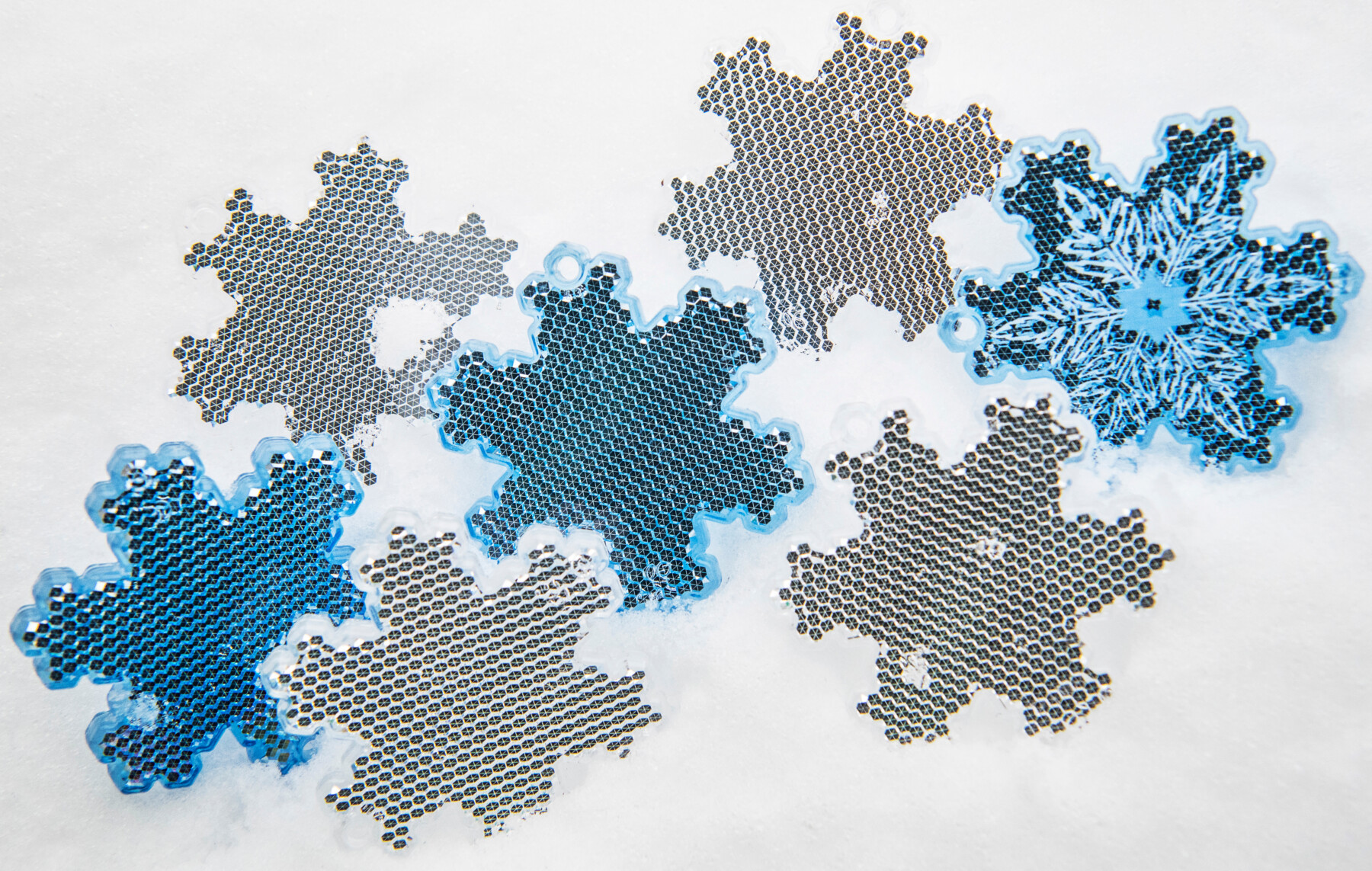
Several flat, six-pointed pieces of plastic are arrayed in a pile of snow.

Snowflakes in the snow: Kalervo Suomela’s Snowflake design helped increase people’s use of reflectors and quickly became a classic.Photo: Kirsi-Marja Savola

Lehti sounded frantic on the phone. A large machine was broken and there were orders waiting to be filled. “What are you doing tomorrow?” he asked Suomela.

“I said I didn’t have too many plans,” says Suomela. “Then Arvi said, ‘Could you come out here first thing tomorrow and dismantle this machine and see what’s wrong with it?’”

That’s how Suomela found himself taking a bus in the early morning hours to reach the factory by seven. They hadn’t even agreed on his salary. Later, as payday was approaching, Lehti called him and offered him 4.70 marks per hour. “I said, ‘OK, let’s do that,’ and that was the only salary negotiation of my life,” says Suomela.

Design a couple new ones

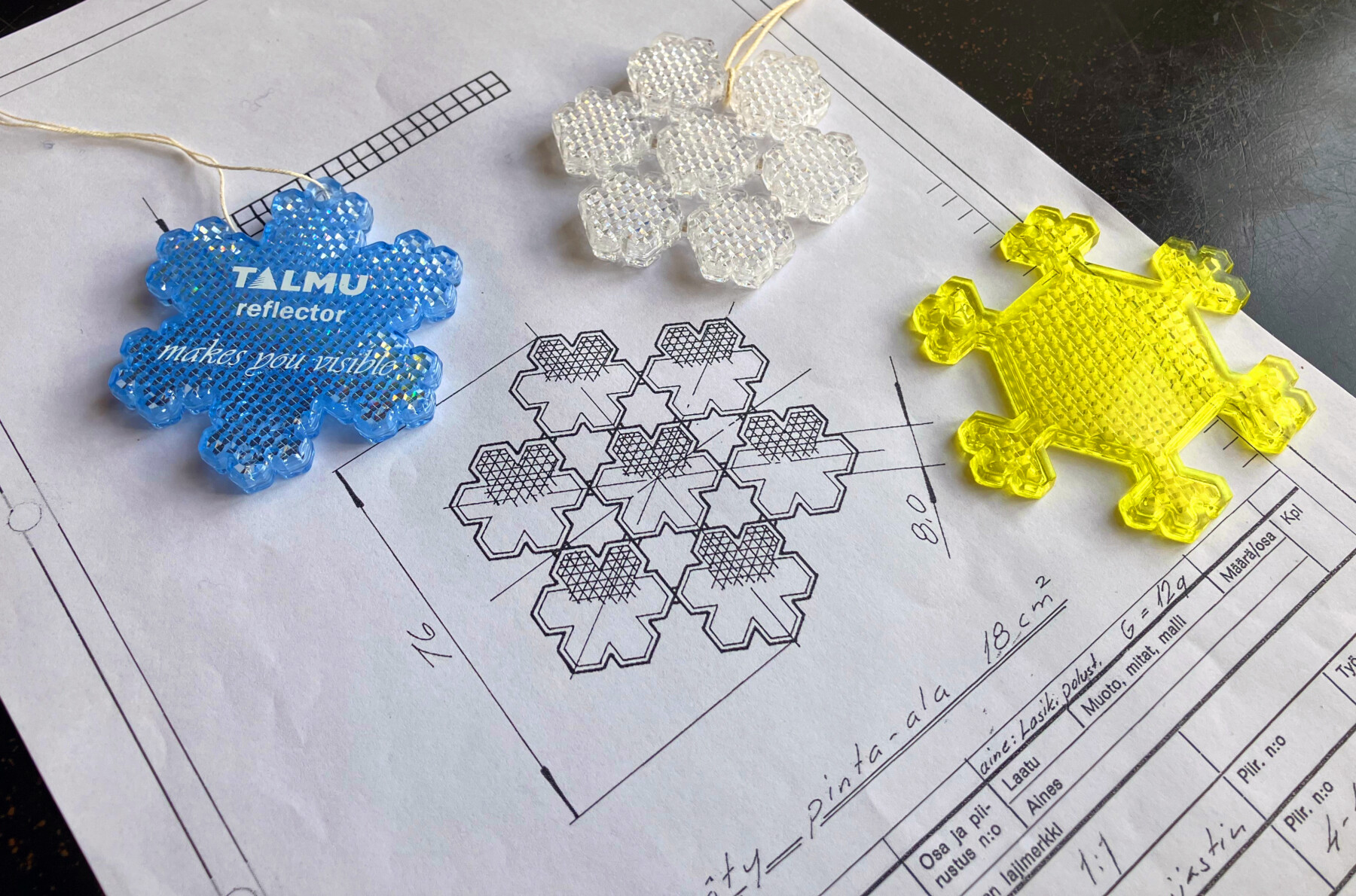
Three flat, six-pointed pieces of plastic, each a different colour, are lying on a piece of paper that shows a similarly shaped technical drawing with measurements.

Kalervo Suomela has saved his original blueprint drawings and various early versions of the Snowflake reflector.Photo: Peter Marten

In 1969, he and another young colleague put in long hours getting all the machines shipshape so that the factory could go from one to two or three daily shifts – which had been Suomela’s suggestion. “I was repairing production units and machines day and night,” he says. “I lost seven kilos [15 pounds] that year.”

Meanwhile, one of the factory’s products, rectangular reflectors, was selling fairly well. A request came down from management for him to “design a couple new pedestrian reflectors,” or at least make some more moulds to increase production capacity.

“I figured I wouldn’t do more rectangles, but something else that people would like,” he says. “We were trying to make something that kids would want to use, to get them into good habits early. After all, this thing saves lives.”

Artistic point of view

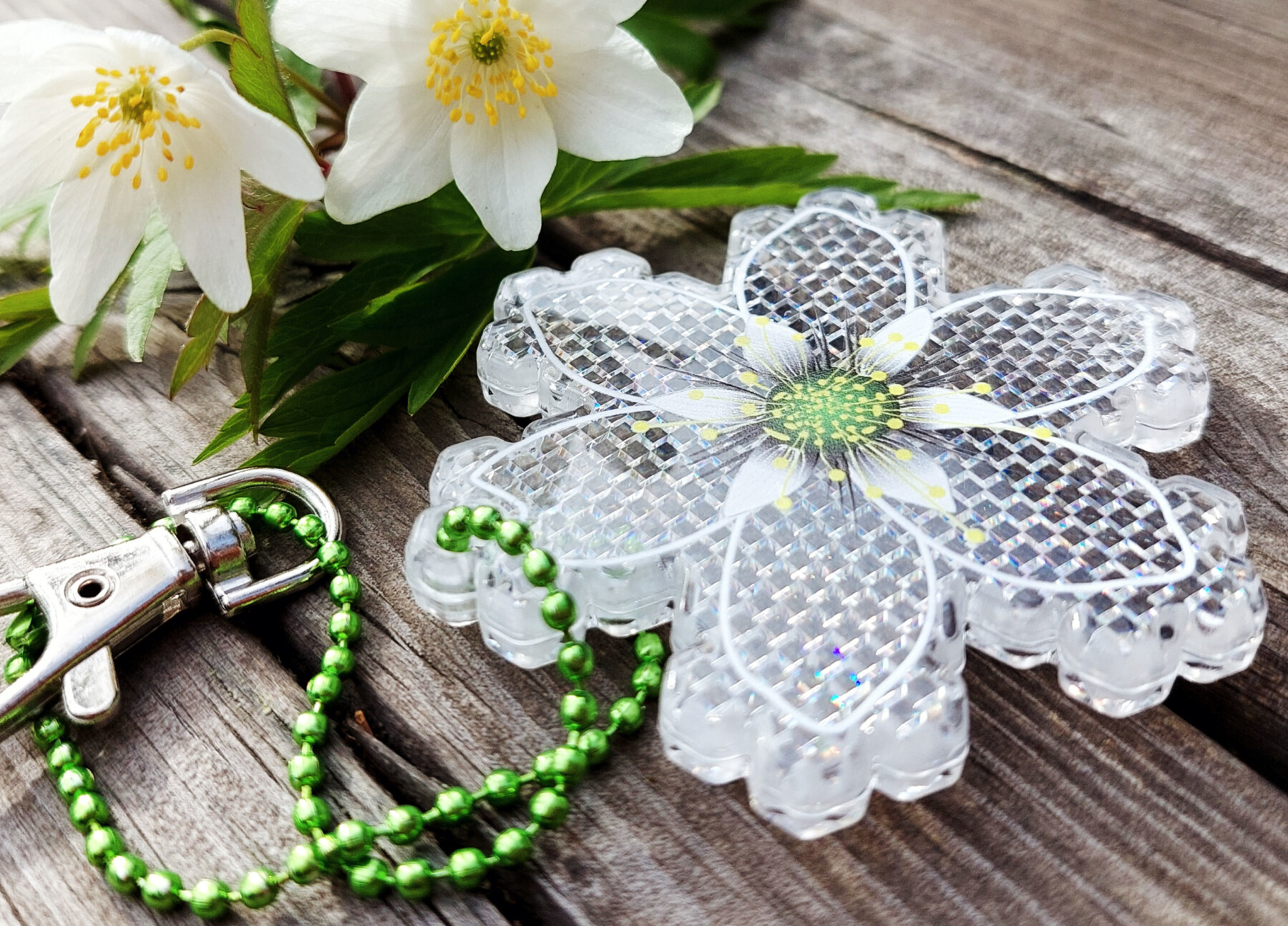
A flat, six-pointed piece of plastic, with lines on it to make it look like a flower, rests on a wooden background together with two real flowers.

Snowflake reflectors have been decorated with flower-like patterns (seen here) or company logos.Photo: Safety Reflector Finland

“Ever since I was a kid, I’ve been totally crazy about drawing and painting and sculpting,” says Suomela. Even now, ceramics is one of his hobbies, and he is locally famous for constructing giant snow sculptures in his yard.

“When my wife retired, she got interested in genealogy,” he says. What she found out may explain his artistic inclination: on his father’s side, he’s related to the world-famous architect and designer Alvar Aalto (1898–1976) and the prominent sculptor Wäinö Aaltonen (1894–1966), who has a museum named after him in Turku.

When Suomela applied to the polytechnic, he knew he wanted to be designing things. It was a logical extension of his interest in making art.

At the Talmu factory, metal sheets were stored in the yard. The company used them to make the precision moulds it needed to manufacture its plastic products.

In the right conditions, tiny ice crystals would form on the metal. This became Suomela’s inspiration for the Snowflake reflector. He went over for a closer look with a magnifying glass on many different occasions.

“I distinctly remember a couple guys walking past and asking what in the world I was doing,” he says. “I was down on my knees on the snowy ground.”

Still a bestseller

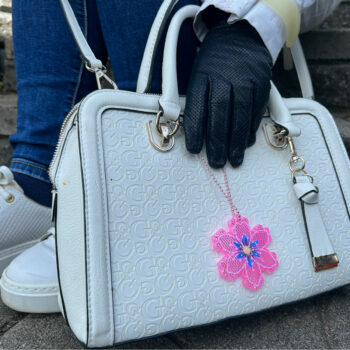
A pink, flat, six-pointed piece of plastic is attached to a white leather handbag.

The aesthetic appeal of the Snowflake reflector helped people realise that you can use reflectors to accessorise, as well as to increase your visibility in traffic.Photo: Safety Reflector Finland

The six-pronged shape of the Snowflake reflector is true to life — every snowflake has six points, because of how water crystallises.

It turned out to be an excellent choice in more ways than one. It’s naturally associated with winter, when there are more hours of darkness and a greater need for reflectors. It’s also a “very neutral symbol,” as Suomela points out. “Nobody has anything against it.”

Starting in 1973, the Snowflake reflector took off. “It went just as I thought,” he says. “People liked it, especially kids.”

It remains a bestseller today. Nobody knows the exact amount produced over the years, but it’s no exaggeration to put it in the tens of millions. The Snowflake reflector is even included in the collection of the Design Museum in Helsinki.

In 2017 (the 100th anniversary of Finland’s independence), the Finnish Road Safety Council invited people in Finland to vote on the best traffic safety invention of the century. The winner? You guessed it: the pedestrian safety reflector, again showing that reflectors have achieved lasting popularity.

A busy career

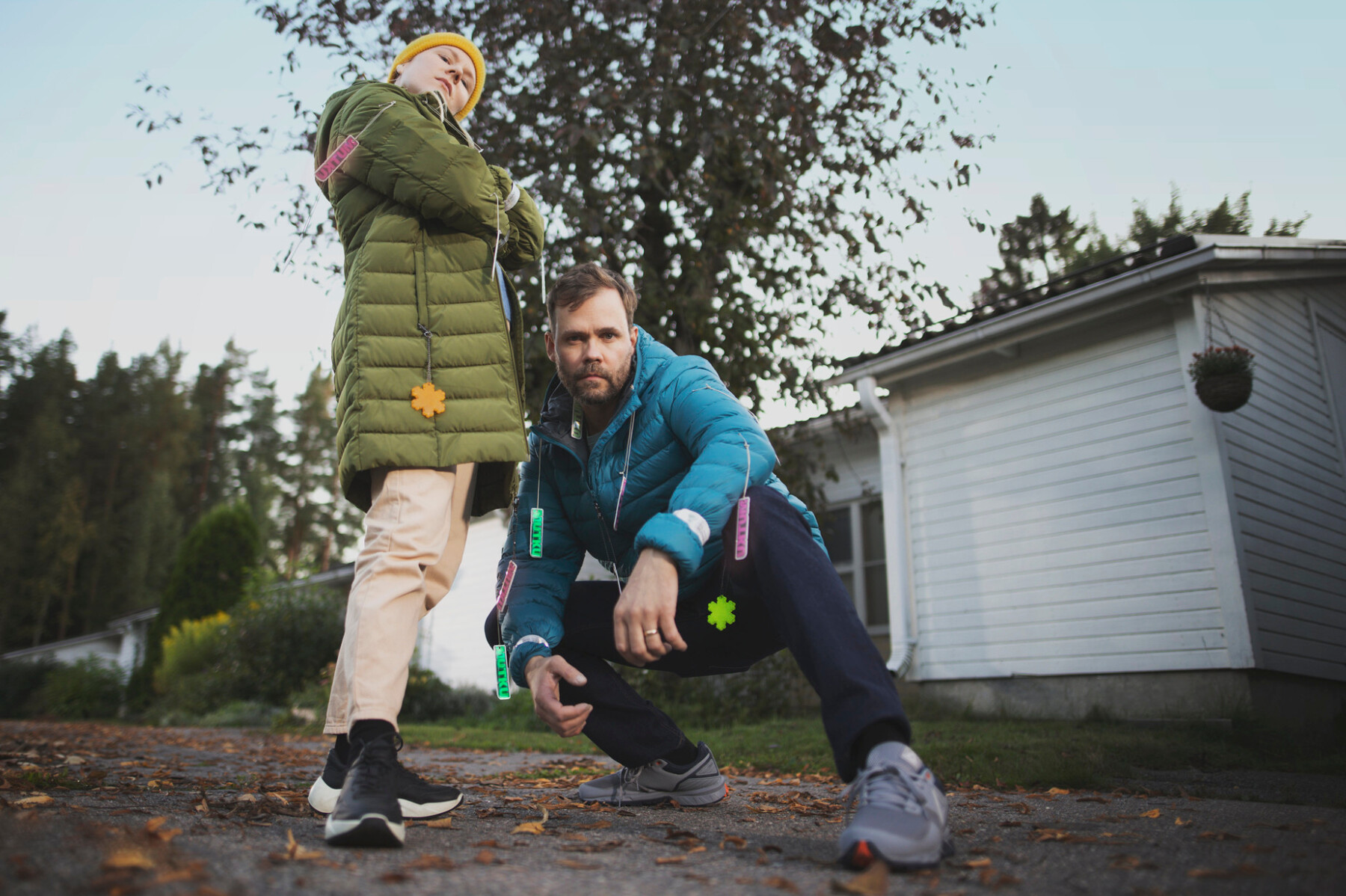
A man and a child in winter jackets, each with several plastic reflectors, are posing for the camera in the yard of a house.

The Finnish Road Safety Council published this photo as part of a campaign to raise awareness about the importance of wearing reflectors.Photo: Risto Vauras/Finnish Road Safety Council

As successful as they were, pedestrian reflectors only accounted for a fraction of the company’s turnover, and of Suomela’s career.

He moved on to many other projects, travelling widely, meeting with customers and partners, devising how to manufacture components for Saab, Volvo, Grundig and others, and ensuring that the designs, machines and moulds for those products functioned. In total, he designed thousands of products.

Then Suomela says something that seems hard to believe: He knew that the Snowflake reflector was a success, but “only when I retired [in the early 2000s] did I begin to realise just how popular it had been.”

What?

“I mean, I would look at the numbers for the traffic product group – OK, this many million units – but I wouldn’t pay terribly much attention to what exact products it included,” he says.

“It only dawned on me later.”

By Peter Marten, May 2024