Celebrating Moomin-maker Tove Jansson of Finland

The year 2014 marked the centenary of Tove Jansson’s birthday. Her international fame stems from the Moomin adventures, which she wrote and illustrated, but there’s much more to her than that.

Tove Jansson (1914–2001) led a remarkable life and remains one of Finland’s most beloved artists and authors. The immensely popular Moomins, although they are called trolls, actually possess surprisingly human traits. They are a curious group of creatures whose foibles and philosophising appeal to both kids and grown-ups.
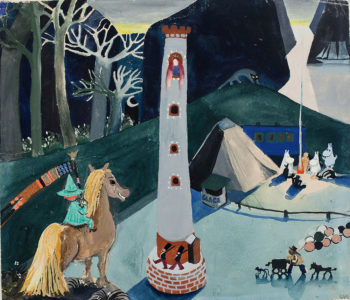
This detail from an early, undated Moomin illustration by Tove Jansson shows Snufkin on a horse (left) and the Moomin family around a campfire (at right, beside tent).

This detail from an early, undated Moomin illustration by Tove Jansson shows Snufkin on a horse (left) and the Moomin family around a campfire (at right, beside tent). Photo: Tampere Art Museum, © Moomin Characters

The characters first appeared in novels, then in comic strips and later in animated films. Jansson wrote the Moomin stories in Swedish, her native language and one of Finland’s official languages. The books stretch over four decades of her career, from the 1940s to ’70s. The first English translation was published in 1951 – several years before a Finnish-language version appeared.

A glance at the table of contents for Comet in Moominland, the first of the books to appear in English, provides a taste of the story’s swashbuckling adventures, humorous antics, philosophical insight and captivating cast of characters.

Here’s a sampling of the chapter descriptions: “Moomintroll and Sniff following a mysterious path to the sea,” “Moomintroll rescues the Snork Maiden from a poisonous bush,” “a fantastic crossing of the dried-up sea,” “a swarm of grass-hoppers,” “a coffee party” and, last but not least, “Chapter 12, which is about the end of the story.” The book’s settings include a cave, an underground river, an observatory and a party in the forest.

Beyond the Moomin books
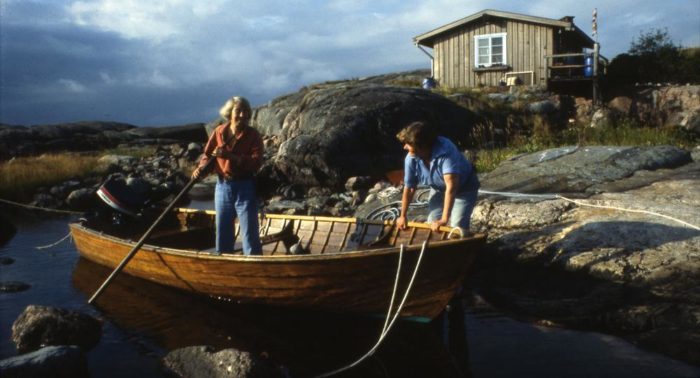
Tove (left), shown here with her partner Tuulikki, spent most of each summer on an island off of southern Finland. The sea and the archipelago figure in many of her books.

Tove (left), shown here with her partner Tuulikki, spent most of each summer on an island off of southern Finland. The sea and the archipelago figure in many of her books.Photo: Per Olov Jansson/Moomin Characters

Many people don’t know that Jansson wrote novels and short stories for a grown-up audience, as well. Over the past several years, Sort Of Books has published these works in beautiful, new, English-language versions. Some of them are appearing in English for the first time ever.

In the introduction to Fair Play, Ali Smith says, “in her writing for adults Jansson was also, in her own quiet way, quite radical both with form and subject matter.” Jansson’s stylistic clarity “makes for mysterious transparency,” and her books describe “people not usually included or given that much space” in literature.

Fair Play forms a collection of autobiographical stories that relate parts of Jansson’s life with her partner Tuulikki. They were together for more than 40 years. Other Jansson books published under the Sort Of imprint include The Summer Book and Sculptor’s Daughter, both of which are considered classics, and four others.

Penguin released another Jansson-related book in December 2014, a new biography by Tuula Karjalainen entitled Tove Jansson: Work and Love (published in Finnish by Tammi as Tove Jansson – Tee työtä ja rakasta).

In addition to providing insight into Jansson’s versatile career as a writer and a visual artist, Karjalainen shows us how bold Jansson was in choosing her path in life. She lived with a man without being married – a scandalous development in those days. She also had relationships with women – these connections were open secrets in Helsinki at a time (the 1940s and ’50s) when such a relationship could still lead to jail or a mental hospital.

Paintings, murals and art circles
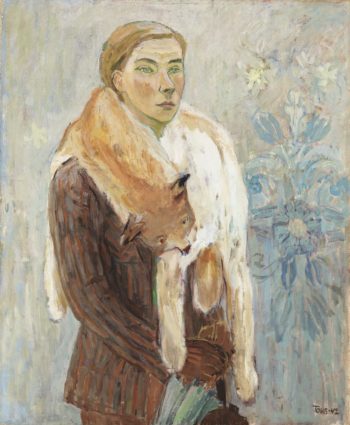
Detail from a self-portrait, “Lynx Boa” (1942).

Detail from a self-portrait, “Lynx Boa” (1942).Photo: Finnish Nat’l Gallery/Yehia Eweis, © Tove Jansson Estate

Another side of Jansson unfamiliar to many Moomin fans is her painting career. Despite the eventual success of the Moomin books and her books for adults, Jansson herself considered painting her main professional calling for much of her life. During one phase of her career, Jansson supported herself by painting monumental wall murals for various government and corporate buildings.

Karjalainen says that Jansson was late in joining the wave of abstractionism that reached Finland in the 1950s, although she later produced fine work in that genre. In an interview for this article, Karjalainen suggests that Jansson did not take readily to abstractionism because she was “a storyteller by nature,” in painting as well as in literature.

In the less-than-open-minded art circles of mid-20th-century Helsinki, Jansson’s storytelling talent, success and versatility seem to have inspired some degree of jealousy. For much of the 1950s, she supported herself – and her other art – by writing and illustrating Moomin comic strips for England’s Evening News. “When she met artists [in Helsinki],” says Karjalainen, “she got a lot of negative feedback. It got so bad that she had to change her phone number because she’d get calls telling her that she’d sold her soul to commercialism.”

“It’s difficult for us to imagine today, but that’s the way it was.”

By Peter Marten, March 2014, updated September 2014
Balancing studies and fun in Finland

International students might have heard rumours regarding Finland’s unconventional student culture, but most of them have no idea what they are getting themselves into.

Finland contains multiple centres of student life: the Helsinki metropolitan area; Turku in the southwest; Tampere and Vaasa further north; Oulu and Rovaniemi much further north; Joensuu in the east; and many more. The country possesses a total of 14 universities and 25 polytechnic institutes. Each university nourishes its own distinct student culture and traditions.

2781-maijutompuric-jpg

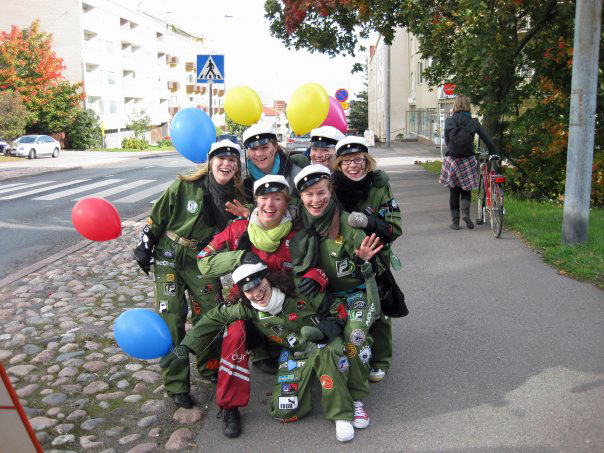
Different overalls indicate different departments: green from Athene, Aalto University’s information networks students’ guild, and red from Teknologföreningen, Aalto’s Swedish-speaking engineers club.Photo: Maiju Tompuri

Many Finnish student traditions are similar to those in the other Nordic countries, especially Sweden. The largest student festivity falls on April 30 and May 1, called Walpurgis in English, Vappu in Finnish and Valborg in Swedish. Every single student – and every other person in Finland, for that matter, takes part.

May Day (May 1) is also a national holiday, Labour Day. For the festivities people bring out and wear their white high school graduation caps. University students sport overalls in various colours, decorated with writing, badges, gadgets, gloves, cups, symbols, toys, tools and whatever else students might need during their adventures.

Rags to riches lifestyle

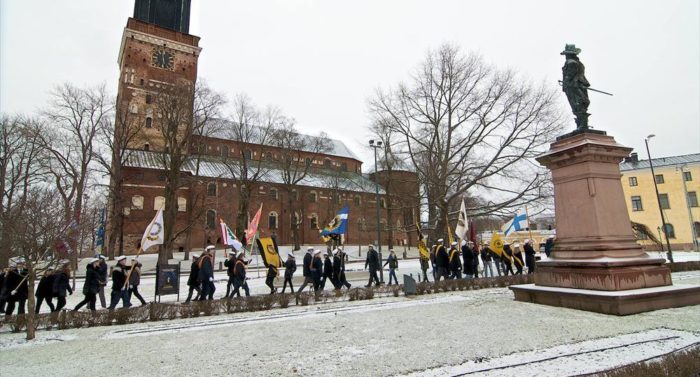
Traditions form an important part of student life: Student associations from Åbo Akademi University in Turku salute a statue of Per Brahe, founder of Finland’s first university.

Traditions form an important part of student life: Student associations from Åbo Akademi University in Turku salute a statue of Per Brahe, founder of Finland’s first university.Photo: Max Weijola

As a garment, overalls hold more value than you’d think. The colour of your overalls is determined according to where and what you’re studying, creating a sense of unity among students. The overalls also act as outstanding icebreakers – you can always make a stereotypical joke related to a certain field of study. Rules regarding the use of overalls vary from one place to another, but luckily student events also exist for people interested in dressing more elegantly.

At annual gala dances, participants wear full evening dress. The event often consists of a three-course dinner, dancing and an after-party. The next morning a herring brunch is held, mainly to help abolish any headaches acquired the previous evening.

Students have the opportunity to participate in a myriad of these events held by multiple smaller associations, student organisations and “student nations” (similar in some respects to fraternities and sororities in the US). Time and money form the only constraints. Some may even travel to similar galas abroad, most likely to the other Nordic countries or Estonia.

From orienteering to singing

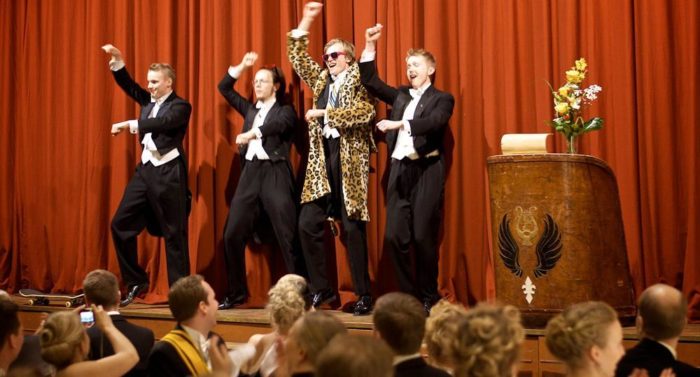
Singing plays a significant role in Finnish student culture, and choirs can be found at any university. This Turku quartet called Kosteat Kosijat (The Wet Suitors) is performing at a banquet.

Singing plays a significant role in Finnish student culture, and choirs can be found at any university. This Turku quartet called Kosteat Kosijat (The Wet Suitors) is performing at a banquet.Photo: Max Weijola

Most student unions in Finland organise large events such as the aforementioned Walpurgis Eve and annual galas, as well as festivities during Finnish Independence Day. Various welcome carnivals and fairs take place in the beginning of the year for the benefit of first-year students. Tradition dictates that an epic sledding competition takes place in the snow on Shrove Tuesday. There’s a lot to discover.

Jäynäkisa, an annual prank competition just outside of Helsinki in Otaniemi, encourages future engineers to apply their technical wit with humour. Similar contests are held at many universities, and student associations from all over Finland participate.

The name of northern Finland’s largest student event, Poronkusema, comes from an old unit of measurement that referred to the intervals at which roaming reindeer stopped to urinate. Poronkusema involves team orienteering and assignments in the city of Rovaniemi.

If you feel like calling yourself a captain of the Aura River, catch the annual pub crawl in Turku. How about a fashion show? Students at Hanken School of Economics in Helsinki organise their own runway and act as models. Want to practice your Finnish or Swedish? Schnapps songs and great company can be found at sits parties, which form a poor man’s version of the three-course gala dinner. Don’t be afraid – they may sing English songs too.

Well-balanced student life

It’s possible to participate in a plethora of different festive occasions during your student life in Finland.

Of course, studying in Finland is not all fun and games. Lectures, assignments, quizzes and exams form an integral part of student life. Still, you have to have a balance. Life experience can be just as valuable as your studies. It’s up to you to decide for yourself how far you want to delve into Finnish student culture and its traditions.

Facts about Finnish student culture

  • Student caps were first used by Julius Osberg, Mortimer Trapp, Paul Edelheim and Alexander Stjerncreutz in 1865. The caps were ordered from Maria Grape in Sweden.
  • Today, all new student caps come with a Helsinki University pin attached to the front, but it can be changed by purchasing a new, university-specific pin from your own student union.
  • Other unique events that happen around Finland: World Championships of Academic Kyykkä (a kind of bowling where you knock wooden blocks over by throwing a wooden bat) at Tampere University, Pampas Nationaldag at the Vaasa branch of Åbo Akademi University, Finnish Student Championships, and many more.

By Lasse Mäki-Hokkonen, September 2014

Don’t mess with Finnish jazz

Jazz fans in Finland have never had it as good as they do now, with a wealth of domestic and foreign performers playing a thriving circuit of clubs and festivals from the southern coast to the far north.

Half a dozen clubs in Helsinki offer weekly, cutting-edge performances by top-tier Finnish musicians, while approximately 20 annual jazz festivals across the country contribute to a scene that thrives on a rich mix of traditional, modern, bebop, blues and Scandinavian elements.

According to Jukka Perko, artistic director of Viapori Jazz Festival, Finland’s jazz bustle can be traced directly to Finland’s institutes of higher education. The Sibelius Academy added formal jazz studies to its syllabus in 1983, a move that the Helsinki Pop & Jazz Conservatory had already made in 1972.

“There are now at least two generations of jazz musicians who are experienced professional musicians and excellent performers or composers,” explains Perko, who is himself a graduate of the Sibelius Academy.

Perko says the jazz boom in Finland started “more than ten years ago, but perhaps because clubs and concert venues are currently more established, jazz now has the ability to reach audiences more easily. It has become closer to the people.”

What makes Finnish jazz Finnish?

3545-prattala_salokoski_bacharach_viaporijazz_550px-jpg

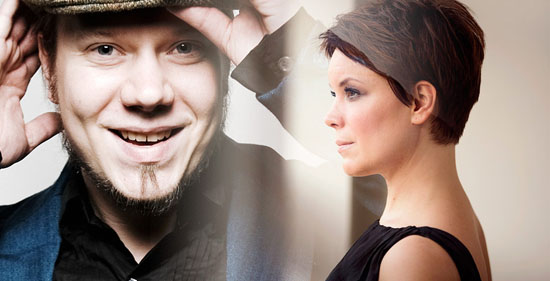
Soulful vocalists Tuomas Prättälä (left) and Emma Salokoski are some of the singers who can be heard at jazz festivals in Finland.Photo courtesy of Viapori Jazz

Finnish jazz is often considered within what is known as Scandinavian jazz. “Finnish jazz has plenty of design,” explains Perko enthusiastically. “It’s more minimalistic. It’s similar to our design, with simple lines, perhaps more edgy. But I believe this can be said about Scandinavian jazz in general.”

He paraphrases a famous quote from renowned Finnish classical composer Jean Sibelius: “Don’t write any unnecessary musical notes!” Perko is referring to an aspect of Finnish culture – and hence Finnish music.

“Our extreme winter weather conditions have forced us to be accurate when sowing and harvesting the crop,” says Perko, himself the son of a farmer. “We couldn’t afford to lose or waste anything. It was all about precision and hard work, weeding out what was unnecessary – like in our music.”

In Helsinki, Finnish jazz can be heard at venues such as Koko Jazz Club, We Jazz and Nyyrikki Jazz. The southwestern city of Turku has its well-established Jazz Club Monk, and in Tampere, two hours north of Helsinki, Paapan Kapakka hosts jazz gigs daily, often by the house band.

Cool hot island festival

3545-jazzbasilli_herd_feat-aili-ikonen_viaporijazz_550px-jpg

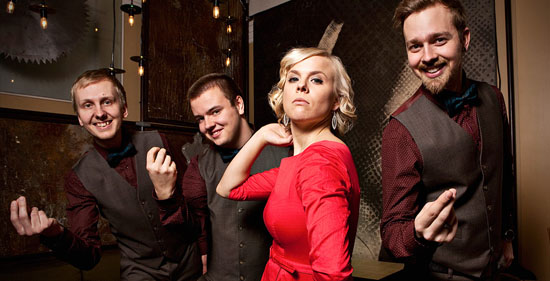
The young trio HERD has been known to perform with singer Aili Ikonen as Jazzbasilli.Photo courtesy of Viapori Jazz

Every August the picturesque island fortress of Suomenlinna, just off the coast of Helsinki, hosts the Viapori Jazz Festival, known for its all-Finnish programme. “It’s important to have a festival where our musicians have the main role,” says Perko. “There are enough fests with famous international artists. But I’m not interested in that. I want to keep our festival small and local.”

“Viapori includes anything that sounds interesting or different or is fun,” says Perko. He compiles Viapori’s programme based on inspiration he gets from chats colleagues and friends or from simply “taking a walk with the dog in the forest.” Viapori’s wide-ranging selection attracts dabblers and connoisseurs alike.

By Carina Chela, May 2013, updated September 2014
Oulu leads with innovative healthcare

Finland and its northern city of Oulu are becoming recognised around the globe for the development of an innovative healthcare ecosystem.

Healthcare leaders from universities, governments and businesses around the world met at Nightless Night, a conference in Oulu in summer 2014, to learn from world-class innovative health programs running in Finland. The event name refers to the fact that the sun hardly sets at all during the northern summer.

Dorothy Whittick of Canada’s IBM Global Centre of Competence for Healthcare and Life Sciences, a keynote speaker at Nightless Night, believes Finns are leading the world in advanced and innovative health and wellness ecosystems.

“The culture of Finland is very collaborative and transparent, which helps to unite diverse groups of stakeholders,” she says. “The OuluHealth ecosystem is an excellent example of this collaboration – between academic researchers, business entrepreneurs, government leaders and health and social service providers. This collaboration, transparency and stakeholder engagement allows them to leapfrog other nations in developing innovative and inclusive health and wellness ecosystems.”

Europe watching Oulu

3181-minnahendolin550px-jpg

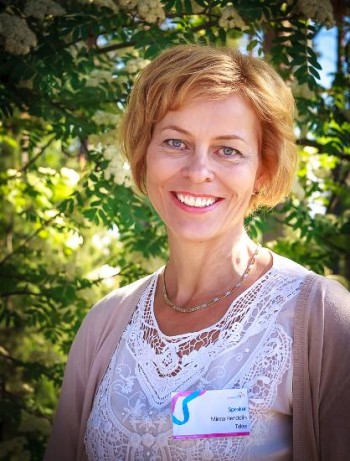
Minna Hendolin of TEKES believes Finland will be “a model country for consolidating a sustainable and innovative healthcare system.”Photo: Tero Suutari/Business Oulu

The city of Oulu is becoming well known internationally for delivering integrated health and social care while embracing technology, says Brian O’Connor, chair of the European Connected Health Alliance: “More and more governments throughout Europe are moving to the same model and want to learn from Oulu.”

“Among other healthcare innovations, Oulu has pioneered the Self Care Project, which allows citizens to engage in direct electronic communication with their doctor, access blood test results electronically and book and manage their doctor’s appointments online. The system is currently being used by over half the city’s population.”

Earlier in 2014, four Finnish government ministers (the Ministers of Economic Affairs; Social Affairs and Health; Education and Science; and Health and Social Services) signed a health sector growth strategy for research and innovation activities that formalised a national roadmap for an innovative healthcare ecosystem. The goal was to create an internationally competitive advantage for Finland.

Minna Hendolin works at the Finnish Funding Agency for Technology and Innovation, known by its Finnish abbreviation TEKES, as executive director of vitality of people. She says this is the first time Finland has established a national strategy that examines its health sector from an innovation investment and business growth perspective, rather than simply treating it as a necessary cost.

“This new strategy aims to build up a national health ecosystem of partners in business, research and public bodies that will boost innovation and business growth,” she says. “We are on the verge of becoming a model country for consolidating a sustainable and innovative healthcare system.”

Finland’s unique health databases

In the digital health revolution, the focus is shifting from health treatment to prevention and making better choices.

In the digital health revolution, the focus is shifting from health treatment to prevention and making better choices.Photo: Juha Tuomi/Rodeo/Lehtikuva

One of the reasons for this success is that Finland has built up reputable biobanks storing human biological samples and associated data. This benefits research aimed at discovering better diagnostic treatment of chronic health conditions and improving prevention of these conditions. Hendolin says the biobanks are establishing close collaboration between government, business and research entities.

Finland is well positioned to make the best use of this collaboration to help prevent chronic disease, believes Maritta Perala-Heape, director of the Centre for Health and Technology at University of Oulu. “We are experiencing a shift away from health treatment to a focus on prevention,” she says.

“The digital health revolution is giving us the opportunity to collect and analyse a lot of health data so that we can build new preventative health services and guide citizens towards better health choices. Finland’s extensive health databases are driving this focus on prevention to help citizens lower the risks of chronic diseases.”

“Our comprehensive national health databases are globally unique,” says Hendolin, “and they’re opening up a real opportunity for Finland to be a forerunner in health sector research, innovation, investment and new business activities.

“Our biobanks especially are leading the way,” she says. “Finnish legislation recently established biobanks that would collaborate with businesses to improve health outcomes. While these biobanks are publicly owned through university hospitals, they are developing a business identity to boost growth in healthcare technology.”

By Mark Badham, August 2014

Iconic Finnish nature symbols stand out

Many countries have an animal or bird as a national symbol, but close-to-nature Finland has seven natural symbols, including a national fish, a national tree and even a national insect. The country also celebrates Finnish Nature Day every year on the last weekend in August.

Finland’s seven magnificent national nature symbols received their status through a series of public polls that attracted tens of thousands of postal votes in the 1980s and ’90s, before the advent of instant online polls. “The reason we have so many iconic natural symbols may be that nature is very dear to the Finns, as can be seen each summer when our cities empty out as everyone heads off to their rural roots,” explains Terho Poutanen, former publicity officer of the Finnish Association for Nature Conservation. The association organised several of the popular national votes together with scientific, corporate and media partners. “Our seven national nature symbols are interlinked with Finnish mythology, traditions and popular culture in various interesting ways,” he says. Many have been proudly featured on postage stamps, in organisations’ logos and on pre-euro Finnish banknotes and coins. Poutanen explains how the votes also aimed to arouse interest in nature conservation among urbanised modern Finns by giving everyone a sense of connection to certain familiar, charismatic or endangered creatures.

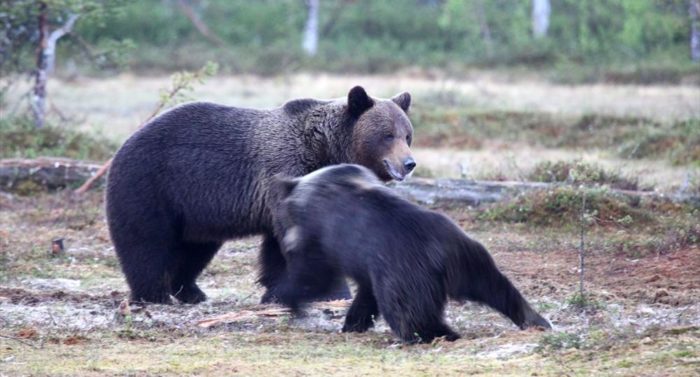
Finland’s national animal: brown bear

Two bears roaming in a forest.

Photo: Tim Bird

Bears feature prominently in Finnish mythology, including the national folklore epic Kalevala. Ancient Finno-Ugric peoples held bears as feared and honoured totemic animals, and Finns still often consider the bear “King of the Forest.” About 1,500 brown bears (Ursus arctos) roam Finland’s vast forests today, but they are very wary of humans and few Finns ever encounter them in the wild – though in recent years safe and sensitively organised bear-watching trips in the bear country borderlands of eastern Finland have enabled increasing numbers of Finns and foreign visitors to watch these magnificent beasts close up. Other animals that fared well in the public poll included the hunters’ favourite the moose or elk (Alces alces) and the Saimaa ringed seal (Pusa hispida saimensis), an endangered freshwater seal found only in Finland.

Finland’s national bird: whooper swan

A whooper swan flying in a clear blue sky.

Photo: Jari Peltomäki/NatureGate

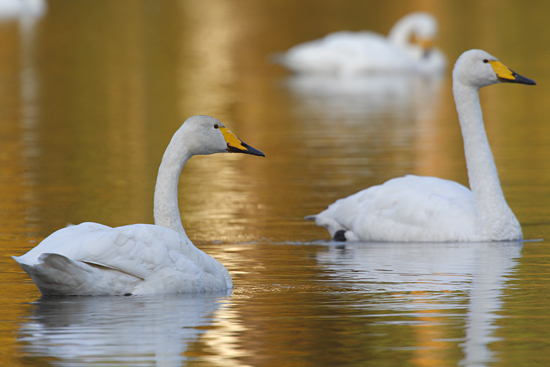
The whooper swan (Cygnus cygnus) is a graceful, northern, pure white, wild swan that features in Finnish folklore and culture, from the Kalevala folk epic to the works of composer Jean Sibelius. During the early 20th century the numbers of whooper swans in the wild declined steeply, until by the 1950s fewer than twenty pairs bred in Finland. The swans have since recovered after being successfully spotlighted as a figurehead species for Finland’s nascent nature conservation movement; and today Finland is home to about 6,000 whoopers. In the springtime the sight and sound of returning flocks of migrating swans brings joy to nature-lovers across the country. Many products in Finland’s stores bear a flying swan logo from a Nordic environmental labelling scheme, or a swimming swan logo signifying food produced in Finland. Finnish euro coins feature a pair of whooper swans in flight over some quintessentially Finnish lakeland scenery.

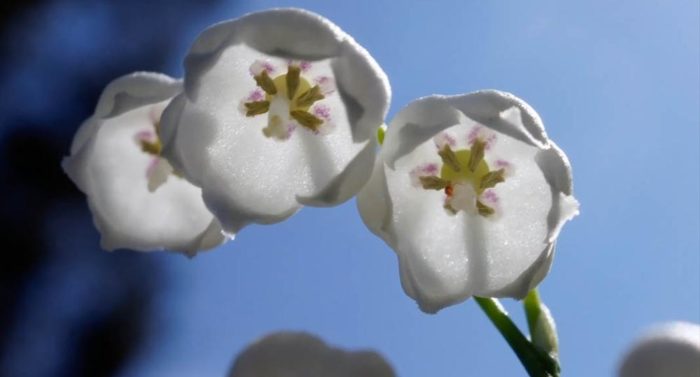
Finland’s national flower: lily-of-the-valley

A close-up of lily of the valley flowers.

Photo: Jouko Lehmuskallio/NatureGate

The lily-of-the valley (Convallaria majalis) was chosen as Finland’s national flower because its attractive and sweetly-scented flowers are very familiar to most Finns. These delicate clusters of white blossoms, shaped like tiny bells, bloom in early summer in moist woodlands, parks and gardens in almost all parts of the country. Perennial lily-of-the-valley plants grow so profusely that children and other nature-lovers can be encouraged to pick them while leaving rarer species to grow, though it’s worth remembering that the bright red berries that adorn them in late summer are poisonous. Lilies-of-the-valley have often featured in Finnish romantic poetry and pop songs. Their Finnish name, kielo, is also a traditional girl’s name that for some reason is also often given to amiable cows.

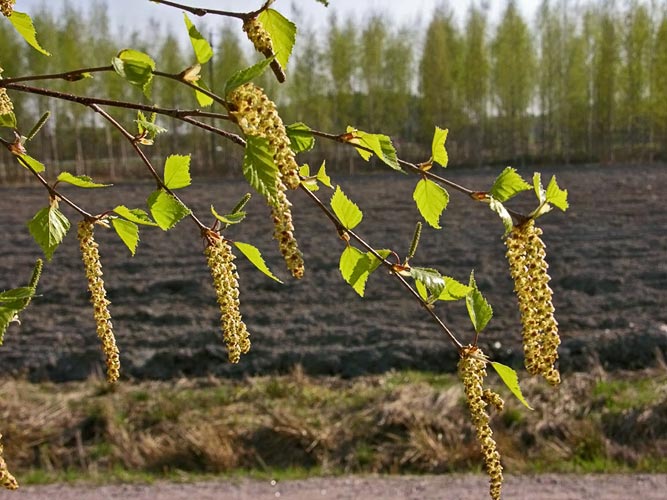
Finland’s national tree: silver birch

A close-up of silver birch leaves and catkins with a field in the background.

Photo: Jouko Lehmuskallio/NatureGate

The silver birch (Betula pendula), with its striking white bark, lush green leaves and gracefully drooping branches, is perhaps the most beautiful native tree in Finland’s forests, so it came as no surprise when the winner of the vote to choose the country’s national tree was announced in 1988. Over the ages Finns have traditionally used birch trees in many other ways than for their timber. Their sap makes a healthy mineral-rich drink. Their bark has been used to make anything from roofs to baskets, and even shoes.  And the freshest, leafiest branches of young silver birches make the best possible switches for gentle flagellatory use in therapeutic sauna massages. To mark Midsummer’s Day many Finns stand two silver birch saplings outside the doorway of their home or holiday cabin, continuing an age-old tradition. And countless old Finnish romantic films feature a cliché image of a blonde Finnish maiden leaning winsomely on a birch tree by a picturesque lakeshore.

Finland’s national fish: perch

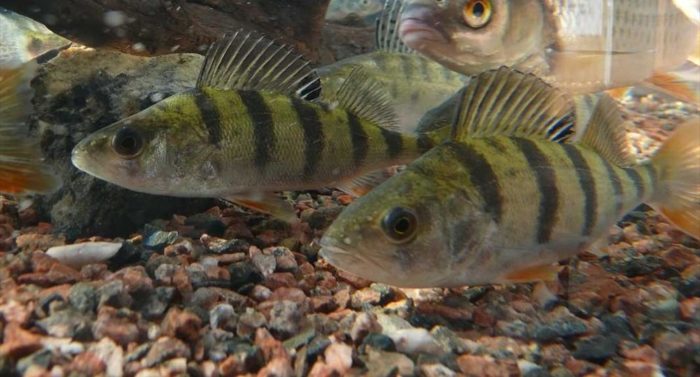
Two perch swimming in clear water near the rocky bottom.

Photo: Jouko Lehmuskallio/NatureGate

With its dark stripes and bright red fins, the perch (Perca fluviatilis) is by far the most familiar and easily recognised fish found in Finnish waters. Some well-known fish only thrive in saltier marine waters, wild rivers or pristine arctic lakes, but the humble perch abounds in ponds, lakes, rivers and coastal waters all around Finland. These hungry aquatic predators can easily be caught by anyone dangling a hooked worm on a line tied to a fishing rod or the end of a branch. But they are also widely trawled and traded by Finnish commercial fishermen. Fresh perch can be seen in shops and markets around Finland. Fried, grilled or baked perch makes a tasty meal, and traditional dishes such as perch soup or rye loaf stuffed with perch are popular in many rural regions.

Finland’s national rock: granite

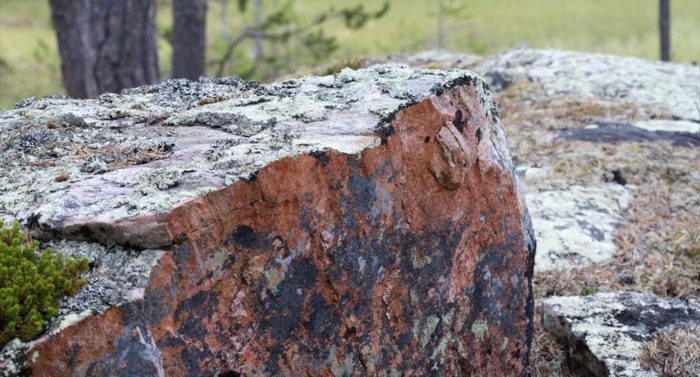
Granite boulders in a forest.

Photo: Karen Siren/Lehtikuva

Granite was chosen as Finland’s national rock type in a postal poll run by the Finnish Science Centre Heureka and a geological institute in 1989. Outcrops of ancient pinkish or greyish granitic bedrock two billion years old or more can be seen in almost all regions of Finland. Attractive and durable granite can also be widely seen in Finland’s cities and towns in monuments, sculptures and prominent buildings. Well-known granite buildings in Helsinki include Parliament House, the National Museum, the Central Railway Station, the National Theatre, Granite House shopping mall, and the atmospheric Temppeliaiukio Church, which is sunk into the granite bedrock that underlies the capital. Most Finns also end their days under a traditional granite gravestone.

Finland’s national insect: seven-spot ladybird

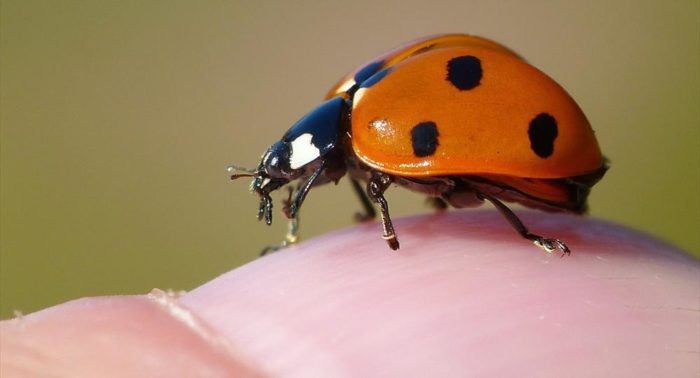
A close-up of a ladybug on a finger.

Photo: baerchen57/flickr, cc by-nc-sa

The seven-spot ladybird (Coccinella septempunctata) was chosen as Finland’s iconic insect in 1996 through a poll publicised by a popular magazine for animal-lovers. It is an ideal choice for encouraging an interest in creepy-crawly creatures, as an easily sighted, beautifully decorated bug that does not bite or sting, but can be safely picked up and observed. Behind its choice undoubtedly lies a children’s rhyme loved by generations of Finnish kids: “Fly, fly, Ladybird, to the foot of the big stone, / There your mummy and daddy are making porridge for you.” Colourful ladybirds also feature in a logo that appears on wildlife-friendly Finnish organic produce.

By Fran Weaver, August 2014

Celebrating Finland’s natural assets

The annual Finnish Nature Day was celebrated for the first time in 2013 and has been an officially recommended flag-raising day since 2017. It highlights the joy and wellbeing that the country’s beautiful natural settings can bring everyone.

“In Finland people traditionally have a close relationship with nature, but there’s a risk that modern trends like urbanisation, globalisation and the way children increasingly spend their spare time using electronic media could weaken this relationship,” says Matti Nieminen of the Finnish Association for Nature Conservation (FANC).

2926-syotemaisemanihailuasyksysaaraairaksinen_metsahallitus550-jpg

Photo: Saara Airaksinen/Metsähallitus

“For this reason we decided to designate a special day to celebrate the importance of nature to Finnish culture, and to highlight the enjoyment and well-being people can get from nature.” Finnish Nature Day is observed annually during the last weekend in August.

“In Finland we should also be proud of our beautiful nature,” Nieminen says. At the  time of writing, FutureBrand’s Country Brand Index showed Finland’s natural beauty as rated third-highest in the world. Such perceptions are a huge plus in terms of attracting tourism, but the locals should also fully utilise these natural assets.

Getting kids back outside

2926-setwidth640-retkelleannemuuri_metsahallitus550-jpg

Photo: Anne Muuri/Metsähallitus

Nieminen rues that these days children and young people don’t seem to spend as much time as previous generations simply exploring the great outdoors without any organised activity. “They also seem to be losing their practical knowledge of nature and wildlife,” he adds.

Enjoying nature can benefit people of all ages. “Research findings clearly show that people’s mental and physical health improve if they spending time in natural green areas,” says Nieminen.

Even restful activities like walking and playing in natural woodlands can reduce problems such as allergies, obesity and depression.

Forest fun

2926-lahteella-rikulumiaro409-jpg

Photo: Riku Lumiaro

“Nature Day aims to get people outdoors, and the end of August is ideal timing, soon after the schools restart,” says Nieminen. “The water’s still warm enough for swimming, and it’s a great time to watch wildlife and find berries and mushrooms out in the forest, for instance.”

Events and publicity for the annual day are jointly led by the FANC, the Finnish Environment Institute, Metsähallitus Natural Heritage Services and a national teachers’ union. Happenings around the country include many guided nature or cultural history walks – as well as lots of activities especially planned for children. Mushrooms are an understandably popular theme at the start of the peak Finnish mushroom-picking season.

During the preceding week many schools use special teaching materials and show the hugely popular Finnish nature documentary film Metsän tarina (The Story of the Forest). For people based in the capital area, many Nature Day events happen or start at the Finnish Nature Centre Haltia, which opened in Espoo, just west of Helsinki, in May 2013.

Building awareness of conservation

2926-autumn_swan_ismopekkarinen_visitfinland_2851-550-jpg

Photo: Ismo Pekkarinen/Visit Finland

Nature Day’s logo features the whooper swan, Finland’s national bird. The recovery of these graceful waterbirds from near extinction in much of Finland is one of the country’s recent conservation success stories.

“Of course we also aim to increase awareness of nature conservation through the annual day,” says Nieminen. Recent “red list” surveys suggest that conditions in Finland’s lakes and rivers are generally very good today, but many farmland and woodland species are becoming rarer.

Nature Day has become a truly national annual event that activates teachers, kids, parents, grandparents, and everyone else – and increases their interest in nature. “It’s great that in Finland you’re never far away from natural green areas, and we encourage everyone to make the most of this,” Nieminen says.

By Fran Weaver, updated August 2020

Finnish military fosters future leaders

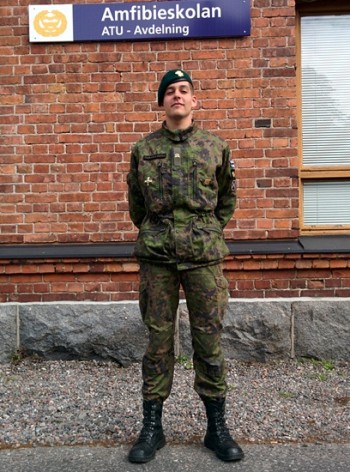
Every year thousands of young Finnish men do their mandatory military service or opt for civilian service instead. Each January and July, a total of about 13,000 recruits travel across Finland by road, rail or air in order to reach their designated brigades and begin six to twelve months in the challenging environment of the armed forces.

In most cases, men who have dual citizenship and live abroad must also come to Finland and serve. Some travel great lengths to attend. Julio Tiusanen, who grew up in Nicaragua, is one of the annual 50 to 70 dual citizens who come to Finland to complete their military service.

While service is not compulsory for women, some of them decide to enlist. Emmie Sumelius, a Swedish speaker, comes from the southwestern Finnish city of Turku and is one of the annual 300 to 400 women that complete voluntary military service. Both Sumelius and Tiusanen served at Nyland Brigade, the only unit in Finland where service, education and training are carried out in Swedish, one of Finland’s official languages.

Natural decision

4009-julio_front_by_juliotiusanen-550px-jpg

Julio Tiusanen, whose dad is from Finland, found in the Finnish military experience a completely new situation where he could focus on values such as discipline and test his mental and physical limits.Photo courtesy of Julio Tiusanen

Tiusanen graduated from Ave Maria University in Nicaragua with a degree in business administration prior to moving across the pond and actually visiting Finland – his father’s home country – for the first time. The decision to serve in the Finnish military felt natural to him because of his father’s experience of tackling a completely new situation where you could focus on values such as discipline and test your mental and physical limits.

Sumelius decided to volunteer in order to further develop her leadership skills. The challenges did not daunt her, as she enjoys working in a team. The discipline and the organisation also interested her, and she is now on a contract working as a second lieutenant teaching new recruits the very things she learned when she first arrived.

The Finnish Defence Forces (FDF) are not directly perceived as an educational institution, yet they offer a wide range of learning experiences. The Army, Navy and Air Force all contain a wide range of Special Forces, branches and institutions. Some conscripts have the opportunity to serve in capacities compatible with their education and work experience: chefs, physicians, lawyers, electricians, mechanics and others. For those who have not yet found their professional calling, the FDF assigns suitable duties based on tests, evaluations and an interview.

The most motivated and suitable conscripts are chosen for leadership training, either for a rank as a non-commissioned officer (NCO), or a commissioned officer in the reserves. Sumelius was selected for the Reserve Officers School while Tiusanen went to NCO School, as well as receiving special training in crisis management. Both Sumelius and Tiusanen were trained and practised leadership for ten months during their service.

Harsh tests, new friends

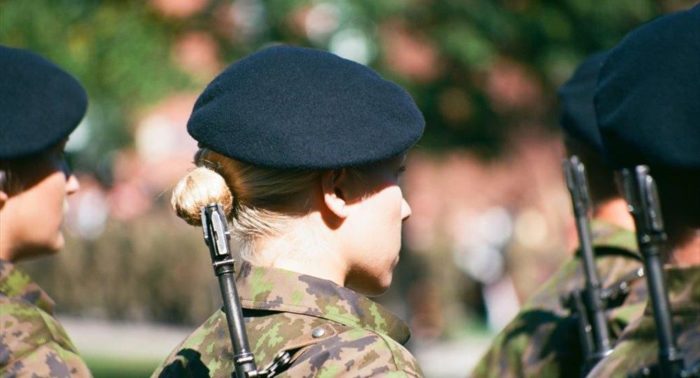
Different branches of the Finnish Defence Forces use different colours of berets. Pictured here is the dark blue beret of the Navy.

Different branches of the Finnish Defence Forces use different colours of berets. Pictured here is the dark blue beret of the Navy.Photo: Marina Pettersson

Tiusanen and Sumelius appreciate the training they have received, but they put the most emphasis on how their personalities have changed for the better. Sumelius explained: “I’m more confident, more focused, mentally stronger and I have 1,000 amazing experiences and memories – and some not-so-pleasant ones.”

The sometimes harsh environment and complete exhaustion made them appreciate their friends and family and the small things in life. “I learned how to deal with different types of personalities and a different culture,” Tiusanen says. “On a deeper level, it made me realise I was stronger than I thought. No matter how difficult or distant it seems, with enough effort and determination you can achieve anything.”

For Tiusanen and Sumelius, the most memorable events happened during the most challenging situations: the 70-kilometre Green Beret March for Tiusanen, and the almost identical Leadership Exercise for Sumelius. The latter measures leadership skills and stamina, and forms the toughest march in the Reserve Officers School.

However, the best memories will always be the friends they shared their experiences with. “You meet a lot of new people from completely different backgrounds and make new friends and establish bonds that will last a lifetime,” Tiusanen says.

Do they have any regrets about their voluntary service? “Not really,” says Sumelius. “Although I had doubts many times during the service, the hard times were all worth it in the end.”

“Absolutely nothing,” says Tiusanen. “I think it was one of the most rewarding experiences of my life.”

Military service in Finland

  • Men become eligible for military service the year they turn 18, and later participate in refresher courses with the reserve forces until they turn 60.
  • Military service is voluntary for Finnish women, and for men with right of residence on Finland’s autonomous Åland Islands.
  • In general, military service is carried out at the age of 19 or 20, but can sometimes be deferred. The maximum age for completion is 29.
  • Military service lasts 165, 255 or 347 days, depending on the duties allotted to the conscript.

By Lasse Mäki-Hokkonen, August 2014, updated August 2018

Finnish bioeconomy making amazing future

Imagine clothes made of wood, plastic made of trees and car fuel that is excreted by microbes. It may sound like the stuff of science fiction, yet this technology is available to us today – and much of it has been developed in Finland.

This incredible technology comes from the bioeconomy. But what is the bioeconomy?

“It’s a whole socioeconomic system that considers the big picture: industrial processes, jobs and wellbeing,” says professor Anne-Christine Ritschkoff, in charge of strategic research at VTT Technical Research Centre of Finland. A world-renowned expert in bioeconomy, Ritschkoff says it’s not just about sustainability of the environment, but sustainability of the whole economy. “The very strict definition,” she says, “is an alternative to oil dependency.”

There’s a lot happening in the scientific and business communities around the world in developing a bioeconomy. Experts agree it is the new wave of the global economy, and it needs plenty of new technology and innovation if it is to succeed. Finland has taken a leading role in this area, not only in research, but also in application.

Natural and human resources

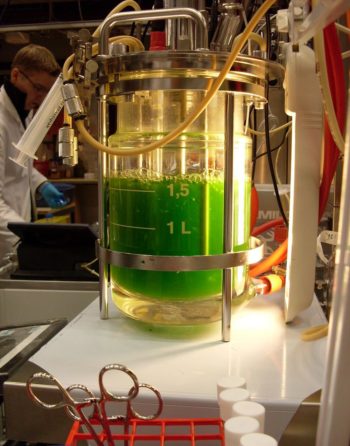
A VTT-coordinated project called Algida explores the use of algae in producing biofuel.

A VTT-coordinated project called Algida explores the use of algae in producing biofuel.Photo: VTT

Finland is important in the development of the bioeconomy because it has both the natural resources and the human resources to make it possible. The bioeconomy is based on biomass, easily renewable plant material and animal waste that can be utilised in manufacturing and industry. The best source of biomass in Finland is the forests that cover 75 percent of the country’s land area. There is also a very highly educated and skilled working population, including the many research scientists and ICT experts that are needed to create new product development processes.

A growing number of success stories highlight the benefits of the bioeconomy. The well-established paper industry has always been very careful to avoid overusing forest resources and to replant regularly. Xylitol, a sugar that actually helps prevent tooth decay, is derived from birch trees and has now been produced for 40 years. A more modern example is St1 Biofuels, which produces car fuel from biowaste. Paint, glue and rubber already use a lot of biomass in their production, making them safer and also more durable.

One product under development with enormous potential is wood cellulose. Textiles made from it are better than cotton, because they are stronger and easier to produce. In effect, you will have clothes made of wood. Wood cellulose can also be used for a new type of plastic: you can make everything from children’s toys to food packaging to medicine from it. It can be biodegradable or long-lasting, depending on its purpose. Bioplastic is set to play a large role in the time ahead.

“We could even have a 100 percent bio-based car in the future,” says Ritschkoff. Imagine a fully recyclable car, driving on fuel made purely from waste.

Truly sustainable bioeconomy

Forestry company UPM is moving into the biofuel market with a wood-based diesel called BioVerno.

Forestry company UPM is moving into the biofuel market with a wood-based diesel called BioVerno.Photo: UPM

People are working today to make it happen. It’s very likely our entire lives will eventually be intertwined the bioeconomy, when everything we eat, buy or use has been made from biomass.

Finland has a bioeconomy strategy that aims to increase bioeconomy production from today’s 60 billion euros to 100 billion euros by 2025, and in the process, create many new jobs and help drive the national economy. It has huge potential: across Europe, the bioeconomy is already worth more than two trillion euros annually and will continue to grow quickly. However, there is still a lot to do if it is to be successful in the long term, including educating new scientists and encouraging new business.

The current market is not utilising new technology as well as it could, because Finland has a limited number of entrepreneurs. “We need more midsize companies,” says Ritschkoff. “They have the resources that allow investment but can still grow.” 

The ideas and the technology are here, so it’s a question of who’s going to use them to help build their success in a truly sustainable bioeconomy. 

By James Perkins, July 2014