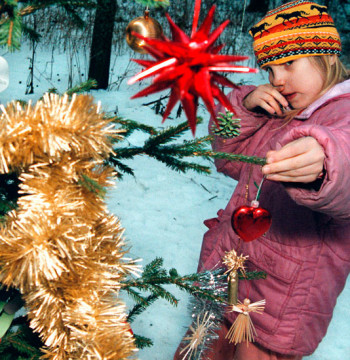
Writer inspires not one, but two statues in the Finnish capital

Zacharias Topelius (January 14, 1818–March 12, 1898) was a Finnish writer whose first language was Swedish (in modern-day Finland, both Finnish and Swedish are official languages). Born outside of the town of Nykarleby (Uusikaarlepyy in Finnish) in the western central coastal region of Ostrobothnia, he showed an early interest in reading.

He moved to Helsinki for school in 1831, and met the poet J.L. Runeberg and other literary and cultural greats of the era. In time, he was considered one of their successors.

Starting in 1841, Topelius made a career as a journalist, writing factual pieces and serial stories for the Swedish-language newspaper Helsingfors Tidningar. The publication’s circulation grew enormously during his tenure there.

In 1854 he was appointed to a professorship in Finnish history at the Imperial Alexander University in Helsinki. Much later he served as rector of the university.

He is known today as a prolific writer of poetry, prose and children’s books. Two public sculptures in his honour were unveiled in the Finnish capital in 1932. One, by Ville Vallgren, stands across from the Design Museum and shows the author reading with several girls and boys. The other, by Gunnar Finne, is located on the Esplanade and portrays two female figures representing truth and fiction.

Grab your skateboard: Finnish architect creates sculpted skate-scapes

At six years old, Saario learned to skate on a homemade board that his father assembled from plywood and four office-chair wheels.

“It was a bit difficult because the wheels rotated 360 degrees,” says Saario, smiling. “But that’s how I learned. I guess my father thought it would be a passing trend like the yo-yo, but eventually he bought me a skateboard.”

Skateboarding turned out to be much more than just a phase. The streets, courtyards and public spaces of Helsinki became the stage where Saario perfected his slides, grinds and kickflips as a teenager. By the time he was in high school, Element Skateboards recognised his talent and invited him to join its European professional team. He travelled the world as a pro skater.

He also became interested in architecture and art, including environmental art. Today Saario is a qualified landscape architect and a key figure on the global skatepark design scene, with 35 parks to his name in countries including Finland, Sweden and the Netherlands.

A continuing passion

See action shots filmed at a skatepark Janne Saario designed in the southern Finnish town of Karjaa.

“I think that a skatepark architect needs to skate for at least eight years before designing,” says Saario, now in his early thirties and a father of two.

In addition to his love of skateboarding, which he still does for fun, Saario’s motivation derives from turning urban spaces into parks “where youngsters can express themselves.” There are not many urban spaces designed specifically for young people.

“Teenagers like to hang out, so the social aspect of skateparks is vital,” he says. “Becoming a parent has also made me think even more about subsequent generations.”

Rolling radical ballet

Watch the making of Saario’s Street Unit movable skatepark elements, and see people skate them when they’re set up in front of Helsinki’s Ice Hall arena.

Saario’s skateparks combines concrete with conceptual thinking to create, in his own words, “skateable sculptures.” He describes skateboarding as “radical ballet.”

Saario currently works on about ten projects a year. One of his recent ventures is Street Unit, a line of movable elements and obstacles that make it easy to set up a skatepark wherever needed. “Skate spaces can also be seasonal or temporary,” he says. The units are made of steel to endure hardcore use and rough weather.

He has a skatepark under construction in Norway. He’s also working on one in Columbus, Indiana, in the US. Eliel Saarinen and his son Eero Saarinen, both storied Finnish architects, designed a number of buildings in that city, several of which are now National Historic Landmarks.

“I guess they just like Finnish architects,” says Saario.

The view from Micropolis

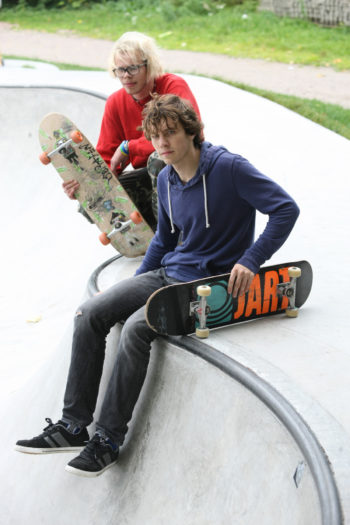
Hanging out on the edge: Felix Fiilin (left) and Ole Meiwes take a break at Micropolis, a skatepark in Helsinki with street elements, green areas and an organically shaped pool.Photo: Hernan Patiño

Located in the Töölö neighbourhood of Helsinki, Micropolis is a quintessential Saario skatepark. Completed in 2006, it consists of various street elements, green areas and an organically shaped pool. Saario’s design also preserved all the trees in the area. Lawn corridors run through the grounds, so that the hares of Central Park can still roam around.

Ole Meiwes, an exchange student from Germany, found Micropolis with Skatemap, an app for locating skateparks in Europe.

“This park is great because you can do almost any trick,” he says. “There’s enough space to manoeuvre.” As a landscape gardener, he appreciates the beauty of Saario’s structures. “I know how difficult it is to build a park like this. It also looks good because there are trees and green all around.”

Felix Fiilin visits Micropolis almost daily with either a skateboard or a scooter. “It’s near my workplace, so it’s convenient to come here when I finish my shift,” he says.

For Fiilin, the social aspect of skating is as important as a good skatepark. “I probably wouldn’t be doing this if there was nobody skating with me here,” he says.

Fiilin learnt to skate in Barcelona, often considered a mecca for skaters. “In Barcelona it’s easier because the weather is better than in Finland,” he says, “but I still think that we need more skateparks here.”

By Carina Chela, January 2018

Finland’s ambassador of Christmas

Santa Claus is the great hero of the Finnish holiday season. As just about everyone knows, he lives in northern Finland and helps spread the joy of Christmas all over the world.

Korvatunturi, the mountain in Finnish Lapland where Santa Claus makes his home, lies 1,000 kilometres north of the capital, Helsinki. He lives there with his wife and hundreds of elves. From the top of Korvatunturi, they can hear the Christmas wishes of all the children in the world.

For Finnish kids, the countdown to Christmas begins during Advent, when downtown streets are decorated with lights and ornaments. Children and adults alike have fun opening windows on Advent calendars, one window a day until Christmas Eve. Usually the windows reveal light-hearted Christmas pictures, although the flaps sometimes conceal chocolate or other small gifts.

During Advent – and other times of year as well – Santa may have time to appear and spread Christmas cheer in towns around Finland and beyond. People often ask him about the elves he works with, and in warmer countries folks also want to know about reindeer – and snow.

The glow of snow and cold

3974-ambassador3_b-jpg

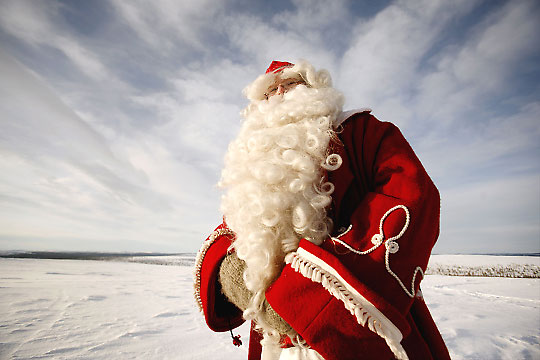
At home in Finnish Lapland: Kids in warm countries often ask Santa about cold weather and snow.Photo: Antti Aimo-Koivisto/Lehtikuva

There’s lots of snow in Finnish Lapland from November until late spring – sometimes even until May. How does Santa answer people’s snow questions? He does his best to describe snow and cold.

Snow is a white, flaky substance composed of ice crystals. You can make it into snowmen, snow castles, snowballs and snow sculptures. And when snowflakes float dreamily through the air to the ground, that’s a beautiful winter day.

Temperatures may drop below minus 30 degrees Celsius, so the snow crunches beneath your feet as you walk and the joints of the log houses creak. But, surprisingly, compared with southern Finland, Lapland doesn’t feel so cold. The frozen sea of the south and the snowy fells of the north make the cold feel different.

Snow makes it easy for Santa to transport the presents. He glides lightly over the snow in a sleigh drawn by prancing reindeer, with Rudolph in the lead.

Our friends the reindeer

3974-ambassador2_b-jpg

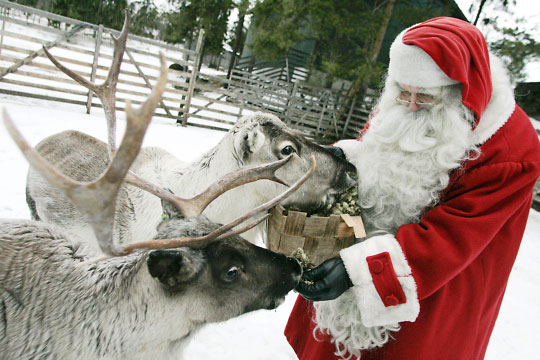
Energy boost: Santa feeds tasty lichen to two of the many reindeer that help transport the presents.Photo: Kasper Pempel/Lehtikuva

Santa’s most famous reindeer is Rudolph the red-nosed reindeer, of course. But Santa could never make the journey to every home in the world with only one reindeer, so Rudolph is just one of many.

All of the working reindeer are males that weigh around 100 kilograms each. They’re strong enough to pull Santa Claus and a sleigh full of presents over long distances. Rudolph is especially important because his red nose provides light on the dark yuletide evenings when Santa has to travel.

Reindeer calves are born in the late spring weighing about five kilograms. They grow very quickly, feeding on lichen. In the autumn, they eat the tasty mushrooms that grow on the northern Finnish fells.

Tourists who visit Lapland can experience a ride in a reindeer-drawn sleigh. It’s a lot of fun when the snow whirls up as the reindeer pull you along.

At home with the elves

Santa lives a peaceful existence at home when not delivering presents or making public speaking appearances. He, Mrs Claus and the elves eat a lot of salmon, porridge and tasty local berries.

The Clauses are not the only ones who have benefited from help from elves over the years. The tradition of household elves goes back to ancient times, more than 2,000 years ago. The household elf has always been the guardian spirit that protects the home, secretly or quietly.

In Finland, such elves have always protected and assisted the inhabitants of country dwellings. They heated saunas, tended the children and saw to the grain, the cattle and the horses in the stable. They were best friends with the dogs and cats. Elves were also very attached to the old buildings in which they lived.

People appreciate elves and give them food in return for their services. In many homes a bowl of rice porridge is put aside on Christmas Eve, and, strangely enough, it’s always empty in the morning.

By Sinikka Salokorpi

My first Finnish Christmas: Cold but cosy

An Englishman who has lived in Helsinki for decades recalls the magic of his first Christmas in Finland.

For most Europeans, Christmas is still firmly a family affair involving all the traditional pleasures as well as pressures: outreaches to distant relatives, extensive purchasing of gifts, strenuous travel and often strained relations.

For Finns, geography imposes certain constraints, not least the weather, but for many visitors these are as exotic as they are extreme. Despite the documented rise in temperatures over the last 40 years the average for Helsinki between December and February is still four degrees Celsius below zero (25 degrees Fahrenheit), and the chances of a white Christmas in the capital are given as 60 percent.

Flight to the countryside

3458-11274499-550px-jpg

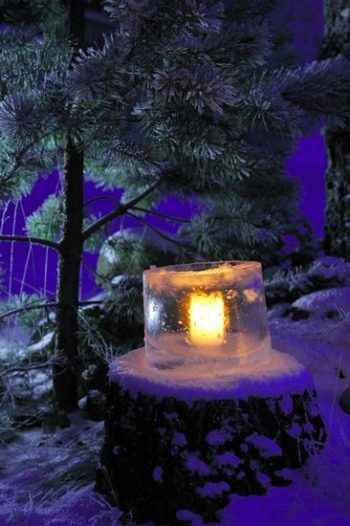
Some Finns decorate their yards with ice lanterns. You let a bucket of water freeze partway then pour out the excess, leaving a hollow space for the candle. Photo: Pekka Sakki/Lehtikuva

There is a steady movement of the Finnish population from rural municipalities, and particularly to the capital Helsinki, but the Christmas period sees a complete reversal of the flow. Despite the increasingly urban population structure, the option to revert to family tracts and traditions is irresistible, making for a very quiet capital during the holiday period.

Long-term Helsinki resident Charles Gil is typical of the generation who live their daily lives in the city centre, but flee to the forests for respite at Christmas: “Before our children were born we spent one Christmas here, but the city was very quiet indeed. We have been at my mother-in-law’s every time since then.” Despite the relaxation of many old restrictions on bars and entertainment, the streets are very empty for the public holiday.

The experience of my first winter season in Finland, in the mid-1980s, is seared into my memory on account of its uniqueness. Our group of five foreigners from Germany, France and the UK had rented a winter break from a brochure: a cottage by the lake in Ruokolahti, a community on the eastern edge of the country, near the border of what was then the Soviet Union.

The owners had never had rental visitors over Christmas before, but the building was well insulated against the outside temperature of 20 degrees Celsius below zero (four degrees Fahrenheit below zero), and the family made a great effort to accommodate us. They collected us and our rucksacks and skis from the nearest station, tolerated our efforts to communicate in rudimentary Finnish and, most spectacularly, they had decorated the cottage for our arrival with twinkling outdoor ice lanterns and a roaring fire in the fireplace.

The manager and owner was a farmer, and he was determined to instruct these gormless townies in the local ways – and in Finnish. Raising water daily from the hole cut in the lake went fine, as long as we remembered to cover the hole each time to stop too thick a layer of ice from forming. Accompanying him on his rounds to check the winter fishing nets, spread between holes bored through the ice, was chilly but very satisfying – there were always some fish.

Tussling with the elements

3458-17421181-550px-jpg

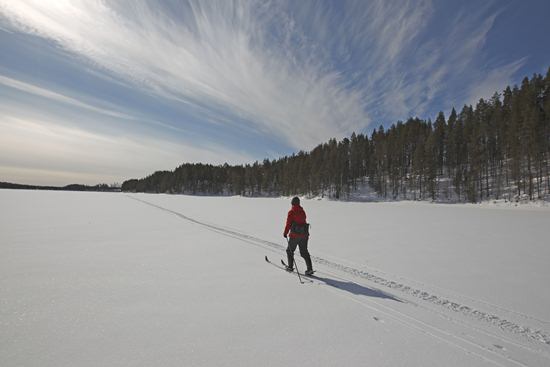
A ski trip across a frozen lake becomes a treasured memory. Photo: Ismo Pekkarinen/Lehtikuva

A greater challenge arrived when he presented us with a catch from one of those nets, a one-and-a-half-kilo (three-pound) burbot. The species forms a common fish in northern waters, related to cod in genus and taste, but possesses an extremely slimy and slippery skin that must be peeled off before cooking. We didn’t understand his instructions very well, but with the help of many hands the fish was skinned, cooked and enjoyed.

Equally memorable was the ski trip that two of us made through the hazy dusk, five or six kilometres across the lake in a mild snowstorm to the historic Ruokolahti Church, a beautiful 150-year-old wooden building, filled to bursting with the Christmas Eve congregation.

Facilities for visitors to Finland during Christmas have boomed since those days, with ski centres in Finnish Lapland offering ranges of holidays from hotel to chalet. Arrangements and prices vary, but traditional Christmas weather represents the norm for virtually the whole country.

By Anthony Shaw

Amid preparations at home in Finland, Santa says Christmas deliveries will go ahead

Santa and Mrs Claus, along with the elves and reindeer who play central roles in gift production and delivery, live in the far north of Finland, in Finnish Lapland.

In a bulletin released by the Ministry for Foreign Affairs of Finland, Santa confirms that a pandemic can’t keep him from doing the job that he looks forward to all year. [Full disclosure: ThisisFINLAND is produced at the Ministry.]

The previous Christmas went according to plan, and so will the current Christmas. “Under specially negotiated multilateral agreements,” says the article, “Santa and his reindeer-drawn sleigh are granted exemption from travel restrictions in order to ensure that they are able to deliver their presents.”

While he and his crew will not have to show their vaccination certificates, Santa notes that he, Mrs Claus and the elves are all fully vaccinated. “In general, I place great value on being nice, so of course I follow all the regulations and recommendations,” Santa told the Ministry for Foreign Affairs.

When ThisisFINLAND contacted Santa to confirm this information, he added that, just as in previous years, he “will not have a diplomatic passport, a travel visa or even a reindeer parking permit” when he makes his rounds.

Goodness and kindness

Sitting in a chair, Santa Claus holds a pen in one hand and a long scroll of paper in the other hand.

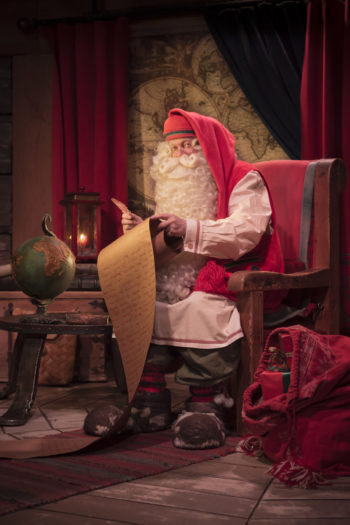
Santa Claus makes and double-checks his list before leaving to distribute presents around the world.Photo: Santa Claus Office

“Despite everything, preparations for Christmas have gone extremely well,” Santa said. Asked about health regulations, he responded, “When you are the world’s guardian of goodness and kindness, it is only natural to respect and follow all public health recommendations and social distancing rules.” He told us that he also follows “the proper use of reindeer back scratchers.”

The Ministry bulletin notes that Santa “listens to children from all over the world, whether he meets them in person or reads the letters they send to Finnish Lapland, where his workshop, post office and home are located. Santa is sensitive to children’s concerns and can see things from their perspective.”

That article quotes his recent public appearance in the Finnish city of Rovaniemi, on the Arctic Circle, where he told listeners, “We have been living in this very extraordinary time for two years,” and expressed concerns about the pandemic’s effect on kids:

“I have heard some worrying news about the wellbeing and coping of children and young people around the globe. As the Christmastime festivities approach, it is time to turn these worries into plenty of goodwill. I have a great wish, a huge desire for us all to try very hard to make this Christmas happy and unforgettable for children.”

By ThisisFINLAND staff, December 2021

Finland announces first recipient of International Gender Equality Prize

Launched by the Prime Minister’s Office, the award honours work in the field of gender equality and will be presented to individuals who have, by their example, advanced equality among genders. It will be awarded biennially.

The primary goal of the International Gender Equality Prize is to create further promotion of gender equality across the world. To achieve this aim, the prize is given to “a distinguished defender and builder of equality,” as the organisers phrase it.

The winner of the award does not receive the prize money (150,000 euros in 2017). Instead, the person identifies an issue or action that advances equality, and the money goes toward that cause. The organisers believe that the choice of award winner, and the actions of that person, will exemplify how investments in equality support every society.

Angela Merkel, Chancellor of Germany since 2005, becomes the first person to receive the International Gender Equality Prize. [Editor’s update, March 6, 2018: Merkel decided to contribute the sum to a nongovernmental organisation in Niger called SOS Femmes et Enfants Victimes de Violence Familiale (SOS Women and Children Victims of Domestic Violence, known by its French-language abbreviation SOS FEVVF).]

Strong roles in society

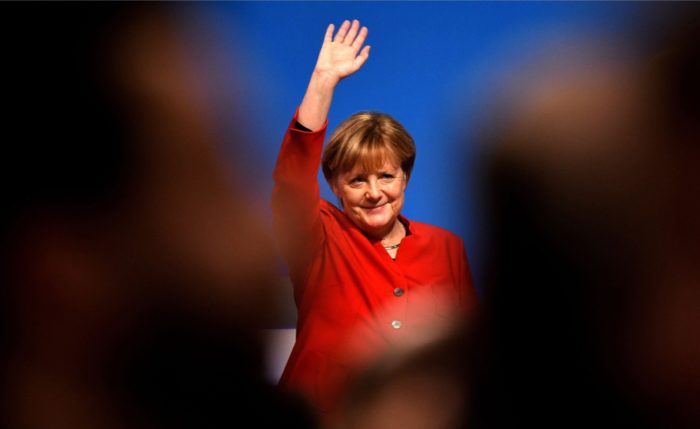
German Chancellor Angel Merkel, a role model for countless women and girls, waves to the audience at a party congress.Photo: Tobias Schwarz/AFP/Lehtikuva

The creation of the prize emphasises Finland’s already strong role as a leader in gender equality issues, a value that can be traced back to the time before Finland had even become an independent nation. In 1906, Finland became the first country in the world to award women full political rights, passing a law that allowed women both to vote and to run for election. (Finland gained independence in 1917.)

It’s only fitting that, since Finland was the first country to grant full political rights to women, the International Gender Equality Prize goes to Merkel, a woman who has made her career in the highest echelons of international politics and who has been prominent in shaping the world we live in and finding solutions to global challenges.

She has become one of the most influential people in the world and represents a role model for countless women and girls by breaking through the “glass ceiling.” While serving as Chancellor, Merkel has put gender equality on the agenda of world leaders, worked to improve the situation of women and families, and defended human dignity and human rights.

The International Gender Equality Prize contains an inbuilt notion of solidarity: It furthers the objective of creating and sustaining platforms for addressing issues of gender equality from different perspectives around the globe. Studies show that countries where women have strong roles in society, working life, and decision making are the most sustainable financially, socially, and ecologically.

The prize was founded in 2017 on International Women’s Day, March 8. In the following months, an online form allowed people anywhere in the world to propose suggested recipients; almost 400 names were submitted. A selection committee considered the submissions and chose a recommended winner.

By ThisisFINLAND staff, December 14, 2017

Old-fashioned Christmas fun in Helsinki

The annual event (held on December 14 in 2025) provides a welcome antidote to today’s increasingly commercialised Christmas.

The volunteer-run Seurasaari Christmas Path is the brainchild of former kindergarten teacher Marjaliisa Kauppinen. “When we organised the first Christmas Path in 1996, the idea was to give a present to the children of Helsinki by re-creating the feeling of old countryside Christmases,” she remembers. “Right from the start we knew the open-air museum island of Seurasaari would be an ideal setting, as it has lots of trees, lovely old buildings transplanted from the countryside – and no cars!”

After crossing the decorated wooden bridge onto the island, families are welcomed by cheerful volunteer elves and forest animals dishing out gingerbread biscuits.

Two-horse open sleigh

2539-seurasaari2_b-jpg

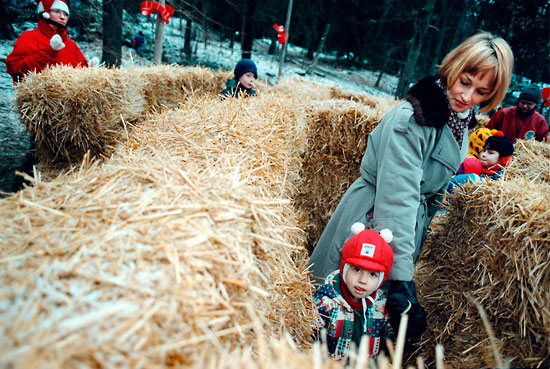
One simple but ever-popular attraction along the Christmas path is a maze made of straw bales. Photo: Sanna Liimatainen

The path leads on to more surprises, including an elves’ adventure trail, a fairy-tale tent and a simple but amazingly fun maze constructed from big bales of straw. “Our idea is to get children out of the shopping centres and let them run around, play games outside and make things for themselves,” says Kauppinen. “We invite them to bring along decorations they’ve made beforehand and hang them in our Christmas trees.”

Another popular activity is a romantic ride through Seurasaari’s forests on a real sleigh drawn by two friendly horses (a cart does the trip if there’s no snow).

In a special Christmas Arena the first Christmas is commemorated with a nativity play, a Christmas gospel and a chance to sing traditional carols with earthbound angels. Generous free portions of Finnish Christmas rice porridge are ladled out for the children (who are asked to bring their own bowls and spoons). Kids are also urged to bring torches so that they can boldly explore Seurasaari’s inviting forests as dusk descends.

One memorable neck of the woods is illuminated by hundreds of candles, creating an atmospheric avenue of light beneath the overhanging branches.

No logos

“We’ve aimed to give the whole event a very Finnish feeling, taking pride in our own Christmas customs, and using traditional materials like wood and straw instead of modern plastic decorations,” says Kauppinen. The path is blessedly free of tacky tinsel, flashing fairy lights or sponsors’ advertisements.

“People are really surprised to find that the whole event is absolutely free,” says Kauppinen. “We’ve been delighted to show that you can really do a lot without a big budget when people get inspired by a good idea!”

Let Christmas commence

2539-seurasaari3_b-jpg

Kids are invited to bring along decorations to hang on the Christmas tree on Seurasaari. Photo: Sanna Liimatainen

Helsinki City Council actively supports the Christmas Path event, and foodstuffs and materials are provided by discreet sponsors, but most work is done by volunteers, including many students and trainee kindergarten teachers. “The joy that this event brings to so many children and their parents is the best possible payback for our work!” says Kauppinen.

Kids leave the island with fresh buns and a gift of a traditional Christmas card. The one-afternoon event typically attracts as many as 15,000 eager visitors, who are encouraged to leave their cars behind and arrive at Seurasaari by bus.

Other Finnish towns are following in Helsinki’s footsteps and setting up similar non-commercial yuletide events. Kauppinen is also proud that many Helsinki families who come back year after year feel that the Christmas Path marks the true beginning of their Christmas season.

By Fran Weaver, updated December 2024

Exclusive interview: Mrs Claus of Korvatunturi, Finland

Santa and his wife, Mrs Claus, have a hectic schedule, but we pulled a few strings and managed to get an interview with Mrs Claus about life at Korvatunturi, their home in Finnish Lapland.

Whenever children – or adults for that matter – have a chance to meet Santa Claus, their heads are packed with questions they’ve always wanted to ask. But the excitement of the moment usually makes them nervous, leaving them with only one thought: “What was it I wanted to ask?” And so the questions go unanswered.

Side by side with every great man is a great woman. Through our extensive Finnish contact network we managed to obtain a rare interview with Mrs Claus about Santa, the elves and the gift delivery process.

Read on to find out if Santa is ever in a bad mood, if you can get work as an elf, if Santa has ever got stuck in a chimney, and much more!

Click or scroll below to find out how Mrs Claus answers:

10 questions about Santa

Santa and one of his reindeer pause from a workout to pose for a photo.Photo: Visit Rovaniemi

1. How old is Santa Claus? 

That’s something not even he can remember exactly. Once when he was sitting in his favourite rocking chair in front of the fireplace at Korvatunturi, the mountain in Finnish Lapland where our home is, he began to count how many Christmases he could remember. But when he got to something like 364, he fell asleep.

2. Does Santa Claus have a family?
Of course! Everyone in the world is his family. Adults and children are equally precious to him.

3. Can people visit Korvatunturi?
Of course they can, if they know how to get there. But it’s a long and difficult journey. And everyone gives different directions. But you have to turn left after the little spruce tree, or if you’re coming from the west along the narrow path, then you should turn right, that is, if you have passed Spruce Pond already.

4. Does Santa Claus have to be good?
Santa Claus is always good. Sometimes he has to be strict, but he is always fair. Sometimes he’s a little angry, sad or upset. He gets really upset if he hears about places in the world where they don’t care for children’s wellbeing.
3962-questions5_b-jpg

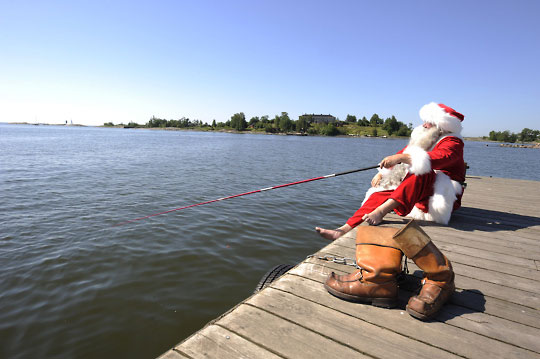
Fishing is one of Santa’s hobbies, but he never catches anything. Here he’s on vacation in the “deep south”, Helsinki, in June.Photo: Martti Kainulainen/Lehtikuva

5. What does Santa Claus think about the way people celebrate Christmas in different cultures?
Every culture has its own customs that deserve to be respected, and that’s just what Santa Claus does.

6. Was Santa Claus ever a child, and did he go to school?
Santa Claus still feels like a child to this day. Life has been one long education for him. You have to keep studying because the world’s always changing. He’s gone to a lot of schools. Once he even visited an elementary school.

7. How tall is Santa?
It depends on whether he is walking deep in thought, or if he is examining little berry branches on the floor of the forest, or if he is looking at the horizon. He’s taller than the tallest elf, but shorter than the old spruce trees in Lapland.

8. What hobbies does Santa have?
Taking saunas, especially old-fashioned Finnish smoke saunas, is something he really likes. Taking naps is also an extremely important pastime for him.

9. Does Santa Claus live at Korvatunturi?
Korvatunturi is his permanent residence and the place he loves the most, but all year long he drops by different places around the world. He only stays in places where he feels content.

10. How many names does Santa Claus have?
I think every country has a different name for him. Here in Finland he’s called Joulupukki, and in America he’s Santa Claus. If remember correctly, in Germany they call him Weihnachtsmann, and in nearby Holland, Kerstman. He has all these names, and many more, because he is so well loved.

10 questions about elves

Elves help Santa sort and read letters from all over the world.Photo: Visit Rovaniemi

1. How many elves are there at Korvatunturi?
No one knows for sure. Elves are fast and they are rarely all in the same place at the same time. But when the sun sets over Korvatunturi, there are probably as many little elf toes under the blankets as there are stars in the sky, if not more.

2. Are elves Santa’s children?
Santa Claus believes that everyone should be everyone else’s child and that being a child is the most important thing in the world.

3. Are new elves still being born?
New Christmas elves and other kinds of elves are born frequently. When the last rays of the evening sun meet with the Northern Lights, the wind is blowing from the north and the stars are shining, that is when elves are born.

4. Is it possible to become an elf?
Of course. And it is possible to stay an elf. Taking care of smaller and weaker people is elf work. Making someone happy who doesn’t have anything to be happy about, or giving toys or clothes to children who need them – these are the best ways to be an elf.

5. Does Santa read all the letters he gets?
The elves help him read the letters and make inventories. Santa Claus gets a lot of Christmas cards, too.
3962-7325376-jpg

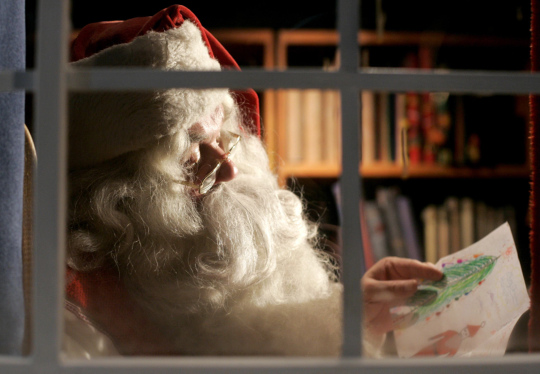
In addition to wish lists, Santa also receives numerous Christmas cards.Photo: Kacper Pempel/Lehtikuva

6. What kind of elves does Santa Claus have?
He has reindeer herder elves. They respect reindeer as wild animals that have learned to live in harmony with humans and elves. He has mapmaking elves and pathfinder elves. He has a wood elf who is so old and wise that he knows how to make the best of each piece of wood, because he understands the spirit of the wood, and he looks like a knotty old pine himself. There are also professor elves who study various important things.

7. Do all the elves have names?
Almost always. They have names like: Threshing Barn Elf of Hill Farm, Sauna Elf of Bay House, and so on. Some of them have nicknames that refer to their profession, like Ink Splotch, Mapmaker, Compass or Surveyor. The nicknames may relate to a personal trait, such as Old Wiseman, Speedy, Wise Guy, Long Beard, White Beard or Black Whiskers.

8. What do Santa and his elves do during their free time?
They play lots of games. One of their favourites things to do is sit by the fireplace and talk about everything in the world. They reminisce about past journeys and recall interesting people and places that they have visited through the years.

9. Can humans see elves?
Elves are good at sneaking around, so it’s usually hard to detect them. Children are often able to see a branch move, or notice something looking through the window or peeping from behind the curtains. Then they know that it’s their own personal elf tiptoeing around. Sometimes elves move something or leave some other sign to show that they have been around. They have also been known to pick up and deliver mail addressed to Santa Claus.

10. Do Christmas elves also go by different names?
Yes, indeed. In Finnish we call them Tonttu; in Swedish and Norwegian, Tomte or Nisse; in German, Heinzelmännchen; in Dutch, Kabouter; and in English some call them gnomes as well.

10 questions about delivering presents

To deliver everything on time, Santa has to plan the route carefully and use time zones to his advantage.Photo: Visit Rovaniemi

1. How does Santa Claus travel?
Lots of ways. He has a sleigh drawn by team of reindeer, but he also has a team of dogs, a car, an aeroplane, a snowmobile and a helicopter. Santa uses whatever means of transport is best suited to the weather conditions and the purpose of his journey.

2. Are all the presents made at Korvatunturi?
Not all of them. Some are made at home, and they are especially precious. Surely you’ve heard of homemade jelly or mustard or hand-knitted wool socks. In some places there are little workshops that also help Santa Claus by making gifts.

3. How does Santa have time to deliver all the presents?
He takes advantage of the differences between time zones. When children in Finland are awake, children in Japan are asleep and vice-versa. There is also some magic involved. Sometimes Santa Claus may delegate the elves to deliver presents. The most important thing is that the gifts get there on time.

4. Has Santa ever got stuck in a chimney?
If that happened, delivery would get cut short. Santa Claus has a big book entitled Chimneys of the World. It is important to know how to get down them, and that is Santa’s specialty.

5. Is it possible to get presents even if you haven’t been good?
Santa Claus is certain that, deep down, all children are good. If a child is hungry or tired, it’s only natural that crabbiness can creep in. Voicing disappointment or not feeling well has nothing to do with being good.
3962-questions7_b-jpg

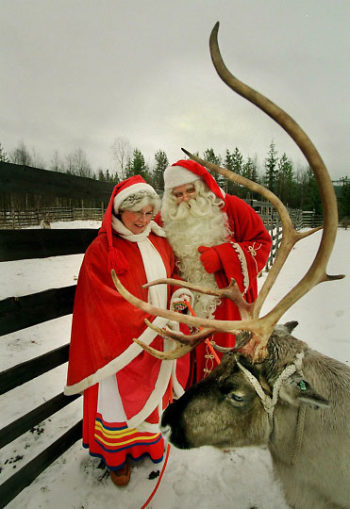
Santa and Mrs Claus keep reindeer, but deliveries can also be made by dogsled, snowmobile, aeroplane, helicopter and any other form of transport if necessary.Photo: Martti Kainulainen/Lehtikuva

6. What does Santa Claus do when he’s not delivering presents?
He relaxes by walking in the forest and listening to the voices of the wilderness. He also spends time preparing the next Christmas delivery by reading children’s letters. His favourite pastime is reading books.

7. Does Santa get any presents?
Oh yes, often. The best gifts, in Santa Claus’ opinion, are the happy smiles of children and the joyful look in their eyes.

8. Can Santa read children’s thoughts?
Maybe not every thought, but at least the thoughts that children want him to read definitely come through. There is a special understanding between children and Santa Claus.

9. How does Santa know how to get to everyone’s house?
This is how it works: The elf secretaries keep exact records of all children by country, state, county, province, city, town, village or district, by house or apartment building, by bedroom or even by bed. These records are used to plan the delivery route. It’s very demanding work; 284 elves work in the address department year round.

10. Where does Santa Claus get all the money it takes to fly around the world?
Shhh! We don’t use the word “money” here. Santa is extremely lucky, because in his world money doesn’t exist. The important thing is that he gets there.

Adapted from The Secret of the Magical Mountain Korvatunturi, a book published by Polarlehdet Ltd.

By Heli Karjalainen and Annikki Marjala