Finnish photographer Meeri Koutaniemi goes to the source

Meeri Koutaniemi stands motionless in a lake in midwinter, concentrating on breathing and keeping her mind calm. After a few minutes, she climbs out of the freezing water and steps into a hot sauna.

This homemade ritual takes place in Kuusamo, northern Finland, where Koutaniemi grew up and where she longs to go whenever she gets a break from her travels around the world. At the time of writing, she is in her mid-30s.

“The sensation of being in the ice cold water is so intense that I can connect with that feeling no matter where I am,” she says.

Global reach
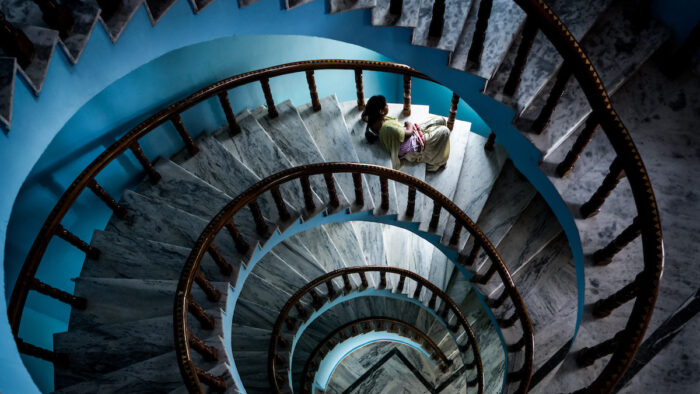
From above, several stories of an ornate spiral staircase are visible, and a woman is sitting on one of the steps.

Rejika from India sits in the stairwell of a hotel in Nepal. When she was young, she worked as a kamalari slave, until she was freed with the help of Plan Nepal. Kamalari slavery is a form of indentured servitude in which tens of thousands of girls over many decades have wound up as domestic slaves in upper-caste homes.Photo: Meeri Koutaniemi

For Koutaniemi, the “where” might be the tribal lands of Kenya’s Masai people or a women’s prison in El Salvador. Armed with curiosity and a camera, she has a knack for finding projects of no small significance – work that deals with hefty themes such as human rights, equality and defiance in the face of overwhelming odds.

“No matter where I go, I’m inspired by the resilience shown by the people I meet,” she says.

Her longest-running project – already ten years in – deals with female genital mutilation on different continents. “I’ve been to 12 countries documenting the topic and will continue the research,” she says. The focus of the project is on local activism.
Activist storyteller

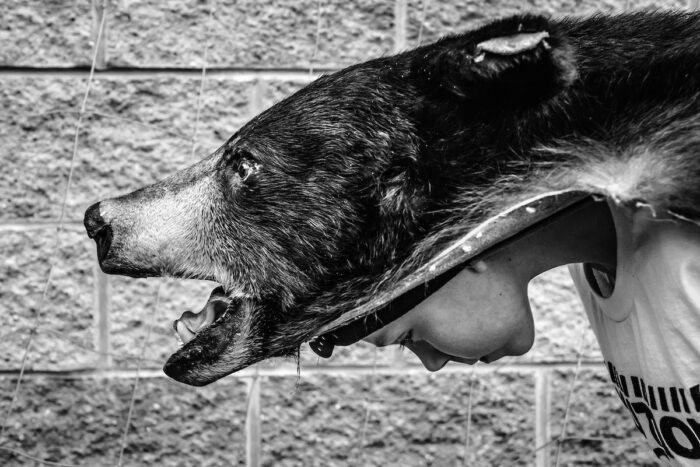
A profile view of a boy who is leaning down, with a bearskin over his shoulders and head, so that the bear’s head and open mouth are pointing straight forward.

A young Findian boy bows with a bearskin draped over him. It is believed to give the wearer animal powers. Findians, the descendants of Finnish immigrants and North American indigenous people, live in the Great Lakes area.Photo: Meeri Koutaniemi

The rights of women and girls light the activist fire in Koutaniemi’s eyes. Simply by providing girls with access to education, you can combat vast problems such as overpopulation, economic inequality and climate change. Studies show that better educated women tend to be more informed about things like nutrition and healthcare and have fewer and healthier children; also, they’re more likely to participate in the labour market and earn higher incomes.

“We need to support change on the local level,” she says. Equality issues rarely improve without a fight.

“For example, women’s right to vote didn’t just happen,” she says. “It took years and years of effort and determination.” Koutaniemi is proud of the fact that Finnish women were the first in the world to gain unrestricted rights both to vote and to run for Parliament, back in 1906.

Roots run deep
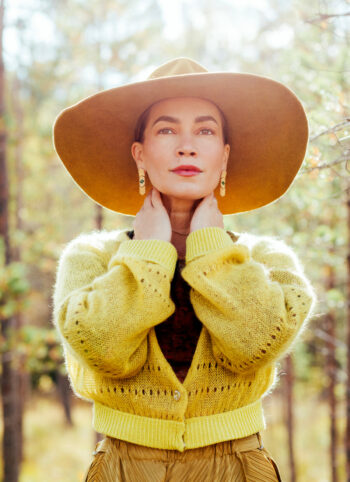
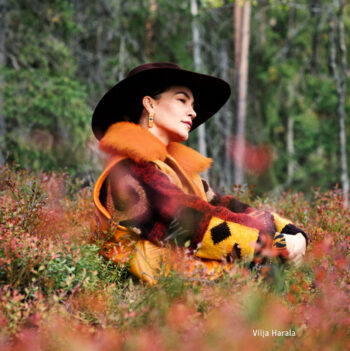
A woman in a wide-brim hat and a yellow cardigan poses in a forest.

“When I am walking in nature, I feel powerful gratitude,” says Koutaniemi.
Photo: Vilja Harala

The globe-trotting Koutaniemi – 60 countries and counting – says that she always carries her homeland with her. “I am empowered by my roots in Kuusamo, where I grew up basically amidst the forest.”

To this day, visiting a Finnish forest, with its pines, spruces and birches, gives her all the sanctuary she needs from the pressures and burdens of daily life.

“The forest, for me, is a place where I can get reenergised and where I can catch my breath,” she says. “When I am walking in nature, I feel powerful gratitude.” She has a strong bond with the northern forests.

“Occasionally you just need some trees to climb,” she says with a grin.

She admits that the “green link” was not always as clear in her mind as it is today. But as photography took her to the farthest reaches of the earth, she sensed something stirring inside her: a powerful longing to reconnect with the nature of her home country.

“I had to travel pretty far before I could really grasp what the woods mean to me,”
she says.

Recently, she also purchased five hectares of forest in Kuusamo, with a clear agenda in mind. “Now that I have those woods, I can make sure that nobody can ever chop them down,” she says.

Driven by instinct
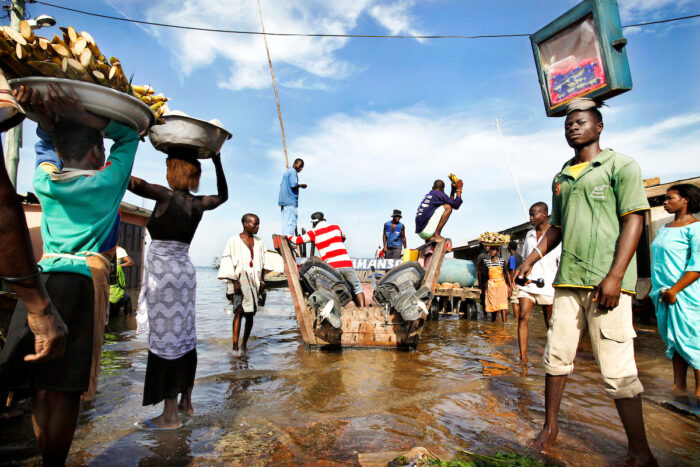
People are walking with large bowls full of branches and other goods on their heads, through an area covered with several centimetres of water.

People carry goods at an open-air market in Dzemeni, Ghana, after a flood caused tremendous damage to villagers’ homes.Photo: Meeri Koutaniemi

Koutaniemi has been prone to independent thinking since she was a teenager.

“I felt that I needed to be the one in charge of deciding where I find my calling,” says Koutaniemi, who became a freelance photographer at the age of 19.

More than 15 years down the road, she hasn’t stopped feeling that way.

“I choose my projects very intuitively,” she says, “but I also consider the social and political side of the theme.”

At the same time, she doesn’t mind taking risks and falling flat on her face.

“Part of the journey is being incomplete and experiencing failure,” she says. “Having your foundations shaken is usually a good thing.”

Human touch
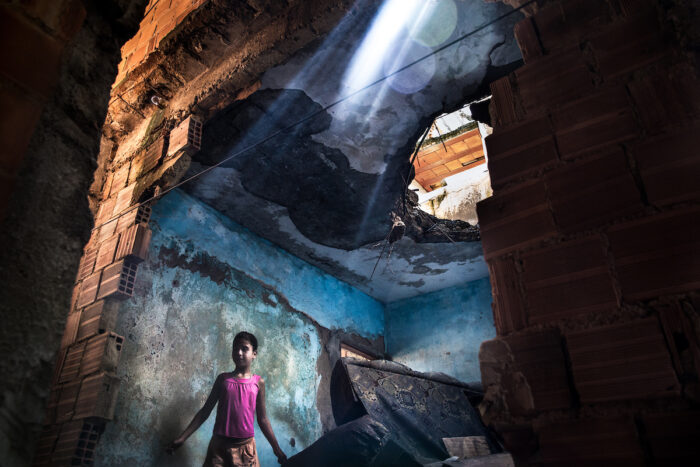
Sunlight streams in over a child of about ten years old who is standing in a half-destroyed building where there is a jumble of old furniture, a gaping hole in one wall and a hole in the ceiling.

Vanderley Pereira da Silva’s daughter plays in a derelict building near their home in the Complexo do Manguinhos favela in Rio de Janeiro, Brazil. At the time of the photo, the family was living under the threat that they would have to be evacuated to make way for bigger roads in advance of the upcoming World Cup.Photo: Meeri Koutaniemi

In the past, she has visited conflict zones, witnessing the full scale of oppression and survival. But how does a photographer relate to subjects who have seen unspeakable things, and not get swept up in emotion? She replies that taking pictures of people is very much about human interaction:

“Mutual respect is always the cornerstone.”

Koutaniemi says that her craft is all about the softer side of storytelling: how you can learn something from others and, ultimately, realise something about yourself, too.

“We have our differences, but there are more things that unite us than separate us,” she says. “What matters is how we work together.”

By Sami Anteroinen, ThisisFINLAND Magazine 2023
Live gigs with fewer climate worries: Finland’s music industry has a plan

Finland’s live music industry aims to be an international trailblazer in carbon neutrality. Industry groups including the Finland Festivals Association and the Association of Finnish Symphony Orchestras teamed up for a year-long study of the industry’s carbon footprint, cofunded by the Ministry of Education and Culture. In 2023 they unveiled their Cool Music climate roadmap at Helsinki’s G Livelab club.

Finland is committed to becoming carbon-neutral by 2035, so every sector of the economy is involved – not just heavy industry, but also “lighter” fields such as the arts. The live music roadmap calls for sweeping changes in how festivals and concerts are staged – and, crucially, how fans reach them.

Implementing and optimising

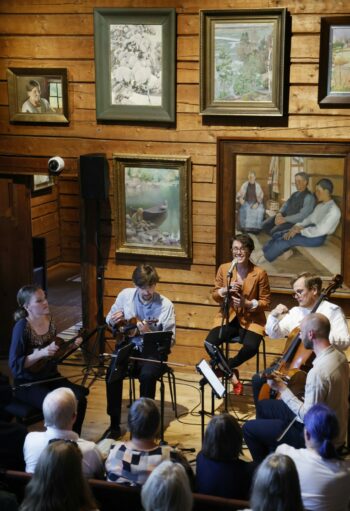
A woman vocalises and a woman and three men play stringed instruments for an audience in a room with numerous paintings on the walls.

American composer and musician Caroline Shaw (centre) performed at Our Festival with the Kamus String Quartet at the studio museum of Pekka Halonen (1865–1933), a famous artist. Our Festival, a member of the Finland Festivals Association, has a long record of sustainability and is taking steps to become carbon-neutral by 2025.Photo: Maarit Kytöharju/Our Festival

An analysis of the existing situation set up a baseline for improvement, revealing that travel accounts for more than 70 percent of the sector’s emissions.

“The biggest emission sources are transport and purchases, including catering, marketing and performance technology,” says Sara Salminen of Positive Impact, a member of the roadmap team. It sets goals for 2030 and 2035 in four main areas: transport, energy, consumption and cultural changes.

“Concrete emission-cutting goals can be implemented immediately by optimising logistics and choosing plant-based foods for catering,” says Salminen.

“The 2030 goals include making plant-based food the norm across the music sector, as well as making climate-savvy choices to limit transport emissions, opting for renewable energy whenever possible and having all music industry operators commit to the shared climate mission.”

Smooth jazz touring

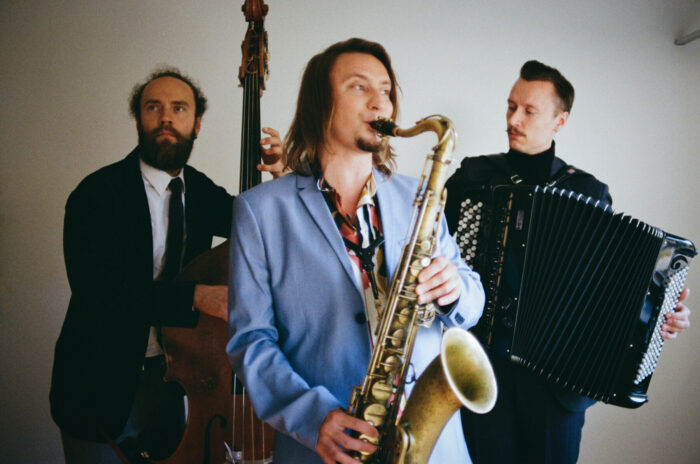
Three men are standing in a row, playing double bass, tenor saxophone and accordion.

From left: Eero Tikkanen, Pauli Lyytinen and Harri Kuusijärvi are Sole Azul, which “rips tango out by the roots and plants it in the Nordic frozen soil,” they say on their website. They’ve been helping the Finnish Jazz Federation pioneer a low-carbon touring model.Photo: Aarni Toiviainen

The Finnish Jazz Federation, which organises gigs around Europe, has been pioneering a low-carbon touring model in recent years.

In 2022 the jazz-tango trio Sole Azul toured northern Finland by taking a train to Lapland, nearly 1,000 kilometres (620 miles) from their Helsinki base. They set up residence in a cabin in Kittilä and commuted by electric car to five concert sites, including several small villages.

“In a country the size of Finland, it’s practically impossible to be a professional performing artist without covering lots of territory and mileage,” says Harri Kuusijärvi, the group’s accordionist. “We hope carbon neutrality will soon be a given on tours.”

Jazz gigs tend to be simpler affairs than those of symphony orchestras or major rock bands, but the industry has been watching the jazz pilot project for ideas.

Culture and art in climate policy

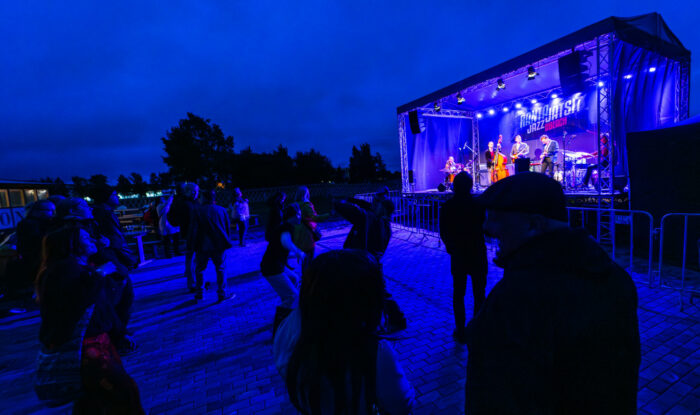
People are watching and dancing in front of an outdoor stage as night falls.

People listen and dance at Raahe Jazz on the Beach, whose organisers advocate “slow touring” by ship and train whenever possible.Photo: Ville Vainio/Raahe Jazz on the Beach

“Most artists, promoters and event organisers already had great interest in climate action before our project, but lacked concrete tools,” says Raisa Siivola, manager of the Jazz Federation’s touring project. “Most of them said they got useful information for improving their sustainability from the project.”

The biggest challenge, she says, is “turning plans into action. It’s hard to change your existing work or consumption culture. Another challenge is raising political awareness about supporting immaterial goods and services, such as culture and art, as a part of overall climate policy.”

According to Charles Gil, who produces international tours and directs the Raahe Jazz on the Beach festival, “there’s more awareness about the topic, but still so much to improve in practice.”

Bikes, buses and trains

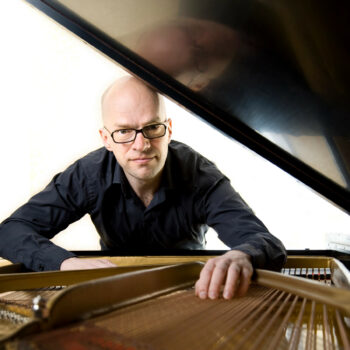
A man in a black shirt on is looking at the camera from behind an open grand piano, with the strings inside the piano visible.

Esteemed jazz keyboardist Kari Ikonen is experimenting with concert tours that use only bike, bus and train transport.Photo: Tanja Ahola

Gil advocates “slow touring” by ship and train whenever possible. It not only reduces emissions, but also decreases musicians’ stress levels, so the audience also benefits. Gil also no longer brings foreign artists to Finland for one-off gigs.

“For the Raahe festival, we only book foreign artists if they’re on tour in Finland,” he says. “It’s more challenging, but the motivation is stronger to find more concerts elsewhere for a visiting artist you really want to get.”

In 2022, with booking support from Gil, acclaimed keyboardist Kari Ikonen made a month-long “Flight-free Zero-CO₂ European Solo Piano Tour” with 14 concerts in five countries, travelling mostly by train. His 2024 tour of the Baltic countries includes train, bus and e-bike.

Ikonen experimented with bicycle touring across southern Finland’s Uusimaa region in autumn 2020, when Covid restrictions kept audiences small. “That tour was great fun and attracted local media attention,” he says. “I was lucky with the weather – I only had to hang my clothes up to dry backstage once.”

By Wif Stenger, October 2023

We love Finnish rye bread: A baking story that stretches across borders and generations

In 1944, with a newborn baby, my grandmother packed a few possessions and moved. The Moscow Armistice had just been signed. Her home region, Uukuniemi in Karelia, had been part of southeastern Finland; three-quarters of it would now become Soviet territory.

Among the things she carried with her was almost certainly a rye bread “starter,” which is a bit of dough that is allowed to ferment and then added to the following batch of bread. Rye bread was a staple of the Finnish diet at the time, even more than it is today.

How likely was it that she took the starter with her? I asked my great-aunt about it, and she said, “Of course she had the starter,” in a way that implied the question was silly.

Getting started

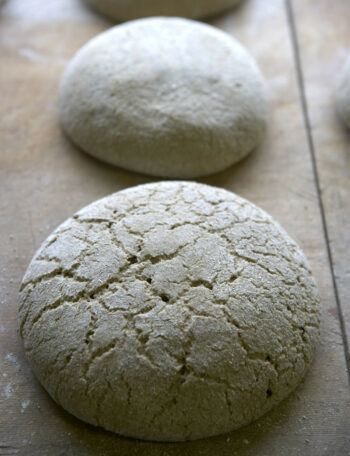
Random cracks decorate the surface of several round loaves of bread dough that are rising on a wooden counter.

As a loaf rises, patterns may emerge on its surface.Photo: Norman Ojanen/Otavamedia/Lehtikuva

My grandmother taught me how to cook. Quiet and unassuming, she was an unwilling teacher, but I was a tenacious learner. She might claim she couldn’t remember how to bake sweet cardamom rolls, pulla, but it jogged her memory to watch my novice attempts in the kitchen. I can remember her telling me, “More butter!”

After her death, I realised, with a sense of loss and missed opportunity, that I’d never learned to bake rye bread, the Finnish food I love most.

I mentioned this to my aunt in southern Finland. She went to the kitchen and came back with a cold grey ball in a plastic bag. This was, she thought, a rye starter that she’d found in my grandmother’s freezer. We later surmised that it was descended from that first travelling starter that had come from Karelia.

Really into rye

A row of grocery store shelves contains dozens of different kinds of dark bread in plastic bags.

Grocery stores and bakeries in Finland offer a wide array of dark rye breads.Photo: Marika Koskensalo/Lehtikuva

According to a website called Suomi syö ja juo (Finland eats and drinks), maintained by Helsinki’s Hotel and Restaurant Museum, rye cultivation in Finland began around 500 BCE. For centuries, life in agricultural Finland was linked to sowing, growing, and harvesting rye for bread.

Baking took place once a week in eastern Finland and twice a year in western Finland, so people ate dried bread in the west and soft loaves in the east. Bread, especially rye, was part of almost every meal. Even today, rye ranks as the country’s favourite bread.

My family and I recently moved to Zagreb, Croatia. To get the starter across the continent, I rolled out a piece of dough and let it dry in a sunny patch on the windowsill. This preserved the bacteria that help the bread rise. Later, after I “fed” the starter (added fresh flour and water to give it new energy), it revived wonderfully.

One ingredient is patience

A glass bowl contains a liquid dough mixture. Beside it is a scoop with flour in it.

Making the starter for traditional Finnish sourdough rye bread takes several days.Photo: Jorma Marstio/Otavamedia/Lehtikuva

Baking rye bread takes patience, since it involves several steps over multiple days.

You need to get the starter from someone (it’s also possible to create your own; see the recipe below). In Portland, Oregon, USA, where I grew up, there were two strands of competing rye starter. Owners of either claimed that theirs was the best, and, coincidentally perhaps, both were “100 years old.”

The starter likes warmth. When I lived in Helsinki, I kept the bowl on a heated towel rack in the bathroom. In Zagreb, I turn the heating on in the kitchen and close the doors and windows tight.

You’ll have to “feed” the starter after a day or two if it doesn’t begin to ferment. You do that by leaving about a decilitre of starter in the bowl and throwing the rest away. Add a decilitre of flour and the same amount of lukewarm water, then whisk and cover. You’ll know it’s ready when it gives off a strong, pungent smell.

Magic taste

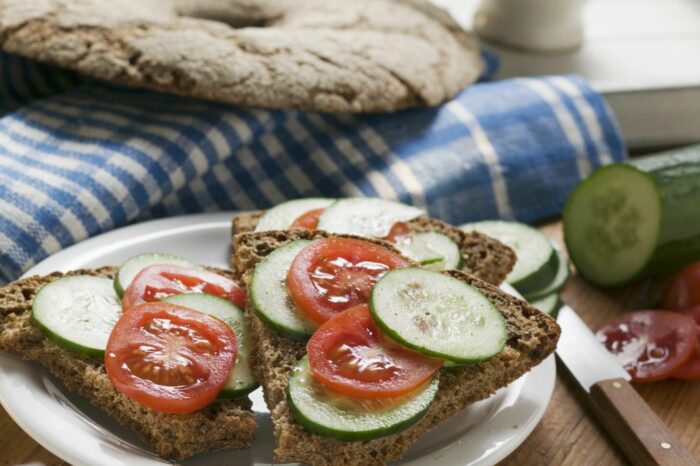
Pieces of rye bread cut from a round, flat loaf are topped with sliced cucumbers and tomatoes.

Rye bread is great with just butter, or you can add vegetables and other sandwich toppings.Photo: Stockfood/Lehtikuva

The real magic happens once you’ve added the rye flour, water, and salt and kneaded the dough. (If the starter is at the peak of its fermentation cycle, no additional yeast will be needed.) Do this in the evening and then let it rise in a warm place overnight – about ten hours.

Shape it into loaves in the morning and let them rise for at least another two hours, then bake. The long fermentation helps develop the sour, tangy taste that is a hallmark of Finnish rye bread (some recipes use a shorter fermentation period).

Timing is everything, and it can be challenging to coordinate it so that the starter is ready on a Friday evening, for example, so you can bake Saturday morning.

Sustaining stories

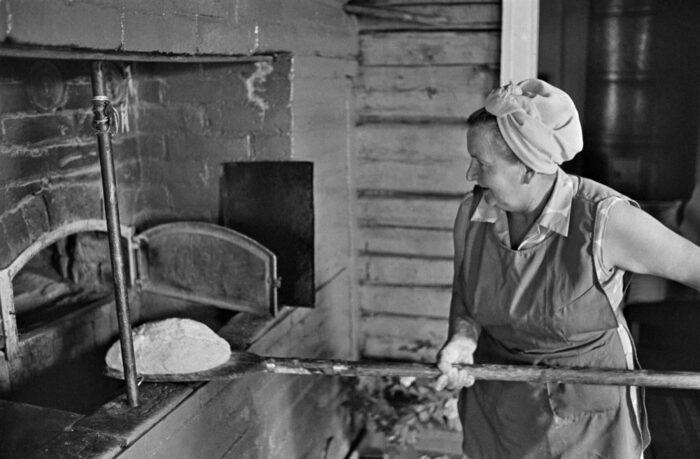
A woman in an apron puts a loaf of bread into a brick oven using a long wooden spatula.

The brick oven in Ilomantsi looked a bit like the one in this picture. The baker in this 1974 photo is Saara Taskinen of Kuopio, a town in central Finland.Photo: Jaakko Julkunen/HS/Lehtikuva

Bread, like the stories from our past, sustains us. I tell my boys that rye bread makes you strong; I tell them about my grandmother and her house in Ilomantsi, a town in North Karelia, near the modern Russian border.

When I visited her in the winter, I’d build snow forts and go skiing and sledding with my sister and our cousins. After I came in, I’d play atop the big wood-heated baking oven, which was made out of bricks. (My grandmother would make a fire in it in the morning and the oven would remain warm all day.) Caked-on snow would melt off my wool socks, and the moisture would then evaporate from the still-warm bricks.

I tell my kids about how it must have been to leave your home and become a refugee, and to keep a baby warm and fed while on the road. And, I say, isn’t it funny to think that through all those times and places, the very same rye bread that you’re eating now has been there, too?

By Eric Bergman, October 2023

Recipe: Finnish sourdough rye bread

A round loaf of bread with a hole in the middle lies on a wooden table together with dried stalks of rye plants.

You can choose different shapes for your rye bread. One of the most common is a round, flat loaf with a hole in the middle.Photo: Ossi Lehtonen/Lehtikuva

The recipe below is republished with permission from the Martha Association (known as Martat in Finnish). Founded way back in 1899, the nonprofit provides advice on food, nutrition, gardening, the environment, family finances and consumer issues.

You can find another rye bread recipe – and many other dishes – if you visit our eastern Finnish recipes page. That method calls for adding store-bought yeast, whereas the sourdough starter in the recipe below contains no commercial yeast, giving the bread a tangy taste that many purists love. (Nonetheless, the final phase of the bread recipe below does include an option to add yeast.)

No matter which kind of rye bread you prefer, be sure to check out our other mouthwatering recipe articles, too.

Making the starter

A wooden spoon lies on a tea towel next to a glass jar with several centimetres of a liquid dough mixture in it.

People often keep starter in an old-fashioned glass jar.Photo: Riitta Veijola/Lehtikuva

In Finland you may be able to obtain starter dough from a bakery, friend, neighbour or shop. However, you can also make it yourself.

Day 1:

  • 3 tablespoons rye flour
  • 3 tablespoons lukewarm water
  • Mix the ingredients in a small glass jar, then put the jar in a warm place, such as on top of the refrigerator, for two days. Put the top on loosely, so that air can circulate.

Day 3:

  • 2 tablespoons rye flour
  • 2 tablespoons lukewarm water
  • Add more flower and water and put the jar in the same place for one more day.

Day 4:

Now you can use the starter to make bread. At first the starter will be only slightly sour, but the taste will strengthen when used to make bread. Starter dough will keep in the fridge for about two weeks, and for longer periods in the freezer.

Making sourdough rye bread

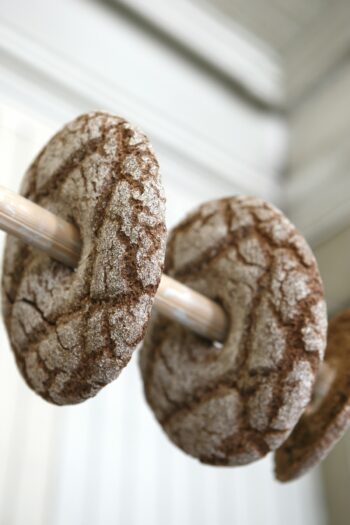
Several round loaves of bread, each with a hole in the middle, are arranged on a wooden pole.

A rye bread loaf with a hole in the middle can be stored on a pole.Photo: Ismo Pekkarinen/Lehtikuva

Now that you have the starter, how do you make the actual rye bread? This recipe makes two loaves.

Phase 1:

  • 2 dl lukewarm water
  • about 1 dl of sourdough starter
  • 2 dl rye flour

Phase 2:

  • 6 dl lukewarm water
  • 1/2 to 1 tablespoon salt
  • (about 10 g yeast) [optional, see below]
  • 1.6–1.8 litres rye flour [approximately 1 kg]

Phase 1:

1. Mix the water, the starter and the flour into a smooth dough.

2. Cover loosely with clingfilm and put it in a warm place, such as near the stove or on top of the refrigerator. Leave it overnight or until it is bubbling properly.

3. When the sourdough begins to bubble and it is producing a mild sour aroma, it’s ready.

Phase 2:

1. Add the salt (adjust the amount according to your own preferences) and the water to the dough and mix until the salt is dissolved. If you want to ensure that the dough will rise, dissolve a bit of yeast into the dough liquid. (Many bakers consider it important that the dough rise naturally, without adding yeast.)

2. Mix the flour into the dough bit by bit. The quality of the flour affects the amount you need.

3. Knead the dough vigorously, for at least ten minutes by hand or five minutes mechanically, until it is smooth and quite firm. Cover it with a cloth, put it in a warm place and let it rise until doubled in size, about three to six hours depending on the temperature. It’s important to let the dough rise properly.

4. Turn the dough out onto a well-floured baking table and leave some at the bottom of the bowl to form the starter for next time. Knead the dough vigorously several times.

5. Divide the dough and roll the pieces into round balls. Put them on a baking sheet and cover with a cloth. You can also use the dough to make quite a thin bread with a hole in the middle [editor’s note: this is another traditional form of the bread that you will often see]. Let the dough rise for two to three hours, depending on how warm the place is. When you press the dough lightly with your finger, it should rise back quickly. If you want to make the bread a bit flatter, you can press the loaves down. Poke holes in the surface of the loaves with a fork.

6. Bake the loaves at 225 degrees Celsius for about 20 minutes, then lower the temperature to 180 degrees Celsius and continue baking for about 40 minutes. If making flatter bread with a hole in the middle, bake at 225 degrees Celsius for 20 to 30 minutes. You can check whether the bread is ready by turning it over and knocking on the bottom of the loaf with your knuckles. If it makes a hollow thudding sound, it’s done. Let the loaves cool under a thick cloth.

Tip: If you’re using an electric oven, you can put water in a container such as a metal dish and place it on the bottom of the oven. [This will help produce a nicer crust.]

Recipe courtesy of the Martha Association

Gathering experiences of working life in Finland

“When I first went to Finland in 2017, I didn’t know much about the country, but I immediately liked the people I met at Lappeenranta-Lahti University of Technology (LUT),” says Jamie Hyneman, who is famous for his work on the TV show MythBusters between 2002 and 2016.

“I like the Finnish work culture. People have sisu, and honesty is a very important value.” Sisu is a Finnish word that denotes a unique combination of courage and perseverance.

In 2021, Hyneman became professor of practice at LUT, in the southeastern Finnish town of Lappeenranta. He’d already received an honorary doctorate there in 2017. He started his career in movies, as a special effects expert. Today, he has a product development company, M5 Industries, based in California.

“The engineers in Finland are like me: straightforward characters with plenty of creativity,” he says. “They tell me the typical attitude is to keep their heads down, drink a lot of coffee and get the work done. I can relate to that.”

English as a working language

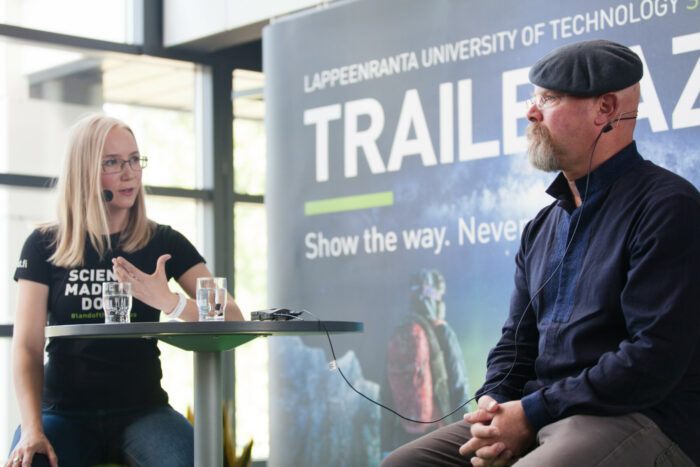
A man wearing a beret and a grey goatee sits at a table on a stage next to a woman who is talking with him.

Jamie Hyneman (right) participates in a discussion event with students at LUT.Photo: Vesa Laitinen/LUT

Hyneman lives in San Francisco and visits Finland once a year. “Remote lecturing is more environmentally friendly than flying from the US to Finland,” he says.

“I have developed tools for remote work; for example, my avatar robot can move around the lecture hall and let me interact with the students face-to-face. Finns are generally ready to adapt to technical innovations, and the students at LUT have an impressive technical vocabulary in English.”

In Finland, it is easy to work in English. Jorma Turunen is a professor of practice at the University of Turku in southwestern Finland. He has been a board member in more than 30 Finnish tech companies. Before academia, he was the CEO of Technology Industries of Finland, a central organisation for public relations and collective agreements.

“English is often used as a company language, especially in technology companies that are looking for international talent to work in expert positions,” says Turunen.

Meaningful work, convenient life

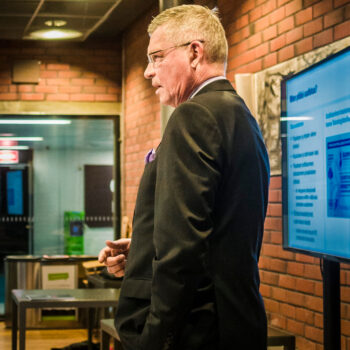
A man in a suit is standing in front of a large screen talking.

Jorma Turunen, a professor of practice at the University of Turku, addresses an audience during a presentation at LUT.Photo: Teemu Leinonen/LUT

Finnish work life reflects the equality of the society.

“Managers are generally not authoritarian, and everyone is expected to take responsibility for their own work,” says Turunen. “You are valued as a colleague if you are honest and reliable. Mutual trust increases work productivity and quality, and it is easy to find your work meaningful. Finland is known for gender equality, and every person has the same opportunities to advance their career.”

Turunen has mentored young researchers who have moved to Finland from abroad.

“Many of them have praised how convenient family life is here. For example, those famous free Finnish schools with amazing learning results.”

Innovation accelerates growth

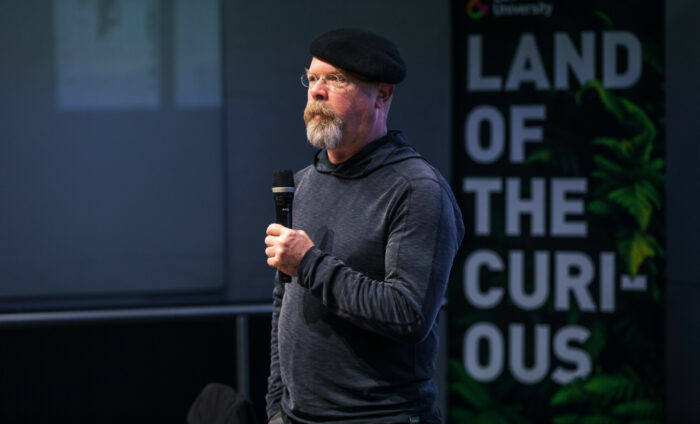
A man wearing a beret and a grey goatee talks into a microphone.

Jamie Hyneman fields questions at a seminar at LUT, in front of a sign that reads “Land of the curious.”Photo: Teemu Leinonen/LUT

Finland ranked among the top 10 most innovative countries in the Bloomberg Innovation Index 2021, as they have been for many years in a row.

Innovative Finnish startup companies have attracted the interest of international investors. Of the 1.2 billion euros funding they received in 2021, 71 percent came from abroad.

By Päivi Brink, ThisisFINLAND Magazine 2023

In northern Finland, three unconventional Sámi artists talk about culture and craft

“These three artists came immediately to mind,” says Auri Ahola. She’s speaking about how she decided who would appear in her short documentary film Bálggis, which contains three portraits of about five minutes each.

Each of the three people, like Ahola herself, is a Sámi artist. The Sámi are the only recognised Indigenous People in the EU area. Their northern homeland, called Sápmi, is divided into four parts by the borders of the nation-states Finland, Sweden, Norway and Russia.

The artists in the film work in fields outside the mainstream art world: Aleksi Niittyvuopio is a circus artist and juggler, Sunna Kitti is an illustrator who creates graphic novels, and Sámi Hustler is a graffiti artist (the name is a pseudonym). Ahola used to dance in the Finnish National Ballet and is now a Sámi regional artist at Arts Promotion Centre Finland, where she plans and leads projects that support and highlight Sámi culture.

Bálggis means “path” in Northern Sámi, one of fewer than ten surviving Sámi languages. The film portrays its subjects’ connections to the rugged, expansive landscapes of northern Finland. Although all three artists now live in southern Finnish cities, Ahola brings them to Sápmi, to areas linked to their childhoods and their heritage. In the process, they describe the paths they have taken.

Moving objects

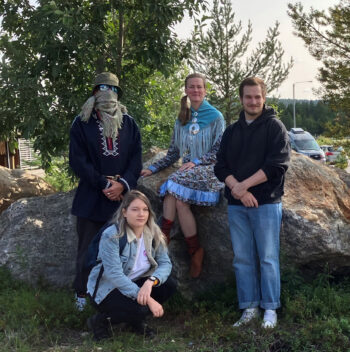
Two women and two men, one of the men wearing a scarf and sunglasses to hide his face, pose in front of a boulder and some trees.

From left: Sámi Hustler, Sunna Kitti, Auri Ahola and Aleksi Niittyvuopio gathered in the far northern town of Inari for the premiere of the documentary film Bálggis.Photo: Peter Marten

As the film opens, we get to glimpse each of the three wandering through northern terrain of peaks, rivers and forests. Then we see them in action as they tell their stories one by one, starting with Niittyvuopio.

One side of his family comes from near Karigasniemi, on the far northern border between Finland and Norway, but he grew up in the south, and lives in the city of Tampere in western central Finland.

“I’m always fascinated by thinking about how an object would like to move,” his voice says as we see him spinning and juggling clubs in a mountainous setting, so far above the tree line that the only vegetation is small plants that hug the ground.

“Something tangible that I’ve incorporated into my own work from Sámi culture is reindeer antlers,” he says. He carefully rotates and balances enormous antlers, looking for a way he might use them in a routine.

Shining a spotlight

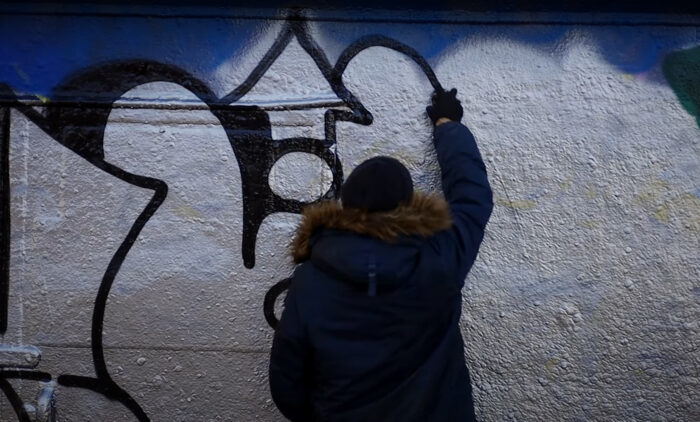
A man is spray-painting a design on a wall, his back to the camera.

Sámi Hustler creates graffiti in a former industrial area in Helsinki.Still photo from the film Bálggis

Sámi Hustler wears a ski mask on camera to protect his identity. We see him visiting a remote fishing shack on the Näätämö River up north. Then the scene abruptly shifts to Helsinki, to nocturnal shots of Central Railway Station and of traffic rumbling up Häme Road.

We watch him create works of graffiti while he tells his story in a voiceover. “I deal with Sámi language and culture in my art, and I want to highlight it,” he says.

He tries to “address some of the issues and discrimination faced by Sámi people.” For instance, his mother was punished in school for speaking Sámi – an unfortunately familiar story in Finland as late as the 1970s. “I try to touch on all the topical issues and shine a spotlight on them,” he says.

Escapist storyteller

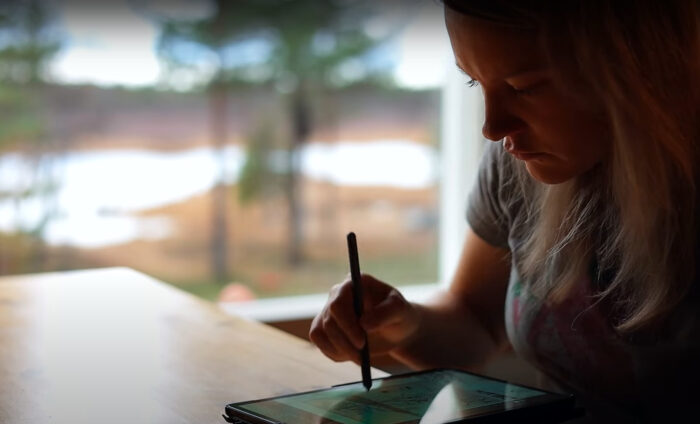
A woman sits at a table, touching an iPad with a stylus, with trees visible outside the window.

Sunna Kitti draws graphic novels that take place in other worlds.Still photo from the film Bálggis

Comic book artist Sunna Kitti grew up in Tirro in the far north and now lives about 1,200 kilometres (750 miles) away in Turku, a city on the southwestern coast of Finland. “I’m a bit of an escapist storyteller,” we hear her say over views of her walking in the woods and riding her bike down a forest road. “I like stories about travelling to other worlds.”

We see her drawing in her notebook in the forest beside a body of water, and later on an iPad at a kitchen table. “This environment is a place for me where I can immerse myself in my own thoughts,” she says of Tirro.

All three artists express similar notions of revisiting their roots, replenishing their energy and gathering inspiration when they travel to Sápmi.

Different paths, different techniques

Watch Bálggis, a short documentary film directed by Auri Ahola. (English subtitles are available – if they are not visible, check the settings on the video.)Video: Auri Ahola/Arts Promotion Centre Finland

Ahola and the subjects of her film appeared onstage for a question and answer session at the premiere of Bálggis, in Inari, a town in the far north. The event took place at Siida, a nature centre and museum of Sámi culture. On the same weekend, the Indigenous music festival Ijahis Idja (Nightless Night) was taking place just across the river at Sajos, the Sámi cultural centre.

“They all represent marginal art forms that are also pretty unusual within Sámi culture,” said Ahola of the artists in the film. “They use their cultural tradition while making art with modern knowledge and technology.”

Among the documentary’s descriptions of how inventive the artists are in their approaches, one thing especially caught my notice: Niittyvuopio’s mention of “thinking about how an object would like to move” when searching for objects he can use in a show. “That’s something I’m processing all the time,” he told the audience in Inari. “You may come across an object unexpectedly.

“For an everyday object, like a towel, let’s say, I start thinking about what you can do with a towel, and what you can do with it that you can’t do with other objects. How can you adapt it for tricks and manoeuvres? Then I start finding different paths, different techniques for that object.”

While each of the artists in Bálggis has their own techniques and paths, Ahola believes we’re going to hear more about all of them. “This film won’t be the last thing,” she said.

By Peter Marten, September 2023

Hold on to summer: Sunny Flow Fest memories in Helsinki last through the autumn and beyond

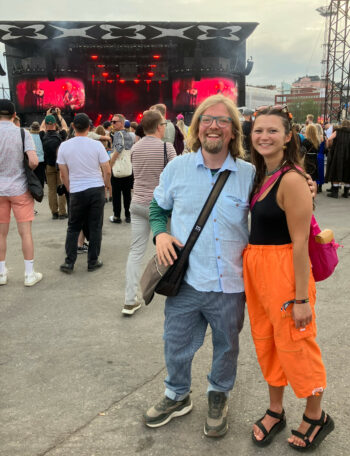
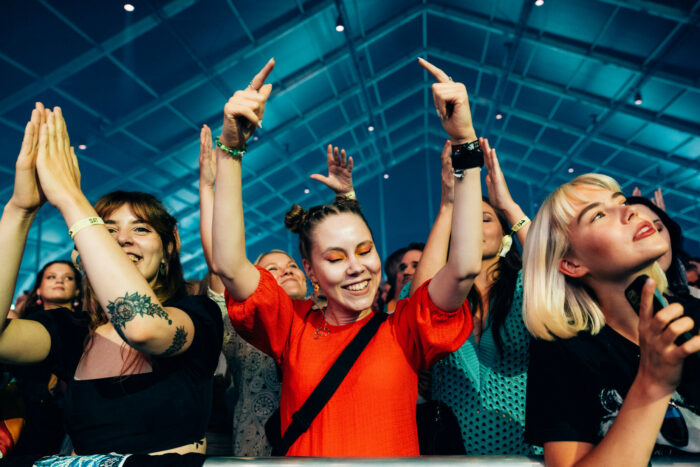
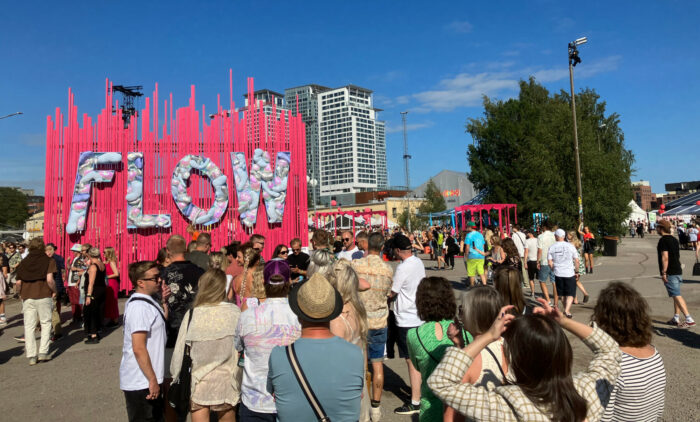
Over three days in August, Flow Festival welcomed about 30,000 visitors a day.

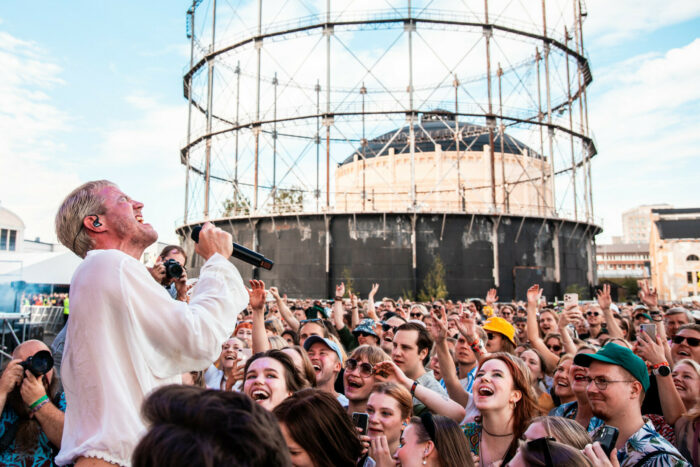
Many of them came to see headliners such as Suede, Lorde and Blur. Those were just a few of the more than 150 artists or ensembles playing that weekend at the four large outdoor stages, four open-air club areas and one indoor stage.

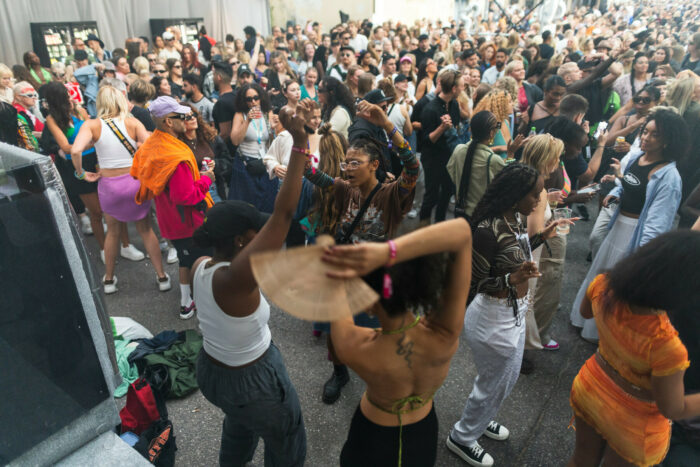
Suvilahti, the former industrial area that has hosted Flow for more than half of the festival’s two decades of existence, resounded with local and international musicians and DJs from afternoon till early morning: Sudan Archives, Christine and the Queens, Alma, Caroline Polachek, Tove Lo, Little Miss Anti-Social Butterfly 2.0 Effective Voluptuous, Verneri Pohjola, Wizkid, Kelela, Litku Klemetti, Pusha T, Paperi T, Meshell Ndegeocello and dozens of others.

Across downtown Helsinki and out in far-flung neighbourhoods, you could hear the concerts echoing in the summer evenings.

Not your everyday gig

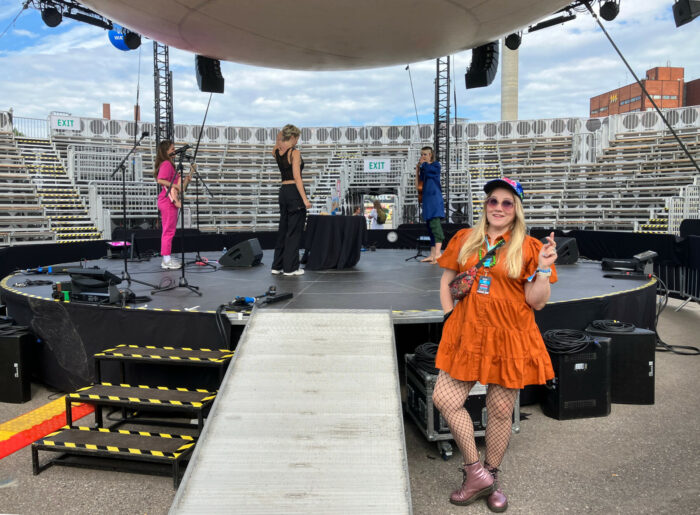
Three women are standing on a round outdoor stage, while another woman stands in front of the stage.

Manager and agent Johanna Sauramäki (right) was at soundcheck with Elsi Sloan (second from right), whose crew included Saara Mänttäri (bass, left) and Veera “Marfa” Ojola (rap and spoken word).Photo: Peter Marten

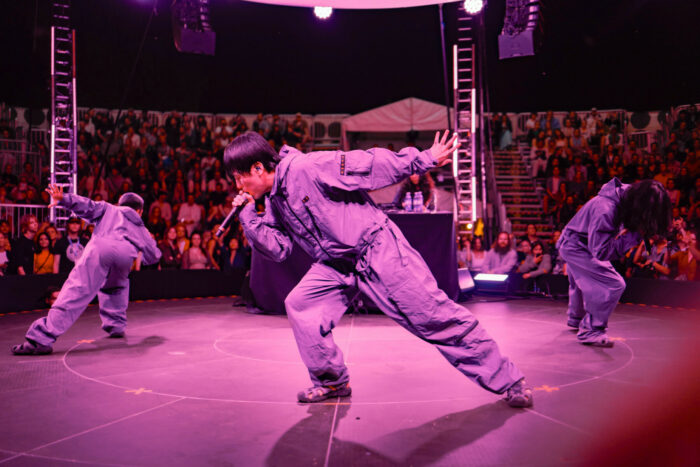
On a beautiful Friday afternoon, Flow Festival is just getting under way. Finnish musician, activist and actor Elsi Sloan, in her early 20s, is the first act to play at Balloon 360, a circular stage with rows of seating on all sides and a reputation for attracting a discerning audience. An enormous sphere positioned above the venue makes it look like the place is about to float up into the sky.

During soundcheck, Sloan’s agent and manager Johanna Sauramäki has a few moments to talk. “Flow is not your everyday gig,” she says. “And at the Balloon there are 360 degrees of spectators around you – that’s pretty different from a regular stage.”

She got to the venue early to go over the details with the stage manager, the technicians, and Sloan and her crew. She says she told the band that “whatever happens today, whatever feelings you have, even tears or nerves, it’s all allowed. You have to let it out, and it’s OK if it happens onstage.”

As soundcheck progresses, a bass guitar thumps and Sloan’s voice fills the empty space, first singular and clear, then magnified and modified by a voice processor. It’s a glimpse of the concert’s contents.

No two Elsi Sloan shows are the same, says Sauramäki. “In addition to being a musician, she’s also an activist. She wants to make a change in what’s wrong with the world, and she brings that to the stage with her.” –PM

Art in mind

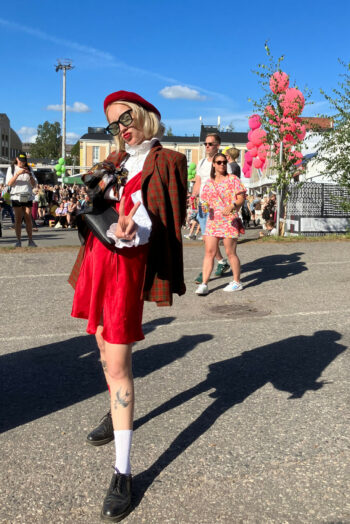
A woman wearing a red beret, sunglasses and a red skirt poses on a sunny day.

Emmi comes to Flow for the music, the ambiance and the art.Photo: Peter Marten

Emmi is a dance teacher from Porvoo, 50 kilometres (30 miles) east of Helsinki. This is her fourth time at Flow, but her first time working here. She’s on duty during Flow’s Family Sunday. For four hours on the last afternoon of the festival, you can bring small kids with you. Activities include art workshops and a family disco.

“I come here for the music, of course, but also for the festival atmosphere and the art,” says Emmi. “I like that the whole festival area has been constructed with art in mind. The area as a whole looks nice and colourful. The festival supports different artists, and even the selfie walls were built and painted specifically for this event.

“These are unique surroundings. With all the brick and concrete elements, it’s urban and even a bit harsh, but all the artworks and colours make it look good.” –AR

Being transported

A man and a woman in summery clothing stand side by side, while in the background a crowd is watching a concert at an outdoor stage.

We caught up with Kári (left) and Hanna just as Caroline Polachek’s concert was revving up on the main stage behind them.Photo: Peter Marten

Kári is an Icelandic poet who has lived in Helsinki for several years, and Hanna is an Icelandic American who lives in Reykjavík, the capital of Iceland.

“Both times I’ve been at Flow, my favourite acts have been in either Balloon or the Black Tent,” says Hanna. She also likes dancing in X Garden – it’s uncommon to find a club with trees growing in it. “I actually prefer X Garden in the daytime, when you can see the sun peeking through the trees.”

Her highlight bands this year include Jockstrap, “and there’s another band – I don’t want to butcher the name,” she says, looking it up on her phone. “Alogte Oho and His Sounds of Joy. That was at the Balloon stage last night, and it was sooo much fun.”

Kári has other favourites: Sudan Archives and Blur. “I randomly just stumbled upon Sudan Archives a couple years ago, and I’ve been listening to Blur since I was a teenager,” he says.

He has just attended Claire Rousay’s concert. “What I thought I was going to see was an avant-garde composer on stage with a computer, but she played these acoustic songs that she intertwined with that. It was a little like being transported out of yourself – it was great.” –PM

(Article continues after slideshow.)

Hear the roar at Flow

An urban tradition

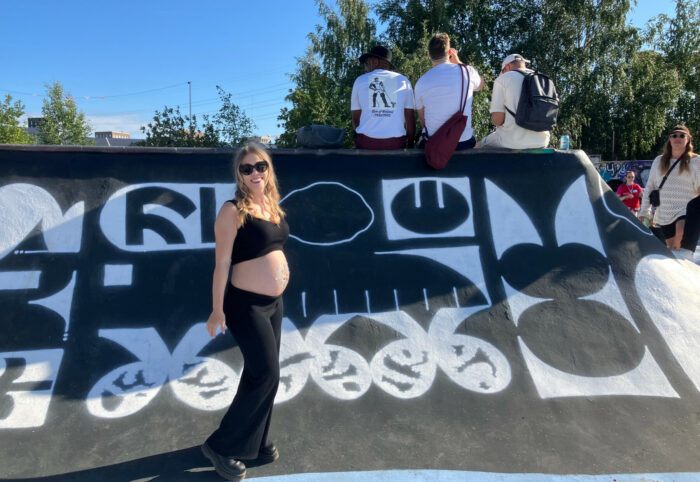
A pregnant woman stands in front of a skateboard ramp where other people are sitting and standing.

We talked to Salla in a skatepark that had been repainted for Flow and served as a lounge area during the festival.Photo: Peter Marten

Salla, a Helsinkian, has been to Flow Festival about ten times. She has a degree in economics and, at the time of writing, is a mother-to-be.

“Flow Festival has become a tradition for me,” she says. “It is a really lovely urban festival. Especially in the beginning, that was something special. Most other festivals were less urban, and you had to stay at a campsite.

“I used to come here to see certain performers, but nowadays it’s more about the whole festival experience. Of course, there are interesting concerts every time. I always see lots of old friends here. The atmosphere is great, and the festival area is beautifully decorated.” –AR

Volunteer resources

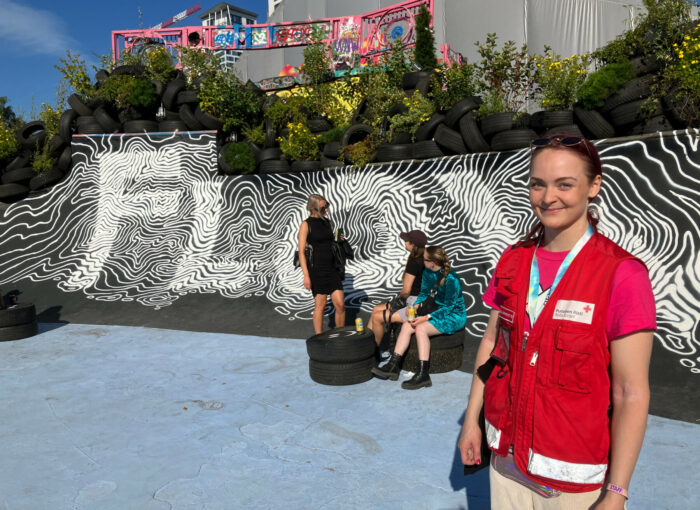
A woman in a red vest stands in front of a wall painted with the word Flow.

Juulia patrols the festival grounds as a volunteer with the Finnish Red Cross.Photo: Peter Marten

Juulia from Vantaa, just north of Helsinki, is on duty at Flow as a volunteer with the Finnish Red Cross. This is her first year at the festival.

“My shift lasts six hours,” she says. “I’ve been a volunteer at some other festivals this year as well. We patrol the festival grounds, talk to people, and hand out a ‘festival survival kit.’ Our most popular item is earplugs.

“Flow Festival has a harassment contact person this year for the first time. If we see or hear of something inappropriate, we can suggest people contact them. Luckily, the festival is quite peaceful.

“I’ve lived in Rome and Barcelona, and I travel a lot, so I am usually not in Finland at this time of year. Now I wonder why I haven’t been to this festival before. It makes me feel kind of like I’m in Berlin. I might attend next year as a civilian.” –AR

Cool transformation

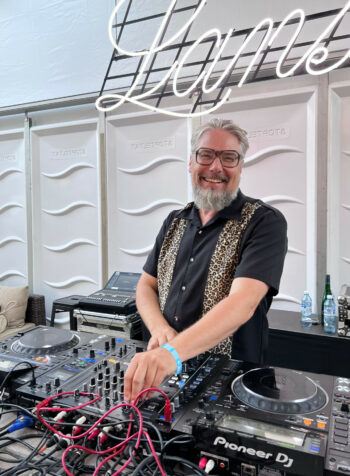
A man with a grey beard and a black shirt smiles and presses buttons on an audio mixing board.

Suvilahti, the former industrial area where Flow Festival has been held many times, “turns into something really cool” for the festival weekend, says DJ Hermanni.Photo: Anna Ruohonen

DJ Hermanni from Helsinki is a musician, an event manager and a sound engineer, among other occupations. He has attended almost every Flow Festival: five times as a sound engineer, other years hosting foreign artists, and four times performing as a DJ, as he is this year.

“I think 2022 was the best Flow Festival ever,” he says. The reason wasn’t only the music. “There was something really special about the atmosphere that year. Maybe because it was the first festival after Covid restrictions were lifted.

“What’s so special about this festival is probably the surroundings. They’re really cozy. There are lots of different locations and stages, and everything looks super-nice, especially the lighting. I mean, this is not the most pleasant place in Helsinki on a regular day, but for the festival weekend, it turns into something really cool. This is the best festival in Finland, and I usually hang out here before or after my shifts as well. It’s so easy, since it’s close to home.” –AR

By Peter Marten and Anna Ruohonen, September 2023

Radical liberty: Finnish director Alli Haapasalo’s movie Girl Picture lets girls be girls

Director Alli Haapasalo’s movie Girl Picture (Tytöt tytöt tytöt, 2022) is a positive story about teenage girls.

The film is a portrait of what it is like to be a girl today,” Haapasalo says. “I would not describe it as a coming-of-age movie, because I don’t think the girls become adults or reach a new stage of development. I wanted to emphasise that we are all unfinished and imperfect. These girls explore their own identity without anyone defining them from the outside. We have received a lot of positive feedback from the audience about this.”

The movie, which is entitled Girls Girls Girls in the UK, has been an international success, especially after winning the Audience Award at the Sundance Film Festival 2022. It is suitable for viewers over 12 years old.

“I wasn’t sure if the film would run into language or cultural barriers,” says Haapasalo. “Luckily, neither has been a problem for international audiences. People coming from different cultures and speaking different languages have related to the characters strongly.”

Love is love

A woman rests her chin on her hand while looking at the camera.

“These girls explore their own identity without anyone defining them from the outside,” says film director Alli Haapasalo.Photo: Marica Rosengård

Girl Picture seeks to challenge how people traditionally perceive girls. In the movie, three girls spend three Fridays together, and two of them fall in love with each other.

“The love affair is about two people in love, regardless of their gender,” says Haapasalo. “Their sexual orientation is a complete non-issue. The third girl is looking for pleasure, but not feeling it. We do not know if she is asexual or simply has not found her sexuality yet – and that is OK. They are just exploring themselves and their sexuality. These girls see sexuality as something fluid, not fixed. They ask permission to touch and respect each other’s space.”

Even though these girls are brave, active young people, they come to no harm because of it.

“Our world is full of stories where girls get pregnant, raped or murdered because they dare to be free,” Haapasalo says. “The screenwriters, Daniela Hakulinen and Ilona Ahti, and I wanted to do the opposite, and not punish girls for their freedom.”

Support for aspiring filmmakers

Three teenage girls sit close together, looking into the camera.

From left: Linnea Leino, Eleonoora Kauhanen and Aamu Milonoff play the girls in Girl Picture. Photo: Ilkka Saastamoinen/Citizen Jane Productions

After studies in journalism, Haapasalo studied directing in both Helsinki and New York. She lived in the US for ten years and enjoyed her time abroad.

“I returned to Finland with my family, and I have been enjoying comfortable, functional Finnish society and the well-organised childcare system,” she says. “My everyday life is logistically very easy, and it is easy to travel from one place to another. For example, I do not live close to the airport, but I can get to it in 20 minutes.”

At work on her film projects, Haapasalo has found support and funding in the Finnish Film Foundation.

“As an aspiring filmmaker, you don’t have to be wealthy and fund your own projects, or well-connected just to talk to the right people,” she says. She believes this increases access to the film industry and contributes to increased social, ethnic and gender diversity. “It makes quite a difference to have public money supporting filmmaking.”

International film production companies can apply for a cash rebate from Business Finland for the costs involved in all the production phases conducted in Finland. More foreign films are shot in Finland.

“I can recommend filming in Finland for foreign productions, too,” Haapasalo says.  “The people who work in the Finnish film industry are well educated and skilful, they take safety issues seriously and you can trust them. I have found them very easy to work with.”

By Päivi Brink, ThisisFINLAND Magazine 2023
Finland promotes media literacy as a civic skill

The world has never before been as interconnected as it is today, but communities are still experiencing polarisation and uncertainty.

The internet and social media in particular offer us endless possibilities, but also challenges we should be aware of and address. People need up-to-date media knowledge and skills in order to fully participate in their societies.

When people have good media literacy skills, it is more difficult to influence them with disinformation or make them act against their own best interests. Without media literacy, people have much less power to influence the things that matter to them, and there is significantly less trust in their society.

In Finland, there is a long history of promoting media literacy. In the 1950s, some schools were already offering mass communication education which focused on newspapers and radio. Around 25 years ago, the first university-level media education programme was established. Today, media education includes all forms of media, both offline and online. Part of media literacy is learning how to navigate social media in a healthy way.

In 2022, Finland was ranked at the top of the Media Literacy Index comparing 41 European countries. The index assesses the ability to resist fake news using media freedom, education and trust in people. In Finland, media literacy is part of curricula from early childhood education to upper secondary level and it is integrated in all subjects. It is also part of teachers’ education. There are several themes teachers choose from, for example evaluating and analysing media, operating in media environments and producing your own media. There is multi-sectorial cooperation: early childhood education and schools work together with NGOs, libraries, youth centres and parents.

Finland has its own policy on media literacy and media education, which the National Audiovisual Institute is responsible for implementing.

By Julia Alajärvi, ThisisFINLAND Magazine 2023
You can also check out the Digipower Investigation by the Finnish Innovation Fund Sitra.