Made in Finland: Sweden sends Finnish sauna-party band KAJ to Eurovision

In early March, Swedish TV viewers and an expert panel chose “Bara Bada Bastu” (roughly “Let’s Just Sauna”) to represent the country at the annual Eurovision Song Contest (ESC) in Basel, Switzerland in May.

Accompanied by gleeful choreography, the song is a simple, catchy ode to the joys of Finnish sauna bathing, performed by KAJ, a Swedish-speaking trio from western Finland who refer to themselves as a humour group. Swedish, one of Finland’s official languages, is spoken by more than 5 percent of the population, mostly along the coast.

The song quickly hit number one on Spotify’s Global Viral 50 list. It also attracted over two million video streams in its first few days, along with numerous comments thanking the band for a moment of fun and escapism from the worries of the world.

KAJ’s songs always have a simple pounding dance beat and a light-hearted party atmosphere. “Bara Bada Bastu” contains hints of reggae, techno and stadium anthems.

Good-natured rivalries

A woman with platinum blonde hair in a black outfit stands in front of a pink wall covered with white logos.

Finnish singer Erika Vikman is Finland’s representative in the 2025 Eurovision Song Contest.Photo: Jussi Nukari/Lehtikuva

Kevin Holmström, Axel Åhman and Jakob Norrgård started KAJ on the west coast of Finland in 2009, when they were in their mid-teens. They formed the group’s name from their first initials, just like the most famous Eurovision champs of all time, Sweden’s ABBA, who won just over 50 years ago.

ABBA’s Björn Ulvaeus was among those who hailed KAJ’s victory at the Swedish Eurovision qualifying contest, known as Melodifestivalen. He posted a social media video from his own sauna congratulating them on their “super-catchy earworm.” The band reposted it, quipping, “We found our fourth member.”

Meanwhile, Finland will be represented in Basel by Erika Vikman with “Ich Komme,” which is steamy in an entirely different way from KAJ’s family-friendly sauna song. Vikman’s tune is the first Finnish entry ever with a German title and catchphrase.

Residents of European countries can’t vote for their own country’s entry in the ESC, so Sweden is assured plenty of Finnish votes, while Finland is hoping for votes from the German-speaking countries – and Sweden, of course.

Quirkiness is catchy

A singer in a bright green top garment kneels with four dancers in pink outfits.

Finnish rapper Käärijä (Jere Pöyhönen) performs “Cha Cha Cha” during the 2023 Eurovision Song Contest.Photo: Vesa Moilanen/Lehtikuva

Finland was part of the Kingdom of Sweden for centuries, up until the early 1800s, and the two countries are good-natured rivals, especially in ice hockey and other sports. That rivalry spilled over into Eurovision in 2023, when exuberant Finnish rapper Käärijä’s “Cha Cha Cha” won the public vote but came in second overall behind Sweden’s Loreen, who notched her second ESC win.

Finland has competed in Eurovision since 1961, never placing better than sixth until 2006, when monster-metal band Lordi won with “Hard Rock Hallelujah,” scoring a record number of points.

In a way, KAJ is carrying on the goofy novelty-act tradition of Lordi, Käärijä and Windows95man (Finland’s representative in 2024). The successes of the first two showed that ESC voters are sometimes just looking for a song that’s fun and catchy, rather than the slick, melodramatic power ballads that often win – and often come from Sweden.

Hot topic

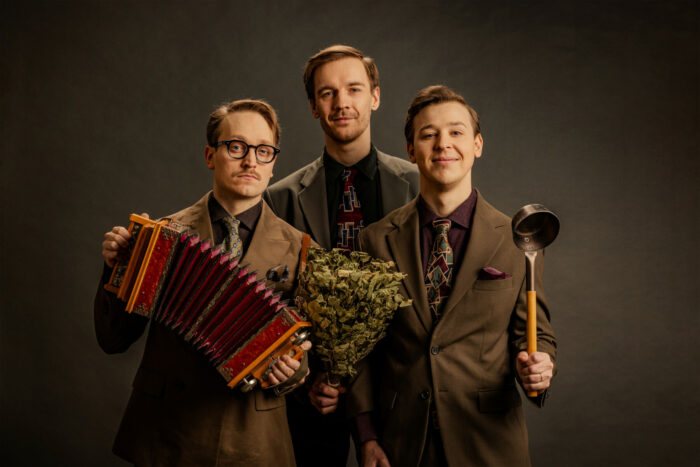
Three men wearing suits pose, one holding an accordion, another holding a bunch of small leafy branches, and the third holding a ladle.

KAJ consists of three guys from western Finland (from left): Axel Åhman, Kevin Holmström and Jakob Norrgård.Photo: Erik Åhman

“Bara Bada Bastu” is a cheerful celebration of Finnish sauna culture. With some 3.3 million saunas in a country of 5.6 million people, Finland takes its steam bathing seriously. Unesco added “Sauna culture in Finland” to its list of Intangible Cultural Heritage in 2020.

Though various kinds of sweat baths have been in use around the world for centuries, Finland is the country most closely associated with the modern-day sauna. “Sauna” is also the only Finnish word widely used in other languages (the Swedish-language term, bastu, comes from badstuga, or “bath cabin”).

“Sauna” is one of a few Finnish-language words sprinkled into “Bara bada bastu,” along with yksi, kaksi, kolme (one, two, three) – as in the line, “Yksi, kaksi, kolme, sauna!” Let the hotly contested competition begin.

By Wif Stenger, March 2025

Inventive Finnish company makes construction ideas float

When Kimmo Saharinen was a student, he heard about a great deal: If you sign up for an international mathematics competition, you can skip class to take the test.

“I just wanted to get out of Swedish class,” Saharinen laughs. “But I did really well and placed second in the district.”

Languages might not have been his thing, but mathematics was. Or, rather, engineering: using math to solve technical problems. His talent for creating and building things has led him through life, and now he is building things people have never seen before.

Building his own car and house

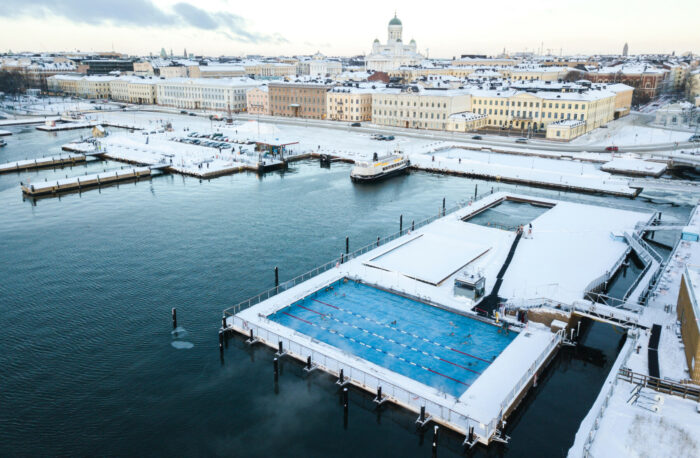
A snow-covered deck, including several pool basins, floats on a harbour with city buildings in the background.

Allas Pool keeps some of its swimming pools open all winter.Photo: Bluet

“For my bachelor’s degree, I designed and built my own car,” Saharinen says. “I even had it licensed for road use. I don’t know if anyone else has ever done that in Finland.”

He received his Master of Science degree from the University of Oulu, where his thesis involved creating and patenting a paper machine. He worked in the forest industry before deciding to build houses.

“I wanted to do the whole thing – running the excavator; pouring the foundation; electricity; plumbing; HVAC; everything,” he says. “I borrowed ideas from how they build skyscrapers. I believe you can always find things to improve, so everything was a little bit different from standard.”

Inspiration from an exhaust pipe

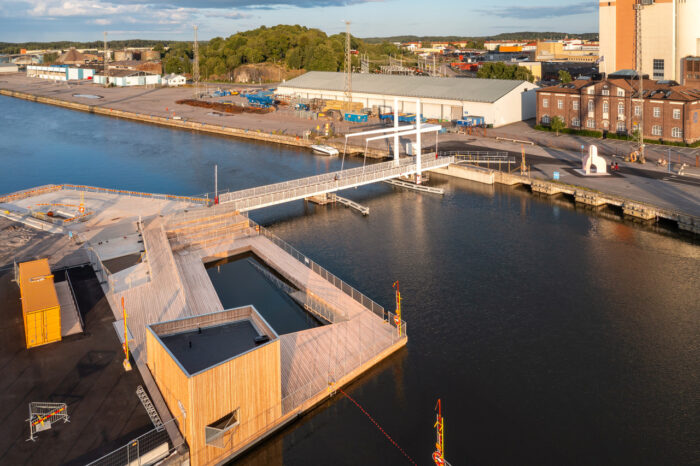
A partially constructed wooden deck, including a pool basin, floats on a harbour with city buildings in the background.

Bluet designed a floating pool complex, viewed here during construction, for Inre Hamnen (Inner Harbour), a neighbourhood in Norrköping, Sweden. Photo: Bluet

“I met Kimmo because I was a realtor and sold his houses,” says Tytti Sirola, picking up the story. “Soon after I started working on floating construction, I heard clients wanting to build big floating platforms and audacious projects. No one knew how to do this, so I told them, ‘I know just the guy.’”

One project was Allas Pool (originally called Allas Sea Pool), a harbourside hospitality centre in Helsinki with conference rooms, restaurants and saunas. Swimming pools would be built on floating platforms. Yet how would a floating structure handle waves and ice? How would steel and concrete components work together? Where can you fit all the infrastructure – the electrical wires, the pumps and the tanks?

Saharinen was brought in to figure it all out.

“It was Night of the Arts, a big cultural event in Helsinki, but instead Kimmo was talking with executives about a piping problem,” Sirola says. “He got inspired by car exhaust pipes and thought of a solution. I don’t think a traditional engineer would have come up with such an innovative idea.”

Pools that float

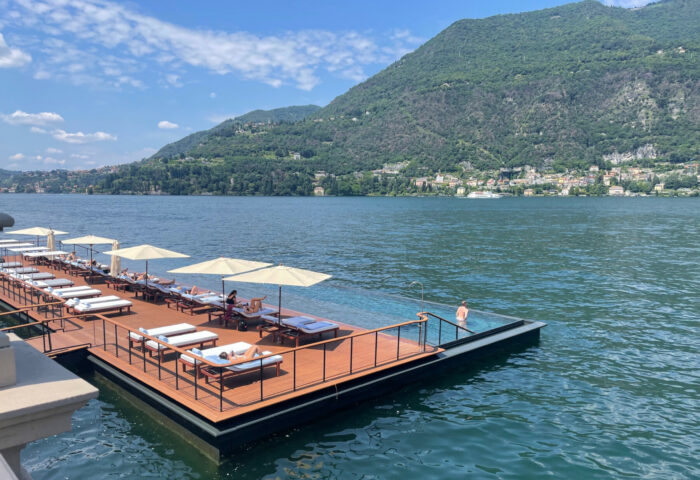
A wooden deck and an attached pool basin float on a lake with a mountain in the background.

For a hotel on the shore of Lake Como, Italy, Bluet made the world’s largest floating infinity pool, visible here beside the deck.Photo: Bluet

Allas Pool opened in 2016 and has been wildly successful. It is now a tourist attraction as well as a popular spot for locals. The casual observer might not notice the attention to detail in the platform.

“Hinges in the deck allow it to flex in the waves, the biggest of which come from the direction of the island fortress of Suomenlinna,” says Saharinen.

The platform can rise and descend by as much as two and a half metres in the tides. In addition, he says, “Water-filled pools exert 500 tonnes of force, so the structure must handle the stresses of filling and emptying the pools.”

Other developers were intrigued, so Saharinen and Sirola became two of the cofounders of Bluet Floating Solutions, a company specialised in creating floating leisure platforms. Sirola is the CEO and handles the business side, while Saharinen is the technical director.

From Italy to Iceland

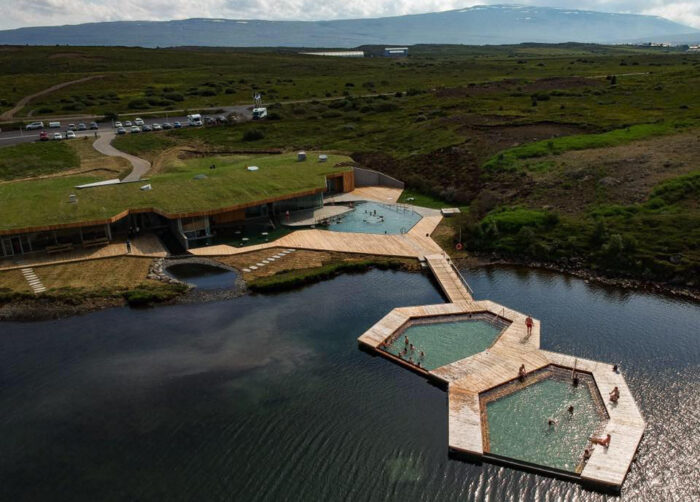
Several pool basins and accompanying wooden walkways float on a lake with mountains in the background.

These thermal spa pools float on a lake in Egillstaðir, Iceland.Photo: Bluet

“This is an entirely new sector,” Sirola says. “In some places around the world, the authorities don’t even know what permits to issue, because no one has ever done anything like this.”

Bluet has created floating houses, concert stages and sports fields. In 2024, they finished the world’s largest floating infinity pool for a hotel in Lake Como, Italy.

Both Saharinen and Sirola cite the floating thermal spa pools in Egillstaðir, Iceland, as a favourite project.

They also designed a floating habitat at Helsinki Zoo for a Saimaa ringed seal in need of rehabilitation. (Saimaa ringed seals are found only in eastern Finland and are gravely endangered, with a population of less than 500.)

There is high demand for floating structures, as space for waterfront development is limited. Saharinen hopes they can keep pushing the boundaries.

“I like challenges,” says Saharinen. “I would like to create a floating platform that can withstand a hurricane, such as in Puerto Rico, or maybe one in strong currents, like off of Alcatraz in San Francisco Bay.”

By David Cord, March 2025

5 tips for enjoying the sauna like people in Finland

1. Take a shower first

Though the sauna is technically for bathing, you should take a quick shower before you go in. It’s considerate to your fellow sauna-goers and also makes the heat more bearable.

2. Wear what makes you comfortable

Contrary to popular belief, you do not have to be nude to enjoy the sauna. A bathing suit or even a towel is perfectly acceptable attire. In some public saunas in Finland swimwear is actually required.

3. Cool off often

Don’t be afraid to step out of the sauna when things get too hot for you! Finns often cool off by hopping into the lake or popping outdoors and go back in when they feel up to it.

4. Don’t be scared of the vihta

The vihta – also called vasta in some regions – is a leafy bundle of small branches, usually birch, that Finns use to gently hit themselves in the sauna. It may look intimidating at first, but is great for your circulation and skin, so give it a go!

5. Enjoy the afterglow

To many, the best part of sauna is the euphoric feeling it gives you afterwards. When you’re done, make sure to sit down with a nice, cold drink and soak in the endorphins.

By Johanna Teelahti, ThisisFINLAND Magazine, March 2025

University of Helsinki research: Prehistoric people may have “heard” rock paintings talking

Rock paintings on a cliff rising directly from a lake are in an acoustically distinctive environment. This feature may have played a major role in their significance to prehistoric hunter-gatherers.

Researchers from the University of Helsinki examined the acoustics of some of the sites, where the art typically portrays elks, humans and boats. They performed measurements in front of 37 rock paintings and found that the cliffs reflect sound particularly strongly and accurately.

When prehistoric hunter-gatherers approached the rock painting sites by water, they could hear an “auditory mirror image” that seemed to come from behind the rock walls. “So, people heard the painted elks talking and the human figures responding with a voice that resembled their own”, says archaeologist Riitta Rainio.

Looking for paradise: Finnish artist Tove Jansson’s paintings go far beyond the Moomins

Yes, of course there are Moomins. The characters that Finnish author and artist Tove Jansson (1914–2001) created are present wherever people display or discuss her work.

There’s also much more. You’re not a hardcore fan of Jansson or the Moomins until you’ve delved into her paintings. That’s exactly what the Helsinki Art Museum decided to do for an exhibition entitled Tove Jansson: Paradise (until April 6, 2025).

Viewing her murals and canvases and considering the time and circumstances of their creation, you get a sense of where Jansson’s life overlapped with her art.

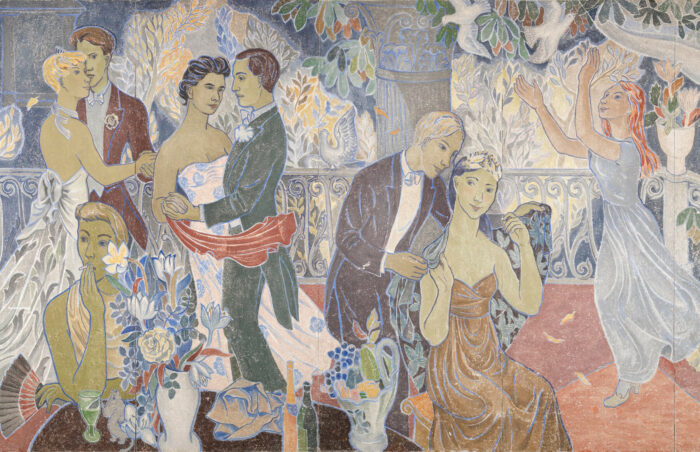
City party, country party

The museum’s wide-open upstairs gallery offers the perfect space for Paradise’s array of murals. Jansson painted numerous commissions between 1941 and 1956; during post-war reconstruction, artworks were in demand for public buildings.

(There are also two famous murals on permanent display at the Helsinki Art Museum: Party in the City and Party in the Countryside (both 1947). A Moomin is hiding in each one. Jansson painted herself among the partiers in City, as well as Vivica Bandler, with whom she had an affair.)

Fantastical scenes

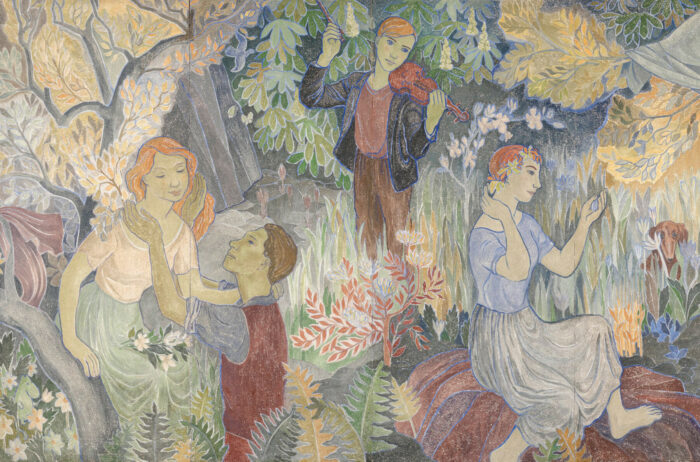
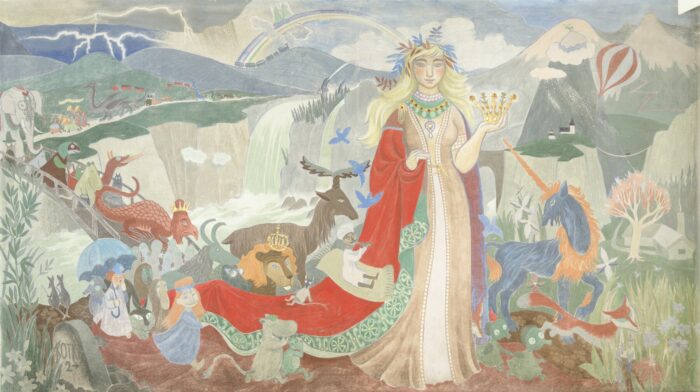
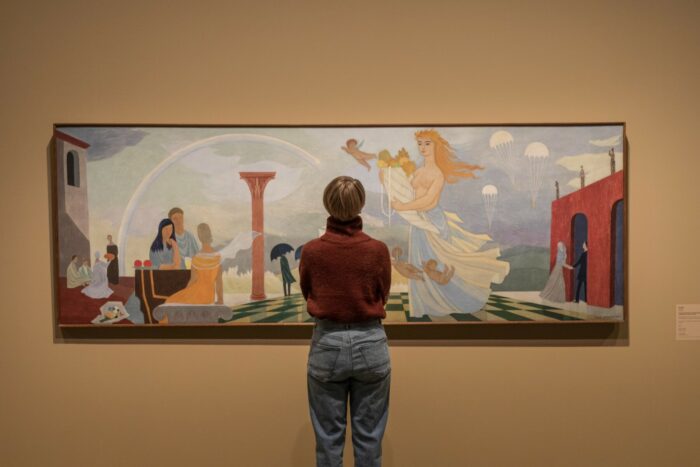
Murals and sketches of murals line the gallery walls. Several that could not be transported are present as full-size projections. Jansson painted for clients including schools, daycares, restaurants, a factory, a bank and a church.

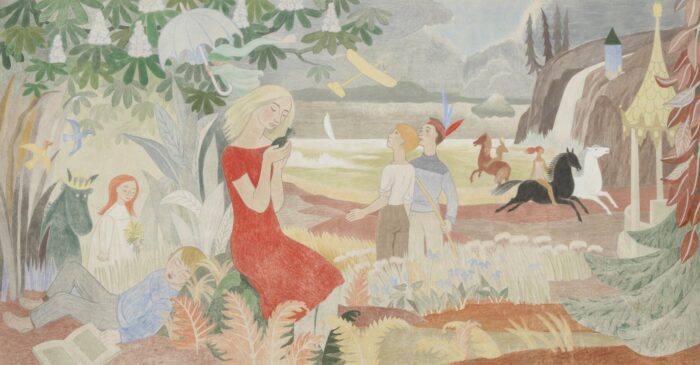
People, animals, mystical creatures and, yes, Moomins appear, crossing landscapes of flowers, trees, bridges, mountains and rainbows by foot or on horseback. In more than one mural, a storm is brewing in the distance. One piece contains a cylindrical blue building very similar to the Moominhouse.

In the corner of Bird Blue (1953), painted for a school cafeteria, a kid has fallen asleep while reading a book. The rest of the fantastical scene may be the child’s dream vision.

Wind and water

For commissions such as a hotel in the harbour town of Hamina or a bank in Helsinki, Jansson depicted adult worlds that retain the allure of fairy tales and paradise while leaning towards the surreal.

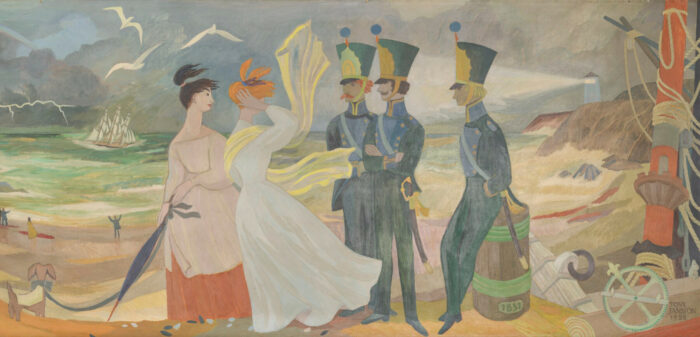
In Untitled (The History of Hamina) (1952), naval officers chat with finely dressed women on a windy shore strewn with what might be detritus from a shipwreck. Far out to sea, a ship in full sail rides the waves as a dark cloud spews lightning. A tiny Moomin is visible – I won’t tell you where.

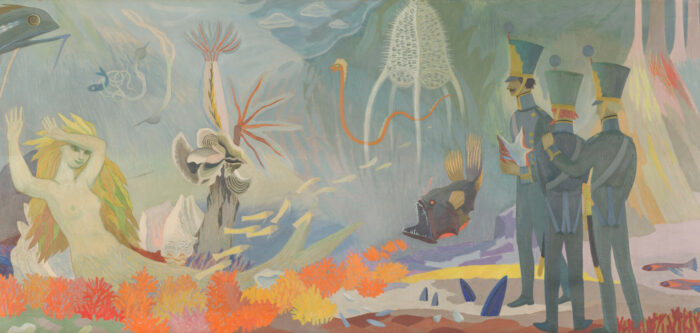
In the companion mural, Story from the Bottom of the Sea (1952), the same officers are standing on the ocean floor. One of them clutches a conch shell as various fish parade past. The men seem to be wondering whether to approach a mermaid who is lounging on the seabed.

A museum worker walked over to say that it would soon be closing time, but urged me to return the next day to watch a documentary film about Jansson painting a mural for the church in Teuva, a town in western Finland. I did.

Tough times in Teuva

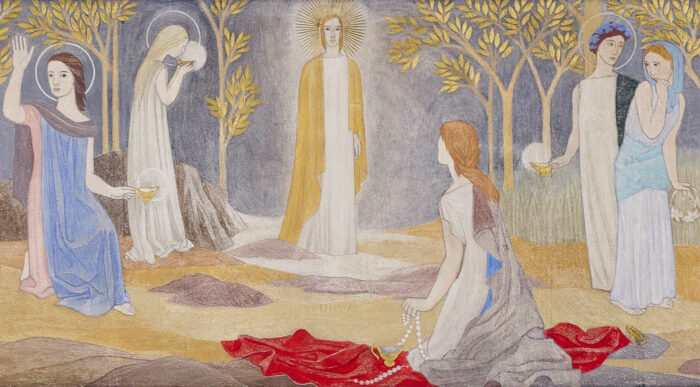
In a painting, one man with a golden halo around his head is standing among several women holding old-fashioned lamps.

Detail from Ten Virgins (1953)
© Tove Jansson Estate. Photo: Linus Lindholm

Teuva Church, built in 1953, replaced a church that had burned down in 1950. When architect Elsi Borg was planning the new building, she also wanted women to design the furnishings. Jansson created the altarpiece, a five-metre-long (16 feet) mural depicting the biblical story of the ten virgins – her only ecclesiastical commission.

The job stretched over several months, and conditions were tough. Cold air swirled in because the windows had not been installed yet. At times, Jansson wore multiple layers and a fur coat while working. However, this and other murals helped pay the mortgage on her downtown Helsinki studio and apartment, a wide, lofty turret with tall windows.

In the film, art historian and Tove Jansson biographer Tuula Karjalainen notes that, for all her skill and accomplishment, Jansson had to put up with male artists and many other people describing her efforts as mere “decorative art.” Meanwhile, murals by her male counterparts – many of them far less productive than Jansson – were “artworks.”

In 1953, Jansson also progressed with other projects, including her next Moomin book. During her time in Teuva that year, the region experienced heavy flooding. A flood happened in the very first Moomin book (The Moomins and the Great Flood, 1945), but the 1953 events may have directly inspired her reuse of the device in Moominsummer Madness (1954), in which a flood submerges Moominvalley.

The long shadow of war

In addition to the murals, the exhibition includes a large selection of Jansson’s other paintings – self-portraits, still-lifes and more.

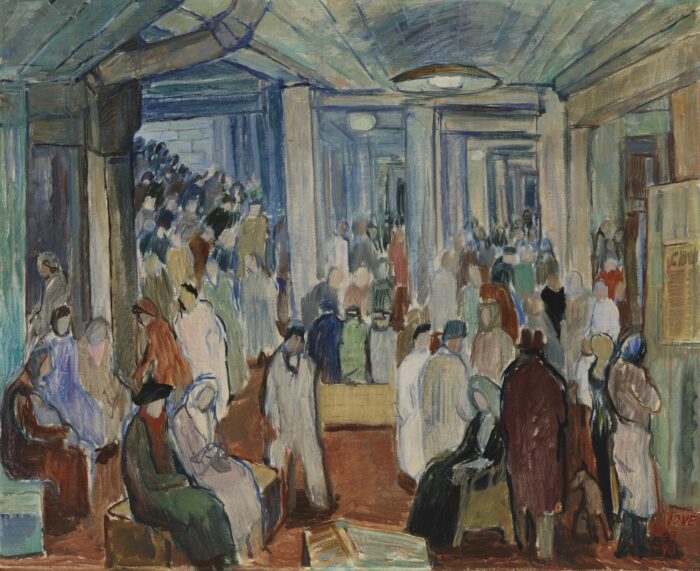
When the Alarm Goes Off (In the Keskuskatu Bomb Shelter) (1940) shows a crowd of people in a cavernous underground space. Each has a dab of paint for a face, making them eerily featureless.

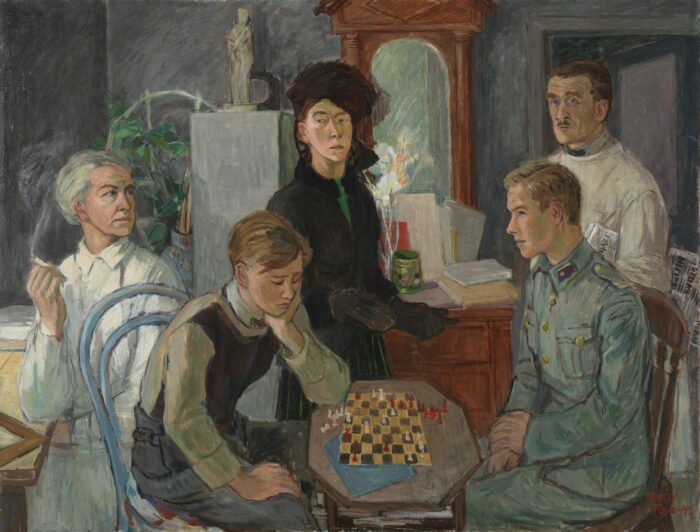
In Family (1942), we see Jansson herself standing in the middle, in dark clothing. Her mother is on one side and her father on the other, while her two younger brothers are in front of her, seated before a chessboard.

The Second World War hangs heavy over the sombre group. So do family dynamics, such as the stormy relationship between daughter and father.

The elder brother, Per Olov, 22 at the time, is in uniform – that very year he was serving at the front. Tove seems to be pointing at him. On a newspaper under the arm of Tove’s father, Viktor, we can just make out the words “Hitler,” “Nazi” and “Stuka” (a German military plane).

Tove, Per Olov and Viktor are all staring at different points in the distance, while Tove’s mother, Signe Hammarsten-Jansson, is looking towards her family – or perhaps past them. The youngest, Lars, has his eyes on the red and white chess pieces, some of them lying overturned on the table.

Tove is wearing a hat and gloves, and, behind her father, a door at the back of the room is half-open.

By Peter Marten, February 2025

Art you can be a part of: Designers discuss Finnish video game Alan Wake and the evolution of games

Do you consider video games to be art? Experts on the subject certainly do.

The Smithsonian American Art Museum, New York’s Museum of Modern Art and the Victoria and Albert Museum in London are only a few of the many distinguished institutions that have chosen to include video games in their art collections in the past decade.

And why shouldn’t they? Games are the joint result of tremendous artistic effort by illustrators, animators, screenwriters, composers, designers and directors, woven together by the skilled hands of programmers.

More importantly, they often have just as much to say about the world around us as any Coppola film or Dalí painting. Today’s game developers boldly tackle tough subjects from childhood cancer to gender inequality and strive to evoke deep emotion in their audiences.

“I’m very passionate about the idea that what we’re making is art. Our creative ambitions are high and artistic expression is an important focus point for all our projects,” says Sam Lake, born Sami Järvi (järvi means “lake” in Finnish), creative director of the Finnish game studio Remedy Entertainment.

Art comes in many forms, from masterwork paintings to music, but Lake’s personal specialty is storytelling. Remedy is globally known for narrative-driven games that purposely push the boundaries of the video game format.

“The way games tell stories is what makes them unique as a medium and an art form, because the player gets to be an active participant in them,” he explains. “A good story is a good story, regardless of the medium, but a video game involves the player in it.”

Early endeavours
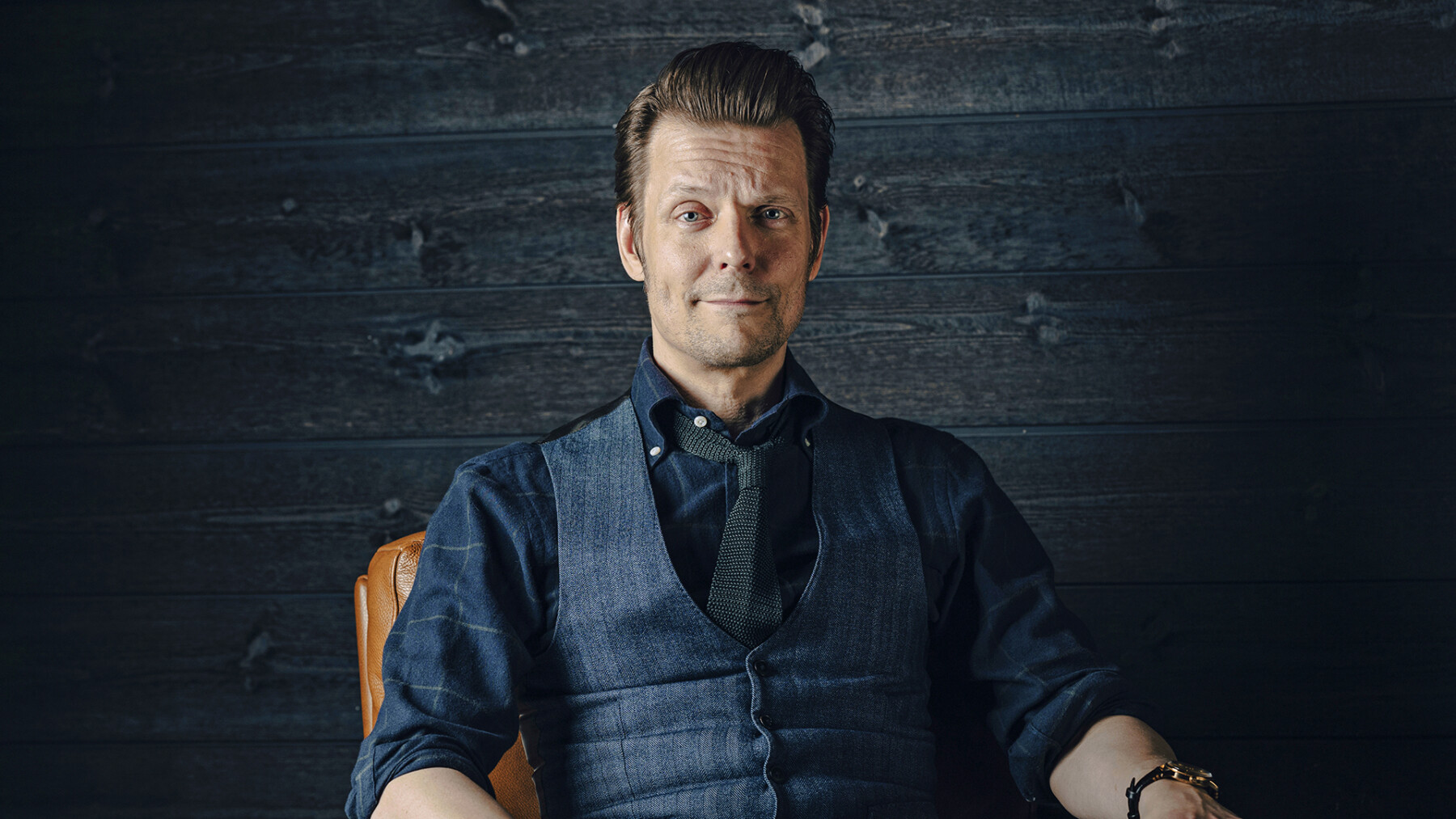
A man in a dark blue shirt and vest is sitting in a chair, looking into the camera.

When Sam Lake began his career at the turn of the millennium, the games industry was in a very different place.Photo: Remedy Entertainment

To some, the fact that video games even have stories may come as a surprise. In the space of only a few decades, games have evolved from simple tests of reflex to cinema-worthy experiences brought to life by near-photorealistic replicas of Hollywood stars.

Those who dismissed the adventures of Super Mario as child’s play in the 1980s might simply not have been paying attention to what’s been happening since.

When Lake began his career at the turn of the millennium, the games industry had barely graduated from Mario-style pixel graphics to rudimentary 3D. Back then, fully animated cutscenes and vivid storytelling were resource-intensive and hard to pull off.

“Audiovisually, video games were pretty clunky at that point in time,” he says. “We could attempt to tell complex stories, but the lack of artistic precision affected the emotional impact we could make on the player.”

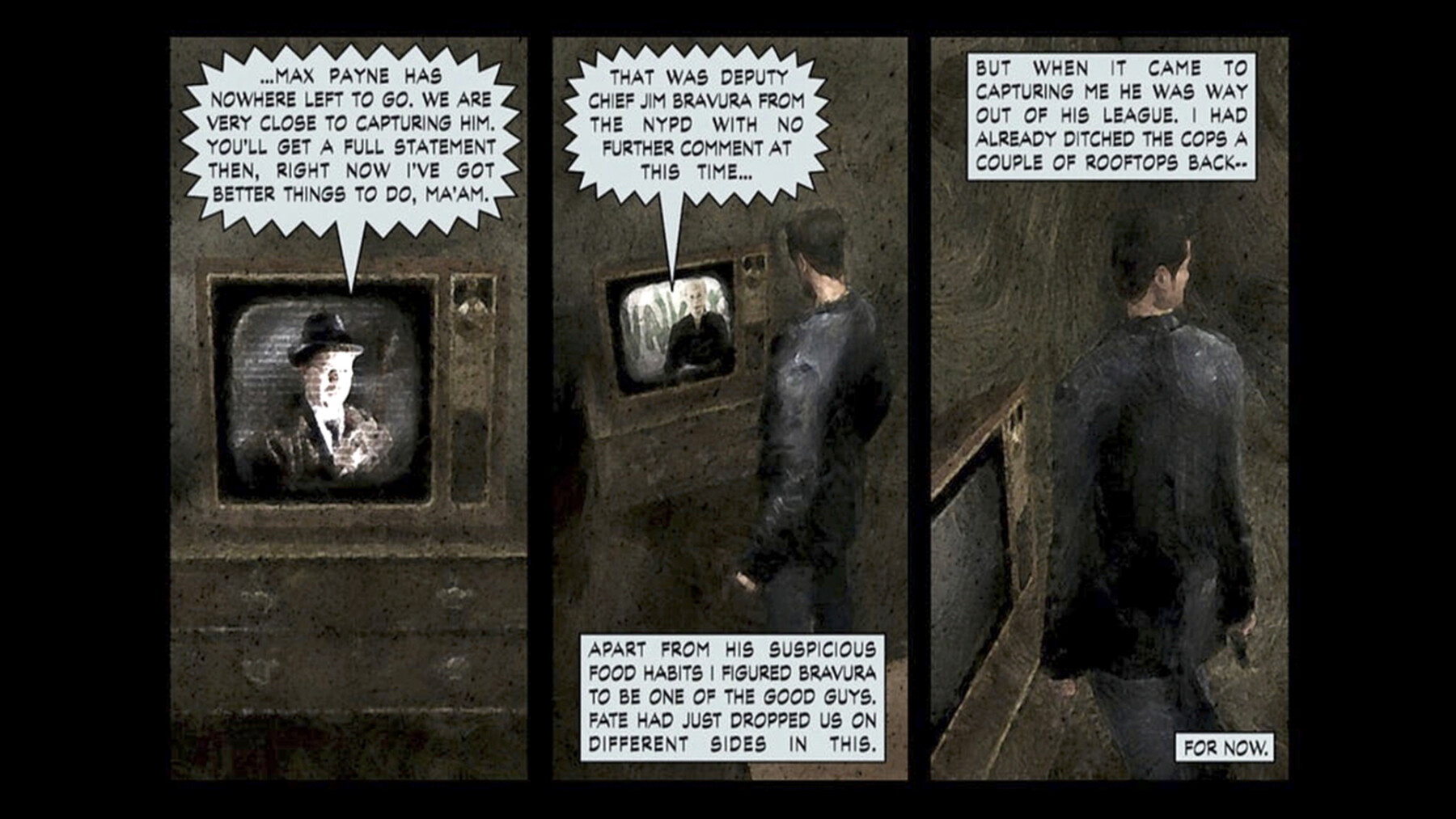
With Remedy’s first global hit, Max Payne, in 2001, Lake nevertheless wanted to find a way to weave a dark, adult tale about a detective out to avenge his dead family. In place of animation, the studio ended up using stylised comic book panels. This was one of Lake’s first forays into storytelling that deliberately oversteps the borders of different kinds of media – an approach Remedy still favours.

“I’ve always wanted to bring something new into the mix and shake up the industry a little bit. To me, that involves breaking the barriers between different forms of art,” Lake says.

High risk, high reward
A drawing with three separate panels and several speech bubbles shows a man watching TV.

This storyboard shows a scene from Max Payne, Remedy’s first global hit, released in 2001.Photo: Remedy Entertainment

The studio’s newest game, Alan Wake 2, tells the intertwining stories of the titular character, an author trapped in a dark nightmare dimension, and Saga Anderson, an FBI agent investigating odd occurrences linked to Wake’s disappearance.

On top of traditional action gameplay, it includes 90 minutes of live-action video material, songs that comment on the game’s plot, custom-made street art and photography, a choreographed musical sequence and snippets from two different novels.

“We worked really hard to bring together different forms of expression in the game. They all intertwine to create a virtual world that comments on the nature of art and how it affects reality,” Lake says.

Although technology has come a long way from the early 2000s, the undertaking still came at a cost. Released in October 2023, Alan Wake 2 is regarded as one of the most expensive cultural productions in Finnish entertainment history.

Thankfully, the game has drawn a feverish response from critics and gamers alike, with TIME magazine even naming it Game of the Year in 2023. Lake himself recently became the first Finn to ever be included in Variety magazine’s annual list of the 500 most influential people in the global entertainment industry – due in large part to his “penchant for narrative finesse.”

“The game has been received wonderfully, even by people who don’t really play games. All the way back in 2010, when the first Alan Wake came out, we heard from people whose non-gamer spouses would not let them play solo because they were so invested in the game’s story,” Lake says.

It’s all about the interaction

Telling a tale in the form of a video game is not as straightforward as simply drawing up a script and animating it. Tying a multilayered, labyrinthine narrative together with interactive gameplay mechanics is an art in itself.

“While interaction is what makes games so interesting, it is also their biggest hindrance. The hardest thing is making sure we’re telling a story that makes sense for interactivity,” says Molly Maloney, narrative designer at Remedy.

“A writer could come to me with a scene where two characters have an argument while the player watches. And that is not a game, that’s a movie! My job would be to figure out how to give the player agency,” she explains.

Maloney’s job description is still fairly new within the industry, but she sees it as a natural extension of the evolving role of storytelling in games.

“You no longer need to make the argument that story matters. We now have story modes even in football and racing games, because they allow people to roleplay.”

Games that make you cry
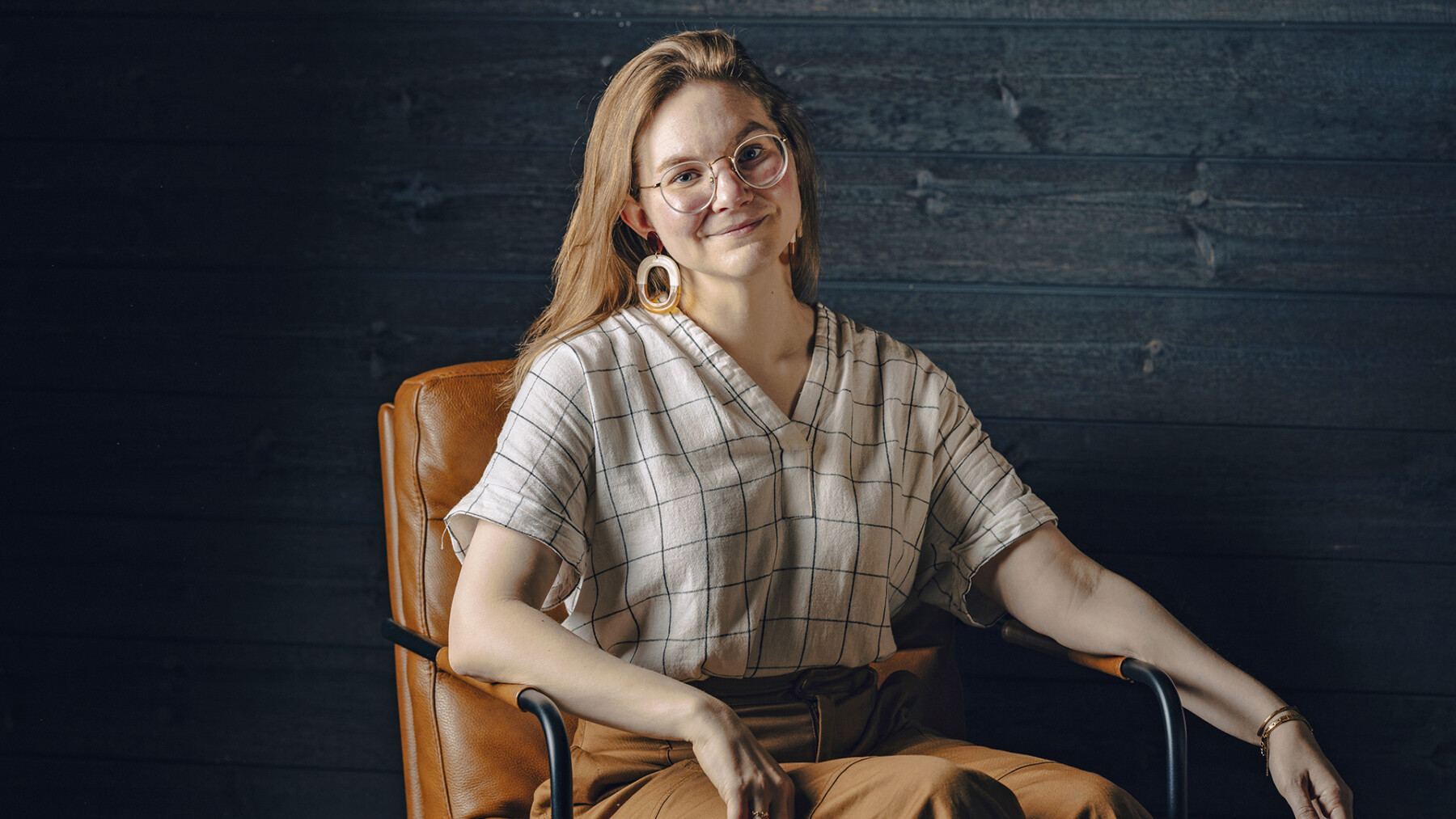
A woman with round glasses and round earrings is sitting in a chair, looking into the camera.

“One of the most exciting things about designing mysteries is that you can make some of the information hard to find,” says narrative designer Molly Maloney.Photo: Remedy Entertainment

In the early 2010s, Maloney worked at Telltale Games, an American game developer devoted solely to narrative adventure experiences. Their games were mainly based on popular entertainment licences, such as The Walking Dead and Back to the Future.

Telltale’s works were largely stripped of traditional mechanics like driving and combat, and focused instead on moral choices and character development. Through this approach, they managed to reach wide, unconventional audiences.

“They showed players that a video game could make you cry,” Maloney says.

While the player could directly affect the plot of Telltale’s games with their choices and actions, leading to different kinds of adventures and endings, many other video games tell stories that progress linearly from start to finish. That is where things get tricky for Maloney and her fellow designers.

“With a linear story like Alan Wake 2, we have to find other ways to give agency. In that case, it is all about designing the story from the ground up so it has a lot to unpack and keeps the player thinking. Mystery is a great genre for that.”

In Alan Wake 2, the player alternates between Wake’s and Anderson’s points of view, and many of the game’s mechanics are tied to these characters’ skills and strengths. As FBI agent Anderson, the player collects clues and interrogates witnesses. During Wake’s sections, the author can physically influence and shape his surroundings with his writing.

“When it comes to games, one of the most exciting things about designing mysteries is that you can make some of the information hard to find. Of course, there is a minimum viable experience that the player needs in order to not feel confused about the story, but we can reward them for exploring and investigating,” she says.

In other words, every player experiences the story slightly differently. The more effort you put into immersing yourself in the world of Alan Wake 2 – or any other video game – the more you get out of it. As Maloney puts it:

“Finding a hidden clue or catching on to information that could have just gone sailing by makes people feel special. Video games manage to do that in a way that film, television and books can’t really replicate, and that is part of what makes them so unique.”

Finland is home to over 230 game studios, including global household names such as Rovio, Supercell, RedLynx and Housemarque. They employ over 4,100 people, 30 percent of whom are foreign employees. In 2022, the Finnish gaming industry’s turnover was 3.2 billion euros.

(Source: Neogames, 2023)

By Johanna Teelahti, ThisisFINLAND Magazine, February 2025

The Finnish island where Moomin author Tove Jansson used to live still inspires artists

The islet of Klovharun lies on the outer edge of the Pellinge Archipelago, roughly 30 kilometres (19 miles) off the coast of Porvoo, a picturesque town in southern Finland.

It is similar to many other islands in the area, but for the fact that it used to serve as a summer hideaway for Tove Jansson (1914–2001), who wrote and illustrated the world-famous Moomin stories. She penned them in Swedish, one of Finland’s official languages; the first book was published in 1945.

Starting in 1964, Jansson and her life partner, graphic artist Tuulikki Pietilä (1917–2009), spent their summers on Klovharun, living in a simple cottage with no electricity or running water, enjoying the solitude and working on their art.

As they grew older, the bare-bones conditions on the island eventually became too difficult for them. They spent their last summer there in 1991, after which Jansson donated the cottage to Pellinge Hembygdsförening, a local heritage association.

The association decided to rent out the island as an artist residence during the summer months. Because of the challenging conditions, residencies last only a week. Over the years, hundreds of artists from Finland and abroad have sought inspiration on Klovharun.

The more barren, the better

Photographer Stefan Bremer and his wife, visual artist Sophia Ehrnrooth, spent a week on Klovharun in July 2013.

Like many Finns, Bremer grew up with the Moomin stories. He later read all of Tove Jansson’s books.

“On Klovharun,” says Bremer, “I appreciated the fact that while she worked in this very confined place, imagination expands the world in her books. It was a magical place.”

Bremer took plenty of photos on Klovharun. Helsinki’s Ateneum Art Museum, part of the Finnish National Gallery, exhibited a selection of them in 2014.

“I’ve always been fascinated by the archipelago – the more barren, the better,” he says. “For a photographer, it was wonderful to experience the purity of the elements out there.”

Observing the birds

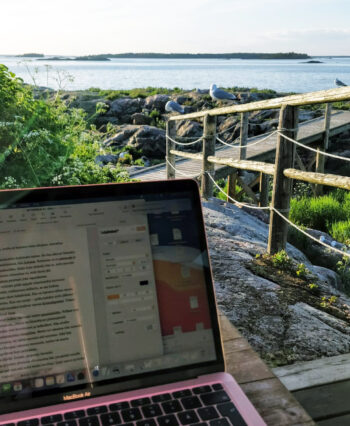
A laptop is open on a table in the foreground and a few seagulls are sitting on a railing in front of the sea in the background.

Finnish author Johanna Venho came to Klovharun to put the finishing touches on a fictional account of Tove Jansson’s last days on the island.Photo: Johanna Venho

For author Johanna Venho, Tove Jansson holds special status: In 2021, Venho published Syyskirja (Autumn Book), a fictional account of Jansson’s last days on Klovharun. The title echoes that of Jansson’s Summer Book, which is not a Moomin adventure but a volume aimed at adult readers.

Venho visited the island in June 2021 when she was finalising her novel. “I presumed that by going to Klovharun I would get to add some details and moods to the book,” she says. “However, as soon as I stepped onto the island, I realised I would still be making major changes.”

Early summer is nesting time for many birds in the archipelago. Venho felt she was an intruder among the numerous seagulls, terns and geese that had made Klovharun their home. A visit to the outhouse would mean becoming the target of threatening swoops by an angry goose.

“The seagull chicks hatched that week, and I observed them learning to walk on the rocks,” says Venho.

Ultimate freedom, outside of time

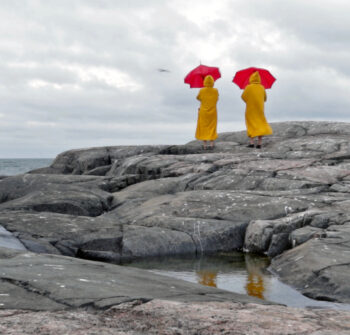
Two women in long yellow jackets are standing on a cliff holding red umbrellas and looking out at the sea.

Swedish artists Ida-Lovisa Rudolfsson and Julia Boström lived without phones or watches while on Klovharun, attaining “ultimate freedom.”Photo courtesy of the interview subjects

Swedish textile artist Ida-Lovisa Rudolfsson and multidisciplinary artist Julia Boström visited Klovharun in June 2024. They had decided that they wanted to experience “being outside of time,” as they put it.

“We turned off our phones and had no watches,” says Rudolfsson. “We worked as long as we wanted, ate when we were hungry, swam when we were warm and fell asleep when we were tired. It was ultimate freedom.”

Although the island and the cottage are very small, Rudolfsson felt that they had everything they needed.

Boström says that every evening after the sauna, she read aloud from The Summer Book, “a book that must be read every summer to remind yourself that you are really alive.”

The pleasures of the simple life

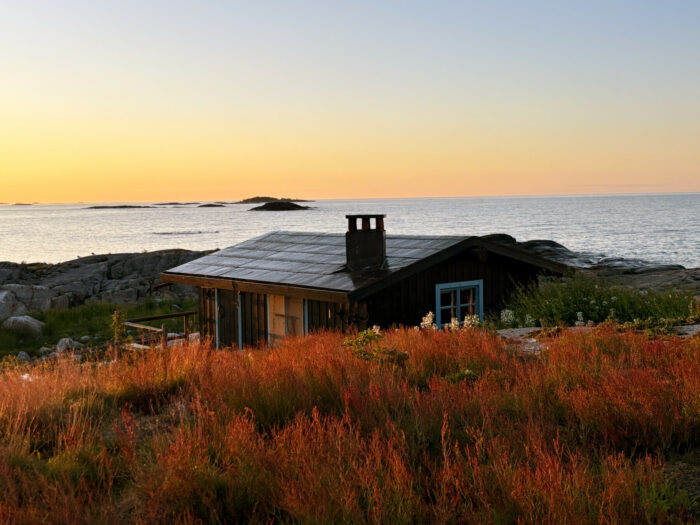
A cottage by the sea at sunrise.

Hungarian dramaturge Katalin Trencsényi filled several notebooks with insights during her stay on Klovharun.Photo: Katalin Trencsényi

Hungarian-born dramaturge Katalin Trencsényi, who lives in London, went to Klovharun in July 2024. She had become familiar with Jansson a few years earlier, when she began work as a part-time lecturer at the University of the Arts Helsinki.

“The more I learnt about Tove Jansson’s work and life, the more I felt that my values and interests were aligned with hers,” says Trencsényi. “Slowly, the discovery grew into a desire to turn this dialogue with Jansson’s work on nature into a new artwork of mine.”

Trencsényi came back from Klovharun carrying “five notebooks brimming with writings and observations.” She is now working on her first novel, titled Palimpsest on Haru, inspired by her experiences on the island.

“During my stay,” she says, “it daunted me how wastefully we live in the city, how little energy and water can be sufficient, and how much pleasure this simple way of living can provide.”

By Juha Mäkinen, February 2025

Finnish sauna offers a warm welcome for people from all walks of life

Social responsibility, inclusivity and equality are key principles that describe the Finnish sauna experience. Everyone can enjoy the relaxing, timeless tradition of the sauna.

Age, social status and background form no barriers in Finnish sauna culture, which is inscribed in Unesco’s list of Intangible Cultural Heritage. Saunas actually have a unique way of equalising and uniting people from all walks of life, as titles and professions evaporate away in the steam.