Riding the new ferry to St Petersburg

This summer a new, much-anticipated, visa-free ferry route runs between Helsinki and St Petersburg.

In addition to Helsinki’s many attractions are its maritime connections. Another was added in late April when St Peter Line started a service between the current Finnish and former Russian capitals. It represents the only regular ferry link between Russia and an EU country whose significance goes beyond mere business and tourism.

St Peter Line’s establishment was kick-started by a 2009 law which allows waterborne passengers up to 72 hours in the Russian Federation without a visa. St Petersburg has long been the number one Baltic port of call and the city authorities wish to make the most of its exotic exclusivity by cutting red tape and time-consuming visa applications.

City of the Great

Booking a return voyage (visitors must enter and exit by ship) with a passport valid for at least six months is a straightforward way for groups of at least two to sample the delights of Peter the Great’s creation. Hotel packages allow time to see more than the outsides of such splendours as the Hermitage Museum; the Church of the Saviour on Spilled Blood; and St Nicholas’s and St Isaac’s Cathedrals; and the Peter and Paul Fortress.

And no visit would be complete without seeing a world-class performance of the Mariinsky Ballet or an opera or classical concert at the Mikhailovsky Theatre or Grand Philharmonic Hall. The nearby sights of Pushkin and Peterhof are within reach for those who take the full visa-free quota.

St Petersburg also possesses modern as well as historical and cultural attractions. A daytime hike can be eased by taking a canal sightseeing tour by boat. Its nightlife continues till dawn, as befits a city of five million, with bars, clubs and discos to whet the appetite and satisfy the taste buds. Restaurants are pricey for locals, but there’s something within reach for travellers especially as the public transport system is cheap and extensive.

Return to the Baltic
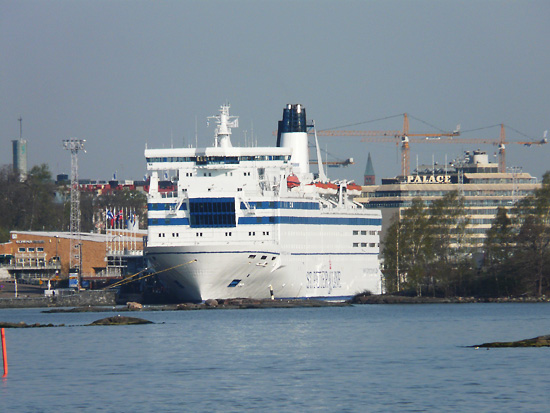
The St Peter Line ferry docked in Helsinki's South Harbour.

The St Peter Line ferry docks in Helsinki’s South Harbour, right downtown.Photo: John Pagni

Now flying the Maltese ensign, the Princess Maria (named after Denmark’s Princess Dagmar who married the future Tsar Alexander in 1866) returns to familiar waters where she started in 1981 on the Helsinki–Stockholm route, but manned by a multilingual, cosmopolitan crew. After a 2009 refurbishment, she looks shipshape, able to transport 1638 passengers in 606 cabins ranging from small to spacious, and nearly 400 vehicles. Her dimensions allow her to comfortably navigate the tricky fairway in and out of St Petersburg’s huge harbour area. Prices range from 51 to1190 euros depending on the season and accommodation.

The vessel makes a daily overnight crossing with evening departures and morning arrivals. The inward or outbound Russian section should interest tourists and photographers, while the voyage to St Petersburg gives a taste of things Russian for newcomers. Menus and drinks lists contain Western and Russian favourites but the substantial live entertainment all derives from the east with violinists, opera, dancers, jazz and folk groups.

It shouldn’t be all one-way traffic either, as St Peter Line believes Russians will grasp the chance to come west. Official help is two-way, too: Russians obtaining a visa to enter Finland can visit, for up to three months, the countries in the Schengen Area, of which Finland is a member.

By John Pagni, June 2010
First lady aims for a global summit

Carina Räihä is alive and well and back in Finland after enduring every imaginable discomfort as she became the first Finnish woman to scale Mount Everest and stand on top of the world, reaching the summit on May 17, 2010. We talked with her just days before she started her quest.

“I think people like me have an extra gene that makes us want to do things that don’t make sense. It doesn’t matter how terrible it is while you’re doing it, you go back for more.”

Carina Räihä is sitting in a café in a shopping mall in an Espoo suburb. Kids are running around screaming nearby; teenagers are munching on burgers. Nothing could feel further from Räihä’s intended goal, the thing that “doesn’t make sense”: to be the first Finnish woman to stand on the peak of Mount Everest, the world’s highest mountain.

Less than two years ago, Carina, who holds a masters degree in economics, was working in a Helsinki city office, absorbing the pressures of the financial world. Most of us only gaze out of the window and dream of leaving the nine-to-five world behind. In Carina’s case, she decided, at the age of 42, to take the biggest challenge of her life.

Kind of insane

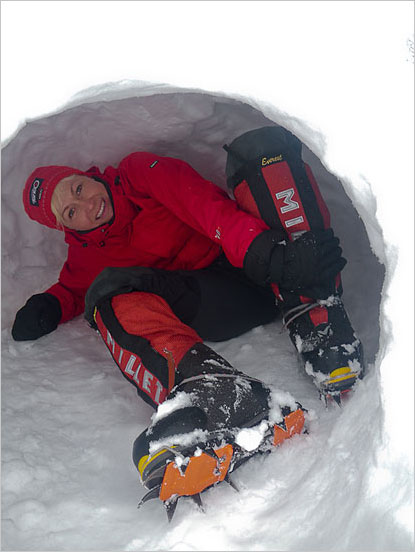
"It's a natural feeling to want to see the top of a mountain, to see what's on the other side," says mountaineer Carina Räihä.

“It’s a natural feeling to want to see the top of a mountain, to see what’s on the other side,” says mountaineer Carina Räihä.© Carina Räihä

“I wanted a change in my life, to do something I really loved,” she says. “In December 2008 I left my job. The idea of climbing Everest came to me last summer. I was at the summer house, enjoying an easy life, walking in the woods, and I could have done anything. But I decided the time was right to fulfil my dream. I thought I might never get another chance.”

Mountaineering is something of a minority pursuit, and in a relatively mountain-free country like Finland, it’s especially hard to find an organisation that coaches the activity. Finland boasts one male “celebrity mountaineer” in the form of Veikka Gustafsson who in 1993 became the first Finn to reach the summit of Everest and whom Räihä mentions often as an inspirational figure. In terms of female mountaineering, she herself is setting the pace.

“Only perhaps 10 percent of the total number of mountain climbers in Finland are women, and I know just about all of them,” she says. “There are only a few of us who are crazy enough to do this. It is kind of insane to spend so much money, time and effort to simply climb a mountain and come back. It’s not even as if it’s nice.”

Miserable, dangerous and expensive

“It’s miserable, it’s dangerous and it’s very expensive,” says Räihä. “But there is something about mountains that is powerfully attractive. It’s a natural feeling to want to see the top, to see what’s on the other side. But for Everest, you need to be mentally and physically fit. In fact, some say it’s more important to be mentally strong. You have to be able to make decisions on your own and accept being in a dangerous place alone.”

Part of her physical and endurance training has taken the form of stomping up and down through the deep snow on an artificial hill in Malminkartano, a suburb of Helsinki. Ascending a mere 90 metres in 400 steps may not sound like much when compared with the 8,000-plus metres of Everest, but it’s a tough enough test when you’ve got a 20- to 30-kilo backpack to carry.

“I don’t mind about the weather,” she says. “I’ll train in any conditions, preparing mentally for the miserable times, because there will be plenty of those.” A yoga and meditation regime also contributes to the preparations.

Look fear in the face

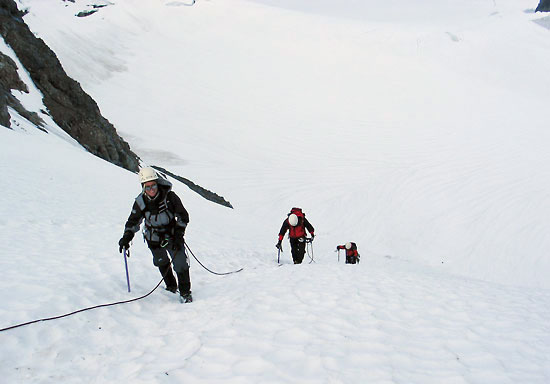
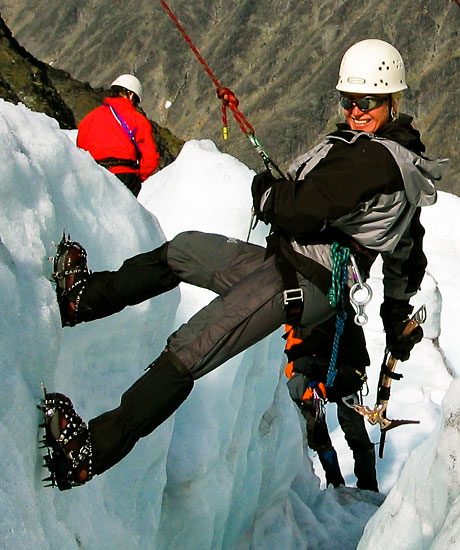
Toughing it out: Räihä’s pre-Everest training covers an array of possible situations.

Toughing it out: Räihä’s pre-Everest training covers an array of possible situations.Photo: Hanna Saari

For those of us who get dizzy just thinking of climbing out to clear snow off the roof, the idea of hanging from a sheer rock face seven or eight kilometres above sea level is enough to make us faint. You’d think a head for heights is the minimum requirement for an Everest attempt. Apparently not:

“I started climbing originally because I did not have a head for heights,” she says. “It is still a challenge. I am still afraid of heights. I think you have to be – it’s natural.

“This is one of the reasons I want to do it, and how I get something out of it – to look fear in the face. I think it’s something you can get used to. I tell myself to think logically, to concentrate on what I am doing, and then I can manage. It’s dangerous if the fear takes you over. But in a way I live for those feelings.”

Takes ten weeks to tango

The January 2010 ascent of Mount Aconcagua on the border of Chile and Argentina – the highest peak outside of Asia at 6,962 metres – was Carina’s first climb to more than 6,000 metres, an important psychological milestone. She set off for the Everest Base Camp from Kathmandu in Nepal at the end of March.

One foot in front of the other: Carina Räihä tells us you need to be mentally and physically strong to make it to the top.

One foot in front of the other: Carina Räihä tells us you need to be mentally and physically strong to make it to the top.© Carina Räihä

The week-long trek to the base camp and preliminary climbs on sections of the route to the summit helped to adapt to the altitude before the main assault on the summit, which she reached on May 17. The whole expedition – officially called Tango Expedition 2010 in reference to Carina’s main sponsors, and organised by a Canadian outfit called Peak Freaks – took some ten weeks from start to finish.

Climbers may endure winds of up to 40 metres a second and temperatures as low as minus 40. The lack of oxygen adds to the difficulty in sleeping after daily climbs of eight or nine hours. Continuous nausea removes appetite, while the purified water tastes unpleasant.

There and back again

The spell in the chillingly titled “Death Zone” above 8,000 metres can only last for a maximum of two days – it’s too dangerous to spend any longer there.

“It has been through my mind how I will feel when I reach the summit,” Räihä muses. “When I reached the top of Aconcagua I felt tired and awful. It was only when I got back to the camp that I felt like I’d really done something. As for Everest, this is something I have always dreamed of, and I’m sure there will be some tears.

“But that’s only half way. Most people who have died on Everest die on the way back. They relax too much – that’s when the accidents happen. But I am not afraid of dying. If it happens – and it won’t – it will be pursuing something I love.”
 

By Tim Bird, March 2010

In search of Finland’s longest word

What’s the longest word in the Finnish language? When I wanted a definitive answer to this question, I decided to go about it the old-fashioned way: email.

I directed my inquiry to a forum full of people who, by definition, must be proud to call themselves language nerds: the mailing list of translators at the Finnish government ministries. Some of them implied by their silence that they thought I was wasting their time, but responses began to trickle in.

Linguistic logistics

However, before we get to that, I should explain, very briefly, how Finnish works. It’s a language where it’s easy to make compound words by smashing smaller words together until they stick to each other, forming one larger word. Add maahan, “into the country,” to muutto, “move,” and you get maahanmuutto, “immigration.” Put  virasto, “authority,” on the end of that and you get Maahanmuuttovirasto, which is what they call the Immigration Service.

You can also add a great number of word endings – this is a point of contention because some people say it doesn’t count for purposes of finding the longest word. Most English prepositions (on, at, to, for) are expressed in Finnish by sticking suffixes onto a word. Then you have additional suffixes that mean “also,” “neither,” “my” or “your,” or that symbolise a question. And that’s just the tip of the iceberg. Really.

Happily ever after

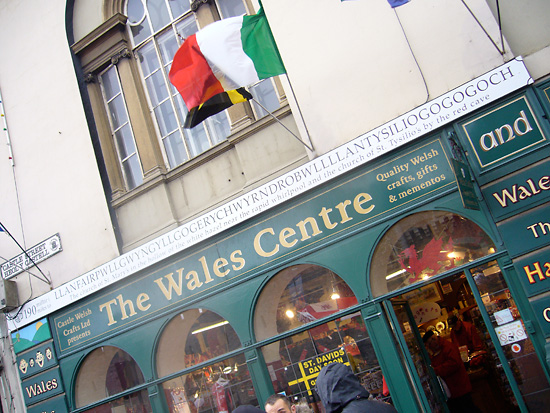
The facade of a souvenir shop in Wales, with the longest place name in Europe written above the shop.

With words like “Llanfairpwllgwyngyllgogerychwyrndrobwllllantysiliogogogoch,” visible above this Welsh shop entrance (it’s the name of a village, and the longest place name in Europe), it’s likely that Wales is the one nation that will never be impressed by this article.Photo: Peter Marten

Back to the email: One of the first words to drop into my inbox is apteekkitavaraintarkastuslaitos, meaning “pharmacy product inspection office.” Not bad at 31 letters, but I have a feeling that we haven’t heard the end of this, and I’m right.

Next up is epäjärjestelmäl­lisyydes­täänköhän (32 letters), approximately “from its unsystematic nature?” Yes, the question mark is part of the translation, reflecting one of the endings, -kö. Some people would claim that this word doesn’t count.

To make a multisyllabic story short, the quest continues, and we finally arrive at the following 61-character creation, widely accepted as the longest Finnish word (drum roll, please): lento­kone­suihku­turbiini­moottori­apu­mekaanikko­ali­upseeri­oppilas.

Dear reader, I would love to leave it at that, allowing you to imagine that it means something glorious, artistic and divine relating to famous glass vases on lakeview windowsills in ascetic Northern architecture, but I suppose I’d better take a stab at translating this one, too.

It refers to someone who is an “aeroplane jet turbine motor assistant mechanic, non-commissioned officer, in training.” And that was the length of that story, as they say in Finnish – meaning, of course, “And they lived happily ever after.”

By Peter Marten, first published quite a long time ago, updated March 2024

Working in Finland

How to find a job

See also

Moomin Characters Ltd keeps a national treasure in the family

Sophia Jansson, niece of Moomin creator Tove Jansson, oversees Moomin Characters Ltd, a company that has a hand in thousands of products worldwide but sells only one thing: Moomin rights.

[Editor’s note: This article was originally published in 2010.]

Moomin Characters Ltd grew up more or less organically alongside the Moomin books and comic strips that Tove Jansson (1914–2001) penned starting in 1945 with the publication of The Moomins and the Great Flood (Schildts). As the Moomins caught on, product manufacturers came looking to tie in and cash in.

“In the 1950s my aunt was advised to set up some sort of company,” says Tove’s niece Sophia Jansson, creative director and chairman of the board at Moomin Characters. “She realised she didn’t want to be handling certain things because she wanted to dedicate herself to writing and painting.”

At the time of writing, in 2010, as the Moomins celebrate the 65th anniversary of their first book, “how we conduct business is the same,” Jansson says. Just five people work for the company, but its commercial agent and the three Moomin Shops employ dozens more.

Moomin Characters doesn’t own any factories, but it influences what is produced and benefits from the sales. “We’re selling rights, not producing goods,” Jansson notes. So the Moomins – or the Janssons, actually – were outsourcing long before high-paid business consultants started using that term.

Close to their hearts

2391-sjansson2_b-jpg

Tove Jansson’s niece, Sophia, deals with Moomin commercial rights as chairman of the board at Moomin Characters.Photo: Erja Sandell/Moomin Characters

The Moomin stories and characters, while universally popular, are especially close to the hearts of readers in Finland. The Moomins amount to semiofficial national symbols, appearing on Finnish design items from Finlayson bedsheets to the Iittala Group’s Arabia-brand mugs.

Outside of Scandinavia, the Moomins’ largest fan bases are in Japan and the UK. Jansson points out that despite the characters’ special place in readers’ hearts, Moomin rights form a commercial venture – though room also exists for “exhibitions or activities on a nonprofit basis.” More than 200 companies, about 100 of them in Finland, are licensed to use the Moomin name and images for approved products.

Jansson came to Moomin Characters back in 1997. “I needed a job,” she says. “My father [the late Lars Jansson, Tove’s brother] said, ‘Why don’t you come and work for the Moomin firm?’

“In the beginning I was his assistant. When he was ill I took on more, and when he passed on [in June 2000] I became art director.” The following year Tove passed away, and a few years later the managing director retired. Sophia acted as art director and managing director until Roleff Kråkström joined her as managing director in 2008.

Inherently sustainable

2391-sjansson3_b-jpg

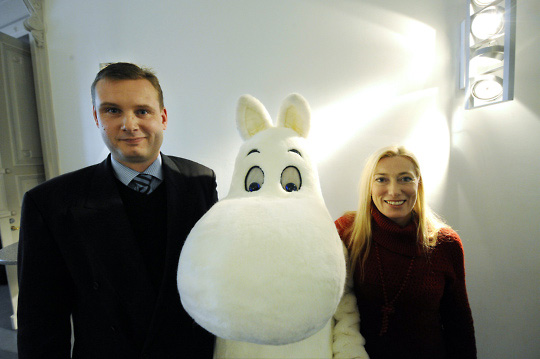
Moomin Characters managing director Roleff Kråkström (left) and chairman of the board Sophia Jansson spend quality time with their all-time top sales rep, Moomintroll.Photo: Timo Jaakonaho/Lehtikuva

Moomin Characters Ltd approves each product and its artwork individually during planning and prototype phases. “That process has tightened up a great deal over the past decade,” says Jansson. “I enjoy the fact that more and more licensees are using Tove’s original artwork, because I think her drawings are excellent, unique and wonderful,” she says. With businesses lining up for permission, how do she and her colleagues determine what’s appropriate? “In the beginning my aunt decided what was a viable Moomin product, then my dad. In general I think our values and guidelines haven’t really changed.

“You don’t use Moomin in politics, or in connection with violence. You’d like to develop Moomin products as some sort of extension of what the Moomins represent in general, their philosophy.”

Classic status

The Moomins experienced a boom period in the 1990s. “In the early ’90s, the general interest was based on the animated TV series,” says Jansson. “The vast majority saw them as a character for the family’s youngest members.

“Because of the renewed popularity of the Moomins, people also rediscovered the original books and artwork. With the demise of my aunt in June 2001, people got interested in her as an artist and in the original works, as so often happens. That meant a shift in what licensing looked like and what companies were interested in doing with their products.

“From the Moomins being perceived as characters for small children, I think today the largest target group is adults. Iittala sells vast numbers of Moomin mugs, and kids don’t have that kind of pocket money.”

The Moomins have attained classic status: “They’re by no means a boom phenomenon – they’re steady sellers. We enjoy the benefits of Moomins having been around for 65 years.”

For all the talk of grown-up Moomin fans, Puffin Books is releasing a series of boardbooks for very young readers. “They’ve been quite successful selling to publishers around the world,” says Jansson. “Moomin Characters will be looking outside the Nordic countries to see how this takes off.”

New directions

2391-sjansson4_b-jpg

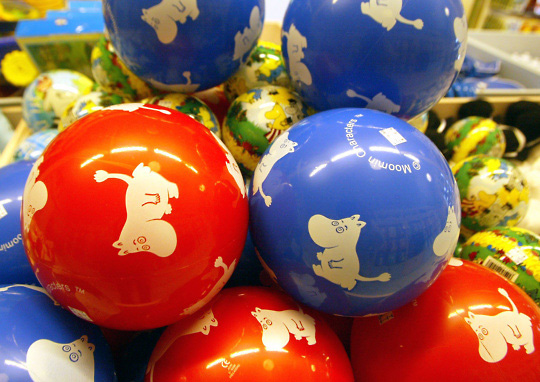
A large variety of Moomin toys exists, but the Moomins also appear on everything from T-shirts and baby bottles to design items such as tableware and bedsheets.Photo: Jussi Nukari/Lehtikuva

“Puffin has aroused interest on markets where the Moomins have been dormant for years,” says Jansson. “Generally for a character to be successful anywhere in the world, it needs a TV programme or a film. We don’t have a new TV show or really new film now, but we have this publishing programme, and we’ll just see where it takes us.”

The Puffin books form part of the Moomins’ 65th-anniversary celebrations, as do various other campaigns. Iittala is selling a special-edition Moomin mug and donating a portion of the profits to a WWF campaign for cleaner oceans.

Jansson hopes that the total donation to the WWF from Iittala and other partners will top half a million euros. On another level – one that requires no money and is open to children all over the Nordic countries – an online Moomin contest with an ocean theme encourages kids to see the world the old-fashioned way: by drawing.

“For Tove, drawing was one of the most important things in life,” notes Jansson. “Today kids are not urged to draw as much. We want to encourage enthusiasm for drawing.”

The drawing contest and campaign products show that “it’s not all about making money,” says Jansson. “It’s about giving something back to Moomin fans and others, for instance by helping take care of our oceans or getting people to discover the joy of drawing.”

By Peter Marten, April 2010

Blogging by and for entrepreneurs

With its coverage of Nordic and Baltic growth entrepreneurship, the blog ArcticStartup has become required reading for investors, entrepreneurs and technology journalists across the globe.

After graduating from the London School of Economics, Ville Vesterinen moved to Amsterdam to work for a global IT solutions provider. But, quickly realising that working for a large corporation did not chime with his entrepreneurial streak, he resigned in 2007 and returned to his native Finland to help his friends set up a company publishing city guides across Europe.

“When I came back to Helsinki, I started asking around to find out where the local entrepreneurs convened,” Vesterinen says. “But noticing a clear lack of events and forums, I thought I might as well set up one myself.”

He had read about OpenCoffee and thought it might be just what Finland needed. OpenCoffees, first introduced by British venture capitalist Saul Klein, are informal events – or “meetups” – in which entrepreneurs, web developers and investors meet each other to chat and network. Vesterinen organised the first Helsinki OpenCoffee Meetup in September 2007.

Before long, he was approached by Antti Vilpponen and Miikka Kukkosuo, two entrepreneurially oriented web professionals who had just kicked off ArcticStartup, a blog covering the Finnish start-up scene. “We started talking and quickly realised we all shared the same passion for promoting growth entrepreneurship and start-up culture,” Vesterinen recalls. The three men decided to combine forces, Vesterinen joining ArcticStartup as editor.

At that point, all three had day jobs – Vesterinen in advertising, Vilpponen in internet consulting and Kukkosuo in online gaming. To ensure ArcticStartup received the attention it required, they also took onboard a fourth partner, Karri Saarinen.

Events and accolades

From the beginning, the quartet realised that to truly promote entrepreneurial culture, writing about start-ups had to be complemented with OpenCoffee-style networking events, and so ArticEvenings were born. Besides informal chatting, the concept includes panel discussions featuring experienced entrepreneurs, investors and other members of the start-up ecosystem.

They also decided that instead of just Finland, ArcticStartup should focus on all the Nordic and Baltic countries. Says Vesterinen, “We soon realised that although all countries did have their own start-up communities, there was very little interaction between them. Our aim is to bring like-minded people together in the entire region.” In addition to Helsinki, ArcticEvenings have since been held in Stockholm, Copenhagen, Reykjavik and Tallinn.

On the journalistic side, ArcticStartup has become a must-read for anyone wanting to stay up to date with Northern European growth entrepreneurship. The website now attracts 30,000 visitors a month, among them venture capitalists from across Europe and the US looking for companies to invest in. It’s not uncommon for a start-up to be approached by several interested investors after being covered by ArcticStartup.

According to Christina Forsgård, founder of Finnish technology PR firm Netprofile, “ArcticStartup attracts readers across the globe because the writers are entrepreneurs themselves, so they have first-hand experience of what they are writing about. The website covers cutting-edge technology companies in a way that is highly appealing to international investors, partners and clients. In many ways, they are already doing what others are still only talking about.”

In March 2010, ArcticStartup received an award from the Finnish Society for Innovation Journalism for its reporting on Finnish start-ups.

Start-ups rock

The founding of ArcticStartup has coincided with, and in part contributed to, a general trend of increased interest towards entrepreneurship in Finland, especially among young people. According to a recent survey by the research firm Taloustutkimus, 60 percent of Finns under 24 consider entrepreneurship as a viable career option after graduation – a marked improvement from previous years.

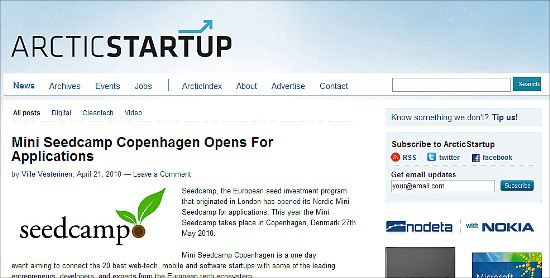
ArcticStartup focuses not only on Finland, but on all the Nordic and Baltic countries.

ArcticStartup focuses not only on Finland, but on all the Nordic and Baltic countries.

“Starting your own company has become cool in the same way starting a rock band was in my youth,” says Vesterinen.

He nevertheless finds things Finland can improve on. Firstly, the presence of angel investors and venture capitalists is currently too limited. “But luckily the situation is getting better all the time. I have high hopes especially for the government-backed Vigo programme aimed boosting the Finnish venture capital industry.”

Secondly, Finland lacks what Vesterinen calls “start-up universities” – consumer-oriented internet start-ups that have grown rapidly into successful companies. “In Silicon Valley, for example, many of the new entrepreneurs started their careers in firms such as Google or Yahoo. Working for a few years in such an environment provides you with skills impossible to attain at any educational institution.”

Next stop: more entrepreneurship

One recent milestone for ArcticStartup has been the Finnish mainstream media starting to cite the blog as a source for breaking start-up news. So far this has happened only a few times, but given that the writers are better connected to the start-up community than any reporter from a traditional outlet, the trend is likely to continue.

ArcticStartup does not aim to become a mass publication,” Vesterinen says. “Given that we focus solely on providing news and analysis for the start-up community, our readership will probably not grow dramatically from the current numbers.” Instead, the company is constantly looking for new ways to promote entrepreneurship: “We have been consulting other start-ups for a while now in product strategy, public relations and marketing. We are also developing our own software products for small companies.”

As for Vesterinen himself, he remains constantly on the lookout for new and exciting things. Covering the Nordic and Baltic start-up sector as the editor of ArcticStartup naturally remains a top priority, but he wouldn’t be an entrepreneur unless he had “a few new start-up ideas brewing.”
 

By Otto Utti, April 2010

Religion lessons support kids’ identities

Finnish children attend the same schools and classes regardless of their family’s background, wealth or culture. However, for one subject a week children are divided into groups: religion.

How can you teach religion in school when children come from increasingly diverse homes? Should society be responsible for providing children with instruction in religion? How can you guarantee fairness, equality and level of instruction?

These questions are being discussed in Finland and all over Europe. Just a few decades ago, nearly all Finns were members of the Finnish Evangelical Lutheran Church, but a significant minority of today’s pupils are non-religious or belong to another religion. At the same time, the state’s relationship with the Evangelical Lutheran Church and, representing the traditional minority, the Finnish Orthodox Church, has dissolved and society has become secularised.

The relationship between education and religion incites strong feelings. When Finland’s Freedom of Religion Act was amended in 2003, the legislative process included extensive debate regarding teaching religion in school. Those holding fast to traditional values demanded the preservation of denominational religious instruction, whereas more radical elements felt that religious instruction should be eliminated altogether. The compromise resulted in the concept instruction in one’s own religion, which strives to guarantee the rights of minorities and to ensure that the child receives an education in accordance with their family’s convictions. Non-religious pupils study a subject called Life Perspective Studies, which includes ethics, worldview studies and comparative religion.

The Finnish compromise stems from the fact that teaching is not denominational, but rather respects the child’s personal background. Religion as a mandatory subject is still considered necessary, because it supports development of the child’s own identity and worldview, which also establishes a foundation for an intercultural dialogue. Because Finland has been homogeneously Evangelical Lutheran since the Reformation, it would be difficult to understand the country’s society and culture without knowing the history and thinking of the Lutheran Church.

Minority religion also taught in small groups

4219-religschool2_b-jpg

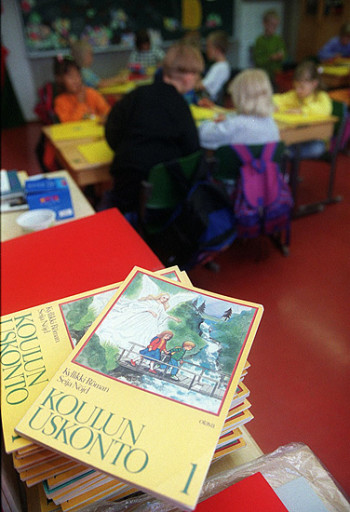
Religion textbooks such as these help children understand the cultural and human significance of religions.Photo: Sari Gustafsson/Lehtikuva

Religion is taught in comprehensive schools and upper secondary schools for one to two hours a week by the school’s own teachers or experts hired on a temporary basis. Minority-religion study groups are offered if there are at least three pupils of the same denomination in the school. Curricula for different religions are created jointly by religious communities and educational authorities. The Finnish educational establishment sets high qualification standards for teachers, and finding qualified teachers for minority religions has proven challenging.

The goal of a religious curriculum is to familiarise kids with their own religion and the Finnish traditions of belief, acquaint students with other religions and help them understand the cultural and human significance of religions. A key part of religious instruction is dealing with ethical issues in way that is appropriate to children.

In an average class approximately 94 percent of the pupils study Lutheran religion, 3 percent Life Perspective Studies and the remainder are divided into minority religions, such as Orthodox and Catholic study groups. In recent years schools in larger population centres have seen the advent of Islam study groups catering to children from immigrant backgrounds.

Sharing neighbours’ celebrations

4219-religschool3_b-jpg

In the Finnish system, teaching is not denominational, but rather respects the child’s personal background.Photo: Jussi Nukari/Lehtikuva

Even though studies show that both parents and teachers are primarily satisfied with religious instruction in schools, discussion on the matter is far from over. One challenge that has risen is how to initiate interaction between children representing different religions. When the same ethical issues are discussed in all religious curricula, is it possible for children to study them together?

Schools address the meeting of religions and traditions in celebrations held throughout the school year. How do children who do not celebrate Christmas at home participate in Christmas festivities? Do all pupils sing the traditional Finnish hymn at the school-leaving ceremony?

Bolder steps are taken in multicultural schools, where representatives of different religions hold traditional celebrations and invite everyone to attend. Sharing in the universal joy of celebration and learning about others’ traditions with an open mind poses no threat to any faith.
 

By Salla Korpela, April 2010

Presenting our whirlwind tour of Finland

We offer presentations about Finland’s people, geography, arts, design, economy, government and history – not forgetting sauna and Santa Claus.

[Editor’s note: Our presentations have been updated and the range of topics expanded. You’ll find them and numerous other resources for telling Finland’s story on the Finland Toolbox website.]

By ThisisFINLAND staff