Nature in Finland

Finland is by nature such a complex and diverse country that it is not easy to describe in a single word – except perhaps “contrast”.

A world of wild contrasts

The most obvious contrast is between the annual seasons. The same lake where people come to swim and sail in summer forms a perfect skating rink or skiing arena in the winter. Warm, light summer nights gradually lengthen, until the snow settles and the late dawn merges colourfully into the early sunset during the midwinter season known to Finns as kaamos.

The country’s population is concentrated in the south, especially around the Helsinki region, which is home to about a million people. At the other end of the country lie the vast unpopulated forests and fells of arctic Lapland.

But the scenery also changes on a smaller scale. Water is never far away. Dense forests always await somehwhere nearby. And there is also sure to be open bog or farmland within easy reach. All of these landscapes are part of Finland’s varied natural scene.

A snowy landscape with two skiing people.

In midwinter most of Finland is usually covered by snow and ice. In February, the coldest month, average temperatures are around -7ºC in the south and -13ºC in the north. Photo: Finnish Tourist Board (FTB)

A northern land

Two people swimming in a lake with snorkels.

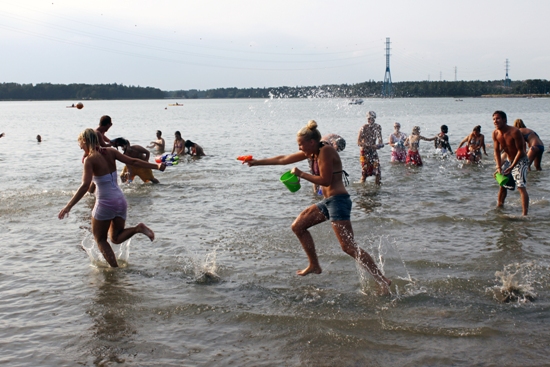
In Southern and Central Finland the summers are warm enough for people to bathe in lakes and also often along the shores of the Baltic Sea.Photo: Plugi/Petri Jauhiainen

Finland is so far north that it lies on the same latitudes as Alaska or Central Siberia. About a quarter of the country is north of the Arctic Circle.

Considering this location, you might think that the country consists of cold arctic landscapes roamed by polar bears. But the truth is fortunately quite different. The ocean current known as the North Atlantic Drift brings so much warmth to Finland that average temperatures in the south are around +5°C, and even up north they are only a couple of degrees below zero.

The winters are nevertheless so cold that every single lake freezes over during the coldest months. The coastal waters of the Baltic Sea also typically freeze over, and snow covers the ground for several months.

But on summer days, temperatures can rise up to 25 or even 30°C. The growing season for plants is still comparatively short, however, averaging just 3–4 months.

Over the ages, nature has adapted to Finland’s pronounced seasonal swings. Most of the country’s plants and animals lie dormant through the winter months, and three-quarters of bird species are migratory.

On the world map Finland also lies between east and west, and the climate combines continental influences from the east, and maritime influences from the Atlantic to the west.

This factor is also evident in Finland’s flora and fauna. Finland is home to species associated with the taiga of continental Eurasia, such as Ural owls and Labrador tea, as well as maritime species including many waders and water birds.

Varied landscapes

An aerial image showing fields, forest and a lake in the background.

Key elements in Finland’s varied landscapes include forests and open waters, often in a scenic interplay.Photo: Plugi/Janne Eloranta

During the last ice age Finland was completely covered by a thick continental ice sheet. This slowly moving mass of ice wore down the rocks and cliffs, and carved out lake basins. Meltwater rivers inside the ice deposited long ridges of sand and gravel which now stand above the surrounding landscape as eskers – the longest of which extend for tens of kilometres.

Eskers are not very high, seldom rising more than a hundred metres. Finland’s landscapes generally do not feature massive elements such as high mountains, steep sea cliffs or wide rivers. The scenery tends to be gentler, featuring subtle variety on a smaller scale.

The relief becomes higher heading eastwards and northwards. The greatest differences in altitude are in Lapland, where many fell-tops rise above the tree line.

Soils are generally thin, with an average depth to the bedrock of just seven metres, because of glacial erosion. The archaic mainly granitic bedrock is visible in many places as rounded and smoothed down rocky outcrops.

Because of the poor soils and the short growing season conditions for farming are not very favourable. By European standards the country is sparsely settled, with an average population density just a tenth of levels in Germany, Britain or Italy.

Forests and bogs

Duckboards in a wetland.

Successive ice ages and the cold climate have led to the formation of a wide range of peatland and wetland habitats around Finland.Photo: Plugi/Tuomas Heinonen

Finland is Europe’s most forested country. About 70% of the land is covered with trees. Most forests are coniferous, as the country lies at the western edge of the coniferous taiga forest zone that stretched off eastwards through Russia and Siberia.

Forests are still natural in the sense that hardly any non-native trees have been planted. The dominant trees are Scots pine, Norway spruce and birches, though forests are also dotted with aspens, alders and rowans.

A big anthill under a tree.

Impressive anthills are a common sight in Finland’s vast coniferous forests.Photo: Plugi/Toni Pihkanen

A growing cloudberry.

Cloudberries grow widely in the bogs of Central and Northern Finland.Photo: FTB/Pekka Luukkola

A grouse in the snow.

Four kinds of grouse can be found in Finland’s forests and bogs: capercaillie (pictured), black grouse, hazel grouse and willow grouse. A fifth grouse – the ptarmigan – lives on Lapland’s open fells.Photo: FTB

Even though they feature few tree species, forest habitats can very greatly. Over a small area spruce thickets may alternate with sunlit pinewoods, marshy hollows and open bedrock.

Many forests are so damp and their soils are so peaty that they can be described as mires. Different kinds of mires cover about a third of Finland. About a sixth of this area consists of treeless bogs. About half of Finland’s mires have at some time been drained to improve timber production.

Forests and bogs are mainly owned by local farming families, who manage their forests and harvest timber according to fairly strict rules governing forestry practices. Finland does not have monotonous regimented forest plantations of a single tree species. Many foreign visitors mistakenly assume that Finland’s forests are completely natural, but the reality is that they have been continuously exploited in many ways for centuries.

About 8% of the country’s forests are protected. Most of the larger protected areas are in the north.

Water, water everywhere

A clear lake reflecting the cumulus clouds above.

All regions of Finland have lakes, but the true Lake District is in the east, where in many areas water covers more than a third of the land.Photo: Visit Finland/Terhi Ylimäinen

Finland is reputed to be the Land of a Thousand Lakes, but in fact the country has tens of thousands of lakes. Most of these lakes are small and shallow. Lakes have an average depth of about seven metres.

Even in the largest lakes, like Saimaa in the southeast, open waters are broken up by many islands and peninsulas. It’s not always easy to say where one lake ends and another begins.

The same is true of Finland’s intricate coastline, which features around 95,000 sea islands, most of which are small rocky skerries. Sailors say that the waters of the labyrinthine Southwestern Archipelago are some of the most navigationally challenging anywhere in the world.

The total length of the coastline has been measured at 40,000 kilometres, including the shores of islands. The lakeshores are even longer – totalling about 130,000 kilometres. This means that the country has approximately 32 metres of shoreline for every inhabitant. People are used to having open water always somewhere nearby.

This abundance of water is also good for birds. In the summertime huge numbers of wetland and water birds breed in Finland, including many duck and wader species, and huge cranes.

And of course wherever there’s water, there are also fish. Finland has 61 native fish species, mostly freshwater fish. One unusual feature is that many lake fish can also thrive in the coastal waters of the Baltic Sea, where salinity levels are low.

The arctic wilds of Lapland

A forested fell next to a lake.

Lapland’s arctic fells have gently rolling profiles.Photo: Hannu Vallas

Even by Finnish standards, the country’s northernmost province, Lapland, is sparsely settled. Lapland accounts for about 28% of Finland’s total area, but only 4% of the population.

Lapland’s natural features include vast areas of wild forest, open fells, flora and fauna adapted to the harsh arctic conditions, and greater variations in relief than anywhere else in the country. Seasonal variations are also even more pronounced here. The deep snows and darkness of midwinter contrast dramatically with the light, mild summers of the Land of the Midnight Sun.

Siberian jays in a snowy tree.

Inquisitive Siberian jays invariably appear whenever hikers stop for a picnic in Lapland.Photo: Plugi/Peter Forsgård

Two reindeer eating from a snowy ground.

Semi-domesticated reindeer roam freely through the forests and fells, foraging for lichens and other food.Photo: FTB

Shrub starting to turn red.

In mid September Lapland’s vegetation turns spectacular colours during a popular hiking season known to Finns as ruska.Photo: Plugi/Pentti Sormunen

Lapland has both forest-covered hills and open fells. Even the highest hilltops are only about 1,300 metres above sea level, but this far north the tree line is so low that many fell-tops are treeless.

Heading down the hillside, the first trees to be encountered are low mountain birches, interspersed with a few pines. Only below this sparsely wooded zone can true forests be found, dominated by pines or spruces. Open bogs can be found among the forests, including some very large bogs in low-lying areas.

Almost 30% of Lapland’s natural habitats are protected, including Finland’s largest national parks – three of which extend over more than 1,000 square kilometres. The traditional local livelihood of reindeer herding can be practised in almost all of Lapland’s protected areas.

Other traditional practices including hunting and fishing are still important in Lapland, alongside the more recently developed tourism industry.

Town and country

People standing and walking their dogs on the frozen sea.

Towns and cities are mainly small and low-rise, with no skyscrapers. In the winter the locals love to get out onto the frozen sea, as they are doing here outside Helsinki.Photo: City of Helsinki Media Bank/Matti Tirri

Finland is one of the most rural countries in the EU, since more than a quarter of the population (1.5 million people) live in rural areas. Most of these rural residents are not farmers, however, as many people live in the country but work in towns. Finland today has almost 63,000 working farms, with an average cultivated area of 35 hectares. The share of organic farming is double the EU average.

Almost every farm includes some areas of forest, as well as fields. The countryside is characterised by a patchwork landscape of forests and fields, also dotted with lakes.

Since soils and other physical conditions tend to be unfavourable, fields have only been created in the best possible locations, and they consequently tend to be small. The largest areas of open farmland can be found in SW Finland.

A chestnut-coloured Finnhorse eating grass.

Traditional Finnish landrace livestock breeds are still raised, though most productive herds today consist of imported commercial breeds. The Finnish horse is a docile breed, good for riding or pulling carts.Photo: Arto Repo

Finnish arable and livestock farms tend to be small-scale family operations. It has been said that Finland is a country where every cow still has a name.

Nature has also successfully established a foothold in towns and cities, which by European standards are mainly small, and offer easy access to natural green areas. Few cities have larger landscaped parks, but almost all urban residential areas lie within a short walk of natural forests criss-crossed by footpaths, cycle paths and skiing trails.

Many towns also have waterside locations enabling residents to go swimming in the summertime within a stone’s throw of the town centre.

Living close to nature

A small wooden cottage by a lake.

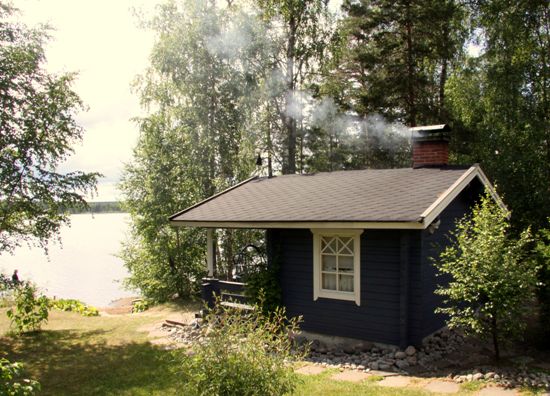
Holiday homes are almost always located by a lake or the sea or on an island. Even people who don’t have their own second home can rent such cottages for a week or longer.Photo: Plugi/Helena Pitkänen

Finns see themselves as people who still live very close to nature. There’s a lot of truth in this, since even those living in urban areas like to spend time in natural settings: walking, skiing, or just spending time at their out-of-town holiday homes.

Heading off to the holiday home is a deeply rooted tradition among Finns. There are almost half a million second homes for a national population of just over five million. These retreats vary greatly in size and facilities. Older holiday homes tend to be small and modest, but more recently built cottages are true second homes, fitted with all modern conveniences. About half of the country’s holiday homes are habitable in winter.

Red lingonberries growing on a shrub.

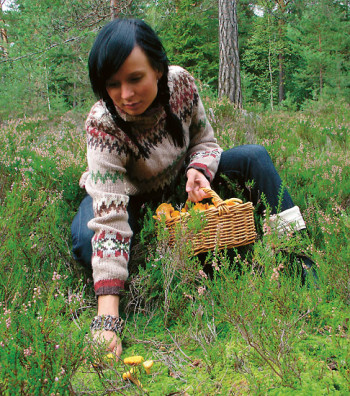
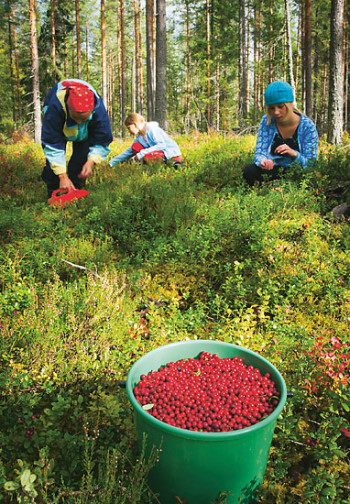
In a good year up to 50 million kilos of wild berries are picked in forests – about 10 kg per person. The most commonly picked berries are bilberries, lingonberries and cloudberries. Mushrooms are also picked widely.Photo: FTB

Hikers with big backpacks walking in a forest.

Finland’s traditional right to roam the land allows everyone to camp out temporarily in the great outdoors. To camp for longer periods or light a fire, the landowner’s permission is needed.Photo: FTB/Pekka Luukkola

Finland’s liberal rights of common access to the land enable everyone, including foreign visitors, to roam freely through forests and other natural areas on foot or on skis and even pick wild berries and mushrooms, regardless of who owns the land. Hunting rights and the right to fish with nets or lures are tied to the ownership of the land or fishing waters, however.

Finland’s 37 national parks, with their extensive networks of trails, are vey popular among hikers. Most of these parks are fairly small, less than 100 km2, and their primary purpose is to protect nature and biodiversity.

In addition to these national parks, Finland also has many other kinds of protected areas, including the wilderness areas of Lapland and mire protection areas. The first nature reserve was established in 1916 up in the high hills in the northwestern corner of Finnish Lapland.

Northern wildlife

Two whooper swans on ice.

Finland’s national bird, the whooper swan, owes its survival to nature conservationists. Its numbers have increased from just 15 pairs in the 1950s to more than 5,000 pairs today. These graceful swans are now a common sight on Finland’s lakes again.Photo: Plugi/Pentti Sormunen

Animals only returned to Finland fairly recently after the continental ice sheet receded from Fennoscandia at the end of the last ice age, about 10,000 years ago – though they were helped by a subsequent warm climatic period lasting four millennia.

Relieved of the massive ice sheet, the land began to rise gradually, alternately opening up and closing natural waterway connections. When the vast Saimaa Lake System, in SE Finland, was cut off from the Baltic Sea, salmon and ringed seals were also marooned, and they have survived in the lake to this day.

Other Finnish wildlife specialities include arctic animals and species associated with coniferous taiga forests. The fells of the far north are still home to the critically endangered arctic fox, which may vanish altogether from Finland if the climate warms. Another rare and exotic inhabitant of Finnish Lapland is the pure white snowy owl.

Finland is particularly well endowed with owls. Ten species can be found here, also including great grey owls and hawk owls.

Another exotic animal, the flying squirrel, makes its home across most of mainland Southern Finland wherever there is enough undisturbed mixed forest.

One of the country’s most impressive four-legged residents is the elk. Elk can be seen anywhere in Finland, where they thrive so well that due to the scarcity of their natural predators they must be hunted to control their numbers.

Where predators prowl

A bear roaming in the forest.

Bears roam throughout Finland, but are commonest in the country’s eastern borderlands, where several local firms run bear-watching excursions.Photo: Plugi/Jorma Leskelä

Large carnivores are generally faring well in Finland, where there are plenty of undisturbed wild areas and abundant prey. Finland is home to all four of Europe’s large predatory mammals: brown bears, wolves, lynx and wolverines.

Finland’s predators have not always had it so good, however. They used to be widely persecuted here, as in other countries, especially in the 1800s and early 1900s. Persecution has since declined, but conflicts still arise at times, especially in Lapland, where wild predators often kill reindeer. Wolverines particularly have a bad reputation in this respect.

A golden eagle standing on its prey.

Golden eagles and other birds of prey are no longer persecuted in Finland. This change in attitude is partly because reindeer herders are today paid compensation scaled according to the numbers of eagles successfully breeding in each herding district.Photo: Plugi/Lassi Kujala

A wolverine in snow.

The wolverine is Europe’s rarest large carnivore. Wolverines are well adapted to northern climes, and able to move around easily even in deep snow.Photo: Plugi/Timo Saloranta

A lynx walking in the forest.

More lynx live in Finland today than at any time in the last hundred years. They have even been seen in Helsinki’s suburban fringe.Photo: FTB

In recent decades the populations of large carnivores have been purposefully restored, and their numbers are now stable. Finland is home to more than 1,600 bears, about 150-160 wolves, nearly 2,500 lynx and 150–170 wolverines.

But anyone out walking in the forests is very unlikely to see any of these animals. All four species are wary of people, and seek to avoid us whenever possible. The best way to see them is to join a guided wildlife watching excursion. This typically involves spending the night in a simple hide out in the forest.

Many birds of prey have also become more common in recent times. Numbers of white-tailed eagles, for instance, have soared since the 1970s to about 1,000. These majestic birds today occupy some 300 breeding territories around Finland.

By Eeva-Liisa Hallanaro, M.Sc., environmental expert; July 2011

Finland: The frontrunner in sports and fitness

It’s hard to imagine Finland without sports and exercise – keeping fit and active is second nature to the Finns.

According to a survey by the European Commission (2010), Finland tops the podium in physical activity in Europe, and it also places among the most active countries in the world. But we won’t rest on our laurels. We’re out to become the most active nation of all!

There are many reasons to exercise. You may have a competitive spirit or want to test your limits. You may be aiming to keep fit and look good, or you might simply want to relax and have fun with a group of like-minded people. Most Finns are active because it promotes health and wellbeing.

Sports – children’s hobby of choice

Children learn to ski at an early age.Photo: Antero Aaltonen

Sports are the number one hobby among children: More than 90 percent of those under 18 are physically active. Sports activities take place in clubs or in informal groups of friends. Favourites include football (soccer), ice hockey, floorball and various forms of gymnastics.

Of the adult population, 90 percent exercise at least twice a week and more than 50 percent at least four times a week. Adults favour sports that are easy to fit into their busy schedules, such as running, going to the gym and exercise classes that are conveniently scheduled at various times of day.

Active in sports clubs

Soccer is the number one sport among children.

Soccer is the number one sport among children.Photo: Roni Rekomaa/Lehtikuva

their members in one or more sports. Clubs are run mainly by volunteers; most are non-profit organisations, with participation based on club membership.

Most sports clubs are members of a national association or a regional organisation. All national sports associations are members of the Finnish Sports Federation (FSF), including the 74 different sports federations, the Young Finland Association, the Finnish Olympic Committee and sports organisations for people who are disabled. FSF has a total of 130 member organisations.

The Finnish National Lottery is the largest individual financer of physical activities and sports. Some 25 percent of its profits are directed to sports through direct grants to clubs or via the Ministry of Education and Culture, which supports national sports organisations and municipalities. Municipalities maintain local sports facilities and provide financial support for local clubs. Other funding for sports clubs comes directly from the athletes or members, from sponsors and, to some extent, from the private sector.

In addition to clubs, independent fitness activity, company facilities and gym chains are becoming increasingly popular.

Volunteers keep the ball rolling

Numerous Finns keep fit by Nordic walking. The sport is also growing in popularity in other countries. Finland's versatile natural environment provides good opportunities for open-air activities.

Numerous Finns keep fit by Nordic walking. The sport is also growing in popularity in other countries. Finland’s versatile natural environment provides good opportunities for open-air activities.Photo: Antero Aaltonen

Volunteer work forms the cornerstone of physical activity and sports in Finland. Out of a population of 5.4 million, as many as 600,000 people volunteer their free time to sports clubs – that amounts to more than 10 percent of the population. The ballpark estimate of the annual value of this volunteer work is 1.5 billion euros.

Sports clubs are run by volunteers, who also coach club members. In addition to helping out at clubs, Finns are also keen to volunteer their time to help organise sporting events.

One of the largest such events is the Jukola Relay, held annually since 1949. One of the biggest orienteering competitions in the world, it’s also the largest annual sporting event in Finland. Every year some 15,000 competitors from all corners of the world participate, watched by 30,000 spectators. It takes around 2,000 volunteers to put on the event.

Excellent opportunities for activities, experiences and skills

The best way to enjoy the winter landscape is on cross-country skis. There are free, well-maintained ski trails throughout the country.

The best way to enjoy the winter landscape is on cross-country skis. There are free, well-maintained ski trails throughout the country.Photo: Antero Aaltonen

The great versatility of Finland’s natural environment, together with the country’s four distinctive seasons and ‘everyman’s right’ – the legal right of Finns to roam the wilderness regardless of who owns the land – provide ample opportunities for open-air activities. Outdoor sports are popular in Finland, including trekking, hiking, walking, Nordic walking, cross-country skiing, Nordic skating, cycling and canoeing.

City planning is paying increasing attention to pedestrian and cycling routes; exercise and recreation areas; and other local sports facilities. Most Finnish municipalities and towns have a swimming pool, a football pitch, an ice rink and an indoor facility for badminton, volleyball, basketball and floorball.

There are 13 sports institutes in Finland, each specialising in certain sports. They offer excellent facilities for competitive and professional athletes as well as hobbyists. In addition, the institutes are important educators in sports-related professions at both secondary and university levels, and boast leading expertise in areas such as testing and sports technology.

Research in sports science takes place at the University of Jyväskylä and the Research Institute for Olympic Sports (KIHU). Other institutes performing sports research include the Foundation for Sport and Health Sciences (LIKES), the UKK Institute and sports medicine centres around the country. Finnish sports and exercise scientists are renowned worldwide.

Go Finland!

Spectators cheer at the World Athletics Championships at Helsinki's Olympic Stadium in August 2005.

Spectators cheer at the World Athletics Championships at Helsinki’s Olympic Stadium in August 2005.Photo: Heikki Saukkomaa/Lehtikuva

Finland is a sports nation, and Finns love to rally around their teams and root for their athletes. Over 70 percent of Finns either attend sporting events or watch sports via the media. Popular spectator sports include cross-country skiing, ski jumping, athletics, ice hockey, football and motor sports such as Formula One and World Championship Rally. More recent favourites include floorball, as well as snowboarding and other alpine sports.

Many Finns are happy to exercise for leisure, but different sporting events also tempt an increasing number of amateurs to the starting line. During the summer and autumn months, marathons and other running and walking events take place practically every week in various parts of the country. The annual Naisten kymppi, a 10-kilometre fun run for women, has been held 27 times, evolving into a massive event with 20,000 participants.

Winter and spring months are filled with skiing events; the best-known one is the traditional Finlandia Ski Marathon.

Several international competitions take place in Finland every year, including some 20 world cup championships and other international events. Finland organises more events than many larger European countries.

As organisers, Finns are known as reliable hosts whose competitions and international congresses run smoothly. The events are also environmentally conscious and utilise the latest technologies. The Helsinki IAAF World Athletics Championships in 2005 formed a memorable event, not least because it was efficient and ecological. The ECOmass environmental programme was launched specifically for the purpose of decreasing the environmental load of the event and establishing an environmentally friendly operation model for future events. Athletes and spectators alike applauded the welcoming atmosphere, too.

Making Finnish sports design known to the world

A new programme called “Ready Steady Go! Finland” aims to get people moving all around the globe, not just in Finland.

By encouraging the international growth of Finnish companies in the field of innovative sports design, accessories and services, Ready Steady Go! Finland wants to make sure that the country’s valuable contribution does not go unnoticed.

Why sport, why Finland? Why not? This is the position of Ornamo and Finpro, who stand behind the project. Ornamo is the Finnish Association of Designers and Finpro forms a network for Finnish companies looking to breakthrough internationally. Aalto University is also cooperating with them. Judging from Finland’s wide-ranging success in sports and proven expertise in technology, design and nature, Ready Steady Go! Finland represents a safe bet for the parties involved.

Links:

Business Finland
Ornamo

National heroes and role models

Driver Mikko Hirvonen traverses the legendary Ouninpohja special stage during Rally Finland in Jyväskylä.

Driver Mikko Hirvonen traverses the legendary Ouninpohja special stage during Rally Finland in Jyväskylä.Photo: Vesa Moilanen/Lehtikuva

In which sports do Finns excel? Finnish athletes often outshine others in motor sports (particularly rally and Formula One), figure skating, shooting sports, cross-country skiing, snowboarding, orienteering, ski jumping, ice hockey and wrestling. In athletics, javelin is a Finnish speciality.

Paavo Nurmi, known as the Flying Finn, won nine Olympic gold medals in long-distance running during the 1920s. In addition to his nine gold and three silver Olympic medals, Nurmi clocked 25 personal and two team world records. He remained the all-time most successful Olympic athlete up until the 2008 Summer Olympics.

Leo-Pekka Tähti has won many Paralympic and World Championship medals in wheelchair racing.Photo: A Aaltonen

Kaisa Mäkäräinen is the first Finnish woman to win a gold medal in Biathlon. She won the 10-kilometre event and took silver in the sprint of the 2011 World Championships. In addition, she won the 2011 Biathlon World Cup.Photo: N. Kolesnikva/LK/AFP

Ice hockey players Teemu Selänne (left) and Saku Koivu show offf their bronze medals at the 2010 Winter Olympic Games in Vancouver.Photo: Matti Kainulainen/Lehtikuva

Other famous Finnish sports stars include Lasse Virén (long-distance running) and Tiina Lillak (javelin); Juha Mieto and Marja-Liisa Kirvesniemi (cross-country skiing); and Matti Nykänen and Janne Ahonen (ski jumping).

Finns also tend to do well in motor sports, football and ice hockey. Juha Kankkunen and Tommi Mäkinen took several World Rally Championships, while Mika Häkkinen and Kimi Räikkönen have been Formula One champions. Teemu Selänne and Saku Koivu laced up their skates for Finland in ice hockey; Laura Lepistö and Kiira Korpi excel in figure skating. Famous Finnish footballers include Jari Litmanen, Sami Hyypiä, Mikael Forssell and Laura Österberg Kalmari, while Jani Sievinen and Hanna-Maria Seppälä are celebrated swimmers. In the Paralympics, successful Finns include Leo-Pekka Tähti (wheelchair racing), Jani Kallunki (judo) and Katja Saarinen (alpine skiing).

These and other talented athletes put Finland on the scoreboard and act as important role models for young sports enthusiasts.

Links:

Research Institute for Olympic Sports KIHU
Foundation for Sport and Health Sciences (LIKES)
UKK Institute

Did you know?

Winter swimming, also called ice swimming, is especially popular among women. A warmly dressed crowd always shows up to cheer the contestants in the annual Finnish Winter Swimming Championships.

Winter swimming, also called ice swimming, is especially popular among women. A warmly dressed crowd always shows up to cheer the contestants in the annual Finnish Winter Swimming Championships.Photo: Antero Aaltonen

  • Invented in Finland, Nordic walking (walking with poles that resemble ski poles) is in full swing: some 445,000 Finns keep fit by Nordic walking regularly. The sport is also growing in popularity in other countries.
  • The sea and lakes freeze over in winter, but even so, some 120,000 Finns regularly swim in an avanto, a hole cut in the ice.
  • Helsinki hosted the Summer Olympics in 1952.
  • The national game pesäpallo, Finnish baseball, resembles American baseball. Developed by Lauri Pihkala in the early 1900s, it became popular in the military because it helped develop the many skills needed in national defence.
  • Aesthetic group gymnastics originates in Finland, which is among the forerunners in this choreographic sport and Finnish teams have won several world championships.
  • Finnish mountaineer Veikka Gustafsson is one of nine people who have conquered, without using bottled oxygen, all 14 of the world’s mountains that measure more than 8,000 metres.
  • Ski jumping is one of the Finns’ all-time favourite spectator sports. Hours are spent in front of the TV watching the slow-paced competitions, which feature intermittent adrenaline rushes as each contestant speeds down a mountainside ramp and becomes airborne, attempting to soar over as much ground as possible before touching down.
  • Some 354,000 Finns play floorball. In terms of membership, the Finnish Floorball Federation is the third-largest sports organisation in the country.
  • The world’s largest gymnastics exhibition, Gymnaestrada, will be held in Finland; Helsinki will be full of gymnasts showcasing their skills in the summer of 2015.
  • The expertise of Finns in the area of equality in sports was recognised when the chairpersonship of the International Working Group on Women and Sport (IWG) was handed to Finland for a mandate lasting from 2010 to 2014. IWG aims to promote equality for girls and women in physical education and sports worldwide.
  • With the support of Finland’s LiiKe sports and development organisation, 11 teachers’ colleges in Tanzania have been granted the right to teach physical education and train PE teachers, supporting Tanzania’s aim to increase the PE curriculum in schools.
  • Numerous national physical activity projects that aim for tangible results have been organised in Finland, such as the Fit for Life Programme, which encourages adults over the age of 40 to include physical activity in their daily routines. School children are inspired to get moving by the Muuvit adventure (further information on Fit for Life is available at www.kki.likes.fi, and Muuvit’s website is www.muuvit.com).
  • Finnish company Suunto is the largest manufacturer of compasses and precision sports instruments worldwide, and a global leader in dive computers.
  • Another Finnish company, Polar, was the first to launch a wireless, wearable heart rate monitor for athletes, in 1982. Polar’s heart rate monitors are used by everyone from top international athletes to hobbyists and beginners. Polar is a leading heart rate monitor manufacturer.
  • An expert in play, Lappset Group is a top manufacturer of inspiring environments for play and games. The company designs and manufactures spaces and entire playgrounds for both children and adults all over the world.

By Katriina Sahala and Soile Koskela, Finnish Sports Federation (FSF), July 2011

I left my heart in Lapland

For many, Lapland conjures up images of winter. But there’s a growing range of summer activities on offer that take advantage of the area’s natural beauty and endless light.

I’m a city person. During the past decade, I’ve lived in London, Vancouver, Toronto, and Helsinki. I’ve never lived in the countryside; even the suburbs make me feel a bit anxious, like I’m too far away from the centre of things.

However, that all changed when I visited Lapland for the first time three years ago, shortly after I moved to Finland. From the moment I stepped out of the airplane at Ivalo Airport, the country’s most northern airport, I was overwhelmed by the fresh air and the natural beauty visible from the tarmac, as we walked toward the small terminal building.

Midsummer magic

It was weeks from the summer solstice and already the night spilled into day, without the sun ever setting, which meant that I was able to pack a lot into my trip, from panning for gold in Tankavaara to whitewater rafting near the holiday resort of Saariselkä, and dipping into the cool, clean waters of Lake Inari, Europe’s sixth largest lake, which draws fishers from around the globe for its world famous salmon.

Since then, I’ve visited different areas of Finnish Lapland and tried various activities. I’ve learned to appreciate the quiet beauty of the wilderness, but I haven’t gotten over my surprise at spotting reindeer (they really are everywhere), and have even considered moving to Lapland. The laidback friendliness of the locals is a charming bonus.

Here’s my shortlist (by no means definitive) of where to go and what to do and see in Finnish Lapland:

1. Fish

I caught my first fish, a greyling, near Kuusamo, which is right on the border of the Arctic Circle. I’d never been fly-fishing on a river before and once I tried it, I was hooked. The Kitkajoki, Kuusinkijoki and Oulankajoki rivers in Kuusamo are renowned for the great trout that come from Lakes Paanajärvi and Pääjärvi in Russia.

The clean waters of Finland teem with a wide variety of fish. River fishing is allowed between June 1st and September 10th. Various lures and flies are permitted, but live bait cannot be used in rivers that have whitefish or salmonoids. Ice fishing and angling with a hook and line are allowed on lakes (with 180,000 of them in Finland, there are plenty of options) and ponds throughout the year by something called jokamiehenoikeus, or “everyman’s right,” which means that no permits are needed. General permits for lure fishing and special waters are needed.

2. Hike

“Everyman’s right” means foreigners and Finns have free access to forests, whether publicly or privately owned. Most routes are found in National Parks and close to holiday resorts, with varying terrain. Because there are few steep mountains in Finland, few hikes require rock-climbing abilities or equipment.

Hiking the Bear's Trail (Karhunkierros) in Oulanka National Park.

Hiking the Bear’s Trail (Karhunkierros) in Oulanka National Park.© Pohjolan Mylly

Among the best-known hiking trails are Pallas-Ounastunturi National Park; the 800-kilometre-long Kalottireitti (also known as Nordkalottleden Trail), which runs through the arctic fells of Finland, Sweden and Norway; Pyhätunturi; the Luosto area; Posio Korouma and the Urho Kekkonen (UKK) route in Salla. (The UKK trail is named after Urho Kaleva Kekkonen, who was one of the longest reigning Finnish presidents holding the country’s top post from 1956 to 1981.)

For a gentle introduction, try Karhunkierros (the Bear’s Trail) in Oulanka National Park, which was formed thousands of years ago when waters from the melting ice shaped the ravines, canyons and river beds. The longest trail (80 kilometres) starts at Hautajärvi Nature Centre and requires three to seven days. The shorter one, Pieni Karhunkierros (Small Bear’s Trail) can be easily done in an afternoon as it is 12 kilometres long.

The hiking is relatively easy and the scenery picturesque (reminiscent of an Akseli Gallen-Kallela painting), as the trails wind through forests and canyons.

As in all Finnish National Parks, there are log huts one can stay overnight in along the path; these are maintained by Metsähallitus, the state enterprise which is responsible for more than 12-million hectares of state land.

3. Celebrate

Midnight Sun Film Festival
In June, Sodankylä

A number of festivals take place in Lapland during the summer. Possibly the most famous is the Midnight Sun Film Festival, which is held in Sodankylä every year. Here, the world’s cinema-rati come together for nonstop screenings at the top of the world. This year legendary French actor Michel Piccoli will attend the festival, as will Italian director and producer Gian Vittorio Baldi and Russian director Andrei Smirnov. There are always surprise guests – a few years ago it was director Francis Ford Coppola and the festival, which was founded by Finnish filmmaking brothers Aki and Mika Kaurismäki, is lauded for its lack of VIP ceremonies or services. Every film fan is welcome.

Jutajaiset International Folklore Festival
In June, Rovaniemi

In Rovaniemi, home of Santa Claus, the Jutajaiset International Folklore Festival brings together midsummer ceremonies and music and dance from Argentina to Africa. In addition to international guests such as the Uinjilisti Choir from Tanzania, local Sámi rock bands including Naiv, Hra Apatia, Slain, Kasapanos and Stalingrad Cowgirls are on the bill.

Pyhä Unplugged
In August, Pyhä

Pyhä Unplugged is an acoustic music festival that has been called “the most sympathetic festival in Finland.” The performing artists are usually well-known Finnish rockers, who perform partly for the challenge of playing without amplifiers or special effects. Concerts are organised at the Hotel Pyhätunturi, Tajukangas (blues by the bonfire) and Aittakuru (an amphitheatre designed and constructed by nature.) Mato Valtonen, actor, inventor and musician, who is perhaps best known for his role in the Leningrad Cowboys, that lovely spoof band immortalised in Aki Kaurismäki’s films, is the artistic director.

4. Adventure

One of many adventures: mountain biking.

One of many adventures: mountain biking.© Pohjolan Mylly

A growing number of companies provide summer safaris and excursions ranging from white water rafting to expeditions into the history and culture of the Sámi, the indigenous people of Scandinavia. A Santa Claus safari offered by a tour operator in Rovaniemi takes participants to the Santa Claus Village where they can meet the man himself and visit his workshop. Also in Rovaniemi, the capital of Lapland, Artikum, a science centre and museum that specialises in Lapland and the arctic regions, showcases the people, nature, history, customs and cultures north of the Arctic Circle. (Please note that the permanent exhibition of the Arctic Centre is closed until March 31st, 2007). Wild North (Villi Pohjola) is a versatile nature adventure tour operator that offers trips back in time – see what life was like in a logging camp – and a variety of programs such as Exotic Summer Wellness à la Wild North, which combines refreshing exercise and local culture in the peace and quiet of the Arctic. Wild North also operates about 200 holiday cottages available in different price ranges in peaceful, unspoilt locations.

What is Lapland?

The province of Lapland, “Lappi” in Finnish, is part of a larger geographical area in the far north of Finland, Sweden, Norway and Russia. In Finland, Lapland technically starts at the Arctic Circle, though cities such as Kuusamo, which are near the Circle are considered by many to be part of Finnish Lapland. The biggest towns in Finnish Lapland are Rovaniemi (the provincial capital), Kemi, and Tornio.

By Katja Pantzar, June 2006

Leaving our comfort zone

It’s natural to fear what is different, but we can’t let that stop us from seeing what we all have in common, writes singer Emma Salokoski. The popular performer (video clip below) tells us about her childhood and how she became aware that such a thing as racism exists.

When I was in grade six in school, one of our assignments was a project about African countries. It formed part of that new kind of studying – you know, where you work independently instead of someone feeding you facts. I guess most of it was copying bits of various reference books and then making sure to decorate your report really nicely.

I chose South Africa and Namibia. Something about them made me more enthusiastic than I had been in other projects. I wrote about natural riches, wide-open deserts, chiefs in Amboland and, of course, apartheid. This was back in the days when Namibia had yet to achieve independence and Nelson Mandela was still in prison. I went and saw the film Cry Freedom and shed bitter tears about the injustices it portrayed. I couldn’t understand how such evil could exist in the world.

The warmth of a different perspective

3643-e-by-cata-portin-2-iso-500px-jpg

Salokoski grew up in a bilingual family speaking both of Finland’s official languages: Finnish and Swedish. Photo: Cata Portin

At the time, my mother was working as an anthropologist doing Africa-related research. Her colleagues often visited us; some of them were members of SWAPO, Namibian freedom fighters in exile. I remember that one guest made a big impression on me by mimicking an astonishing range of animal calls and cries.

I think that my contact with these people was what allowed me to empathise so deeply with South Africa’s struggle for freedom. At that time I must have been a bit different than most kids my age. My classmates were dressing in Lacoste shirts and deck shoes and spending most of their time gossiping about the latest party.

I didn’t really fit in. I had strange ideas and listened to different music. My chatter about supporting justice and opposing racism fell on deaf ears. It just wasn’t cool to preach about colonialism and segregation if you were a nerd and you wore the wrong kind of clothes.

It got worse as my early teen years progressed. Then the gossip was about the latest punch-up with the Roma down at the railway station. And it wasn’t pretty to listen to. One time a guy came up to me and said, “You probably think it’s racist to dislike the Gypsies.” When I said yes, he let out a burst of disparaging laughter.

Fights with the Roma were the only multicultural encounters those guys had. They’d never experienced the warmth of meeting people who see the world from a completely different perspective, never been uplifted by the beat of their music, never listened to their stories or seen their pictures.

See the heart within

See Helsinki scenery in Emma Salokoski’s video of Veden alla (Underwater). The song bounced to the top of the iTunes download list after being performed on TV in November 2010.

The tone of the public discussion about immigrants lately has got me worried. Worried and confused. I thought racism was a thing of the past. I thought apartheid had been extinguished 20 years ago. But it lives on like a dark cloud, like a smouldering fire under the forest floor.

Racism exists in us all. Sometimes it flares up and takes on frightening populistic features, and can even become something close to a generally accepted attitude.

We have to keep alert. It’s natural to fear what is different. That’s why we have to fight to make the unknown familiar. Learn about other people’s customs and, moreover, get to know people who are different. We have to see what is different, but also what is the same: the heart that beats within every single person.

Maybe we have to leave our comfort zone to see other people’s hearts, but I submit that we will be enriched by doing so.

A version of this article originally appeared in magazine HelsinginTaidemuseo.fi, issue 2/2010.

By Emma Salokoski, April 2011

Doing business with Finns

Finland and India might seem geographically worlds apart, but when it comes to doing business the distance is not that great. Let Mohan Rajkarne, the country manager of Tata Consultancy Services, tell how it is to work with Finns.

Tata Consultancy Services, (TCS), is part of the Tata Group, one of India’s largest industrial conglomerates and most respected brands. They have been present in Finland for more than twelve years enhancing customers’ IT services, business solutions and outsourcing, having today more than 1 200 consultants working for Finnish clients. TCS has its country office in the modern Ruoholahti business district in Helsinki and has recently moved to bigger premises to accommodate growing business.

Mohan has been country manager for TCS for three years now. He sees his mission as bringing TCS’s experience of working globally to Finnish companies that want to receive a consistent level of service everywhere.

Structured approach to doing business

2459-fin_mumbai_queens_neclace-550-jpg

By plane Mumbai is only six hours away from Helsinki. Photo: Finnair

Finns have often been described as matter-of-fact types in communication, a description with which Mohan agrees.

“Always when coming from a different background it takes a little while to understand what people mean,” Mohan states. For example, when listening to presentations Finns tend to sit quietly, a custom which might leave the speakers wondering whether or not their message went through. But soon he realized, “If there is a point to be made, then the point will be made. So if no question is asked, the audience have probably understood.”

“People interpret situations differently. For example, take ambiguity. Ambiguity in business situations, from our background, at times, is quite all right, whereas, in Finnish situations one really needs to have a well structured plan,” Mohan states and continues, “Since our entire way of doing business is a very planned operation, a structured plan actually helps us in doing business rather than making it difficult.”

According to Mohan, setting up a business or running one on a daily basis in Finland is not challenging since the authorities follow the same structured method of working:

“We have regular interaction with the authorities and whether it is for work permits, compliance-related issues or taxation, in all of these matters we have had a high level of harmony with the authorities. And what helps greatly is that they are able to guide one very clearly in what to do and what not to do.”

Innovation

2459-ilmakuva-550-jpg

Helsinki has been recently selected as the most livable city in the world by the lifestyle magazine Monocle. Photo: Visit Helsinki

According to Mohan the level of innovation sets Finnish business culture apart.

“I think it is the reason why I am personally here and why our company is really investing a lot in this market. If you look at the top 30 companies here, it was not that they always had all the natural resources available to them, it was more about how to be able to galvanize available resources and make them work together. And they all came up with breakthrough ideas to be succesful.”

“That’s really the amazing part to us, and hugely inspirational! What we are doing is therefore to tap into some of that talent, to interact with the young minds and learn from the innovative companies here.”

TCS has doubled its workforce dedicated to Finnish customers within a year regardless of the fact that 2010 was generally tough on businesses due to the global slowdown.

“We have been growing at a very good rate and we are even more committed to this particular country. The reasons for doing that are the way that we are structured, the way we are doing business and the level of innovation. Those are the reasons for us to be successful and importantly we want to learn from companies here!”

By Riia Järvenpää, June 2011

See Finland’s two newest national parks

Finland’s 36th and 37th national parks were established in early 2011, just in time for the arrival of the warm season: a new park encompassing unspoilt forest habitats just a stone’s throw from Helsinki; and an extensive marine park around the archipelagos of the Bothnian Sea along the west coast.

The ecologically diverse forests of Sipoonkorpi are already popular with nature-lovers in the Helsinki area. New trails, picnic sites and other facilities for visitors will soon be created following the area’s designation as a new national park. This will provide a valuable new recreational amenity in the east to rival the popular Nuuksio National Park, which lies just west of the capital.

The Sipoonkorpi National Park is easy to reach from Helsinki.

The Sipoonkorpi National Park is easy to reach from Helsinki. Photo: Metsähallitus

But the main reason for establishing the park is to protect Sipoonkorpi’s old-growth forests, rocky crags and woodland springs and streams, together with their rare flora and fauna, in the face of increasing pressure for building development as the Helsinki conurbation spreads eastward.

Its total extent of just 18.5 square kilometres makes Sipoonkorpi one of Finland’s smallest national parks, but Minister of the Environment Paula Lehtomäki, in office at the time of the park’s inauguration, said she hoped more land would soon be acquired for the park. “Landowners in surrounding areas will be encouraged to join conservation schemes, and we are also urging local authority planners to establish ecological corridors linked to the park to benefit nature, as well as recreational areas to benefit the many people who live nearby,” she said.

Finland’s largest marine national park

A view of the Bothnian Sea National Park.

A view of the Bothnian Sea National Park. Photo: Metsähallitus

The new Bothnian Sea National Park off Finland’s west coast covers a much larger area of 900 square kilometres, but most of the park consists of open marine waters. Nature conservationists are disappointed that the park includes few islands and shores, and that the hunting of seals and seabirds has not been more restricted within its boundaries.

Lehtomäki admits conservation compromises had to be accepted to make the designation of the park acceptable to local communities, and particularly to help the local fishing industry. But she feels the park still fulfils its main goal of protecting ecosystems beneath the waves. “The establishment of this large marine national park in the west fills the last major gap in our protected areas network,” she says.

On boat trips out to the Bothnian Sea’s lonely lighthouse islands from Uusikaupunki or Rauma, visitors can spot the new park’s wildlife, including inquisitive seals, sea ducks, auks and white-tailed eagles.

National parks for all seasons

Finland’s 37 national parks cover a total area of almost 1,000 square kilometres. The largest parks in the north contain the wide-open fells of Finnish Lapland. Coastal parks in the south and west encompass Finland’s labyrinthine Baltic archipelagos. Many other parks protect unspoilt forest and lakeland scenery.

National parks are primarily designated to protect wildlife and natural landscapes, but during 2010 Finland’s parks welcomed almost two million visitors. Many free facilities are provided in the parks, including visitor centres, inviting nature trails, shelters and campfire sites stocked with firewood. For tips on visiting Finland’s 37 national parks and other beautiful natural areas at any time of year see

By Fran Weaver, June 2011

What’s up with the “True Finns” party?

When the results from parliamentary elections started to roll in on April 17, Europe-at-large was taken aback: What on earth is happening in Finland, known for its mostly underwhelming political news?, asks Kyösti Karvonen, managing editor of the newspaper Kaleva.

The point in question is a party with a funny-sounding name, the “True Finns,” with its firebrand chairman Timo Soini, an avid fan of British soccer club Millwall FC and a Roman Catholic in a mainly Lutheran country.

In international election coverage, the party has been called far-right, xenophobic, populist, anti-EU, anti-Islam and racist.

I’ve covered the “True Finns” party and its predecessor, the Finnish Rural Party, since the early 1980s. Over all those years, it has been mission impossible to pin it down on the political map. However, it is easier to overrate than to downplay the party’s essence.

Suspicion and sewage

|||Photo: Mikko Stig/Lehtikuva

The safest bet, at least at first, is to call the “True Finns” populist. They can also be categorised as EU-critical and as a party that stands for tighter immigration rules. To be sure, individual extremist voices are often heard from the party’s rank-and-file.

There are deeper currents in the Finnish psyche where the party has recently managed to strike a chord. Being a Finn ultimately entails suspicion of, or even detest for, the powers-that-be. The social protest that materialised in the ballot boxes was, to name a few ingredients, a cocktail of EU bailout funds, election financing scandal and an extremely unpopular law that forces the Finns to build expensive sewage systems for their beloved summer cottages.

Soini himself has called the “True Finns” a “working-class party without socialism.” There is definitely something to that. When the leading Finnish daily Helsingin Sanomat asked the candidates a set of questions, the answers of the “True Finns” and the Social Democrats stood closest to each other, out of all the parties.

Afraid of being trampled

|||Photo: Jussi Helttunen/Lehtikuva

The “True Finns” did not come out of the blue. The party has existed for more than 50 years – though previously under two other names.

The “True Finns” have rocked the Finnish political scene before, though they were called the Finnish Rural Party back then. That happened in the early 1970s and in 1983. On both occasions, the party either disintegrated soon after due to internal squabbles or took a nosedive after a spectacular showing in the elections.

The party platform has never been rich in content, but most often it has been chaired by a leader with political talent, charisma and good oratory with witty sound bites.

Soini, 48, fulfills that description to the letter. He holds a masters degree in social sciences and rather fittingly did his thesis on populism.

Soini, in an oracular fashion, wrote in his autobiography in 2008 that “a populist leader often comes to the scene when social modernisation and structural change constitute a threat. The populist electorate is made of people afraid of being trampled upon.”

From peasants to Parliament

|||Photo: Mikko Oksanen/Lehtikuva

Soini learnt the trade working in the party under the rocky leadership of the late Veikko Vennamo, the founder of the two preceding incarnations (the Small Peasants’ Party of Finland in 1959 and the Finnish Rural Party in 1966). Vennamo’s trademark was fiery oratory; once he was even carried off of the parliamentary podium when he exceeded a time limit.

Vennamo founded the party in the late 1950s after he resigned from the what is now the Centre Party following a bitter fight with Urho Kekkonen, who went on to serve as president of Finland from 1956 to 1982.

After the Second World War, Vennamo formed a key figure when evacuees from Karelia, the eastern Finnish region annexed by the Soviet Union, were resettled in Finland. It is widely considered that Finland avoided post-war social upheaval thanks in part to the resettlement.

The ups and downs started in 1970, when the party snatched 18 seats in the 200-member Parliament. The party soon split and disappeared into political oblivion before making a comeback in the 1983 elections. The party entered a coalition government for the first time in its history, then gradually fell back again into the political wilderness.

That period came to an end a few years ago, when the “True Finns” started to make headway. The first signs were seen in the local elections in 2008 and in European Parliament elections in 2009. Soini was elected to European Parliament by a landslide.

By Kyösti Karvonen, May 2011

Where Indian craft meets Nordic design

The handmade design products of Tikau have become regular features on the pages of Finnish magazines, but they encorporate much more than just cool design. Inspired by the aesthetics and craftsmanship in rural areas of India, Tikau combines Scandinavian design with a wide approach to fair trade and sustainability, providing a unique alternative to mass-produced products.

2751-6-6-2011_tikau_550-jpg

Most Tikau products stay the same from season to season and form timeless design elements. Photo: Tikau Design

As interest in craftsmanship and the values behind our daily products increases, Tikau has quickly found its way into the homes and hearts of conscientious Finnish consumers. The beautifully crafted textiles, rugs and pillows gain their unique look and feel from the century-old skills and knowledge of the local artisans in rural India.

The woman behind Tikau is designer Taina Snellman, whose trips to India and interest in ethical and environmental production brought her the idea of combining Scandinavian aesthetics while cherishing local artisan work and traditions. The philosophy at the heart of Tikau is also to create design that is as socially, aesthetically and environmentally sustainable as possible. Tikau itself is a Hindi word meaning long lasting, durable and sustainable.

Timeless design and philosophy

The values of Tikau are implemented at every stage of production. In contrast to mass production, which begins with the product and then seeks a producer, Tikau is based on the skills and traditions of the local artisans and the local materials. Snellman and the maker start to plan how a product would fit Scandinavian aesthetics. Some of the products have been designed by Snellman herself, some by other designers and some are creations of the craftspeople themselves. Traditional patterns and materials are often used.

2751-6-6-2011_tikau_550_tyynyt-jpg

Tikau products are made of natural materials and colours. Photo: Tikau Design

In production, Tikau attempts to revive the disappearing artisan traditions to the use of environmentally friendly methods for processing textiles. It uses natural materials such as uncolored wool, organic cotton, water reed and banana fiber for the core of most Tikau products, and the use of chemicals is avoided by utilising traditional vegetable dyes whenever possible.

Most Tikau products stay the same from season to season. Rugs, blankets, baskets and pillows in their natural colours and quality fabrics form timeless design elements.

By Amanda Soila, June 2011