Slush: It’s crazy *not* to visit Helsinki in early winter

Well over 20,000 people are attending the gathering at Helsinki Expo and Convention Centre on November 30 and December 1, 2017. With keynote speakers such as former US Vice President Al Gore, MOVE Guides founder Brynne Kennedy, NASDAQ CEO Adena Friedman, Finnish mobile-game company Supercell cofounder Ilkka Paananen and Zynga founder Mark Pincus, the event is expected to break its 2016 attendance record of 20,900, including 2,330 startup companies and 1,100 investors.

“We’re hosting over 500 more startups and a few hundred more investors this year, so the sheer size poses new challenges,” says Slush CEO Marianne Vikkula. “We focus on quality of contacts to make sure the right people meet each other.”

Slush’s Matchmaking Tool, a meeting-booking database for investors, startups, executives and media, has received upgrades. New services, such as speed-mentoring sessions given by the speakers, will highlight the needs of initial-phase companies.

New arenas emerging

Arielle Zuckerberg of venture capital firm Kleiner Perkins Caufield & Byers spoke at Slush 2016 against a backdrop depicting the evolution of humankind – and robot-kind, too.Photo: Kai Kuusisto/Slush

New in 2017 are Slush Y Mobility and Slush Y Science. The former is organised in partnership with think tank Demos Helsinki, the latter with the University of Helsinki and the Helsinki Institute of Life Science.

We had searched a long time for a suitable concept to bring financers and scientists with enormous unused potential together,” Vikkula says. “This will be a new kind of arena for academics and scientists to explore how to commercialise their ideas and introduce new ways of getting their future projects financed.”

Slush has grown exponentially since 2008, when Helsinki’s slushy sidewalks and early winter chill inspired its name. About 400 conventioneers met up in a repurposed tram-maintenance hall. Among them was a young engineering student named Niklas Wahrman, from the southwestern Finnish city of Turku, there to present an idea by his software company Nixarn.

“At the time, I had several projects in mind,” Wahrman says. “I read online about this new startup event planned in Helsinki and contacted one of the organisers, Peter Vesterbacka [subsequently of Rovio and Angry Birds fame]. We met over coffee and he encouraged me to pitch one of my ideas to the jury at Slush.”

Spirited ideas

Linda Liukas, creator of the Rail Girls global movement to teach young women how to code, appeared on the Founder Stage at Slush 2016 and is back in Helsinki again as a Slush speaker.Photo: Kai Kuusisto/Slush

Wahrman’s idea, an online service called WhenWorld, split Slush’s inaugural three-way first prize of 15,000 euros. His project was never fully realised, but the adventure left an impression on him.

“That’s how it is, you have 100 ideas and maybe one of them might work,” he says. “As a student at Åbo Akademi [a Swedish-language university in Turku], we were told, you’ll study here for five years and then you’ll join Nokia. But attending Slush had changed my attitude and opened my eyes to different kind of life path by encouraging me towards entrepreneurship.”

The spirit has caught on in Finland. According to a 2016 poll by the Confederation of Finnish Industries (known by its Finnish abbreviation EK), about one-third of Finnish high school students said they would consider self-employment as a career choice. Fifteen years earlier, only one to two percent had been interested in founding their own businesses.

Slush-fuelled startups

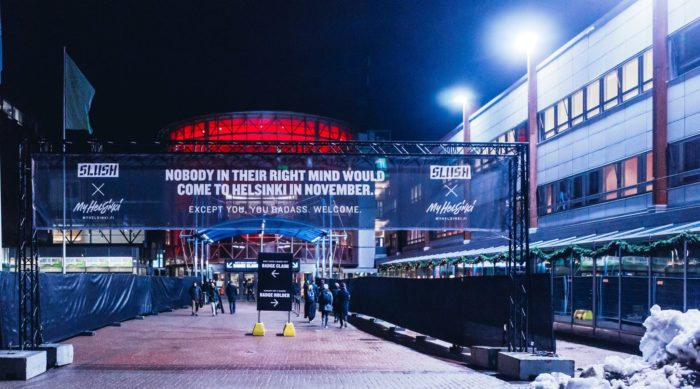
The Slush sign that went viral: “Nobody in their right mind would come to Helsinki in November. Except you. You badass. Welcome.”Photo: Petri Anttila/Slush

Wahrman, who founded the mobile game company TicBits in 2010 with his cousin Fredrik Wahrman, gives credit to Slush.

“Thanks to the contacts from that event, starting our own company was easy,” Niklas Wahrman says. “Ease of networking, providing contacts, sharing experiences and information with a group of peers as well as more experienced mentors. For me those were the main benefits of Slush.”

His company has been profitable every year, reaching revenue of more than one million euros in 2015. The success of games such as Crazy Kings attracted larger companies. TicBits was sold to Hong Kong-based Animoca Brands for 3.35 million euros last year.

Wahrman meets his tech-enthusiast peers again at Slush 2017. Since 2008 the event has grown 57-fold. It’s the biggest event of its kind in Europe, and it’s on its way to establishing itself as the most relevant startup gathering in the world.

Evolving in an ecosystem

Max Lilja, cofounder of Finnish heavy-metal cello group Apocalyptica, played an electric cello solo in the Slush 2016 opening show, much to the delight of an audience eager to record and share the moment on their phones.Photo: Kai Kuusisto/Slush

About 7,000 startup companies have attended Slush in the past nine years. They’ve received almost 850 million euros in venture capital funds via investments or pledges.

Slush also occupies a vital place in Finland’s startup market in general. Investments in 400 early-stage firms increased to 383 million euros in 2016, up 42 percent from the previous year, according to statistics from the Finnish Business Angels Network (Fiban).

“We want to enable the startups and investors to establish contacts that will benefit the whole ecosystem of Finnish startups,” Vikkula says. “This is one of the ways we can measure how well we do our job.”

Asked about Slush’s focus now and in the future, she says, “The main thing is to provide solutions to startup entrepreneur’s daily challenges, such as recruiting the best talent or how to get later-stage funding.” The latter has proven to be one of the most demanding steps for startups as they aim for growth, and will receive additional attention as Slush moves into its second decade.

By Nina Broström, November 2017

ThisisFINLAND Christmas quiz

Here’s a fun quiz about Christmas in Finland! Choose the right definition for each of the following Finnish words and tally your total at the end.

1.

Tonttu

a) Santa’s bad-tempered gnome sidekick (who thinks almost all kids are badly behaved)
b) an ancient Finnish winter god (worshipped at midwinter during the pre-Christian era as “the bringer of darkness”)
c) a mischievous but good-hearted elf-like mythological Finnish land spirit (most easily spotted around Christmastime when wearing a pointed red cap with a bell on top)

2.

Himmeli

a) a small bell hung from the antlers of a reindeer to help its owner find it in the dark (modern versions also have dangling reflectors)
b) a complex geometrical Christmas decoration made of straw (hung up well away from candles due to its extreme flammability)
c) a supernaturally spectacular display of the northern lights in the dark winter sky (often seen after New Year’s parties)

3.

Rosolli

a) Finland’s Christmas bird – the red-breasted snow finch (Robinus fennicus)
b) a cold Christmas dish made with chopped beets, apples and carrots (served with a topping of pink cream)
c) a decoration made of green branches adorned with bright red ribbons (hung outside the front door during the Christmas season to welcome visitors)
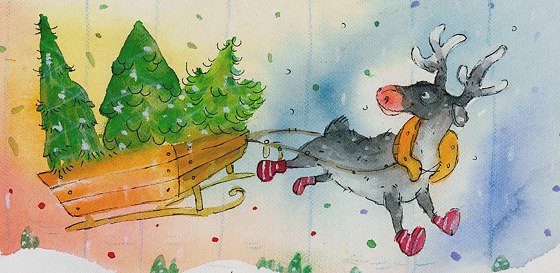
An illustration of a reindeer pulling a sledge filled with spruces.

To the Finns, whose country is 75 percent forest, these three trees look very different – and only one is a true Christmas tree.Illustration: Heli Pukki 

4.

Joulukuusi (“Christmas tree” – Which of the following is Finland’s traditional Christmas tree?)

a) Norway spruce (Picea abies)
b) Scots pine (Pinus silvestris)
c) Lapland larch (Larix lapponicus)

5.

Lanttulaatikko

a) a traditional winter dessert made of stewed lingonberries and leftover breakfast porridge (still popular in remote regions of northern Karelia)
b) star-shaped Christmas pastries filled with apple, prunes, fish or minced meat and rice (not all in the same pastry!)
c) a hot Christmas dish made of mashed rutabaga baked with breadcrumbs, butter, eggs, spices, salt and syrup (sweet-and-sour, Finnish-style!)

6.

Pikkujoulu (literally “Little Christmas”)

a) a special Christmas play performed by children (to help them remember the first Christmas in Bethlehem)
b) a popular outdoor communal carol-singing event (held a week before Christmas in town squares or other public places)
c) a workplace party arranged in November or December to enable colleagues to enjoy socialising, eating and drinking together (often with an emphasis on the drinking)

7.

Lipeäkala

a) a typical Nordic Christmas fish dish, made by soaking dried cod for several days in lye – a solution made with caustic soda or potassium hydroxide (yummy!)
b) a melancholy Finnish Christmas carol (sung quietly in candlelight to the accompaniment of a five-string kantele harp)
c) a traditional winter game played by children throwing stones or tightly packed snowballs across a frozen lake to make spooky noises (try it and listen!)
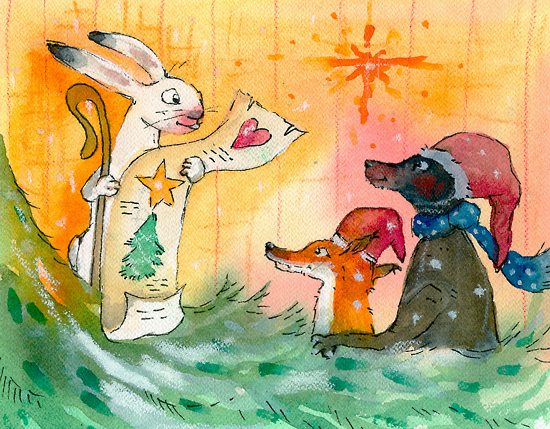
An illustration of a rabbit reading a scroll for a fox and a wolf.

Is this a secret recipe? A sermon? A sing-along? Or perhaps some other “piece” of Christmas?Illustration: Heli Pukki 

8.

Joulurauha

a) a special Christmas candle placed on the grave of a deceased relative (Finnish cemeteries are picturesquely filled with candles at Christmastime)
b) an aromatic oil made of pine resin and marshland herbs, used in the Christmas sauna (a central part of Christmas for most Finnish families)
c) the season of Christmas peace, ceremoniously declared on December 24 by the mayor of Turku (crimes committed during this period are penalised more harshly than usual)

9.

Glögi

a) a Christmas pudding made with layers of cranberry jelly, old rye bread soaked in milk, and sour milk curds sweetened with sugar (a kind of Finnish trifle)
b) a warm drink served at Christmas parties, made using red wine and/or berry juice, spices, raisins and almonds (also sometimes spiked with vodka)
c) Santa’s special Christmas sleigh, built to a design offering plenty of extra luggage space (for bulging sacks of presents)

10.

Jouluateria (Finland’s traditional Christmas meal – what dish most typically forms its centerpiece?)

a) roast turkey
b) roast ham
c) roast reindeer

Answers

Check your answers against the key below and add up the amount you got correct to find out how much you know about Finnish Christmas traditions:

1. c, 2. b, 3. b, 4. a, 5. c, 6. c, 7. a, 8. c, 9. b, 10. b

How many did you get right?

0–4 Never mind! Come and visit Finland soon to learn more about these colourful Christmas traditions!

5–7 Well done! You already have a grasp of Finnish Christmas traditions – or you may be on a lucky streak?

8–10  Onneksi olkoon! Congratulations! (Do you have Finnish blood?)

Hyvää joulua! Happy Christmas!

By Fran Weaver

A Finnish Christmas cookbook

Christmas is the most traditional of Finnish festivals. It is a time for family, close relatives and friends, and of course Christmas is many children’s favourite holiday.

While numerous new recipes have also found their way into the mix in many homes, the good old traditional dishes appear on the Christmas dining table year after year.

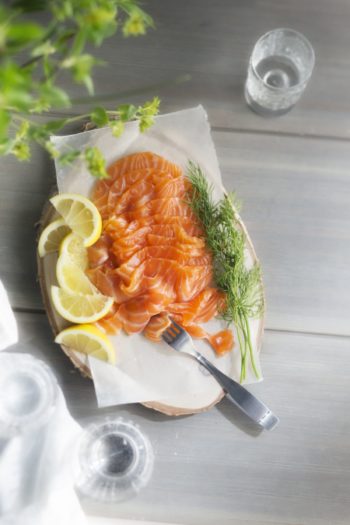
Freshly salted salmon
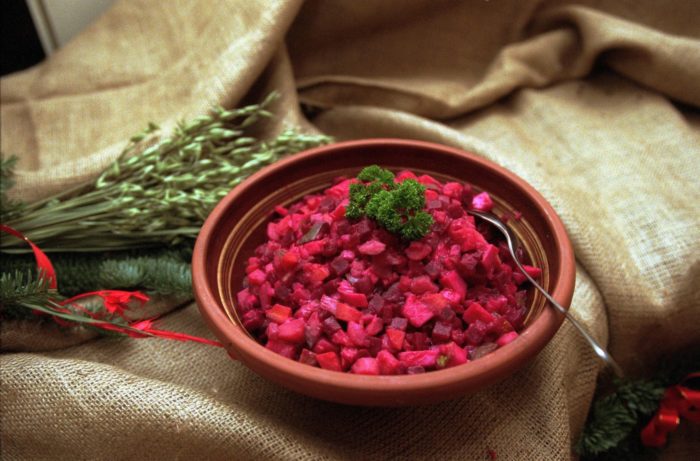
Rosolli salad
Casseroles
Glass Masters herring
Baked ham
Rice porridge
Mixed fruit soup
Christmas bread
Christmas pastries / Joulutortut
Gingerbread cookies / Piparkakut
Christmas glögg (mulled wine)

Freshly salted salmon

A platter contains slices of salmon and lemon, and sprigs of fresh dill.

Freshly salted salmon requires no sauce.Photo: Mirva Kakko/Otavamedia/Lehtikuva

Preparation time: about 25 minutes
Salting time: 1–2 days
Not suitable for freezing

  • Large piece of salmon, about 4 1/2 lb. (2 kg)
  • 2 tablespoons coarse salt
  • 1–2 tablespoons sugar
  • 1 tablespoon roughly ground white pepper
  • plenty of fresh dill

1. Fillet the salmon unless bought already filleted. Do not, however, remove the skin.
2. Wipe the fillets with paper towels without rinsing.
3. Sprinkle the bottom of a suitable sized dish with salt and place one of the fillets, skinside down, on the salt. Spread the seasoning over both the fillets, placing the other fillet, skinside up, on top. Sprinkle the rest of the salt and the dill over the fish. Cover the dish tightly with aluminium foil. Put a small weight on top and store in a cool place.
4. Scrape off all the seasoning and cut the fillets down to the skin into thin, oblique slices before serving.

Hint

Freshly salted salmon does not require any sort of dressing, especially when served at Christmas. However, mustard dressing goes very well with this dish.

Prepare as follows just before serving the salmon: Mix together 3 tablespoons of dark mustard, 2 tablespoons sugar and 4 tablespoons wine vinegar. Add 3/4 cup (2 dl) oil, preferably olive oil, in a thin stream while beating at the same time. Last of all, mix in plenty of finely chopped fresh dill.

Back to top

Rosolli salad

A bowl contains chopped pink and red vegetables.

Rosolli is a name for a salad based on pickled beetroot.Photo: Sari Gustafsson/Lehtikuva

  • 4 boiled potatoes
  • 4 boiled carrots
  • 4 boiled or pickled beetroot
  • 1 gherkin
  • 1 small onion, salt, white pepper

Dressing:

  • 1 dl cream
  • 1 tsp vinegar (10%)
  • 1 tsp sugar
  • (water the beetroot was cooked in)

Cook the vegetables (except for the onion!) in their skin well beforehand until just tender. Peel the vegetables and onion and cut them with the gherkin into small, equal-sized cubes. Mix them together and season with a little salt and white pepper.

Whip the cream lightly, season with sugar and vinegar and add a few drops of beetroot liquid for colour. Serve the dressing separately. (You can garnish the salad with hard-boiled eggs, the yolks and whites chopped separately and laid in stripes on the top.)

Back to top

Casseroles

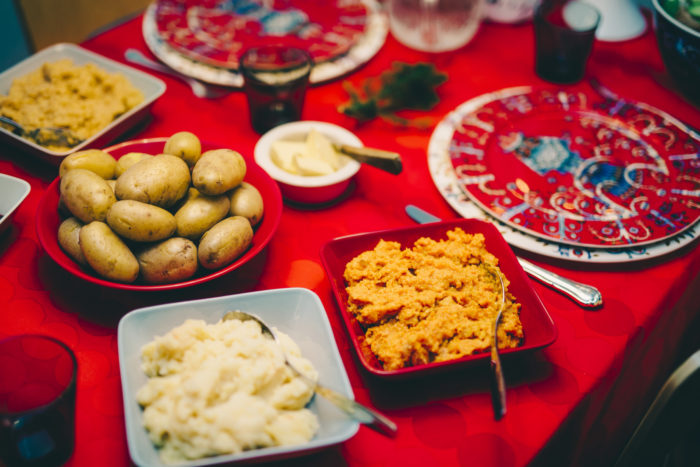
A festively decorated table has serving bowls full of vegetable casseroles and boiled potatoes.

Casserole dishes made from carrots, rutabagas and potatoes are tasty and easier to prepare than you might think (and boiled potatoes are ever-present). Photo: Jussi Hellstén/Visit Finland

Casserole dishes form the main hot dishes served at Christmas. They are very useful from the hosts’ and hostesses’ point of view because they can be prepared well in advance. They keep well for two or three days when stored in a cool place.

Homemade casseroles are nutritious and much easier to prepare than you would imagine, and also exceptionally economical.

Rutabaga casserole

Preparation time: 25–30 minutes
Boiling time for the rutabagas: 30–40 minutes
Cooking time: 1/2–2 hours
Oven temperature: 350°F (175°C)
Suitable for freezing

  • 2 large rutabagas, 3 1/2 lb. (about 1 1/2 kg)
  • 1 1/2 cups (4 dl) cream or mixture of cream and milk
  • 3/4 cup (2 dl) dried breadcrumbs
  • 1/3 cup (1 dl ) dark syrup
  • 1 egg
  • 1 1/2 teaspoon ground ginger
  • 1/2 teaspoon white pepper
  • 1/2 teaspoon grated nutmeg
  • 1 tablespoon salt

Coating: dried breadcrumbs, butter

1. Scrub and peel the rutabagas. Cut up into large pieces and boil in slightly salted water until soft.
2. Strain, keep the cooking liquid, and mash or blend the rutabagas in a kitchen blender.
3. Mix in the cream and dried breadcrumb paste, dark syrup, beaten egg and spices, and as much of the cooking liquid as is needed to give a loose soft consistency.
4. Turn into a greased baking dish, press the surface with a fork to make a pattern, sprinkle over a thin coating of dried breadcrumbs.
5. Dot the top with butter and bake in the oven.

Note: The flavour of the rutabaga casserole can be further enhanced by adding some lightly fried, grated onion.

Carrot casserole

Preparation time: 40 minutes
Cooking time: 20 minutes + 1 1/2 hours
Oven temperature: 350 °F (175°C)
Suitable for freezing

  • 3/4 cup (2 dl) rice
  • 1 1/2 cups (4 dl) water
  • 1/2 cup (1.2 dl) milk
  • 3 teaspoons salt
  • 3 lb. (1 1/2 kg) carrots
  • 3/4 cup (2 dl) milk or a mixture of cream and milk
  • 1/4 cup (50g) butter
  • 3 eggs
  • 1 teaspoon grated nutmeg
  • 1 tablespoon sugar
  • 2 teaspoons salt

Coating: dried breadcrumbs, butter

1. Boil the rice in the water and milk mixture and cook until the rice starts to thicken just a bit.
2. Peel and grate the carrots.
3. Mix the grated carrots, milk, melted butter, eggs and spices into the rice pudding.
4. Pour the mixture into a greased baking dish. Sprinkle with dried breadcrumbs and dot with butter. Bake in the oven until brown all over.

Back to top

Glass Masters herring

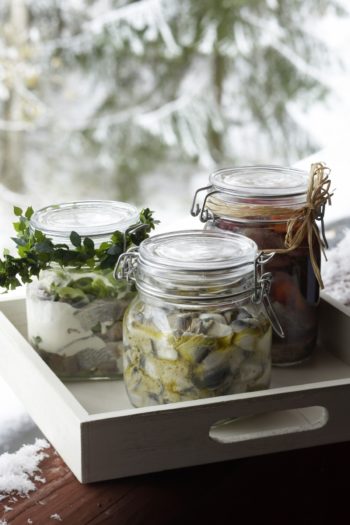
Several jars containing sliced herring sit on a tray in front of a window showing a winter landscape.

You may see several different varieties of marinated herring on the table at Christmastime.
Photo: Jarmo Wright/Otavamedia/Lehtikuva

Preparation time: 30 minutes
Soaking time: 12 hours
Marinading time: 2–3 days

  • 4 good-sized herrings
  • 3 red onions
  • 2 carrots
  • 30 whole allspice and white peppercorns
  • 4 bay leaves

Marinade:

  • 1 1/4 cups (3 dl) vinegar
  • 1 1/4 cups (3 dl) sugar
  • 2 1/2 cups (6 dl) water

1. Soak the fish overnight in cold water or equal portions of water and milk. The liquid can be changed occasionally.
2. Prepare the marinade; boil up all the ingredients and leave to cool at room temperature.
3. Remove the gut and inside belly membrane with, for instance, kitchen scissors. Rinse well and dry with paper towels. Cut up into shortish sections.
4. Peel the onions and carrots and cut into rings.
5. Fill a suitable glass jar with alternate layers of fish slices, onions and carrots, and the spices. Pour over the liquid.
6. Cover the jar and store in a cool place for at least two days. The herrings will keep for a couple of weeks in a cool place, but they are at their best after four to five days.

Hint

Different spices can also be used: thin slices of horseradish or celery seeds or mustard seeds. The fish can also be filleted and the skin removed. In that case, soaking is not required.

Back to top

Baked ham

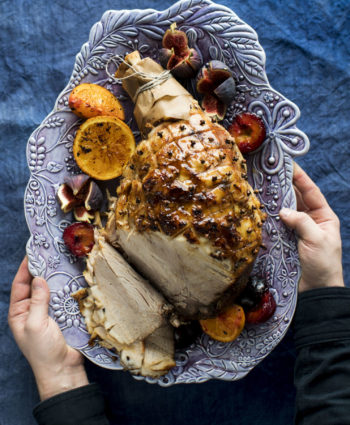
Two hands carry a platter with a large ham on it.

Baked ham is a Christmas mainstay for non-vegetarians.
Photo: Pekka Holmström/Otavamedia/Lehtikuva

Preparation time: 10 minutes
Cooking time: 45–55 minutes/2 lb. (1 kg)
Oven temperature: 250–300 °F (125–150°C) and 440°F (225°C)

  • Ready-salted ham 10–15 lb. (5–8kg)

Coating:

  • 2–4 tablespoons mustard
  • 2–4 tablespoons brown sugar
  • 2–4 tablespoons dried breadcrumbs

cloves for decorating

1. Place ham on a wiregrid in the roasting pan, skin side up. Push a roasting thermometer into the thickest part of the ham, making sure it does not touch the bone.
2. Put the ham in the oven. It is difficult to give a precise roasting time. It is best to go by the roasting thermometer. When it reaches 170 °F (77°C) the meat is cooked.
3. Remove from the oven and let it stand for a moment. Remove the skin and as much of the underlying fat as required.
4. Mix together the ingredients for the coating and smear over the ham. Put back into the oven at 440 °F (225°C) for ten minutes or until golden brown all over. Decorate the surface of the ham with cloves.

Note: If the ham is cooked at a lower temperature, less liquid will be lost and the meat will be much more succulent. Of course the lower the temperature, the longer the cooking time.

Variation

Many people consider that the meat will be much juicier if the ham is covered with a pastry crust. Prepare the pastry by mixing about 2 cups (800 g) rye flour in one litre of water. The pastry is then rolled out or patted over the surface of the ham to give a crust about 1/2 inch (1 1/2 cm) thick. No salt should be added to the pastry. If the ham happens to be too salty, the pastry crust will absorb the excess salt.

Hint

The meat juices that collect in the roasting pan can be used to make a tasty gravy. Be careful, however – it will be rather salty. One well-tried method is to mix in some applesauce flavoured with ground ginger and mustard, and serve together with the warm ham.

Back to top

Rice porridge

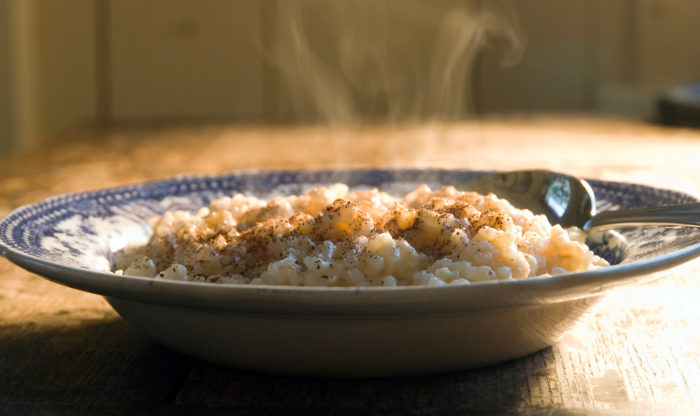
Steam rises from a bowl full of porridge.

For Finnish people, the holiday season is not complete without rice porridge.
Photo: Ingela Nyman/Vastavalo/Visit Finland

(for 10 people)
Preparation time: 10 minutes
Cooking time: 40 minutes
Suitable for freezing

  • 2 cups (1/2 litre) water
  • 6 cups (1 1/2 litres) milk
  • 1 1/4 cups (3 dl) rice
  • 1 1/2 teaspoons salt
  • 1 blanched almond

1. Add the rice to the boiling milk and water mixture.
2. Simmer until cooked. Add the salt and one blanched almond. Serve with ground cinnamon, sugar to taste, and milk.

Note: The almond is believed to bring good luck to the person who happens to get it.

Back to top

Mixed fruit soup

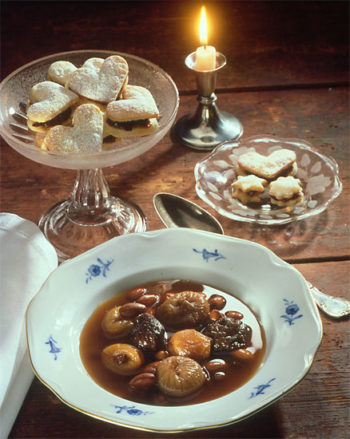
A bowl containing fruit soup is flanked by platters of cookies.

Fruit soup is a rare delicacy, but is not complicated to prepare.
Photo: Studio Fotoni

Preparation time: 5 minutes
Soaking time: overnight
Cooking time: about 15 minutes

  • about 1 lb. (400g) dried mixed fruit
  • 8 cups (2 litres) water
  • 3/4 cup (1 1/2 dl) sugar
  • stick of cinnamon
  • (dash of salt)
  • 3 tablespoons potato starch

1. Rinse the mixed fruit in cold water and leave to soak overnight in water containing a little sugar.
2. Boil the fruit in the soaking liquid with the cinnamon and a touch of salt if desired.
3. Continue to boil over a low heat until the fruit is fully cooked.
4. Transfer the fruit with a slotted spoon to the serving dish and remove the stick of cinnamon.
5. Thicken the juice: remove the pan from the heat, mix the potato starch in a little cold water and add in a thin stream to the liquid, stirring continuously. Bring quickly back to the boil without stirring.
6. Pour over the fruit and sprinkle a little sugar over the top.

Back to top

Christmas bread

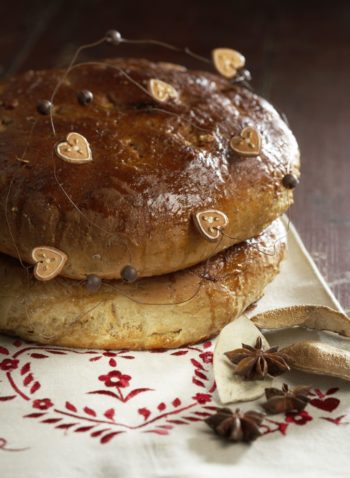
Two round loaves of bread are stacked on a tablecloth.

Tastes such as orange peel and caraway are found in this unusual, slightly sweet bread served only around the Christmas season.
Photo: Jarmo Wright/Otavamedia/Lehtikuva

(makes 3 loaves)
Preparation time: 30 minutes
Rising time: 1 1/2 hours altogether
Baking time: about 40 minutes
Oven temperature: 400 °F (200 °C)
Suitable for freezing

  • 4 cups (1 litre) buttermilk
  • 2 oz. (50 g) yeast
  • 3/4 cup (2 dl) dark syrup
  • 2 tablespoons grated orange peel
  • 1/2 tablespoon roughly ground caraway seeds
  • 1 tablespoon salt
  • about 3 cups (8 dl) rye flour
  • 1 1/2 cups (4 dl) graham flour
  • about 4 cups (1 litre) white flour

1. Warm up the buttermilk.
2. Crumble in the yeast and add the syrup and spices.
3. Mix in the flour and knead thoroughly. Cover with a cloth and leave to rise. If the kitchen is drafty, stand the covered bowl in warm water.
4. Divide the dough into three and shape each portion into a round loaf. Put in a warm place to rise. Prick with a fork before placing in the oven.

Back to top

Christmas pastries / Joulutortut

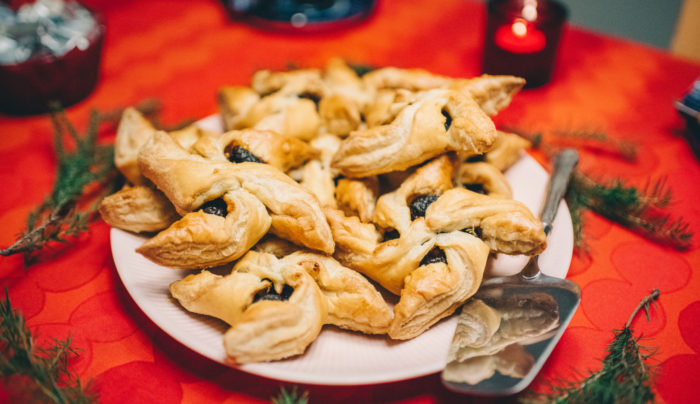
A festively decorated table contains a platter stacked with pastries.

These fluffy, star-shaped pastries are available at every store and café in Finland during November and December.
Photo: Jussi Hellstén/Visit Finland

Pastry:

  • 7 oz (200g) soft butter or margarine
  • 1 cup (2 1/2 dl) flour
  • 1/3 cup (1 dl) cold water
  • 1 teaspoon vinegar

Filling:

  • sweetened prune puree or plum jam

1. Put all the pastry ingredients into a bowl and mix quickly by hand into a dough. Don’t knead too much.
2. Put the dough to a cold place to harden.
3. Roll out on a floured board, folding a few times to make a puff pastry, and finally make a 1/2 cm thick sheet.
4. Cut the sheet into 7 x 7 cm squares. Split the corners of each square.
5. Place a bit of prune puree or plum jam in the middle of each square. Fold over every other split end onto the center, to form a windmill-like pastry.
6. Brush with beaten egg and bake at 450° F (250° C) until light brown. To make round pastries, cut into circles, fill, and fold in half. Bake as above.

Back to top

Gingerbread cookies / Piparkakut

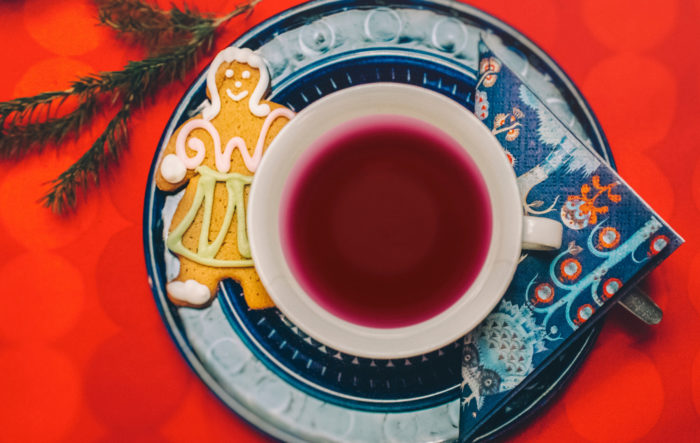
A view from above shows a cup of red liquid beside a gingerbread cookie shaped like a person.

Gingerbread goes great with a hot cup of tea, coffee or mulled wine.
Photo: Jussi Hellstén/Visit Finland

(makes about 200)
Preparation time: 30 minutes
Cooking time: 10 minutes per batch
Oven temperature: 400°F (200 °C)

  • 1 1/4 cups (300 g) margarine
  • 1 1/4 cups (300 g) sugar
  • 3 eggs
  • 1 cup (2 1/2 dl) dark syrup
  • 2 teaspoons ground cinnamon
  • 2 teaspoons ginger
  • 2 teaspoons ground cloves
  • 1 tablespoon grated orange rind
  • about 7 cups (1 kg) white flour
  • 3 teaspoons baking soda

1. Boil the syrup and spices, add the margarine and beat until the mixture is cool.
2. Beat the eggs and sugar.
3. Mix the soda in with part of the flour and then combine with the syrup-margarine mixture. Add the whipped eggs and the rest of the flour. Do not knead the final mixture.
4. Cover the dough with plastic wrap and leave overnight in a cool place.
5. Roll out the dough, cut up into shapes and bake the cookies in the oven until golden brown.

Back to top

Christmas glögg (mulled wine)

A hand holding a glass mug full of red liquid clinks it against another similar mug.

Many events during the holiday season include mulled wine, usually offered in a non-alcoholic version as well.
Photo: Sampo Korhonen/Otavamedia/Lehtikuva

  • 1 bottle of red wine
  • 2–3 tablespoons Madeira (optional)
  • 1/2 cup raw sugar, or to taste
  • 1/3 cup raisins
  • 1–2 sticks cinnamon
  • 5–6 whole cloves
  • peelings from an orange
  • 1/4 cup blanched, slivered almonds
  • 1/4 cup vodka to spike it up (optional)

In a large kettle, combine all the ingredients except the vodka. Heat slowly, until the drink is steaming hot. Stir every now and then, and taste with a spoon whenever you feel like it. Do not let the drink get even close to boiling. Just keep it warm. Before serving, add vodka if you wish. You can also make a non-alcoholic version using grape juice, blackcurrant juice, apple juice, cranberry juice, or a mixture of juices – if so, you can probably leave out the sugar, too.

Back to top

Finnish Arctic weather expertise takes trip to Pacific tropics

In February 2016, the strongest tropical cyclone ever recorded roared through the South Pacific. With winds of 285 kilometres (175 miles) per hour, Cyclone Wilson devastated small, low-lying islands, causing 1.2 billion euros in damage. Forewarning is the key to surviving such a storm, and the Finnish Meteorological Institute (FMI) has been working with Pacific island nations to develop critical weather forecasting and warning services.

“This is really a unique area of the world,” says Matti Eerikäinen, project manager at FMI. “It is spread over a very wide area, and there can be huge distances between islands.”

Additionally, many of the islands are barely above sea level. Australian researchers have concluded that the sea in the area is rising by about ten millimetres (0.4 inches) annually, and climate change could result in stronger storms. The combination could see storm surges entirely overwhelm some islands.

“The collection and distribution of information is extremely important,” Eerikäinen says, “not just to protect property, but also to protect lives.”

The benefits of better forecasting

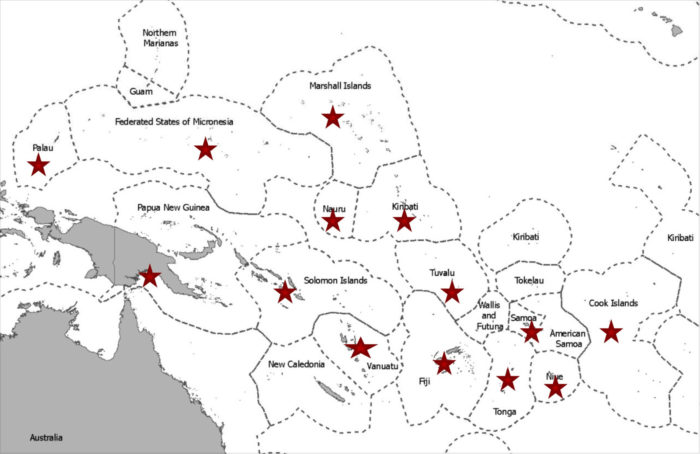
FINPAC project coverage stretches over 14 countries: Cook Islands, Federated States of Micronesia, Fiji, Kiribati, Marshall Islands, Nauru, Niue, Palau, Papua New Guinea, Samoa, Solomon Islands, Tonga, Tuvalu and Vanuatu.Map courtesy of FINPAC

The result is the Finnish-Pacific (FINPAC) project, coordinated through the Secretariat of the Pacific Regional Environment Programme (SPREP) and supported by the Finnish Ministry of Foreign Affairs using development cooperation funds [full disclosure: the ministry also produces ThisisFINLAND]. The four-year project concluded in the summer of 2017.

Salesa Nihmei, a meteorology and climate officer of SPREP based on Samoa, explains that the project covered two main goals: to improve weather forecasting and to use that information better together with the local villagers.

“We wanted to reduce the vulnerability of the Pacific island countries’ livelihoods to the effects of climate change,” says Nihmei. “We improved the capacity of the countries’ national meteorological services to deliver weather, climate and early warning services. We did this in cooperation with the International Federation of Red Cross and Red Crescent Societies, for the benefit of villagers in Pacific communities.”

Blizzards and typhoons

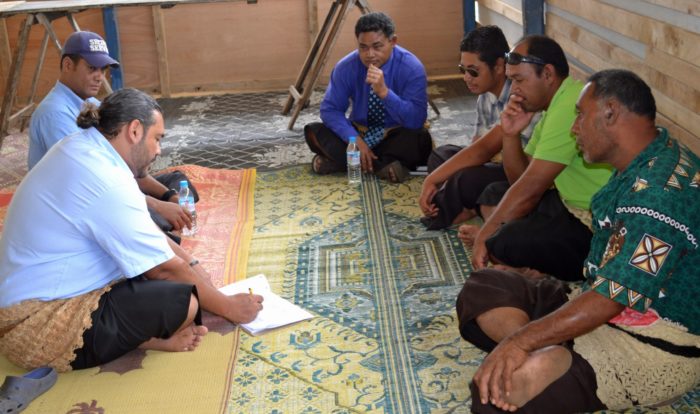
The director of Tonga Meteorological Services, Ofa Fa’anunu (left foreground), talks with members of the community on Mounga’one Island. Photo: SPREP

You might wonder what Finnish meteorologists, who are used to dealing with blizzards and frozen seas, know about forecasting weather in the sunny South Pacific. Can expertise in foretelling snowfall translate to predicting typhoons?

“No, no,” Eerikäinen answers, laughing. “Forecasting tropical weather is indeed different from forecasting Finnish weather. We just provide the tools – they know their own weather.”

The tools include both automated and manual weather observation stations. FMI helped fix some old ones and also supplied spare parts. Additionally, it provided the SmartMet meteorological display system and SmartAlert severe weather warning system.

“The local meteorological services can use SmartMet for general weather forecasting,” Eerikäinen says. “They get lots of data on one platform, which they can digitally modify for forecasting in new formats. SmartAlert provides warnings in a standard map format. Third parties can use this information and update their own systems. People can get warnings delivered to Google Maps on their smartphones.”

Villagers get involved

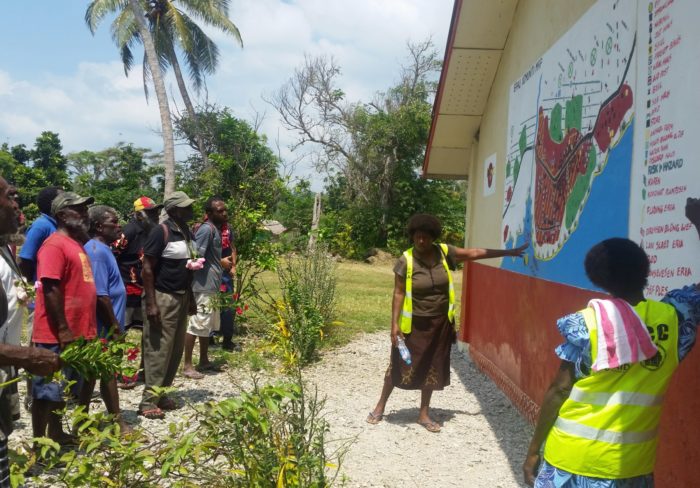
In Epau, Vanuatu, community members discuss a risk map painted on the wall of the local school, showing potential flood areas, landslide danger and other information relevant to evacuation plans.Photo: SPREP

Yet FINPAC wasn’t simply a technical solution. Local meteorologists were trained in using the systems, but improving weather forecasting is no help if that information can’t be used effectively. One key was the involvement of news organisations.

“We also brought the media together with the meteorologists,” Nihmei says. “They discussed the opportunities and challenges of weather information and how to provide it in simple terminology or translate it into their own common languages.”

Local communities were involved in the entire process, all the way from initial planning to the installation of systems. The Red Cross helped with preparedness, emphasising the need to designate responsibilities during a storm and explaining how to tie down roofs. Large signs were erected detailing emergency numbers, how to gauge wind strength and which routes to take during evacuations.

“This was really a unique project,” Eerikäinen says. “We’ve never implemented a project down the whole value chain before and are very pleased with how it turned out. Finnish development aid is based on sustainability, so we are keen to continue support and build capacity in the region.”

By David J. Cord, November 2017

Sending Santa letters in Finnish Lapland

Do you ever wonder where all those letters that children write to Santa Claus wind up? In Finnish Lapland, of course, at Santa’s Main Post Office – and right next door, you can meet Santa himself. We pay him a visit.

On the Arctic Circle, at 66.5 degrees north latitude, Santa Claus runs his very own post office with the help of his elves. Located outside the city of Rovaniemi in Finnish Lapland, Santa’s Main Post Office forms a logistics centre for the more than half a million cards, letters and packages he receives each Christmas. He gets more than 30,000 a day during the holiday season.

As everyone knows, Santa Claus makes his home farther north in Finland, on a mountain called Korvatunturi. However, his special magic also allows him to be in Rovaniemi much of the time, all year round, for people to meet him.

Writing to Santa

Santa Claus sitting in a rocking chair by a fireplace; a Christmas tree in the background.

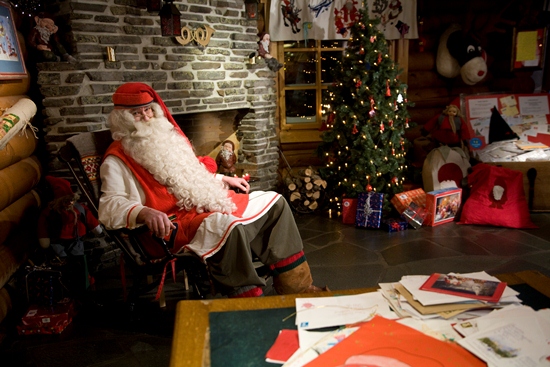
Santa Claus takes a break after reading a pile of letters in his post office in Finnish Lapland. Photo: VisitRovaniemi.fi

Letters to Santa Claus form an important part of Christmas preparations for many Finnish children, especially the smaller ones, but it’s not limited to a certain age group. The letter to Santa represents a genre unto itself, with subgenres ranging from messages from kids who have just learned to write (“Dad, how do you spell ‘Santa Claus’?”) to longer compositions by somewhat older children.

Although the specific content of the letters Santa receives is of course confidential, our elf sources tell us that subjects often range beyond the obvious holiday gift wishlists. Writers trust Santa with their thoughts about life and whatever troubles the world is experiencing at the time of writing, and some also ask for advice.

Our contacts among the elves also say that grown-ups, not just kids, are interested in Santa. People of all ages write to extend holiday greetings or to express profound wishes that go beyond Christmas presents, such as world peace. On a lighter note, if you visit Santa’s Main Post Office you will find out that a great many toddlers have – at the suggestion of their parents, no doubt – sent their soothers (also known as “pacifiers” or “dummies”) to Santa Claus as a sign that they have outgrown them.

Something about Santa strikes a chord that is appreciated by people of all nationalities – he has received mail from 198 different countries to date. Perhaps because of this, he and his elves form an impressively multilingual bunch.

Meeting Santa

Depending on your viewpoint, this video is either cute or too sugary, but it does show you what Santa’s office looks like.Video: Santa’s Main Post Office and City of Rovaniemi

Santa’s Main Post Office makes up part of a cluster of buildings known as Santa Claus Village. The Arctic Circle cuts through the middle – it is painted onto the pavement.

One building houses Santa’s “office.” You enter through a vaulted room where a giant pendulum swings back and forth. Labelled “Earth’s Rotational Speed Regulator,” this enormous piece of clockwork gives you an impression of the magic and mystery Santa draws upon in order to get around the globe and deliver billions of presents on a tight deadline.

Upstairs, elves usher you into a chamber and – there he is, Santa himself, with a long white beard, looking just like he does in all the pictures. He greets the kids and gives the grown-ups a hearty Finnish handshake. When the author of this article visited with a group consisting of about 20 people from as many different countries, Santa chatted with us in a wide variety of languages.

You don’t need Santa’s magical insight to figure out that everyone who passes through will want a photo opportunity. A photographer elf snaps away, immortalising the moment. They even have a live webcam so anyone can take a peek as Santa receives guests.

No matter what time of year visitors arrive to see Santa and his post office, he and his elves are bound to fill their hearts with genuine, long-lasting Christmas spirit. That’s what it’s all about.

By Peter Marten

In Finnish climate change film, the future still exists

What can one person do? Why doesn’t everyone feel like I do? What can we do now for the future? British Finnish director John Webster asked himself these questions while planning and filming the documentary Little Yellow Boots: A Story for the Future. An unusual climate change movie, it makes a wide range of viewpoints readily accessible by placing interviews alongside a story Webster tells about his own family.

“Sometimes there’s a film subject and there’s this inner need to make it,” said Webster to a DocPoint Festival audience in Helsinki. Planning for Little Yellow Boots began in 2010 and the editing process concluded a few days before the American presidential election in November 2016. That event’s repercussions, such as the US decision to withdraw from the Paris Agreement on climate change, have only made the film even more topical.

Recognising that climate change is essentially connected with loss, Webster includes details in the film of how, at the age of 12, he lost his father to a stroke. He talks to his mother and his wife. He also invents Dorit, his own hypothetical great-granddaughter, born in 2063.

He intersperses his own story and his messages to Dorit with appearances by environmentalists, coal miners, researchers, scientists and others. By showing something as universal as a family, and by placing several generations of his own relatives in the movie, Webster encourages audiences to empathise with all the different people in the film and to be receptive to its discussion of climate change.

What will your world look like?

Watch the trailer for Little Yellow Boots: A Story for the Future.

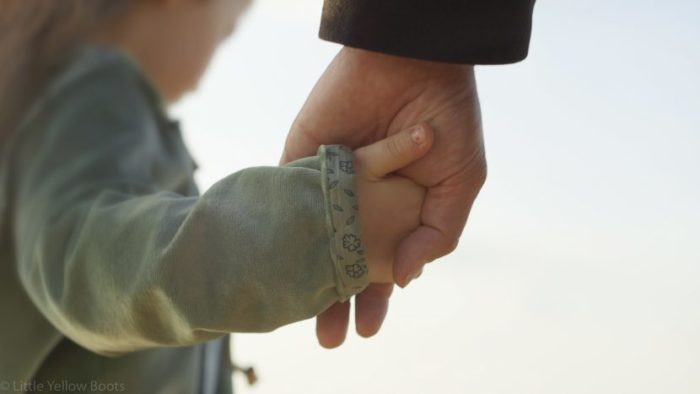
The boots of the title belong to Dorit, and they reappear throughout the movie in shots where a new water level is superimposed on present-day footage: a North Carolina neighbourhood with streets, lawns and fire hydrants below the waterline, or a half-submerged car parked under a highway overpass in New York City.

“What will your world look like the year you are born, about half a century from now?” Webster’s narrating voice asks his great-granddaughter. “When I was born there were three billion people. You will share this planet with nine billion. Your world will also be warmer than mine by about two degrees. It doesn’t sound like much, but it is significant on this watery planet.”

From there, he sets out to see what the world will look like in the future, to find out who will be affected by climate change and to observe how people are reacting in the 2010s. He covers a lot of ground, from the Arctic islands of Svalbard to the Marshall Islands in the Pacific.

He attends a UN Climate Summit in New York. He takes a train across the US with a group of activists, and also crosses Russia by rail to talk to coal miners in Siberia, engaging passengers in conversation as he goes.

It’s not like the world goes on forever

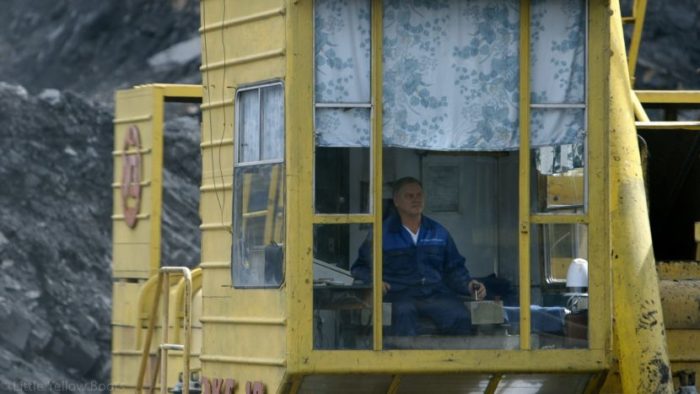
“Nature itself is telling us to use [coal],” says miner Alexander Chunaryov in the Kuznetsk Basin region of Siberia.Photo: Tuomo Hutri     

“Siberia does feel endless,” says Webster during an interview at his office in Helsinki. It’s in a building built in 1904, just a couple blocks from the shoreline. “When I took the train,” he says, “day after day, all these trees, and I’m like, what am I worrying about? It’s easy to lose the horizon, to feel that the world goes on forever. But it’s not like that.”

While making Little Yellow Boots, Webster says he found himself asking (and here he switches to an exaggerated voice, like a comedian imitating an actor in a Shakespeare play), “Why? Why don’t they see it like I do?”

Some of the people we meet in his film do seem unworried by the damage being inflicted on the environment. This influenced his approach. “I thought it was healthier to turn the question the other way around,” he says. In other words, why doesn’t he feel like those other people?

This mind-set leaves him open to a wide variety of viewpoints. “Nature itself is telling us to use [coal],” miner Alexander Chunaryov tells him in Siberia, implying that, otherwise, there wouldn’t be so much coal within relatively easy reach.

Another miner, Alexander Klimov, says, “We’re building something more important than clean air: society. And the next generation will find a way to clean the air.”

Some of the coal from the region helps power Webster’s own city in Finland, he notes in a voiceover as we see an aerial view of a train, a river and an open-pit coal mine, each of them cutting a path through the landscape. On board the train, he tells a man called Mikhail, “I’m making this film for my great-granddaughter in the future, because I’m worried that her world will be worse than mine and there is something I could do about it and I’m not doing it.”

Mikhail, who is a great-grandfather himself, replies, “I think you are overestimating yourself in this respect.”

One person out of many

Making Little Yellow Boots allowed director John Webster to address his hypothetical great-granddaughter, Dorit, born in 2063.Photo: Tuomo Hutri

Is there anything one person can do? Many of the people Webster meets are trying. He covers the UN Climate Summit of 2014 in New York during a speech by poet Kathy Jetñil-Kijiner, who comes from the Marshall Islands, a Pacific nation severely endangered by sea level rise. She recites a powerful poem in the General Assembly, moving the dignitaries to a standing ovation.

In an interview, she tells Webster, “What am I going to do, tell [my baby daughter], Give up?…You want to believe that things will get better.” Her poem includes the line, “We deserve to do more than just survive.”

On the train across the US, Webster talks with African American activist and grandfather Carl Anthony about not giving up. By “allowing despair to enter into your psyche,” Anthony says, “you end up hurting the people that you love the most” – your family. He’s here, he explains, because his ancestors didn’t despair during generations of slavery. “They found within themselves whatever it took to maintain the hope.”

Webster is careful to tell me that he’s not comparing his own setbacks with those of African Americans. However, Anthony’s philosophy still fits the subject. “Throughout the film, different people talk about family, the next generation, what you pass on,” says Webster. “You cannot necessarily see now where things will go.”

He wants Little Yellow Boots to inspire discussion. The even-handed film presents the challenges of climate change, drawing viewers into the conversation without concealing the sobering facts.

“If you are watching,” he says to Dorit in his voiceover, “the one thing I would most want to tell you is that I thought about you, Dorit, and the world you will live in.” Spoiler alert: Webster isn’t giving up. Before the closing credits, he tells her, “I am hopeful for you and your future.”

Refusing to give up is a step in the right direction.

By Peter Marten, November 2017

Maija Kauhanen combines modern beats with folklore elements and powerful singing

“Kantele isn’t a typical band instrument, and at some point I realized that there’s no point in waiting for others to ask me to join their bands. So I formed my own”, Maija Kauhanen recalls the start of her solo career.

Maija Kauhanen is a Finnish one-woman band, singer, songwriter and player of kantele, the Finnish traditional chord instrument.

The Finns have a special bond to the sound of kantele: it’s in our DNA, and most of us have played the instrument in pre-school. But outside of Finland the sound is less familiar. After touring the world with her music, Kauhanen has found that after concerts people often want to take photos and touch the instrument. When asked to describe the instrument, Kauhanen often describes kantele as a mix of harp, guitar and sitra.

Maija Kauhanen’s songs require concentration from the audience as they can last up to ten of fifteen minutes.

“People are used to hearing songs that are around three minutes and are constructed in a certain way”, Kauhanen says.

“My songs are not like that, and if you’re in a very hectic state of mind you might have a hard time focusing on my music. But you just have to embrace the fact that this might take a while and let your spirit run free.”

Finnish teens put art to the test

In cooperation with museums, theatres and concert halls, Art Testers sponsors and arranges two events per school year for each participating class – one event close to home and the other farther away.

Known as Taidetestaajat in Finnish and Konsttestarna in Swedish (also one of Finland’s official languages), the project has funding confirmed until summer 2027. With approximately 60,000 students per grade, more than 500,000 children have participated (while between the ages of 13 and 15) since the programme began in 2017. With these numbers, Art Testers professes to form the biggest art review in the world.

Solving the logistical challenges is the responsibility of a nationwide network of coordinators from the Association of Finnish Children’s Cultural Centres. One of them is Helsinki-based Siiri Oinonen.

“Art Testers came about in celebration of Finland turning 100 in 2017,” she says. The country gained independence in 1917. “When the Finnish Cultural Foundation was first established in the 1930s, youngsters went around collecting donations door-to-door. The capital they raised formed the core of the foundation, and this project is a way of giving something back to young people.”

Seeing red

Knowing where to draw the line: Students from Meilahti Upper Secondary School went to see The Red Line, a theatre performance by Timo Ruuskanen (left) and Tuukka Vasama of the Red Nose Company.Photo: Tero Ahonen

In autumn 2017, eighth-graders from Meilahti Upper Secondary School in Helsinki attended Punainen viiva (The Red Line), a theatre performance by Red Nose Company. In the spring the students travelled to another theatre event in Lahti, about 100 kilometres (60 miles) northeast of the capital.

Art teacher Marita Brace appreciates the scope of the project: “I often take my students to galleries, but they have chosen to study art and are motivated. Art Testers, on the other hand, allows students with little or no previous experience of art to engage with it. It’s also very equal, since students from regions with fewer cultural options get to travel for an art experience – sometimes quite far.”

Funding for Art Testers comes from the Finnish Cultural Foundation and the Swedish Cultural Foundation in Finland, which have announced that they will continue only until summer 2027. A survey by the former found that 97 percent of schools would go to art institutions more often if it was cheaper.

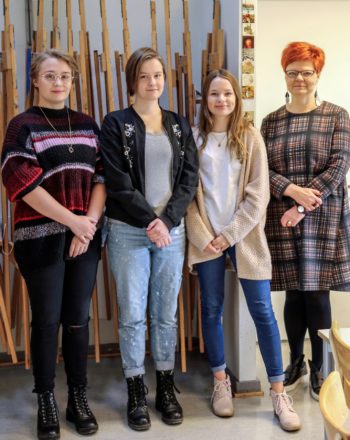
Eighth-graders Jenna, Pihla and Aada have all enjoyed being part of Art Testers. It’s nice to have learning experiences outside of school sometimes,” says Pihla. Although all three are experienced theatregoers, it was a positive new experience to see something they didn’t choose themselves.

Filling in the blanks

From left: Jenna, Pihla and Aada line up with their teacher, Marita Brace, in front of a row of easels in their school’s art classroom.Photo: Joanna Nylund

“The play was…different,” says Jenna, and smiles. “A little hard to understand, but also interesting for that reason. It made me think.”

Aada agrees: “The actors wore clown masks the whole time, and that was interesting because it made me use my imagination more, to fill in the blanks.”

Before an event, students receive material to prepare them for what they are about to experience. Afterward, teachers are free to continue processing reactions with the students. However, the main focus is on giving feedback online.

After attending an event or exhibition, the teens fill out a quick survey on the Art Testers website, which receives praise all around. “They seem to understand what appeals to this age group,” says Brace.

The students agree. “The survey questions felt relevant, like what our mood was afterwards and if we’d consider going back,” says Pihla. They were also satisfied that giving feedback online didn’t require a lot of additional writing on their part.

Inspiring questions, feelings and thoughts

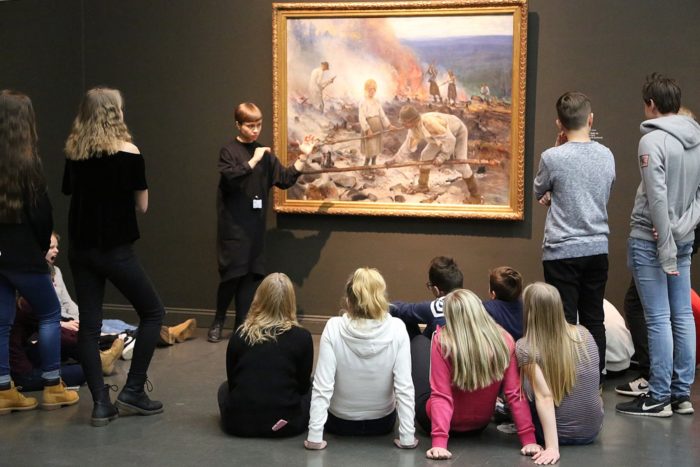
A group of teenage students listen to a guide reveal the secrets of Eero Järnefelt’s Under the Yoke (Burning the Brushwood) from 1893, one of Finland’s most famous paintings, during an Art Testers excursion to Helsinki’s Ateneum Art Museum.Photo: Jani Kivelä/Art Testers

The results are displayed in animated graphs on the Art Testers public website. Under “What feelings did the art inspire?” a heart fills with colourful stripes corresponding to choices such as “happiness,” “whatever” and “peace,” each accompanied by a percentage.

Students can also write additional comments. Ranging from “Really loved it” to “I fell asleep,” the comments provide interesting reading.

Oinonen hopes that the art venues involved will make use of the feedback when planning future events. “One of the purposes of art is to raise questions, to help us feel and think new things,” she says. “These events all have adult audiences in mind. We have, of course, made sure that the subject matter is suitable for eighth graders, but we are not dumbing anything down. We want to challenge the students a little, but also make it easier for them to seek out art on their own.”

Aada, Jenna and Pihla all recommend Art Testers. “I really appreciate art and would like others to have the chance to discover it as well,” says Jenna.

By Joanna Nylund, November 2017, updated October 2025