Tero Saarinen takes the right steps

Dancer and choreographer Tero Saarinen’s unique work combines movement and images to take audiences to another dimension.

Saarinen joined the Finnish National Opera Ballet School at the age of 18 and became a member of the adjacent professional company in 1985. Despite his rapid success he soon felt he wanted to explore other possibilities of expressing himself as a dancer.

In 1988 he won the gold medal at the Paris International Dance Competition with B12, a solo that renowned dancer and choreographer Jorma Uotinen created especially for him. This became Saarinen’s breakthrough and realisation that he was finding his own way and taking the right steps. “With my dance I want to reach the unspoken, the inexplicable, the unnamed,” Saarinen explains. “I believe in dance that touches, in dance that speaks for itself.”

But he still needed to explore further. In 1992 he took off for Japan and Nepal to study dance through cultural heritage. In his own choreography, Saarinen feels he can come up with something “very poignant, essential and cohesive about us humans” by studying archetypes and typical situations.

Human psyche

Saarinen’s interest in the human psyche is strongly reflected in his work. He says he gets his ideas from living and observing life. He values “seemingly mundane acts and emotions” above all and pinpoints them in his work.

He refers to human beings’ ancestral knowledge: “We should not neglect being aware of the lives lived before us –and for us. Our minds and bodies have been given a rich inheritance by our ancestors that we should be aware of and nourish.”

Saarinen’s choreographies are a wonderful blend of contemporary and classical dance, martial arts and influences from Japanese butoh dance and spiritual rituals, often combined with live music and always accompanied by strong visuals.

Watching Tero Saarinen Company is like taking a journey into the subconscious of the human mind. Saarinen explains that dancers and choreographers have “a privilege and possibility to connect with the ritual essence of dance – man’s eternal desire to connect with oneself,” a connection he considers essential for his work.

By Carina Chela, May 2011, updated October 2012

Finns help startups reach New York

A new programme called Nest New York provides young companies with everything they need to set up shop in Silicon Alley.

Petra Söderling logs in to a social networking website and posts a picture of her company’s new office. “Top floor plus rooftop!” she writes. She has good reason to use an exclamation point: Few brand-new Finnish companies can boast of a Manhattan address.

Söderling obtained the space through Nest New York, a programme designed to help young technology companies gain a foothold in the important American market. The programme is backed by an impressive list of partners including Aalto University in Finland and the New York City Mayor’s Office.

“We offer coworking space in the heart of the New York tech centre Union Square,” says Ismo Rantala, the head of the project. “But we also offer all the necessary business service partners, such as business and immigration lawyers, public relations partners and whatever starting companies need. In addition, we have an accelerator programme, where a company can get mentoring, help with venture capital, and even pilot customers.”

Capital of digital marketing

|||Photo courtesy of Petra Söderling

Petra Söderling of Mobile Brain Bank found office space in Manhattan and other services for her company through Nest New York.Photo courtesy of Petra Söderling

At the heart of the project is a dual need: Many of the high-tech companies in New York have difficulty finding talent, while Finnish technology firms must break into an international market to expand. It was a perfect match for Söderling’s company, Mobile Brain Bank, which offers mobile application engineers to business customers looking to outsource development.

“It is an ideal market for Mobile Brain Bank’s services,” says Söderling. “I chose New York because it is the capital of digital marketing and finance, and also because many large companies have a presence there.”

She enjoys being able to book meetings downtown without having to find her away around New York’s concrete canyons. She also receives other services from Nest New York.

“I had a clear idea of what type of services I needed, and the guys were able to offer good providers to fill those needs,” says Söderling. “I have set up a US company, opened a bank account and am looking into immigration policies and housing through their services. Through Nest’s contacts I have been able to find customers and leads for sales representation.”

Individualised services

Companies interested in participating in the programme have to meet specific criteria. Rantala says that revenue and size don’t matter, but the company has to be ready to enter the tough New York market. They have to believe that the company has a chance to succeed and that Nest New York can help. Each company is different, so the service can be individualised.

|||Photo: david.nikonvscanon, flickr.com, cc by 2.0

Green light, big city: Nest New York aims to give companies a foothold in the tough conditions of the Big Apple.Photo: david.nikonvscanon, flickr.com, cc by 2.0

“Sometimes this might mean just offering a desk,” explains Rantala. “Sometimes this means a full-time commitment to building the company. In this case we talk about possible equity purchases or investments to make it interesting and successful for both sides.”

Fees vary upon what the young firm needs. If it only wants office space, it could rent a desk for 500 dollars per month. If it wants the full accelerator programme, fees are agreed upon separately.

Demand has been high. Rantala says they have already served about ten companies and have ten more currently in the programme, with an additional twenty expected during the autumn. Queries are coming in from other northern European nations as well as Finland. Interest has been so great that Nest New York is now looking at setting up a similar operation in Palo Alto, California.

Rantala notes that Finland “brought the world cell phones, the sauna, our education system and xylitol [a natural sweetener that does not cause tooth decay]. Maybe the Finnish, hard-working Nest model will be the next big thing to nurture future success stories.”

By David J. Cord, September 2012

A taste of the Åland Islands

New businesses are springing up based on treasured traditions as Finland’s autonomous archipelago province Åland rediscovers and savours its local culinary heritage, including fruit, fish, beer and pancakes (recipe below).

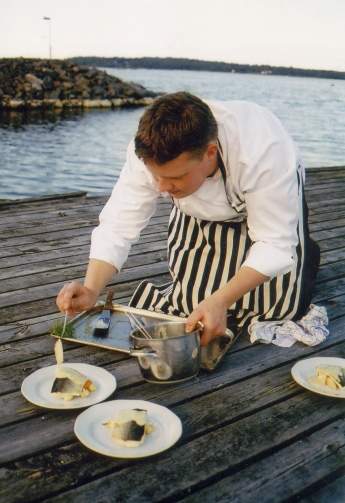
Michael Björklund, a prize-winning celebrity chef familiar to TV viewers in both Finland and Sweden, has gone back to his roots on the Åland Islands, west of the Finnish mainland, to set up Smakby (Taste Village). This culinary centre for Åland has an idyllic setting beside the medieval Kastelholm Castle and the picturesque outdoor museum Jan Karlsgården, which celebrates local rural building styles.

“At Smakby we want to celebrate Åland’s culinary traditions, which are a bit different from elsewhere in Finland, with more influences from Sweden and from Russia,” Björklund says. “I want my kids and their generation to learn the old ways to make food, so they can enjoy the tastes and smells I remember from my childhood.”

Land of milk and honey

2586-michael_b_4-frmbjorklund-550px-jpg

Photo courtesy of mickesmat.ax

“Åland has fertile soils that formed on the sea bottom,” Björklund continues. “Our climate is also a bit different, with a cool spring but a long mild autumn, so vegetables like potatoes and asparagus and fruits like apples, strawberries and buckthorn grow slowly, concentrating the taste wonderfully!”

The restaurant at Jan Karlsgården already serves home cooking featuring taste-packed local ingredients, but Björklund enthusiastically explains his ambitious plans to expand Smakby into an artisanal complex that will be both a tourist attraction and an educational facility – with a seasonal hotel doubling as accommodation for student chefs.

“We already have plans to start making honey and producing the local apple brandy Ålvados here,” says Björklund. He is also collaborating with the local cooperative dairy ÅCA in order to produce specialist cheeses, butter and ice cream at Smakby. “We’ll then start making organic Åland sausages and traditional smoked ham – and revive local fish dishes like golden smoked Baltic herring and locally caught zander.”

Björklund is pleased that Åland farmers are increasingly going organic: “There are many small producers here – which is great for chefs like me interested in quality more than quantity. Small is beautiful!”

Slow food and slow beer

2586-rokta_abborrar_maria_haggblom_2011_aland-550px-jpg

Photo: Maria Häggblom/Visit Åland

Åland provides many food and drink products to mainland Finland – including tangy cheeses, creamy butter, potato snacks, dark Åland malt-bread, and scrumptious cloudy apple juice.

Åland microbrewery Stallhagen is also increasingly exporting a range of tasty ales produced applying Czech and German techniques in a charming country location 15 kilometres north of Åland’s capital Mariehamn.

“We’re proud of our concept of ‘slow beer,’ which involves giving fermenting beer much more time to develop its taste, unlike most of today’s industrially mass-produced beers,” says Christian Ekström, who manages Stallhagen brewery’s gastropub.

“We’re more interested in quality than volume, and we also want people to take time to savour our beer, together with good food and the cultural events we organise here,” adds Ekström. Local fish, game and lamb dishes feature on the menu of the rustic Pub Stallhagen, which is becoming increasingly popular among islanders and tourists.

Ekström’s own favourite brews include Stallhagen’s Czech-style pilsner and a smoky Baltic porter produced according to an old local recipe. A diver in his free time, Ekström recently recovered several bottles of nearly 200-year-old beer and champagne from a Baltic shipwreck. Experts are currently analysing the bottles’ contents, and Ekström hopes to recreate the tastes that people around the Baltic enjoyed in the early 19th century.

His dream very much reflects the Åland islanders’ rediscovery of the joys of local food and drink.

Recipe: Åland Pancake

This deliciously filling local snack and dessert is popular in homes and cafés throughout the Åland Islands – especially with cycling tourists keen to recharge their calorie count. (Thanks to Pettas Organic Home Bakery for advice on the recipe.)

2 dl (4/5 cup) semolina (some islanders use the same amount of pudding rice instead of semolina)
1 dl (2/5 cup) wheat flour
1 litre (4 1/4 cups) whole milk
2 or 3 eggs
1 tsp salt
1 dl (2/5 cup) sugar
2 tsp cardamom
Serves 4 to 6 people

Heat the semolina in the milk for a few minutes to a porridge consistency, and let it cool down. Mix eggs, sugar, salt and cardamom separately, then stir this mixture and the flour into the semolina.

Pour the mixture into a baking dish greased with butter, and scatter a few small knobs of butter over the top of the pancake. Bake 50 to 60 minutes at 200 degrees Celsius (390 degrees Fahrenheit), until the surface of the pancake is golden brown.

Serve hot or cold topped with whipped cream and stewed prunes or jam (popular jams in Åland are made of local apples, strawberries, rhubarb or buckthorn berries).

By Fran Weaver, September 2012

Urban treasure hunting with an Aalto app

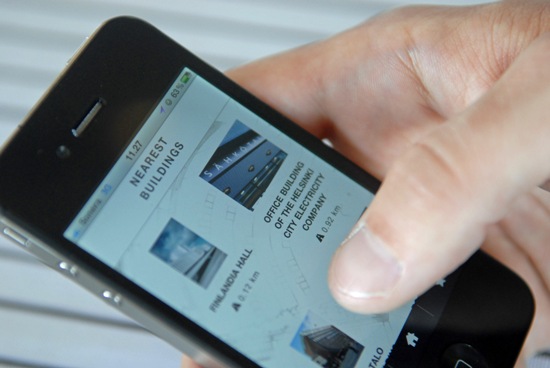
For the many people who visit Finland with an eye on architecture, a new smartphone app called AALTOsites makes it easy and fun to discover landmark buildings by Alvar Aalto in Helsinki, in neighbouring Espoo and soon in the central Finnish city of Jyväskylä, as well.

“I just met a Japanese family visiting Finland who wanted most of all to see Aalto’s house and studio, and then the Moomin World theme park in Naantali,” says Tomi Summanen with a grin. He works as mobile services producer at the Alvar Aalto Museum.

The first-ever mobile application from a Finnish museum, AALTOsites, takes you on an urban treasure hunt.

Available in English, Spanish, Finnish and Swedish, the free app shows you where the closest Aalto buildings are; then provides a succinct background to help appreciate each one. Photos and drawings, more than 150 in total, illuminate each location. AALTOsites incorporates unpublished rarities, including sketches from the visionary architect’s notebooks.

“The app functions as a stand-alone exhibition of Aalto’s work,” says Summanen, who produced the app along with a small Helsinki software firm. “We’re always trying to bring awareness of his work to new people through new platforms.” A year in the making, AALTOsites was released in June 2012 in conjunction with the city’s year as World Design Capital.

Inventor, adventurer and designer

2296-dsc_9274b-550px-jpg

The AALTOsites app acts as a guide to Aalto’s architectural creations in the Finnish capital.Photo: Sinimaaria Kangas

Like the designer himself, the museum has always enthusiastically embraced new technology. In 1994, it became the second museum in Finland to enable virtual visits through the new medium of the worldwide web.

“A few years later, Encyclopaedia Britannica picked our site as one of the world’s ten best – maybe because it was cool and minimalist and black-and-white at a time when everyone was trying to be as colourful and busy as possible,” says Summanen.

That same philosophy applies to AALTOsites, which lets you post your location and comments on Facebook – but so far not on Twitter or foursquare. “We wanted to keep it simple for now,” says Summanen.

Aalto himself was also quick to adopt new technologies.“In 1924 he and his wife Aino left for their honeymoon by airplane, which was a big deal in those days. He was very curious about new technologies and held many patents for inventions of his own, particularly for furniture production.” AALTOsites spotlights his product designs, such as the iconic Savoy Restaurant vase and Artek’s three-legged stools.

Summanen notes that, surprisingly, the furnishings and structures of most of Aalto’s buildings in Helsinki lack protected status. While the Alvar Aalto Foundation was consulted about the ongoing renovation of his 1958 House of Culture, it has recently expressed concern over plans to modernise the iconic Academic Bookstore.

Let’s get lost

2296-dsc_9335b-550px-jpg

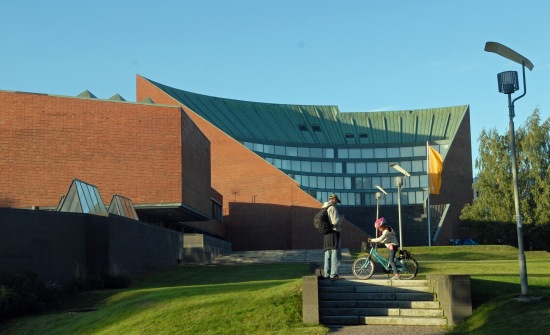
Alvar Aalto designed this building – and its lampposts – for the University of Technology campus just west of Helsinki. In a fitting turn of events, the institution now forms part of Aalto University.Photo: Sinimaaria Kangas

Away from the downtown locations, AALTOsites guides you to three buildings in the leafy Munkkiniemi neighbourhood, including the Aalto family home. On the other side of the Helsinki city line, in Espoo, you find the classically inspired campus of the University of Technology – now fittingly renamed Aalto University.

One of the most useful elements of the app is an offline map. Its locator does not require internet access – though nowadays open wifi networks cover much of the city centre.Summanen is working on an iPad version, as well as a Jyväskylä section and a Japanese version.

So far, AALTOsites is only available for Apple and Android handsets. “A Windows Phone version would be quite a big investment, and there are still relatively few users,” says Summanen. “Of course, we’d welcome any ideas about cooperation.”

By Wif Stenger, September 2012

Finland tests Baltic oil-spill readiness

Finland leads a major international exercise testing readiness to clean up oil spills in the Baltic Sea.

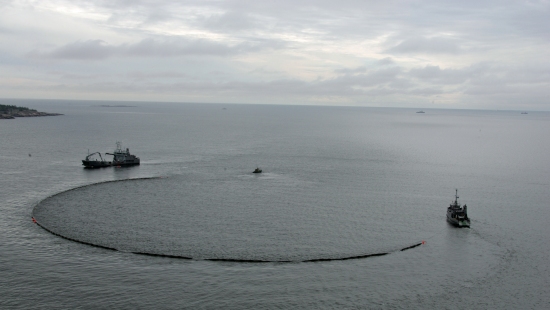
The grey waters of the Gulf of Finland south of Helsinki are dotted with ships and boats towing booms, scoops, brush-rollers and skimmers designed to remove spilt oil from troubled waters. The Finnish multipurpose pollution response vessel Louhi practises firefighting by spraying water over a target boat, as a Finnish Air Force helicopter buzzes past above them, overseeing the action.

The annual Balex Delta oil-spill response exercises, coordinated by HELCOM (the Helsinki-based international Baltic Marine Environment Protection Commission) are among the largest worldwide.

“About 250 million tonnes of oil are transported through the Baltic every year, mainly from the Russian end of the Gulf of Finland, and these figures are rising fast,” says Bernt Stedt of HELCOM. “It’s vital for the coastal countries to maintain a joint rapid oil-spill response capacity, so we run exercises for our international HELCOM fleet of 70 response vessels to test procedures and identify scope for improvement.”

High risks in the Gulf

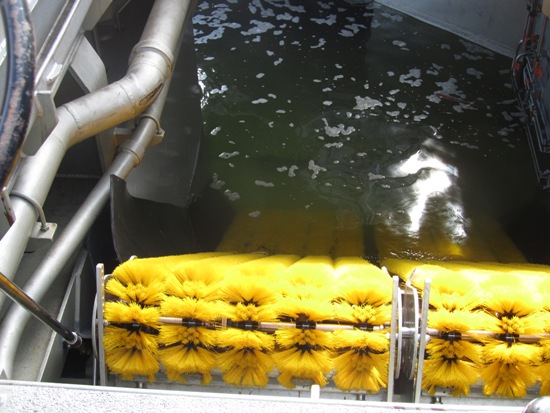
In addition to booms that can be lowered into the water, the Finnish vessel “Louhi” contains brush-rollers and other specialised equipment for containing and removing oil spills.

In addition to booms that can be lowered into the water, the Finnish vessel “Louhi” contains brush-rollers and other specialised equipment for containing and removing oil spills.Photo: Kati Tahvonen/SYKE

Each year one of the members of HELCOM – the countries around the Baltic Sea – host the Balex Delta exercise. When Finland last hosted the exercise involved a simulated 15,000-tonne oil spill in a high-risk zone in the Gulf of Finland, where passenger ferries and freighters shuttling between Helsinki and Tallinn cross the courses of oil tankers heading west from Russian ports. In parts of the exercise peat was spilt into the sea to simulate oil slicks. Popcorn was previously used in such trials, but it tended to be gobbled up too quickly by hungry seagulls.

Finland’s participation is led by the Finnish Environment Institute, the national pollution control authority (known by its Finnish abbreviation SYKE).

“SYKE runs a 24–7 hotline for oil-spill alerts. One of our three main vessels is always ready to respond to a spill within four hours,” says SYKE response commander Kalervo Jolma. “Cleanup efforts on the first day are vital. We reckon on a maximum of three days to act before oil becomes too dispersed to recover.”

State-of-the-art Finnish response fleet

Closing the loop: Boats tow oil-containment equipment in HELCOM’s oil-spill readiness drill on the Baltic Sea.

Closing the loop: Boats tow oil-containment equipment in HELCOM’s oil-spill readiness drill on the Baltic Sea.Photo: Finnish Boarder Guard

“Finland’s national response fleet of oil-recovery vessels is equipped with state-of-the-art technologies,” says Jolma. “Our strengths include the ability to recover oil even in problematic icy conditions. The completion of a brand new multipurpose pollution control vessel will further improve our response capacity.”

Many of the vessels practising cleanup procedures in the gulf use booms, skimmers and brushes bearing the logos of the Finnish company Lamor, a leading global producer of oil-spill recovery equipment.

All hands on deck

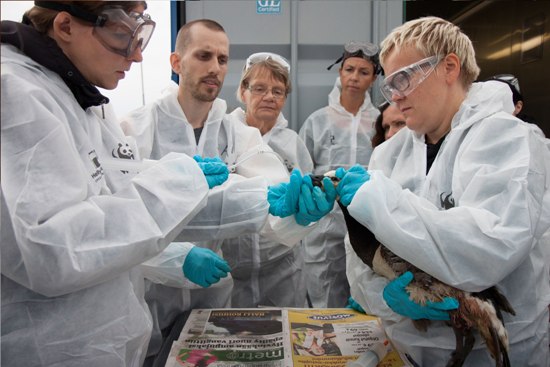
With a veterinarian present to supervise and instruct them, WWF volunteers increase their oil-spill readiness by practising tubefeeding a bird. (No wildlife was harmed during the exercise.)

With a veterinarian present to supervise and instruct them, WWF volunteers increase their oil-spill readiness by practising tubefeeding a bird. (No wildlife was harmed during the exercise.)Photo: Alexandra Antell/WWF

Baltic marine and coastal ecosystems are highly sensitive to oil pollution. SYKE’s expertise on environmental protection is vital during oil-spill emergencies. The aim is always to recover as much oil as possible offshore, to minimise cleanup costs and ecological damage.

The Balex exercise also rehearses responses to ecological impacts. “It takes many pairs of hands to collect oil from polluted shores and to clean oiled birds,” says Jari Luukkonen of WWF Finland. “WWF have a network of more than 6,000 volunteers prepared to help, including hundreds trained to clean beaches or oiled birds.”

In addition to Finland, other members of HELCOM include Denmark, Estonia, the EU, Germany, Latvia, Lithuania, Poland, Russia and Sweden. The participating organisations emphasise that such exercises play a vital role by testing everyone’s readiness, and highlighting each country’s capabilities to help out their neighbours.

By Fran Weaver, September 2012, updated July 2015

How Finnish robots could save the world

ZenRobotics, an environmentally conscious Finnish startup, is bringing in robots to help save us from drowning in waste.

A colossal sign atop a building near Helsinki Central Railway Station marks the headquarters of ZenRobotics, an award-winning startup company that has steadily gathered media momentum since its appearance in 2007. Its product is a highly intelligent robot whose “brain” is inspired by that of a human, making the waste recycling process more efficient than was ever thought possible.

“We all know the world is drowning in waste and resources are running out,” says Jufo Peltomaa, marketing director at ZenRobotics. “Why isn’t the same amount of passion and expertise expended on the end-of-life logistics of a product as is consumed in making it? Why is the products’ life cycle linear instead of circular? Factories spew out endless amounts of new things every day, of which 98 percent ends up in landfills within six months of purchase. Most materials – such as metal – could be redirected back to production.”

Peltomaa believes that after five years of vigorous development and piloting of ZenRobotics’ groundbreaking product, world domination of robots could finally be around the corner. “Robots are no longer the future – they are here,” he says.

With an increasing amount of big names jumping onto the bandwagon – the latest addition is Kone Corporation’s customer experience director Juho Malmberg – and with the first major deals being signed, Peltomaa might just be right.

Mad chorus of maniacal laughter
3278-zrr_with_waste-550px-jpg

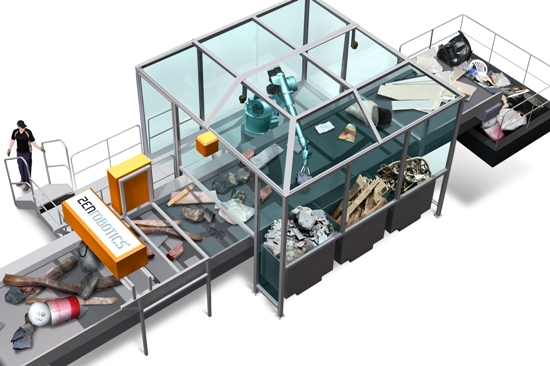
As the waste rolls by on a conveyor belt, the robot moves different kinds of recyclables into various bins.Illustration: ZenRobotics

The ZenRobotics website, marketing and media releases are far from ordinary – they are tongue-in-cheek creations. They may refer to the company’s experts as a “mad chorus of world domination doctors” or quote the CEO as commenting, “Mwbrahahahaaaaa!” (a representation of maniacal laughter).

All that could inspire mockery, were it not for the fact that the ZenRobotics team of experts, all at the top of their fields of research, are developing a seriously useful product that has yet to find a rival.

“When we started ZenRobotics, we applied some practical experience from Hybrid Graphics Ltd, the previous successful technology company Tuomas [Lukka, present director of research] and I were in previously,” says Peltomaa. “We consulted a couple of hundred customers in order to find out where robotics could best help them. From micro-assembly to shipyards, it soon became clear that they all had the same problem: Dealing with objects that a robot is unable to grasp or recognise due to their complex and ever-changing 3D shape.”

“The idea to concentrate on recycling had its origins in this realisation, for various reasons. For one, it’s easier to get funding for ecological projects, as they are considered increasingly important. Recycling also forms a current megatrend, as it attracts media attention and all companies want to develop their green strategies. Combining recycling with robotics – another megatrend on the rise – seemed like a perfect match. And personally, we love both.”

ZenRobotics Recycler represents the brainchild product of extensive research, whose foundation is based on principal scientist Harri Valpola’s groundbreaking 20-year study of neurobiology and machine learning.

The product is currently designed for construction and demolition waste only, but plans for the future include all kinds of solid waste, including commercial metal waste and hazardous waste. As recycling requires separating raw materials from waste, the task is currently too complex for conventional robots and thus mostly done by humans, often manually and in very dangerous conditions.

Clever people, clever robots
3278-dr_harri_valpola_zrr_bins_3000pix-550px-jpg

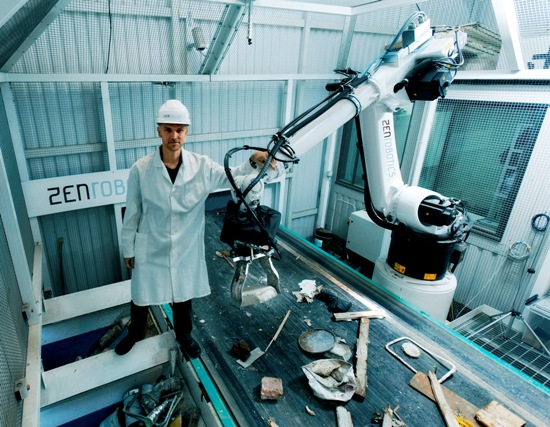
Getting a grasp on the future: ZenRobotics Recycler can discern recyclable objects and separate them from other rubbish.Photo: ZenRobotics

Whereas conventional industrial robots usually have very few sensors and work in simple, predefined conditions with uniform objects of the same material, ZenRobotics Recycler’s “bioinspired” control system uses numerous sensor inputs. This means it functions similarly to the human brain, with a trial-and-error capability to learn from its mistakes and improve at its task.

The ZenRobotics Brain will, in the long run, form a coherent overview of the situation and reclaim or remove materials from the waste stream as needed. This is unheard of in the robotics world, although we may think otherwise after having watched too many sci-fi films. Peltomaa emphasises that there has never been such a diverse and accurate analysis of waste before. “We are truly revolutionary in this field.”

You’re either with us or against the world

Although a ZenRobotics Recycler robot will cost you an estimated one million euros, the market is there and so are the customers. After running pilot projects with Sita Finland (a subsidiary of Sita Environnement, a world-leading water and waste management company), ZenRobotics is starting to sign deals with customers around the world.

If all goes according to plan, we may see a cleaner, better world soon, a world where robots do the most tedious, hazardous jobs for free without complaint and work round the clock.

Perhaps that will help us humans concentrate on using less, thinking about what we buy and enjoying what we have.

A planet is drowning in waste and dramatic music, but there is hope for the future.

By Anna Leikkari, September 2012
Summer adventure in Helsinki

The best way to get the most out of a new city is to see it with a local guide. Our video provides that experience by taking you to our favourite places in the Finnish capital.

Jump into this insider’s guide to the Finnish capital. Music by Sami Nenola & Markku Mäkelä/TopBillin. Video: Gustavo Alavedra

Helsinki is buzzing with activity right from early morning to late at night. And you never know what you might find if you are blessed with a sense of adventure and curiosity. You can enjoy brunch in an industrial setting, dance salsa in a park, run into a water fight on a beach and party in a boat while cruising past the Helsinki coast at sunset. Press play and hop onto this tour of our Helsinki.

By Amanda Soila, August 2011

Samba in the heart of the Finnish summer

Every summer the streets of Helsinki turn into a blur of colours, rhythms and dancing bodies as samba schools from around the country compete in the annual Helsinki Samba Carnaval. Our videographer joined the party to capture the exotic atmosphere and find out how this Brazilian tradition has settled happily up here in the far north.

The samba event, arranged in Finland, gathers in the vicinity of 20,000 spectators in downtown Helsinki. Over a thousand dancers of all ages take to the streets to show their talents and costumes under the bright northern summer sun. As the caravan wound its way through the city we met Annami Nieminen, a dancer in the samba school União da Roseira and vice member of the board of the Association of Samba Schools in Finland, to find out more about the relationship between Finns and the samba.

Finns feel the samba. Video: Gustavo Alavedra

By Gustavo Alavedra, June 2011