A long and fit working life

With the population ageing and the baby-boom generation starting to retire, more attention is being given to employee well-being in Finnish working life. How can employees be encouraged to stay on at work right up to pensionable age, while staying fit and active? Solutions are being found at national and workplace level. Even better, action to boost well-being at work is proving to be an investment that benefits companies and their staff.

A few years ago, Lassila & Tikanoja Plc, a company engaged in environmental and property maintenance, woke up to the fact that incapacity to work was causing the company enormous costs and that the challenge posed by an ageing workforce would be a key competitive factor in the future.

“Direct staff-related costs account for about half of our total expenditure, so ensuring the working capacity of our personnel is an absolutely crucial element in our future success,” explains director Jorma Mikkonen.

Containing the cost of disability

In Finland, responsibility for dealing with and paying for occupational health and work disability is shared among many different actors. Big companies are required by law to provide for occupational health services, the Social Insurance Institution (KELA) deals with per diems and benefits that come under general social security, and companies handle pensions through their own pension foundations or one of several pension insurance companies. Every person resident in Finland is entitled to municipal healthcare services. The various cash flows and cost sources are complicated and difficult to follow within both society as a whole and individual companies. Research by Guy Ahonen published in 2004 indicated that work disability generated about 10 billion euros in costs every year, 2.5 billion of this in the 500 biggest companies.
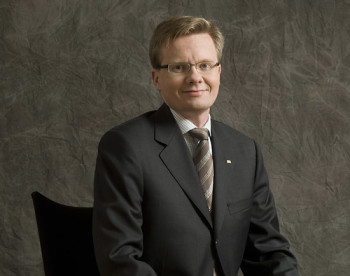
Jorma Mikkonen: economic losses from work disability were enormous.

Jorma Mikkonen: economic losses from work disability were enormous.Photo: Lassila & Tikanoja

“Here at Lassila & Tikanoja, we started to calculate the economic impact of work disability in 2005. It was a huge job digging out all the actual costs, but one well worth doing. We found that the company’s economic losses from work disability were about 20 million euros a year. That’s an enormous sum – nearly 40% of our net profit,” says Mikkonen.

The contributions for employment-related pensions paid by Finnish employers are at 11 levels, the lowest being 20% of total payroll and the highest 31%. The percentage a company has to pay depends on the level of its work disability costs during the two previous years. That means action to promote employee health and working ability can have a substantial impact on business costs.

“With our cost structure, there is a drift of about 14 million euros in pension contributions,” explains Mikkonen. “So the conclusion to be drawn was obvious: investing in maintaining and raising work capacity was definitely worthwhile.”

Fit on retirement

Lassila & Tikanoja has devised a work capacity management programme called Sirius, aimed at ensuring that as many employees as possible stay fit and healthy right up to normal retirement age.

“Today, companies are financially responsible for staff work disability, yet have no effective way of managing what this costs. Expensive decisions are made elsewhere, and companies just have to pay up. At L&T we launched a programme that allows us to actively influence these costs,” Mikkonen continues.

The processes of work capacity management are anchored in an accounting approach that treats realized costs as investments and constantly measures the financial impact of action taken.

The range of measures available to Sirius is extensive. One of the programme’s most important dimensions was a new agreement under which the nationwide company’s entire occupational health services were put into the hands of a single provider. This speeds up and simplifies employee tests and treatments, spreads good practices efficiently, and generates a central bank of information about staff healthcare challenges and needs.

Another important investment is in work safety and ergonomics.

“Nowadays, we pay serious attention to correct working positions and lifting and handling technique. For instance, if the driver of a waste collection truck jumps down from the cab onto a slippery street dozens of times a day, his joints aren’t going to last him till he retires. He has to take a bit longer and use steps,” explains Mikkonen.

L & T places staff in suitable jobs

The company supports sports and leisure activities that help prevent health problems and keep employees fit. Supervisors are encouraged to intervene as soon as possible in problems with intoxicants and mental health, for instance, and to help employees find suitable treatment and rehabilitation. Employees unable to do their previous jobs because of waning strength or injury are actively helped to find other work within the company and if necessary retrained for it.

“Employees who can no longer cope with their previous jobs are treated at L & T as ‘key clients’ and we do everything we can to find them, or specially tailor for them, suitable work. Relocation is always a more financially sound option for the company than premature retirement. Many companies don’t seem to realize this,” says Mikkonen.

For such cases, the company has special Sirius instructors who help employees to get used to new tasks and arrange support services when necessary. The plans are formulated jointly by the employee, the supervisor and a doctor. Most employees are keen to make the move to different work. Lassila & Tikanoja has even developed completely new services manned partly or entirely by staff with some impairment.

The margin earned on these services does not need to be very great, because the company is already making a significant profit from the fact that they are still workers and not pensioners.

For special situations there is also a crisis fund called ‘Medi-Heli’ after an emergency helicopter service of the same name. If necessary, this can used when swift decisions are needed to save work capacity and health, for instance to pay for fast private-sector surgery on an injury sustained in an accident.

Work capacity aid targeted beyond the ongoing quarter

“In the Sirius programme, the most important factor is the change in attitude. Top management monitor how the programme is used and its effects extend to every supervisor and worker. We used to think of money spent on occupational health as a cost, but now it’s viewed as an investment. The financial indicators see it that way, too: an additional spending of 2 to 3 million euros on staff work capacity can yield 10 million in cost savings, and that has a significant impact on competitiveness and profits,” Mikkonen sums up.

Labour shortage will become a problem. No company can afford to waste able hands. For comparison, Mikkonen says that Lassila & Tikanoja can easily spend 60 million euros a year on machinery and equipment, and no-one questions the sum.

Half of the workforce will be retiring during the next 10 years. Finnish labour is a shrinking natural resource that should be better taken care of.

“People shouldn’t be treated like machines that are used until they break down and then replaced. This isn’t obvious if you look at things by the financial quarter, but we are investing in well-being in the long term.”

Markku’s injured leg doesn’t stop him working

Back to work after lengthy sick leave

L & T maintenance man Markku Pihlakari was injured about four years ago in a fall when a ladder slipped from under him. His leg was operated on several times and he went through rehabilitation, but he was unable to return to outdoor work such as snow clearing and gritting because the leg is too stiff to enable him to operate the machinery. After a long sick leave Markku was found a completely different job in charge of the loading bays at a large shopping centre.

“I have to make sure the loading bays are kept clean and in order, and advise the cleaners and shop staff on waste handling,” Markku explains.

The Sello shopping centre houses over 160 shops. It has to deal with enormous volumes of goods, and if the whole system is to work efficiently and safely it is vital for nothing to be left lying around. It’s Markku’s job to ensure this, and both customers and the fire inspector are satisfied.

“People aren’t disposables, and Lassila & Tikanoja understand that. It’s good to see a company that meets its responsibilities and looks after its people.” says Markku Pihlakari.

Lassila & Tikanoja Plc

The Finnish listed company Lassila & Tikanoja Plc specializes in environmental maintenance and support services for real estate and properties. Its turnover is in excess of 500 million euros and it employs some 9,500 people. L&T also operates in Sweden, Latvia, Russia and Norway.

By Salla Korpela, January 2008
Finlandia by Jean Sibelius

Finlandia is probably the most widely known of all the compositions of Jean Sibelius. Most people with even a superficial knowledge of classical music recognise the melody immediately. The penultimate hymn-like section is particularly familiar and soon after it was published the Finlandia Hymn was performed with various words as far afield as the USA.

In the autumn of 1899 Sibelius composed the music for a series of tableaux illustrating episodes in Finland´s past. The tableaux were presented as a part of the Press Celebrations held in November that year. The celebrations were a contribution towards the resistance to the efforts to increase Russian influence in the then autonomous Grand Duchy of Finland. The music culminated in a stirring, patriotic finale, “Finland awakes”.

The music made an even deeper impact later in the year, when four of the parts, including “Finland awakes”, were performed again in concert. “Finland awakes” soon came to be in great demand as a separate concert piece and Sibelius revised it in the following year, giving it the title Finlandia, as suggested in a letter from an anonymous admirer. (Sibelius later came into closer contact with this fan, Axel Carpelan, who became an indefatigable supporter and a self-appointed fund-raiser.)

Finlandia became a symbol of Finnish nationalism. While Finland was still a Grand Duchy under Russia performances within the empire had to take place under the covert title of “Impromptu”.

In Finland the Finlandia Hymn was not sung until Finnish words for it were written by the opera singer Wäinö Sola in 1937. After the Russian aggression against Finland in 1939 (The Winter War) the Finnish poet V.A. Koskenniemi supplied a new text, the one that has been used ever since. Sibelius arranged the Hymn for mixed choir as late as 1948.

Listen to the Finlandia Hymn on YouTube.
Video: Tarja M/Gulo Film

Finlandia

Finland, behold, thy daylight now is dawning,
the threat of night has now been driven away.
The skylark calls across the light of morning,
the blue of heaven lets it have its way,
and now the day the powers of night is scorning:
thy daylight dawns, O Finland of ours!

Finland, arise, and raise towards the highest
thy head now crowned with mighty memory.
Finland, arise, for to the world thou criest
that thou hast thrown off thy slavery,
beneath oppression´s yoke thou never liest.
Thy morning´s come, O Finland of ours!

(This translation of Koskenniemi´s text is by Keith Bosley. It is included in Bosley´s superb anthology “Skating On the Sea – Poetry from Finland” published by Bloodaxe Books – (ISBN: 1 85224 388 0) and in Finland in co-operation with the Finnish Literature Society.)

© Keith Bosley and Bloodaxe Books

Eero Saarinen: architect for a new world

Eero Saarinen and his father Eliel were prominent architects of the 20th century. Eero’s memory is being currently honoured by a grand exhibition that opened in Helsinki in 2006 and will close at Yale University in 2010, after touring in Europe and the United States.

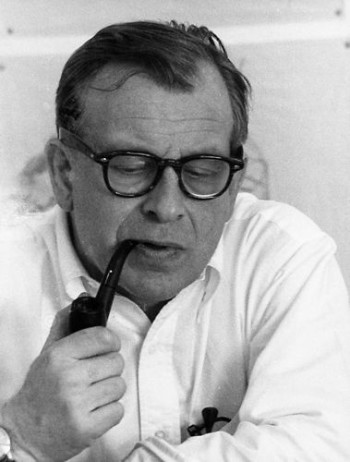
Eero Saarinen 1910-1961.

Eero Saarinen 1910-1961.Photo: Balthazar Korab Ltd.

Born in Finland, Eero Saarinen became an American but Finns still think of him as one of their own. For one thing, his name is as Finnish as Sean Murphy is Irish, and, famous Finnish Americans are relatively few and far between.

Eero Saarinen’s greatest works were created in America where they remain and are admired still as emblems of mid-century modernity, in the homeland of modernity that gave the world mass produced automobiles, refrigerators, TV channels, skyscrapers and Elvis.

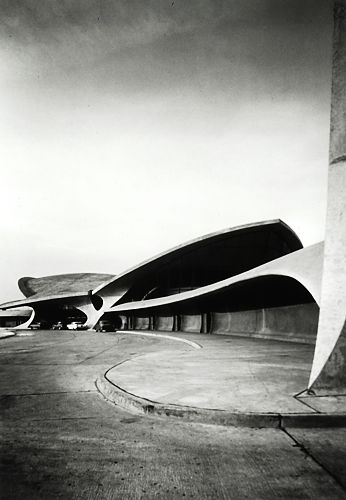
Saarinen’s architectural legacy includes Dulles International Airport, in Virginia, a taxi ride west of Washington D.C.; the TWA terminal at New York’s John F. Kennedy Airport; the technical headquarters of General Motors near Detroit, known wittily as “the Versailles of Industry”; and the towering arch that is the Jefferson National Expansion Memorial by the Mississippi River, outside St Louis, Missouri.

Demise and revival

The Saarinen family moved to the United States in 1923 when Eero was thirteen. They were not refugees from poverty or persecution in Europe. On the contrary; Eliel Saarinen was by then firmly established as an eminent architect in Finland, designer of the National Museum and the imposing Central Railway Station in Helsinki whose extraterrestrial stone giants still guard its main doors.

Eero Saarinen studied architecture at Yale, graduated there in 1934, and took U.S. citizenship in 1940. He was to die young, victim of a brain tumour at the age of 51. His early passing, like all premature deaths, left a void, a numbness among those who knew him close-up as a person or from afar as an artist.

Photo: Ezra Stoller/Esto

Eero Saarinen, TWA Terminal, John F. Kennedy International Airport, New York.

Eero Saarinen, United Sates Jefferson National Expansion Memorial, St. Louis, Missouri.

Eero Saarinen, United Sates Jefferson National Expansion Memorial, St. Louis, Missouri.Photo: Balthazar Korab Ltd.

For decades afterwards his work was given little attention by students or researchers of modern American architecture. But now times have changed and his achievements have reappeared on the mental radar of the pundits.

The revival was triggered once architect Kevin Roche, who had been a colleague of Eero’s, had donated the archives of their practice to Yale University in 2002. A Saarinen expert at Yale, professor Eeva-Liisa Pelkonen, said in a recent interview that the donation is very significant. “Post-war, mid-century architecture interests the current generation of researchers. Saarinen is a genuine proto post-modernist whose work has not yet been studied thoroughly.”

Now it can be. The Saarinen revival has already generated the four-year exhibition, which is entitled “Eero Saarinen – Shaping the future”. And the exhibition catalogue, published by Yale University Press, and including 450 illustrations, is expected to become the definitive Saarinen reader.

By Joe Brady, October 2006

Finnish resolve: efficient farming in extreme conditions

Farming couple Anu and Esa Immonen run Esa’s family estate in Nilsiä in the province of Savo, a good 400 km north of Helsinki. These are the northernmost farmed areas in the world. The crops that grow in these latitudes comprise a small selection of cereals, vegetables, berries and grass for hay. The growing season is short but intense — there is enough sunlight and water during the few summer months.

Anu and Esa are peacefully drinking their afternoon coffee at the table in their cosy farmhouse living-room. They have about 50 dairy cows, but no longer have to rush to milk them. These days an automatic milking system takes care of that. The cows walk to the milking station by themselves when they feel like it; the machine cleans their udders, takes the necessary samples, milks them, and provides each cow with a programmed amount of feed concentrate. The farmer’s and his wife’s most important device is the computer that produces a real-time report on the cows’ milking behaviour and health. This level of efficiency compensates for the disadvantage of a short growing season.

“The amount of work done in the cowshed has decreased by a certain amount and the automatic milking system gives more flexibility in managing our time,” explains Esa happily. “Now I can attend the spring party at my children’s musical kindergarten, even if it is held at the traditional milking time,” he adds enthusiastically. Esa and Anu have two young daughters, Veera, 4, and Riina, 2.

From small family holding to successful business enterprise

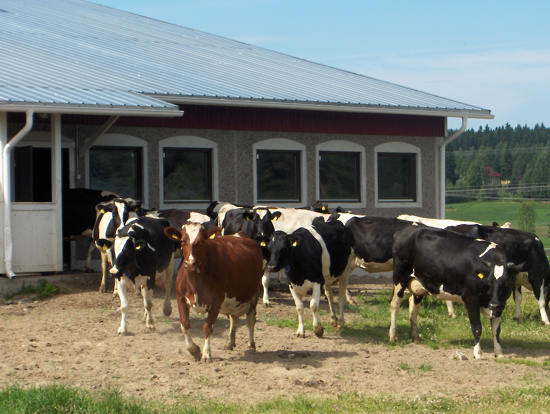
Milch cows coming out from a byre.

Milk cows coming out from a byre.Photo: Salla Korpela

Nilsiä is located in a traditional dairy-farming region, which has experienced a powerful structural change in recent years. In the 1940s, the area comprised small family farms less than ten hectares in size, where people did all the work themselves and owned very little machinery. The farms of today are large in comparison, and most are equipped with the latest technology. The labour force on the farms is small, usually consisting of only a married couple, one of whom often has a second job elsewhere, at least part-time. This is the case in the Immonen family too — Esa’s other role is selling snowmobiles.

Esa and Anu have implemented changes to their farm themselves. When they took charge of the farm in August 2000, it comprised 22 dairy cows and about 40 hectares of arable land. Now the number of dairy cows has trebled, in addition to which there are 50 beef cattle, 40 heifers as well as calves. The area of land for growing grass and fodder grain for the cattle is double what it was when they started. To achieve all this Esa and Anu have invested heavily — mainly with borrowed money. But the young couple are not worried about the situation.

“We have calculated everything carefully,” explains Anu, who has an MSc in Economics and Business Administration. She takes care of the farm’s finances and the paperwork required by EU farming regulations, which these days takes up a lot of her time. Esa, who has a degree in agriculture, is responsible for planning and developing the work of the farm.

“Our most crucial asset is our skill in handling the work here. In principle, the farm functions in such a way that the everyday tasks can be managed by one person, if necessary.”

Finnish farmers supported by forest

Farms in Finland often include a sizeable area of forest. Esa’s and Anu’s farm is no different with its total of 165 hectares of forest land. Timber is sold to forest companies as raw material for paper, and to sawmills. Productive forest holdings are sources of investment reserves and security for hard times. Forest maintenance in the form of replanting and clearing must be done annually in order to ensure that the forest remains productive.

The milk from the farm’s cows is first collected in a 5,000-litre refrigerated storage tank, then transported by a milk tanker every other evening to a dairy in Lapinlahti, about 40 kilometres away.

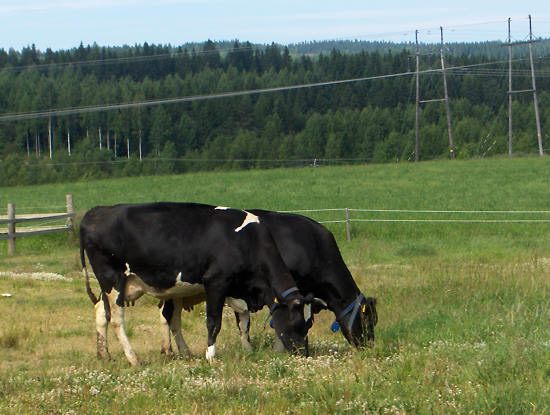
Elements of Finnish farming: cows, fields, and forest.

Elements of Finnish farming: cows, fields, and forest.Photo: Salla Korpela

Esa and Anu employ temporary workers during the busiest times of the year, the sowing and harvesting seasons, and they completely outsource some services and mechanical work, such as the forest maintenance previously referred to.

Esa believes thoughtful outsourcing makes good sense. “In the past, farmers were proud of the fact that they did everything themselves. It is not possible to think like that nowadays unless you want to work yourself into an early grave. It would also be unwise for every farmer to buy all the machinery needed as some of it is just so expensive,” he explains.

The previous owners of the farm, Esa’s parents, live in their own house on the property and help out. They look after the children when Esa and Anu are busy.

Country life leaves room for hobbies

“All in all, this is a great job as there is so much freedom to plan and carry out the work and the results can be seen all around. I don’t even feel that the work is physically demanding,” explains Esa.

“And the cows don’t complain!”

In their free time, the Immonen family enjoy the opportunities of life in the country. Esa rides a motorbike in the summer, and a snowmobile in the winter, while Anu likes to ski. The family share an interest in dogs and dog shows.

Esa and Anu are even able to have a holiday. They are entitled to statutory leave of 23-24 days a year, while a municipal holiday substitute takes care of the daily routines at the farm. Esa and Anu also purchase the services of a holiday substitute for extra days off from the farm.

By Salla Korpela, July 2005

A bashful star – Harri Koskinen

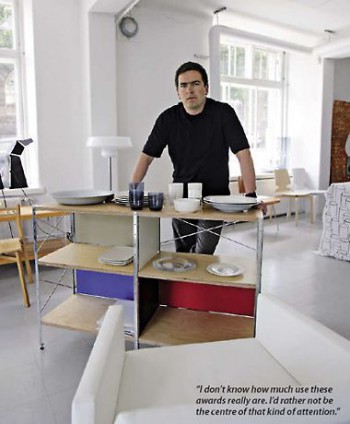
Designer Harri Koskinen poses with a few of his creations.

Designer Harri Koskinen poses with a few of his creations.Photo: Eastpress/Seppo J.J. Sirkka

The first impression of designer Harri Koskinen is of a quiet, well-intentioned, somewhat shy man whose life has been devoid of any unusual events. This impression is deceptive.

Lots of unusual and important things are continuously happening in Koskinen’s life. Over the past decade, he has become one of Finland’s most respected, internationally successful young designers.

He is a cosmopolitan who gets orders for work from around the globe. Yet he is indeed quiet, well-intentioned – and genuinely modest. In fact, he is so modest that he does not even admit to being modest.

“I guess it’s just being sensible,” he says.

Being sensible – along with being ambitious – is one of the main characteristics of Koskinen’s work and personality.

For instance, being sensible plays a role in designing a 300 square metre villa in the upmarket seaside town of Ekenäs (Tammisaari).

“The person who commissioned it dreams of it being the world’s most handsome villa,” says Koskinen. “I’m designing it as a team with two talented young architects. This project doesn’t have as strict a budget as there usually is on this kind of job. This situation offers us freedom and even a chance to come up with some completely new structural solutions, for instance.”

Could there be a more ideal job for a designer and architects in this world of stringent budgets?

“Well, it does cause some problems of its own,” Koskinen points out in a serious tone.

“In spite of everything, we have to preserve the sensibility and honesty of the design. The costs have to be kept within sensible limits.”

One of his favourite words is “honesty”.

“You have to have a certain kind of work ethic,” he says. “My bases of work have to be acceptable and the execution has to be honest. I have to be able to stand by them in public.”

Koskinen did not originally aim for the position in which he is now. He seems to have become a star through his own weight, without any visible creative angst, special effects, diva behaviour, noise, glitz or fanfares, which makes it seem natural and effortless.

“It’s funny to talk about it as a career,” he says, seeming embarrassed.

Koskinen’s starting point was the small village of Vahanka in Karstula,central Finland. His father was a farmer and his mother a practical nurse. Young Harri went south to the Lahti Institute of Design.

“There I became a cabinetmaker. But I was more interested in design. I planned to set up a design office – and now I have one.”

2747-koskinen3_b-jpg

He was accepted at the University of Art and Design in Helsinki. Upon graduation at the age of 26 this budding talent was snapped up by the Iittala company, an icon of Finnish design, where he was introduced to the world of glass.

“Iittala uses designers’ names as an argument to support sales,” explains Koskinen, sounding as if he had got mixed up in something unsavoury.

“So that started my career as a name designer – sort of by accident.”

Koskinen says he has been an admirer of Finnish design legend Kaj Franck (1911-1989).

“I have said so when asked,” he says. “But Franck is not a role model for me. I never even met him. Maybe what we have in common is that Franck, like me, doesn’t like to make an unnecessary fuss about things.”

Does Koskinen find it annoying that discussions of Finnish design always seem to revolve around the same demi-gods who earned international acclaim in the 1950s and ‘60s, such as Tapio Wirkkala and Timo Sarpaneva?

“Well, not really,” says Koskinen with a smile. “It just sort makes me smile that there are so few of them to be compared to. If you could see what has been done around the world, these discussions might have a bit more of a realistic basis.”

As to his plethora of awards, Koskinen says: “At best, of course, they help me to get work, because they show a certain recognition. But I don’t know how much use they really are. They’re more just a hassle. It’s not my idea of fun to be the centre of that kind of attention.”

By Juha Numminen, October 2008
Originally published in “Breakthroughs – 90 Success Stories from Finland”, 2007

Finnish recipes

Abbreviations: Weights and measures:
dl  =  decilitre
l  = litre
tsp  = teaspoon
tbsp  = tablespoon
g  = grams
1 kilogram = 1000 g = 2 lbs 3 oz
100 g = 3.5 oz
1 litre = 10 dl = (more than) 2 pints
1 decilitre = (less than) ½ cup

Salads

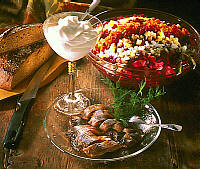
A table set with dark bread, herring, sour cream and a salad.

Rosolli salad (Rosolli)

  • 4 boiled potatoes
  • 4 boiled carrots
  • 4 boiled beetroot or pickled beetroot
  • 1 gherkin
  • 1 small onion
  • salt, white pepper

Dressing:

  • 1 1/2 dl cream
  • 1 1/2 tsp vinegar (10%)
  • 1 1/2 tsp sugar

(and the water the beetroot was cooked in)

Cook the vegetables in their skin well beforehand until just tender. Peel the vegetables and onion, and cut them into small, equal-sized cubes. Mix them together and season with a little salt and white pepper.

Whip the cream lightly, season with sugar and vinegar and add a few drops of beetroot liquid for colour. Serve the dressing separately. Garnish the salad with hard-boiled eggs, the yolks and whites chopped separately and laid in stripes on the top.
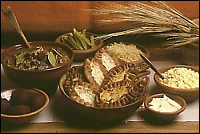
A table set with pickles, mushroom salad and different pasties.

Finnish mushroom salad (Suomalainen sienisalaatti)

  • 3–4 dl of salted mushrooms
  • 1 onion

Dressing:

  • 2 dl cream
  • 1–2 tsp lemon juice or vinegar
  • 1/2 tsp of sugar
  • dash of freshly ground white pepper

Soak the salted mushrooms until the salt level is right. Press the excess water out and chop the mushrooms. Peel and chop the onion. Check the taste, it should have a slightly sharp tang. Stir the mushrooms and the chopped onions into the dressing.

The traditional Finnish mushroom salad is made of salted milk caps. Before salting, the cleaned mushrooms are boiled in plenty of water for five minutes, rinsed and cooled. Then the mushrooms are placed with layers of salt (salt content is 10–15% of the weight of the mushrooms) in glass jars. The mushrooms are pressed down into the jar by covering them with a weight, e.g. a plate with a clean stone on it, and stored in a cold place.


Breads and cheeses

A table set with Karelian pasties, egg butter and other side dishes.

Karelian pasties (Karjalanpiirakat)

Ingredients:

  • 1 decilitre water
  • ½–1 tsp salt
  • 2.5 decilitre rye flour

Rice filling:

  • 2.5 decilitre water
  • 1 litre milk
  • 2.5 decilitre rice
  • 1 tsp salt
  1. Rinse the rice and place it in boiling water. Simmer until most of the water is absorbed.Add the milk, lower the heat to a minimum, and partially cover the pot. Simmer until the milk has been absorbed and the rice has turned into a thick porridge. Season with salt and leave to cool.
  2. Add the flour and salt to the water and mix into a solid, compact dough.
  3. Form the dough into a strip and divide into 12 pieces.
  4. Roll the pieces into flat thin ovals.
  5. Spread some filling on each oval. Then fold the sides towards the center, pinching and making neat pleats along the edge.
  6. Bake at 300 ºC for about 10 minutes.
  7. Brush them well with melted butter or a butter and water mixture.
  8. Place the pasties, separated with baking paper, in a bowl and cover with a towel to soften the crusts.
  9. Serve warm with butter or egg butter which is made by mixing equal parts of butter, (cottage cheese) and chopped hard-boiled egg.

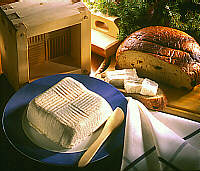
A square-shaped block of egg cheese and a loaf of bread.

Egg cheese (Munajuusto)

  • 3 l milk
  • 1 l sour milk
  • 4 eggs
  • 1 tsp salt

Bring the milk almost to boiling point. Combine the eggs and sour milk and add to the hot milk, stirring gently. Continue to cook the milk over low heat, stirring until it curdles. Remove the saucepan from the stove and let the whey separate in a warm place for half an hour. Using a slotted spoon, transfer the curds to a sieve lined with muslin. Lightly press the whey out. Add the salt, stirring in well. Place a light weight on the cheese and leave it to stand in a cold place overnight.

Next day, turn the cheese onto an ovenproof dish. Brush the cheese with egg and bake at 250 °C until nicely brown.


Main courses

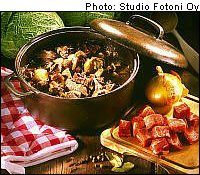
A large pot filled with meat stew; diced meat next to the pot on a cutting board.

Karelian Hot Pot (Karjalanpaisti)

(serves 4–5 people)

  • 300 g chuck steak
  • 300 g pork shoulder
  • 300 g stewing lamb or mutton
  • 2–3 onions
  • 1.5 tsp salt
  • 8 allspice
  • water

Cut the meat into cubes (4×4 cm). There is no need to remove small bones. Put the meat and coarsely chopped onion in layers in a casserole, seasoning each layer with salt and allspice. Add enough water to almost cover the meat.

Bake without a cover at a moderate temperature, c. 175 °C, for 2.5 to 3 hours. Cover the casserole towards the end of the cooking time.

Serve with mashed potato, boiled swedes and lingonberry purée.
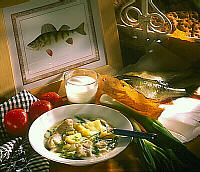
A bowl of fish soup and a glass of milk on a table in front of a painting of a perch.

Fish soup (Kalakeitto)

(serves 4–5 people)

  • 1 kg fish
  • 1 l water
  • 1 tsp salt
  • 1 onion
  • 10 allspice (whole)
  • dill stems
  • 1/2 leek
  • 4 large potatoes
  • 4 dl milk
  • 1 tbsp flour
  • dill and chives

Clean and fillet the fish. Boil the bones with coarsely chopped onion and spices. Cook for about 20 minutes. Strain the liquid into another saucepan. When the liquid comes to the boil, add the leek cut into rings and the peeled, diced potatoes. Cook for about 15 minutes. Cut the fish into chunks and add to the soup. Cook for another five minutes. Mix the flour with milk and add to the soup. Let the soup simmer for a few more minutes. Sprinkle plenty of chopped dill and chives on top of the soup.

If you want to use ready filleted fish, you will need 300–400 g. Add a fish bouillon cube to the liquid.
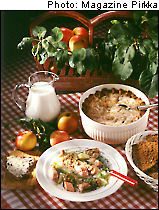
A table set with a bowl of fish soup, a jug of milk, rye bread and a casserole.

Fish soup à la Kainuu (Kainuulainen kalakeitto)

  • 1–1.5 l water or good fish stock
  • 1–2 onions
  • 5–6 allspice berries
  • (salt)
  • 4–5 potatoes
  • about 1/2 kg of filleted fish
  • (salmon, whitefish, pike, perch)
  • dill, chives, chopped parsley

Served with: melted butter chopped raw onions

Peel the onions and split them in pieces. Place them in the water or fish stock together with the allspice berries and bring to the boil. Cook for a while for the stock to become tasty. Peel the potatoes and cut into small pieces the size of your fingertips. Also cut the fish fillets into small cubes. Remove the onions and allspice berries from the stock and add the potatoes to cook. Let the soup boil for about ten minutes. Then add the fish and continue to cook for a few minutes until the fish is done. Chop the herbs and add to the soup. Serve the soup with melted butter and chopped raw onions, which every eater can add to the soup according to taste. The soup is at its best when eaten with rye bread.
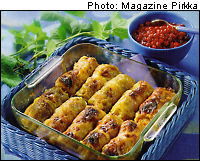
A glass casserole filled with cabbage rolls; a bowl of lingonberries next to it.

Cabbage Rolls (Kaalikääryleet)

(serves 4–5 people)

  • 1 large white cabbage
  • water, salted at 1 tsp per litre

Filling:

  • 400 g of lean minced pork or beef
  • 1 onion
  • 1 dl cabbage cooking liquid
  • 2 dl chopped cabbage

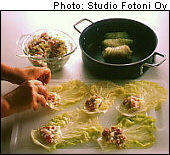
Cabbage leaves on a cutting board with filling on them; a person getting ready to roll them.

  • 2 dl boiled rice
  • 1 tsp salt
  • 1/4 tsp white pepper
  • 1 tsp marjoram

Topping:

  • 1–2 tbsp syrup
  • butter or margarine
  • Cabbage cooking water for basting

Gravy:

  • 3 dl pan juice
  • 2 tbsp flour
  • a little cream

Cut the stalk off the cabbage and cook the cabbage in salted water until the leaves are soft. You can carefully loosen the outer leaves as they soften. Lift the cooked cabbage onto a large plate to drain. Loosen the leaves one by one and chop the small inner leaves for the filling.

Finely chop the onion and fry in small amount of oil until translucent but not brown. Combine the meat, rice, chopped cabbage and seasonings into a smooth mixture. If the mixture is too thick, add some more of the cabbage cooking water.

Flatten the cabbage leaves. Lift a good tablespoonful of filling onto the leaf and roll it up tucking the edges round the mixture.

Place the rolls side by side in a baking dish, pour syrup and a little fat over them.

Bake the rolls for 1 hour at 200 °C. Half way turn the rolls over and baste them every now and then with the cabbage water.

Strain the pan juices and thicken with flour mixed with water. Add a little cream.

Serve the cabbage rolls with boiled potatoes and lingonberry purée.
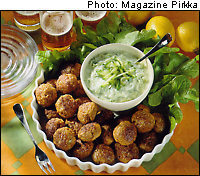
A big pile of meatballs with a dip and herbs on the side.

Meatballs (Lihapullat)

(serves 4–5 people)

  • 500 g minced beef
  • 1 dl fine dry breadcrumbs or two slices of white bread
  • 1 dl cream
  • 1 onion
  • 1 tbsp oil
  • 1 egg
  • 1 tsp salt
  • 1/4 tsp allspice or white pepper

Gravy:

  • 2 tbsp fat
  • 2 tbsp flour
  • 4 dl pan juices

Mix breadcrumbs with water and cream in a bowl. Let stand for a while. Finely chop the onion and sauté in oil in a frying pan or microwave oven. Add the onion, egg, seasonings and meat. Mix until smooth. Wet your hands and shape the mixture into balls. Fry meatballs in hot fat on all sides. Small meatballs will be done in 3–5 minutes, larger ones 5–8 minutes.

To make gravy, brown the flour lightly in fat. Add the liquid stirring all the time. Add the cream and check seasonings. The gravy can be served separately or poured over the meatballs. Serve with potatoes and grated carrots. Lingonberry jam and gherkins also go well with the dish.
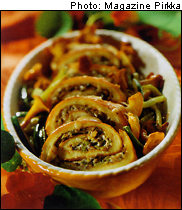
A sliced up omelette roll with cooked vegetables on the side in a white dish.

Mushroom-omelette roll (Sienimunakas-kääryle)

Omelette batter:

  • 6 eggs
  • 5 dl milk
  • 1 dl wheat flour
  • 1 tsp salt
  • 1/2 tsp white pepper

Filling:

  • 3 tbsp butter, margarine or cooking oil
  • 1 l chantarelles, hedgehog mushrooms, ceps
  • 2–3 onions, salt, black pepper
  • basil or thyme
  • (a little cream or crème fraiche)

On top:

  • grated cheese

Preheat the oven to 200° C. To prepare the batter, first mix the flour in the milk. Beat the eggs in a separate bowl and add to the flour and milk mixture. Spice with salt and white pepper. Line a high-edged baking plate with greaseproof paper and pour the omelette batter on the paper. Bake in the oven until light brown. Overturn the omelette on another piece of greaseproof paper and remove the paper from the bottom. Chop the onions for the filling. Fry the chopped mushrooms in hot oil, add the onions and let cook until the liquid has nearly evaporated. Spice with salt and pepper, and, if you like, basil or thyme. (In case you prefer the filling to be more saucelike, add a little cream to the mixture and let cook for a while). Check the taste. Spread the mixture on the omelette and roll the sheet up. Carefully move the roll on a greased ovenproof plate and sprinkle grated cheese on top. Heat the omelette roll in 200° C before serving.
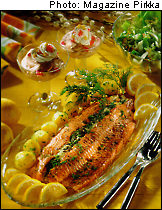
A piece of baked salmon on a glass dish surrounded with slices of lemon.

Cheese-and-herbs stuffed salmon (Yrttijuustolla täytetty lohi)

Ingredients:

  • 1 kg salmon fillet
  • black and lemon pepper
  • salt
  • lemon juice

Stuffing:

  •  unripened cheese
  • dill, chives and thyme

Season the fish fillet with salt and black and lemon peppers to taste. Using a sharp knife, cut a less than one centimeter deep opening in the middle of the fillet from head to tail. Place the knife in the opening and cut a pocket to both sides of the opening. Unfold the pockets and spread the cheese in. Sprinkle finely chopped dill, chives and thyme on the cheese. Turn the upper side of each pocket on the cheese and herbs. Secure the opening with cocktail sticks some 5 cm apart. Sprinkle with lemon juice.

Bake in 200° C for about 20–25 minutes. When the fish is done, remove the sticks.

Serve with boiled potatoes and green salad.


Desserts

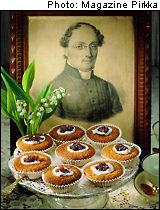
A tray of Runeberg tortes in front of a sepia portrait of J.L. Runeberg himself.

Runeberg cakes (Runebergin tortut)

(serves 4–5 people)

Ingredients:

  • 200 g margarine or butter
  • 2 dl sugar
  • 2 eggs
  • 2 dl wheat flour
  • 1 tsp baking powder
  • 1 tsp ground cardamom
  • 2 dl sweet bread crumbs (e.g. crumbled biscuits)
  • 2 dl ground almonds (appr. 80 g)
  • 1 dl single cream
  • solid raspberry jam

To moisten:

  • 2 dl water
  • 1 dl sugar
  • 2–3 tbsp arrack liqueur or rum

Topping:

  • solid raspberry jam or marmelade

Icing:

  • 1 dl icing sugar
  • 2 tsp water or lemon juice

Preheat the oven to 200°C.

Grind the almonds and combine them with the bread crumbs. Cream the butter or margarine and sugar together. Add one egg at a time, beating the mixture well after each egg. Combine the flour and baking powder and stir into the mixture.

Add the cardemom, bread crumbs and almonds and finally the cream. Mix lightly but do not unnecessarily stir the mixture. Grease a muffin mould and put a equal amount of the mixture into the hollows. Leave room for the mixture to raise in the hollows. Using a floured fingertip, press a hole in the middle of each muffin. Place about half a teaspoonful of jam or marmelade on each muffin. Bake in the middle of the oven for about 15 minutes.

Boil the water and melt the sugar in it. Flavour with the alcohol. Moisten the baked muffins with the liquid. When the muffins are still hot, add another half a teaspoonful of jam in the middle. Let the muffins cool.

Combine the icing sugar and water or lemon juice in a small bowl. Pour the liquid icing around the jam.
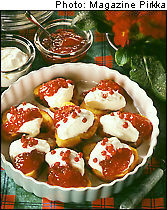
Bun slices topped with jam and cream in a white dish.

Poor knights (Köyhät ritarit)

  • 1 slice of French bread or coffee bread per person
  • 1 egg
  • 3 dl milk
  • pinch of salt

For frying:

  • butter or margarine

On top:

  • lingonberry jam (and whipped cream)

1. Cut a thick slice of bread for each person
2. Whip the egg and mix in milk and a pinch of salt
3. Dip the slices in the milk and egg mixture
4. Fry until golden brown on both sides
5. Serve hot topped with a bit of lingonberry jam. If you top it all off with whipped cream, your “poor knights” become “rich knights”.
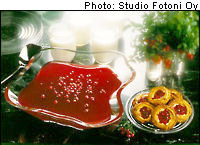
Red lingonberry kisel in a glass bowl, cookies next to it.

Lingonberry Delight (Marjakiisseli)

  • 1 l diluted, sweetened berry juice
  • 4 tbsp cornflour
  • 2–3 dl fresh or frozen lingonberries

Place the berries in a serving dish. Put the cornflour and cold juice into a saucepan and bring to the boil, stirring the whole time. Remove the saucepan from the heat and pour the thickened juice over the berries. Sprinkle a little sugar on top. Serve with milk. Bilberries and strawberries or redcurrants and raspberries can also be used.
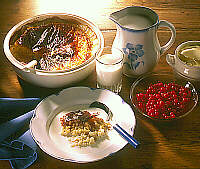
A table set with a bowl of oven porridge topped with milk, a jug of milk and a bowl of berries.

Oven porridge (Uunipuuro)

  • 2.5 dl pearl barley
  • 0.5 l water
  • 1.5 l milk
  • 1 tsp salt

Combine all the ingredients in a buttered oven dish.

Bake the porridge for 4–5 hours at 125 °C. Also whole oats, wheat, rice, buckwheat or millet make excellent porridge. Serve the porridge with milk or fruit sauce.
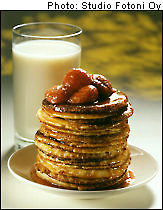
A high pile of pancakes with a glass of milk.

Pancakes (Ohukaiset)

  • 0.5 l milk or 2.5 dl cream and 2.5 dl water or mineral water
  • 1.5 dl flour
  • 2 eggs
  • about 1 tsp salt

1. Mix the flour and the milk. Add the salt and beat in the eggs. Let the batter stand for a minute before frying.
2. Fry pancakes on a hot pan, greased with butter or margarine.
3. Serve with sweet jam.

To make a sheet pancake from the same batter, pour into a greased baking pan or frying pan and bake in the oven at 225° C until golden brown.
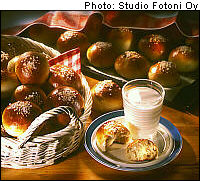
A basket full of sweet buns, a plate with a bun and a glass of milk next to it and a tray with more buns in the background.

Sweet Buns (Pikkupullat)

  • 5 dl milk
  • 50 g yeast
  • 1 egg
  • 1.5 dl sugar
  • 1 tsp salt
  • 1 tbsp cardamom
  • about 1 kg plain flour
  • 100–150 g margarine or butter

Heat the milk until lukewarm. Dissolve the yeast in a bowl with the warm milk. Stir in egg, sugar, salt and cardemom. Add enough flour to make a thick mixture and beat until shiny.

Add the rest of the flour to the dough and knead by hand. Leave some of the flour for shaping the buns and continue to work the dough until smooth and elastic. Add the softened fat and knead the dough until it comes off your hands and the edges of the bowl. Cover the bowl with a towel and leave in a warm draught-free place until double in bulk. Then put it on a floured board and shape it into small round buns. Brush the risen buns with beaten egg and sprinkle with sugar.

Bake the buns at 225 °C for 8–10 minutes. Let cool covered with a towel.
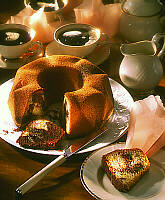
A bundt cake on a tray; a couple pieces already cut out.

Tiger cake (Tiikerikakku)

  • 200 g margarine
  • 2 dl sugar
  • 3 eggs
  • 3 dl flour
  • 2 tsp vanilla sugar
  • 2 tsp baking powder
  • 3 tbsp milk
  • 2–3 tbsp cocoa

Carefully butter and flour a cake tin. Beat fat and sugar until light and fluffy. Add eggs one at a time, beating thoroughly after each one. Add the baking powder and vanilla sugar to the flour and stir in slowly. Put one-third of the mixture in another bowl and add 2–3 tbsp of sifted cocoa and 3 tbsp of milk.

Put the mixture into the prepared cake in tin in layers, beginning and ending with the plain mixture. Bake at 175 °C for 50–60 minutes or until a skewer inserted in the centre comes out clean.
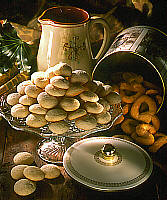
A glass tray with a pile of small round biscuits.

Aunt Hanna’s biscuits (Hanna-tädin piparkakut)

  • 150 g melted butter or margarine
  • 3 dl sugar
  • 3 dl cornflour
  • 4 dl plain flour
  • 1.5 dl (sour) cream
  • 1 tsp soda

Mix all ingredients together and leave until firm. Shape the dough into long rolls. Cut the rolls into pieces of equal size and form into small balls. Bake at 200 °C until golden.
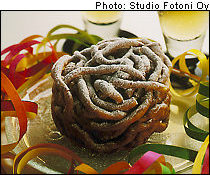
A funnel cake on a glass plate surrounded with paper streamer.

May Day Cookies (Tippaleivät)

  • 2 eggs
  • 2 tsp sugar
  • 1 tsp salt
  • 2 dl milk
  • 4 dl flour
  • ½ tsp vanillin

To fry:

  • vegetable or coconut oil

Mix the eggs and sugar, but don’t beat! Add the other ingredients and stir into a smooth batter.

Put the batter into a paper cone or a pastry bag fitted with a small-holed nozzle.

Squeeze the batter in a thin band into the hot oil. Use a spiral motion to form nest-like cookies. If possible, use a metal ring in the pot to keep the cookies in shape.

When the cookies have turned golden brown, remove and drain them on paper towels.

Dust the cold cookies with powdered sugar.


Drinks

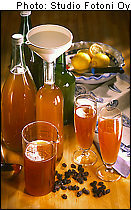
Four glass bottles and three glasses filled with mead; raisins on the table and lemons in the background.

Mead (Sima)

  • 5 l water
  • 350 g sugar
  • 350 g brown sugar
  • 2 lemons
  • tiny bit of yeast

Wash the lemons and peel them thinly. Remove the pith. Slice the lemons and place them with the peel and sugar in a sufficiently large vessel.

Bring half of the water to the boil and pour it over the lemons, peel and sugar. Stir and leave to stand covered for a while. Add the rest of the water cold. When the liquid is lukewarm add the yeast.

Keep the mead at room temperature until it starts to ferment, i.e. about one day. Put a couple of raisins and 1 tsp of sugar into clean bottles, and strain the mead into the bottles. Loosely cork the bottles and store them in a cool place. The mead is ready when the raisins rise to the surface.

Photos by Studio Fotoni (except main photo)

The Åland example: Autonomy protects a minority

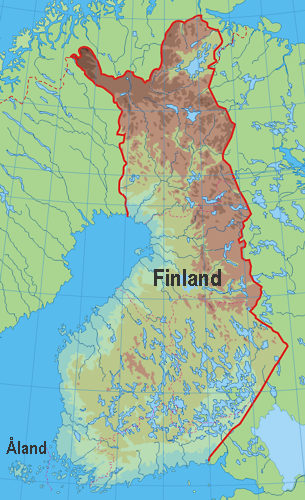
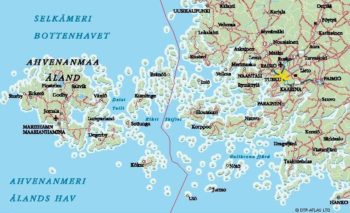
Åland is a group of islands located off the southwestern tip of Finland. Its special autonomy agreement is of interest not only to the local population, but also to many other nations. The archipelago has attracted and continues to attract international attention as an example of how to successfully secure the position of a minority.

The words “war” and “armed conflict” bring to mind classic warfare between countries, but in today’s world such clashes are becoming more of an exception than a rule. Accordingly, many of the armed conflicts currently under way around the globe are internal struggles in countries with some sort of minority issue. Such issues cannot be resolved by creating new, small, independent states ad infinitum. Looking for alternatives to nation building, countries turn their eyes towards Åland, whose autonomy is perceived as a compromise between independence and total integration.

A large number of politicians, reporters and researchers have studied Åland’s autonomy as a potential solution to conflicts. The list of regions and minorities that have led people to take an interest in Åland is long: Israel-Palestine; Nagorno-Karabakh in the South Caucasus region; Northern Ireland; Georgia; Kosovo; Sri Lanka; Aceh in Indonesia; Kashmir between India and Pakistan; Zanzibar; and East Timor. Some have examined Åland’s model in an attempt to avert a crisis, while others are trying to find a solution to a conflict that has already broken out.

Making the constitution work

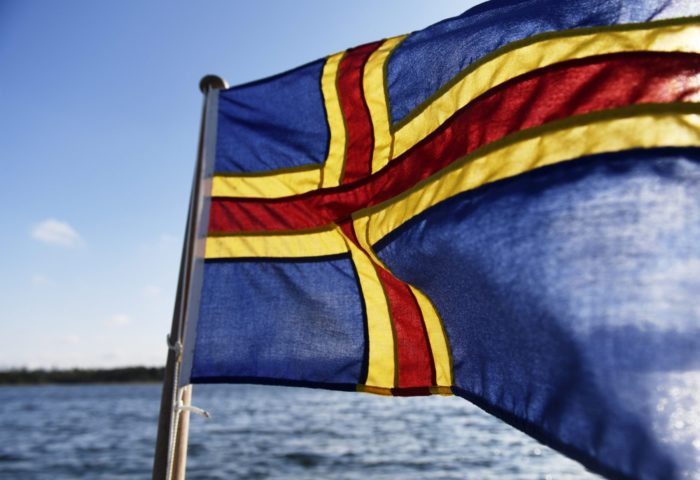
The sun shines behind an Åland flag billowing at the back of a boat, with islands visible in the background.Photo: Vesa Moilanen/Lehtikuva

How, then, can Åland really serve as an example? Writing a functional constitution is hard, but it is not impossible. There are many experts on international and constitutional law who are capable of framing regulations that protect the rights of minorities, but the real problem is often to make them work in practice.

There is no doubt that Åland has a functioning system of autonomy based not only on a good constitution but also on workable reality. During numerous visits by representatives of various minorities, it has been significant to recall how a minority that initially refused to accept any form of self-rule subsequently built up a well-functioning society with the help of such autonomy. When Finland gained independence from Russia in 1917, Ålanders expressed interest in the islands being ceded back to Sweden. This became the source of some regional tension. In 1921 the Council of the League of Nations put into place guarantees for Åland’s autonomy, and a convention on Åland’s demilitarisation and neutralisation was created.

Åland is a society that enjoys amiable relations with both its motherlands, old and new. What’s more, Åland is a prime example of how autonomy can be extended over time. Every problem does not have to be solved at once; self-government can be expanded at an appropriate moment.

There is full awareness in Åland that no single solution can ever be universally applied to other problems, which is why Ålanders would prefer to speak of their home as an example rather than a model. They have no ambitions of imposing their solution on anybody, nor do they have the power to do so. In fact, the absence of any such power may be a blessing, just like the fact that nobody can suspect Åland of pursuing any self-interest in this matter.

Favourable preconditions help

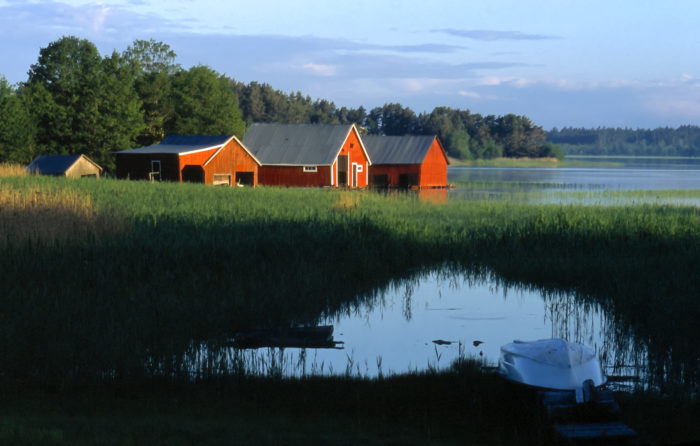
Boathouses squint against the sun by a bay in Geta, an area of northern Åland.Photo: Udo Haafke/Visit Finland

The preconditions for autonomy in Åland have been and remain favourable. Åland has geographically well-defined boundaries and linguistic homogeneity. Finland is a democratic country based on the rule of law, and controversy over Åland’s affiliation has never included any violence. Such circumstances do not exist in many of today’s conflict areas.

That said, it was never self-evident that Åland would become a success story. After all, the odds are not the best when autonomy is imposed on people against their will, as was the case with Åland. However, Åland’s example shows that a solution with which all the parties were initially dissatisfied can be successful in the long term.

Features of autonomy

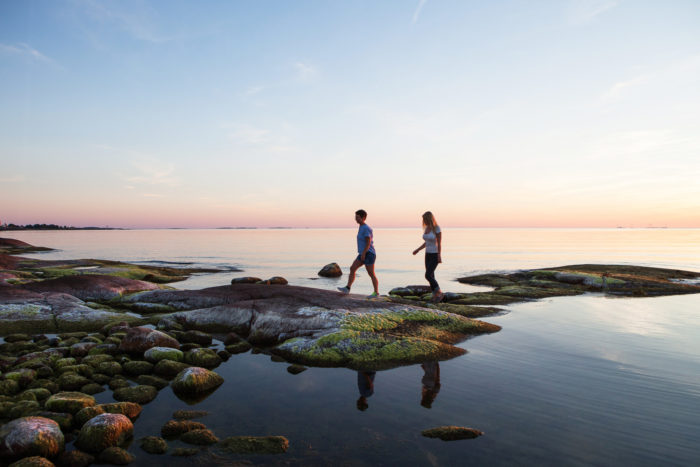
Åland is known for its autonomy, but also for the proximity of unspoiled nature in the archipelago.Photo: Tiina Tahvanainen/Visit Åland

Numerous studies on Åland’s political status have shown that the issues attracting interest are wide-ranging indeed. Here are some examples:

1. Autonomy secured by the Finnish Constitution: The Act on the Autonomy of Åland provides for a division of political power between Åland and the rest of Finland. Laws affecting Åland’s status are passed following the procedure prescribed for the enactment of constitutional legislation subject to adoption by the Parliament of Åland (Lagtinget), meaning that the island’s autonomy enjoys very strong legal protection. In practice, this means that Åland can veto any changes to the division of power between Åland and the central government of Finland.

2. Origin of self-government in Åland: The fact that the Åland issue was settled by an international resolution arouses a lot of interest. The decision of the League of Nations was a compromise that took into consideration not only the two countries involved but also the interests of the local population and, above all, the need to protect their language.

3. International guarantees: As a result of the involvement of the League of Nations in the establishment of self-rule, Åland secured international guarantees for its language and local customs. Consequently, the preservation of the Swedish language is both a national and international matter.

4. Language regulations: Åland is the only region in Finland with only one official language (Swedish), whereas the rest of the country is bilingual (Finnish and Swedish). The regulations concerning the language used in administration and education attract a lot of interest.

5. Division of power: The fact that legislative powers are divided between the central government and Åland, and not delegated, is of interest. Many people have studied the question of what legislative powers can be assigned to self-governing bodies and what areas are of such nature that they apply to the country as a whole.

6. Regional citizenship: Regional citizenship, which is a precondition for land ownership and transaction of business, is reserved exclusively for persons permanently residing in Åland. Additionally, regional citizenship is a prerequisite for eligibility to vote in local parliamentary elections.

7. Law and order: The fact that most members of the police force come from Åland has created a degree of interest in places where it is important that the police enjoy the confidence of the local population.

8. The Åland Delegation: The role of the Åland Delegation as an intermediary between the central government and Åland continues to attract interest.

9. Symbols: The flag of Åland is often of great interest to people, just like Åland’s passport, which has the words Suomi, Finland (the Finnish and Swedish words for Finland) and Åland printed on the cover, all in the same font size.

10. Influence over international agreements: Even though foreign policy is in the domain of the central government, Åland is not without influence in this area. Under the Act on the Autonomy of Åland, the consent of the Parliament of Åland is required for international agreements affecting the inherent powers of the province; for instance, this provision meant that the Parliament had to take a position on joining the EU along with Finland in 1995.

11. Participation in Nordic cooperation: Nordic cooperation is a noteworthy form of cross-border cooperation. It entitles the Nordic self-governing regions to participate more or less on the same terms as sovereign states.

12. Pragmatism: The people of Åland have always been down-to-earth with little interest in theoretical speculation. For one thing, they have never bothered to discuss whether they should be perceived as a minority, a matter that has generated lively debate and disagreement elsewhere. Instead, the people of Åland have focused on tangible regulations that secure their interests.

Åland as an international example

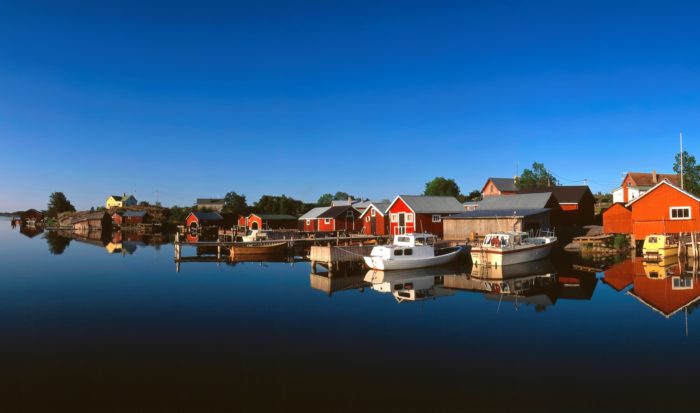
Calm water reflects a shoreline village in Kökar, southeastern Åland.Photo: Udo Haafke/Visit Finland

Åland has had and will continue to have the resources to respond to the interest that its political status generates worldwide. This helpful openness seems certain to remain part of the character of the province.

Ålanders have realised that it is of great importance for the credibility of the Åland example that representatives of both the majority and minority of the local population have declared that they are pleased with the solution. The central government is also interested in providing information about the Åland solution in situations where it may be of relevance. To this end, the Åland Government and the State of Finland have jointly appointed a contact group under the auspices of the Ministry for Foreign Affairs.

By Susanne Eriksson, senior legal adviser, Åland Parliament; updated June 2017

Family-friendly Finland

Finns pay high taxes but get a lot in return for their money. Families with children are especially well taken care of by society, and their lives are made easier by the many types of support and benefits available.

Let’s meet the Tuurala family from Helsinki and see how they benefit from society’s support for families with children. Clicking on the underlined words will bring up more information about the forms of support available in Finland.

Kati and Klaus Tuurala and their daughters Freja and Iiris (6 and 4 years old at the original time of publication) live close to the centre of Helsinki in Ruoholahti. They lead an active life and earn an average income.

Kati, 36, works full-time and her husband Klaus, 61, is retired. His last position was at telecoms company Sonera as a usability expert. He has used his retirement to return to studying at the University of Helsinki. The couple’s daughters are in municipal family daycare and Freja also attends preschool. But before going into greater detail, let us turn back the clock six years to when Kati and Klaus were about to become parents.

The big day

When Kati discovered she was pregnant, she did what all mothers-to-be do in Finland. She got in touch with the prenatal clinic in her own area. There she was assigned a midwife whose clinics she attended at least once a month during the pregnancy for check-ups and observation.

Kati was allowed to choose in which of the three local area hospitals that were part of the Hospital District of Helsinki and Uusimaa she would like to give birth. She chose the Kätilöopisto Maternity Hospital because of the homely Haikaranpesä (Stork’s nest) ward, which is especially for women wishing to have a natural, active birth. As prospective parents in the ‘Stork’s nest ward’, Kati and Klaus went and had a look at the maternity unit and met the staff in advance.

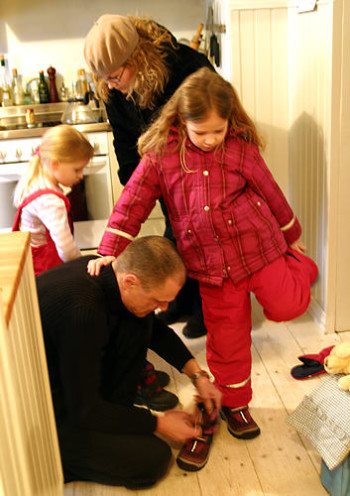
Wrapping up warm on a winter morning.

Wrapping up warm on a winter morning.Photo: Elina Bicsák

The couple discussed the birthing plan with the midwife, and familiarized themselves with the equipment and methods used to ease the birth and relieve pain. They also took part in antenatal classes held at the Stork’s nest with other expecting couples. Prospective fathers had their own discussion group. The birth went well, and the couple were left with pleasant memories of the event.

Klaus was present at the birth, and the whole family spent the night at the hospital in their own room. The midwife assigned to them for the birth visited them at home during the baby’s first weeks to check on progress and to teach the parents how the baby should be carried in a baby sling. The Tuuralas had everything ready for the baby on her arrival home, including little vests and suits in the cupboard together with the babycare equipment. Some of the baby gear they had bought themselves, while some they had received in the maternity package supplied by the state.

Kati went on maternity leave from Akava, her employer at the time, 5 weeks before the due date. Klaus took three weeks paternity leave when the child was born. When baby Freja was about four months old, Kati continued to look after her on parental leave and for some months after that on care leave. A daily allowance paid by the Social Insurance Institution (commonly known by its Finnish abbreviation, Kela) guaranteed the family income during these periods of leave.

Since the birth of Freja, the state has been paying child allowance directly into the parents’ bank account. This allowance will continue until the child reaches 17 years of age.

Back to work

Kati returned to work when Freja was 16 months old. She taught as a part-time teacher while finishing her teacher-training studies at the same time. The Tuuralas applied for a municipal family daycare place for Freja and their request was successful. Freja was looked after near home by a friendly lady called Riitta. The family’s second child, Iiris, was born when Freja was 2 years and four months old. The birth and benefits for the child were as before, with the exception that instead of the maternity pack the Tuuralas opted for the maternity grant and a higher rate of child allowance was paid for the second child.

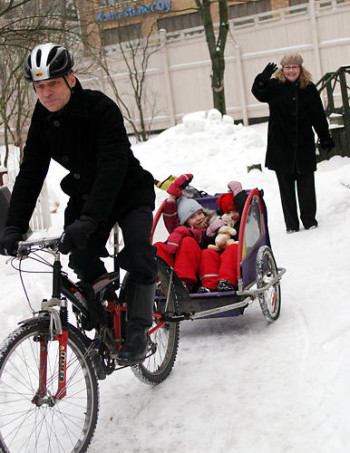
And off we go to school.

And off we go to school.Photo: Elina Bicsák

Kati went to work for the publishing company WSOY a year after Iiris’s birth, and Iiris was able to go to the same family daycare as Freja, which both girls are still attending. Freja, who starts school next autumn, attends a preschool class at a nearby daycare centre in the mornings, and in the afternoon is in Riitta’s care. If one of the children falls ill she cannot go to daycare but must remain at home. In a situation like this, one of the parents has the right by law to stay at home to look after the sick child. If she so wished, Kati’s former employer, WSOY, would also pay for a carer for the sick child for the days when Kati had to be at work. Now that Klaus has retired he looks after the children at home when they are sick.

Fortunately, the Tuuralas’ children have been healthy. Since their birth, the children have attended their local child welfare clinic to be examined by a doctor or nurse at least once a month during their first year and after that at least once a year. The children’s growth and development is checked at the clinic and they receive vaccinations in accordance with the national vaccination programme. The children’s teeth are also checked at the clinic’s dental surgery once a year.

If they become unwell and need to see a doctor, they will be seen on the same day in the emergency medical clinic of their local health centre or at the city’s emergency clinic for children. If they have symptoms requiring further examination or treatment by a specialist, they will be referred to the children’s hospitals in the Helsinki and Uusimaa Hospital District. All services provided by child welfare clinics, dental clinics and health centres are free for children.

Home sweet home

The Tuuralas’ home is cosy, but not very large; many families with children face the same situation since living costs in Finland, and Helsinki in particular, are relatively high. The government alleviates this problem by allowing a tax deduction for interest on owner-occupied housing.

Families with children are never short of housework. The Tuuralas get some respite thanks to their home help, Leena, who comes to clean their home once a fortnight. The Tuuralas can offset the wage and social costs they pay on her behalf against their own tax as a domestic help credit. When they modernised their kitchen a few years ago, they were also able to deduct the labour costs of the builder and plumber from their taxes.

When their daughters were small, they attended infant swimming lessons with their parents and mother and toddler exercise classes. Nowadays, Klaus takes Freja to the fairytale gym every week and while she is there he takes Iiris to choose books to take home from a special children’s library. The children’s pastimes do not cost much because the facilities are provided by civic organizations that receive financial assistance. The girls spend some time every week in the local children’s play park, which has outdoor playground equipment provided by the local authority and is supervised during the daytime.

Does reading this leave you breathless? Perhaps it’s no surprise that there are dozens more forms of social support and services for families with children in Finland that could be described, but we included the most important ones here.

Effective family policies have achieved at least two things: Finland has for a long time had one of the lowest infant mortality rates in the world, and mothers have a significantly better chance of being active in working life than in many other EU countries.

Why not join Freja and Iiris? Put your ice skates on and head for the rink in your local park — which the council workmen have just iced over to the great delight of the local youngsters.

By Salla Korpela, updated April 2016