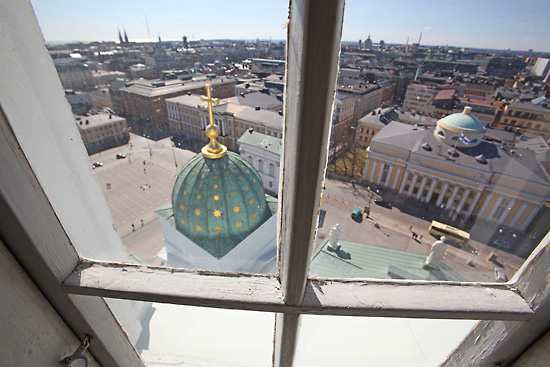
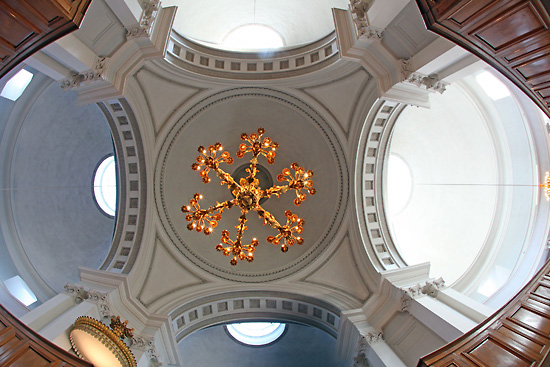
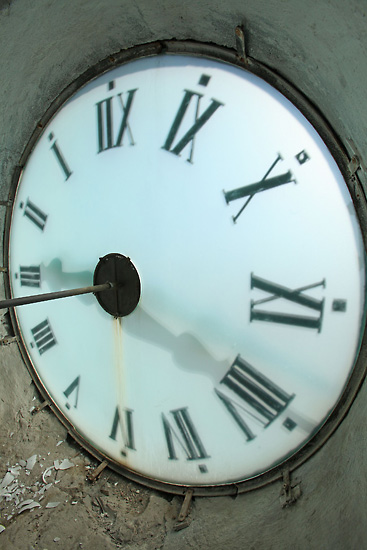
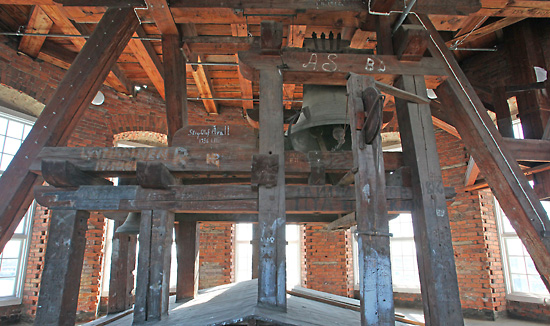
View the heart of Helsinki Cathedral

If you had to pick just one building that has come to symbolise Finland and especially Helsinki, it wouldn’t be Alvar Aalto’s Finlandia Hall or Eliel Saarinen’s Central Railway Station.

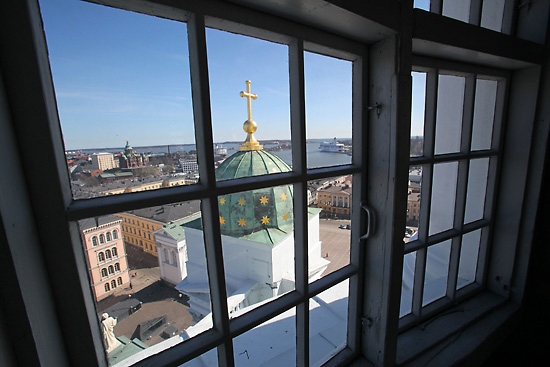
The edifice that shows up in every guidebook and every tourist’s photo album is the Lutheran Cathedral, Carl Ludvig Engel’s elegant neoclassical work completed in 1852. Overlooking Senate Square and the harbour, the church’s towers never go unnoticed.

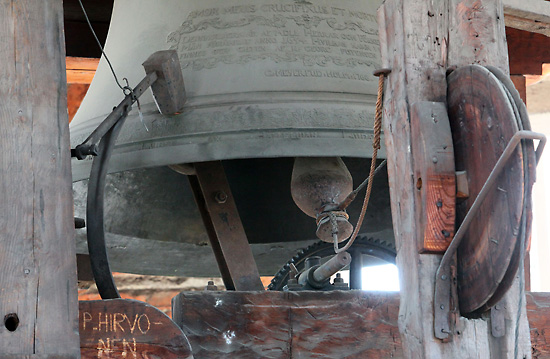
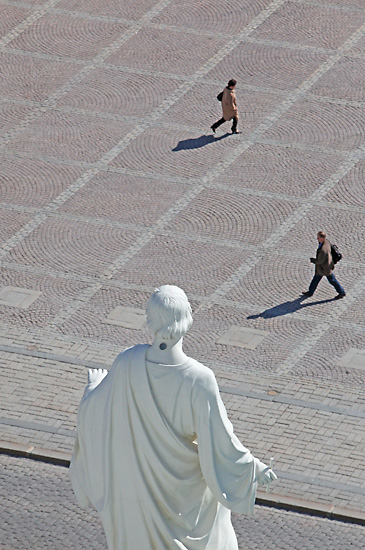
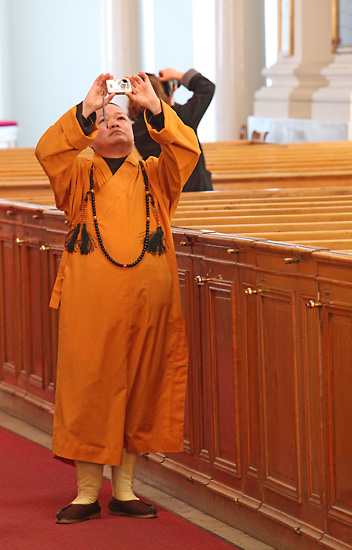
Our slideshow takes you inside the main tower, where tourists are not allowed to set foot, and seeks out other new angles, bringing you Helsinki Cathedral as you’ve never seen it before.

Photos by Tim Bird
Text by Peter Marten

Unveiling Finland’s mediaeval secrets

The vaults of the Finnish National Library house one of the world’s largest collections of mediaeval manuscript fragments, totalling more than 10,000 parchment leaves. A research project was launched in spring 2007 to explore this treasure.

Most of the fragments are from manuscripts written and used in Finland during the Middle Ages. As was customary then, they were written on parchment, which is made from animal skins. These fragments form by far the largest body of mediaeval literature preserved in Finland. Whereas only a few dozen complete mediaeval codices are known to have survived, it is estimated that the parchment fragments at the National Library represent as many as 1,700 different manuscripts.

Thematically the material is very diverse. Most of the fragments come from mediaeval religious texts, but there are numerous other fragments dealing with, for example, legal matters or philosophy. The beautifully gilded initial letters and endearingly wobbly handwriting open a door to the mediaeval world.

Why only individual leaves?

Why has the material survived only as individual parchment leaves? The answer is that after the Reformation that took place during the reign of King Gustav Vasa (1523-1560), king of Sweden and Finland, Catholic religious literature became redundant. Mediaeval manuscript books were broken up into single leaves and, in an early example of recycling, used again as cover wrappings for the taxation scrolls of the King’s bailiffs.

Cataloguing the fragment collection of the National Library was begun in the 1920s and is still going on. But although this collection is a treasure trove of information on the Middle Ages in Finland, it is so extensive and so complex that very little use has been made of it in scientific research.

Pioneering research project

A beautiful initial letter R in a missal of the 13th or 14th century.

A beautiful initial letter R in a missal of the 13th or 14th century.Photo: National Library of Finland

We know surprisingly little about Finland’s literary culture during the Middle Ages, even though it was the literature written in Latin and Swedish which linked Finland firmly to the Western cultural sphere and left a legacy whose influence is still evident today.

A research project launched in spring 2007 endeavours to shed some light on the emergence, development and impact of this earliest form of Finnish literature. The three-year project is led by Tuomas Heikkilä (a lecturer at the University of Helsinki) and financed by the Emil Aaltonen Foundation. Support has also been given by the Academy of Finland and the National Library.

This project is the first to explore all of the surviving Finnish mediaeval manuscripts and fragments. The collection of the National Library constitutes the majority of this corpus and thus has special status in the project.

Overview of writing and literature

The aim of the project team is to create for the first time a comprehensive overview of writing and literature in the mediaeval Diocese of Turku, whose domain broadly coincides with modern Finland. This will help clarify previously unanswered crucial questions, such as: What did people write and read in mediaeval Finland? What were the writers’ influences, and how did texts find their readers? How did the cultural identity of Finland come to be linked with western Europe and the Latin part of Christendom in the Middle Ages?

A page of liturgical text from a lectionary of the 14th century used in the diocese of Turku.

A page of liturgical text from a lectionary of the 14th century used in the diocese of Turku.Photo: National Library of Finland

The project is not only nationally significant but of international interest too. The spread of social and cultural values in mediaeval Europe and the emergence of a common European identity is one of the hottest issues in international mediaeval research. The spread of established Latin literature to the newly founded Diocese of Turku, where no indigenous pagan written culture existed, is highly relevant from a general European point of view.

The project team will study the manuscript material using methods drawing on the disciplines of history, philology, textual research, paleography, codicology and information processing science. Not only will this diverse approach generate new information on the earliest roots and development of written Finnish culture, it will also create a new, solid foundation for future research and, finally, put Finland firmly on the map of mediaeval text studies in Europe.

Treasure in danger?

The National Library’s parchment fragment collection constitutes the earliest layer of literary culture in Finland. It can without exaggeration be dubbed Finland’s oldest national treasure.

The existing fragments have survived the soiled hands of their mediaeval readers, reuse by bailiffs of the 16th and 17th centuries, several fires, and arduous journeys from Finland to Sweden and back. Even though parchment is a very durable material, many of the National Library’s fragments are now quite fragile from heavy use and recycling, and are faded, torn and scorched. In the Middle Ages, the useful life span of a parchment manuscript was generally estimated at 300 years, but these fragments are now up to three times older.

Digitizing the collection would make the fragments accessible to both scholars and the general public without endangering the originals and without the difficulty and great care required in handling them. Careful professional cleaning and conservation of the fragments would improve their readability and durability.

Tuomas Heikkilä is a lecturer at the University of Helsinki and leader of this research project.

By Tuomas Heikkilä, November 2007

Finnish national landscapes

The Finnish National Landscapes series is probably the best audiovisual presentation of Finnish scenery and historical sites available on the internet today.

Go to the video Towns and industrial heritage in southern Finland
No ‘dark satanic mills’, memories of labour and nature in mellow harmony.
Go to the video Southwestern Finland and the archipelago
Rolling farmland leading to the peace, solitude, sea, and sky of the islands.
Go to the video Historic Häme, province with a past
The essence of Finland yesterday, today and tomorrow.
Go to the video Lakes and rapids
Gentle on the eye, soothing to the mind.
Go to the video The Hills of Eastern Finland:
If you believe in a Finnish mystique, it is probably here.
Go to the video The windswept plains of Ostrobothnia
The wind-lashed plains of the west.
Go to the video Lapland
Tranquillity, unspoilt wilderness, round-topped fells, and much, much more – Lapland has it all.

Who’s afraid of Finnish?

Finnish has a reputation for being a difficult language. Is this true?

What is “a difficult language”? We all learn a mother tongue as children as a matter of course. Finnish children learn Finnish as easily as their counterparts in other countries learn their mother tongues. In this sense Finnish is no more difficult than any other language. But, of course, when people talk about “a difficult language”, what they really mean is a language that is thought to be particularly difficult for a foreign adult learner.

In “Where does Finnish come from?” and “Is Finnish a difficult language?” (links below), I discuss some features of Finnish which in my experience as a teacher of Finnish to foreigners for many years are perceived as difficult, but in reality are simply different, for example, from English. To illustrate this difference I shall start with some historical background. Then I shall suggest why and how Finnish has gained its reputation as “a difficult language”.

By Hannele Branch, lecturer in Finnish, University of London

The Finnish pain of the profane

On Finnish Language Day, April 9, some Finns – especially young ones – may celebrate their fondness for colourful language. Undeterred, our reporter shares his views on the subject.

Finland is a conservative country. At least, this conventional wisdom is echoed in countless guidebooks and newspaper articles. But in many instances, Finns refuse to act as you would expect conservative people to behave.

Their use of language, whether their own language or a foreign one, is a case in point.

Look up Finnish profanity on Wikipedia and it will tell you that in Finland ‘it is commonly considered impolite to swear excessively…and particularly in front of children’. This generally holds true.

The V-word

However, a large slice of Finnish youth seems overly familiar with the less polite zones of their language, mostly expletives describing various parts of the human anatomy. These words have a way of popping up in public situations: on buses, on trains and in shops. And they leave the mouths of boys and girls alike.

Profanity is part and parcel of language usage, of course, as any linguist can tell you, but shouldn’t it be saved for special occasions? Some Finns now claim that the V-word (if you don’t know what the really bad words are in Finnish, we’re not going to repeat them here) has been said so often that it’s lost its shock value.

Don’t get me wrong. I must point out that most Finnish kids are not programmed to utter expletives. But the polite, soft-spoken ones are often overshadowed by the minority that go to extremes.

Words that get the job done

Leaving aside the juvenile talent for forming whole sentences comprised of anatomy-related obscenities, a fair amount of strong Finnish language is unrelated to the body and its functions. We don’t suggest that you add it to your vocabulary, but the old standby perkele refers to the Devil and derives from the pre-Christian word for the god of thunder.

Finland’s Swedish neighbours refer to “management by perkele”, a reference to the supposedly direct approach of Finnish bosses to dealing with workplace situations and the frequent use of the word to punctuate their orders. This makes Finnish offices sound much scarier than they really are, but it’s part of Finland’s myth in many Swedish eyes.

Our F-word

Visitors to Finland may notice the casual use of English profanities – although this particular phenomenon seems to be audible in most countries nowadays, no matter what language the locals speak. The Finnish proficiency in English is admirable, but it does not need to extend to the liberal use of our F-word (“our” referring here to English speakers).

It’s our F-word, after all. The Finns wouldn’t like it if we used their equivalent with the same lack of sensitivity.

Things would be much simpler if the words of popular travel writer Bill Bryson were true. Infamously, in one of those gaffes that Finns will never forget, he states in his book Mother Tongue that “some cultures don’t swear at all… The Finns, lacking the sort of words you need to describe your feelings when you stub your toe getting up to answer a phone at 2:00 am, rather oddly adopted the word ‘ravintolassa’.”

This perfectly polite word simply means “in the restaurant”. It makes you wonder who was pulling Bill’s leg.

A cross, crass hedgehog

Finnish cartoonist Milla Paloniemi has made swearing into an art form with a comic strip entitled The Cursing Hedgehog. Bored during an art history class, she drew a bad-tempered hedgehog, later self-publishing it online and as a photocopied zine.

It became a bestseller and for the past couple years a publishing house called Sammakko has been releasing hardcover collections of the prickly character’s adventures. It won the Comic Strip Finlandia Prize in 2008.

Just about every episode ends with the hedgehog screaming swearwords, yet the comic strip is amusing and appealing. Maybe that’s because it expresses what the rest of us would like to say but can’t – because we’re too polite.

–Peter Marten

By Tim Bird, April 2009

A day in the life of Helsinki’s Strömberg School

All Finnish kids address their teachers by their first names, as the students at Helsinki’s Strömberg School do, but many other aspects of education at this school can be considered progressive no matter where you’re from. Let’s open the door and step inside.

Here we go!

It’s a few minutes past eight and the dim October morning has not yet given way to daylight when the pupils of Strömberg Lower Comprehensive School (ages 7–13) start taking off their jackets, caps and shoes in front of their coat-racks. An inviting fire, lit by the school caretaker to cheer the pupils up, is crackling in the fireplace in the hall.

Hellos are shouted along the corridors as pupils, teachers and the rest of the school staff greet each other. In this school, everybody knows each other, and the pupils call their teachers by their first names, as is customary in Finland.

Each child finds his or her own group. The classes are named after animals that live in Finnish forests: Elks, Bears, Foxes, Lynx, Hawks, Weasels, Seals, Eagle Owls and Wolves. And there are the Beavers, a class of pupils with mental disabilities; these kids arrive by taxi each morning. The school day can begin.

Light, space and social spectrum
2862-scho2_b-jpg

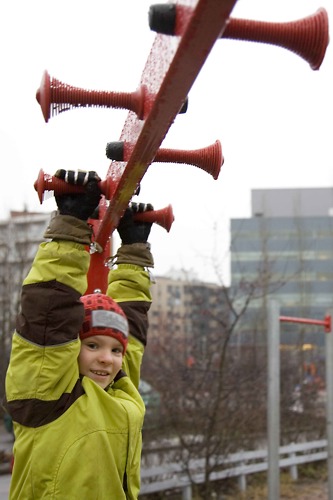
Students at Strömberg Lower Comprehensive School and schools everywhere in Finland spend time outside during recess, no matter what the weather.Photo: Anna Dammert

Strömberg Lower Comprehensive School in Pitäjänmäki, a suburb of Helsinki, is located in the middle of an old industrial estate that has recently been filled with new blocks of flats. Situated near busy thoroughfares in the western part of Helsinki, some ten kilometres from the centre, Pitäjänmäki encompasses a wide social spectrum, from high-income homeowners to low-income families living in city-owned rental houses. A fair number of immigrants live in the area.

The school itself is a City of Helsinki comprehensive school, drawing pupils from homes in the neighbourhood. It is located in a former machine engineering workshop that was converted and extended for use as a school in 2000. The school principal, Päivi Ristolainen, took part in planning both the school curriculum and the building, her expertise helping ensure that they serve the modern concept of good learning.

In typical Nordic architectural style, the premises are light and spacious, the materials durable and the colours warm. Apart from ordinary classrooms, the school has workshops for magazine-making, handicrafts, music, drama, science and environmental education; and a gym and a library. The school’s specialities include a small winter garden, corners with sofas for reading, and chess tables for games.

Active lessons

Back to the classrooms: some of the groups are being taught in their own home classrooms. For these lessons, which include Finnish, mathematics and more, the pupils determine weekly targets with their teachers and choose tasks to be carried out at their own pace.

Some groups are taking their turn in the workshops, learning through practical training. For instance, each group regularly spends time in the magazine workshop, working on their own publication.

The lessons are by no means spent in silent memorization; the children walk around, gather information, ask advice from their teacher, cooperate with other pupils and occasionally even rest on the sofa. The classroom situation is active, but the teacher never lets go of the reins – and doesn’t have to resort to authoritarian methods.

Learning by doing
A schoolgirl looking at a tortoise in a tank.

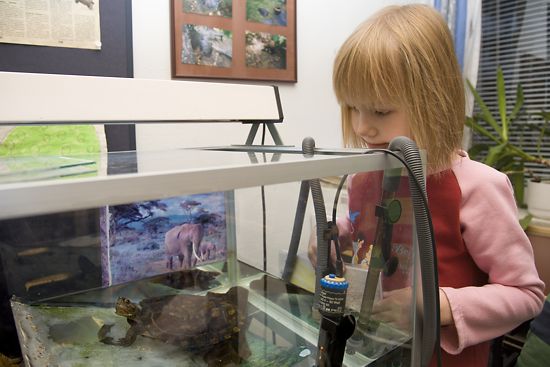
Students at the Strömberg School take turns taking care of the pet tortoise, Pertsa.Photo: Anna Dammert

Each lesson lasts 90 minutes. The pupils usually spend the thirty-minute recess outside playing in the schoolyard, regardless of the weather. They use the sports field for football in the summer and skating in the winter.

The school follows the pedagogical principles of the Frenchman Célestin Freinet, who underlines learning by doing and community orientation. Mrs Ristolainen-Husu points out that both the Finnish national core curriculum and the Helsinki city curriculum comply with Freinet’s ideas, but Strömberg School takes the model one step further.

This also means that the school has age-group–integrated classes, so that each group has children of two different ages. In such groups, differences between the children are taken for granted and less comparison results.

Windows on the world

Learning by carrying out “chores” is a key element in the school’s curriculum. This means that pupils participate in common chores from the first year onwards. Taking turns in groups, they see to the school’s houseplants, library, wastepaper collection, recycling, compost, yard and aquarium. They help in the kitchen and the Beaver classroom and care for the environmental workshop’s pet tortoise Pertsa.

Non-teaching staff guide the kids in these chores: cleaners, kitchen workers, the caretaker, the school secretary and attendants. Everyone shares responsibility for educating the children and unnecessary hierarchy is avoided among the staff.

The school is also open to the local community. Parents are always welcome in the classrooms and their expertise is utilised in the workshops and evening school sessions. The classes go on a lot of excursions.

Each year the school has a special theme for all pupils; it is discussed from interdisciplinary and artistic viewpoints. The themes rotate from year to year: water, earth, air and fire.

Lunchtime!

It’s time for a break after all that studying. And we’re hungry, too!

Like all Finnish schools, Strömberg School serves a free hot meal every day. Today it’s meatballs and mashed potatoes, a favourite with generations of children, served with salad, bread and milk. Special portions have been reserved for children with different dietary requirements for health or religious reasons. The children eat at cosy tables with tablecloths and flowers in vases throughout the year.

No extra funds above the average school construction budget were spent in building or maintaining Strömberg School. Yet a lot of ideas have been implemented here that people come from all over Finland and the world to learn about. Architects, too, come from all over the world to see the school building designed by Kari Järvinen and Merja Nieminen.

Fun for everyone
Kids' colourful paintings.

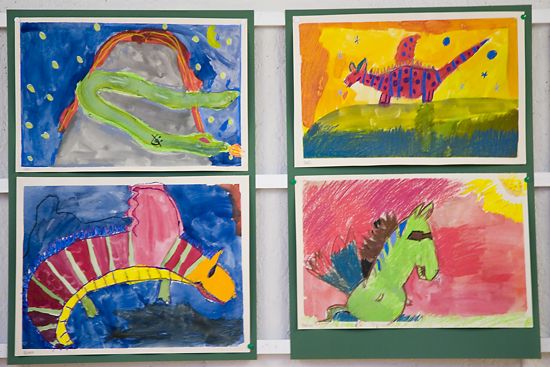
Artistic viewpoints also form part of the school day.Photo: Anna Dammert

The school day is over between 12 noon and 2 pm, depending on the day and group. Nearly all the children come from families where both parents work fulltime, as is customary in Finland, and the little schoolchildren find the afternoon alone at home too long. Consequently, city authorities have built a playground near the school, with access safe from motor traffic.

The playground offers the schoolchildren an extensive recreational area with playground and games equipment and two buildings where first- and second-grade children can do their homework or play indoor games. Playground attendants take care of the children, who are also provided with a snack at cost in the afternoon. Otherwise the entire playground facility is free of charge.

After four o’clock in the afternoon, the playground gate opens and shuts repeatedly as parents arrive to pick up their children. The knees of the children’s trousers are dirty and their gloves are damp; they’ve done and seen a lot. They’ve played hard and a fun time has been had by all.

The school also arranges a low-cost snack and free afternoon clubs and hobby groups for students in the upper grades. This year they are studying Japanese, learning to play in a band and doing arts and crafts.

On with your rucksacks and wave to the attendants – see you tomorrow!

By Salla Korpela, updated March 2011
With free, high-quality education for all

Finnish teenagers’ maths, science and reading skills are once again rated close to the top of the nearly 65 countries assessed in the PISA (Programme for International Student Assessment) study.

A three-yearly appraisal of 15-year-olds in the principal industrialised countries, PISA is organised by the OECD (Organisation for Economic Cooperation and Development). For the results gathered in 2009 and published in 2010, a total of 6,415 students from 203 schools took part in Finland.

In that PISA study, special attention was paid to reading literacy. In this subject Finnish 15-year-olds came out second among the 33 participating OECD countries, after South Korea by a margin of only three points (Korea 539, Finland 536). Finland was third among all 65 PISA countries, with Shanghai-China placing first.

Finland scored well in the secondary portions of PISA 2009 as well: mathematical literacy and science literacy. In mathematics, the Finns placed second among OECD nations and sixth among all 65 participants, while in science they scored first among OECD countries and second overall.

Understanding children’s needs

According to the survey, the strength of the Finnish school system is that it guarantees equal learning opportunities, regardless of social background. Instead of comparison between pupils, the focus is on supporting and guiding pupils with special needs. Very few children need to be made to repeat a year.

The teaching staff in Finnish schools is highly educated. Qualifications for all school levels require a Master of Arts degree including extensive pedagogical study and qualifications in special subjects.

Small children’s feelings of safety and motivation are increased by the fact that they are taught by a single teacher. Also, although students receive progress evaluations, scaled grading is not introduced until the fifth year. Finnish schools aim for natural, warm relations between teachers and pupils.

Finland’s repeated success in the PISA study has focused widespread international attention on the country’s school system and its support for lifelong learning.

Comprehensive school

Comprehensive school education is provided by the child’s home municipality, and the network of primary-level schools is dense. Instruction and all basic education materials are free of charge for the children, and services include a free hot lunch every day, school healthcare and free transport for children who live too far from the school to walk or use public transport.

Preschool instruction is provided for six-year-olds. This is voluntary, but almost the entire age group participates.

Instruction is provided in both official languages, Finnish and Swedish. In major cities schooling is available in other languages as well. Special schools exist for disabled or hospitalised children. Practically every Finnish child goes to school.

Upper secondary and basic vocational education

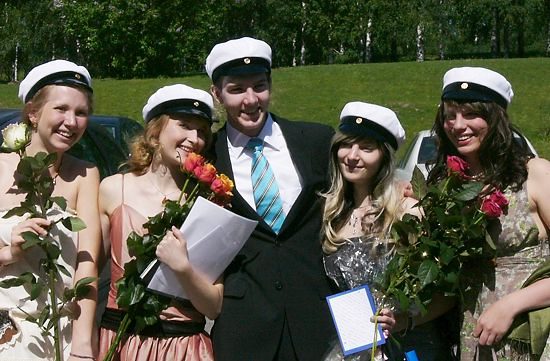
A group of students celebrates after graduating from upper secondary school.

A group of students celebrates after graduating from upper secondary school.Photo: Erja Raiskila

Approximately 50 percent of each age group continues to upper secondary schools. The curriculum covers a great many optional subjects and takes an average of three years, concluding with the national matriculation exam. Matriculation provides a foundation for continuing studies.

Apart from upper secondary schools, a three-year basic vocational education alternative also exists. This line of study is chosen by nearly all those who do not continue to upper secondary schools – only 7 percent of young people choose not to continue studying. Those who obtain a further vocational qualification can continue their studies in polytechnics or other institutions of higher education.

Institutions of higher education

Higher education is divided between polytechnics and universities. Polytechnics provide education and training aimed at high-level professional skills to meet the requirements of working life, while universities carry out scientific research and provide conventional academic instruction.

Depending on the institution in question, student selection is based on examination certificates or a combination of certificates and entrance examinations. Finland’s national strategy aims to provide a polytechnic or university degree to 42 percent of young adults by the year 2020.

In Finland, school education stretches over a long period of time; a significant number of higher education students do not graduate before the age of 25. The goal is lifelong learning; plenty of further training opportunities are supported by the public sector for adults who are already employed.

All school levels are free of charge for the pupils. The government has provided funds for various social benefits for students relating to means of support, meals, housing and healthcare. Educational institutions are predominantly owned by the local or central government.

Thanks to its comprehensive, high-quality public-sector school system, Finland has no commercial training and education market in basic education. At other levels and in other sectors, commercial provision is also relatively small compared with many other Western countries.

Inside Finnish schools

Classes number about 30 pupils per age group, usually less in the younger classes. For the first six years of comprehensive school, the children are instructed by a class teacher. Instruction during the last three years of comprehensive school is taken over by subject teachers. Pupils are also given special instruction if needed for speech impediments and for reading and writing problems or similar special needs.

Comprehensive school subjects include native language and literature; other languages; environmental studies; civics; religion or ethics; history; social studies; mathematics; physics; chemistry; biology; geography; physical education; music; art; handicrafts and home economics. The goals of instruction and the core curriculum are the same nationwide, but the local authorities and schools draw up their own local curricula on that basis.

Emphasis on languages

Finnish schools emphasize foreign language studies. The first foreign language is generally introduced in the third year of comprehensive school and the second domestic language (Swedish for Finnish-speaking pupils and Finnish for Swedish speakers) in the seventh year, if not sooner.

In addition, pupils may opt for up to six different languages by the completion of upper secondary level. The most common foreign languages are English, German, French, Russian and Spanish.

Immigrants with native languages other than Finnish or Swedish receive special instruction in Finnish as a second language. Municipally funded instruction in the children’s native language is provided twice a week.

Religion with respect to family values

Most Finns are members of the Evangelical-Lutheran Church, and their children participate in instruction in that religion. Members of other religious groups are also entitled to instruction in their own religion if a minimum of three pupils form a study group.

Those who are not members of a religious group are exempted from instruction in religion. Instead, they study ethics, interpersonal skills and religions throughout their school career.

Options for both pupils and teachers

Many municipalities have upper comprehensive and upper secondary level schools with weighted curricula focusing on subjects such as music, art or sports.

Teachers’ high education level allows them to plan their work and choose their methods independently. The Finnish school system is based on a culture of trust, not control, and teachers are active in developing their own work. On the job they set an example of lifelong learning.
 

By Salla Korpela, March 2009, updated March 2011

Aimo Sori, what’s your name?

Meeting new people from different backgrounds is always exciting, but sometimes you run into unexpected complications – for instance, pronouncing the name of your new acquaintance. Finns are no exception.

The Finnish language in general is regarded as difficult and Finnish names have an exotic ring to them. For example, you introduce yourself to a Finnish woman and it sounds like she responds, “I know.” She might not be saying that she is aware of who you are, but that her name is Aino. Perfectly normal.

Understandably, Mr Aimo Sori (pronounced “I’m oh sorry”) also had a hard time getting his name across initially. But most problems occur with long names including the letters å, ä and ö. Therefore names such as Äkäslompolo or Yrjönen often raise eyebrows and give rise to verbal acrobatics. However, your new Finnish friend will appreciate your effort. At worst, you’ll have a laugh together.

When being introduced, a follow-up question in many countries is about the meaning of your name. Let’s present some well-known Finns and explain what their names mean.

Nomen est omen

It seems as if some people were destined for their vocation the moment they were christened. Weather forecaster and television profile Pekka Pouta is one. To the regret of many Finns and tourists alike, he all too seldom forecasts the type of weather associated with his last name, which means “sunshine”. That of course, is not his fault, but an occupational hazard of working in Finland.

Mika Ihamuotila, the chairman of leading Finnish clothing and textile design company Marimekko, has been dubbed Mr Marimekko by Finnish media. Probably a name and a title to his liking, but his surname already contains the word “muoti”, which means “fashion” in Finnish. He used to be a banker, but perhaps he was driven by his fateful name to buy a controlling interest in Finland’s famous fashion house.

The kindest man and the fastest man

Most Finns were proud, and with good reason too, when former Finnish President Martti Ahtisaari was awarded the 2008 Nobel Peace Prize. Interestingly, in contrast to his nonbelligerent nature, Ahtisaari’s first name actually means warlike. It can be traced back to the Latin name Martinus, which in turn is linked to Mars, the god of war.

What about Ahtisaari’s surname? “Ahti” is the sea god in the Finnish national epic Kalevala, and “saari” is Finnish for “island”. So the name of the current Nobel Peace Prize holder can actually be loosely translated as “Warlike, from the island of the sea god”. A patriotic Finn could try to excuse this juxtaposition between character and name by noting that Ahtisaari’s grandparents were Norwegian and changed their surname from Adolfsen to Ahtisaari in 1929.

Nicknames can describe a person’s career or maybe even character. Finnish Formula One star Mika Häkkinen is called “Häkä”, a diminutive of his surname which also happens to mean carbon monoxide, a waste gas produced by engines. His compatriot Kimi Räikkönen, however, is called “Räkä.” Räka means “snot” and might refer to his childish looks and unapologetic behaviour.

Trying to pronounce Finnish names just adds to their charm. But sometimes even a Finn is left wondering if there might be a hidden meaning behind all those ä’s and ö’s.

By Jens Alderin, April 2009, updated July 2015