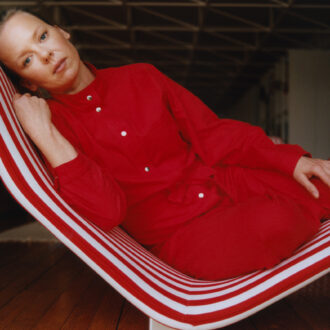
It’s an unusual feat to bring lightness into a genre that is known for its literal and figurative darkness. Yet Nordic noir author Satu Rämö has managed to do just that. She treats her characters well and attempts to see the good in people, even when the devil on their shoulder wins.
“I bring a compassionate mindset to my work, especially when I’m creating characters who do harmful or morally questionable things,” she says. “I try to approach them with some softness, to understand what drives their behaviour.”
Rämö is best known for her international bestseller Hildur (published in English as The Clues in the Fjord) and its sequels Rósa & Björk (The Grave in the Ice), Jakob (The Shadow of the Northern Lights), Rakel (The Secrets from the Deep) and Tinna (The Stranger from the Mountains). Set in a remote Icelandic village, the series begins with police officer Hildur Rúnarsdóttir and her Finnish colleague, police trainee Jakob Johanson, attempting to solve a string of interconnected murders. While working as the chief of the missing children’s unit, Hildur struggles with the trauma caused by her younger sisters’ disappearance years earlier.
When Rämö talks about approaching all her characters through a lens of compassion, she means trying to understand the powerful emotions behind criminality. These are often rooted in shame, rejection and the feeling of being unseen or unheard.
“I’m not interested in glorifying violence,” she says. “I want to understand what drives it. We all carry a deep, dark well within us, and it reflects different things in each of us. That’s the space I’m drawn to explore.”
A surprise success
Since the publication of the first Hildur book in 2022, the series has become a massive hit. It has broken Finnish sales records and gained success in international markets. Translation rights have been sold to dozens of countries, including the UK and Germany, where the book spent eight weeks on the magazine Der Spiegel’s bestseller list. The first one of three volumes was recently adapted into a Finnish-language play, and an internationally produced television series of Hildur premiered in Finland in early 2026, with other countries to follow.
Rämö is hesitant to guess why the world of Hildur has been so widely celebrated, but she suspects it might have something to do with her human approach to the characters.
The emotional depth comes across in interactions and small gestures, especially between Hildur and Jakob. These characters wish the best for each other, even when the surrounding world closes in on them. Whether it’s Jakob’s custody battle over his young son or Hildur’s quiet resilience as she deals with one loss after another, readers have found emotional resonance.
“People tell me they don’t usually read crime fiction, but have gotten into the genre through my characters,” Rämö says. “For many, emotional relatability comes first, then the crimes and plot twists.”
She’s managed to capture the interest of the elusive “wide audience”: at a book fair a group of teenage boys approached her for autographs, while at the other end of the spectrum, she’s received handwritten letters from 90-year-old readers.
Creating a new friend

The character of Hildur was born out of seclusion during the Covid pandemic. Originally from Finland, Rämö first fell in love with Iceland (and an Icelandic man) in the early 2000s as an exchange student. That man is now her husband and the couple has two children. The family has been living in Iceland for more than a decade.
Just as Covid restrictions were beginning, Rämö and her family left Reykjavík for Ísafjörður, a town of 3,000 people seven hours away from the capital. As newcomers, they didn’t have a community network yet. Stuck at home and desperate for something to do, Rämö remembered having an imaginary friend as a child.
“We would have conversations and play hide-and-seek,” she recalls fondly. Even though the friendship happened inside Rämö’s head, it created a real sense of belonging.
She returned to her old ways and started imagining. She wanted to create someone she could relate to, but who would be different enough to be intriguing.
Little by little, Hildur came to life: a police officer who surfs in the unruly Atlantic Ocean, deadlifts twice her body weight, and enjoys pizza for lunch.
Through this character, Rämö took the opportunity to imagine the dark underbelly of the peaceful Icelandic community. In Ísafjörður, crime rates are low, and people feel safe enough to leave their doors unlocked at night.
But what if the sense of safety was false? What if child abuse, corruption and cronyism were secretly a part of this community, too?
With social critique mixed in with the plot, a modern Nordic noir classic was born.
Fighting an endless November
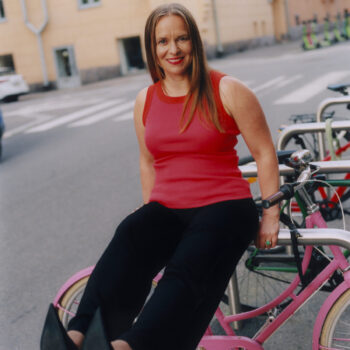
Satu Rämö’s Finnish roots and Icelandic home both shape the atmosphere of her bestselling crime series.
Rämö’s compassionate approach to her characters is not exactly common for Nordic noir and its screen adaptations. In fact, Jaakko Seppälä, lecturer in film and television studies at the University of Helsinki, summarises the genre this way:
“Nordic noir is crime fiction that dwells on negative emotions, set against the backdrop of an endless November. There’s no snow on the ground yet; it’s pitch black and rainy. People are disappointed and exhausted.”
According to Seppälä, one thing makes the genre distinct, especially compared to American crime fiction.
“In the background, the Nordic welfare state is slowly unravelling,” he says. “These countries are often held up as a global model of social order, free healthcare, functional social services – you get the gist. Finland was recently rated the happiest country in the world for the eighth time in a row. [Editor’s note: Since this interview, it has happened again, for the ninth time.] All of this makes the cracks in the system all the more compelling to explore.”
Nordic noir does its best to expose cracks in a system that’s supposed to take care of everyone. It highlights class divides by placing the wealthy in sleek, design-filled homes, while others live in cramped apartments or end up on the streets. International hits such as the Danish TV series The Killing or Swedish author Stieg Larsson’s Millennium trilogy dig into the abuse of institutional power and the ways the system fails to protect women and children.
“The genre asks what happened to us and where we are going as a society,” Seppälä says. “We feel like we’ve lost something that was once dear to us – and that something is the welfare state.” Even small structural changes can lead to significant fears, especially for people who are already at the mercy of the system or have been failed by it.
And that is usually when the crimes begin. Viewers are glued to their dimly lit screens as traumatised police officers chase psychopaths and evil geniuses, the only source of light being the main detective’s moral compass.
Hildur comes alive
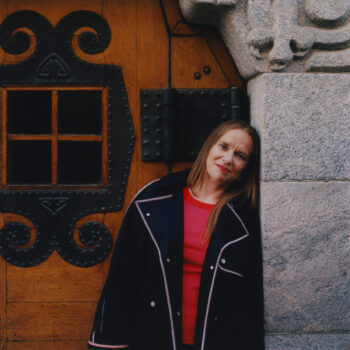
In 2025 Satu Rämö’s book Hildur was adapted into an international television drama series of the same name.
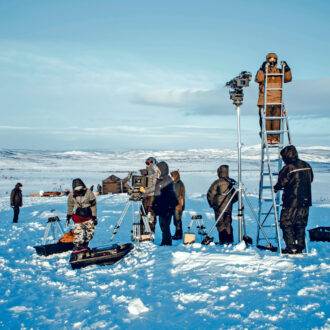
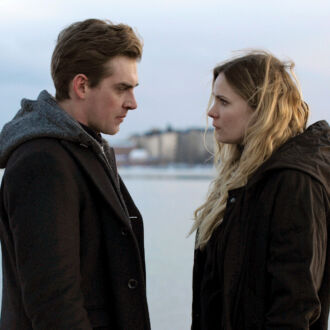
In the winter of 2025, Rämö stood on a beach in her home city. It is a familiar place she often visits, but this time was different. In front of her, in the ice-cold waves of the ocean, actor Ebba Katrín Finnsdóttir was teaching co-actor Lauri Tilkanen to surf on camera. Hildur and Jakob came to life as Hildur was being adapted into a multilanguage television series in the exact location of its source material.
A sign of Nordic noir’s evolution, according to Seppälä, is its move away from major cities and into more remote, peripheral settings. Instead of Copenhagen, Helsinki and Malmö, criminals roam around Fjällbacka, Ivalo, and Ísafjörður.
These shifts introduce viewers to new and exotic locations where rural Nordic nature gets to play a role of its own.
Even though Rämö wasn’t involved in the script or casting of the show, the books’ wary rays of light bleed onto the screen.
“It is a Nordic noir series, but it won’t be as dark and depressing as it could be,” says Rämö. “Yes, everything is quite horrible in Hildur’s universe, but there’s a lot of good there, too. I’m glad they’ve chosen to show that.”
Conventionally unconventional
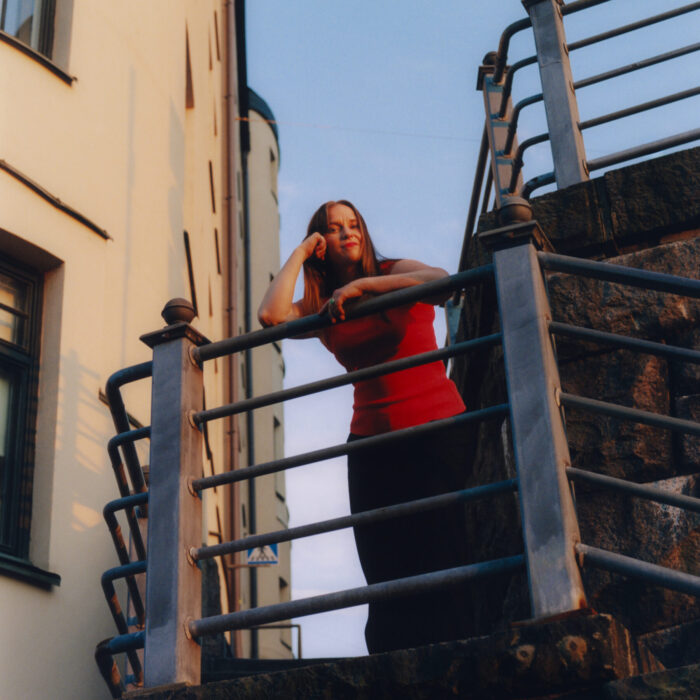
Rämö likes to break genre conventions. There are no murdered women found naked on the beach, and no detectives flirting with alcoholism while desperately trying to balance work and family.
While traditional Nordic noir protagonists drown their stress in booze and all-nighters, Rämö’s main character Hildur goes for a run and enjoys a plate of greasy sausages with her aunt. Jakob, the Finnish colleague, knits.
“I wanted to create characters who could just be,” says Rämö. “Jakob is a little softer and a little calmer than a police officer traditionally is. Hildur enjoys casual sex and strength training simply because that’s who she is. It’s not a heroic tale of a strong woman or a gentle man, although we need both of those, too.”
If there’s one Nordic noir trope she relates to, it’s isolation. As an expat Finn living in Iceland, Rämö is between two countries and two nationalities, always feeling a little bit like an outsider.
Hildur herself occupies a similar liminal space. She enjoys a solitary life without a large group of friends or a romantic partner. She doesn’t want to build a family of her own, yet she longs for the one she lost.
Rämö identifies with that feeling of solitude. She says, “There’s something beautifully melancholic about Hildur and the story she tells herself. She’s alone but not lonely.”
New to Nordic noir? Start with these shows
The Bridge (Bron/Broen, Sweden and Denmark) Swedish detective Saga Norén works with her Danish counterpart Martin Rohde to solve the murders of two bodies discovered on the bridge linking their countries. The series carried on for four seasons and inspired a short-lived American TV adaptation.
Bordertown (Sorjonen, Finland) A Finnish noir classic, Bordertown is set in the sunny southeastern city of Lappeenranta, near the Russian border. Detective Kari Sorjonen investigates dark crimes that sharply contrast with the town’s peaceful atmosphere.
The Killing (Förbrydelsen, Denmark) Detective Sarah Lund unravels complex murder cases and wears knitted sweaters that eventually became nearly as iconic as the series itself. Adapted into an American series, the show amassed millions of viewers and several awards, and helped define the Nordic noir genre internationally.
Arctic Circle (Ivalo, Finland and Germany) Set mainly in the far-northern Finnish town of Ivalo, this series features criminal investigator Nina Kautsalo crossing wintery landscapes to solve chilling cases that have far-reaching international connections.
Text: Kristiina Ella Markkanen, ThisisFINLAND Magazine
Photography: Mikael Niemi
Style: Suvi Poutiainen
Make-up and hair: Essi Kylmänen