Finland enjoys a golden age of Northern Lights

The lane leading to a wooden building is lined with pine trees. A traditional, unpainted fence forms a square beyond the trees. Unlike in many places around here, the fence is not for keeping the reindeer out, but for catching something that can’t always be seen with human eyes.

The appearance of the buildings is also misleading. More than 40 people, scientists and engineers from all around the world work here at Sodankylä Geophysical Observatory (SGO). Together they want to understand something that humans can only observe in the dark polar sky: the Northern Lights.

Eija Tanskanen, the director of the SGO, has studied the Northern Lights and magnetic disturbances in the atmosphere for more than 30 years.

As a child, she would lie down in the snow and wonder what the Northern Lights actually were. Before settling in Sodankylä, Tanskanen worked in various research, teaching and management positions, including at NASA’s Goddard Space Flight Center.

Science has progressed a lot since Tanskanen’s early years, benefiting all of us. Giant leaps in navigation technologies – in compasses and airplanes – are due to increased knowledge of magnetic fields and disturbances.

“We understand the atmosphere much better now,” Tanskanen says.

Understanding the Northern Lights is closely related to understanding magnetic fields. The Northern Lights occur approximately 100 kilometres (60 miles) from the ground, in the upper atmosphere, when the sun’s solar wind carries magnetic storms towards the earth. The lights follow the earth’s magnetic fields.  In northern regions it’s called aurora borealis, and in southern regions, aurora australis.

What do birds see?
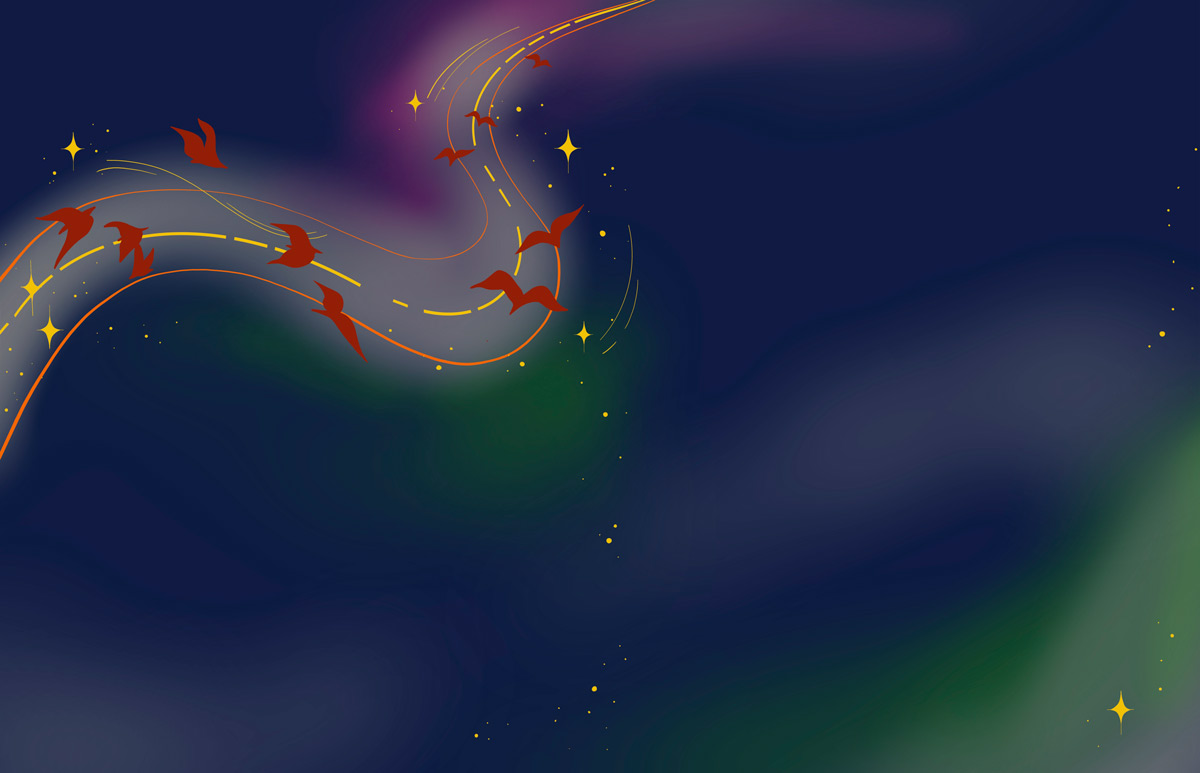
An illustration shows streaks of colour across a night sky and bird-like shapes that are following a wavy line across the picture.

Illustration: Annu Kilpeläinen

Outside the observatory Tanska­nen walks along the sandy road. She keeps gazing up so she can see the sky. That has been her constant position since her early years: eyes toward space.

For her PhD, Tanskanen studied the sun’s energy budget, or, as she frames it more practically, “where the Northern Lights get their energy from.”

Located 120 kilometres (75 miles) north of the Arctic Circle in Finnish Lapland, the Sodankylä observatory has served as a base for scientific geophysical measurements since 1914.

Today, the observatory is an independent research department of the University of Oulu. From the very beginning, the earth’s magnetic fields have been measured here.

“All things that are related to navigating or going in some direction, such as planes and compasses, are based on measuring the magnetic fields,” Tanskanen says.

The magnetic poles are places where the magnetic fields are vertical. The earth has two magnetic poles: in the north and south. The Northern Lights are only visible for the human eye around magnetic pole areas when a solar storm hits the planet. Migratory birds use magnetic fields for navigation. They can see the magnetic fields like humans can see roads.

Polar expeditions ahead
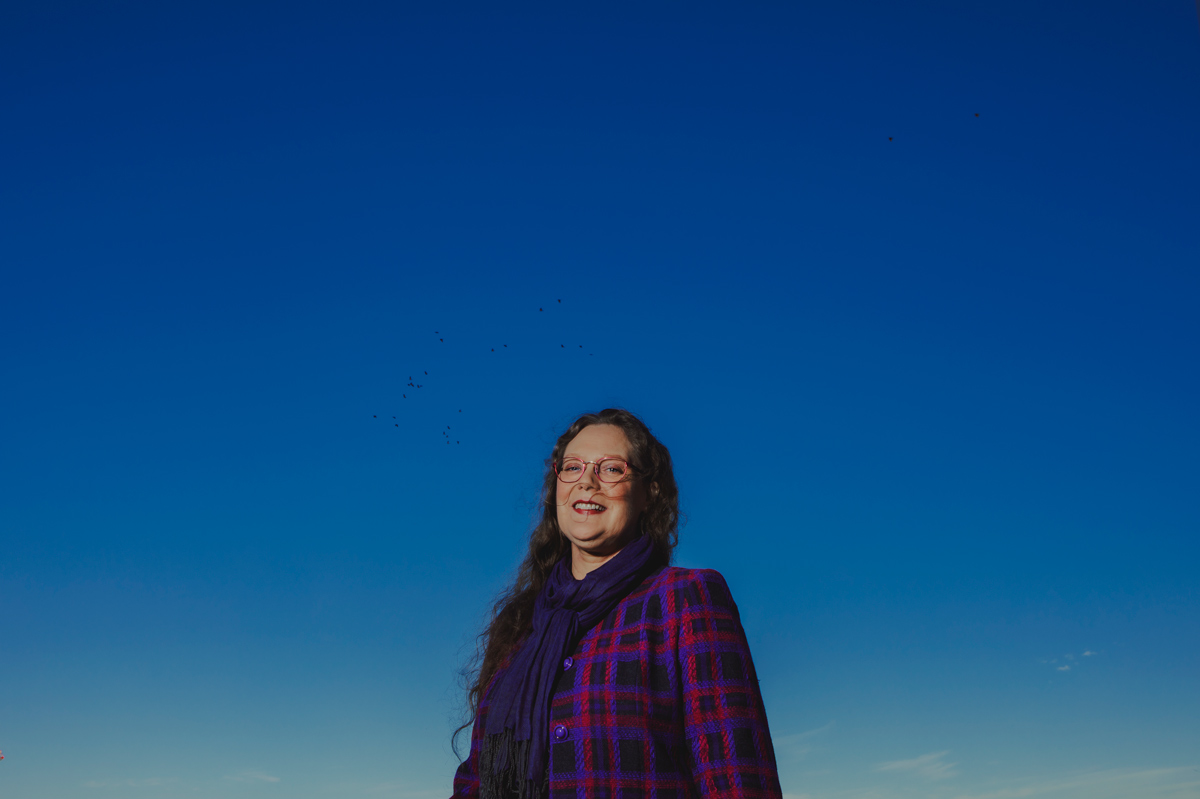
A woman wearing a jacket and scarf stands beneath a blue sky.

Sodankylä provides the perfect conditions for studying the Northern Lights, says Eija Tanskanen.Photo: Sabrina Bqain

The geophysical science community has a problem. The locations of the magnetic poles are in constant movement, and their exact geographical points are currently unknown. They are not the same as the geographical poles, and at the moment they should be about 500 kilometres (300 miles) from each other.

Insufficient knowledge of the magnetic poles’ location causes inaccuracy in navigation, especially in polar areas.

“We know that the magnetic north pole left Canada’s archipelago at the end of last century and that it is moving somewhere in the Arctic Ocean towards Siberia,” Tanskanen says.

The solution for the problem is to go and find the wandering magnetic poles. In September 2025, a polar expedition starts its journey from Sodankylä to an unknown spot somewhere in the middle of the Arctic Ocean to find the earth’s magnetic north pole. A similar trip to the south starts in February 2026.

“The explorers don’t know where the pole is, nor what the conditions will be,” says Tanskanen.

The explorers might need to ski or even swim to reach the pole. To add to the challenge, reaching the exact location of the pole is not enough. The explorers must somehow let the rest of the world know the location, from the edge of the world.

“We don’t know yet how it will be done,” Tanskanen says.

What is certain, though, is that the most important equipment for these expeditions will be made here in Sodankylä. It includes a special, ball-shaped compass that will point downward at the exact location of the magnetic pole.

Connected to the universe

Around the observatory area, red huts house magnetometers that measure the magnitude, power and direction of the magnetic fields. They connect Sodankylä to the world.

“Actually, to the whole universe,” Tanskanen corrects.

Here, the sun never sets during the summer, whereas in the winter, there are only a few hours of daylight. These extreme light conditions make Sodankylä and the Finnish Lapland region an excellent travel destination for people wishing to see the Northern Lights, but also an ideal location for geophysical research.

“Every time somebody wonders why we want to do science in the periphery, I say that this kind of science has to be done in a place where you can hear the voices of nature over the voices of people,” Tanskanen says.

Good years ahead

An illustration shows streaks of colour across a night sky, as well as a fiery orange round shape in one corner.

Illustration: Annu Kilpeläinen

Tanskanen has fantastic news for everyone who dreams of seeing the Northern Lights: starting from 2025, the amount of the Northern Lights will increase until 2028.

This is because the sun’s face will turn angry. It sounds more ominous than it is, Tanskanen says.

The solar cycle has reached the point when there are large sunspots on the sun’s surface. One sunspot can be the size of the planet Jupiter.

“Solar radiation is cyclical,” she says. “The most commonly known cycle is 11 years, another one is 22 years. The sun’s north pole and south pole change places every 11 years, so that the north is north, and the south is south every 22 years.”

Tanskanen shows a picture: At the beginning of each cycle, the sun is more or less evenly yellow. Around years four and five of the cycle, the surface gets many small dots.

“It resembles the moment just before water starts to boil in a pot and you see many small bubbles on the bottom of the pot,” she says.

In 2025, we are around that point. The sun is about to boil, and the small sunspots bubble, and some burst out of the sun. When they hit the atmosphere and the earth’s magnetic field around the north and south poles, the Northern Lights appear.

In 2025, the Northern Lights should be rather simple and green. Around 2026–2028, that is, during years six and seven of the sun’s cycle, the number of sunspots reaches its peak.

That’s when the storms really start, Tanskanen says.

“And that’s when we say the sun has an angry face. It looks like it’s grimacing. At this point, there will be more Northern Lights, and they take on more complex forms and colours, like red and blue.”

By Anna Ruohonen, ThisisFINLAND Magazine

Discover how Finnish lingonberry innovation can boost oral health

Dentist and researcher Pirjo Pärnänen discovered that when lingonberry juice is fermented, its natural sugars disappear but its beneficial compounds remain. The result: a sugar-free rinse that fights the microbes linked to gum disease and tooth decay.

Clinical studies show that fermented lingonberry products can reduce inflammation, ease dry mouth and support good oral hygiene. Pärnänen’s research and the resulting products indicate how Finnish nature continues to inspire science and sustainable health innovations.

Finnish workwear: Fashioned with purpose

From timeless wardrobe essentials to meaningful accessories, Finnish workwear reflects culture and values.

The art of meaningful style

A collage shows product pictures of fashionable items: a blazer, a shoe, a sleeveless top, a bag, trousers, a bracelet and a pair of earrings. Next to them is a photo of a woman at a café wearing similar clothing.

1. Lesley bouclé blazer, Andiata; 2. Precious slingback 55, Hagelstam; 3. Vida brushed top, Almada Label; 4. Fortune Cookie tote bag, Pihka; 5. Bella trousers, Almada Label; 6. Aina bracelet, Lumoava; 7. Classic Aida mini studs, Aida.Lookbook image: Andiata

Timeless style is about essentials that always work, but it’s also about items you wear with confidence and pride. Finnish brands excel at this, focusing on quality, day-to-day wearability and sustainability. From Pihka’s leather pieces, handmade in Helsinki, to meaningful pearl earrings from Aida, which not only look beautiful but also support refugee women starting a new life in Finland, these are truly pieces with purpose.

Shown here is a classic blazer look updated for the season with a focus on silhouette and texture. A fitted bouclé blazer with a French twist is paired with wide-legged trousers. A sleeveless turtleneck layers easily under a blazer without bulk, yet is structured enough to wear on its own for more festive occasions.

Workwear made to travel

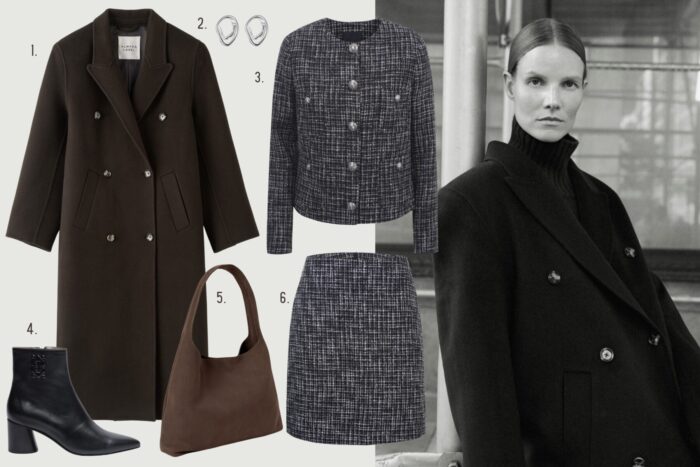
A collage shows product pictures of fashionable items: a coat, a pair of earrings, a blazer, a boot, a bag and a skirt. Next to them is a photo of a woman wearing similar clothing.

1. Deja doublé coat, Almada Label; 2. Männyt silver earrings, Kalevala; 3. Biella tweed blazer, Ril’s; 4. Scoop ankle boots, Minna Minna; 5. Terra Grande mocha bag, Pihka; 6. Elba tweed skirt, Ril’s. Lookbook image: Almada Label

This autumn season is about classic tailoring in warm, earthy tones that feel both strong and soft. Browns and greys work beautifully together, offering a smart alternative to black.

A matching tweed blazer and skirt is ideal for work trips. Easy to pack, simple to mix and match, and always polished. Decorative buttons add detail, almost like jewellery, so no bold accessories are needed.

A coat often makes the first impression, especially when travelling for work. Almada Label, the winner of the Textile & Fashion Award 2025, is known for luxurious knitwear and timeless outerwear. Their chocolate-toned coat is the kind of piece that carries you with ease from airport to meetings. Simple silver earrings and ankle boots with a comfortable heel complete the look.

From desk to dinner

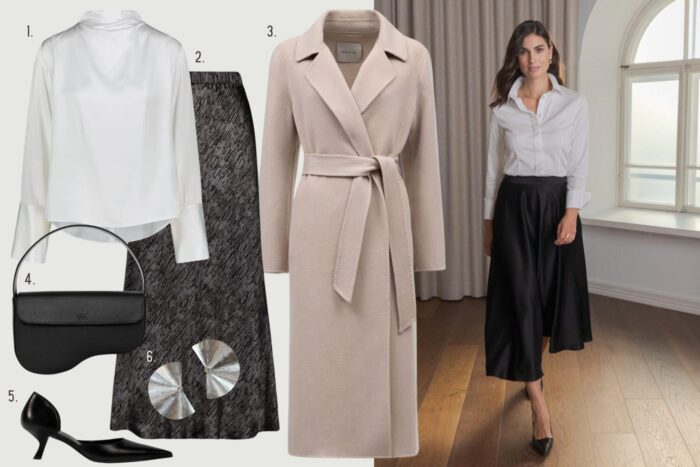
A collage shows product pictures of fashionable items: a blouse, a skirt, a coat, a bag, a shoe and a pair of earrings. Next to them is a photo of a woman wearing similar clothing, walking across a wooden floor in front of a window.

1. Ariella silk blouse, Katri Niskanen; 2. Jillian skirt, Voglia; 3. Greta coat, Balmuir; 4. Clover bag, Ask Scandinavia; 5. Amber D’Orsay pump 55, Hagelstam; 6. Beryl earrings, Keski-Pomppu. Lookbook image: Original Story

When the schedule is filled with official events and work dinners, a wardrobe needs to adapt. A crisp white button-down is the perfect starting point. For an evening silhouette, swap trousers for a flowing midi skirt and sheer tights.

Accessories play a key role. Add a piece of statement jewellery and change into lighter heels to elevate the look. For more formal occasions, choose a smaller handbag. The Clover bag from Ask Scandinavia carries essentials and is created with sustainability and responsibility at its core. Made from Mirum, a cruelty-free biomaterial, it combines the feel of luxury leather with a fraction of the environmental impact.

Finnish tailoring for him

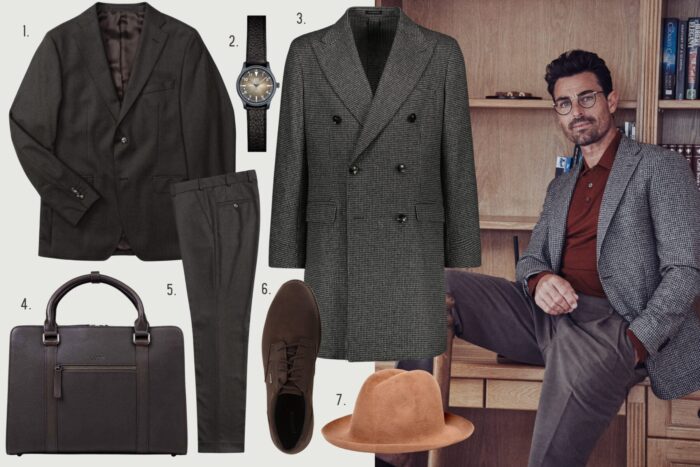
A collage shows product pictures of fashionable items: a jacket, a watch, a coat, a briefcase, trousers, a shoe and a hat. Next to them is a photo of a man wearing similar clothing, posing in front of a bookshelf.

1. Brown flannel jacket, Turo; 2. 180NN Noki Nero watch, S.U.F. Helsinki; 3. Viareggio Grey DB Luxury coat, Schoffa; 4. Venture briefcase, Aarni; 5. Brown flannel trousers, Turo; 6. Neva Men’s Gore-Tex shoes, Pomar; 7. Fedora Curvy, Én Hats. Lookbook image: Turo

The simpler the outfit, the more important the cut and materials become. In formal menswear, personal touches are often subtle but noticeable to those who appreciate them. Brown is a key colour this season and Pantone’s Mocha Mousse is Colour of the Year 2025.

A brown suit from Turo shows professionalism with a modern touch, while a checked wool overcoat from Schoffa adds texture. When sticking to one colour palette, texture matters. Suede shoes and leather details bring subtle variation.

Nordic edge

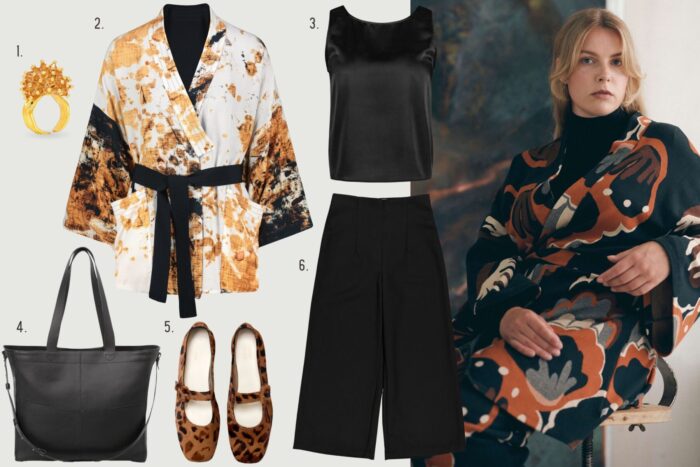
A collage shows product pictures of fashionable items: a ring, a jacket, a sleeveless top, a bag, a pair of shoes and a pair of trousers. Next to them is a photo of a woman wearing similar clothing, sitting on a chair.

1. Dreamy Dandelion ring, Annele; 2. Framtiden reversible kimono jacket, Niinmun; 3. Sarah top, Gauhar; 4. Aitta bag, Lovia; 5. Violette Mary Jane ballet flats, Terhi Pölkki; 6. Wool culottes, Archetype. Lookbook image: Mainio

When thinking of Finnish fashion, strong and distinctive prints often come to mind. Brands such as Marimekko, Kaiko and Klaus Haapaniemi are known for patterns that are instantly recognisable. Style expresses personality, and a print does exactly that: it tells a story about the wearer and can even spark conversation.

In more formal settings, prints work best when paired with clean, modern cuts. A kimono-style jacket in a bold pattern brings individuality to the workplace while staying polished. It can be styled with matching trousers for a modern set or balanced with tailored black wool trousers for a more formal approach.

The Nordic edge is about expressing personality while keeping the overall impression refined and professional.

By Johanna Piispa, October 2025
(Images courtesy of the brands)

How Finland’s snow storage is shaping the future of skiing

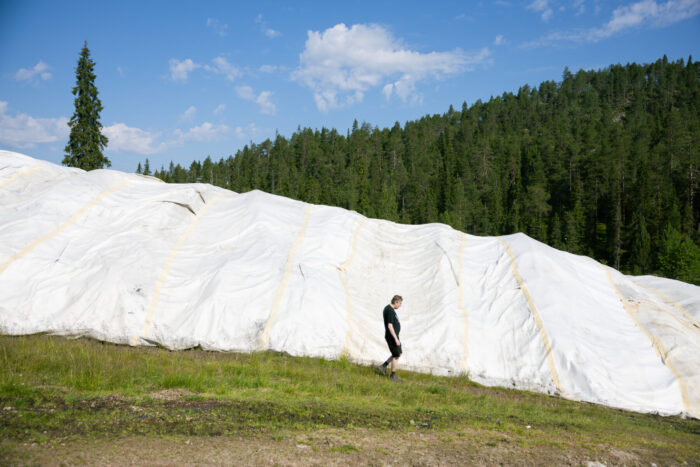
Beneath thick white covers lies a mountain of snow – over 200,000 cubic metres (7,000,000 cubic feet), stretching hundreds of metres long and towering up to eight metres (26 feet) high. That’s enough snow to cover around 28 European football fields with a one-metre (three-foot) layer.

Quite a sight in summer.

We are visiting Ruka, one of Finland’s leading ski resorts, in July, and the air is shimmering with heat.

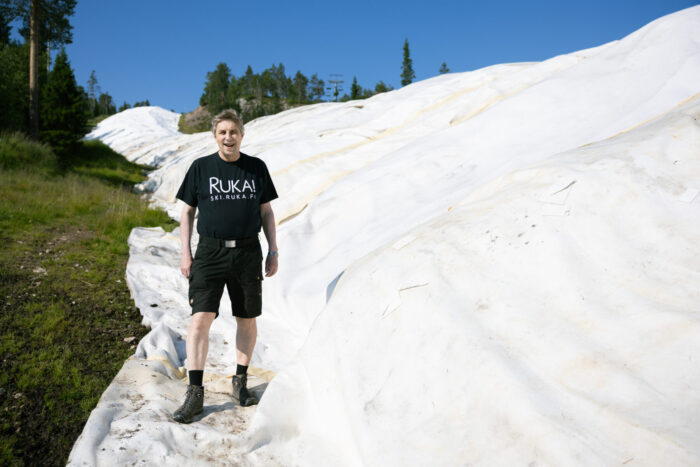
 A person in a T-shirt and shorts stands on a white tarp with green grass and trees visible behind them and a clear blue sky above.

Matti Parviainen has worked at Ruka since 1980.

Ruka’s slope manager, Matti Parviainen, walks along the snowy ridge, carefully avoiding puddles and mud.

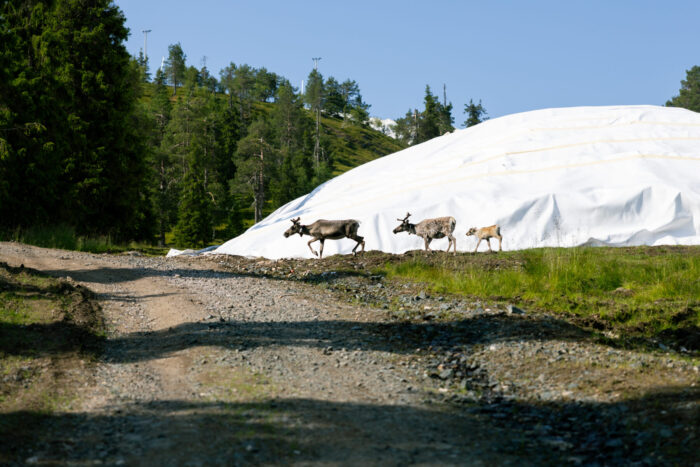
A small group of reindeer lounges in the shade, cooling off. It’s hard to imagine that in just a few months, these slopes will be teeming with skiers and snowboarders, thanks to snow saved from the previous winter.

Astounding surroundings and clever solutions

Two adult reindeer and a calf walk past a large snow mound covered in white sheeting, near a dirt road in a forest.

Ruka produces most of its artificial snow during the coldest months of midwinter using snow guns. Making snow in winter is much more environmentally friendly, and also more cost-effective, than during the milder conditions of autumn.

Located in the northern municipality of Kuusamo, near Finland’s eastern border, Ruka is famous for its stunning nature: ancient forests, rushing streams and rolling fells.

Rukatunturi is a fell whose peak rises to around 500 metres (1,600 feet), and the resort boasts 41 slopes and more than 200 skiable days each year, from October to May.

But even here, October skiing would be impossible without a clever solution.

Long before modern refrigeration, people kept food cold using snow or ice, topped with sawdust for insulation. Today, the same idea helps preserve snow itself.

Ruka began experimenting with snow storage in the late 1990s, possibly the first resort in the world to do so. The first large-scale modern tests were done in 2016.

Few know more about it than Parviainen, a lifelong skier who first hit the slopes in the late 1960s at age four, guided by his father, on these very same runs.

“We needed to be able to give visitors a fixed opening date,” says Parviainen. “That’s hard to do if you’re relying on natural snow. And snowmaking in warm, rainy weather just doesn’t make sense.”

Snow farming

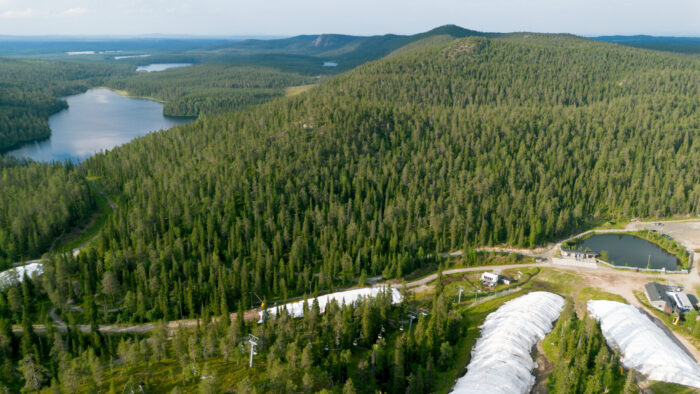
An aerial shot shows a tree-covered landscape, a lake and several white covers running down ski slopes toward a small pond.

Ruka is one of Finland’s leading ski resorts, alongside Ylläs and Levi, which are located further north. Levi Ski Resort also makes use of stored snow to ensure an early start to the season.

In the early years, Ruka used a small test site for “snow farming.” Methods and results varied, but lessons were learned. And over time, the technique became reliable enough to bank on.

Now, at the end of the ski season, large piles of snow are gathered using snow groomers on the north side of the resort, ready to be revealed again in autumn.

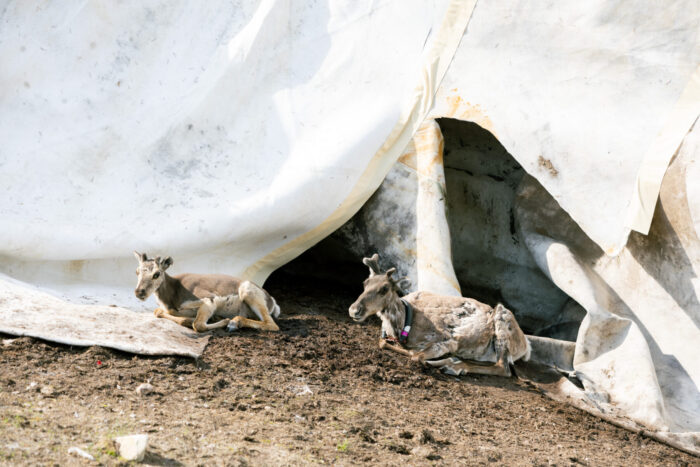
Two reindeer rest on the ground next to a large white tarp covering stored snow.

In the reindeer herding area of northern Finland, reindeer roam and graze freely. In summer, they sometimes rest beside the snow piles to keep cool.

There are three snow storage methods that Ruka uses today: sawdust, which preserves 80 percent of the snow but is messy and therefore used sparingly; white insulating fabric, easier to handle but with up to 40 percent snow loss; and a special plastic insulation developed by Finnish company Snow Secure, which offers the best balance, preserving about 80 percent of the snow.

“We’ve studied this for decades,” says Antti Lauslahti, CEO of Snow Secure. “Snow storage is the most environmentally friendly and energy-efficient way to guarantee early snow.”

Their expertise is now being exported to Europe and North America. Finnish snow-how is a true thing.

Getting ready for ski season

A person walks past a large snow mound covered in white sheeting on a grassy slope with a forested hill in the background.

During Matti Parviainen’s lifetime, winters in the north have shortened dramatically. For example, the period of ice cover on nearby Oulanka River has decreased by nearly two months on average over the past 50 years.

When temperatures drop and autumn progresses, the insulation is removed and the preserved snow is spread onto the slopes.

In Ruka, the stored snow is enough to open five runs, each with a snow depth of around 1.6 metres (5.2 feet), providing a solid base for skiers and snowboarders.

Snow is also stored for cross-country skiing, allowing Ruka to open competition-level trails even before the first natural snow falls.

It’s not just curious families and early holidaymakers who can’t wait for the winter season to start. According to Parviainen, international training teams are among the first on the slopes.

“In October, the only real training options worldwide are Ruka or the Alpine glaciers,” he says. “Ruka’s small size is a bonus. A lift ride takes just two minutes, so athletes can do more runs each day.”

And what about Parviainen himself – will he be among the first to go skiing?

“Definitely,” he says. “The first runs of the season after summer always feel great – it’s a good feeling when winter begins.”

Text and photos Emilia Kangasluoma, October 2025

Nature photographers find a haven in Kuusamo, northern Finland

This must be the most beautiful place in the world.

That thought lingers as we climb the steep slope, breathless, muscles aching and sweat beading on our brows.

It’s ten o’clock in the evening, yet the sun still blazes overhead, as it does in the far north during summer. The day was unbearably hot, and even the mosquitoes seem dulled by the heat.

Nature photographers Eeva Mäkinen and Mikko Oivukka pull their cameras from their backpacks. Their movements are confident as they begin shooting the landscape.

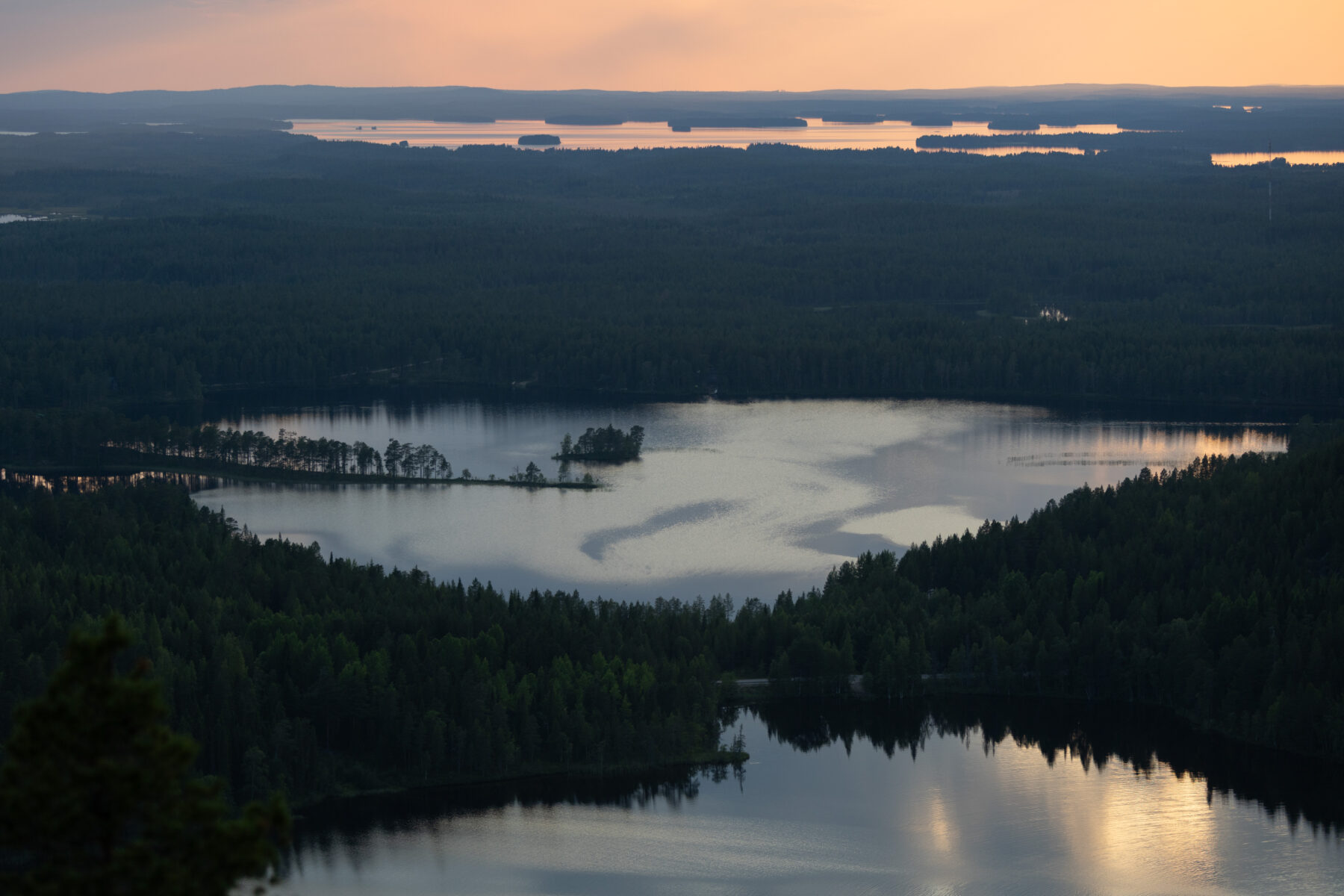
From the ridge, we gaze out across tens of kilometres of pristine wilderness: the fells of Riisitunturi National Park and the shimmering Kitka Lakes. Nearby looms the dramatic outline of Konttainen, Kuusamo’s northernmost peak.

This scenery is the reason we are here.

Beyond the ski slopes: Discovering Kuusamo’s wild heart

A landscape view shows a lake surrounded by a dense forest with water reflecting the sky under evening light.

Finland is known as the land of a thousand lakes. In Kuusamo alone, there are dozens, if not hundreds, of lakes and ponds.Photo: Emilia Kangasluoma

Many know Kuusamo as a winter sports hub, but there’s much more to it than ski trails and snowy slopes.

A vibrant northern town near Finland’s eastern border, it boasts an astonishing diversity of landscapes: forested fells, deep canyons, rushing rapids, winding rivers, and hundreds of lakes.

Nestled just south of the Lapland region, the Kuusamo area alone contains two national parks, Oulanka and Hossa, and three more are close by: Salla, Riisitunturi and Syöte.

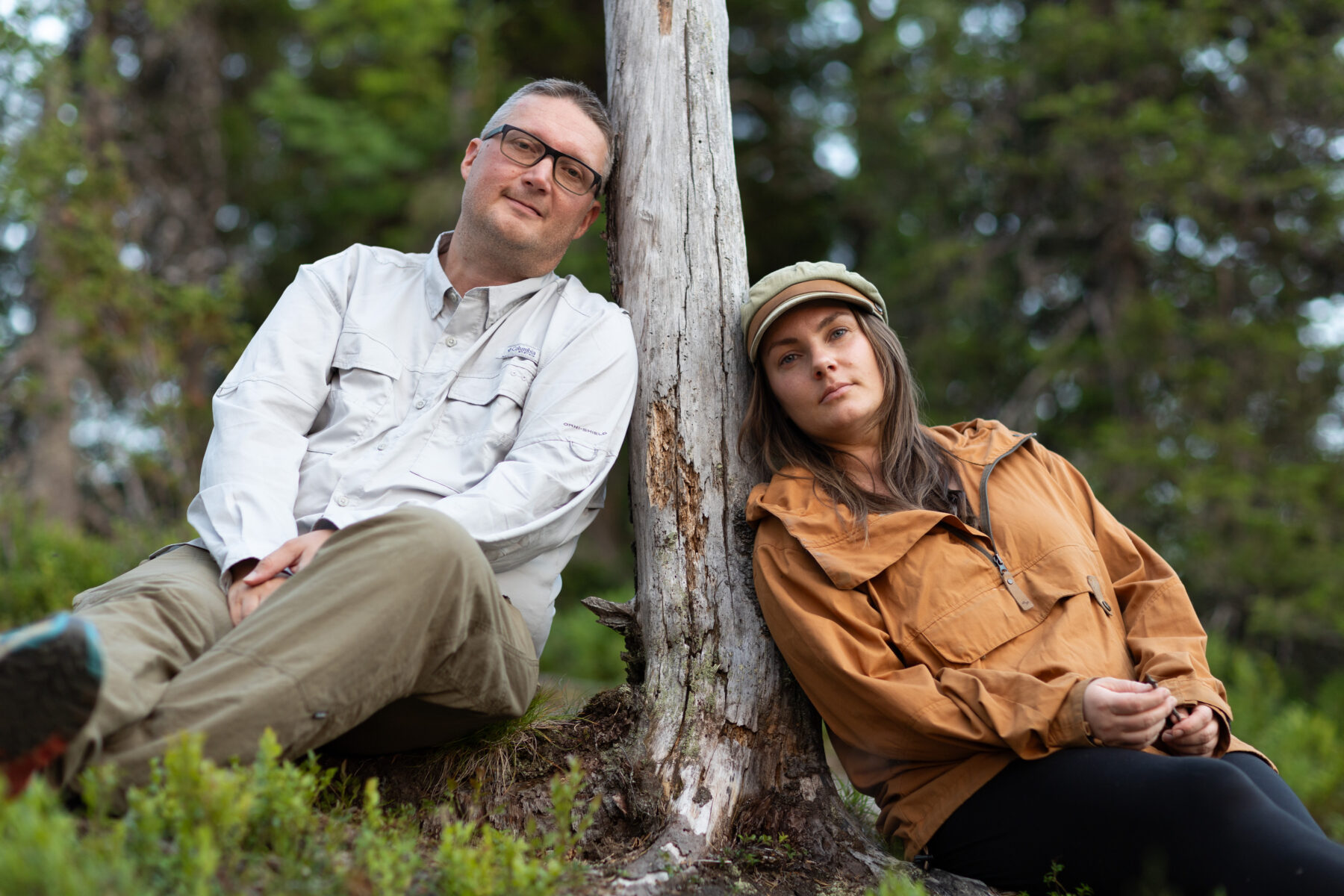
A man and a woman sit leaning against a tree trunk in a wooded area.

As qualified wilderness guides, Mikko Oivukka and Eeva Mäkinen not only lead guests safely through Kuusamo’s landscapes, but also gain a deeper connection with nature.Photo: Emilia Kangasluoma

But Kuusamo’s magic isn’t just in the scenery.

“Look, a red-flanked bluetail (Tarsiger cyanurus)!” Oivukka points to a delicate bird perched on an ancient spruce. He has spent years photographing the region’s elusive flora and fauna and knows the topic well.

Kuusamo sits at a unique ecological crossroads where northern and southern species overlap – some more typical of Siberia than of Finland.

“This may be one of the best places in Finland to encounter a capercaillie (Tetrao urogallus) or a red-flanked bluetail, like this one,” Oivukka says.

His enthusiasm is contagious. Kuusamo, with its engrossing wildlife and breathtaking scenery, has quietly become, as Oivukka puts it, “a nature photography mecca.”

A photographer’s northern leap

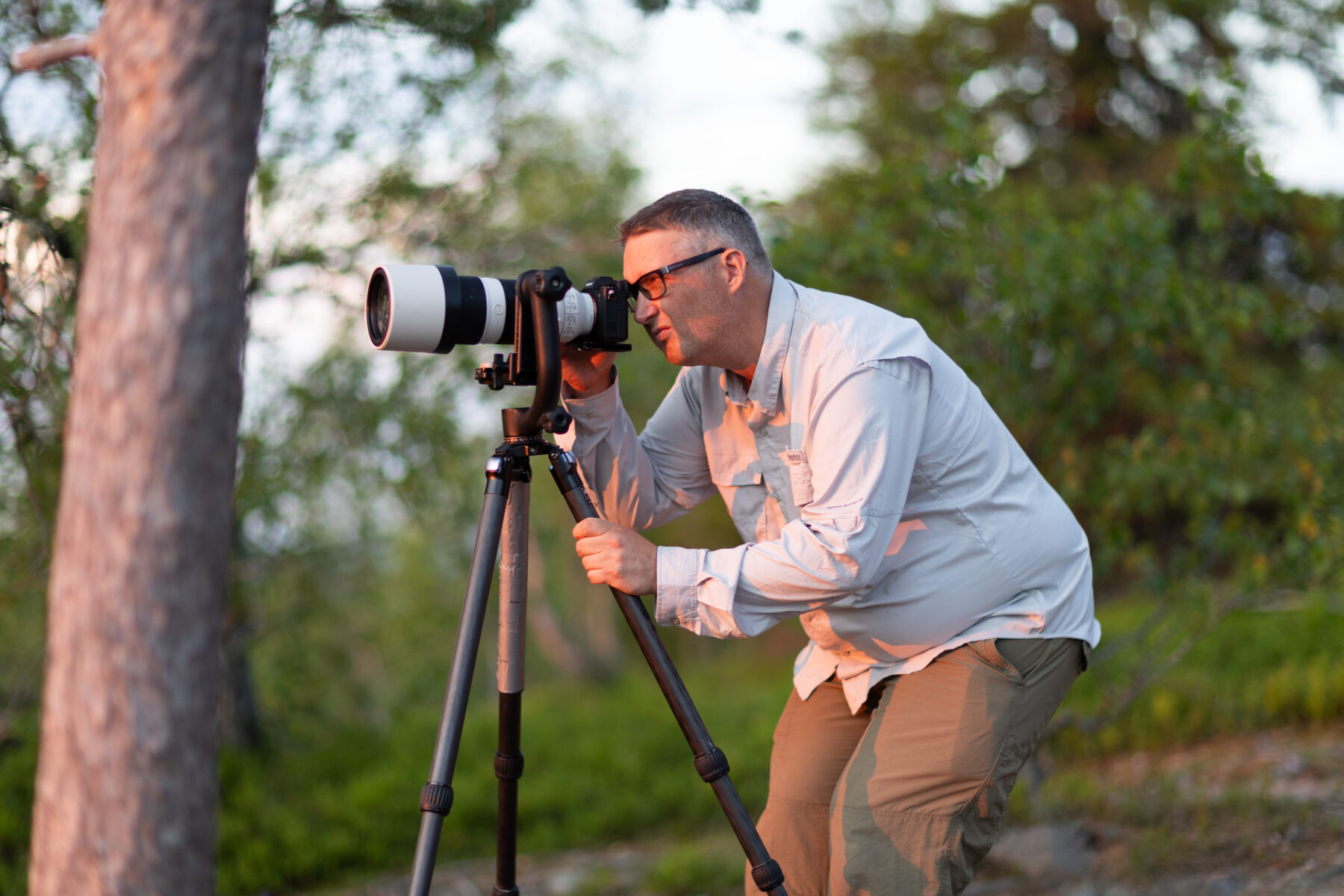
A man looks through a large camera mounted on a tripod in a forest setting.

Mikko Oivukka is a big fan of the Konttainen and Valtavaara areas for taking photos. “This place is a real hotspot for nature photography,” he says. His inspiration is Hannu Hautala (1941–2023), a legendary Kuusamo-based photographer whose exquisite bird images made him a household name in Finland and beyond.Photo: Emilia Kangasluoma

Oivukka is originally from southwestern Finland, but the call of the north proved too strong, and he moved to Kuusamo in 2017. Initially drawn north by birdwatching and nature guiding, he now devotes his days to photography and leading photo tours through his company, Kuusamo Nature Photography.

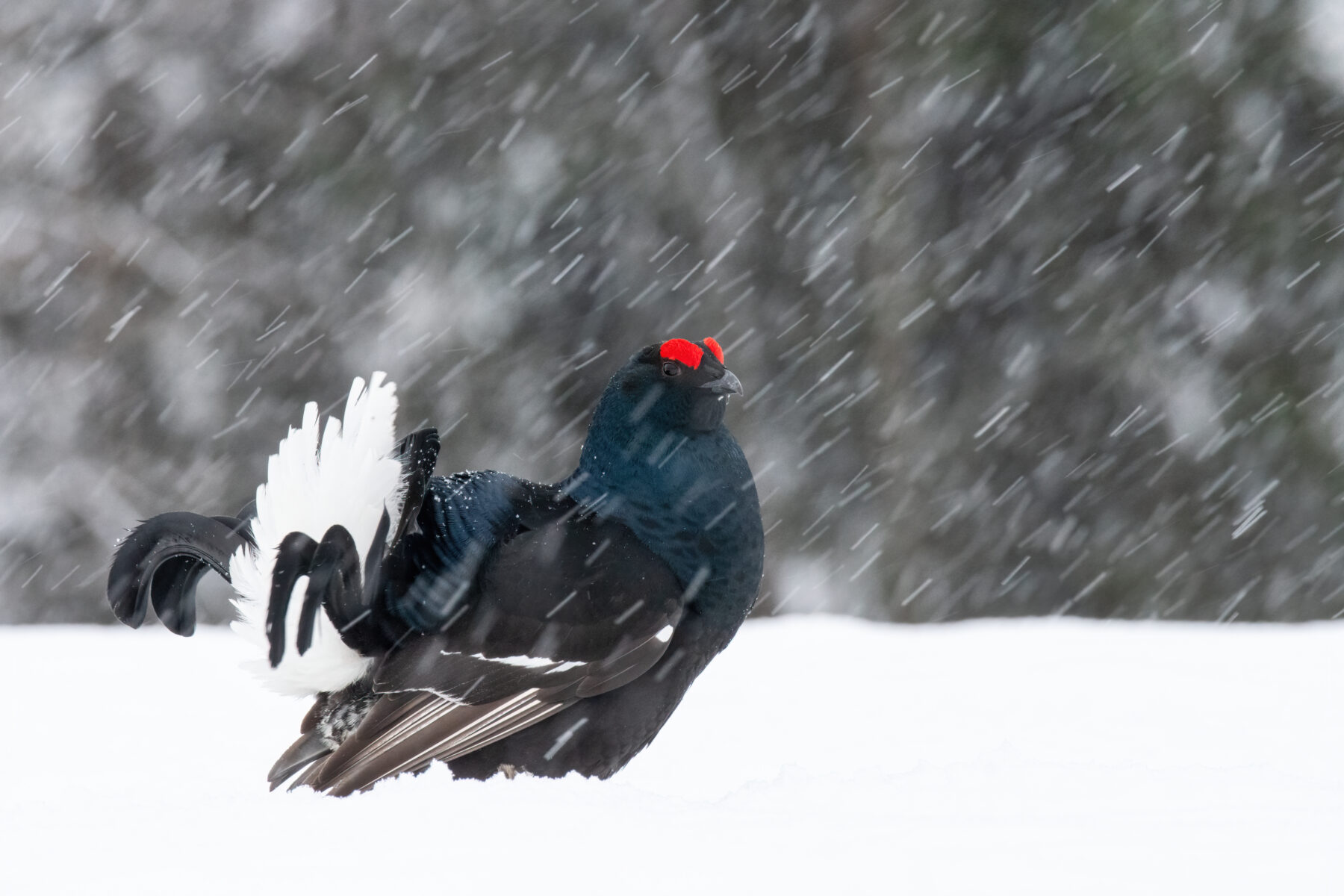
A black grouse with mostly dark plumage and red markings on its head stands in a snowy outdoor setting.

The courtship display of the black grouse (Lyrurus tetrix) is an annual event in Kuusamo each spring. In April, the conditions in Kuusamo are quite wintry, with snow flurries occurring from time to time. Usually, black grouse aren’t very active during snowfall, but if you’re patient enough to wait in the hide, you might manage to capture a good shot.Photo: Mikko Oivukka

On his tours, participants learn about bird and animal behaviour, discover the best local photography spots, and pick up camera techniques. Many of the sessions take place in hides, offering chances to spot golden eagles, capercaillies, and even bears.

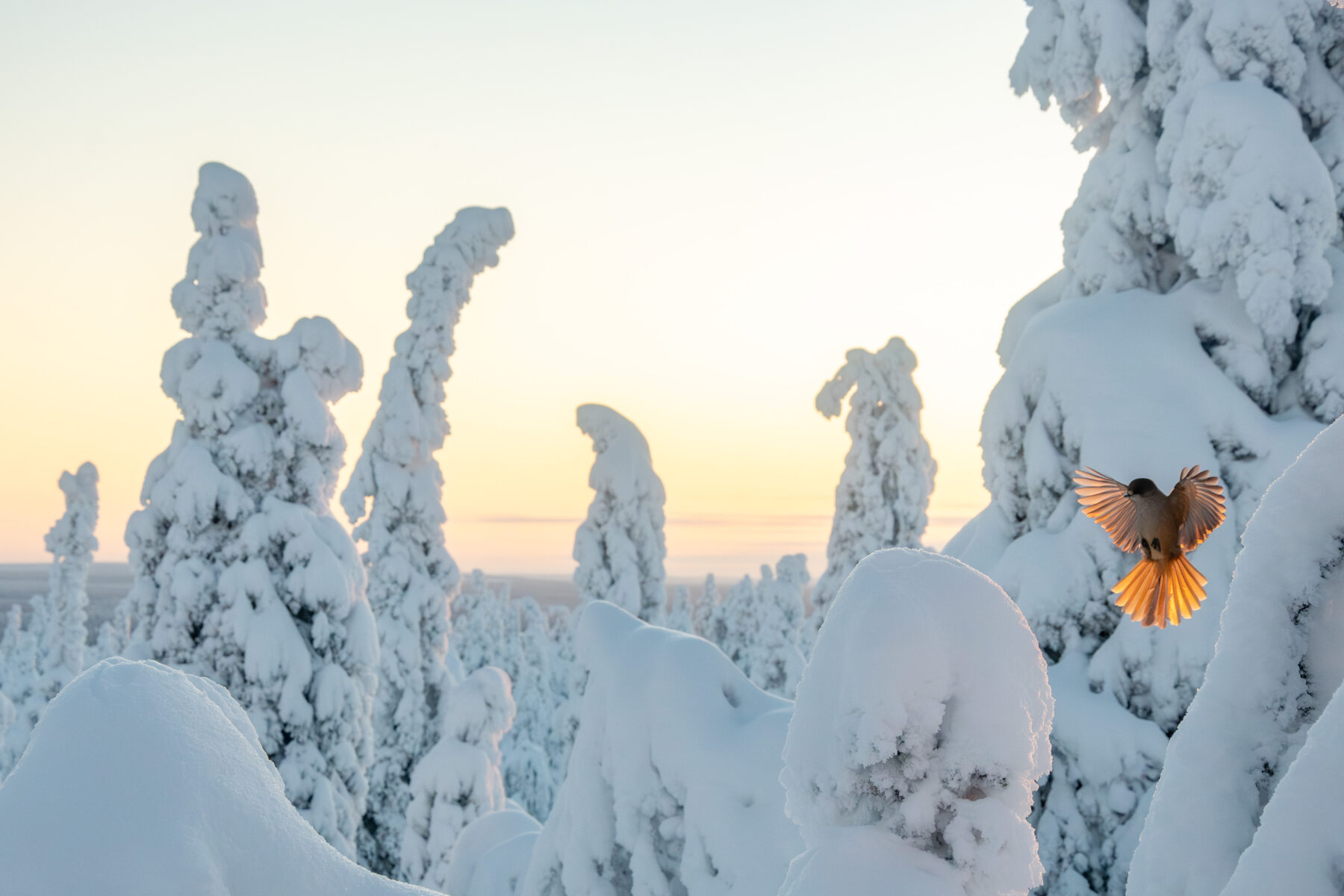
A bird flies above snow-covered trees silhouetted against a sunny sky.

“I was photographing a stunning sunset in early January when I noticed Siberian jays lingering in the same spot,” Oivukka says. “I stayed put, hoping they would fly to the top of the right tree in a perfect position.” Siberian jays (Perisoreus infaustus) are quite accommodating birds, often following the same route several times, which gave Oivukka a chance to practise a few times before getting the perfect shot. “Although I missed the actual sunset, capturing a great photo of the jay was the highlight of the trip.” You can admire more of Mikko Oivukka’s nature photography on Instagram: @KuusamoNaturePhotography.Photo: Mikko Oivukka

“Exploration is an important part of this.” Oivukka says.

“You can’t go out looking for birds with gritted teeth.”

Capturing Kuusamo’s quiet soul

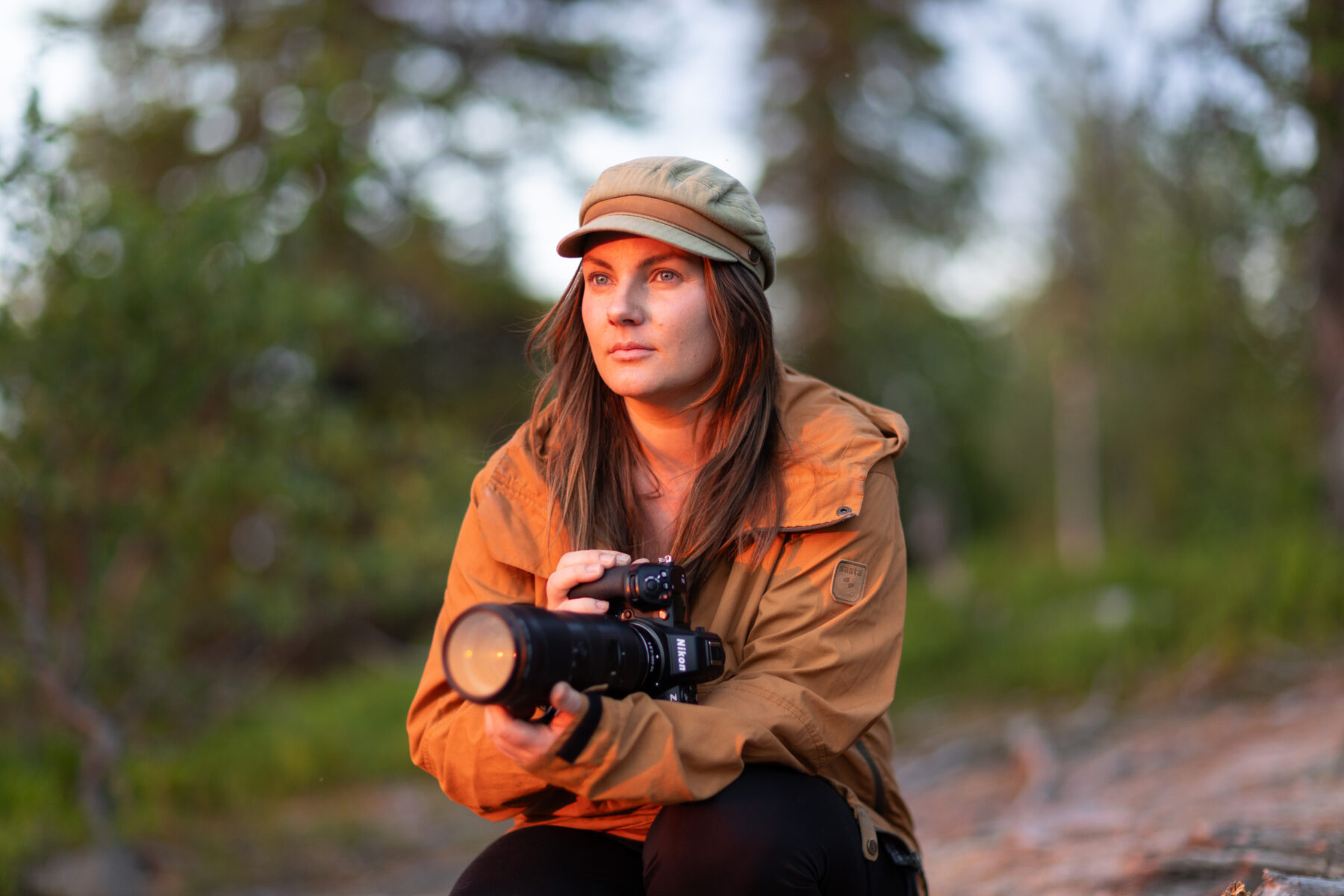
A woman wearing a jacket and hat outdoors holds a camera with a telephoto lens.

Eeva Mäkinen loves places like Oulanka National Park and Riisitunturi for their easy access. She also has dozens of secret favourite spots discovered through careful map study: “I look for steep slopes, lakes and ancient forests.”Photo: Emilia Kangasluoma

Mäkinen settles on a mossy patch to frame her shot, just at the edge of a precipice overlooking a lake called Konttaisjärvi. Through Instagram, she has introduced hundreds of thousands of people to Kuusamo’s northern beauty.

A misty river valley, snow-laden spruces, the fiery hues of autumn foliage: Mäkinen has a gift for capturing nature’s quiet drama.

Mäkinen’s photographic journey began in her twenties as she travelled abroad capturing classic tourist scenes. But something was missing.

“I realised I wanted to discover my own sights and hunt for stories that made the images personal.”

After a year at wilderness guide school and countless nights under the stars, she was sure: she didn’t just want to photograph nature, she wanted to live in it.

She began leading nature excursions, helping guests find beautiful locations to photograph.

As those journeys increasingly led north, she and her partner asked themselves: what if we stayed for a year?

“Six years later, here we still are,” she says.

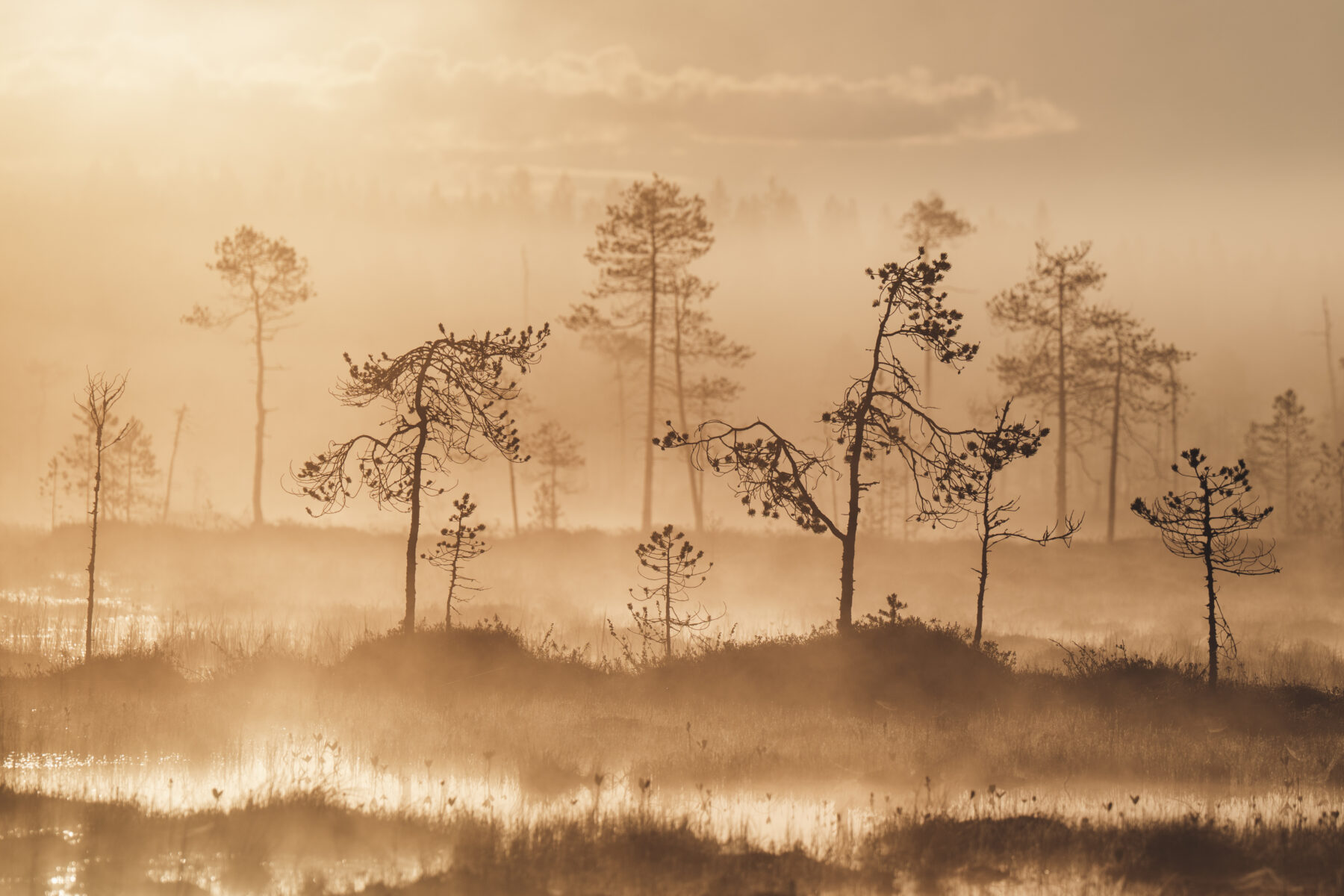
A foggy, sepia-toned marsh landscape shows sparse trees rising from small islands, creating an ethereal scene.

This photo was taken in early summer, when Eeva Mäkinen loves spending her mornings in the boggy landscape: “I’d been searching for a scene like this close to home for a long time, and finally stumbled upon it almost by chance. One morning, through the mist, I spotted this view and noticed the sun rising from just the right angle to create the perfect backlight for the shot.” Her Instagram account is @eevamakinen.Photo: Eeva Mäkinen

What captivates her most is Kuusamo’s ever-changing character: “Whenever the moment feels right, there’s always something striking to photograph.”

Winters bring snowy fells; summers beckon with lakes, rivers and swamps.

“I go to the marshes before Midsummer, as misty mornings and the cold earth are just magical,” she says.

Her favourite time? Late autumn, just before the first snow, when orange aspen leaves glow and the Northern Lights shimmer over unfrozen lakes.

“Those photos often raise more questions than answers,” she says. “They’re not so overexposed or familiar. The world seems to hush; time stands still.”

Ethical nature photography in the North

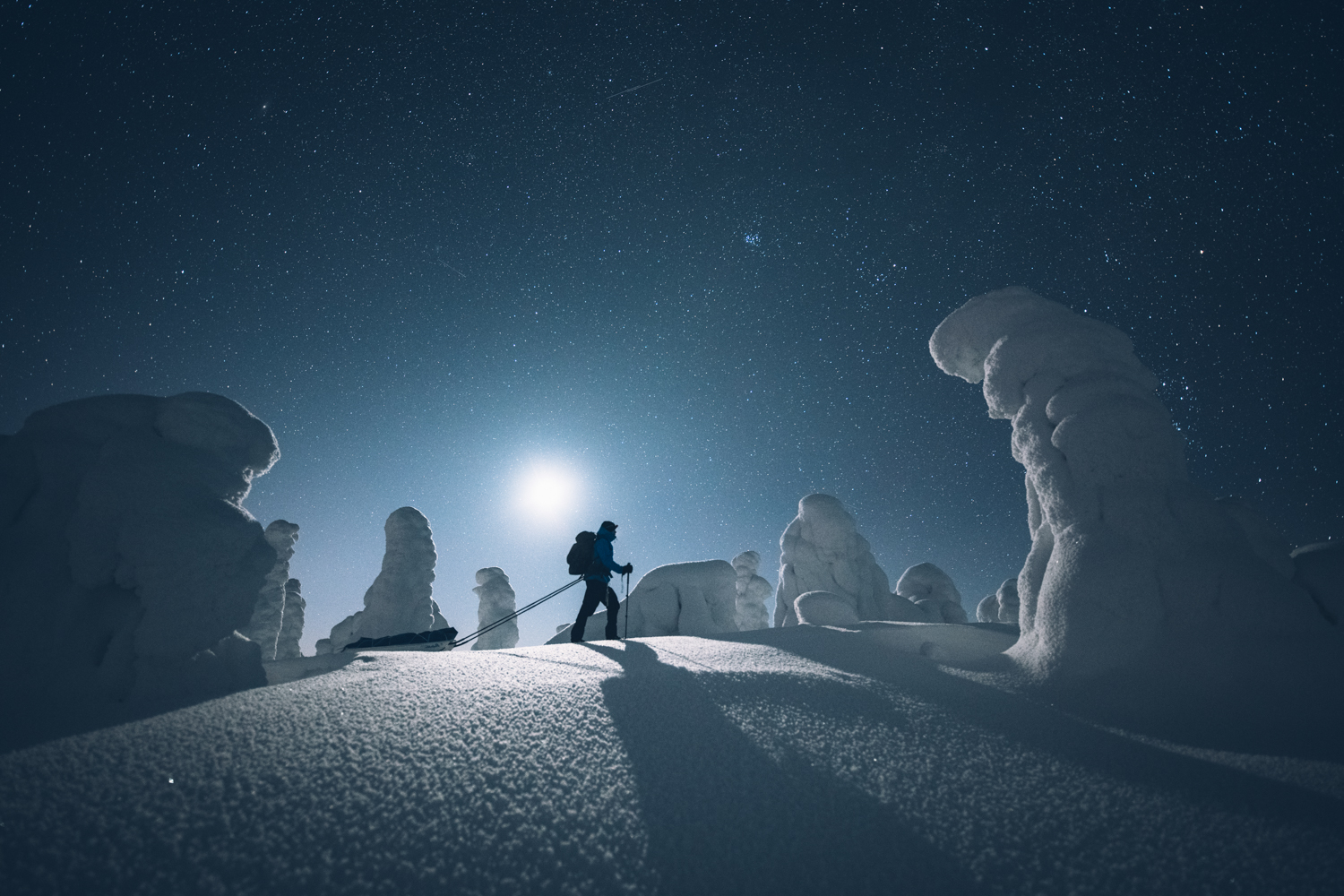
A person with a backpack and ski poles walks through a snowy landscape at night, illuminated by the moon and stars.

“I had found an interesting spot on the map where I could camp right on top of the fell, surrounded by snow-laden trees,” says Eeva Mäkinen about this photograph. “The forecast for the night was freezing temperatures, but I decided to go on the trip with a friend anyway. As dusk fell, the moonlight illuminated the snow-covered trees perfectly. On this trip, I gained a better understanding of how the size of the moon affects night photography.” The photo was taken in February, with temperatures well below minus 20 degrees Celsius (minus four degrees Fahrenheit).Photo: Eeva Mäkinen

Today, Mäkinen mostly photographs the wild herself, but she also leads international travellers on photographic journeys, from Europe to India and Australia.

Her tours are unhurried. There’s no rushing along ski trails or tallying hiking distances. Instead, she teaches guests to slow down, observe, and respect the environment.

Animals and plants are not to be disturbed. Stay on the trails. Leave nothing behind but footprints.

Oivukka sits down next to Mäkinen on the mossy hillside and lets his camera drop to his lap. He sums it up:

“Respecting nature is everything. We must leave it as we found it. That’s paramount.”

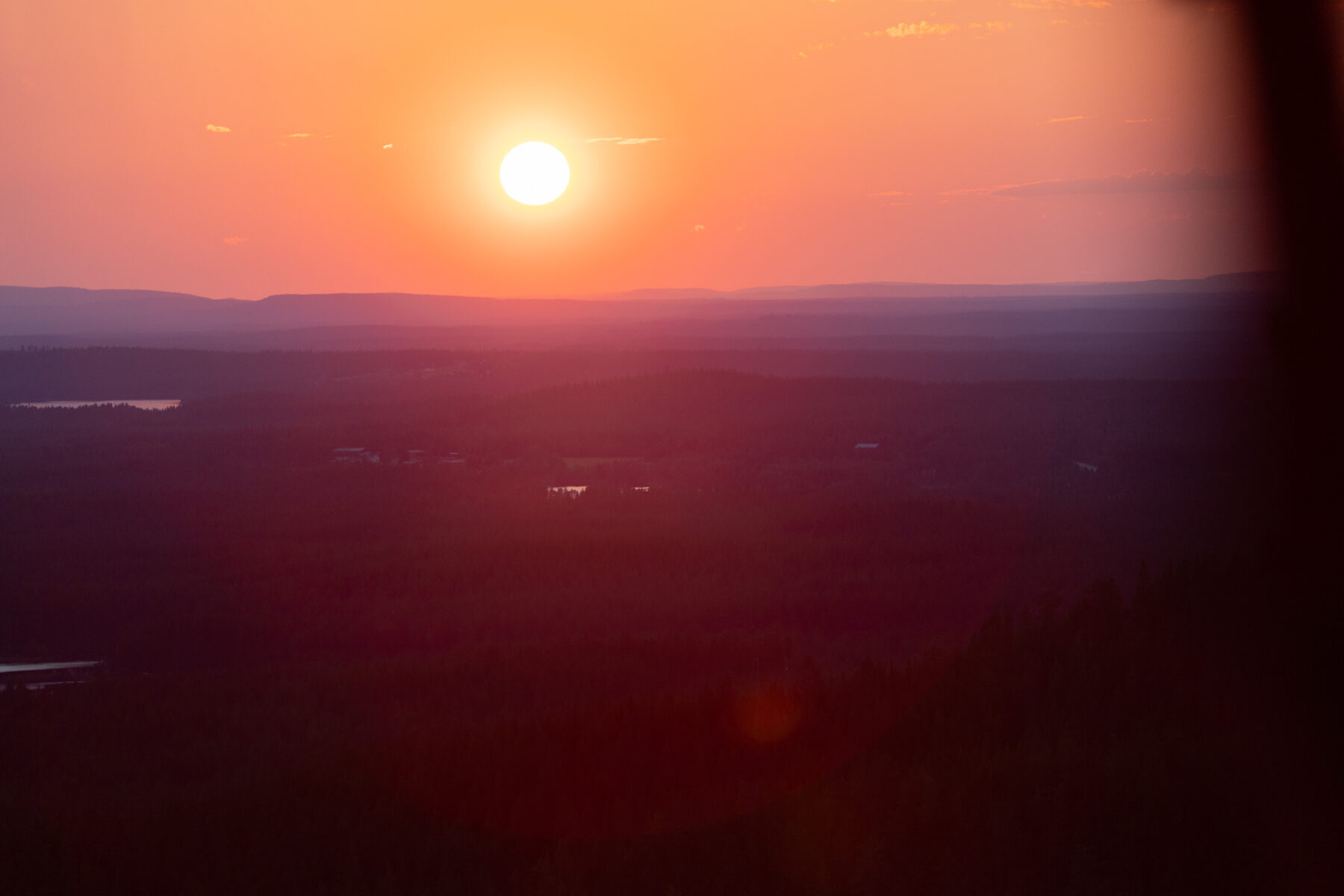
A sunset casts a warm glow over a landscape of dark forests and distant mountains.

As the setting sun paints the sky overhead, no view seems more beautiful than the one before us, right here, right now.Photo: Emilia Kangasluoma

As the light dims, it seems impossible for the scene to get more perfect. It’s time to make our descent, but there’s time for one last question: What does it feel like to capture a truly great nature photograph?

“Wonderful,” Oivukka says.

“Sometimes you know it the moment you press the shutter. But as a guide, I get even more excited when my guests get good shots.”

Mäkinen takes a moment to reflect. Some of her images have been planned for months, even years.

And when everything aligns – light, wind, mist, sun – it feels like fate is smiling.

“It’s incredible,” she says. “Absolutely incredible.”

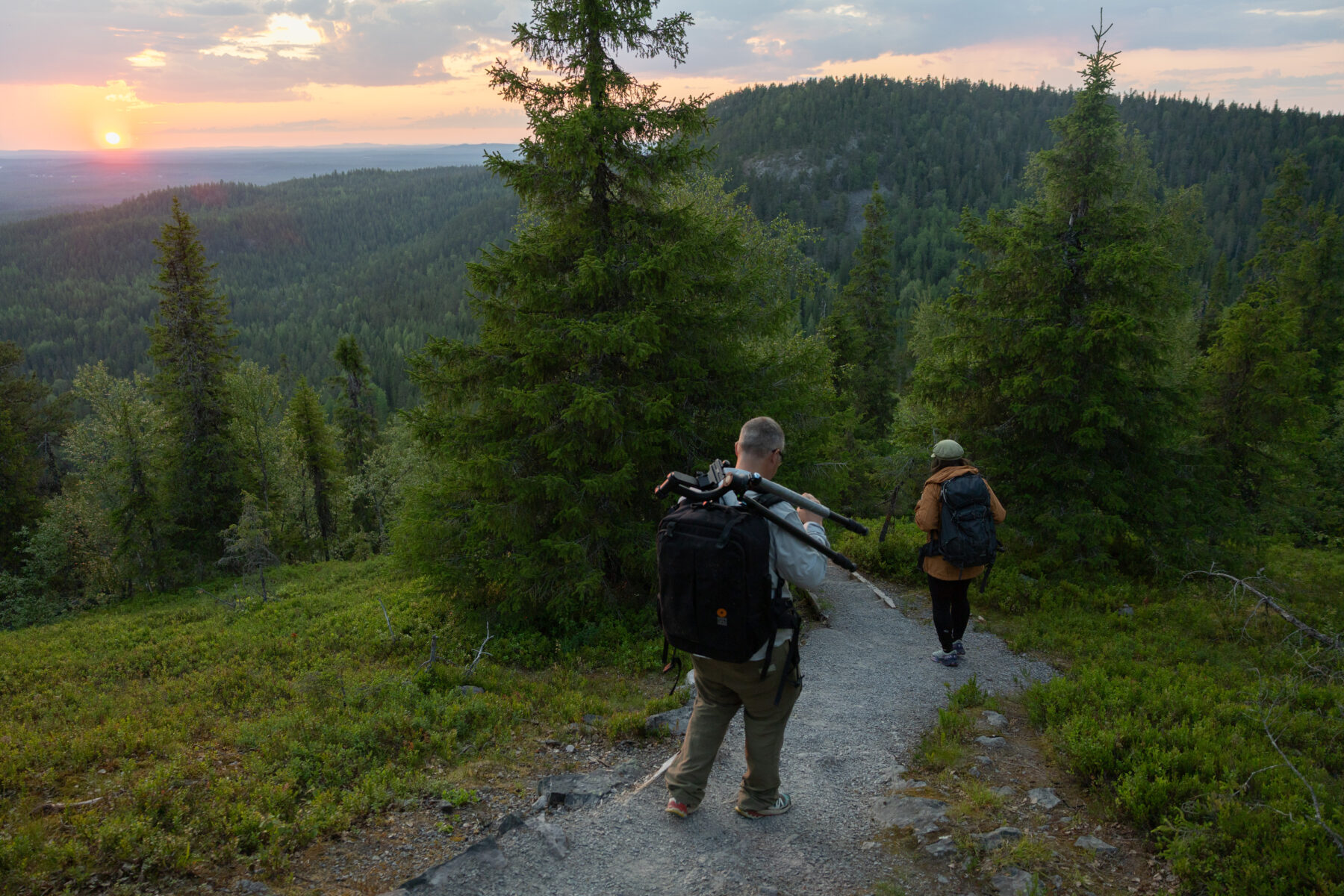
Two people with backpacks walk on a path surrounded by trees at dusk.

At midnight, nature has fallen asleep.Photo: Emilia Kangasluoma

By Emilia Kangasluoma, October 2025

Finnish writer Saara Turunen’s work plays on new stages in Helsinki and Germany

Acclaimed Finnish writer and director Saara Turunen presents her latest stage work, Hyenans dagar (Hyena Days), in an autumn 2025 run at Helsinki’s Swedish-language Lilla Teatern (Little Theatre). (Swedish is one of Finland’s official languages.)

In November, audiences at Staatstheater Hannover in Germany will see the production in German, also directed by Turunen herself.

Based on Turunen’s 2024 Finnish-language novel, the play follows one woman’s journey through fertility treatments, intertwining personal experience with broader social themes. “We are transferring the design directly from Helsinki to Hannover, but of course a new language area and cultural context always bring some changes,” says Turunen.

In Hannover, the Finnish presence continues, with the same creative team as the Helsinki production: set design by Milja Aho, costumes by Liisa Pesonen, sound design by Tuuli Kyttälä, lighting and video by Ainu Palmu, and choreography by Janina Rajakangas. The German premiere of Die Tage der Hyäne takes place on November 14, 2025.

Spotlight on Vörå, Finland: the local impact of KAJ’s Eurovision success

KAJ’s Eurovision success has sent waves of excitement through their home village of Vörå in western Finland. Known for its peaceful countryside and a tight-knit Swedish-speaking community, Vörå has suddenly found itself in the spotlight, and local pride has been soaring.

A large roadside billboard of KAJ welcomes drivers as they enter Vörå, where people are smiling and there’s a renewed energy in the air. [Editor’s note: Vörå also has a Finnish-language name: Vöyri.]

According to resident Päivi Torrkulla, KAJ ’s success has become a symbol of what’s possible, even from a small village.  And it’s not just about music — it’s also about identity and belonging.

“KAJ  has inspired young people and boosted their self-esteem,” she says. “They believe that they can do something big, that you don’t have to come from a big city: even in Vörå, you can become a star.”

See what the people of Vörå think about their hometown.
Video: Erika Benke/ThisisFINLAND.fi

The buzz has reached beyond borders. Mayor Jan Finne says businesses are taking a fresh look at Vörå, seeing it as a place with creative energy and cultural potential.

“We’ve had inquiries from businesses and families about moving to Vörå,” he says. “Before KAJ, people were waiting for opportunities to come here: now they are thinking about founding new businesses.”

This suggest a big change in attitudes in Vorä, which – like many rural areas in Finland – has been facing demographic and economic challenges in recent years, including young people moving away to cities.

Now the mayor hopes that KAJ’s success might just help Vorä buck that trend – and some young people agree.

Since KAJ put Vörå on the map, says 16-year old Linus Back, “Now I’m prouder of being from Vörå. I think I will stay in Vörå all my life. I belong here.”

We caught up with the members of KAJ and asked them about their success.
Video: Erika Benke/ThisisFINLAND.fi

By Erika Benke, September 2025

The taste of Finnish nature: Where forest meets fine dining

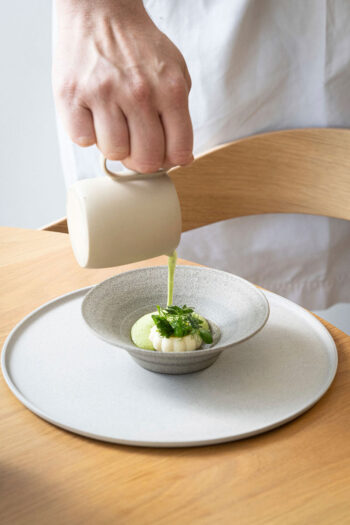
A green dressing is poured over a delicate dish topped with herbs.

Vår, Porvoo: The collective operating the restaurant cherishes traditions but also strives to present their playful version of modern Finnish cuisine. They use fresh local ingredients, with wild fish, vegetables and the finest Finnish dairy products as the basis of the menu.Photo: Vår, Porvoo

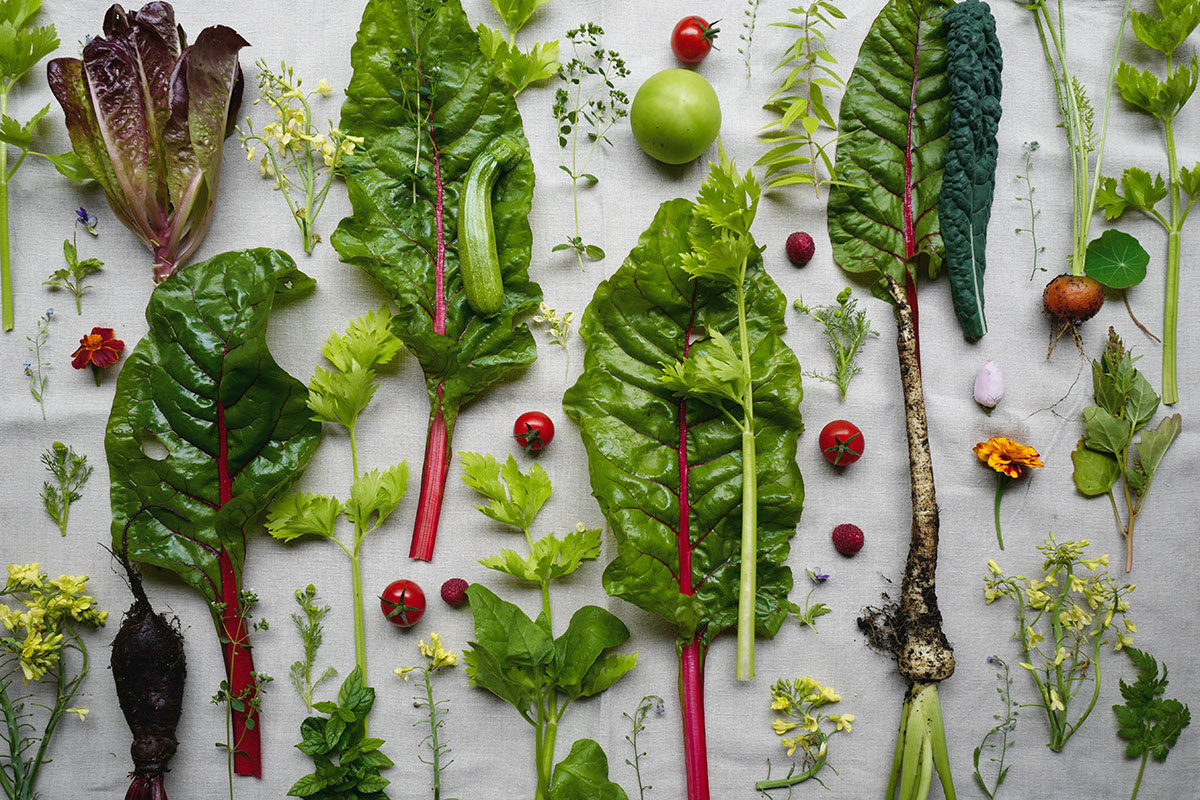
An overhead view of colourful vegetables laid on a white background.

Grön, Helsinki: Despite their urban location, Grön owns a farm that supplies their vegetables and greens. Photo: Grön, Helsinki

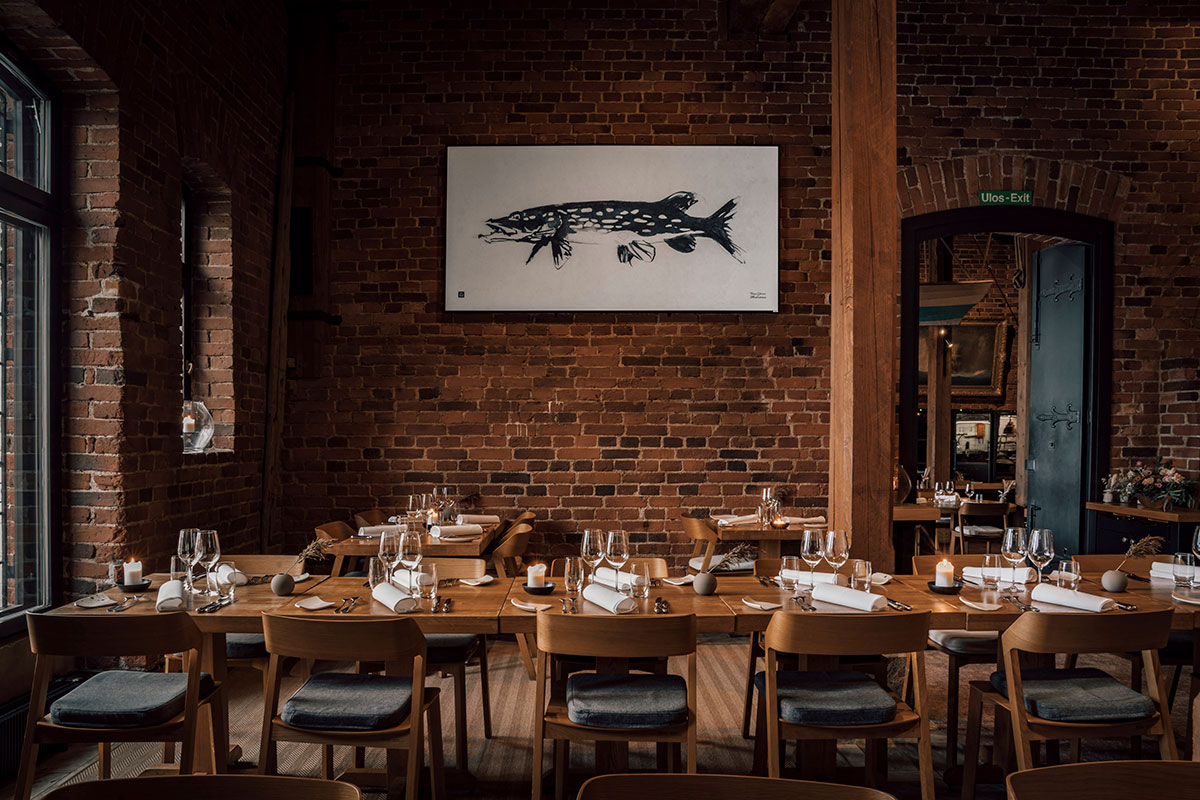
A restaurant interior with brick walls, wooden tables and a a painting depicting a pike on the back wall.

Nokka, Helsinki: The chef and owner Ari Ruoho harvests, hunts and fishes to secure the best ingredients. One of their specialties is rockweed, a native seaweed. Photo: Nokka, Helsinki

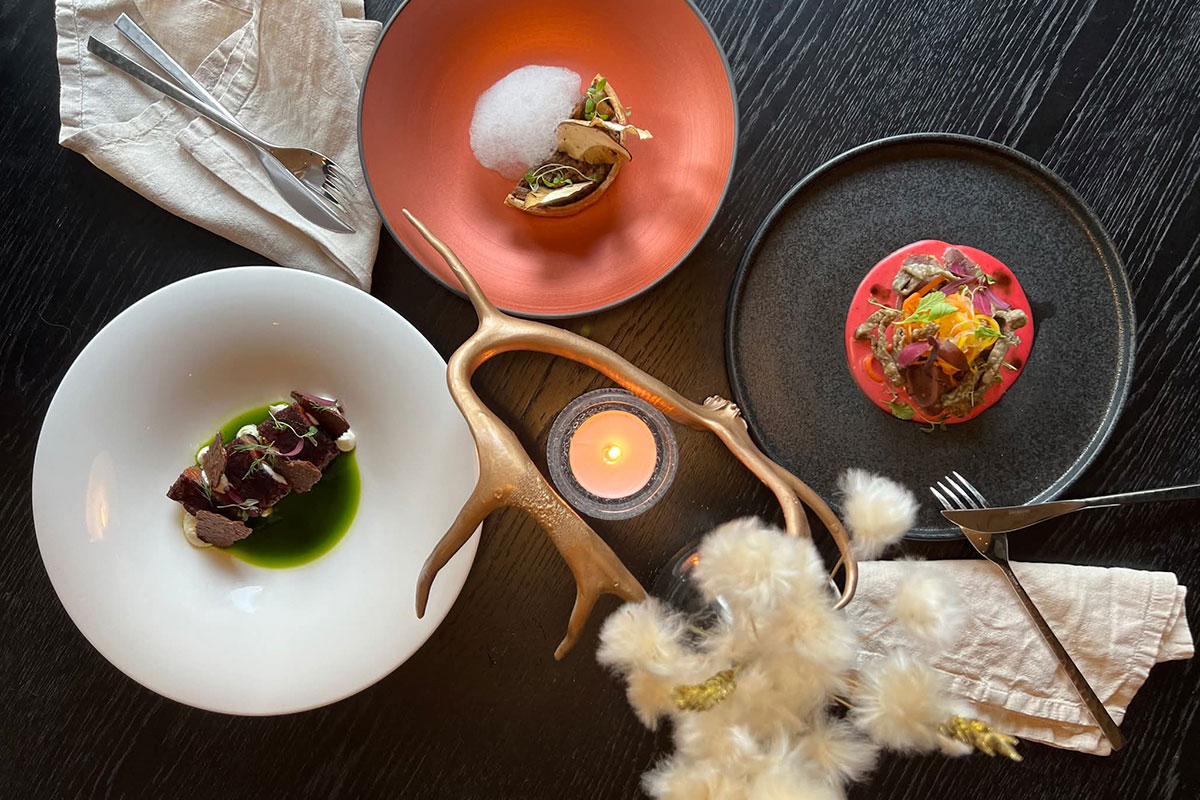
Three artfully plated dishes sit on a black wood table with a candle and antler centrepiece.

Aanaar, Inari: The kitchen creates dishes unique to Lapland, using everything from lichen and the traditional Sami herbal plant Angelica, to reindeer and Lake Inari’s fish.Photo: Aanaar, Inari

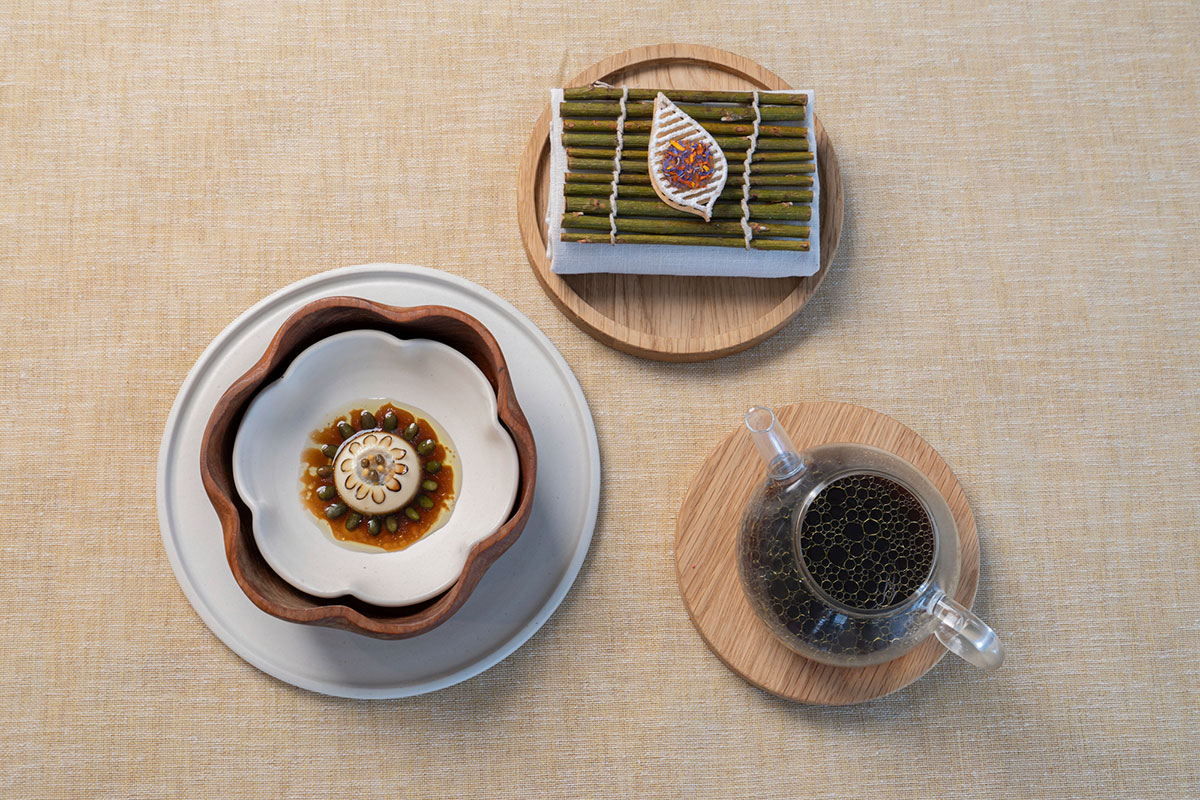
Three artfully presented small dishes are arranged on a table.

Kaskis, Turku: In the forests and archipelago around the southwestern Finnish city of Turku, you might bump into chefs Erik Mansikka and Simo Raisio foraging for ingredients. The menu always features wild herbs in some form.Photo: Kaskis, Turku

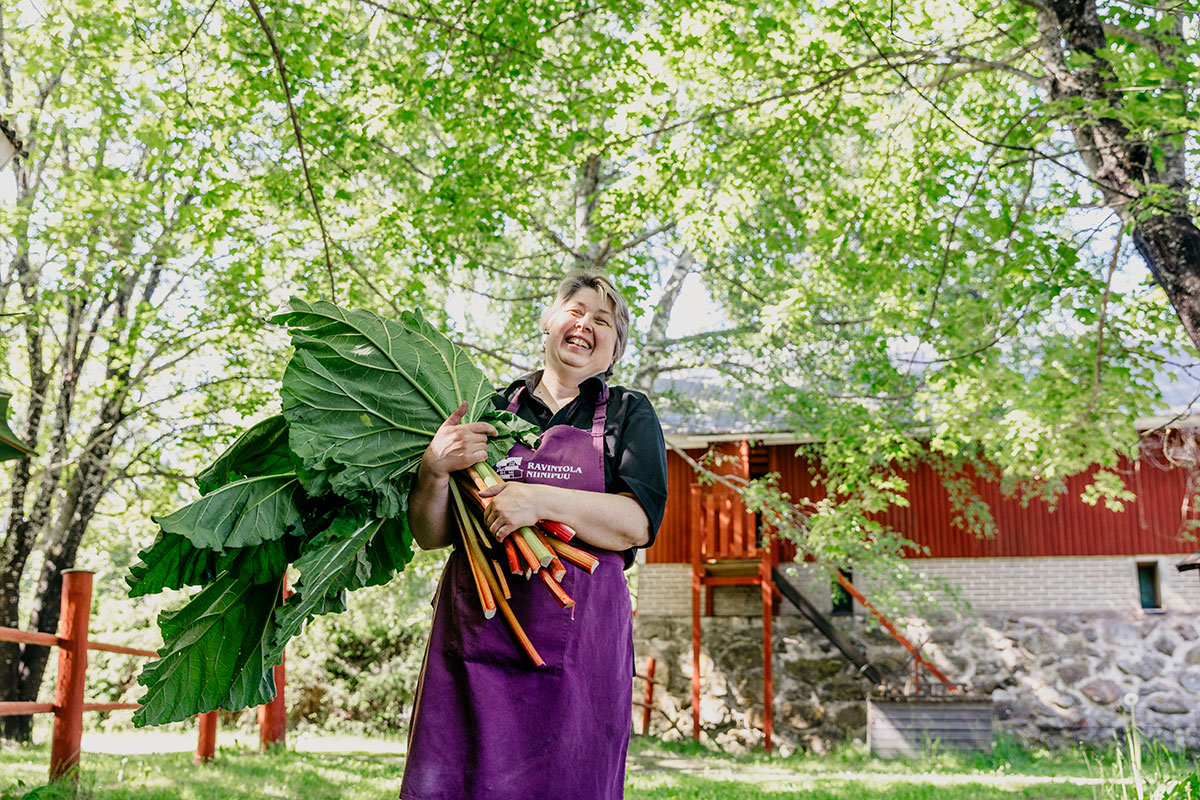
A woman smiles holding giant rhubarb stalks outside a barn beneath a green leafy canopy.

Niinipuu, Okkola holiday resort: The restaurant is situated in an old barn on an island in Finland’s biggest lake, Lake Saimaa. The menu prominently features local fish.Photo: Niinipuu, Okkola

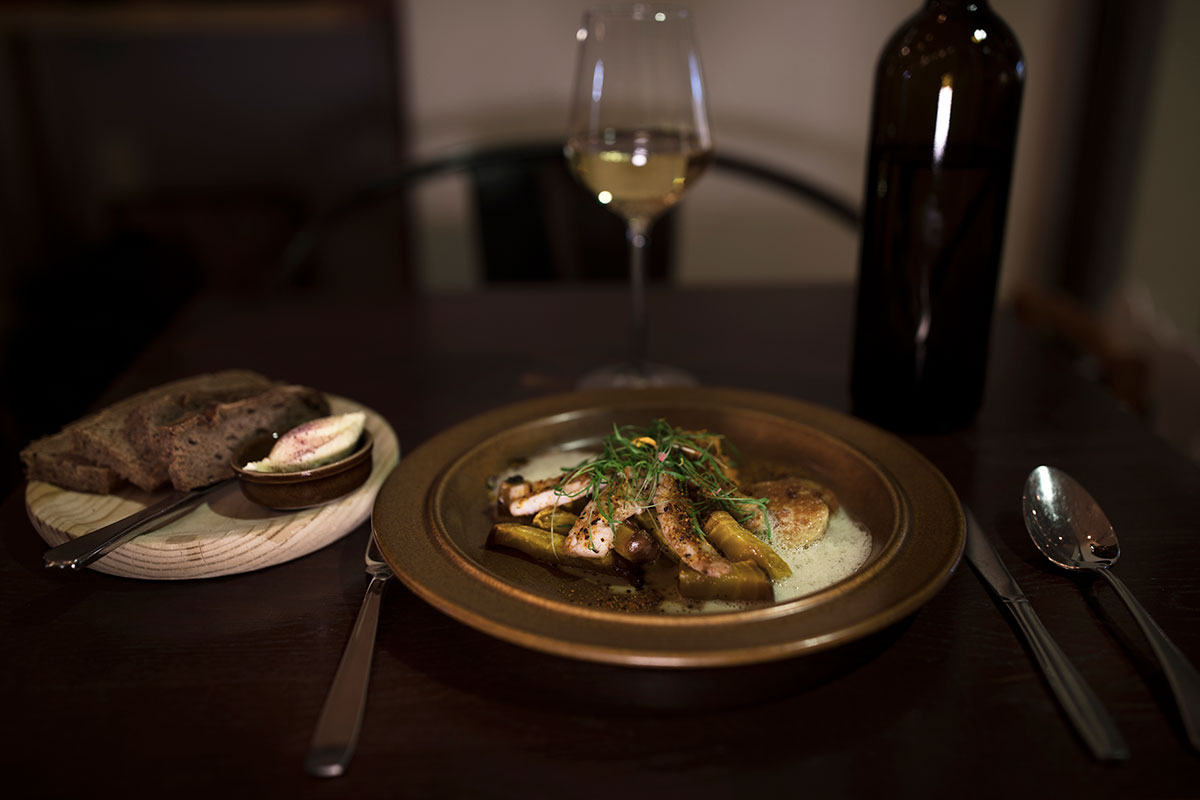
A plated main dish with bread and white wine set on a restaurant table.

Skörd, Helsinki: All ingredients and beverages come from Finnish producers. Skörd’s menu features wild herbs and berries picked by hand, as well as game, fish and ecologically farmed lamb.Photo: Skörd, Helsinki

By Lotta Heikkeri, ThisisFINLAND Magazine