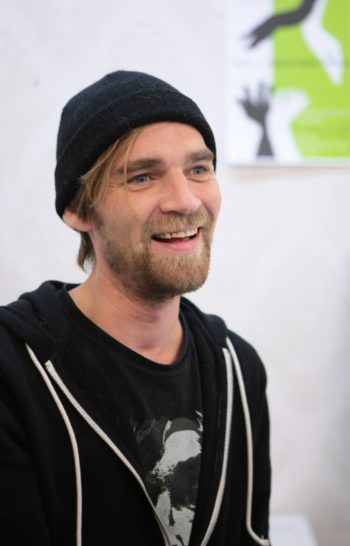
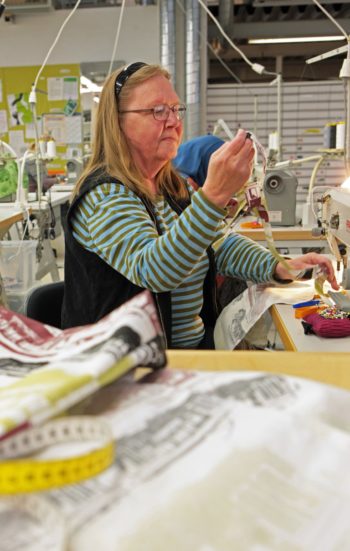
From slope videos to a million-euro business

In 2017, Flatlight’s own Finland 100 project 100 Moods from Finland will take viewers on a virtual trip through a hundred Finnish landscapes shot with 360 technology.

The company will also carry out a worldwide tour where viewers can ‘teleport’ themselves to locations such as the top of a fell by stepping into a space filled with video projections.  The Arctic know-how of this Northern production company is a major asset.

The fact that the company comes from Lapland is important to Niemi. He says that being from Lapland is both an identity and an attitude. It means fulfilling your promises and doing everything as well as possible. Especially when viewed from an international perspective, the northern location is very beneficial.

“Our backyard is Lapland with all four seasons, and that’s what separates us from the rest. If we’re in, say, Cannes, the fact a company like ours comes from Rovaniemi and not Helsinki generates more interest.”

Managing Director Niemi still shows the same kind of curiosity and enthusiasm in his work as he did a decade ago. Developing something new and stepping outside of your comfort zone is inspiring. Niemi strives to think about the company’s possibilities on an international scale, while keeping his focus close.

Finland and Arctic Council take aim at climate change

In Fairbanks, Alaska, the day before Finland took over from the US as chair of the Arctic Council, teams of diplomats from the eight Arctic nations were still haggling over the wording of a key document. At two-year intervals the council holds a ministerial meeting in one of the member countries; the ministers of foreign affairs sign a declaration and formally pass the baton to the next nation to chair the council.

Such declarations contain more than just symbolic value. They provide a framework for the coming years, listing notes, concerns and affirmations in several categories: Arctic Ocean safety, security and stewardship; Improving economic and living conditions; Addressing the impacts of climate change; and Strengthening the Arctic Council. The declaration is also an essential reference for many organisations and working groups when they apply for funding.

This year, in light of statements the US president had made about his views of climate change and possible withdrawal from the Paris Agreement on climate change, several countries were apprehensive about challenges in reaching agreement on the declaration text. In the end, the Paris Agreement did make it onto the front page of the Fairbanks Declaration, although the wording could have been more forceful.

Several countries pointedly mentioned the Paris Agreement in their speeches the next day, May 11, 2017, at the publicly broadcast ministerial meeting chaired by US Secretary of State Rex Tillerson. Finland noted that “The Paris climate agreement is the cornerstone for mitigating climate change.”

In addition to the eight Arctic Council member states (Finland, Canada, Denmark, Iceland, Norway, Russia, Sweden and the US), indigenous peoples also take part as permanent participants, including delegates from the Sámi (whose territory stretches across northern Finland, Norway and Sweden and the northwest corner of Russia), the Aleut, the Athabaskan, the Gwich’in, the Inuit and an association of the indigenous peoples of northern Russia.

These delegates emphasised that indigenous people possess local knowledge gained from centuries of experience and observation, allowing them to contribute in a valuable and necessary way that complements and strengthens the efforts of the “Western” participants. Judging by the applause and the content of various countries’ speeches, everyone in the room seemed to agree on this point.

No nation is an island
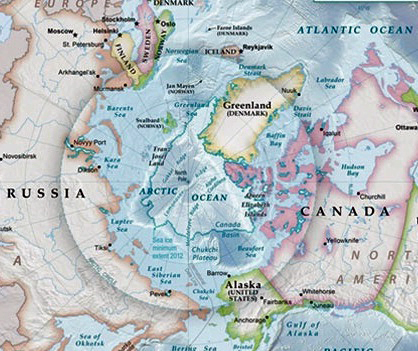
This circumpolar view of the Arctic provides a new perspective on the world.Illustration: Detail of map created by US State Department during the US Chairmanship of the Arctic Council (link to full version below).

With the big ministerial meeting in town, Fairbanks celebrated the Week of the Arctic with conferences, workshops and cultural events. The city feels like many Finnish cities, at least in the sense that it’s surrounded by woods, but different tree varieties dominate: shaggy black spruce with spindly trunks, and smooth, sturdy, white paper birch. The hills are much larger, and from some of them you can see the majestic mountains of the Alaska Range in the distance. Denali, North America’s highest peak at 6,190 metres (20,310 feet), is only about 250 kilometres (155 miles) away as the raven flies.

In this setting, Arctic Council working groups and other related organisations presented their most recent findings on protection of the marine environment; emergency preparedness and response; conservation of flora and fauna; sustainable development and more.

Although dealing with a direly urgent topic, the assembled diplomats, scientists, community leaders and researchers maintain a resolutely constructive, forward-looking attitude in the face of a sobering reality. Finland’s vision for its period as chair of the Arctic Council and beyond includes four priorities: environmental protection, connectivity, meteorological cooperation and education.

The experts at the Week of the Arctic emphasised repeatedly that humans must do everything possible to mitigate climate change – one of the simplest ideas could be to paint house roofs white to reflect sunlight. However, researchers are also evaluating methods of adapting. One of the Arctic Council working groups, the Arctic Monitoring and Assessment Programme (AMAP), presented a new set of reports under the title Adaptation Actions for a Changing Arctic.

“Adaptation is absolutely needed, but there is also a need for us to reduce our greenhouse gases,” says Sarah Trainor of the International Arctic Research Center at the University of Alaska in Fairbanks, who is one of the many coauthors. “I don’t want to talk about adaptation without putting that forward as well.”

Responding with resilience
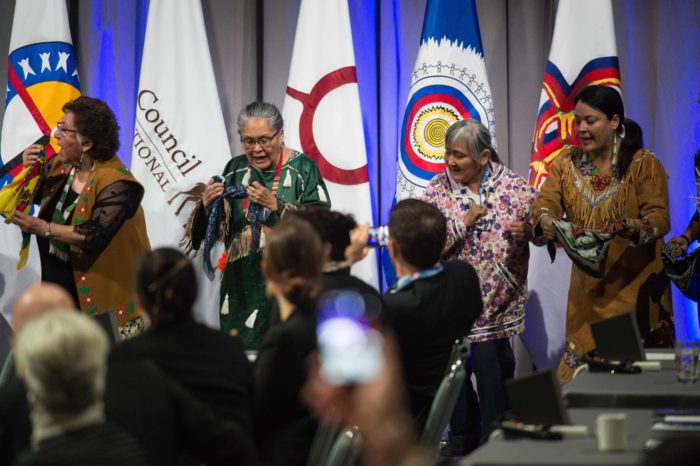
The 2017 Arctic Council ministerial meeting in Fairbanks, Alaska opened with music and dancing by indigenous people from the region.Photo: Nicholas Kamm/AFP/Lehtikuva

AMAP’s multidisciplinary approach includes looking at economic, technical, demographic and political factors and investigating ways that governments, civil society, businesses and academics could increase their ability to adapt to change. “What are the issues that are really important?” asks Annika Nilsson of Stockholm Environment Institute, another coauthor. “It turns out it’s not just climate change, there are a lot of other issues going on that concern local municipalities and local planners.” In other words, you have to combine the small picture and the big picture.

Rafe Pomerance leads Arctic 21, a network of scientists and Arctic climate advocates. He uses the term unravelling when discussing the Arctic reality, because the word “pulls all the pieces together and describes the state of the Arctic with regard to climate change.” The signs are there in the sea ice, the snow cover, the permafrost, the Greenland ice sheet and other Arctic glaciers. “All the trends are in the same direction: melting, thawing, shrinking,” he says. And it is only accelerating.

Pomerance and other attendees have had lots of experience convincing people in non-Arctic regions that these issues are important to everyone on the planet. “The fate of Florida, the fate of coastal areas around the world, is tied up with the fate of the Arctic,” he says.

To paraphrase a thought expressed by a number of researchers and delegates at the Week of the Arctic: What happens in the Arctic doesn’t stay in the Arctic. It affects the whole globe.

By Peter Marten, May 2017
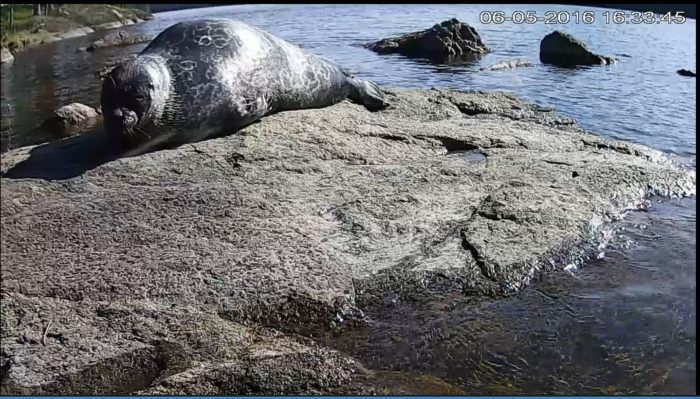
Still saving Finland’s Saimaa ringed seal

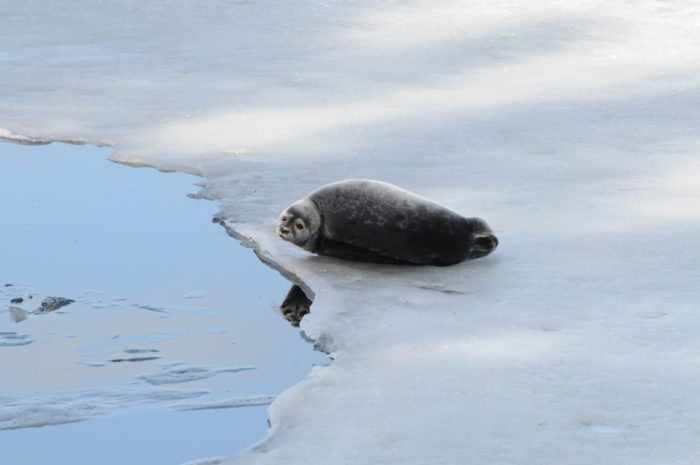
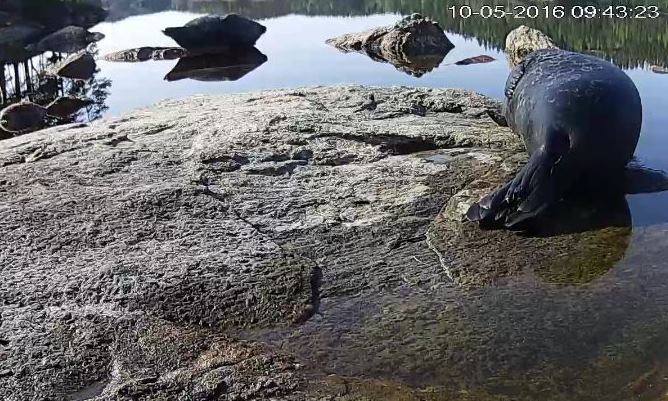
Somewhere on Lake Saimaa in southeastern Finland, a roly-poly, healthy-looking seal sprawls out on a rock by the shore. At times the seal scratches its neck with its front paw or rolls from one side to the other. But mostly it just basks on the rock. Sometimes it is joined by another seal, which does what its companion is doing – not much of anything.

This spectacle of Saimaa ringed seals (their Finnish name is saimaannorppa) hooked people in May 2016 when WWF started streaming it via webcam as Norppalive. Returning in 2017, it consists of a wildlife camera broadcasting real-time video from a rock popular among the seals.

The Saimaa ringed seals attracted enormous attention and put viewers in good spirits. Norppalive received over two million views during a one-month period.

“People experienced Norppalive as soothing,” says WWF communications officer Joonas Fritze. “Even though seals weren’t always visible on the rock, just the beautiful natural environment of Lake Saimaa produced a zen-like feeling. Sighting a seal was the icing on the cake.”

The immensely popular Norppalive webcast goes online again in May and June. This time, the seals’ reality TV is also being streamed abroad via an English-language website (link below).

Norppalive increases desire to protect seals

This seal, nicknamed Pullervo, showed up to delight Norppalive viewers in the service’s inaugural year.Photo courtesy of WWF Finland

The Saimaa ringed seal is one of very few species of freshwater seals in the world. It was isolated in Lake Saimaa, now Finland’s largest lake, about 8,000 years ago, when the link to the Baltic Sea broke after the Ice Age. The Saimaa ringed seal is an iconic and rare animal – if it disappears from Lake Saimaa, it will disappear from the face of the earth.

“The goal of Norppalive is to raise people’s awareness of the Saimaa ringed seal and its life, and to increase the desire to protect it,” says Fritze.

The greatest threats to the Saimaa ringed seal are fishing net deaths and climate change.

“Fishing is highlighted more because it is easier to influence than climate change,” says Petteri Tolvanen, a programme director at WWF.

Statutory and voluntary fishing restrictions have improved the situation of the Saimaa ringed seal, but even so, the number of seal pups living to reproductive age is not as high as it should be. Pups die in nets and certain kinds of fish traps, where they get stuck and drown. Adult seals also die in fishing tackle.

During the month of Norppalive streaming in 2016, more than 120 people pledged on the WWF website to give up net fishing on Lake Saimaa. This represented a huge addition, as 240 had already pledged in the previous two years. Donations on behalf of the Saimaa ringed seal also increased.

Intensely threatened

Climate change and fishing net deaths form the greatest threats to the Saimaa ringed seal.Photo: Mervi Kunnasranta/WWF Finland

All means of protecting the Saimaa ringed seal are necessary. Thanks to decades of conservation efforts, the seal population has gradually risen from 150 to 360 individuals, but this is still far from a viable population.

“The Saimaa ringed seal remains highly endangered,” says Tolvanen. “The official interim goal is 400 seals by the year 2025. Then extinction would no longer be an immediate threat, but even that is in no way adequate.”

The population is estimated annually on the basis of seal births – the more accurate the birth count is, the more precise the population figures are. In spring 2016, 86 seal pups were born, a number greater than any year in the previous three decades. In 2017, the corresponding figure is 82.

The pups are born in late February. Net fishing restrictions to protect Saimaa ringed seal pups are in force in the seals’ key habitats from mid-April to the end of June. The use of certain types of fishing tackle is prohibited throughout the year.

The fishing restrictions are opposed by a small but vocal group.

“I’m glad that people’s wish to protect the Saimaa ringed seal through fishing restrictions is greater in areas populated by the seal than elsewhere in Finland,” Tolvanen says.

Building snowbanks helps

The Norppalive camera has a peaceful, zen-like influence on viewers, who watch the seals basking in the sun.Photo courtesy of WWF Finland

If climate change is not checked, future prospects for the Saimaa ringed seal are bleak.

The seals need snow and ice to survive. The female seal builds her nesting lair in a snowdrift – it’s safe to give birth there, and the pup stays dry and warm. However, winters with little snowfall are becoming increasingly common.

“In the future, there may be winters when we don’t even have ice [on the lake],” Tolvanen says. “In bad winters, pup mortality can reach up to half of all births.”

Fortunately, people can pile up snow into snowbanks that can act as nesting sites for the seals. In the winter of 2014, when there was very little snow, more than 90 percent of the season’s seal pups were born in nests built in human-made snowdrifts.

Even if you don’t live close enough to help build nesting sites for the Saimaa ringed seals, you can still follow them and participate in conservation efforts online. The Norppalive webcam link is right here. And as the WWF website says, “Chances are it will be the cutest Finn you’ll ever see.”

By Tiina Suomalainen, May 2017

Sisu begins where perseverance ends

Adversities form an integral part of human experience, but what is it that enables us to endure the toughest of situations and take action against nearly impossible odds? What keeps us going when we feel we have reached the end of our abilities?

The Nordic country of Finland has a cultural construct known as sisu, used to describe the enigmatic power that enables individuals to push through significant hardships. The term dates back hundreds of years. However, the idea of sisu is much older. It is a central part of Finnish collective discourse and can been seen as a life philosophy. Sisu is extraordinary courage and determination in the face of adversity. It’s about not seeing a silver lining in the clouds, and yet jumping into the storm anyway. At the core of sisu is the idea that, in each of us, there is more strength than meets the eye.

Even though the construct of sisu has its roots in Finland, it is relevant to all human beings anywhere in the world. It is a potential which we all share and which can have a powerful impact on our daily lives. Sisu is embodied by people everywhere who defy the odds and hold on to hope when at first there seems to be none.

The aim of Sisu not Silence is to end the silence around interpersonal violence, remove the stigma and shame imposed on individuals who have experienced it, and create a community which survivors feel proud to belong to. Sisu not Silence features and highlights stories of overcoming abuse, regaining strength and reclaiming ownership of one’s story, if it was once lost.

Emilia Lahti is a researcher and social activist with special interest in applied positive psychology and social justice. Her ambition is to create practical, empowering applications, which can be leveraged on a systemic level to enable a more positive human future.

Emilia Lahti talks about Sisu in TEDx Turku

Finnish designer empowers sustainable fashion

It was the summer of 1986, and Timo Rissanen was 11 years old. It was a confusing time to be growing up in a suburb in Finland. You could no longer just step into a grocery store and fill your basket without thinking twice. A catastrophic accident had just occurred at a nuclear power plant in Chernobyl, in what is now Ukraine, and a cloud from the explosion had travelled north, reaching Finland.

Families had to take precautions when it came to putting food on the table – many people remember the temporary ban on picking berries or mushrooms. For the first time, Rissanen realised that the environment wasn’t just an abstract concept, but rather it was the water that he consumed and the air that filled his lungs.

Fast-forward about a decade, and Rissanen was attending the University of Technology in Sydney, Australia, studying design with an emphasis on fashion and textiles. He was fascinated when his undergraduate professor, Julia Raath, brought up in a discussion on the high toxicity levels in textiles and dyes.

The link between fabric and environment

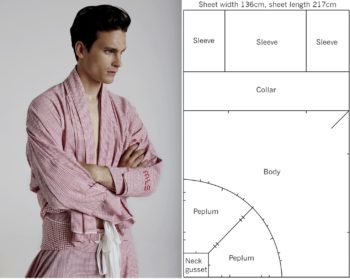
A model shows off zero waste pyjamas designed by Timo Rissanen. The pattern ensures that the fabric is used as efficiently as possible.Photo: Mariano Garcia; pattern: Timo Rissanen

Rissanen’s subsequent work experience as a high-end designer became the validation he needed to put Raath’s education into context and connect it with his childhood experience. “I noticed that a lot of textiles and fabrics used were imported from countries like Bangladesh, China and India because they don’t have regulations when it comes to the use of toxic chemicals in manufacturing processes,” he says. “This not only affects the labourers, but also consumers who wear these fabrics, and eventually the environment.”

He also remembers the startling levels of waste produced: “Almost 15 percent of handwoven fabrics worth 200 dollars a yard, from countries like India or Italy, would be thrown aside,” he says. What he saw as a clear relationship between the environment and fashion inspired his Ph.D. research (also in Sydney) on sustainable fashion and zero waste. In 2011 he started teaching at Parsons School of Design in New York, where he was the first professor hired to educate the coming generation of designers on these two concepts.

Fashion versus climate change

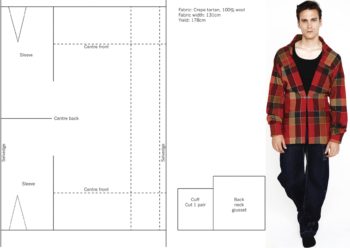
A pattern and a person display a zero waste cardigan by Timo Rissanen.Pattern: Timo Rissanen; photo: Mariano Garcia

Currently, Rissanen works closely on the curriculum, ensuring that all of the elective courses in the School of Fashion cover sustainability to a certain degree. His biggest contribution has been developing a core freshman course in 2013 called Sustainable Systems. The course aims at arming future designers with in-depth knowledge on fashion’s relationships with water, soil, the atmosphere and climate change. “My biggest takeaway from Timo’s class was the ability to critically think about the design process when constructing a garment,” says 22-year-old design student Jacob Olmedo.

His classmate Casey Barber says, “I had never approached design with questions such as, ‘How will this garment look after three to five washes?’ and ‘Will it maintain its shape and texture?’ Since learning from Timo I have continued to explore creative construction methods such as zero waste pattern making and sustainable sourcing of materials.” Olmedo and Barber will form part of the first graduating class to have taken Rissanen’s challenging freshman course.

Letting life flourish

Rissanen’s career includes several book projects: He is one of the editors of “Shaping Sustainable Fashion” (Routledge, 2011) and one of the writers of “Zero Waste Fashion Design” (Bloomsbury, 2016).

Sustainable techniques are slowly being implemented within luxury brands, partly due to consumer awareness and pressure from organisations like Greenpeace, and also because massive profit margins allow them the ability to wean themselves off of toxic chemicals and hire trained labour. However, many popular high street brands still practice unsustainable, harmful techniques.

In addition, the current culture is one of fast consumption, where quantity takes precedence over the quality of the garments you own. It has been called the Instagram phenomenon, referring to the app where the lifespan of an image is two hours. It influences brands to constantly create new collections to appease consumers. “I know this is utterly depressing,” says Rissanen, but he is optimistic that within 20 years sustainable fashion and zero waste will “simply be good business practice.”

He’s continuing the good fight by training his future army of designers and taking his teachings beyond Parson. His projects have included co-curating the exhibition Yield: Making Fashion without Waste in 2011 and co-authoring the book Zero Waste Fashion Design (2016), both together with researcher and designer Holly McQuillan.

Rissanen believes that large-scale change starts on an individual level, and he has been gradually adopting sustainable techniques in his personal sphere: He brings his own grocery bags to the store, takes his food waste to a composting facility near his apartment in Queens, and makes his clothes last longer by avoiding use of a dryer. “Eventually, sustainability is the possibility that humans and other life can flourish on earth forever,” he says, quoting John R. Ehrenfeld, a scholar who co-authored the book Flourishing: A Frank Conversation about Sustainability (Stanford University Press, 2013) with Alfred J. Hoffman. “It’s simple in a way, but [it’s something] we can’t take for granted anymore.”

By Sholeen Damarwala, April 2017, updated May 2017

Finnish kids create media buzz every spring

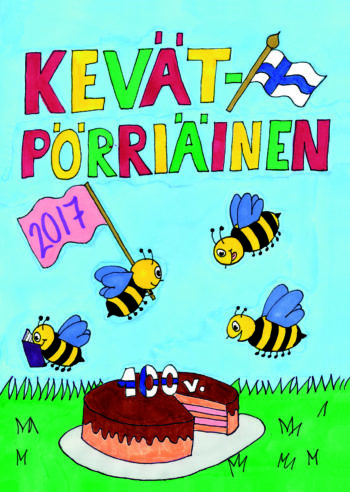
Called Kevätpörriäinen (Buzzing Spring Bee) and founded in 1949, the magazine is legendary for its jokes page; some of the material may even give professional comedians a run for their money. The publication also contains poems, stories, games and artwork, all produced by kids in grades one to six. All profits are considered charitable donations and are distributed to schools for the benefit of the students.

As warmer spring weather reaches Finland, it is common to encounter groups of children selling the magazine. It’s not just child’s play – “grown-up” media often quote their favourite excerpts from Kevätpörriäinen on TV and radio and in paper publications. Below are our own favourites, used by permission. In honour of the 100th anniversary of Finland’s independence, the 2017 edition includes sections called “Top 5: Best things about Finland” and “My Finland.”

Top 5: Best things about Finland

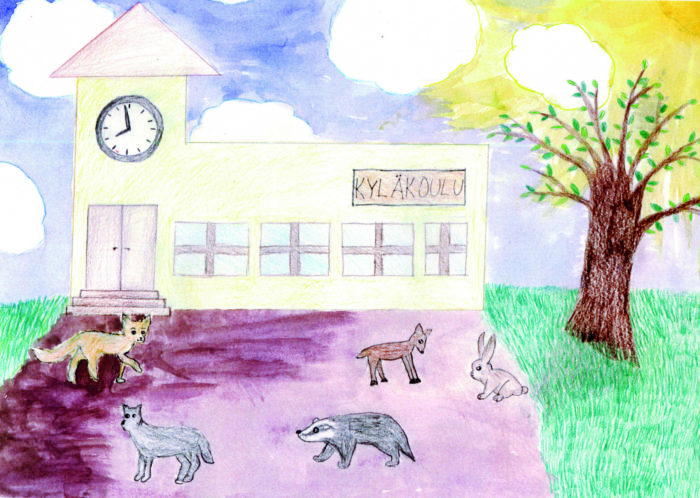
Finnish schools are famous for their approach to learning – and now for the variety of animals found in the schoolyard. Illustration: Vilma and Ulla, grade 6

1. The seasons 2. The homes 3. The friends 4. The schools 5. The families (Lilja, grade 1)
1. The forest 2. Berries 3. Animals 4. The food 5. Stuffed animals (Pinja, grade 1)
1. Mom 2. Candy 3. The Tooth Fairy 4. Santa Claus 5. My cat (Seela, grade 1)

In my opinion, the best things about Finland are my big sister and my mum and my friends and my home and my granny. (Eevi)

Parks, schools, summers, amusement parks, shops (Tula, grade 4)

1. Summer 2. It snows in winter 3. Freedom of religion 4. There’s food and water 5. There are grown-ups (Essi, grade 1)
A. Sun B. Summer C. Water D. Sauna E. Sand (Eemeli, grade 6)
1. Sauna 2. Ice hockey 3. Youtubers 4. Winter 5. The Northern Lights (Rasse, grade 4)
1. Ice hockey 2. Runeberg cakes 3. Karelian pies 4. Santa Claus 5. The Moomins (Selma, grade 5)

My Finland

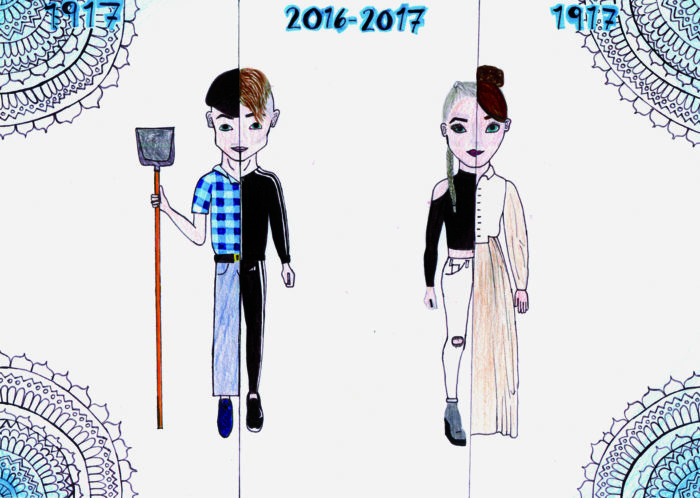
This drawing interprets the way clothing has changed over Finland’s 100 years of independence. Illustration: Amanda, grade 5

To me, Finland is family, friends, hobbies and school. In Finland, school doesn’t cost anything and we get free food at school. It’s nice to be a Finn. Women have the right to vote. And everyone has the right to be different. From time to time I visit other countries but it’s always nice to return to Finland. Congratulations Finland on your 100th birthday! (Junia, grade 4)

In my Finland, there’s no bullying at school, no evildoers and no poor people. I’d like to accomplish these three things. (Olivia, grade 3)

[My nicknames for the months of the year are]: winter month [January], ski month [February], Easter month [March], April Fool’s month [April], Vappu month [May, with its May Day (Vappu) celebrations], sun month [June], swimming month [July], apple month [August], leaf month [September], slush month [October], snow month [November] and gift month [December]. (Oona, grade 3)

My Finland is beautiful, nice, clean, different. In Finland you find fun friends. Finland has good schools where you learn a lot. My Finland has nice teachers. Nice schools and good ferries that can take you wherever you want to go. (Naz, grade 2)

Joking around

The cover of the 2017 issue of “Kevätpörriäinen,” an annual Finnish tradition. Illustration: Senja, grade 6

Many of the entries on the jokes page are plays on words, so we present some of those that are most readily translatable:

The mouse and the elephant went to the beach. “Oh no,” said the mouse. “I forgot my bathing suit.” The elephant replied, “Would you like to borrow mine?” (Julia, grade 4)

Why do bears have such thick fur? Because they’d look silly in overcoats. (Unna, grade 3)

What is a fishing net? It’s a bunch of holes held together by string. (Eevi, grade 4)

What living thing has the best hearing? The korvasieni [literally “ear mushroom,” the Finnish name for the false morel, a mushroom that resembles an earlobe in appearance]. (Arttu and Otso, grade 6)

By ThisisFINLAND staff, May 2017

Finland sees dual benefits from rehab and recycling

The City of Helsinki runs the imaginative Uusix scheme in a set of converted workshops where people who have been struggling to get back into the job market can gain skills and experience. The name Uusix stems from uusi, the Finnish word for “new,” and implies a process of renewal.

At the workshops, recycled materials are put to good use in the production of goods ranging from jewellery and ceramics to textiles and furnishings. Uusix workers also repair furniture, computers and bicycles.

Valuable social contacts

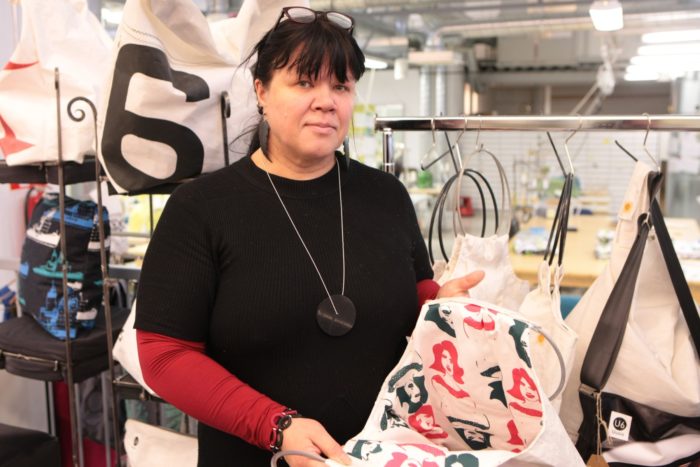
Uusix manager Vuokko Oivarinen shows off a Jaqueline Kennedy bag.Photo: Hernan Patiño

“We get most of our materials free from various departments of the City of Helsinki, or from commercial businesses,” says Uusix manager Vuokko Oikarinen. “People and organisations today are rightly reluctant to throw away useful stuff. We also feel it’s nice that there are stories behind our products – like our range of Jaqueline bags, made from the sails of a large yacht that the Kennedy family used to own, and printed here with graphic images of the former US First Lady.”

“Really our most important goal is to give unskilled people who have fallen out of the job market a first step back into working life,” says Oikarinen. “They earn a little extra money – which certainly helps – and also gain useful skills. But the most important thing is often for them to get back into the social environment and routine of a real working community.”

Social and physical activities, from aerobics and yoga sessions to quizzes and museum visits, are regularly organised for the staff at Uusix. Oikarinen explains that many people there are recovering from problems such as excessive alcohol or drug use, in addition to long-term unemployment.

Getting back on track

Tuukka Semi is gathering experience in graphic design at Uusix while also getting himself back into the swing of working life.Photo: Hernan Patiño

Marginalised jobseekers are referred to Uusix from Helsinki’s social services department. The only strict requirement is that applicants must promise that they are not currently using illegal drugs.

Tuukka Semi, who is in his late 30s, has worked at Uusix for almost a year, specialising in graphic design and IT work, including the production of Uusix’s own magazine and website. “I was previously unemployed for many years, only able to find occasional freelance work after dropping out long ago from a graphics course at a polytechnic institute,” he says.

Semi also suffered from alcohol problems, but he feels his job at Uusix is now putting him back on the right path. “I believe working here will help me to get back into working life more permanently,” he says. “It’s great to get into a routine and gain good practical experience in a field that interests me.”

Constant renewal

Anita Pulli uses spare cloth donated by Finnish design house Marimekko to sew tote bags printed with Uusix’s own designs.Photo: Hernan Patiño

The Uusix workshops bustle with people busy fixing old chairs, converting old keys and coins into trendy jewellery, and tinkering with used bikes and computers.

Many of Uusix’s design products are passed on to departments of the City of Helsinki for use as gifts. Others are sold in pop-up Uusix stalls at events, or in a permanent shop adjoining the workshops, where mugs, printed bags and unique jewellery items are among the most popular purchases.

By Fran Weaver, April 2017

The moment for industrial wood building in Finland is right now

“Interest in timber construction is emerging everywhere, even without the tradition of wood construction that we have in Finland. This is precisely the moment to develop our own expertise and to look for entirely new kinds of timber construction solutions,” says Katja Lähtinen,  Finnish Professor of Business Economics and Wood Construction at the University of Vaasa.

Wood construction is a flagship project of the Finnish Government. The aim is to increase industrial wood construction and exports, but also the environmental and climate friendliness of construction. A wooden building acts as a carbon storage throughout its life – even hundreds of years.

From the beginning of next year, Finnish wood construction regulations, such as fire safety regulations, will be relaxed so as to allow wood to compete on an equal footing with concrete and steel.

For long, Finland’s strength in wood construction has been the construction of single-family homes and summer cottages. According to a recent study by the Pellervo Economic Research Institute, more than 80 per cent of detached houses in Finland have a wooden frame and practically all leisure homes are made of wood.

“A good example of a hybrid construction is Löyly in Helsinki. It is a sauna and restaurant building, where all materials have been left exposed. And that highlights the properties of wood even better,” says Lähtinen.