The heavy door opens, and a rush of cool air greets us.
“This is my favourite place in our offices during summer,” says Mika Hovilainen with a grin. He is CEO of Railotech (formerly called Aker Arctic), an icebreaker design company.
Small red boats are neatly arranged across the large space, their hulls curving elegantly in and out. These are few-meters-long miniatures of existing and upcoming icebreakers and icegoing vessels that Railotech designs.
Finland is world-famous for its icebreaking expertise. The know-how was born out of necessity; all Finnish ports freeze during winter. (Estonia is the only other country that can make the same claim.) Shipping lanes need to be kept open. The challenge has driven technological innovation and fostered a deep understanding of how ice behaves.
Hovilainen opens another door, and the air becomes even colder. This is Railotech’s pride and joy: a 75-metre-long ice tank where employees and visiting researchers can observe how miniature vessels manoeuvre in ice-covered waters.
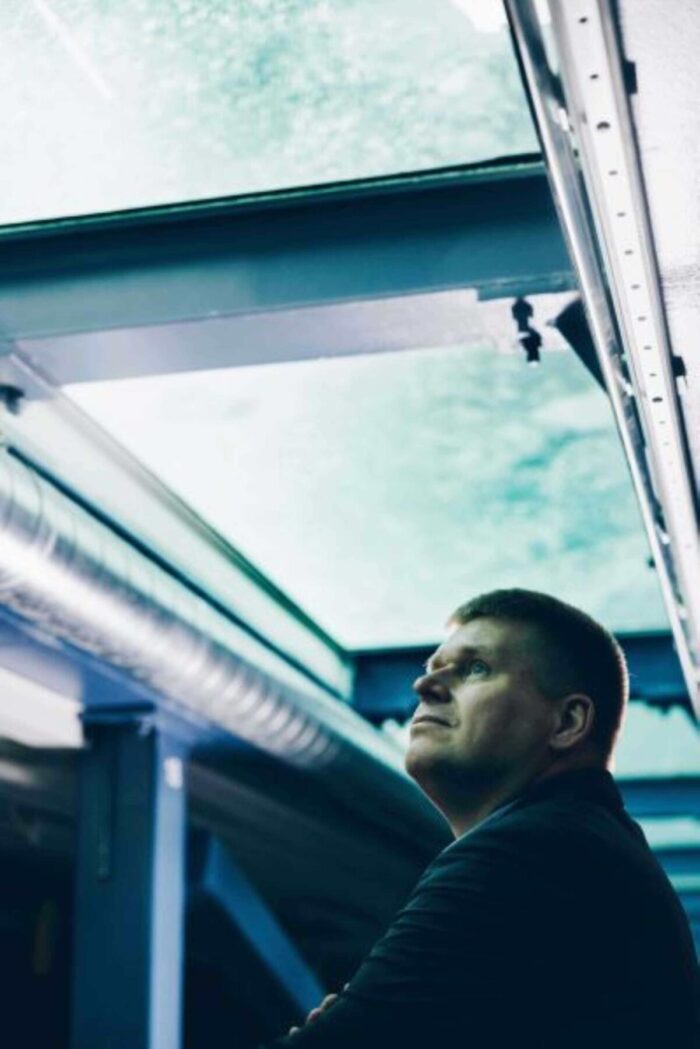
Mika Hovilainen is the chief executive of Railotech.
Real-life testing – albeit at 1:40 scale for the largest vessels – is crucial to understanding how ice and vessels interact.
“People often think that an icebreaker simply rams through the ice, forcing the mass out of its way,” Hovilainen says. “In fact, the shape of the hull turns a forward force into a downward force that breaks the ice. The ice slides beneath the hull, breaks into smaller pieces, and is pushed to the back and to the side.”
There’s more to ice than meets the eye
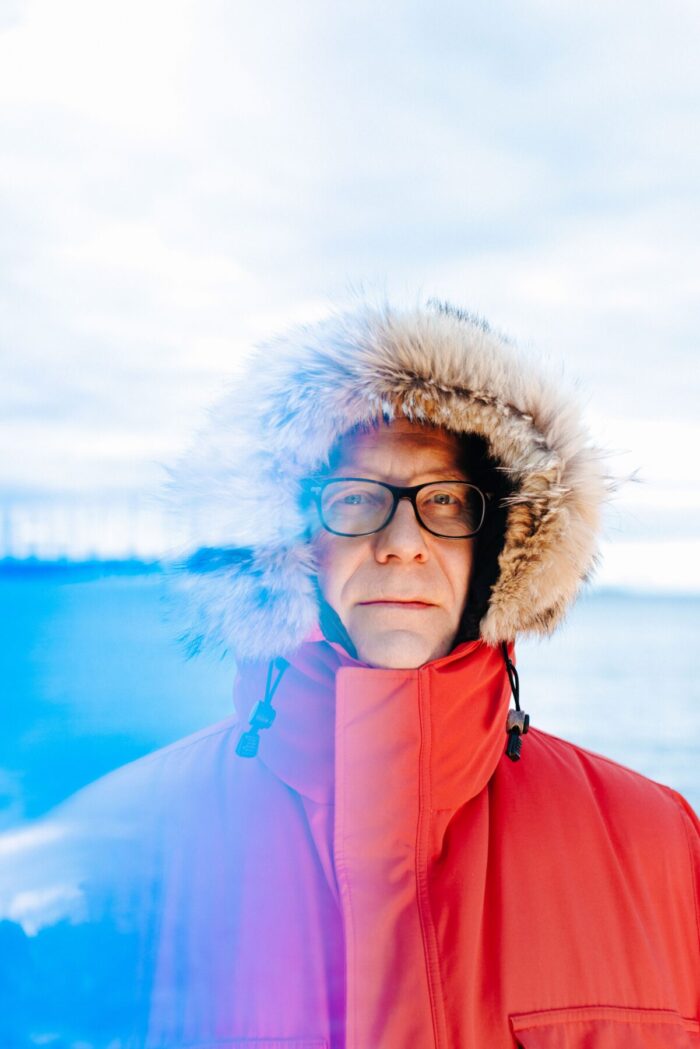
Jukka Tuhkuri studies ice mechanics and arctic marine technology.
“Ice is a difficult material,” muses Jukka Tuhkuri, professor at Aalto University. His area of expertise is ice mechanics, a discipline studying how ice deforms and breaks.
Tuhkuri says there are a few common misconceptions about ice. The first and most persistent is that ice is cold.
“As a material, ice is not cold, because it’s so close to its melting point.”
To illustrate, he compares ice to steel, which melts at around 1,500 degrees Celsius. At room temperature, a steel beam is still far from its melting point. However, even at minus 10 degrees — a common winter temperature — ice is already very close to melting.
Another misconception is that ice is fragile.
“Yes, ice can be fragile when cold or under rapid loading, but if ice is under slow, steady stress, for example when it is pushed against something, it flows like liquid.”
Operating a vessel in ice-covered seas is far more complex than in open water. To add to the challenge, sea ice is not always a single flat field but a maze of ice floes that move around and press together with currents and wind, putting immense stress on any obstacles in their way.
“When wind presses the ice slowly against a vessel or a structure, such as a bridge or an offshore windmill, it’s anything but fragile.”
Know your vessels
 Icebreaker
A vessel designed to break ice and create paths for other ships. Features a reinforced and rounded hull and very powerful engines. Uses various manoeuvres to break free of ice.
Icegoing vessel
A vessel that can operate in icy waters but cannot break thick ice. Often used for commercial shipping, research or military purposes and typically follows behind an icebreaker in difficult ice conditions.
Ice classes
Countries have different classifications and requirements for icegoing vessels. In Finland, there are six classes with specific requirements for hull design, engine output and performance in ice.
Finnish icebreakers
Around 80 percent of the world’s icebreakers are designed and around 60 percent built in Finland.
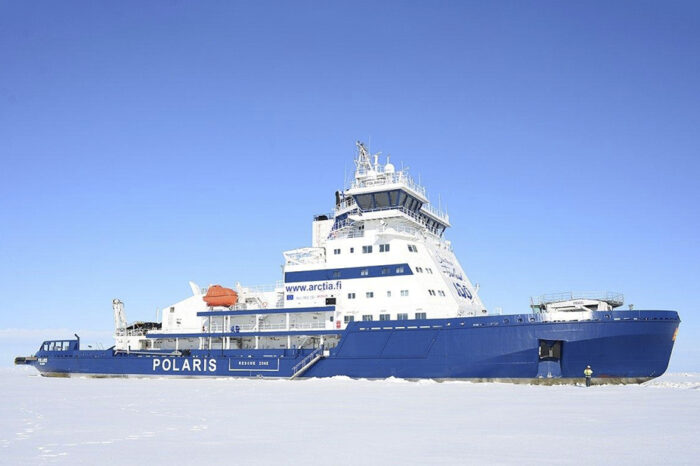
Finland has eight operational icebreakers: Otso, Kontio, Voima, Urho, Sisu, Fennica, Nordica, Ahto and Polaris, the world’s first icebreaker to use liquefied natural gas as fuel. During summer, many of them can be seen moored in Katajanokka, close to downtown Helsinki. A new icebreaker, Aino, has been commissioned and will be operational in 2029.
Unparalleled snow-how keeps airports open
While ice is the raison d’être of Railotech’s expertise and Jukka Tuhkuri’s research, at Helsinki Airport ice is an unwanted visitor.
Airplanes need friction to take off and land safely. When the temperature drops close to zero and ice starts to form on the runway, maintenance operations at Finland’s busiest airport kick into high gear.
“Our objective is to provide summertime conditions on the runways year-round,” says Jani Elasmaa, vice president at Finavia. The company maintains Finland’s airport network and is world-famous for its “snow-how,” expertise in keeping airports safe and operational in the harshest weather.
“The ideal winter weather would be long-lasting periods of sub-zero temperatures,” he says. “Unpredictable weather and temperatures that oscillate above and below freezing – the conditions we nowadays often have – are the most challenging.”
There are around 130 maintenance workers on the ground at the peak of winter. They clear the runways of snow in dramatic convoys of trucks and inspect the tarmac for frost damage, another problem caused by repeated freezing and melting.
Finavia’s snow-how attracts visitors from other airports. Guests are particularly interested in the collaboration between air traffic control and the ground team.
“It’s not about keeping the planes in the air at any cost,” says Elasmaa. “The priority is to ensure that passengers and crew get home safely.”
While the decision to shut down air traffic is never taken lightly, sometimes it’s the only option. A few years ago, a downpour of supercooled water covered the apron areas, the planes and all maintenance equipment in a four-centimetre-thick layer of ice.
All air traffic had to be stopped.
“We were running again in two hours,” Elasmaa says, with a touch of pride in his voice.
Snow storing saves skiing seasons

Just 20 kilometres west of Helsinki Airport along Ring Road 3 lies Oittaa, one of the most popular outdoor recreation centres in the capital region. It boasts one of the longest cross-country skiing seasons in the country, even when compared to the far north.
The capital region may get proper snowfall only a few times per year, but snow stored from the previous season means that Oittaa’s skiing season often starts as early as late October, before any new snow has fallen.
Storing snow is not a new phenomenon. Before refrigerators, snow and ice were covered in sawdust or wood chips to help preserve food. Now, it’s also a promising business venture.
“Storing existing snow is the most energy-efficient way to ensure there is snow in the early season,” explains Antti Lauslahti, CEO of Snow Secure, a company that develops snow storage systems.
Snow storage is particularly appealing for ski centres in Europe and North America. The ability to open slopes early, when there’s no natural snow or it’s not cold enough to use snow guns that turn water into snow, makes a big financial difference.
Storing snow doesn’t replace snow guns, but it complements them, Lauslahti explains.
“Snow guns produce the best quality of snow when it’s minus ten degrees. That’s the optimal time to make good snow and store it for the upcoming season.”
The snow is piled into hard-packed mounds and covered with insulating mats. Sensors monitor the temperature inside and outside the cover. Lauslahti says that even when the temperature outside rises above 40 degrees, it is barely above zero just a few centimetres below the mound’s surface.
“I think this is a very Finnish solution. We take something very niche and turn it into a patented innovation with global appeal.”
Warm ice behaves differently

Finnish ice and snow expertise must now adapt to a major challenge: climate change.
As winters become milder and temperature swings increase, ice changes as well. Lately, professor Jukka Tuhkuri has been studying what he calls “warm ice.”
One key question Tuhkuri and his fellow researchers are rushing to answer is what kinds of loads warm ice places on icebreakers. This knowledge is crucial not only for icebreakers but also for other vessels operating in increasingly ice-free waters.
“We have discovered some surprising things about warm ice,” he says. “For example, we have measured that ice loads on ships in a warm and soft ice can be just as high as ice loads on cold and hard ice.”
Even incremental changes in ice temperature can make a big difference in its material qualities, Tuhkuri notes. These are not yet reflected on the calculations and vessel-building guidelines.
“When ice conditions are seemingly – and I underline the word seemingly – easy, unenforced vessels will operate longer into autumn and earlier in the spring, but warm ice may not be as innocent as it looks like,” he says.
Choppy waters ahead

In Railotech’s test tank, a miniature prototype of an icebreaker sits still in open water. A few translucent sheets of ice float nearby, the last remnants of today’s test runs.
For the icebreaker industry, climate change is both an opportunity and a challenge. Traffic is expected to grow significantly as the waterway remains open for longer, increasing demand for ice-enforced vessels.
On the other hand, icebreakers have not been built for long voyages in open, choppy waters.
“A vessel that is ideal for breaking ice is not ideal for manoeuvring in open water and waves,” Hovilainen explains. “An icebreaker’s life cycle can be over 50 years, so we have to carefully assess what kind of needs the vessels will have in the future.”
We descend a flight of stairs to a viewing area beneath the test tank. Here a window runs the entire length of the pool. Through it, we’re looking directly up at the underside of the model vessel’s hull. This, Hovilainen says, is where many big aha moments about ice happen.
Ice, in the end, is a difficult material – something computers or AI-powered weather prediction models cannot fully grasp. When the full-size version of this vessel powers through a jumble of ice floes in the future, it will continue to rely on a human’s understanding of ice.
“Even with all the technology,” says Hovilainen, “it still comes down to the captain’s experience and ability to read the ice.”
By Lotta Heikkeri
Illustrations: Tilda Rose
Photos: Vesa Laitinen