In the far north, Siida shows a Sámi view of how nature and culture go together

The Siida Sámi Museum and Nature Centre, located in the far-northern town of Inari, Finland, reopened in 2022 after renovations and the installation of a new permanent exhibition, These Lands Are Our Children. The museum then proceeded to break all previous attendance records. It posted a new annual high again in 2025.

The Sámi are the only recognised Indigenous People in the EU area. Their northern homeland, called Sápmi, is divided into four parts by the borders of the nation-states Finland, Sweden, Norway and Russia.

In addition to the museum, the Siida building also houses a shop, a restaurant, Inari Tourist Information and the Northern Lapland Nature Centre, run by Metsähallitus, the state-owned enterprise that manages Finland’s national parks. Metsähallitus also worked together with the museum on designing These Lands Are Our Children.

You’re in the north now
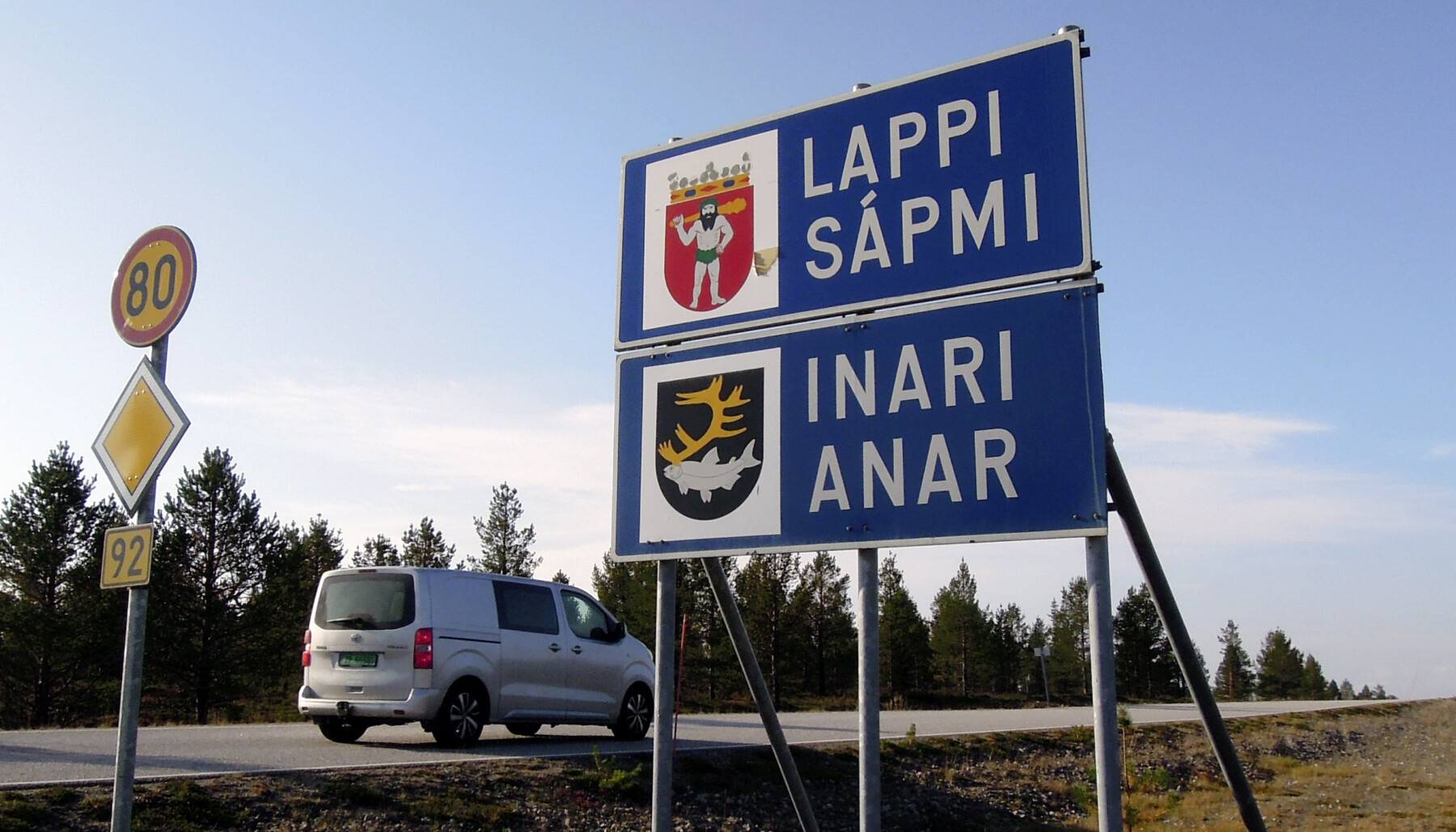
A car drives past road signs in a forested landscape.

These bilingual signs at the Norwegian border in northeastern Finland tell you where you are in Finnish and in Northern Sámi.Photo: Ritva Siltalahti/Lehtikuva

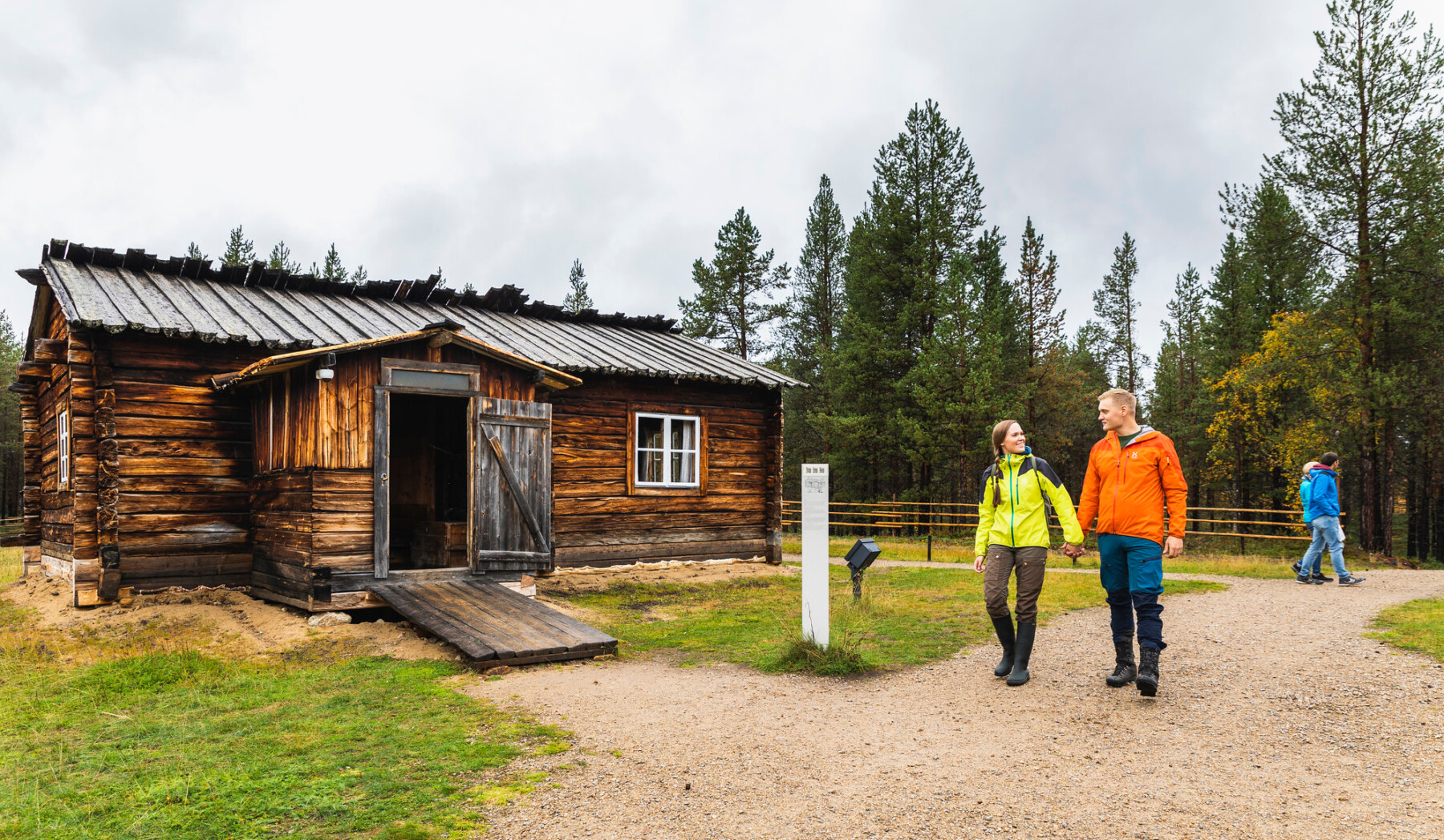
Siida, whose name is a Northern Sámi word referring to a home village or community, presents Sámi culture together with Arctic nature. Museumgoers soon perceive the clear ties between the two.

While Siida is not exactly difficult to reach, you do have to make some effort: Inari is 1,000 kilometres (620 miles) north of Helsinki, at a latitude matching that of northern Alaska. During one typical summer week, I spotted license plates in the parking lot from Finland, Norway, Sweden, Estonia, Denmark, Germany, the Netherlands, Belgium, Luxembourg, France, Spain, Italy, Slovenia, Switzerland and Poland.

A landscape full of landmarks
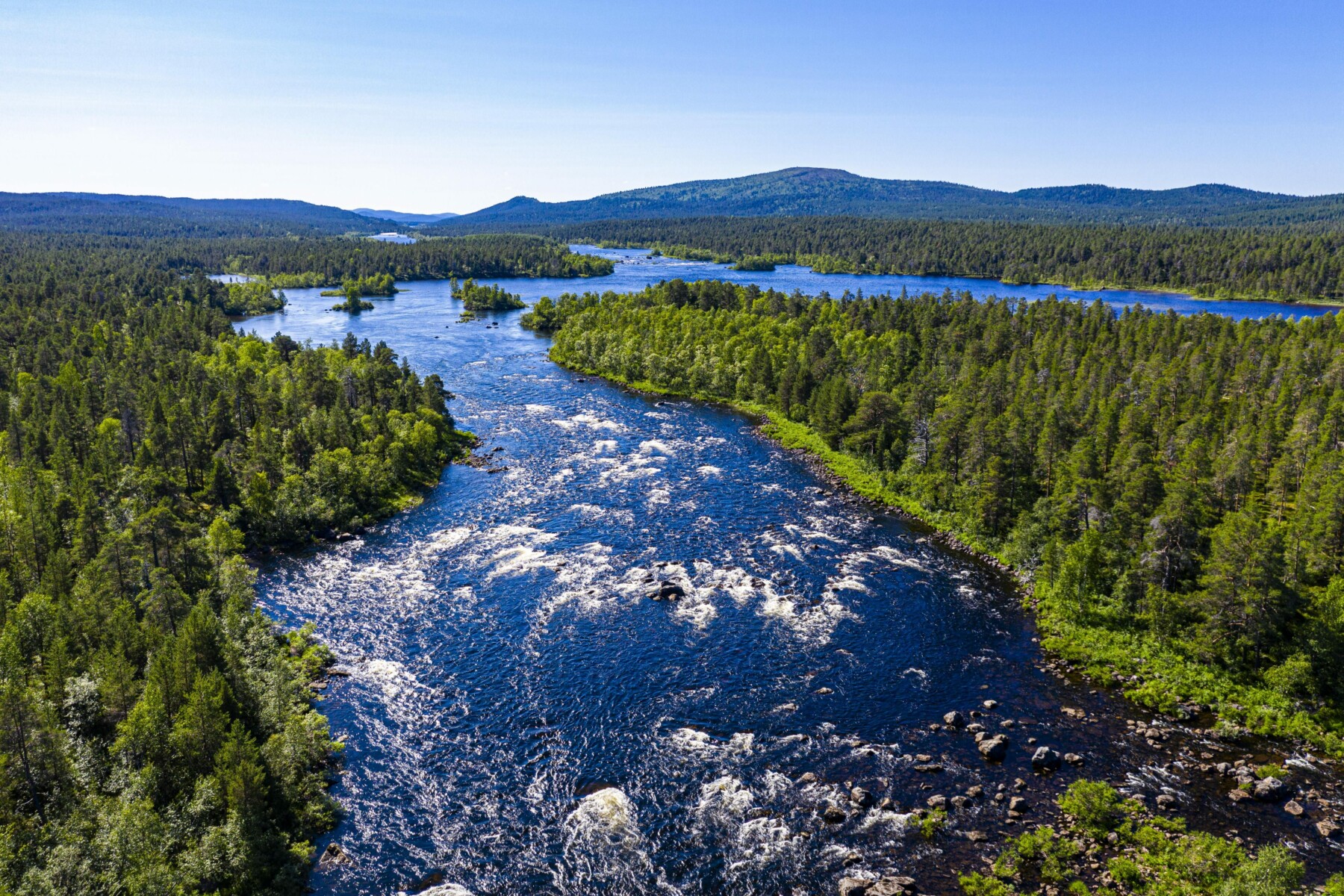
In an aerial photo, a large river flows through a forested landscape with mountains in the background.

A river called Juutuanjoki in Finnish and Juvduujuuhâ in Inari Sámi eventually flows past Siida and into Lake Inari.Photo: Michael Runkel/ImageBroker/Lehtikuva

The museum galleries are on the second floor. Initial exhibits provide historical, cultural, linguistic and geological orientation about Sápmi and the Sámi before you enter the main hall.

In an expansive square room, 12 massive photographs stretch across the walls, three to a side, lit from behind. Each picture was taken in a different month of the year and shows a landmark Sápmi landscape, many of them in national parks or nature preservation areas: Kevo Canyon in April, the rivers Tenojoki and Lemmenjoki (in June and July), Lake Inari (October), the peaks of Paistunturi and Hammastunturi (December and January).

On smaller accompanying panels, you can tap a screen for more specifics about what you’re seeing, including details about wildlife, vegetation, geology and history. You can toggle to maps, month-by-month temperature charts and graphs showing the extent of daylight hours (here in the far north, they vary dramatically, from zero hours in the winter to 24 hours in the summer).

The info is available in six languages. They include the three different Sámi languages spoken in Finland – Inari Sámi, Northern Sámi and Skolt Sámi – that have status as official languages in the area of Finland that overlaps Sápmi. The others are Finnish and Swedish, which are official languages throughout Finland, and English.

A kind of closer look
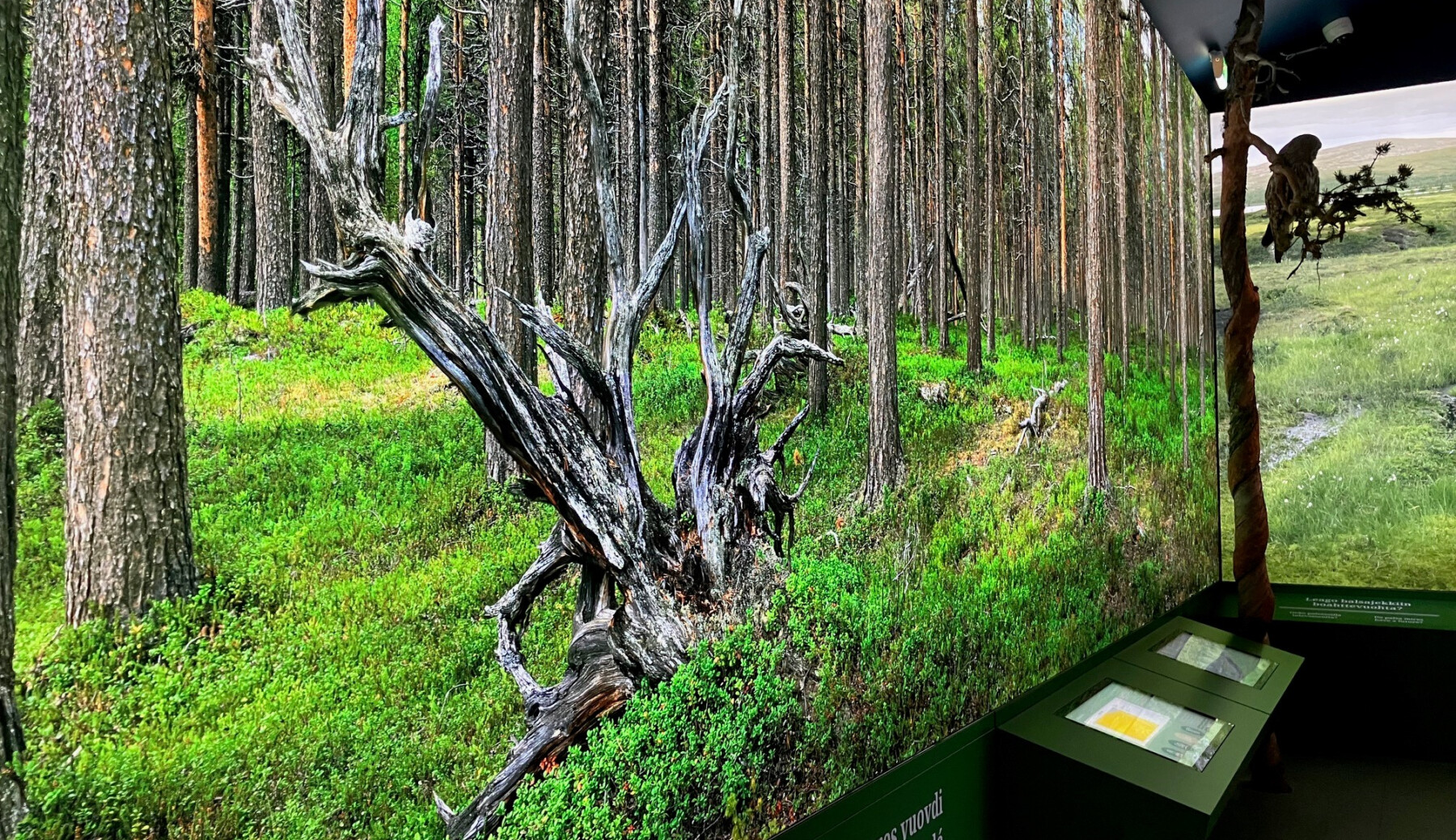
An enormous photo on a wall shows trees and other greenery in a forest.

In Siida’s main exhibition, you can lose yourself in the detail of the enormous photos of various local landscapes.Photo: Peter Marten

At any museum, different visitors get different things out of the exhibitions. This is especially true of Siida, which presents a complex combination of nature and culture and draws its audience from near and far.

Who you are and how far you’ve journeyed affect how you experience the exhibition. Many visitors have taken a long road north past forests, swamps, lakes and multiple series of rounded peaks that fill the horizon. People may have just finished hiking or skiing through a national park. Some travellers may be feeling a kind of dazed surprise at finding themselves this far north.

Siida offers an additional way to make sense of everything you see out there – a magnifying glass on the boundless landscape. It’s another way of stopping to take a closer look, just as you do if you’re out hiking.

Eight seasons
A green ring of light is visible in the dark sky over a snow-covered landscape.

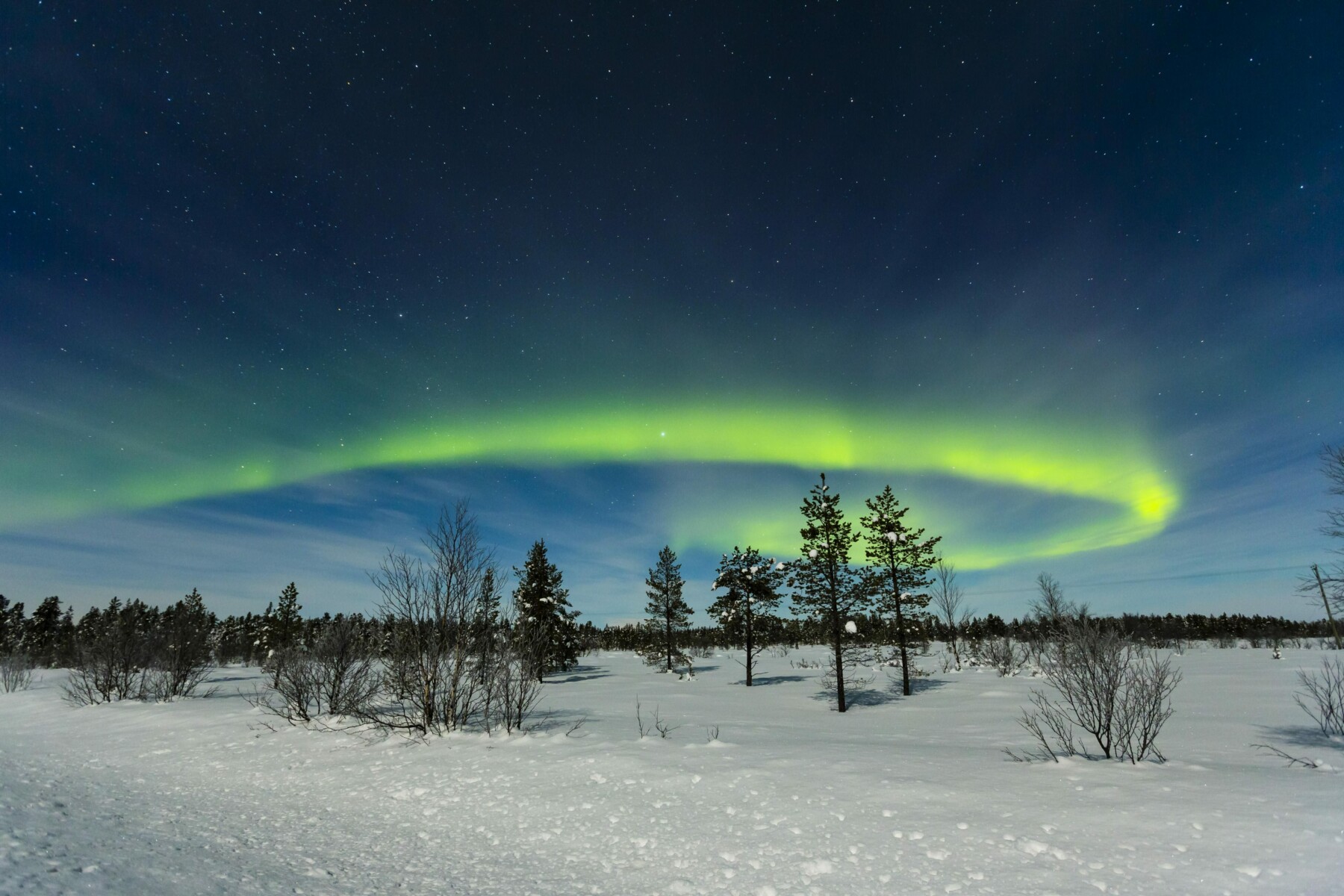
In midwinter the sun doesn’t shine in the far north, but the Northern Lights may make an appearance.Photo: Stephan Rech/ImageBroker/Lehtikuva

If this is your only visit to the far north, the museum shows you what the region looks like during the rest of the year. Outside, it may be summer, when the nights are “nightless” because of the midnight sun. Inside, you might be looking at photos of the polar night, a midwinter period when the only light in the sky may be aurora borealis (the Northern Lights) or the moon.

You’ll also get acquainted with new seasons – the Sámi divide the year into eight seasons, with “spring-summer” coming between spring and summer, “autumn-summer” between summer and autumn, and so on.

Of course, none of that will come as any surprise to museumgoers who are Sámi themselves. For them, Siida can act as a flagship and a cultural resource that contributes to maintaining the shared memory and heritage of the Sámi people.

These Lands Are Our Children contains “the story of Sámi culture, told by the Sámi themselves,” says museum director Taina Pieski in a press release, and “it clearly speaks to both outsiders and the Sámi community.”

A culture that continues
A woman holds up one of several woven ribbons from a box on a table.

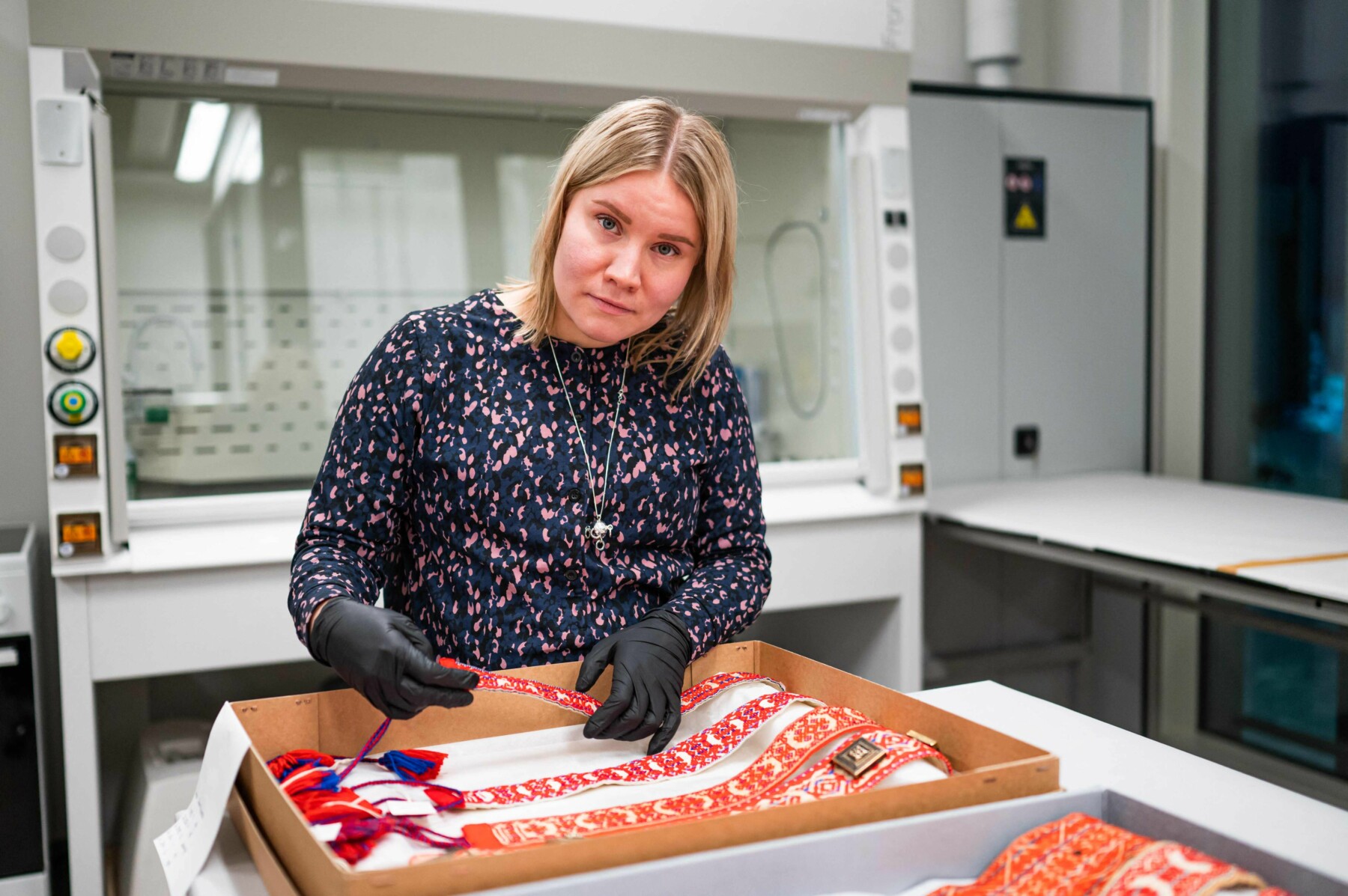
Siida curator Anni Guttorm examines some of the 2,000 Sámi objects repatriated to the Sámi Museum by the Finnish National Museum in 2021.Photo: Jonathan Nackstrand/AFP/Lehtikuva

In the middle of the exhibition hall, videos show modern everyday Sámi life, and glass cases display objects and artefacts from the recent and distant past. They include Sámi duodji (Sámi handicrafts), ládjogahpir (an ornate hat worn by Sámi women) and souvenir T-shirts from Ijahis Idja (Nightless Night), an Indigenous music festival held in Inari every summer.

One video follows a crew that is restoring a river to its pre-1960s condition to provide a better environment for fish. The project draws on Sámi traditional knowledge.

Another display details the “the ancient and fluid relationship between the reindeer and humans.” The Sámi are a “culture based on reindeer” – the animal has “major communal and cultural significance for all Sámi groups,” says the accompanying text.

Annual events such as the reindeer roundup in winter bring families and communities together. Working with reindeer is even an important element of Sámi languages, which contain “a large vocabulary related to reindeer husbandry and nature.”

The renovations at Siida added a new space for the many items in the museum’s collection that are not on display in the exhibitions. With more than 10,000 items, it’s the world’s largest collection of Sámi objects. In addition, it contains thousands of photos. And it has continued to grow: The Finnish National Museum repatriated more than 2,000 Sámi items to Siida in 2021, and the Museum of Northern Ostrobothnia repatriated 400 items in 2024. The return of such objects to the Sámi has “a profound meaning for the Sámi community,” Pieski says.

Poetic writing on the wall
In an aerial shot, the water of a forest-lined lake reflects the sky and clouds.

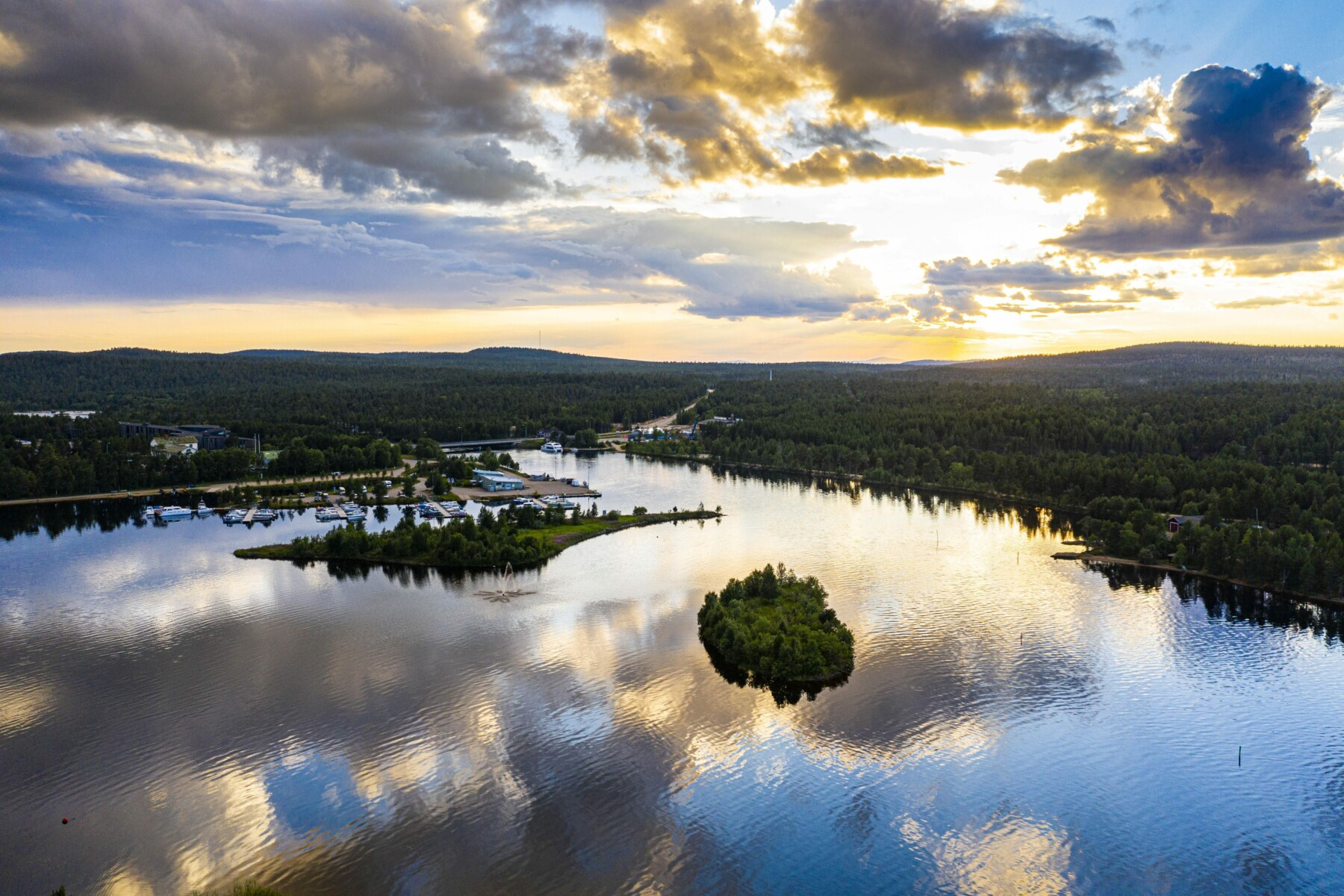
Lake Inari (Aanaarjävri in Inari Sámi) covers an area of more than 1,000 square kilometres (400 square miles).Photo: Michael Runkel/ImageBroker/Lehtikuva

A ramp leads from the lobby up to the exhibition spaces. If you’re too eager to get to the top, you might miss something important on the way.

Lettering on the wall in Inari Sámi, Finnish and English presents a poem by Inari Sámi author and teacher Matti Morottaja (born in 1942). It’s about the significance of the names attached to the locations and features in the landscape, to “each bay and headland,” as the poem says.

“These names are like the walls of a house,” Morottaja writes. They form a “map” – they carry and convey stories, history and signs of life. The way “someone named the bay and its sandy shores” is not that different from the way parents name their children.

Places in the terrain, given names by ancestors, “are older than any person,” the poem says. It ends with the line that gives the exhibition its title: “These lands are our children.”

Past and future generations
A view from a mountaintop showing forest, lakes and other mountains in the distance.

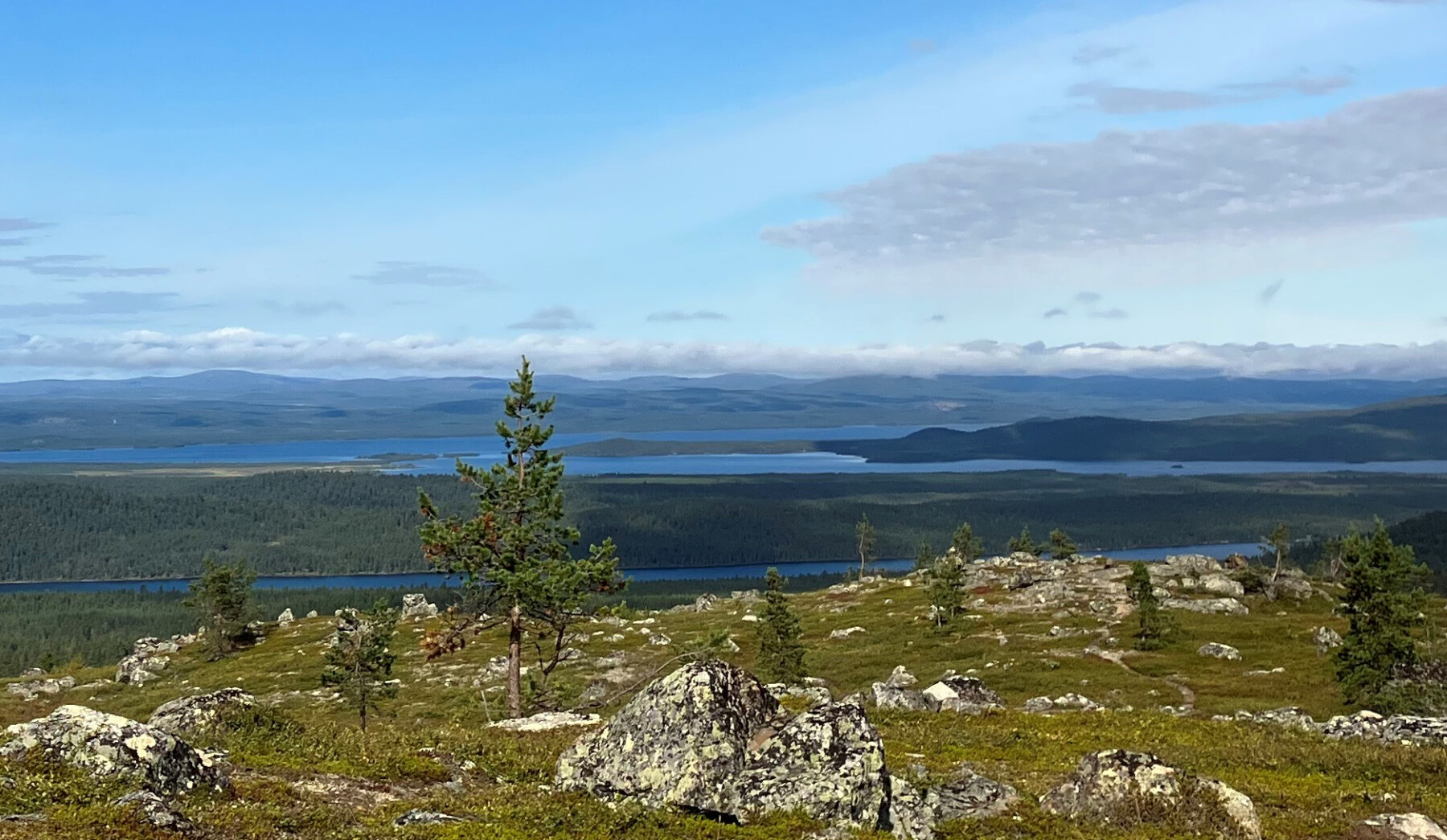
You can see mountains, lakes and the wide-open sky from the top of Otsamo (Ocomâš in Inari Sámi), a peak near the town of Inari (Aanaar).Photo: Peter Marten

How can places be old and still be children? Even without being able to read the poem in the original language, you can still guess that Morottaja and the curators wish to draw visitors’ attention to ideas they’ll find in the exhibition upstairs.

The landscape is older than the people who long ago placed names on its features in Sámi languages or other languages. But if these lands are “children,” they deserve respect and nurture. Or maybe “These lands are our children” means that, in a profound sense, future generations will depend on the land to sustain them, just as we do. It’s their inheritance.

Names and language can help connect people with nature and culture. All the info at Siida, all the words and imagery, goes a long way towards deepening that connection, no matter where you come from.

By Peter Marten, February 2024, updated January 2026
A humble but powerful Finnish invention: Pedestrian safety reflectors save lives

The best ideas are often the simplest. In 1955, Arvi Lehti, a farmer in Pertteli, near the town of Salo in southwestern Finland, bought an injection moulding machine for making plastic objects. He was also interested in the reflective properties of prisms. He started making reflectors out of clear plastic for trailers and horse wagons.

In 1963, he hit upon the idea of creating two small reflectors and gluing them together back-to-back. You could attach them to your coat using string and a safety pin. That’s how the life-saving pedestrian reflector originated in a Finnish village.

Pedestrians are difficult to see at night. The Finnish Road Safety Council says a person is visible only 50 metres (54 yards) away in a car’s low-beam headlights.

With a reflector, they can be seen 350 metres (380 yards) away, giving drivers much more time to react. In 2017, Finns chose pedestrian reflectors as the best traffic safety invention, judging them even more important than seatbelts or antilock brakes.

Snow crystals and Moomins

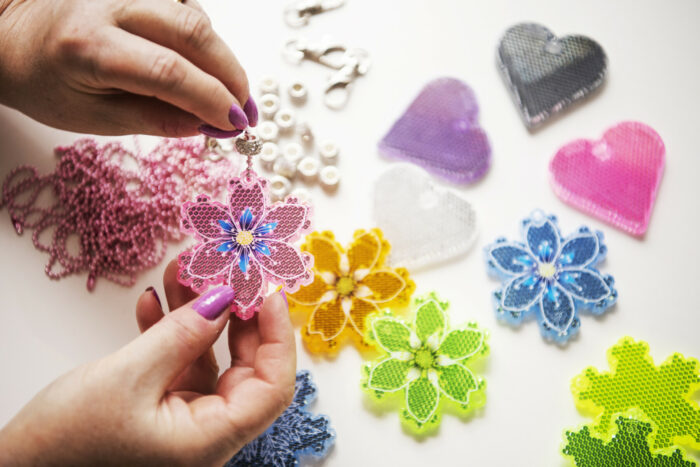
Two hands are holding a pink and blue snowflake-shaped plastic piece, with other shapes and colours lying on a table in the background.

Reflectors come in all shapes and colours, including numerous versions of the ever-popular Snowflake.Photo: Kirsi-Marja Savola

Arvi’s son, Taisto Lehti, gradually took the reins of the business. He was in his mid-20s when he became director in 1972, after Arvi died. Taisto adopted new plastic moulding technology, enlisted the help of traffic safety authorities and worked with a young designer, Kalervo Suomela, to create an array of appealing designs.

Suomela had come onboard as a product developer in 1968. In 1973, he famously jumped into a snowbank with a magnifying glass to study snow crystals. That led his supervisor to think he had lost his mind, but it also resulted in the iconic Snowflake reflector, which is still one of the best-selling models.

“The Snowflake, heart shapes and animals are popular designs,” says Jutta Vainio, managing director of Safety Reflector Finland. “People love cats! We have also had branded reflectors with characters like Angry Birds, Hello Kitty and the Moomins. We want the reflectors to be fun and attractive so people are happy to wear them.” (Angry Birds and the Moomin characters are also Finnish creations, of course.)

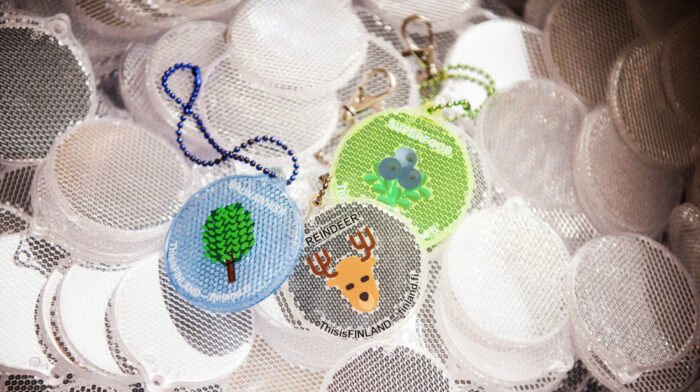
[Full disclosure: In the mid-2010s, after ThisisFINLAND introduced Finland’s national emojis and they became a viral hit, the website partnered with Safety Reflector Finland to create pedestrian reflectors with Finland emoji illustrations. They were distributed non-commercially.]

Sustainable family business

Small plastic discs bear illustrations of a leafy branch, a reindeer head and a cluster of blueberries.

Finland’s enormously popular national emojis, which ThisisFINLAND first released in the mid-2010s, have also appeared on pedestrian reflectors. Seen here are the sauna whisk, reindeer and superfood emojis.Photo: Kirsi-Marja Savola

The company Lehti founded, Talmu, now focuses on the automotive market. Its pedestrian reflector business moved to Safety Reflector Finland, run by Vainio and her son Tommi Behm. The reflectors are manufactured in the southwestern Finnish town of Laitila at Coreplast, a modern factory with its own solar farm.

“Sustainability is important,” says Vainio. “We make these reflectors strong and durable so you can use them for decades. They don’t need batteries, and they can be recycled.”

Visible all over the world

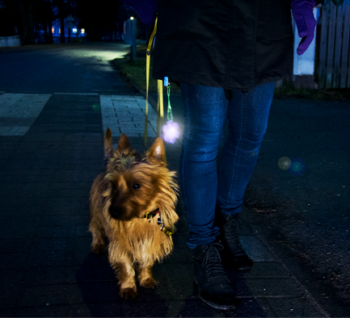
A person is walking a dog on a dark street, with a reflector hanging from the person’s jacket.

Many pet owners are conscientious about reflector use.Photo: Safety Reflector Finland

It’s common to see reflectors on pedestrians, cyclists and even pets in the Nordic and Baltic regions. According to Finnish law, pedestrians are required to wear a reflector when it’s dark outside, although people are not punished for failing to do so.

“Most of our business is international,” says Behm. “Germany, Austria and Switzerland are important markets. In America, traffic safety is handled by individual states. We have talked to Alaska, California and states in New England.”

People can buy reflectors online or in stores, and they are often distributed by schools, charities, businesses and government agencies as a public safety measure.

Saving lives

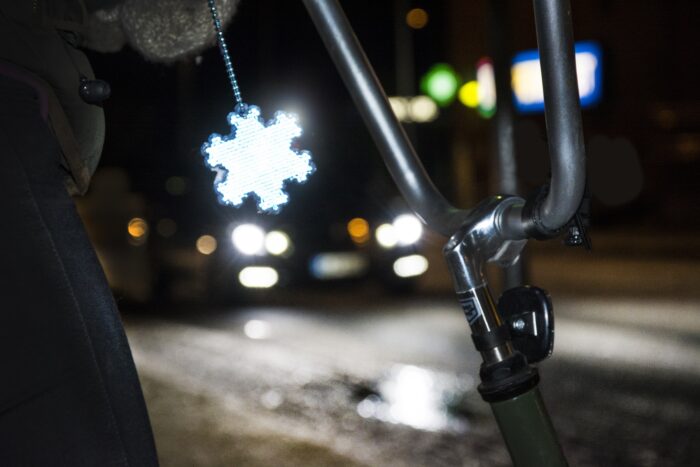
On a dark road, a cyclist’s snowflake-shaped plastic reflector shines bright as a car approaches.

Safety reflectors save lives by making pedestrians, cyclists and pets more noticeable in urban and rural settings when it’s dark outside.Photo: Safety Reflector Finland

“Pedestrian reflectors are the world’s cheapest insurance,” Behm says. “You might think a reflector is important in a rural area, but more accidents happen in urban settings, such as crosswalks. Accidents involving pedestrians are down almost 80 percent in Finland since pedestrian reflectors were invented.”

Other safety improvements have also contributed to the decline in pedestrian accidents, but experts have verified the value of reflectors. Finnish road accident investigators have determined that lives can be saved if pedestrians wear reflectors.

Many forms

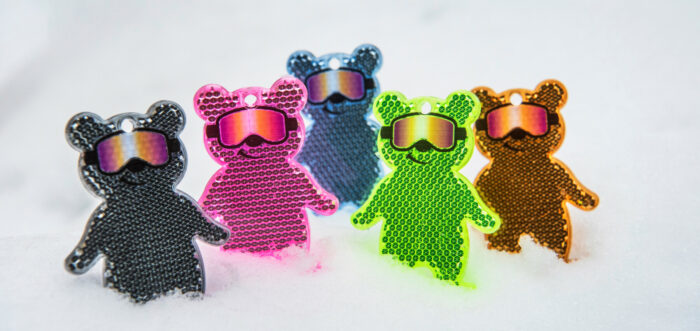
Five small bear-shaped pieces of plastic of various colours are standing in a pile of snow.

Sometimes bears also need ski goggles.Photo: Kirsi-Marja Savola

Today there are many different methods to increase pedestrian visibility. They include high-visibility vests, soft reflectors, coats with reflective textiles, LED lights and slap wraps, which are springy, flexible strips that can be wrapped around your wrist to make a reflective bracelet. Yet Vainio and Behm still prefer the original: hard-plastic reflectors that dangle from your coat.

“I prefer to wear mine at about knee-height, one on each side,” says Behm. “If they hang from a string they will twist and swing, which is important because movement will catch drivers’ attention.”

Original Finnish invention

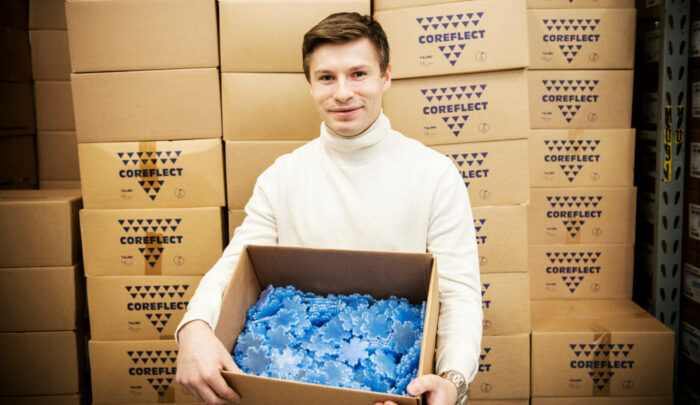
A man holds an open box full of snowflake-shaped plastic pieces, with stacks of similar boxes in the background.

Tommi Behm of Safety Reflector Finland shows off a box full of classic Snowflake reflectors.Photo: Kirsi-Marja Savola

Behm is in the process of taking over the family business. At the age of 28, he is about the same age as Taisto Lehti and Kalervo Suomela were when they made what turned out to be radical innovations in pedestrian safety.

“I enjoy business, but I like it even more because we are doing something that has a real value to people and society,” says Behm.

By David J. Cord, January 2024

7 wow-worthy Finnish saunas: Where steam meets interior design

Sauna culture in Finland” is on Unesco’s list of Intangible Cultural Heritage, and the country is known as the sauna nation – English and many other languages have adopted the Finnish word sauna, making it part of the global lexicon. Nowhere else is the sauna woven as closely into the fabric of daily life as it is in Finland.

It’s only natural that people in Finland don’t overlook any aspect of the quintessential Finnish steam bath, and that includes interior design.

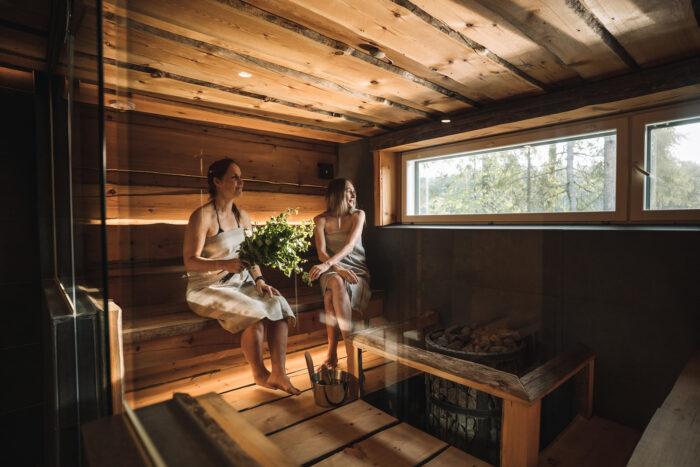
A sauna’s interior is as important as its setting – preferably in or near nature – and as significant as the quality of its löyly, the gentle steam that emerges when you pour water over the rocks on top of the sauna stove.

With 3.3 million saunas in a country of 5.6 million people, the whole population of Finland could, in theory, enjoy its national treasure at the same time, says Carita Harju, founder and director of the international organisation Sauna from Finland.
She chose seven different types of saunas based on their unique interiors and experiences. They all tap into the ancient ritual that soothes mind, body and soul.

Circular design

The Art Sauna at Serlachius (Mänttä-Vilppula)
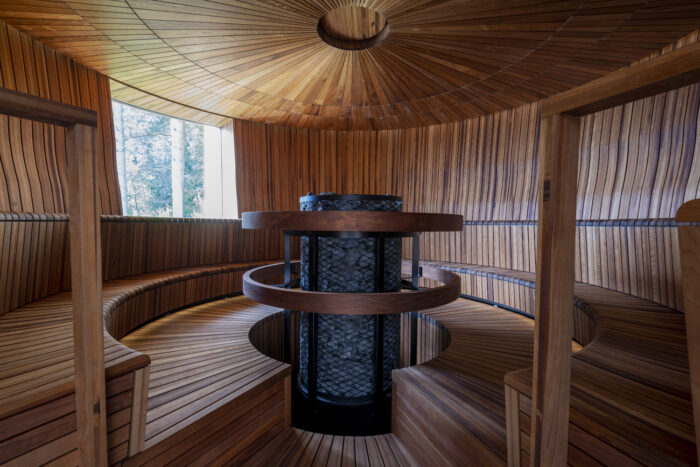
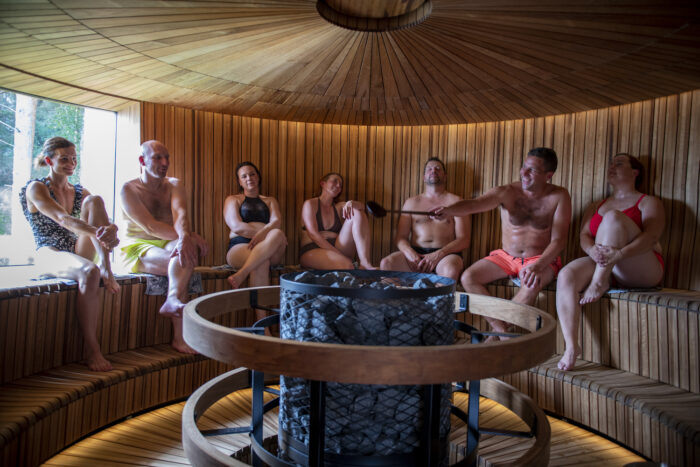
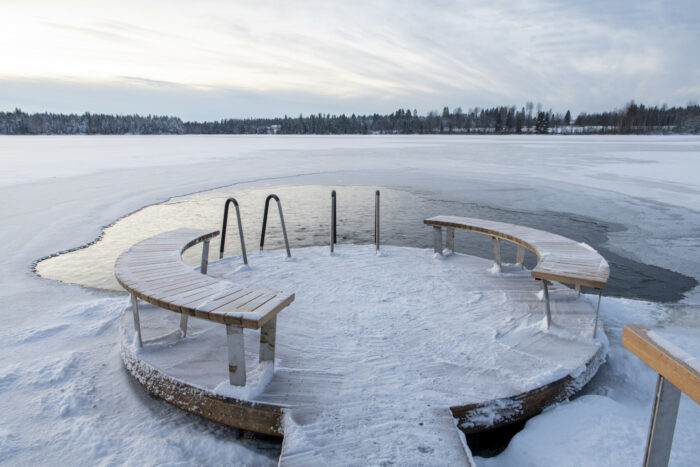
The stunning and highly original round sauna represents a circular first. Most saunas in Finland are rectangular or square-shaped. An international trio of celebrated Barcelona-based architects – Héctor Mendoza, Mara Partida and Boris Bežan – designed it, with Pekka Pakkanen as the Finnish architectural project partner.

“The round shapes emerged as an idea of ‘gathering’ and ‘embracing,’ where the architecture becomes an integral part of the visitor’s experience,” says Mendoza. “Having everyone facing one another sets the place for sharing thoughts, comments and coexperiences of sauna culture.”

High-end art adds to the unique milieu in the foyer and outdoors en route to the dock for a quick dip – part of the Finnish sauna tradition of cooling off in a natural body water after basking in the hot steam. The Art Sauna is adjacent to one of Finland’s leading private art collections, the Serlachius Museums, housed in two grand buildings in the countryside between the central Finnish cities of Tampere and Jyväskylä.

Instagram favourite

Furuvik Seaside Sauna (Helsinki)
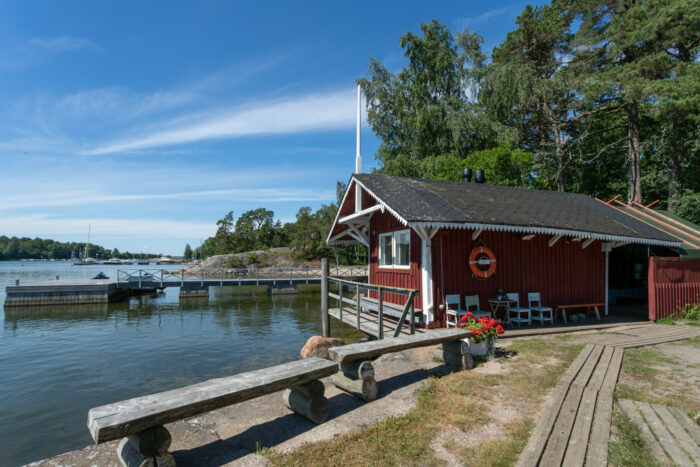
At a yellow seaside villa built in the late 1800s, Furuvik has two picturesque saunas, one inside the house and another in a charming red wooden cottage on the water.

The seaside sauna’s large window looks out over the water and brings natural light into the steam room. The changing area is furnished like a cosy family cottage, complete with wooden tables and benches and colourful traditional rag rugs made from old clothing and textiles.

“History and traces of everyday life are not hidden here,” says owner Tea Lindberg, who runs Furuvik and lives there with her two young children. “In fact, we want to emphasise them.”

Eco-style wilderness getaway

Cottage saunas at Hawkhill Cottage Resort (Nuuksio)
Nestled next to Nuuksio National Park, this collection of upscale log cabins, each with its own private sauna, has been created with a strong focus on peace, quiet and the restorative qualities of pure nature. You can enjoy the authentic Finnish experience of alternating hot and cold by going for a post-steam dip in the freshwater pond.

Located just 45 kilometres (30 miles) from Helsinki city centre, Hawkhill is a family-owned, family-run business with a strong commitment to the planet. Every element has been carefully considered, from the low-emission heating solutions to low-impact catering options that include local food.

Sweet sauna suites

Hotel room saunas at Lapland Hotels Bulevardi (Helsinki)
This modern hotel in downtown Helsinki includes an original feature in 100 of its guest rooms – chic, easy-to-use ensuite saunas that offer a view directly into the hotel room. All rooms are decorated in a style that calls to mind Lapland, Finland’s northernmost region.

Special sauna packages can be customised to include ways to relax, stretch and practice mindfulness, along with an informative intro to Finnish sauna culture for newbies. A mystical Nordic twist rounds out the experience: Guests can listen to music in the sauna while enjoying the soft steam.

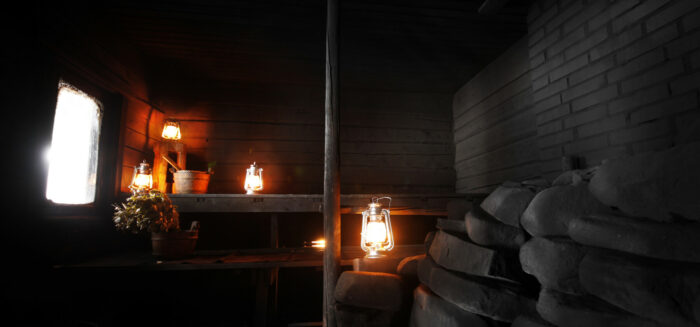
Smoke sauna with a view

Several lanterns decorate the benches of a sauna room with a window on one side.

Photo: Seven Star Smoke Sauna

Seven Star smoke sauna (Ruka-Kuusamo)
On the shores of Heikinjärvi, a lake in the breathtaking wilderness of northern Finland, the Seven Star smoke sauna offers a unique experience.

As a Finnish smoke sauna heats up, the smoke fills the room. Later the smoke is released and the sauna-goers can enter. The steam is especially soothing, and you leave with a sweet, smoky aroma on your skin.

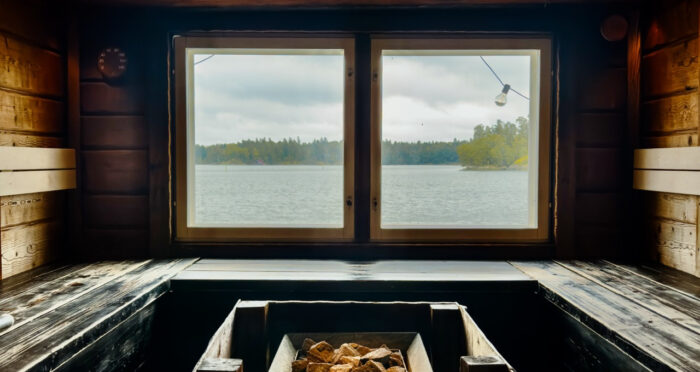
“Our traditional smoke sauna has a big window that offers a lake view that’s like a changing work of art, different every day and every season,” says Katja Vira, who runs the family-owned sauna with her sisters.

Unlike many smoke saunas, which are almost dark inside, Seven Star is tastefully furnished with soft lights and lanterns – a nice touch that first-timers and others may appreciate.

World’s largest smoke sauna

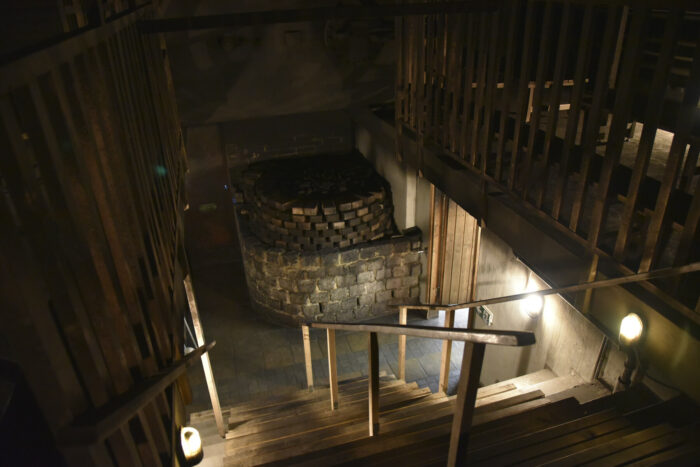
Balconies and a stairway look over a large brick-sided oven in an enormous sauna room.

Photo: Tupaswilla

Tupaswilla (Laukaa, near the central Finnish city of Jyväskylä)
Up to 160 people at a time can be accommodated in Tupaswilla’s smoke sauna. It is known for its traditional women’s smoke sauna evenings featuring an extra touch: skin treatment with peat, touted for its health-promoting effects. This popular event, held once a month, is often sold out.

The log beams of the sauna building, which includes a spacious changing area, date back to the 17th century. Much of the interior is made from recycled materials, and the shower water comes straight from a freshwater pond about 100 metres (110 yards) away.

Mobile steam

Lapelland sauna wagons (anywhere you put them)
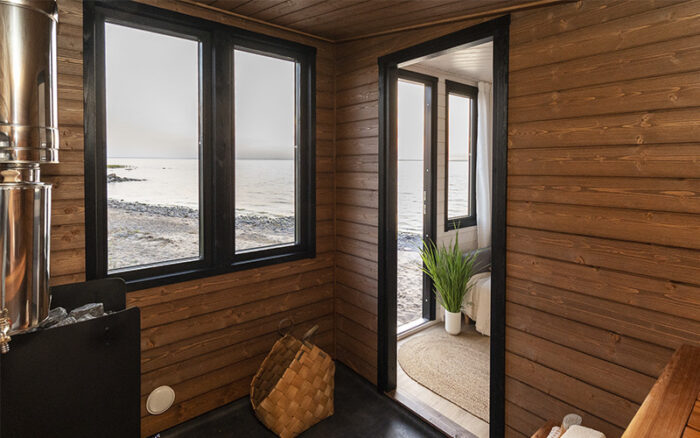
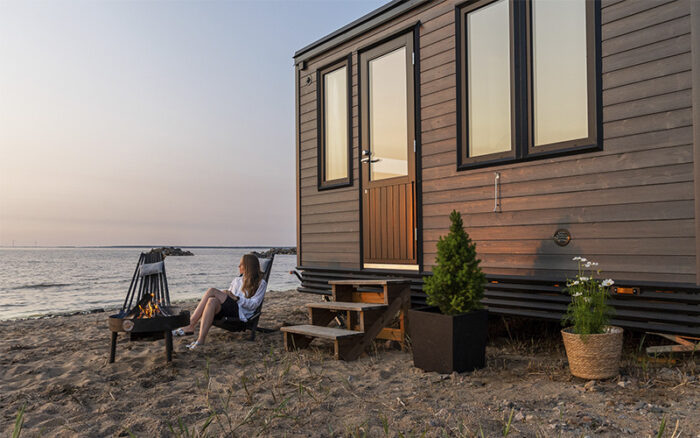
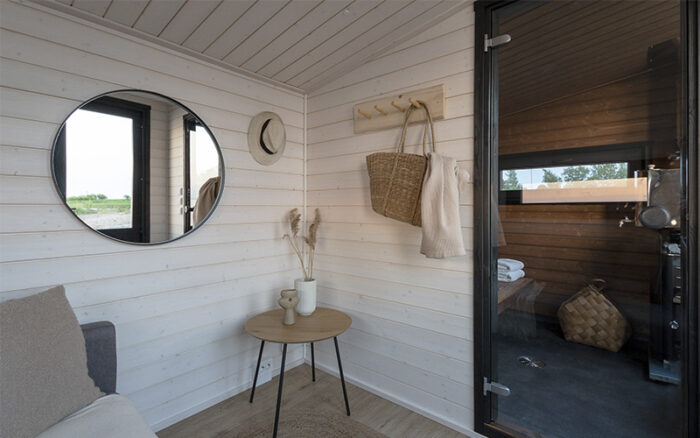
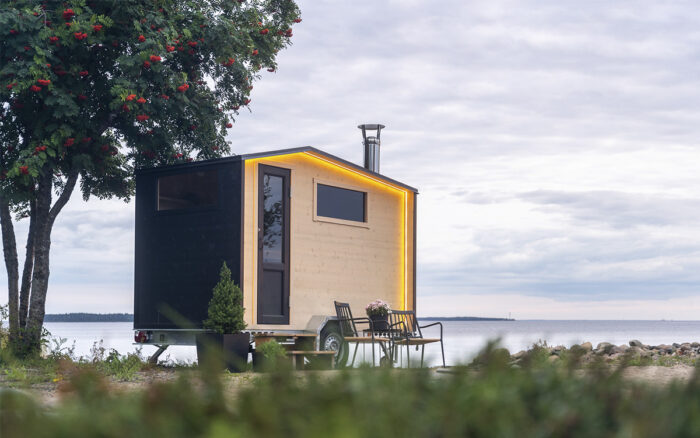
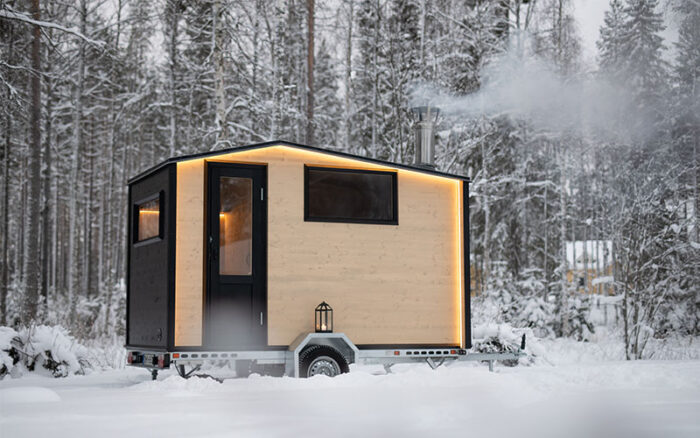
Interest in portable saunas is growing. Lapelland sauna wagons can be towed from place to place, allowing aficionados to enjoy a good steam just about anywhere.

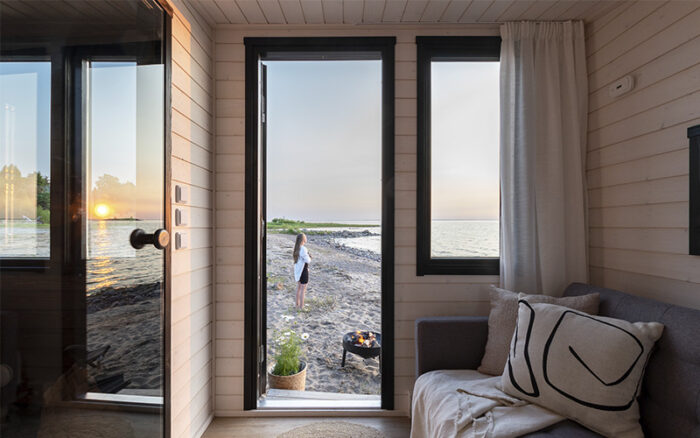
The wagon range serves as another testament to the national significance of saunas in Finland. It includes a tiny-house model complete with a kitchen and lounge area whose sofa converts into a bed, making it possible to live the sauna lifestyle around the clock.

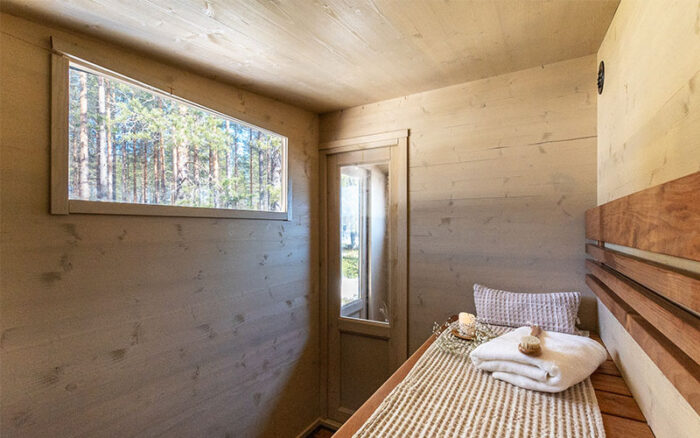
The sauna wagons are designed and made in Finland and delivered ready-to-use. The idea is to provide an on-the-go sauna experience that is authentic in every detail, right down to the heat-treated aspen benches.

By Katja Pantzar, December 2023

Filmed in Finland: Nordic noir shows regular people in irregular circumstances

In recent years, Finnish films and series have captivated international audiences.

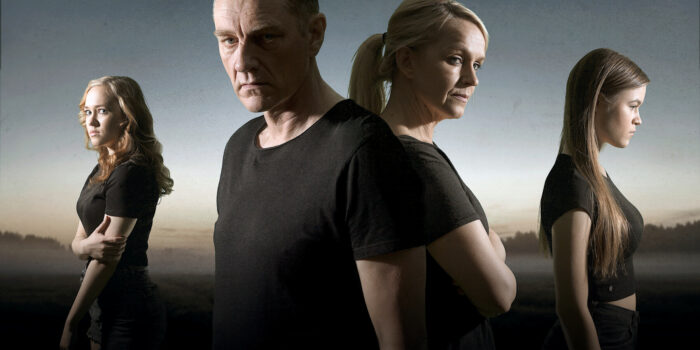
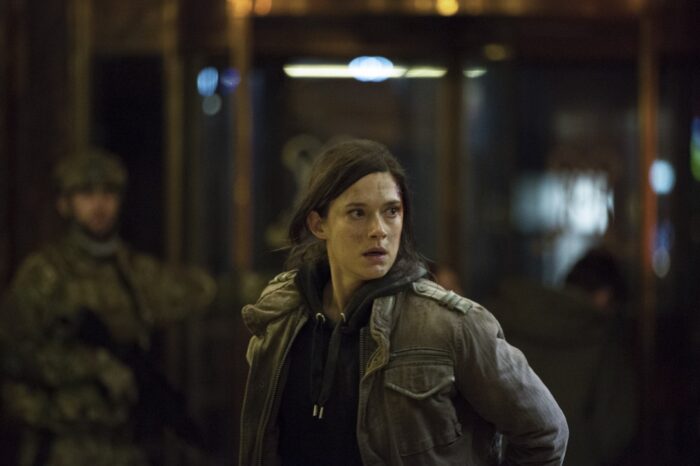
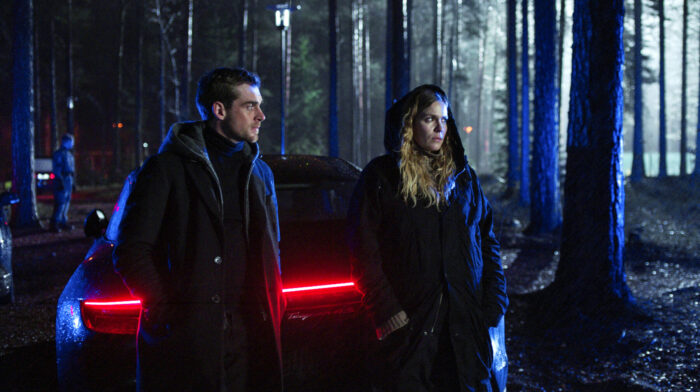
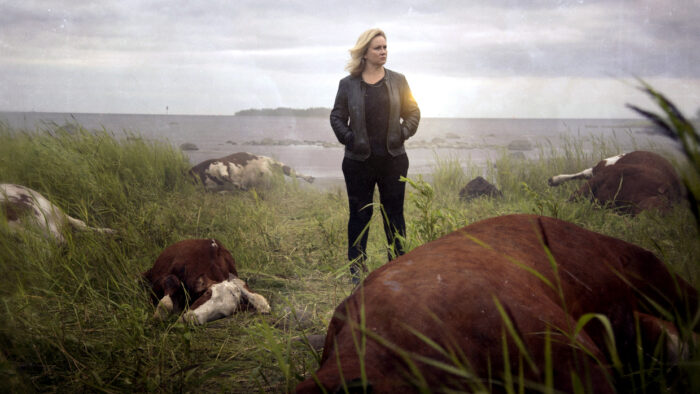
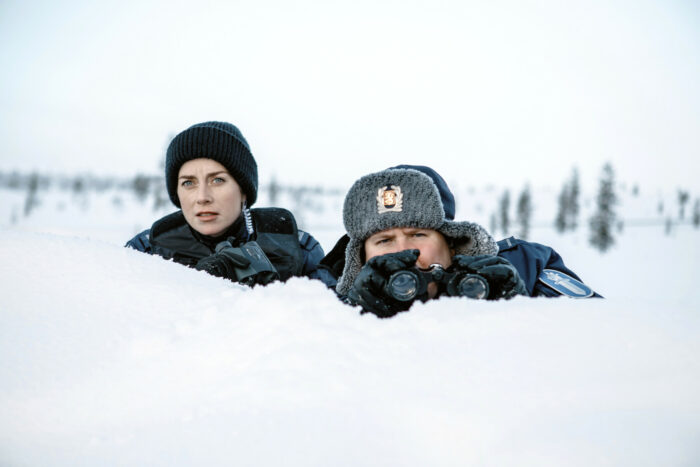
For example, the crime series Deadwind with Pihla Viitala as the leading star and Bullets starring Krista Kosonen have attracted attention on TV. Bordertown was one of the first Finnish Nordic noir series.

Entangled in crime

Watch the season two trailer for Arctic Circle, in which a Finnish police officer investigates an ominously secretive international hunting club in Russia and also reopens the unsolved case of a brutally murdered Olympic judo star in Finland.

“Even if the Nordic genre of socially topical crime novels was born back in the 1960s, the name Nordic noir is only about ten years old,” says showrunner Miikko Oikkonen, the creator of Bordertown, an internationally popular TV series from Finland. “When we started making Bordertown in 2010, the term was not yet in use. The popularity of the books has shown that people keep finding Nordic noir interesting.”

Typically, Nordic noir deals with regular middle-class people who become entangled in crime by unusual circumstances.

Seeing people as they are

Watch the season two trailer for All the Sins, a series set in northern Finland in 1999 that includes murders, technological developments, and a conservative religious subculture.

“When we make Nordic noir, we have to dare to see people as they are,” Oikkonen says. “Everyone has a dark side, and we try to understand why people commit crime. The characters are easy to relate to and the viewers grow very close to them.”

The narration style is much slower than that of many TV productions.

“We have long takes showing an aerial view of a city landscape or countryside,” says Oikkonen. “It’s important to show how much space and unspoilt nature we have around us.”

Everyone has a noir side

By Päivi Brink, ThisisFINLAND Magazine 2023

Navigating life sustainably at an archipelago school in Finland

You can find island communities in many places along the coasts of Finland, but you only have to glance at a map to see that the thickest archipelago extends into the Baltic Sea around the southwestern tip of the country.

The whole coastal and archipelago region has traditions that go back hundreds of years in fishing and trading, not to mention farming and hunting. The people there nourish many of those traditions in the present day, as well.

Archipelago knowledge

See how kids on an island in southwestern Finland learn about nature, boating and fishing as part of their school curriculum.Video: Erika Benke/ThisisFINLAND

On an island about 35 kilometres (20 miles) from Turku and 200 kilometres (125 miles) west of Helsinki, there’s a community called Nagu in Swedish and Nauvo in Finnish. (Both languages are official languages in Finland.) The local kids attend Kyrkbacken School, which has introduced a new course to pass down the archipelago’s cultural heritage to the next generation.

The class, called Archipelago Knowledge, fits right in with the need to live sustainably.

“What we’re going to learn is how to make food and how to survive in nature,” says 14-year-old Ina, who has just tied a boat to the jetty with a perfect knot.

Edvin, 13, is on the pier helping a group of seven-year-olds try fishing for the first time. “We make a meal out of the fish we catch,” he says. “I think it’s really special. You can’t do this stuff everywhere.”

Åsa Sundström, the principal of Kyrkbacken School, says that every age group in the school takes Archipelago Knowledge. “Children learn to row a boat, navigate, catch fish and swim in the sea,” she says. “Traditional life in the archipelago is fairly sustainable, so with these activities we also raise awareness of sustainability and climate change.”

A better understanding

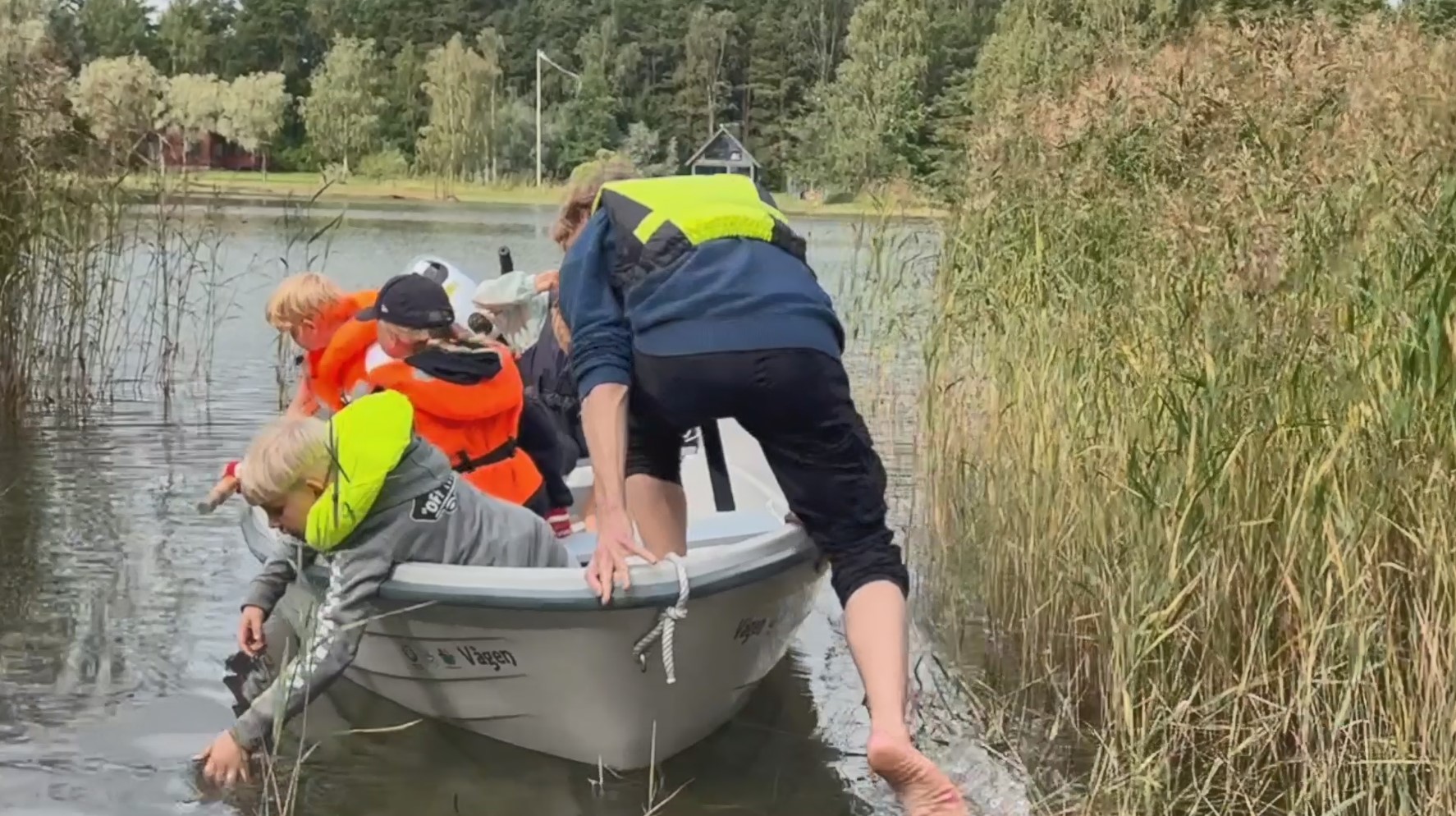
A man is hopping into a boat with several children in it while he pushes it away from the shore with one foot.

Not your typical field trip: Kyrkbacken School students of various ages “learn to row a boat, navigate, catch fish and swim in the sea,” says principal Åsa Sundström.Still photo from video/Erika Benke/ThisisFINLAND

The brain behind Achipelago Knowledge is biology teacher Peter Rönnberg. The previous year, the children’s boating skills developed to such a level that they were able to navigate to Turku and back without their teachers intervening.

“It was a three-hour trip each way, on their own in the archipelago,” Rönnberg says proudly. During the epic outing, he was in one of the boats but did not have to help the kids find their way. “They’ve learnt survival skills that have been very important for people living here for centuries,” he says.

He says that even the youngest children understand that catching fish means they will need to buy less food in the supermarket. “Overconsumption contributes to climate change, and children learn first-hand what they can do to fight it.”

Principal Sundström says Archipelago Knowledge has given children a greater sense of responsibility for their local area. They understand better why they need to recycle and to pick up rubbish. “This is the only way to make sure they will protect nature and take action to fight climate change,” says Sundström.

By Erika Benke, November 2023

Digital services in Finland help families lead smoother lives

Let’s get one thing straight: the Antila-Suurpää family is not too keen on IT. At least the grown-ups, Petra Antila and Tuomas Suurpää, feel that way.

And yet, Petra has more than a dozen useful applications on her phone, providing access to electronic services.

She has two banking apps, two parking apps and two medical centre apps. She also has applications for public healthcare, communicating with her child’s football team, public transport, the library, museums, parcel tracking and many other purposes.

Although Petra and Tuomas say that they are not particularly well informed about the digital world, online services are a vital part of their family’s life at work, at school, during free time and when using public services. “Digital services are an inseparable part of our society,” Tuomas says.

All the info in one place

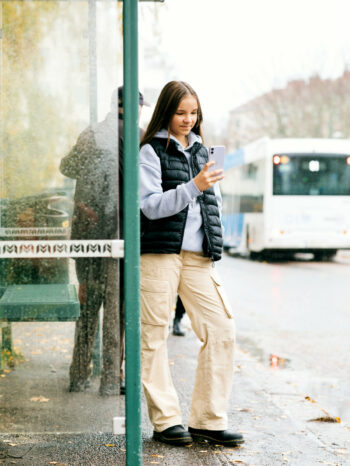
A pre-teen girl stands at a bus stop, looking at her mobile phone.

Frida often uses a journey planning app that helps her choose the most suitable public transport route. She purchases her ticket with the same app.Photo Vilja Harala

Where is the football match today? How do we get there? Petra asks these questions on a regular basis. The family’s youngest child, eight-year-old Frans, has football practice twice a week. During the competition season, he might also have one or two games a week.

Information about training, matches and venues is on the MyClub app, where Frans’s team have their own group. The app is a Finnish innovation used by sports clubs and families.

Petra goes on the app to tell the coach whether Frans can make it to the upcoming training sessions. She can also use it to contact other parents and the team managers, and to handle payment invoices for the fees.

The night before, she checks where the game is and how long the trip will take.

On the morning of a match day, Petra opens the app to check the football field’s location. MyClub leads her to a map that shows her the route from her front door to the venue.

“It makes things so easy,” she says. “Without it, transport would be a nightmare.”

The family’s eldest child, 11-year-old Frida, is on a competitive cheerleading team, which also calls for scheduling and planning. Tuomas is in charge of getting her to training and competitions. The fact that each parent is only responsible for one child’s hobbies makes things easier.

Keeping parents up to date about school

A man sits on a sofa with a piece of paper in one hand and a laptop open in his lap.

Tuomas used the tax authority’s online service to check if he was up to date on his real estate tax. Photo Vilja Harala

Parents are not the only ones to manage daily life with online services. Frida uses her school’s communications application, Wilma, every week. The app, which had several predecessors but was first released under that name in 2001, is now used by the majority of schools all over the country.

Wilma enables messaging between home and school about attendance, homework, exams and grades.

Frida uses it to view her homework for each week, see what her PE teacher has planned for the following class, and so on. Her mother also uses Wilma on a daily basis. She can follow her children’s daily school life and communicate with the teachers through the app. She also receives a summary of the following week’s events.

Frida’s teacher has recommended that pupils also use an app called Otso, which is a nickname for “bear.” The app is linked to a schoolbook publisher and contains additional learning material. It is almost like a pocket-sized teaching assistant.

Database services provide support

Petra and Tuomas both feel that being able to manage their daily lives online saves them a lot of hassle. For example, you can renew a library loan with the click of a button, instead of having to phone or visit the library. “This has saved us a lot in late fees,” Petra says.

Speaking of money, the couple rarely use cash, apart from when they withdraw some from an ATM for their children. This is because they can take care of a variety of financial matters without leaving their couch, from transactions to investments.

The same is true of communicating with various public authorities. Recently, Tuomas used the tax authority’s online service to check if he was up to date on his real estate tax. You can also use the service to submit tax returns and update tax info that your employer needs. In 2022, 88 percent of Finns checked and, when necessary, amended or corrected their tax returns through the online service.

The family uses private, occupational and school healthcare services. A nationwide service called Kanta connects all three and contains doctors’ reports, laboratory results and prescriptions.

Contacting public administration services is also made easier by the national service Suomi.fi, which lists all access channels in one place. That’s the quickest way to see which service you need.

Money, time, effort and paper – the family saves all of these things in their daily lives by using digital services.

By Anne Ventelä, ThisisFINLAND Magazine 2023

Receiving polished pictures from Finnish photographer Pentti Sammallahti

“You can’t say that, in my opinion,” said Pentti Sammallahti, standing in front of a large black and white photo at K1, a downtown Helsinki gallery run by the Finnish Museum of Photography.

It was opening night at his exhibition The Two of Us (through February 25, 2024). He was responding to Erja Salo, a curator who had just quoted a major magazine calling him “the most esteemed Finnish photographer of his generation.”

Sammallahti (born in 1950) seemed unnecessarily modest again a couple minutes later when he remarked, “I’ve never gone on assignments – this is all on sort of a hobby basis.” This brought chuckles from the assembled crowd.

“You do hear that people are laughing?” said Salo.

“But it’s true,” said Sammallahti. “I don’t ever have to force things. If I go out to take pictures and nothing comes of it, it doesn’t matter. If I was a professional, then I’d have to accomplish something [regardless of the circumstances].”

The pony and the bird

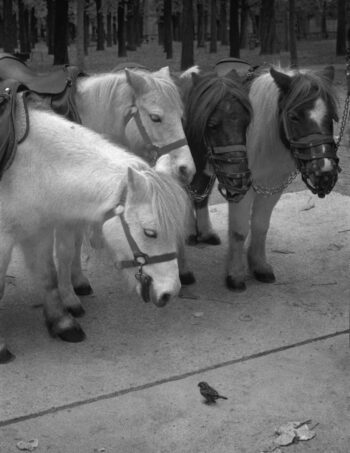
One pony in a row of four ponies is looking down at a small bird on the pavement in front of it.

What is the pony thinking as it regards the bird in Paris, France, 2000?Photo: Pentti Sammallahti/Finnish Museum of Photography

Sammallahti’s career spans almost six decades, including nearly 20 years teaching photography at the University of Art and Design Helsinki. He would fit anyone’s definition of “professional,” even though he’s not a news photographer.

The exhibition contains everything from postcard-sized photos to near-panoramas as wide as an arm span. All of them are black and white, and Sammallahti does his own darkroom work, which is an art form of its own.

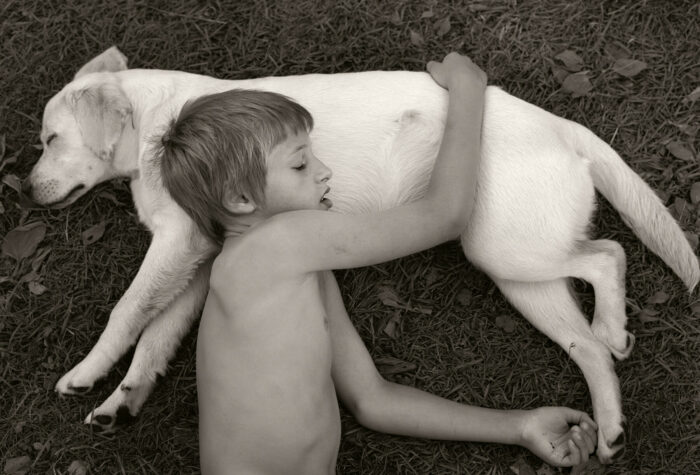
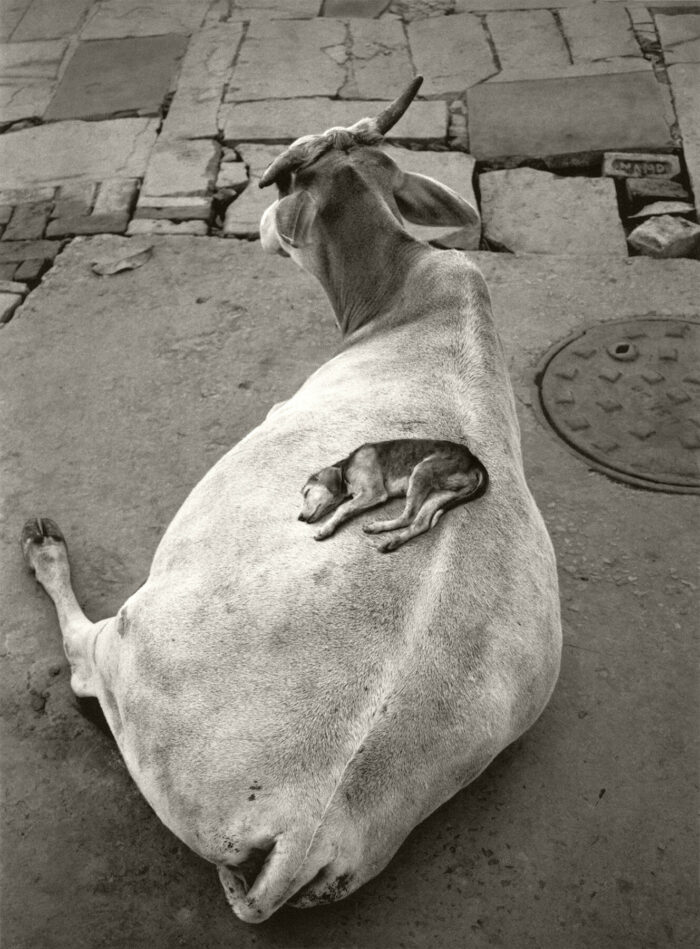
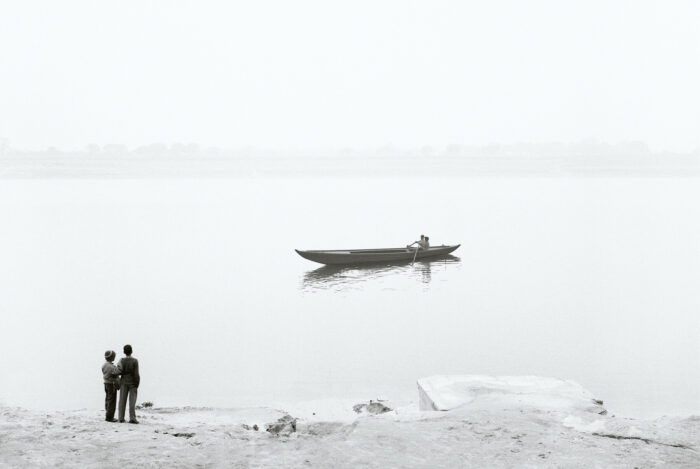
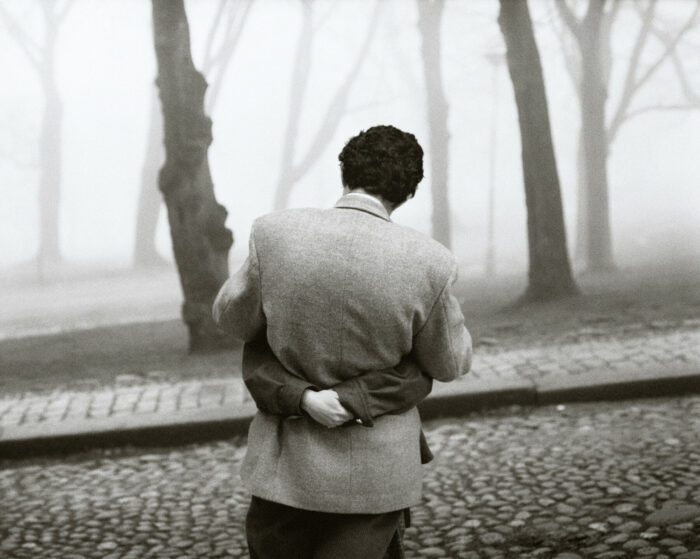
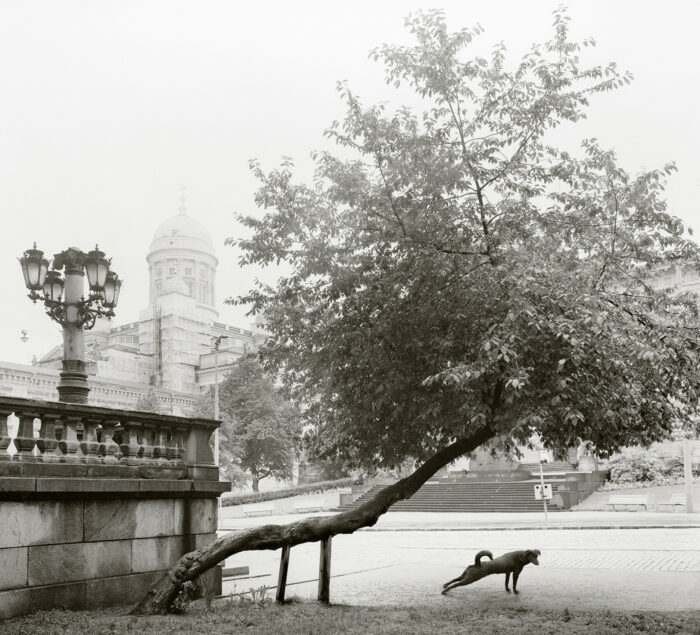
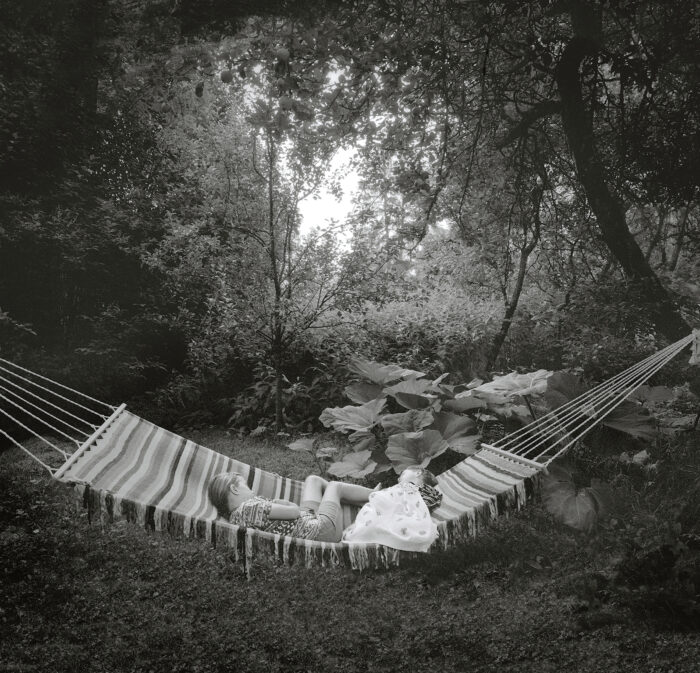
Most of the pictures in The Two of Us show pairs of figures – people, trees, birds, horses, dogs, cats. In some, their companionship is literal: a kitten peeking out from inside a child’s jacket, two horses nuzzling each other, a couple embracing on a waterside stairway, two kids asleep in a hammock on a summer day.

In others, Sammallahti’s ability to find exactly the right moment and angle to click the shutter produces a photo that implies togetherness in some way. A pony looks at a little bird, seemingly smiling at it or talking to it across a line on the pavement. Or two pigeons walk past the reflection of a nearby statue in a puddle.

About the exhibition’s title, Sammallahti said, “It could have been about sky or trees or birds or dogs. Actually, most of my pictures could fit into lots of different themes.”

A world of photos

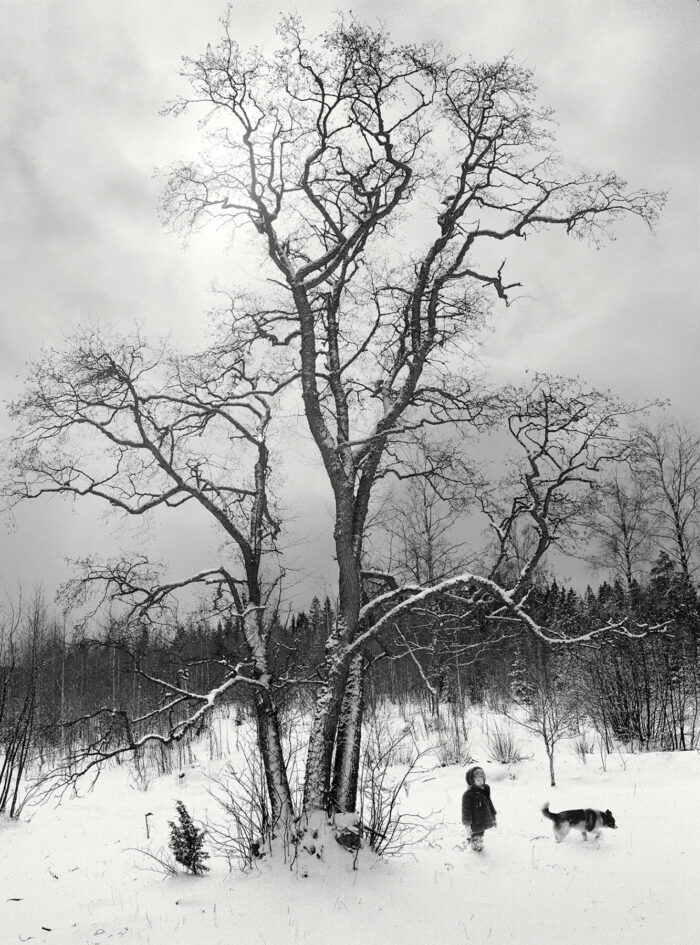
In some photos, silhouettes pop out against snowy landscapes or misty skies. Dark birds perch on white chunks of ice on black water. People pull sleds past enormous trees in a snowy Helsinki park. In front of a distant mountain range, a person on a horse looks over a snow-covered expanse towards a cabin. It works the other way, too: A white horse stands in front of a dusk-darkened forest.

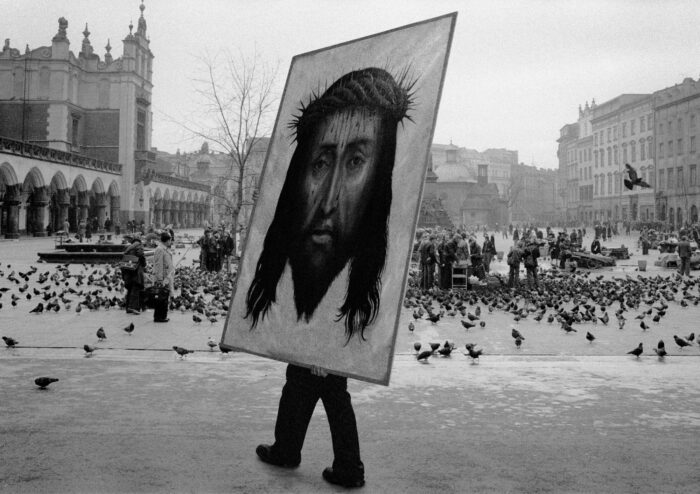
The info posted beside the pictures gives you an idea of how far Sammallahti has travelled with his camera: Shetland, South Africa, Siberia, Vietnam, Nepal, India, Georgia, Ukraine, Egypt, Bulgaria, Hungary, France, Ireland and more.

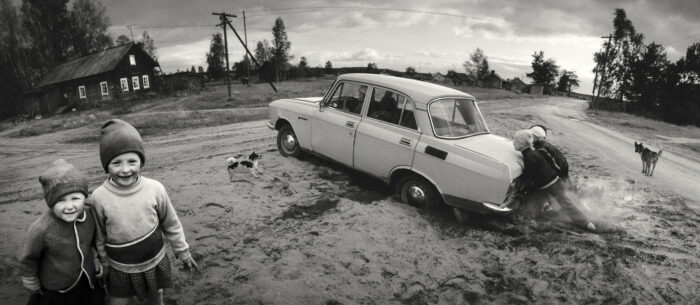
He told the story of how he took – or received, as he prefers to say – one of his photos, in 1991 in Vuokkiniemi. The village is located in Viena, a northern area of Karelia, a region that spans the Finnish-Russian border. He was coming down the road and saw a car that had gotten stuck and was spinning its wheels.

“Some boys came to push, and dogs were barking,” he said. “Two little girls noticed my camera – there wasn’t a single camera in the village back then, and they were delighted. They hurried into the picture.”

Quotes on the gallery walls reflect Sammallahti’s long experience as a photographer and teacher and provide clues about his thinking. One quotation is: “The best images are rarely planned or expected, but result from moments of lucky coincidence.”

By Peter Marten, November 2023

Love’s labour isn’t lost in Finnish director Aki Kaurismäki’s Fallen Leaves

At the centre of Aki Kaurismäki’s Fallen Leaves is the beating heart of humanity. Earnest souls search for meaning and connection in a world that threatens to wear them down.

From pathos to a few choice laugh-out-loud moments, it is a story about two regular Helsinkians whose small-scale lives take on epic emotional proportions. The New York Times calls it “a tender, beautifully directed love story.”

It won the Jury Prize at the 2023 Cannes Film Festival, and it’s the Finnish entry for the Best International Feature Film award in the Academy Awards. Just weeks after the Finnish premiere, it was on its way to becoming the most-watched domestic film of the year in Finland, and had already sped past Kaurismäki’s previous all-time best in terms of domestic viewer numbers (Cannes Grand Prix winner The Man without a Past, from 2002).

Social ladder

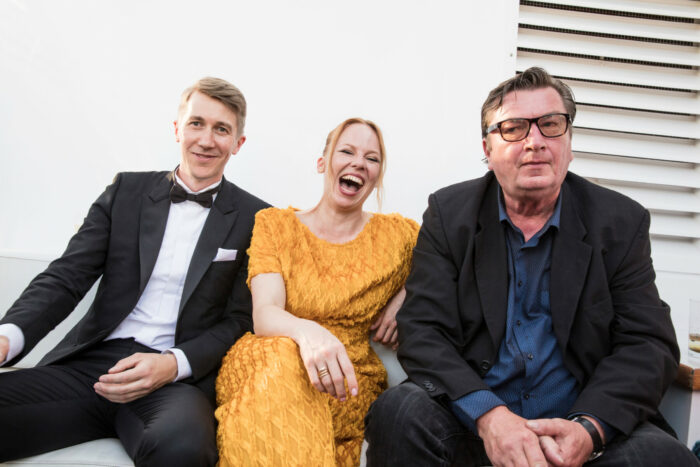
A man in a tuxedo, a laughing woman in a bright dress and a man in a jacket are sitting next to each other on a bench.

From left: Actors Jussi Vatanen and Alma Pöysti and director Aki Kaurismäki came to Cannes to attend the film festival.Photo: Lasse Lecklin/B-Plan

Labour is significant in Fallen Leaves, which forms part four of Kaurismäki’s Proletariat Trilogy. Releasing a fourth instalment of a trilogy is typical of Kaurismäki’s humour – unless you’re paying attention, you’ll miss the joke.

Ansa (Alma Pöysti), a supermarket clerk on a zero-hour contract, gets fired for taking food that is past its sell-by date. Holappa (Jussi Vatanen) is an industrial worker who is injured because of his boss’s stingy unwillingness to buy new, safer equipment. The fact that Holappa has been drinking on the job only makes things worse for him.

The trilogy’s other films, Shadows in Paradise (1986), Ariel (1988) and The Match Factory Girl (1990), also feature labourers. Their central characters are a garbage collector, a miner who has recently lost his job, and a match factory worker. They bend and almost break in a society portrayed as dreary and harmful for people who, like these characters, find themselves at the wrong end of the social ladder.

Heroic struggles

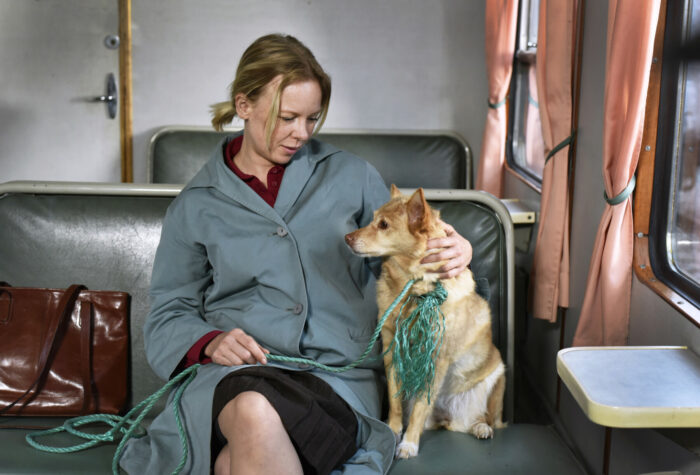
In a commuter train, a woman and a dog sit on a bench, the woman with her arm around the dog.

Ansa adopts a stray dog that is hanging around the factory where she works, and calls it Chaplin.Photo: Malla Hukkanen/Sputnik

Kaurismäki’s workers struggle heroically, despite the societal mechanisms that conspire to thwart them.

When Ansa must empty her bag – including a “stolen” sandwich – in front of the store manager and the bear-like security guard who reported her, two older coworkers stand with her in a show of solidarity. One of them reveals that she, too, has taken something, and the other one quits outright.

It’s nearly impossible not to sympathise with them. The trio march off, leaving the job with their heads held high, while the male supervisors’ resolve visibly ebbs away.

Empathy play

Watch the trailer for Aki Kaurismäki’s film Fallen Leaves.

The firing episode resonates with many of Kaurismäki’s other films. Brutal management guided by profits and an illogical rulebook may be foreign to some of us, but the collateral damage to humanity is unmistakeable.

At home with no paycheque, Ansa turns off the radio, then the microwave, and eventually just flips the switch of the distribution box. The scene emphasises the dependence of life on work – here, work translates to the ability to pay the electric bill.

This is melodrama, Kaurismäki style – when done right, it yanks us in by the taut lines of our empathy. Contemporary Helsinki as shown on the screen may appear unfamiliar, but the story is compelling.

Human story

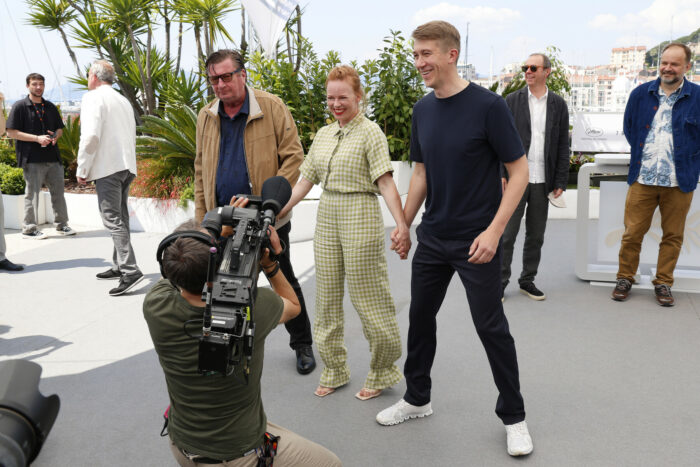
Two men and a woman are holding hands and posing in front of camerapeople outdoors, with palm trees in the background.

From right: Actors Jussi Vatanen and Alma Pöysti smile for the cameras at the Cannes Film Festival, as does director Aki Kaurismäki – kind of.Photo: Kurt Krieger/Sputnik

History is present in Fallen Leaves. Ansa listens to radio reports from the war in Ukraine on her beloved transistor radio. She expresses little outward emotion, even as the broadcast describes civilian deaths.

Moviegoers also listen. Kaurismäki has said that, someday in the future, when today’s atrocities have been forgotten, people will still be watching old films, and that snippets of news in films such as Fallen Leaves will stand as testaments to human history.

Fleeting glances

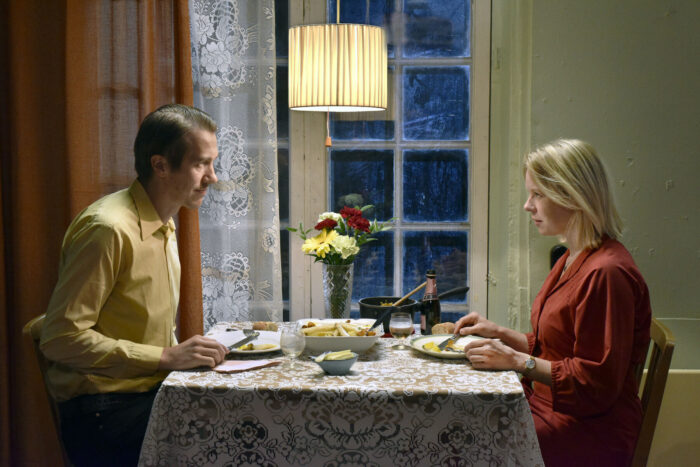
A man and a woman are sitting across from each other at a small table, eating a meal.

Holappa and Ansa make conversation over dinner at Ansa’s place.Photo: Malla Hukkanen/Sputnik

Music periodically creates interludes and atmosphere in the film. The evening Ansa and Holappa first lay eyes on each other at a karaoke bar, they aren’t singing, but Kaurismäki gives ample space to performances by two others.

Holappa’s friend Huotari (Janne Hyytiäinen) sings an out-of-tune version of “Syyspihlajan alla” (Under the Autumn Rowan Tree). Later, Mika Nikander, a bass who has performed with the Finnish National Opera and appears in the film credits as “karaoke singer,” sings Schubert’s “Serenade.”

Ansa and Holappa’s unspoken expressions of desire and hope, as well as of melancholy and fear, are better represented in the songs – and in the characters’ fleeting glances – than in any amount of dialogue. And, true to form, Kaurismäki keeps dialogue to a minimum.

A pause to perceive

A woman and a man shake hands in front of a door that says “Ritz.”

After going to the movies together, Ansa and Holappa are unsure whether to finish the evening by hugging, kissing or just shaking hands.Photo: Malla Hukkanen/Sputnik

Labour may be exploitative, and luck may appear to be working against Kaurismäki’s characters, but beauty manages to stand out as the central message of Fallen Leaves, as in many of his other films. You may have to stop speaking and pause to perceive it, but it’s there – in the movie, and in real life.

It’s classic Kaurismäki. His method of portraying humanity still works, helped along by a soul-stirring soundtrack. If you can’t cry, it’s good to laugh.

By Eric Bergman, November 2023