Why Finland’s Moomin books still matter in today’s world

Moomin Characters Ltd is the company that owns all Moomin rights. There will be no pancake party to celebrate the 80th anniversary of the Moomins at their headquarters, says managing director Roleff Kråkström.

“We’ve always felt a bit awkward about commercial celebrations.”

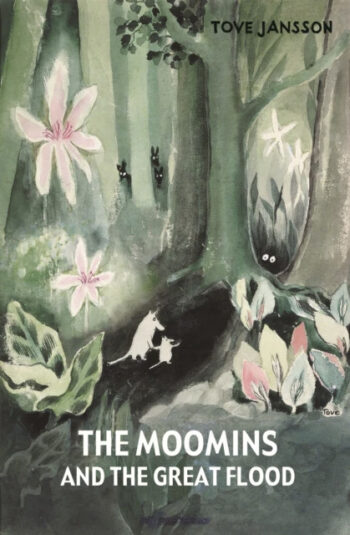
Instead, the company returns to the first Moomin book, The Moomins and the Great Flood from 1945. It’s a story in which the Moomin family is looking for Moominpappa.

“The great flood can be interpreted as an allegory for the war that had just ended in Finland and Europe. Almost every family had lost a father, a son or a brother.”

Many elements introduced in this first Moomin book later became characteristics of Moomin stories, says Kråkström. “Tove Jansson uses looming catastrophe as an element of drama that brings out archetypical behavior in the characters. She also introduces the concept of flexible family. On their quest the family encounters creatures of which some  join the family for a while, others become permanent family members.”

The family’s approach to these creatures can be seen as a cornerstone of the Moomin philosophy: they are accepted as they are, but also required to take full responsibility for themselves.

“Courage is important in the Moomin stories. Many of us are afraid and need to find the courage in ourselves. We need that courage to be free and to achieve something. Only then we can be generous, face others as they are and help them.”

Eighty years on, the story of a displacement is, unfortunately, still very topical, says Kråkström.

“There are more than 200 million refugees in the world today. A huge number of children are displaced and their futures uncertain.”

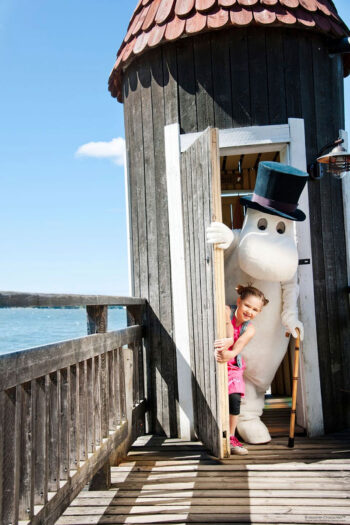
A child and a theme park mascot emerge from a round, tower-like wooden house with a conical roof.

Moominland, Naantali: The official Moomin theme park in Naantali, western Finland, opens its doors every summer. Visitors get to meet Moomin characters, visit their houses and explore Moominvalley and all its marvels. Photo: Moomin Characters Ltd

To address this issue, the company is licensing a purpose-designed set of artworks based on Jansson’s original illustrations from The Great Flood for their partners to use for merchandise. A portion of the proceeds will be donated to the Red Cross. The goal is to raise a million euros for the International Red Cross and Red Crescent.

The Moomins and The Great Flood ends with the family finding both Moominpappa and the Moominhouse of their dreams. As part of the anniversary celebrations and Refugee Week in the UK, Moomin Characters Ltd has invited contemporary artists in four cities to create their interpretations of the Moominhouse, together with the local refugee communities.

“They probably won’t look anything like a blue cornet but reflect what home means for them,” says Kråkström.

An illustrated book cover shows cartoon characters walking through a surreal forest filled with oversized leaves and towering trees, with dark figures and glowing eyes peeking from the shadows.

Photo: Moomin Characters Ltd

By Ninni Lehtniemi, ThisisFINLAND Magazine

The whimsical humanity of Finnish Moomin author and artist Tove Jansson

In one of Tove Jansson’s books we meet Muskrat, a grumpy philosopher temporarily living with the Moomin family. A cake has mysteriously gone missing from the dining table, but Muskrat couldn’t be bothered—he’s simply trying to ruminate in peace in the corner. After some investigation, we discover he’s sitting on the very cake.

Muskrat’s antics are just one of countless examples of Jansson’s ability to capture the essence of what makes us human. Best known for her Moomin characters, she was a prolific and multi-talented artist—painter, illustrator, cartoonist, and writer. Her body of work could easily fill several lifetimes.

“Her pen stroke is vivid, soft, beautiful, and inimitable. It is one of the finest things in the world,” says the art historian and non-fiction writer Tuula Karjalainen, the author of Tove Jansson: Work and Love, a biography.

To live freely

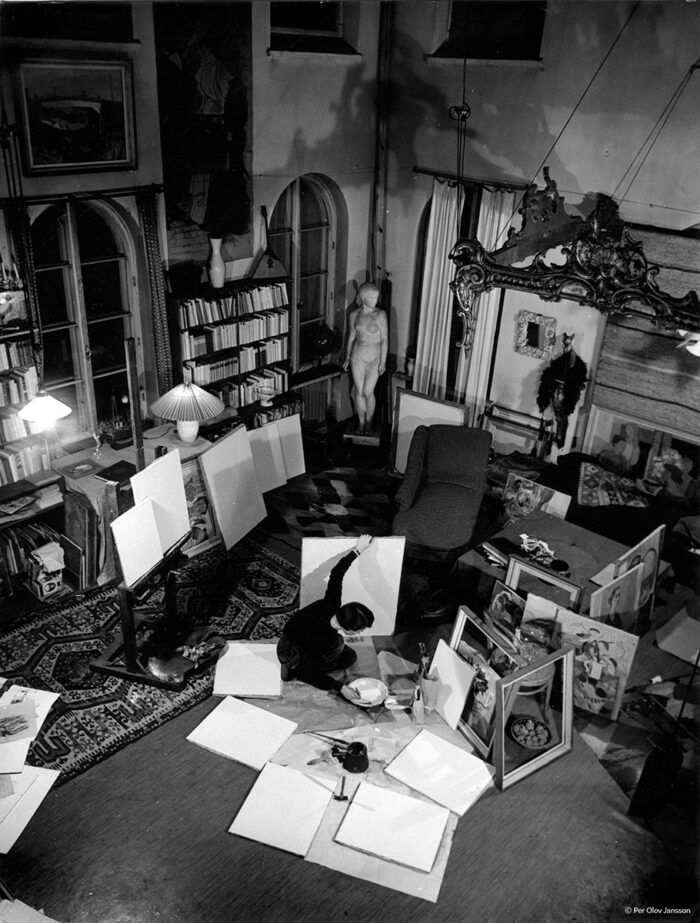
A woman kneels in an art studio, surrounded by blank canvases. She dips a brush into paint on the floor while holding a canvas steady with her other hand.

Katajanokka and Kaartinkaupunki, Helsinki: Tove Jansson was born in 1914 and spent her childhood in Katajanokka, a maritime neighbourhood in downtown Helsinki. She often painted at the foot of the Uspenski Cathedral, the largest Orthodox cathedral in Western Europe. A nearby park is named after her.
As an adult, Jansson worked and lived in a high-ceiling atelier at Ullanlinnankatu 1, bathed in natural light. A permit from Moomin Characters Ltd is required for group visits but passers-by can admire a relief of the young Jansson on the building’s exterior. Photo: Per Olov Jansson

In Jansson’s beloved novel The Summer Book, Grandmother teaches Sophie about the importance of making one’s own choices, saying, ​​“everything is fine as long as one can just be free.” This sums up Jansson’s life philosophy quite nicely.

Freedom is a significant theme in Jansson’s works, often embodied by her characters. For example, there’s the Moomin character Snufkin – a solitary wanderer who sleeps in a tent and plays a melancholic harmonica. When summer is over, he packs his belongings and leaves Moominvalley for the winter.    ​

Although her works have become widely loved by audiences around the world, Jansson painted, drew, and wrote only for herself. This was a way of living freely; the fight she fought for her entire life.

As a child, she was allowed to roam around the family’s home by the seaside in Helsinki on her own. The Jansson family spent their springs and summers on an island east of Helsinki surrounded by the archipelago’s wild nature. Although she would later study at the prestigious École des Beaux-Arts in Paris, among other institutions, she struggled with early education.

“She was more interested in the thrilling stories of adventures her mother read to her than school,” Karjalainen says. As it happens, there is no school in Moominvalley.

Love letters to the sea

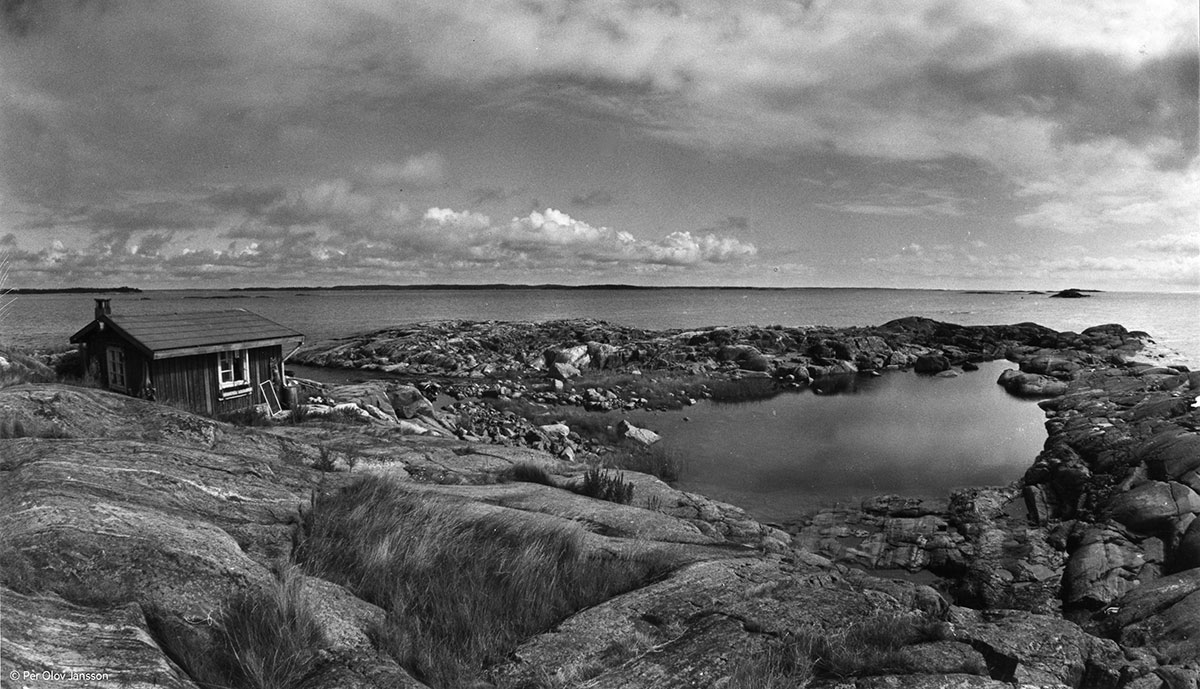
A rugged island shoreline with a small cottage on the left.

Klovharun Island: The Pellinge archipelago near Porvoo has profoundly influenced Jansson’s life and work. She spent 28 summers on Klovharun island with her life partner Tuulikki Pietilä, later donating their cottage to the local heritage association. Klovharun and the surrounding islets form a nature reserve. Photo: Per Olov Jansson

Most of Tove Jansson’s life was set against a maritime backdrop. Perhaps it was the sea’s boundlessness that Jansson herself wanted to embody. The sea does what it wants: “foaming recklessly, raging furiously, but somehow tranquil at the same time,” she writes in Moominpappa at Sea. The same body of water that provides a refreshing oasis for Moomins to frolic can suddenly turn into an unpredictable and even frightening force that can sink a boat or tear a tent apart.

“She worshiped the sea. She could spend long periods alone in the archipelago, even though she was afraid of the dark. The sea strengthened her sense of freedom,” Karjalainen says.

Some of Jansson’s writing took place literally in the middle of the sea, on an island that greatly influenced her. Jansson spent many summers on Klovharun Island in Pellinge, in the archipelago east of Helsinki, with her long-time life partner, graphic artist Tuulikki Pietilä.

The small, rocky Klovharun was difficult to access, and there was no electricity or running water. Yet Jansson and Pietilä felt drawn to the island and built a cabin there. When it finally stood on the Klovharun, it was exactly as the partners had hoped: four walls, four windows, and a shared desk where they could draw and write.

One long dance of rich adventure

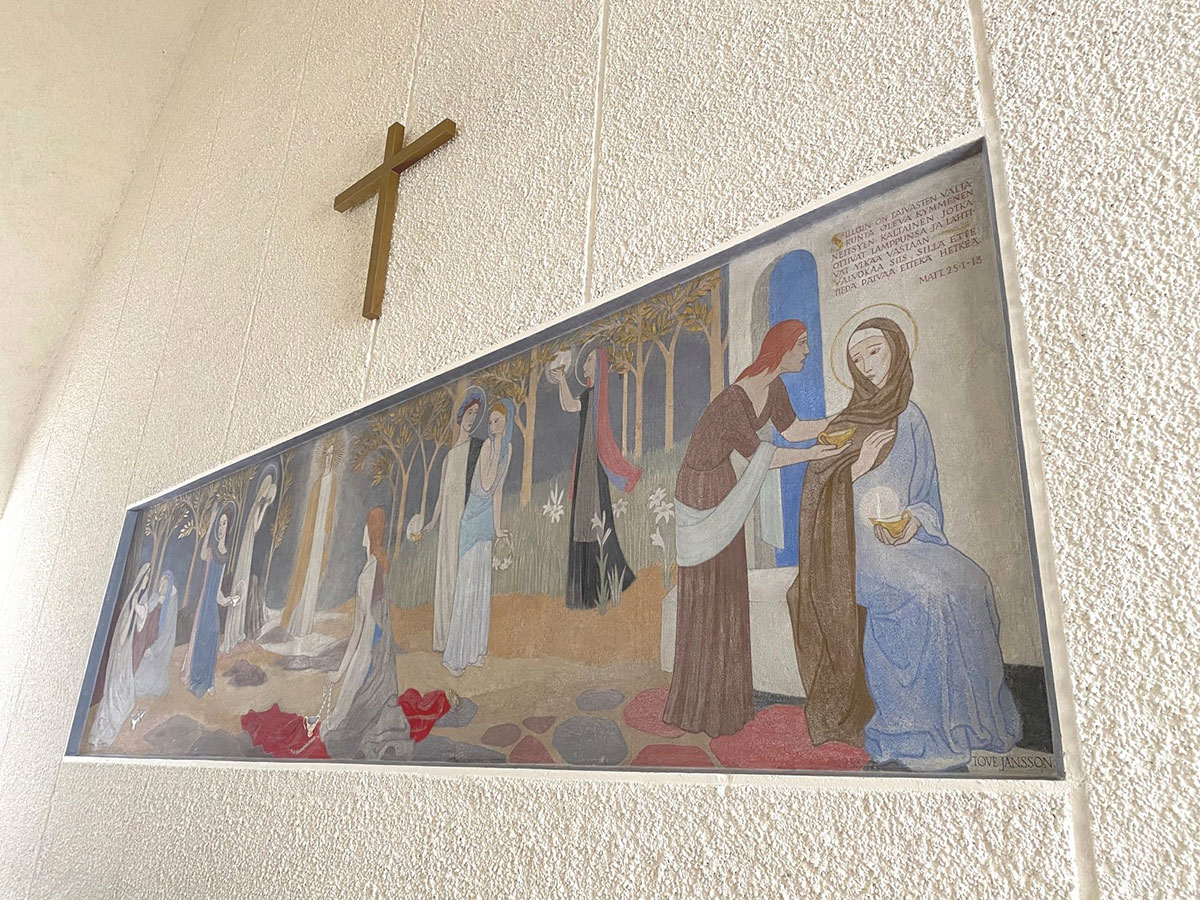
A colourful mural shows ten women holding lanterns, painted on a white wall above an altar and beneath a metal cross.

Teuva Church: Teuva municipality near Seinäjoki, western Finland houses the only altarpiece Tove Jansson ever created. Ten Virgins was painted onto the church’s stone wall, its bright colors still vibrant 71 years after its completion. Photo: Moomin Characters Ltd

Jansson’s relationships and experiences seeped into the pages of her books and comics. The inseparable Moomin duo of Thingumy and Bob represents Jansson and theatre director Vivica Bandler; the wise and steady Too-ticky, in a striped shirt, is modeled after Pietilä. Jansson’s 1968 book Sculptor’s Daughter is based on her own experiences as a child.

“She never wrote a single sentence that she hadn’t lived or felt herself. Nothing was superficial, whether it was descriptions of nature or articulating her inner life,” Karjalainen says.

During the Second World War, Jansson fell in love with Vivica Bandler. Being in love with a woman was a new and unfamiliar experience, but Jansson wrote to her friend: “It seems to me so absolutely natural and genuine. These last weeks have been like one long dance of rich adventure, tenderness, intensity.”

Today, many view Tove Jansson as a queer icon and a trailblazer in LGBTQ+ issues, and rightly so: she went against the mainstream in a time of strict normativity. Homosexuality was illegal in Finland until the 1970s, decades after Jansson first engaged in a lesbian relationship. She never married or had children. Her life was solely her own, not anyone else’s.

“She didn’t carry protest signs or banners. For her, it was just a natural life that she answered for herself,” Karjalainen says.

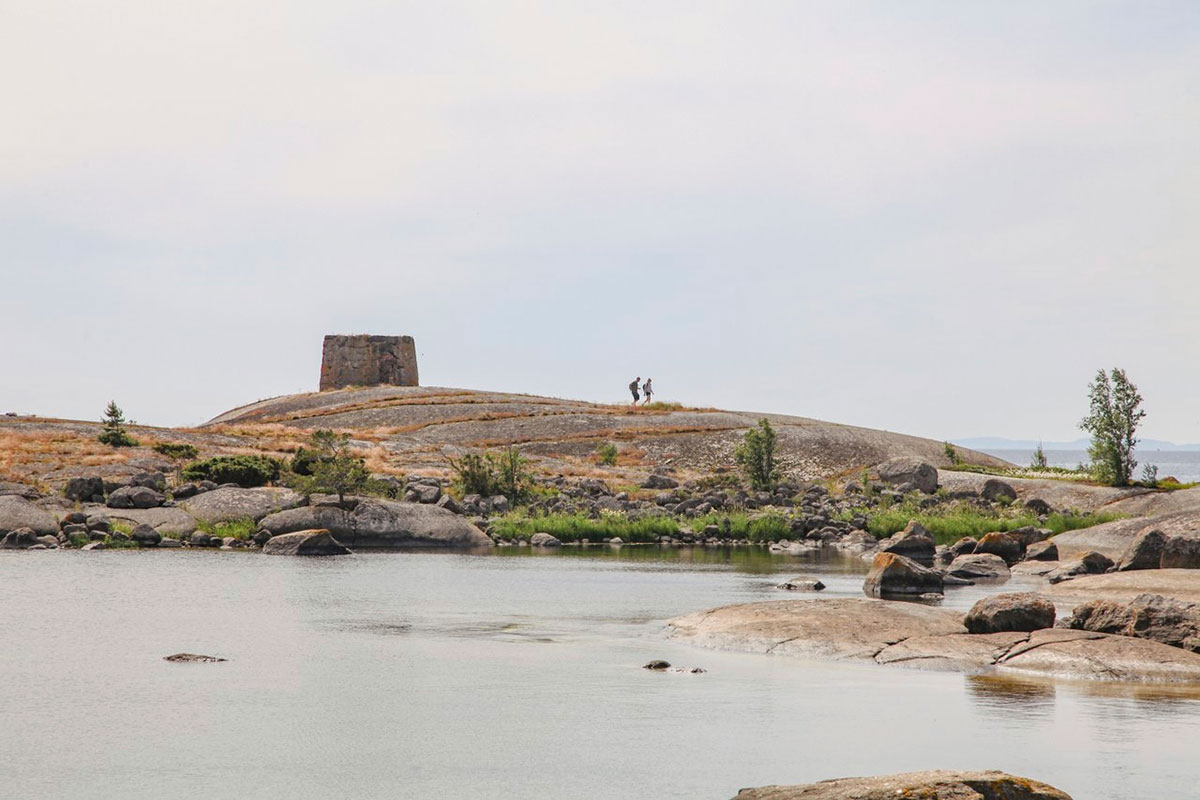
Two people walk across a rocky island landscape with sparse vegetation.

Rankki, Kotka: Jansson’s The Summer Book has been adapted into a movie that came out in 2024 starring Oscar nominee Glenn Close and featuring Golden Globe nominee Alma Pöysti. The main filming location was the former military island Rankki, off the coast of Kotka. Photo: Moomin Characters Ltd

By Kristiina Ella Markkanen, ThisisFINLAND Magazine

Discover the wild herbs growing across Finland

In Finland, nature is always close by – even in the capital region. Just a 20-minute metro ride from central Helsinki takes you to Mellunmäki, the world’s northernmost metro station and the gateway to a surprisingly wild landscape. Here, wild herb expert and cook Suvi Metsämansikka introduces us to edible wild plants and explains why they are such great ingredients.

Metsämansikka’s connection to plants goes back to childhood. That early curiosity grew into a lifelong passion, eventually leading her to study wild herbs and share their potential with others.

From spring to autumn

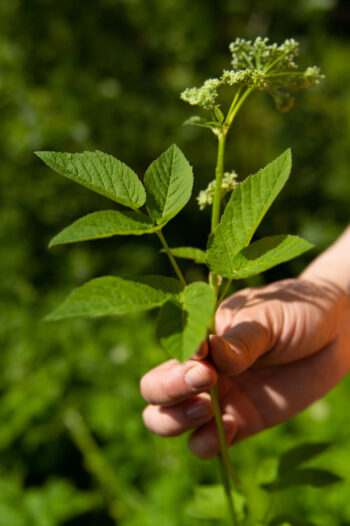
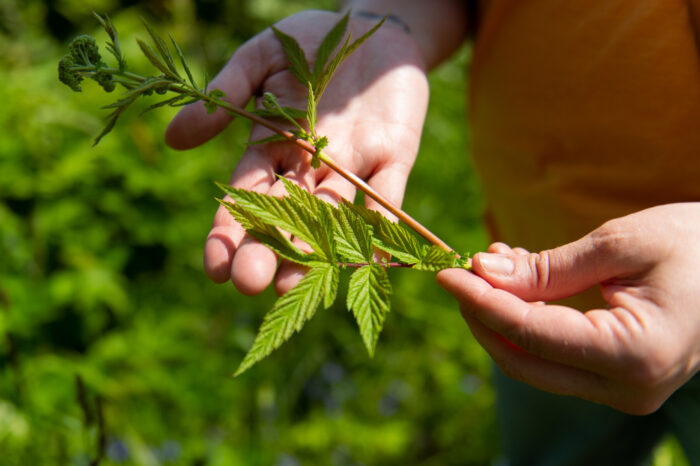
A hand holds a goutweed stem with leaves and flowers.

Goutweed (Aegopodium podagraria) has a mild, carrot-like flavour and is best harvested when young. It works well in pestos and salads, but older leaves can still be used in stews. This plant belongs to the umbellifer family, some of which are deadly poisonous, so it is important to learn to identify the plant correctly.

Finland’s nature offers fresh edible plants from spring well into autumn. Soon after the snow melts, shoots start to emerge from the ground.

“The green parts of plants are at their best when young,” Metsämansikka says.

Goutweed and common nettle (Urtica dioica), for example, are most flavourful before they flower.

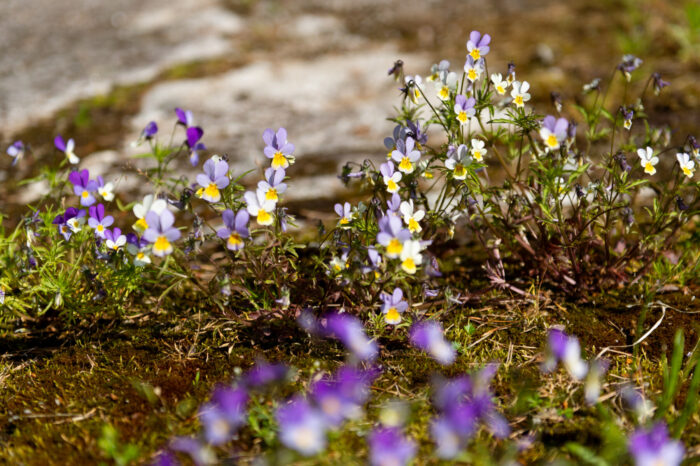
Clusters of Viola tricolor bloom over a rocky surface.

The flowers of Viola tricolor have a mild, vanilla-like taste and are ideal for flavouring sugar for baking.

When wild herbs start to bloom, it’s worth taking advantage of the flower heads. They make beautiful decorations for salads and desserts, and some offer subtle flavour. The flowers of Viola tricolor, for instance, have a hint of vanilla and can be used to flavour sugar for baking.

Other edible blossoms include fireweed or rosebay willowherb (Chamaenerion angustifolium), dandelion (Taraxacum) and wild strawberry (Fragaria vesca).

Later in the summer and into autumn, the berries and seeds are ready to be eaten.

“As autumn approaches, it’s a good idea to gather waybread seeds (Plantago major),” says Metsämansikka. “They make a great addition to breakfast porridge or smoothies.”

Easy to start with nettle and dandelion

When asked about her favourite wild herbs, Suvi Metsämansikka doesn’t hesitate. Dandelion and common nettle top her list.

“They are both very versatile wild herbs, and they are usually abundant and easy to find,” she says. “The dandelion has a nice and bitter taste. The flower heads can be used to make marmalade or syrup, which is like a vegan alternative to honey. You can also make delicious biscuits from the inflorescences or use them as a flavouring for sima [a Finnish May Day drink].”

Common nettle on the other hand, is perfect for soup or pesto. Metsämansikka recommends combining it with other wild herbs like common yarrow (Achillea millefolium) to add depth of flavour. When harvesting nettles, gloves and scissors come in handy, as the plant can sting bare skin. It’s also a good idea to blanch the nettles first – that way, their stinging hairs won’t irritate your mouth.

Metsämansikka reminds foragers that not every wild plant is safe to eat. “It is critical to collect only plants that you are certain to identify correctly,” she says. “Some plants that resemble edible species can be deadly poisonous.”

It’s also important to know how much of a plant is safe to eat and whether it’s suitable for children.

Rules for gathering wild herbs

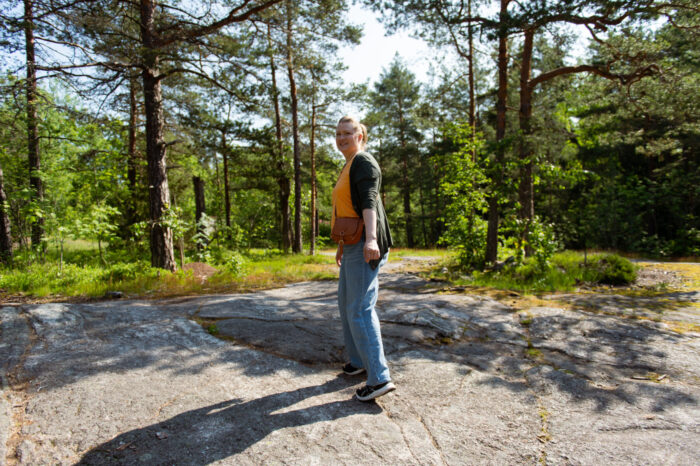
A woman walks across a sunlit rock in a clearing beneath tall pines.

Suvi Metsämansikka enjoys combining hiking with foraging. “Hiking food is easy to prepare at a campfire or with a portable stove,” she says. “If you’re hiking in a national park or other area where foraging is not allowed, you can gather the ingredients for nettle soup on the way to the park or bring them from home.”

In Finland, the right to roam – known as “everyone’s rights” – makes it easy to enjoy nature. These rights allow people to pick wild herbs, berries and mushrooms without needing the landowner’s permission.

“They’re a wonderful part of Finnish life,” says Suvi Metsämansikka. “But it’s still important to know what’s allowed.”

Foraging herbs is not permitted in nature reserves or national parks, although berries and mushrooms may still be gathered in those areas.

Digging up plant roots is never allowed without the landowner’s consent, and the same goes for woody plants, shrubs, and tree parts. For example, blackcurrant leaves can only be picked from your own property or with permission. Some plants are protected by law and cannot be collected at all.

As a general rule, you can only gather the above-ground parts of herbaceous plants.

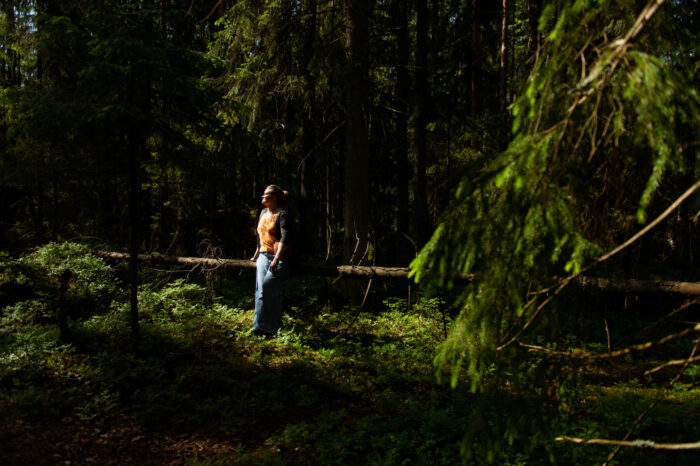
Sunbeams fall on a woman looking up at the sky in a dim spruce forest.

“In addition to being ecological, local and seasonal food, wild herbs are healthy and free nutrition”, Metsämansikka says. “Gathering them and preparing meals with them is also a fun hobby. Being active in nature is also beneficial for mental well-being.”

For best results, collect wild herbs on a dry day, away from busy paths and roads. You may wish to rinse the wild herbs before use, but this is not usually necessary. Most wild herbs can be eaten raw, but some benefit from light cooking or fermentation to bring out the best flavour.

Text by Anttoni Tumanoff, July 2025
Photos by Emilia Kangasluoma

Then and now in photos: Helsinki 50 years after the Cold War summit

In August 1975, Helsinki found itself in the global spotlight. Leaders from 35 countries gathered in Finland’s capital to sign the Helsinki Final Act, a landmark agreement in the Cold War era that helped lay the groundwork for dialogue between East and West. It was one of Finland’s most significant diplomatic moments, launching what would become the Organization for Security and Co-operation in Europe (OSCE).

Fifty years later, Finland again welcomes representatives from across the OSCE region to mark the anniversary. While the political landscape has shifted in countless ways, the values agreed upon in 1975 around cooperation and human rights remain deeply relevant today. The 2025 commemorative events reflect on those ideals and their enduring role in European security and diplomacy.

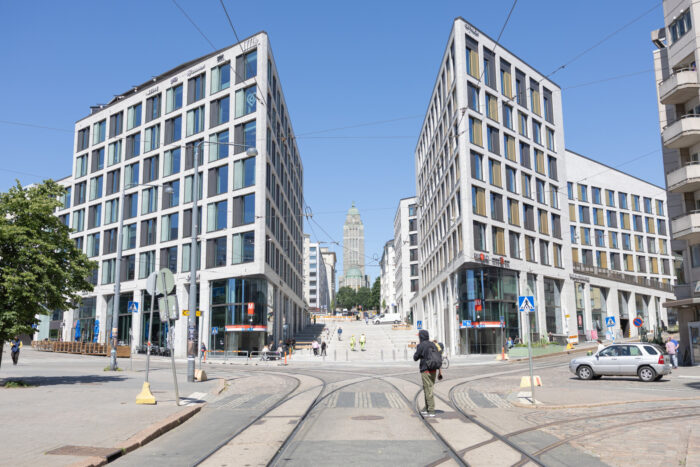
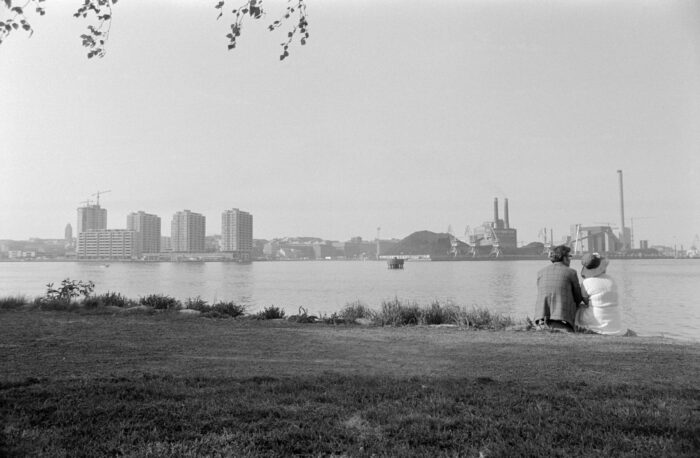
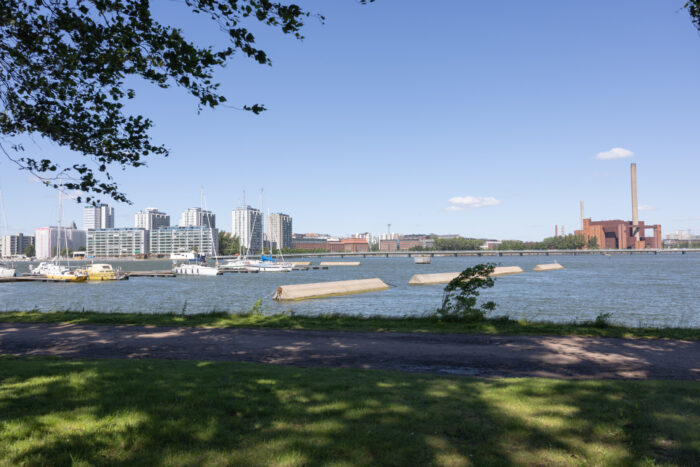
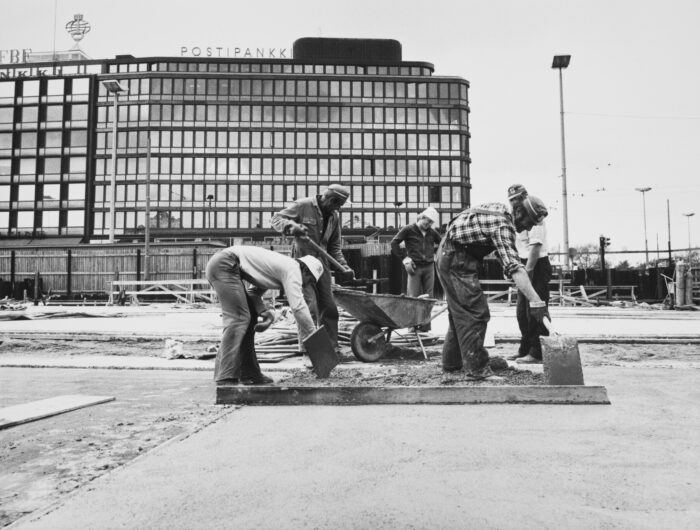
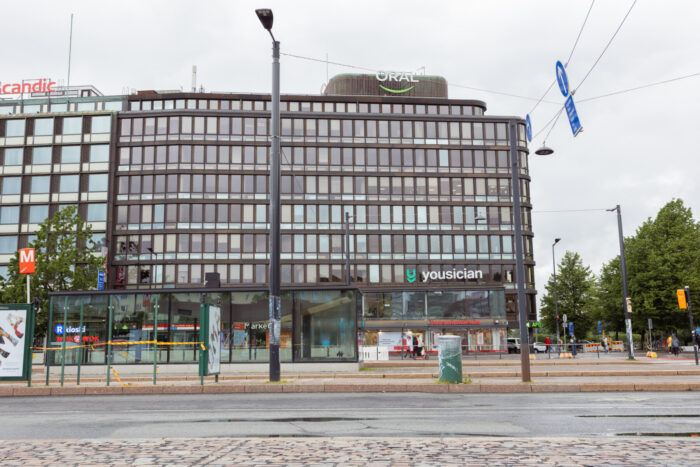
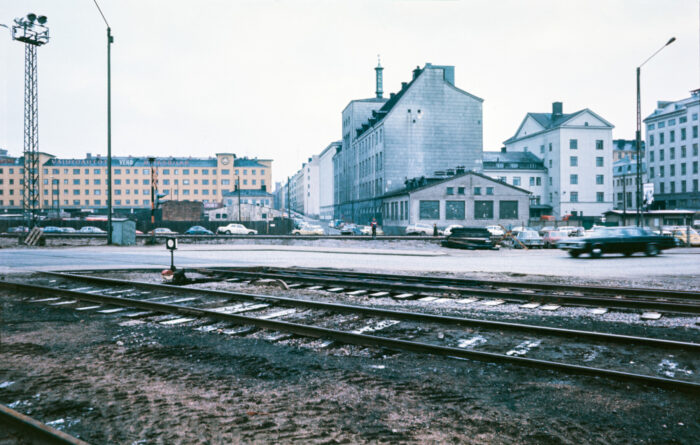
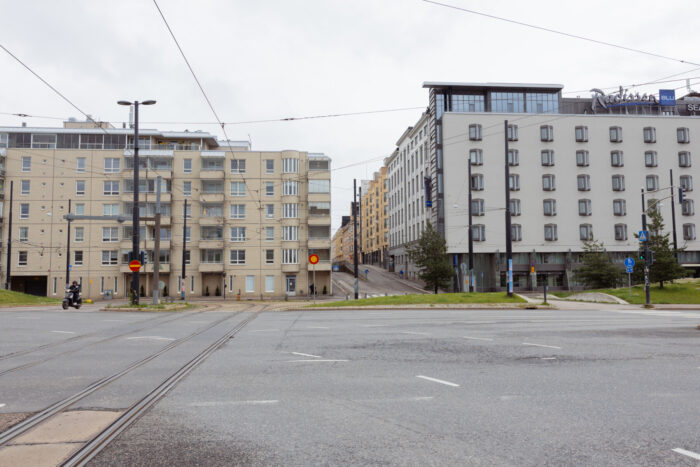
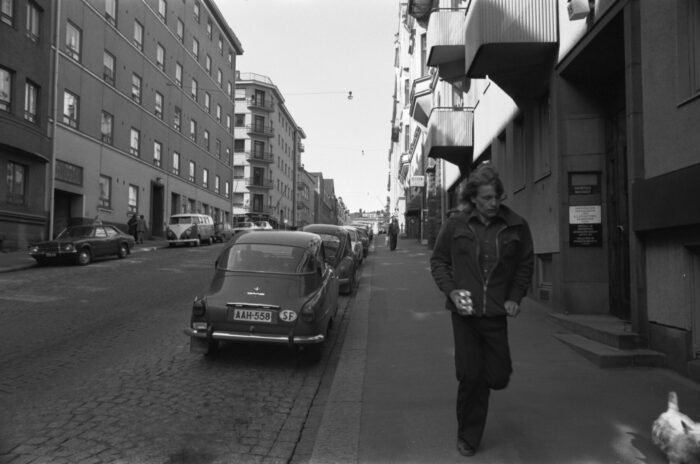
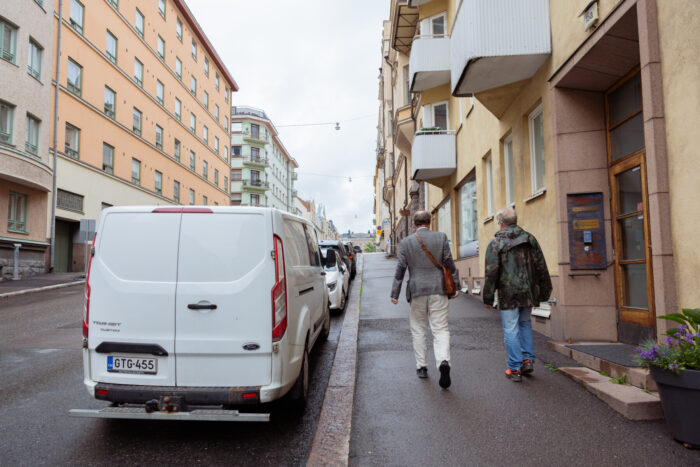
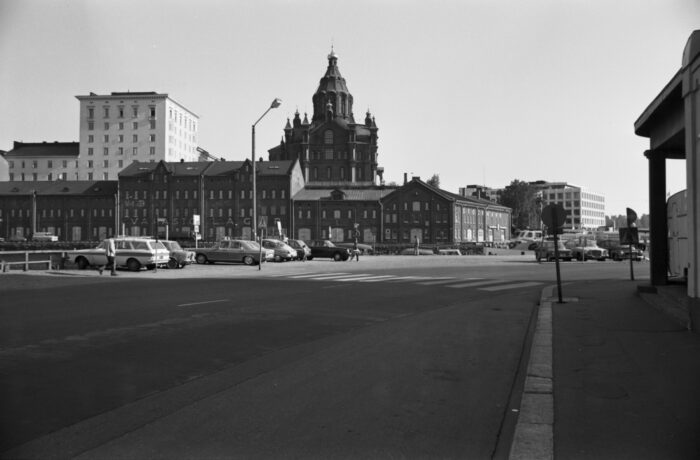
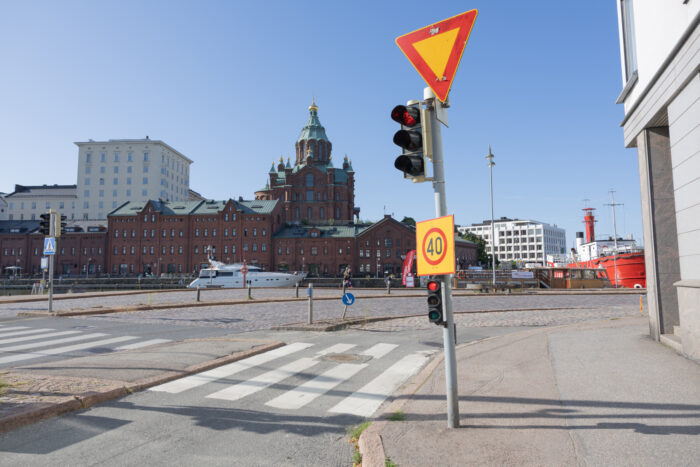
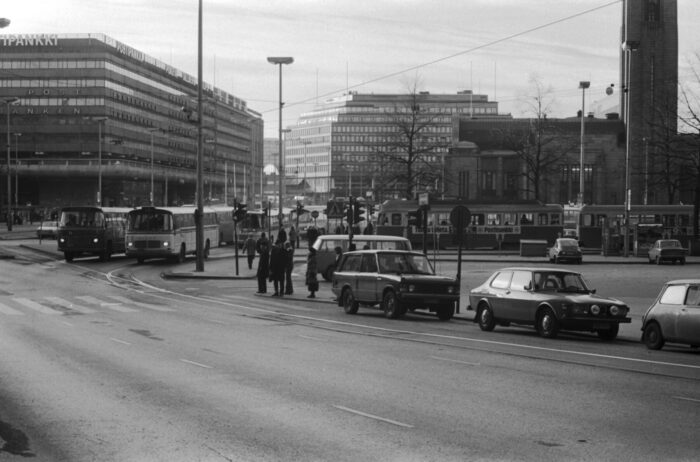
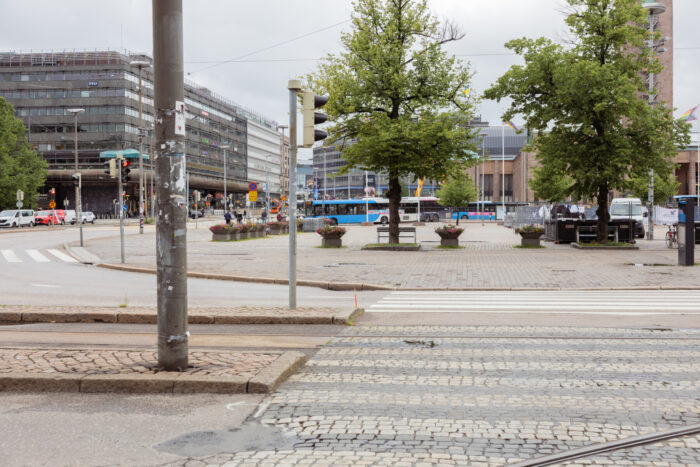
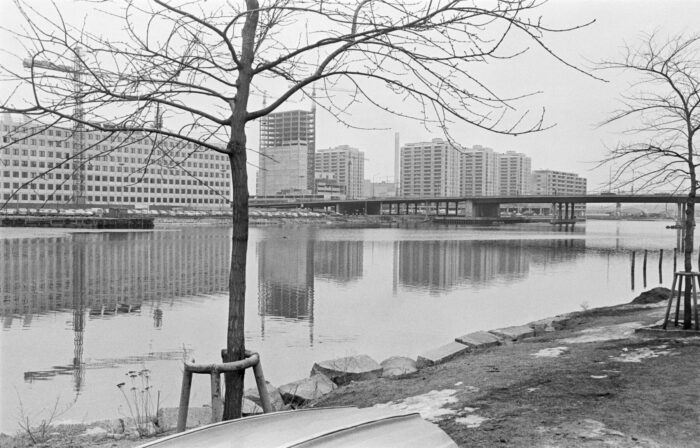
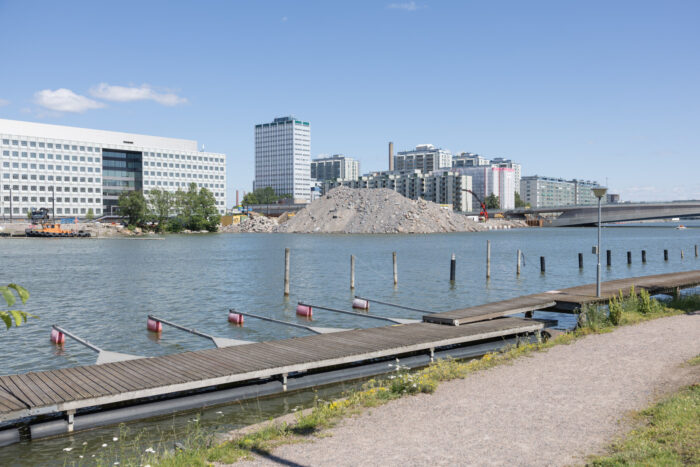
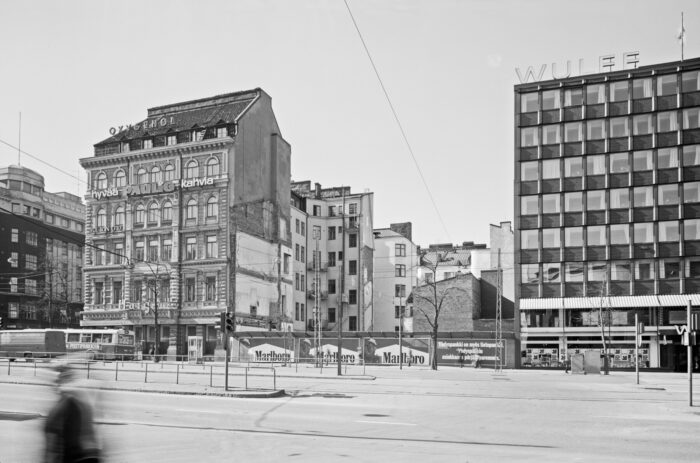
To honour the moment, we’re stepping into a visual time machine. These ten sets of photographs pair archival images from 1975 with new ones taken in the exact same locations this year. Some scenes are nearly unrecognisable; others appear untouched. Together, they tell the half-century story of urban transformation in Helsinki.

1. Porthaninkatu and Toinen linja, Kallio

Construction at this busy Kallio corner foreshadowed the city’s underground future in 1975. The underground structures, like many in the network, were built to serve a dual purpose: metro transit and civil defence, functioning as bomb shelters if needed. Above ground, Kallio has transformed over five decades: from a working-class district into a more expensive and trendy neighbourhood.

2. Tervasaari shoreline

A couple sits beside the water in 1975, with coal piles and the Hanasaari power plant behind them. Today, the view is cleaner and greener: Helsinki Energy (Helen) stopped using coal in Hanasaari in 2023, marking a major step toward a carbon-neutral city.

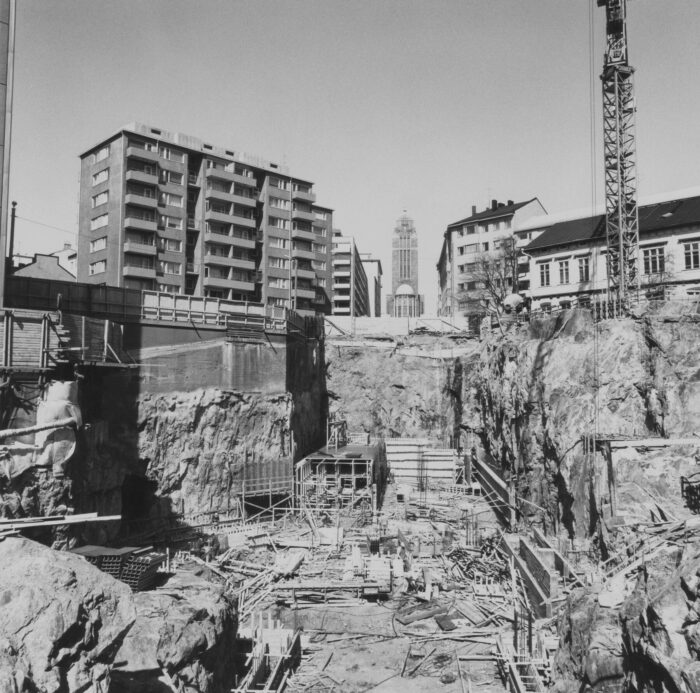
3. Hakaniementori

In 1975, the site at Hakaniementori was a bustling construction zone, part of Helsinki’s first metro digging works. The metro opened in 1982 with 17 stations and has since expanded to 30, stretching from Kivenlahti in the west to Mellunmäki and Vuosaari in the east.

4. Köydenpunojankatu and Kalevankatu, Kamppi

In the 1975 photo, the Valio building on Kalevankatu marks the spot where Nobel Prize–winning chemist Artturi Ilmari Virtanen once worked on groundbreaking food preservation methods. The location is now a hotel, and the surrounding area has been completely transformed. Kamppi’s harbour tracks have vanished, making way for a mix of housing, offices and cultural spaces.

5. Mariankatu, Kruununhaka

This quiet stretch of Mariankatu still looks much the same as it did in the 1970s, with rows of historic buildings and a calm, residential feel. While cobblestones have been replaced with pavement, the overall atmosphere of Kruununhaka remains steady, more lived-in than polished, and slightly out of step with the pace of the city centre just a few blocks away. It’s a part of Helsinki where change happens slowly, if at all.

6. Pohjoisranta, looking toward Katajanokka

In 1975, parked cars lined the waterfront as Pohjoisranta served as a key route for traffic heading out of the city centre. Today, a bike path runs where the cars once stood, part of Helsinki’s broader transformation into a more cycling- and pedestrian-friendly city. Across the water, Uspenski Cathedral and the red-brick warehouses of Katajanokka remain a distinctive part of the skyline.

7. Kaisaniemenkatu near Rautatientori

Buses crowded Kaisaniemenkatu in 1975, the road thrumming with traffic and serving as a central conduit just outside Helsinki’s main station. The left-most building, constructed in 1967, was nicknamed Makkaratalo (the “Sausage House”) for the cylindrical concrete cantilever around the facade. During major renovations in 2005, there was an opportunity to remove the “sausage,” but it was instead marked for preservation due to its architectural and historical value. Originally designed with car ramps and rooftop parking, the building reflected a time when Helsinki was planning for a car-oriented future. Today, the ramps are gone, and the area has shifted toward wider sidewalks, bike lanes and pedestrian space.

8. Merihaka from Siltavuorenranta

Merihaka’s striking concrete towers rise in this 1970s view, part of a distinctive housing project that stood apart from most of Helsinki’s more traditional neighbourhoods. Today, a new bridge has replaced the old one, with a tram line under construction along the shoreline to better link Merihaka with the rest of the city. The trail here is also a recent addition, part of a 15-kilometre loop that traces the city’s inner coastline.

9. Mannerheimintie, Kamppi

In 1975, this lot at the corner of Mannerheimintie and Bulevardi sat empty after a previous building had been demolished. Like many parts of central Helsinki in the postwar decades, the area was in transition, shaped by shifting plans for development. Today, it houses a modern office building and sits at a key junction between the city centre and Kamppi.

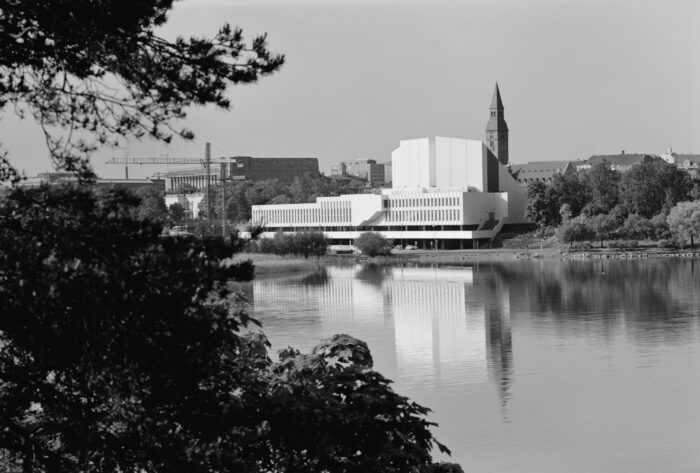
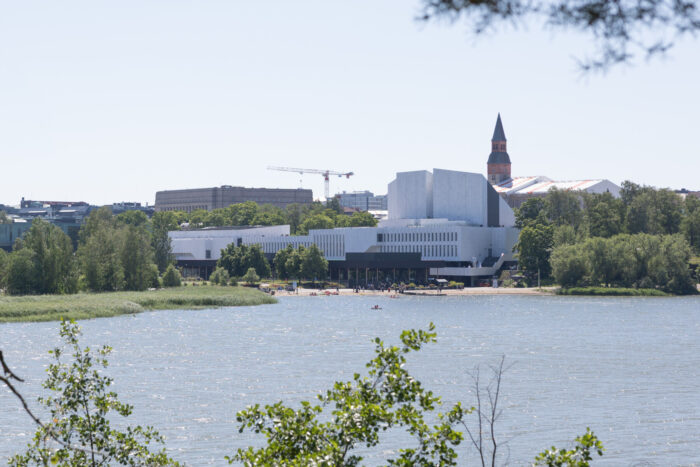
10. Finlandia Hall from Töölönlahti

This view across Töölönlahti toward Finlandia Hall places us near the very heart of the OSCE story. Designed by Alvar Aalto, the white marble building hosted the historic summit in 1975 and continues to host major events today.

As Finland commemorates the 50th anniversary of the OSCE, Helsinki offers both a physical and symbolic backdrop: a place where diplomacy was once signed into history, and where everyday life continues to evolve.

Text by Tyler Walton, July 2025

New York’s Met Museum showcases beloved Finnish painter Helene Schjerfbeck

In the art world, it doesn’t get more prestigious than a solo show at New York’s Metropolitan Museum. With Seeing Silence: The Paintings of Helene Schjerfbeck (December 5, 2025–April 5, 2026), the Met is staging its first-ever exhibition of a European woman painter born in the 19th century.

The extraordinary career of Helene Schjerfbeck (1862–1946) spans a fascinating journey, from the romanticism of the Golden Age of Finnish art to gripping self-portraits from the World War II era. She played a crucial role in the birth of Finnish modern art. In the 1880s, she spent time in France and England, and she continued to stay in touch with European art and fashion trends after her return.

“Schjerfbeck’s story is unique,” says Dita Amory, curator of the exhibition. “Living in Finland, far removed from the centres of cultural ferment in Europe, Schjerfbeck evolved her idiosyncratic brand of modernism without reference to other artists, experimenting in a new, radical language.”

[Editor’s note: The “schj” at the beginning of her name is pronounced like “sh” in English. It’s not a Finnish-language name; Schjerfbeck’s first language was Swedish, which is still one of Finland’s official languages.]

Distinct artistic language

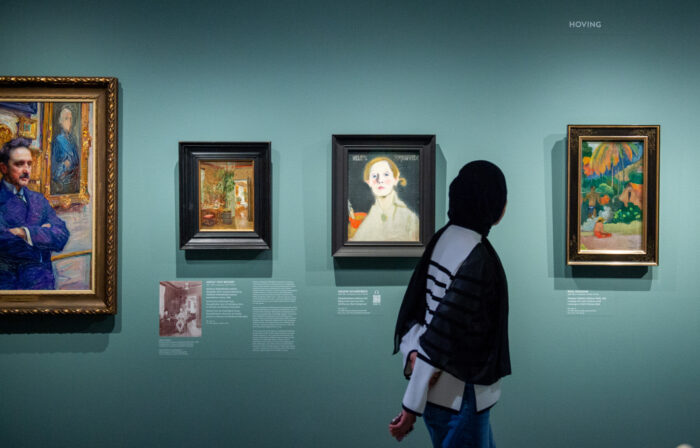
A person walks past several paintings hanging on a gallery wall.

A visitor at Helsinki’s Ateneum Art Museum passes Helene Schjerfbeck’s Self-portrait, Black Background (1919), hanging beside a Paul Gauguin painting and others.Photo: Emilia Kangasluoma

Seeing Silence includes 59 works that “trace her entire career in discrete passages that reflect her changing artistic language,” says Amory.

Helsinki’s Ateneum Art Museum is loaning many of the paintings in the Met show, and Ateneum director Anna-Maria von Bonsdorff is serving as consulting curator. “Schjerfbeck is known internationally for having a very distinctive, signature style,” she says. “It’s interesting how she did those paintings, not just what they represent. She’s not just presenting an apple or herself or a simple view.

“She created a figurative modernism that concentrates on what’s most important and on artistic technical development. Schjerfbeck was interested in using different types of media and in reworking her paintings over long periods of time.”

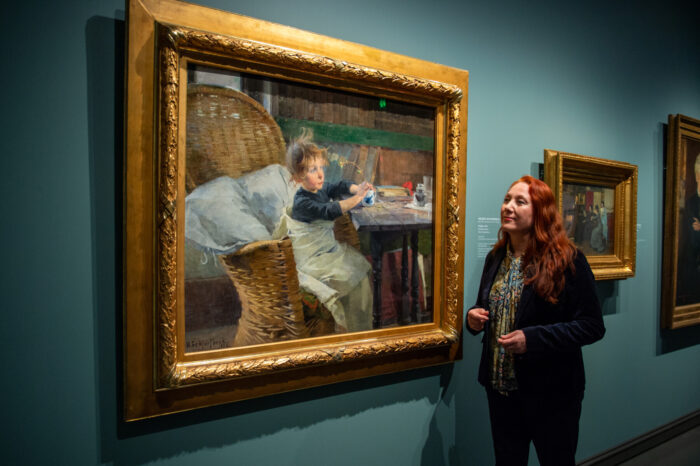
While The Convalescent, which Schjerfbeck painted in her mid-20s, is among Finland’s most beloved paintings, “the modern part of her career is more interesting from a contemporary point of view,” says von Bonsdorff.

No-filter goblin mode

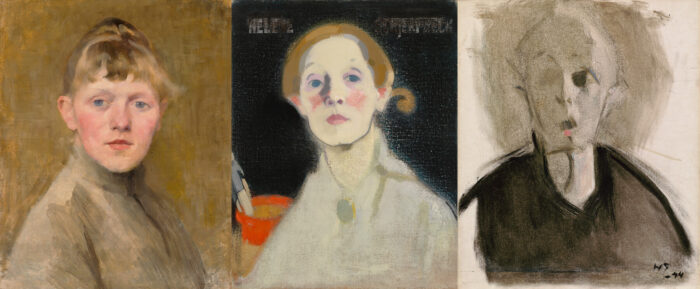
Three paintings side by side show self-portraits in styles progressing from realistic to abstract: a young woman, a middle-aged woman and an older woman.

Schjerfbeck painted self-portraits throughout her lifetime with frankness and intensity. From left: Self-portrait (1884–1885), Self-portrait, Black Background (1919) and Self-portrait with Red Spot (1944).Photos: Jenni Nurminen, Hannu Aaltonen, Hannu Aaltonen/Finnish National Gallery/Ateneum Art Museum

The curators agree that the most fascinating Schjerfbeck works are her self-portraits, painted from her teenage years until just before her death at 83.

This extraordinary series mirrors the evolution of her style, from French-styled naturalism to stark, nearly abstract modernism with influences from Japanese art. Her endless, fraught variations on self-portrayal presage the selfie culture of our century, from idealised filters to brutally honest “goblin mode.”

“Her late self-portraits share a raw, self-reflective examination of pending death unlike anything seen anywhere else,” says Amory.

“People are really astonished by the frankness and the intensity,” von Bonsdorff says. “The late self-portraits are done with really forceful brush strokes. She put all her energy and concentration into doing them. Once you’ve seen those paintings, you never forget them.”

Von Bonsdorff has presented Schjerfbeck works in many settings, including a 2014 retrospective at the Schirn Kunsthalle in Frankfurt, Germany. Collaborating on the show was that museum’s director, Max Hollein. He’s been fascinated by Schjerfbeck ever since – and is now director of the Met.

“The idea for this exhibition came from Hollein, as Schjerfbeck is one of his favourite artists,” says von Bonsdorff.

Financial, medical and romantic setbacks

A woman looks at a large painting on a gallery wall, showing a child sitting in a wicker chair.

Anna-Maria von Bonsdorff, director of the Ateneum Art Museum and consulting curator for the Met’s Schjerfbeck exhibition, says The Convalescent (1888) represents only one facet of the artist’s wide-ranging career.Photo: Emilia Kangasluoma

The first major exhibition devoted to Schjerfbeck in the US “will be a revelation to Met audiences,” according to Amory. “They will find the very compelling story of Schjerfbeck’s life a fascinating introduction to a woman who painted for 80 years despite considerable adversity.”

That included financial, medical and romantic setbacks throughout her life, most of which was spent living with her mother, scraping by on a small pension.

Yet Schjerfbeck was fortunate to grow up in the Nordic region, where women enjoyed more opportunities for artistic education and expression than elsewhere in the 19th century. That’s evident in the recent array of major international exhibitions featuring her Nordic contemporaries Hanna Pauli, Harriet Backer and Hilma af Klint.

“Nordic women artists had a very different status compared to others in Europe, thanks to the educational system,” says von Bonsdorff. “Schjerfbeck was admitted as a student when she was 11 because she was so talented.”

Ateneum focused on that legacy in its exhibition Crossing Borders: Travelling Women Artists in the 1800s (through August 24, 2025), presenting 19th-century women artists who paved the way for Schjerfbeck and other early modernists such as Ellen Thesleff, herself the subject of a future Ateneum exhibition.

“It’s about time that we privilege these overlooked artists, whose art is as fine in every way as their male counterparts,” says Amory.

By Wif Stenger, July 2025

A night hike into the heart of Finnish folk music

A mosquito buzzes by your ear. Your socks are already wet from the puddles soaking through your trail shoes and the person ahead of you nearly slips on the smooth granite. Behind you, a stream of colourful raincoats stretches deep into the pine forest.

Still, no one complains. In the air is the sound of laughter, a faint smell of mosquito repellent and somewhere in the distance, the sound of a fiddle.

Welcome to Kaustinen, a tiny municipality in western Finland with just over 4,000 inhabitants, best known as the home of the largest folk music festival in the Nordic countries. Here, the week-long celebration of traditional music begins not with fireworks or grand openings, but with something far more memorable: a night hike into the forest.

A festival like no other

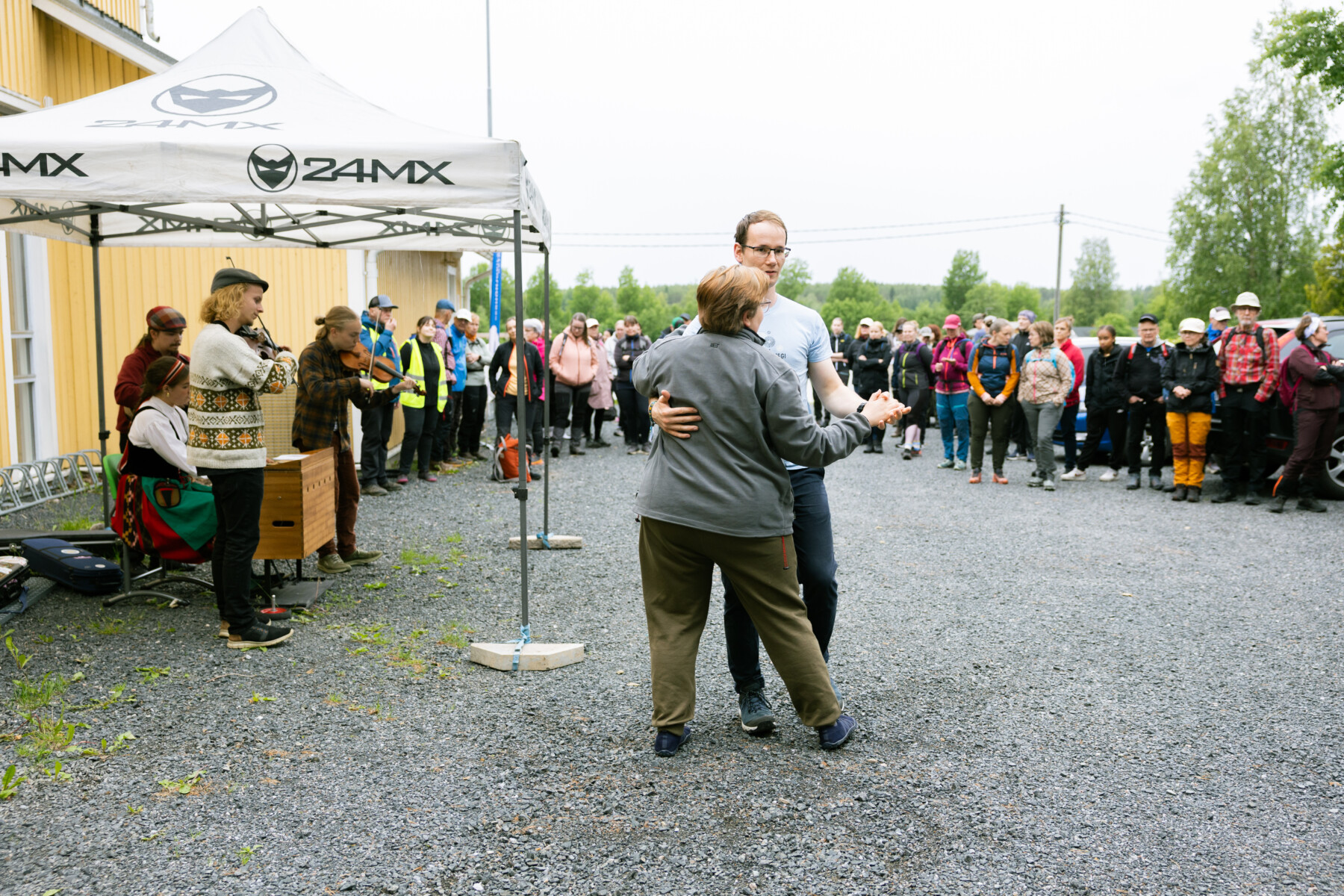
Two people dance in front of musicians as a crowd of people watch.

Johanna Laurila and Hendrik Clercx couldn’t resist the music and started dancing – something that often happens in Kaustinen.

It’s raining, as it sometimes does in a Finnish summer. But at the car park of a small village school in Järvelä, people are lacing up their boots.

Spirits are high. The Kaustinen Folk Music Festival is about to start once again.

The night hike is open to all and offers two routes: a 4.5-kilometre (2.5-mile) route or a longer 15-kilometre (9-mile) loop. Along the trail, participants stop to enjoy live folk music: sometimes at a clearing in the woods, sometimes beside a fire.

This year, rain meant the instruments couldn’t make it into the forest. But the musicians still played in the schoolyard before departure. The group Musiikin Esittäjät (The Performers) set the mood with a lively waltz and an upbeat tune. Some hikers, undeterred by the drizzle, even danced.

A musical path through the woods

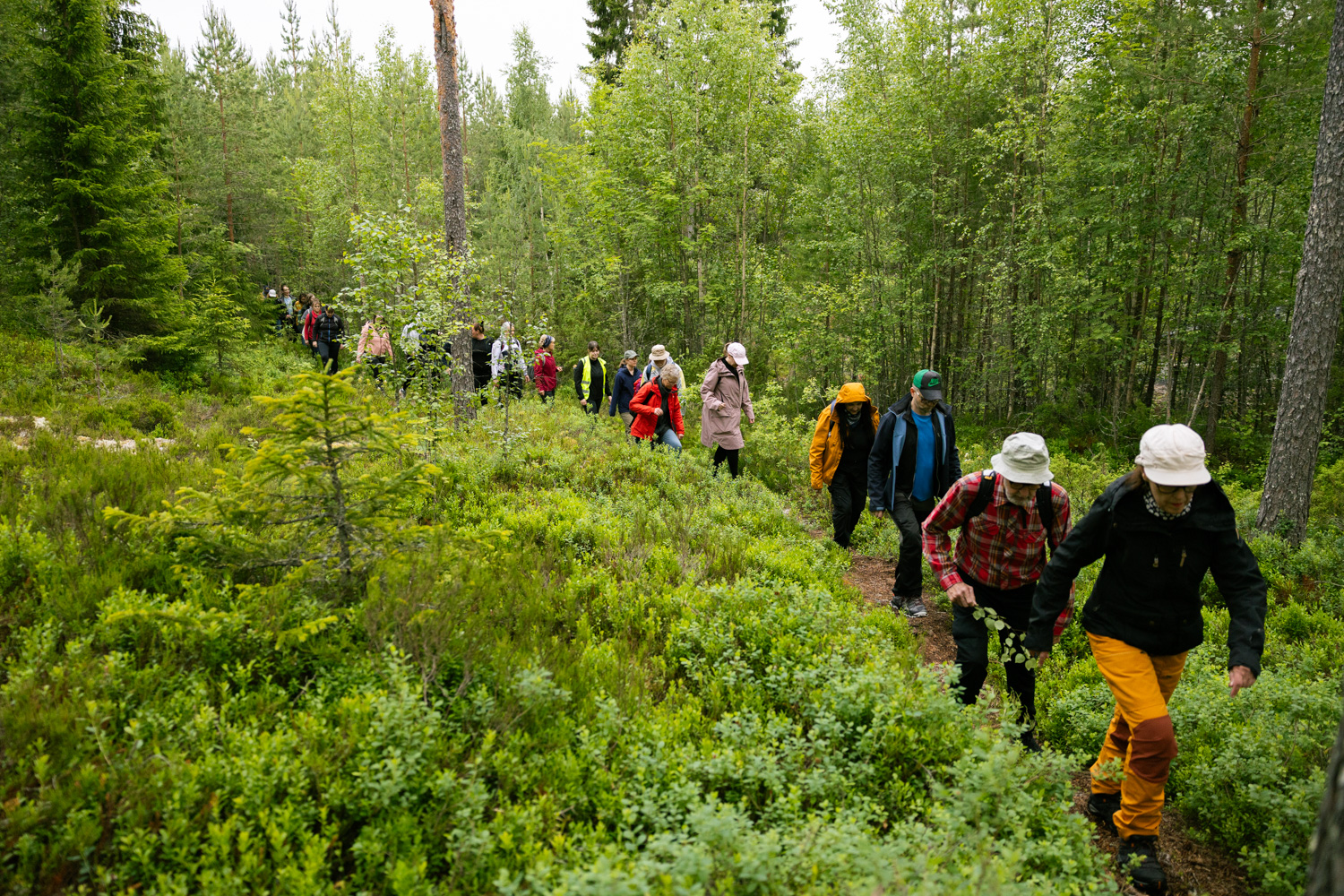
People in rain gear walk along a path through a forest.

A little rain doesn’t bother the hikers as Finns are well accustomed to rainy days.

The hike starts through soft pine forest, then narrows into smaller and muddier trails. A local guide from the Perhonjokilaakson Retkeilijät (Perhonjoki Valley Hikers) club leads the group of over a hundred participants into the trees.

Raindrops ripple through puddles. A lone bird chirps. The forest smells of moss and rain. Though the hike began at 8 pm, the sky is still light. In Finland, darkness barely comes at all in early July.

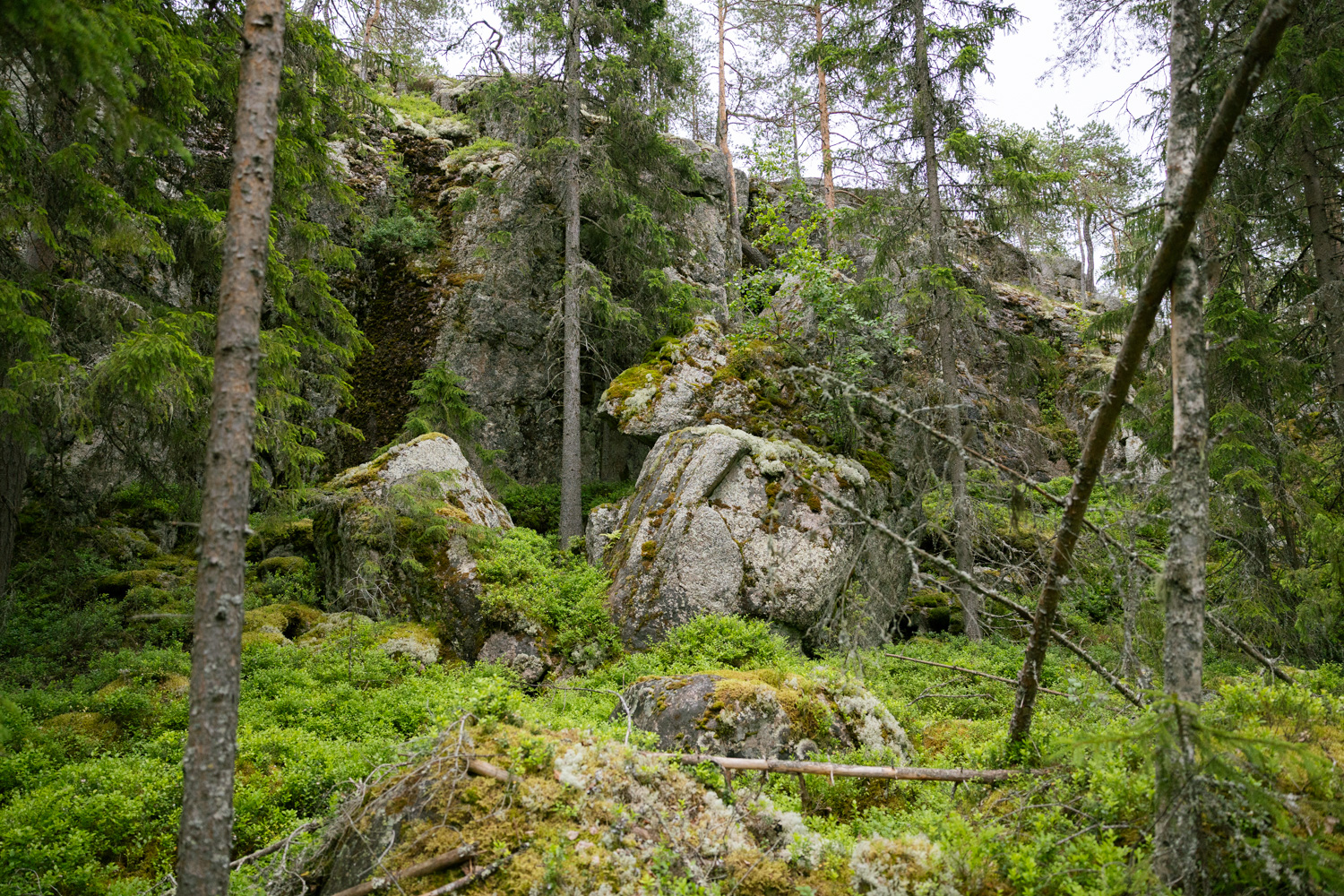
Large, moss-covered boulders lie in a forest. In the background a cliff rises.

Legend has it that a troll lives somewhere in these cliffs.

The group snakes deeper into the woods, eventually arriving at a place that feels like it belongs in a fairytale: the Pööskallio cliffs. According to local folklore, trolls live here among the massive boulders. Standing there, it’s not hard to believe.

Time for a break. People sip from thermoses, unwrap chocolate bars and lean against rocks.

Music brings people together

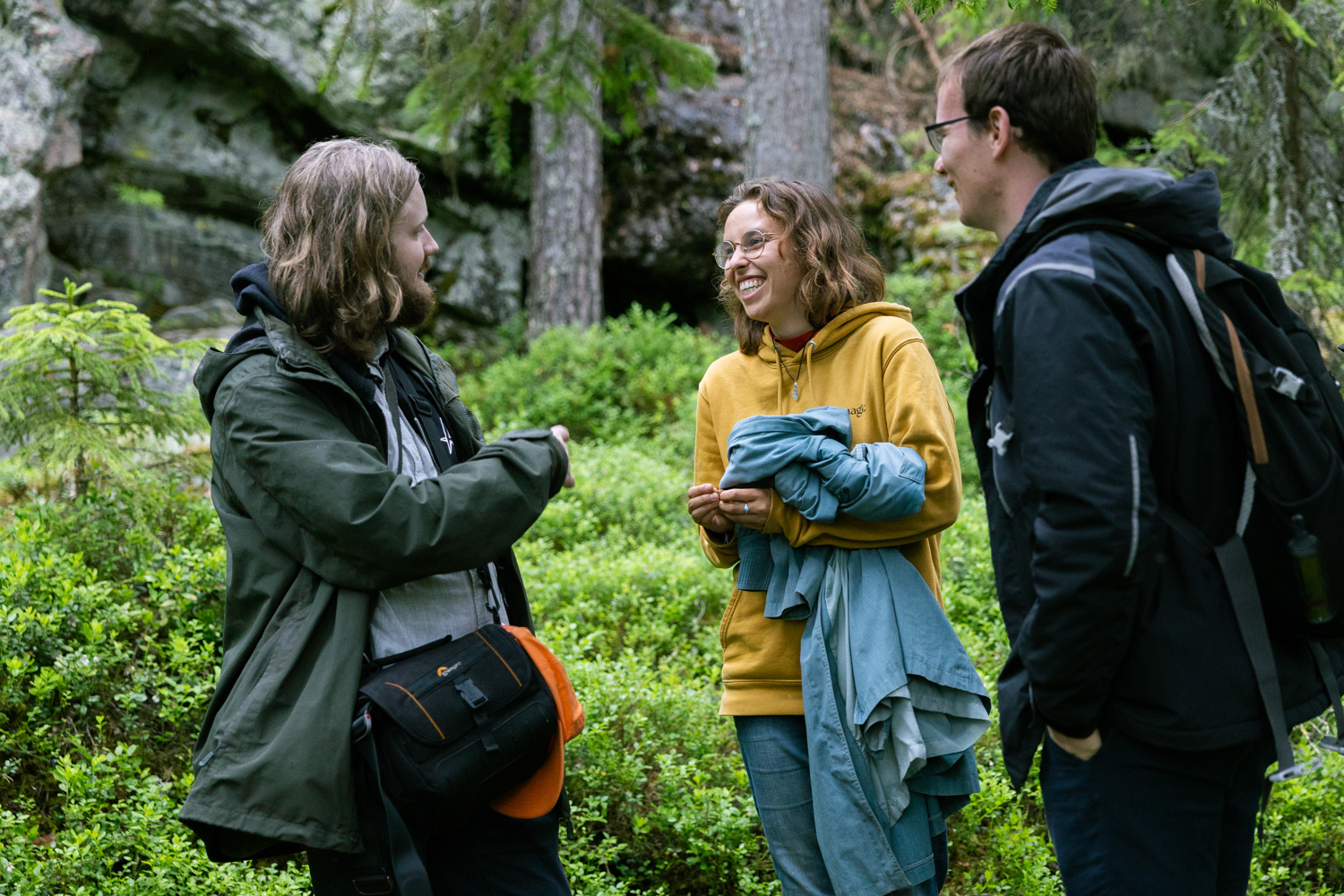
Three smiling people talk in front of a forested cliff.

Ilya Crols (left), Joosje Holstein and Hendrik Clercx met each other at a music camp. The hike was a welcoming break for them, since the past few days have been all about making music.

Among the hikers are Joosje Holstein from the Netherlands and Ilya Crols and Hendrik Clercx from Belgium. They’re here as part of Ethno Finland, a youth music camp that gathers young folk musicians from all over the world.

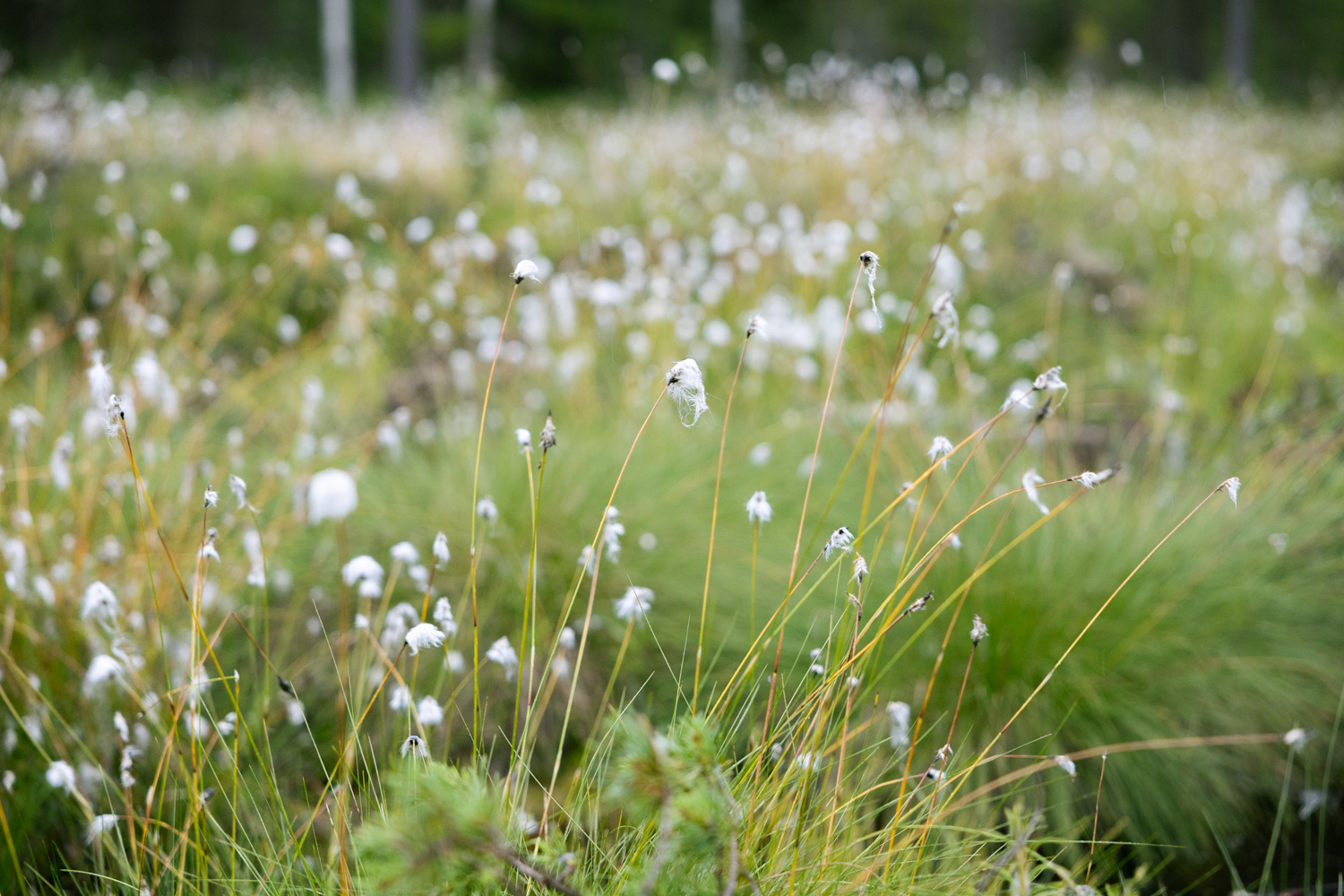
A field of grass and flowers in seed, with a forest in the background.

The route of the night hike winds through diverse landscapes, taking hikers first to the rocky outcrops of Pööskallio and then up to the heights of Isokallio.

“It’s so beautiful here in the forest,” Holstein says. “I never would’ve ended up in a place like this on my own.”

“And this evening light! It’s very special,” Clercx adds, looking up at the sky, now tinged with pink.

This is one of those moments when strangers become companions.

Isokallio: The high point of the trail

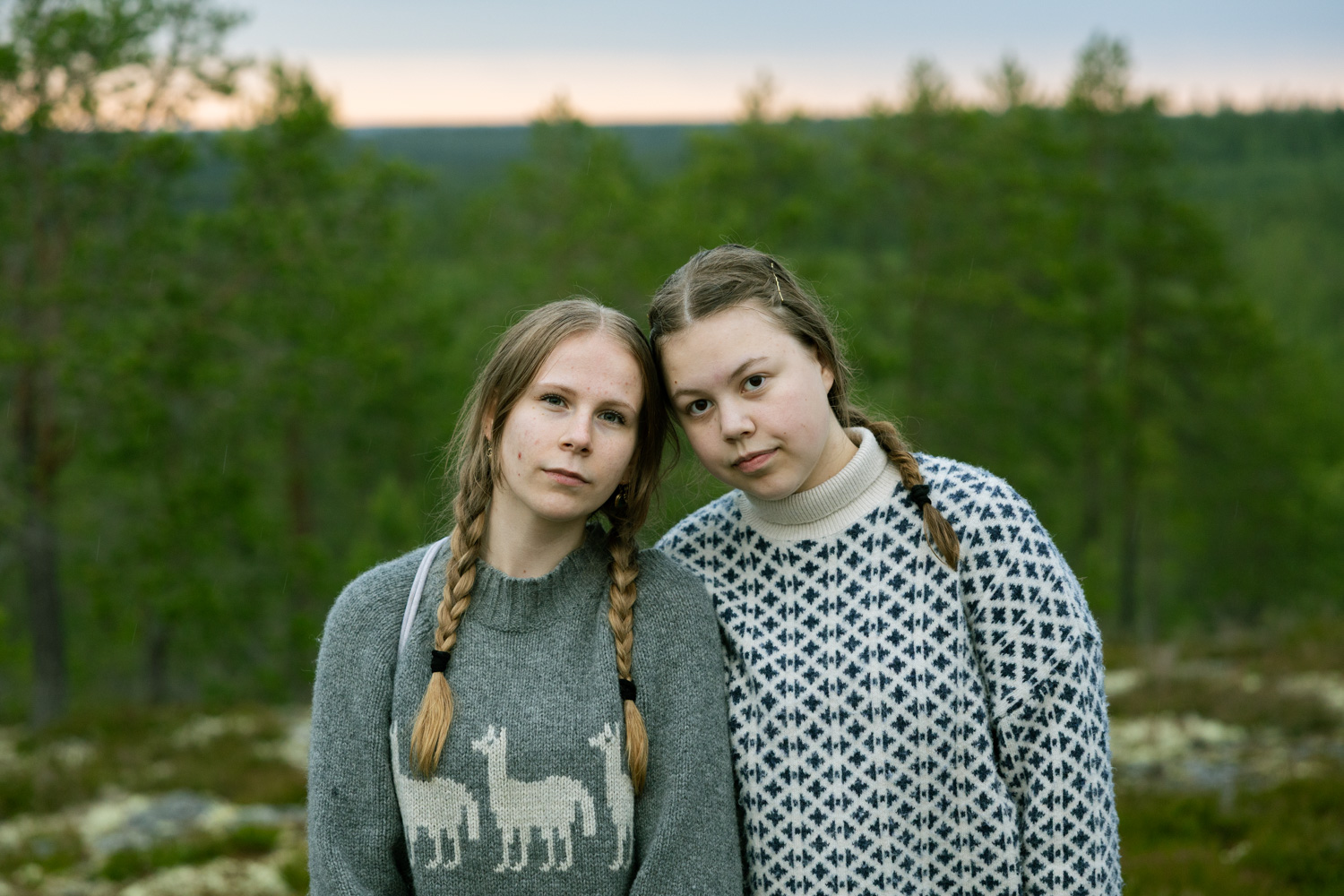
Two young women pose with heads together in front of a forested landscape falling away into the distance.

Anni-Marija Vauhkala (left) and Tytti Huttunen recently graduated from Kaustinen’s music-focused upper secondary school. Vauhkala’s main instrument is the violin, Huttunen plays the cello.

Around 10 pm, the group reaches Isokallio, the highest point on the trail. The view opens up over the forest, stretching far in every direction.

At the summit stands a traditional Finnish kota (a wooden hut) where a fire glows gently in anticipation of sausages.

Anni-Marija Vauhkala and Tytti Huttunen are standing barefoot on a mossy mound.
Their shoes were already soaked, so they just gave up. But the discomfort doesn’t matter.

“I grew up surrounded by forest, so this feels like home,” Vauhkala says.

“Starting the festival with a long walk in nature – what could be better?”

Huttunen nods.

“I love hiking, and combining it with live folk music. It’s just an amazing experience.”

Back to where it all began

A folk music band, Musiikin Esittäjät (The Performers), is a group of young musicians who play especially for the annual night hike event.

As the final kilometres pass, the group descends through the forest, returning to where they started. Folk music can be heard from afar, gently warming the evening air.

The rain has eased.

It’s nearly midnight, but no one’s in a hurry to leave. There’s talk of saunas and swims in the Perho River, of what concerts to catch tomorrow, of how unexpectedly magical this rainy evening turned out to be.

In Kaustinen, folk music never sleeps, not even during the rain, and not even in the middle of the night.

Text and photos by Emilia Kangasluoma, July 2025

Finnish design by Artek still resonates, nearly a century after the company began

I fell in love with Finnish design a long time ago.

When I moved recently from Toronto to Helsinki, I wanted to simplify my life. I gave away most of the contents of my house and arrived with just a few cherished possessions, including a vintage Artek Stool 60.

That piece became the starting point around which I designed my ideal apartment.

I added a few more stools, an Aalto Daybed, a vintage Chair 611 with pink webbing, some Kori pendant lamps and a Harri Koskinen Lento table – all Artek products. As I posted my finds on social media, a friend saw the stools and joked that soon I could open a kindergarten.

Those Artek pieces, along with some flea market treasures and a few items from Finnish design shops, now furnish my flat.

A new kind of living

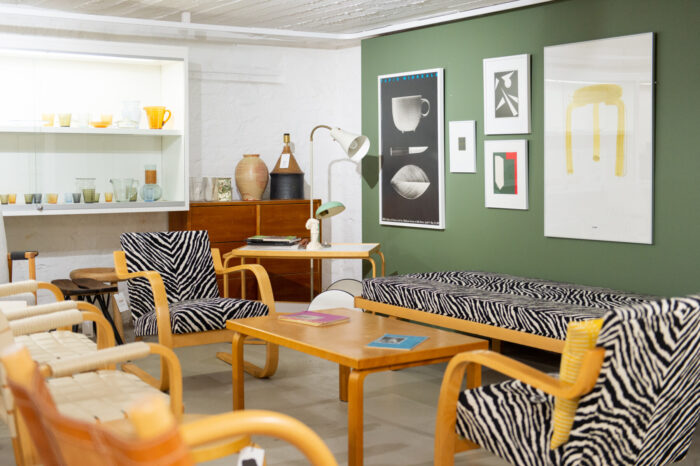
A room in a furniture store contains items including chairs, glassware, and pictures hanging on a green wall.

Artek came onto the scene in the 1920s as a bold new proposition, blending idealism with innovation in its furniture.Photo: Emilia Kangasluoma

Artek was founded in 1935 by modernist design pioneers Aino and Alvar Aalto, art patron Maire Gullichsen and art historian Nils-Gustav Hahl. It set out to promote a new kind of living – one that merged art and technology into functional, elegant design.

The name Artek itself reflects the fusion of art and tech, concepts that were integral to the modernist movement in the 1920s. The company was a bold new proposition, blending idealism with innovation.

Multiple celebrations

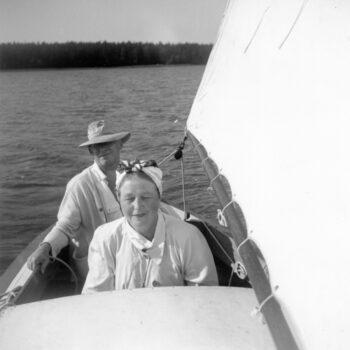
A black-and-white photo shows a woman and a man steering a sailboat with a forested coast in the background.

Modernist design pioneers Aino Aalto and her husband Alvar were two of the cofounders of Artek in 1935.Photo: Alvar Aalto Museum

On the occasion of the company’s 90th anniversary in 2025, Artek’s flagship store in central Helsinki released a special anniversary collection, including an Artek + Moomin line featuring the Moomin characters created by Finnish artist and author Tove Jansson. (The first Moomin book was published in 1945, so it turns 80 the same year Artek turns 90.)

The Artek + Moomin line consists of classic Aalto furniture engraved with Jansson’s early drawings and handwritten texts. One stool reads, “Oh! How brave you are!” while another exclaims, “Well strike me pink!”

The showroom display recreated Jansson’s studio, complete with seashells, an easel and seaside-themed curtains. It included a guestbook from Villa Mairea, the iconic residence the Aaltos designed for the Gullichsens, opened to a 1940s entry by Jansson, who left a note and a watercolour of the house.

Preloved Finnish design

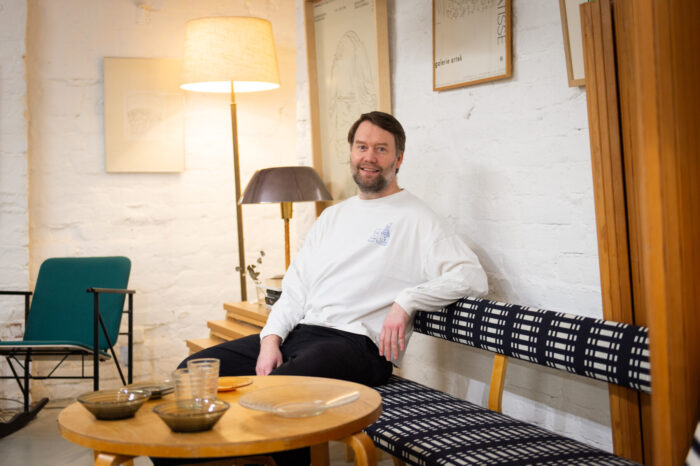
A man in a light sweater sits in a room with furniture and decorations.

Artek 2nd Cycle recirculates Artek furniture and is more than just a shop, says its manager, Antti Tevajärvi.Photo: Emilia Kangasluoma

Artek’s influence extends far beyond commemorative collections. Its commitment to sustainability and design longevity is embodied by Artek 2nd Cycle, a platform launched in 2006 to recirculate well-worn yet still-functional Artek furniture. Its manager, Antti Tevajärvi, sees it as more than a shop. “Artek 2nd Cycle is a continuous research platform into the past 90 years of Artek’s strong design heritage,” he says. “We’re always celebrating Artek, even when it’s not an anniversary year.”

Originally created to showcase the patina and longevity of Aalto stools, 2nd Cycle opened its own store in 2010 in Helsinki’s Design District. For lovers of Finnish design, a visit can feel a bit like a pilgrimage. The vast subterranean shop houses an eclectic mix of Artek originals – some lovingly worn, others rare.

Still in production

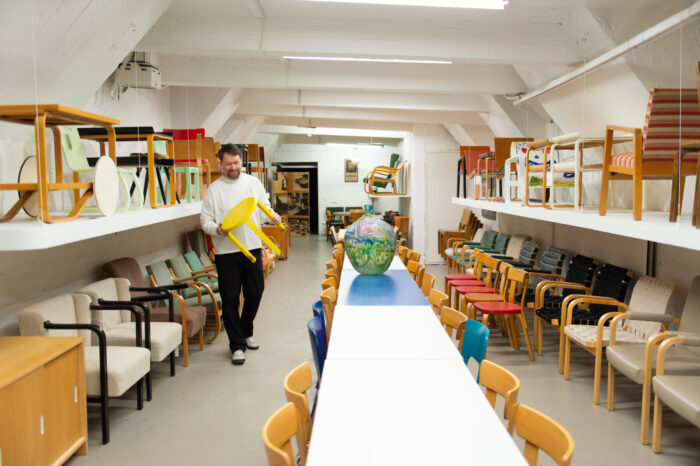
A man in a furniture store carries a yellow stool past a long table flanked by chairs and other furniture.

The vast subterranean space of Artek 2nd Cycle houses an eclectic mix of Artek originals.Photo: Emilia Kangasluoma

In addition to staples like the Stool 60, visitors might encounter Maire Gullichsen’s elegant glass lamp, Maija Heikinheimo’s brass and copper coffee pot or Yrjö Kukkapuro’s sculptural Karuselli lounge chair. The store’s ever-changing inventory tells the story of Finnish homes and tastes across generations. Artek “has a very special pocket in the history of the international modernist movement,” says Tevajärvi.

Almost 100 years after Artek started, many of the items created by the original founders and the designers who came after them are still in production. The company remains relevant – not just in curated museum displays or chic interiors, but also in the everyday lives of those who make use of its designs.

“Perhaps it’s the organic modern form, the use of natural materials, the innovative engineering with a human touch or a combination of these things which continues to fascinate our followers,” Tevajärvi says.

By Karen MacKenna, July 2025

The Alvar Aalto Museum’s Aalto2 Centre features Artek designers in Visibly Invisible: Artek’s Drawing Office 1936–2004 until September 14, 2025.

Fit as a Finn: The story behind Finland’s affinity for exercise

Let’s talk about fitness – not the kind that wins gold medals or graces Olympic podiums, but the kind that belongs to everyone: the delightfully casual variety, where the only goals are rosy cheeks, a light sweat and a brighter mood.

On any given Sunday in Finland, you’ll spot brisk walkers chasing their daily 10,000 steps, or, come winter, skiers slinging through snowy forests that look like the setting of a Nordic nature documentary.

What drives Finns to jump onto their bikes at the first hint of spring, or to hit the trails for Nordic walking (fitness walking with poles that resemble ski poles, so that your arms also get a workout – a Finnish invention)?

The early days of fitness in Finland
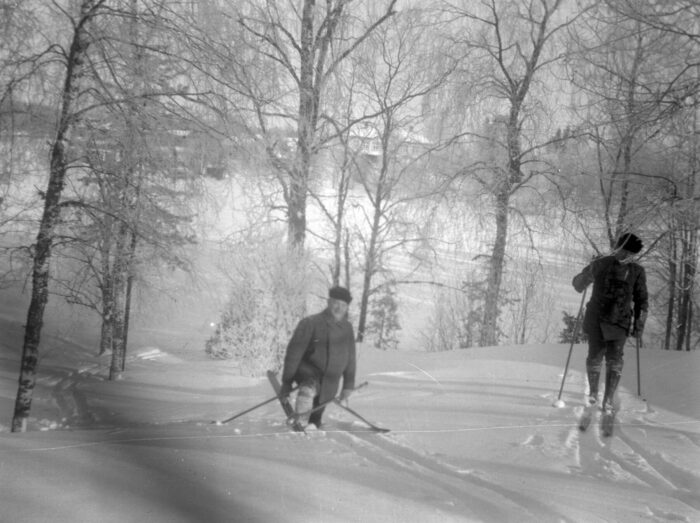
Two men are cross-country skiing through a snowy landscape.

Cross-country skiing has long been part of Finnish life. These two men were photographed skiing through deep snow in 1917.Photo: Axel Tammelander/Vapriikki

There was a time when fitness and sports weren’t part of the daily conversation in Finland.

A few centuries ago, most Finns got their physical activity from everyday life. Chopping wood, hauling water and ploughing the fields left little need (or energy) for recreational jogging.

If people moved for reasons other than survival, it was usually in the form of games, competitions or community gatherings – not something we would call “exercise” in the modern sense of the word.

Something began to shift in the 19th century. Perhaps it was the influence of public enlightenment or the spread of health trends from continental Europe, brought over by Finland’s intellectual elite. Whatever the reason, more people began to participate in sports for enjoyment.

When Finland’s first sports club, Segelföreningen i Björneborg (Pori Sailing Club), was founded in 1856, it planted the first seed of a growing movement. Soon, sports clubs began to spring up across the country like wildflowers in spring.
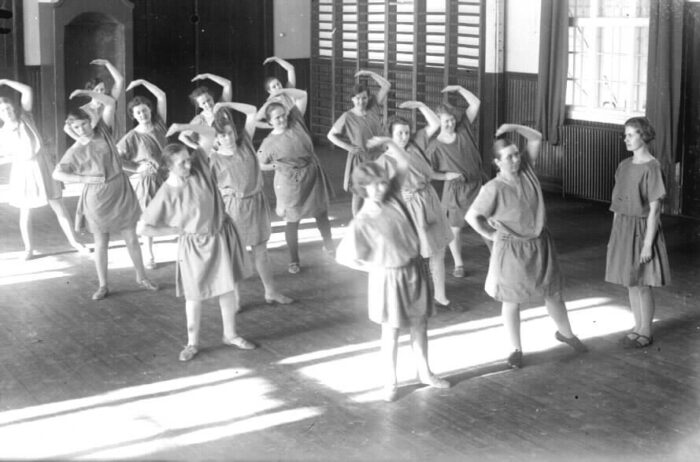
A women’s gymnastics team practices indoors in an old black-and-white photo, wearing period-appropriate, loose-fitting exercise outfits.

Women practice gymnastics in an undated historical photo. Gymnastics played a role in promoting public health in Finland.Photo: Matti Luhtala/Vapriikki

Civic organisations such as temperance societies, youth associations and labour unions also adopted physical fitness as part of their mission. For example, sharpshooter battalions and volunteer fire brigades promoted physical activities, particularly skiing competitions.

By the late 19th century, gymnastics had become a part of school curricula, with exercise serving as a way to improve the physical health of citizens.

Olympic victories in the early 20th century sparked a true sports craze and bolstered national pride. Finland won its first two Olympic medals in 1906, and by the 1924 Paris Olympics, the tally had risen to 37.

A shift in everyday life
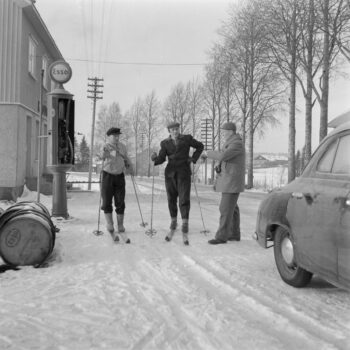
Two men with skis stand in front of a gas station during winter while another man without skis stands nearby.

The Pirkka Ski Race began in the 1950s and continues today. Covering 90 kilometres (56 miles), the trail attracts more than 1,000 participants each year.Photo: U.A. Saarinen/Finnish Heritage Agency

As the new century progressed, the everyday lives of Finns changed significantly. A growing number of people moved from the countryside to urban areas, and many jobs began to demand mental acuity rather than physical strength.

Exercise was no longer an automatic part of daily life. To maintain physical fitness, people had to start working out intentionally.
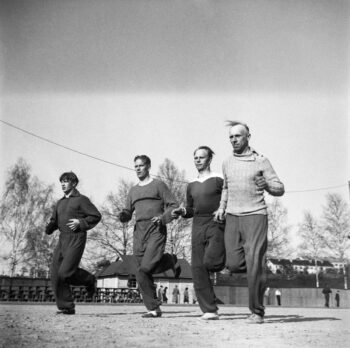
Four men run on a sports field in a historical black-and-white photo.

Men run across a sports field in 1948, reflecting the postwar emphasis on physical fitness and organised athletics in Finland.Photo: U.A. Saarinen/Finnish Heritage Agency

Lauri “Tahko” Pihkala, one of Finland’s most vocal advocates for physical fitness, promoted the idea that a strong, active population was essential – not just for individual health, but for the strength of the nation as a whole. Physical conditioning was seen as a matter of civic duty and national defense.

People were encouraged to take up skiing and jogging, not because they needed to get from one place to another, but for the sake of movement itself. The founding of Suomen Latu (literally “Finland’s trail”) in 1938 marked a turning point: Finland now had its first organisation dedicated specifically to promoting recreational fitness among ordinary citizens.

The five-day workweek and the fitness boom
A man exercises on wooden outdoor fitness equipment located in a wintery forest.

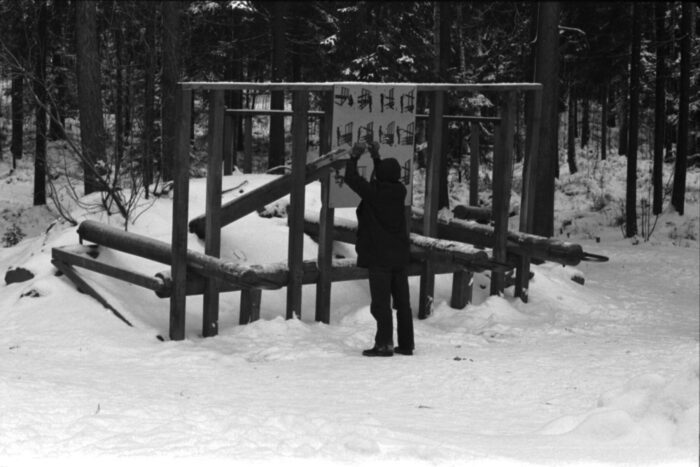
A man uses wooden outdoor fitness equipment in Pirkkola, northern Helsinki, in the winter of 1974. Photo: Eeva Rista/Helsinki City Museum

A significant shift in Finnish behaviour occurred in the late 1960s, when many workplaces adopted the five-day workweek. By then, a majority of Finns were living in cities, and with more free time on their hands, people began exploring new ways to stay active beyond traditional pastimes like sauna sessions and berry picking.

Especially in urban areas, opportunities for exercise expanded significantly. By the 1970s, Finland had built dozens of swimming halls to provide year-round access to aquatic sports – an important form of fitness and recreation, especially in winter, when outdoor swimming wasn’t feasible. Alongside swimming halls, most municipalities also developed sports fields and jogging tracks to encourage active lifestyles.

Fitness was in the air. And tracksuits were having a moment.
A man in a tracksuit poses with one hand resting on a bicycle and the other hand holding a jacket.

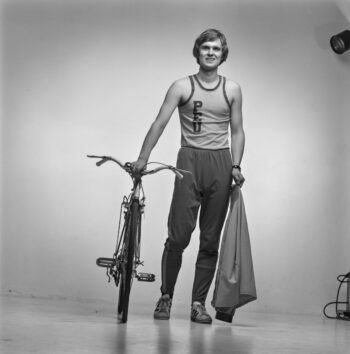
A man models the Perniön Urheilijat sports club tracksuit in 1974. Tracksuits became popular in Finland as recreational fitness grew in the 20th century.Photo: Kari Pulkkinen/Finnish Heritage Agency

As fitness culture grew, so did the demand for practical sportswear. In the 19th and early 20th centuries, there were few clothes designed specifically for exercise. But by the mid-20th century, more flexible, comfortable garments – such as tracksuits – became popular for their ease and style for workouts and casual wear alike.

Tracksuits became an iconic symbol of an era when awareness of exercise was spreading in Finland. Because some people took to wearing tracksuits all the time, not just for sports, the clothing was also the object of jokes about fashion sense – but it had found a lasting place in the national identity. As far as fashionability is concerned, tracksuits have experienced ups, downs and resurgences over the decades, and they can still inspire nostalgic or ironic reactions.

Fitness in Finland today
Two people run across a muddy field during an orienteering event, with a forest in the background.

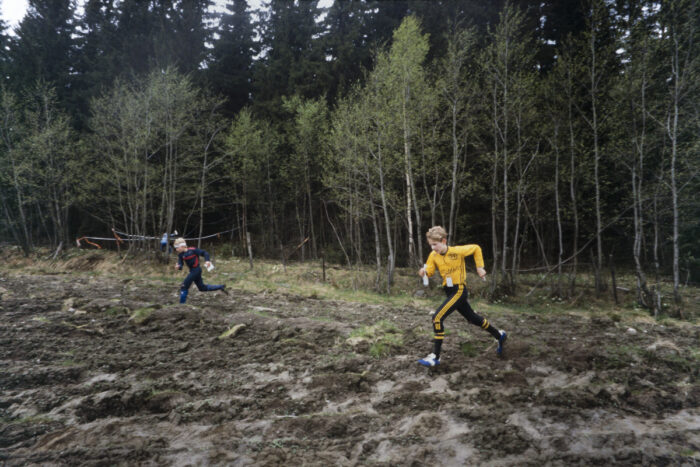
Orienteering has long been popular in Finland. This photo from 1983 shows two boys taking part in an event.Photo: Hannu Lindroos/Finnish Heritage Agency

Today, fitness is widely encouraged by public authorities at both national and municipal levels. From building bike paths and jogging trails to funding fitness centres, the message is clear: healthy citizens lead to a healthier society – and to lower public health costs.

So, what’s the deal with all this sweating? Are Finns chasing six-packs, better health or just a little peace of mind? Probably all of the above. Finland’s UKK Institute for Health Promotion Research says most working-age Finns exercise to stay in shape, clear their heads and keep the doctor away.

Walking and gym sessions are the go-to favourites, while kids stick to soccer like it’s a rite of passage. No matter where you live, there are plenty of opportunities: swimming pools, jogging trails, and outdoor gyms. There are even sets of open-air fitness stairs you can climb – usually well over 100, sometimes several hundred.

You may wish to take a cue from Finland’s current president, Alexander Stubb, a devoted triathlete who once said, “One hour of exercise brings two hours of energy to your day.”

By Emilia Kangasluoma, June 2025