How to sleep under the stars: 3 unforgettable stays in Finnish nature

What’s better than drifting off beneath a sky full of stars, with the scent of pine in the air and the sound of waves as your bedtime soundtrack? In Finland, nature isn’t just a backdrop. It’s a place to stay.  From forest tents to island cabins, here are three ways to sleep surrounded by the quiet, wild beauty of the outdoors.

Keeping it classic
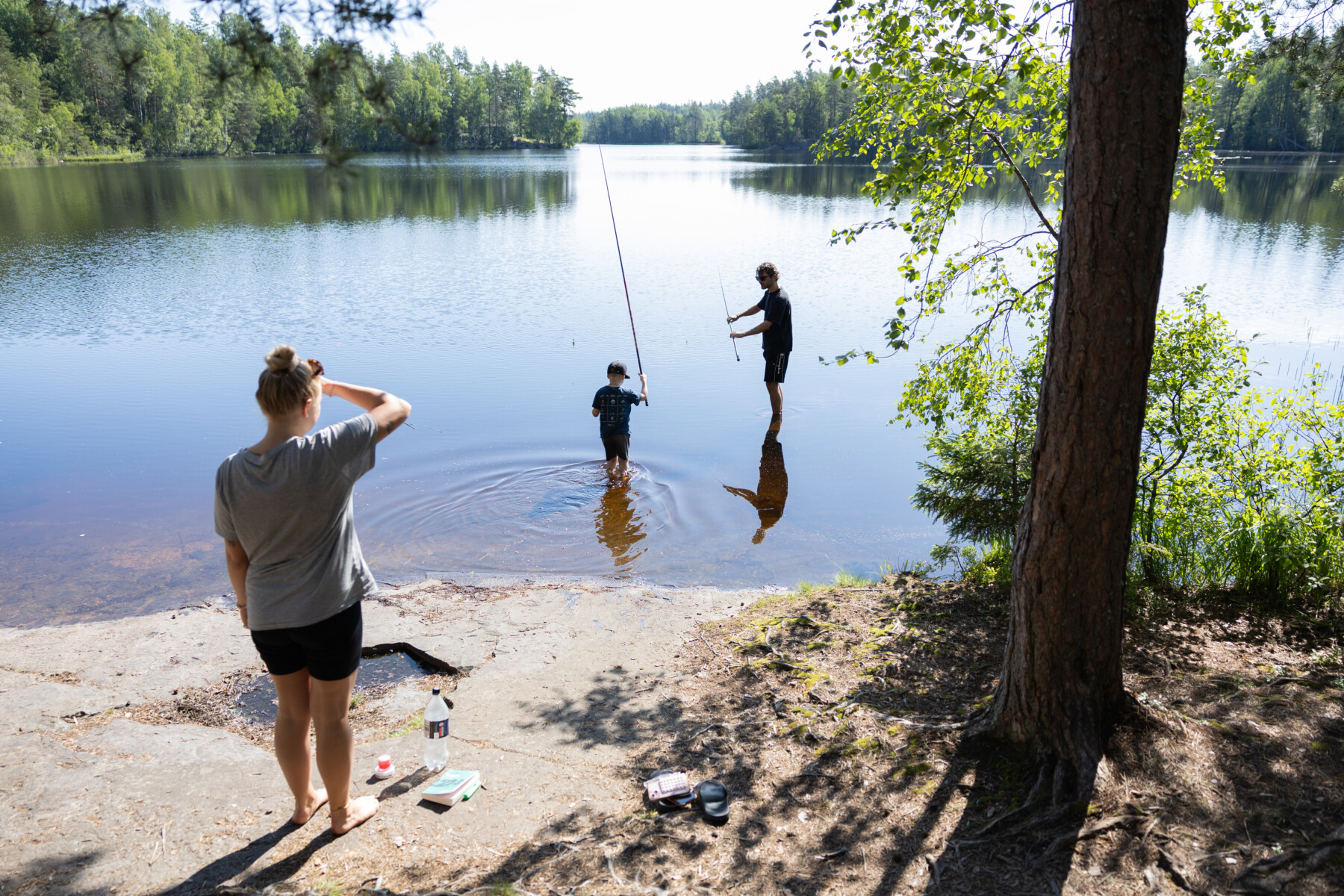
A man and a child stand in shallow lake water holding fishing rods while a woman watches from the shore.

Lake Fiskträsk lies in Sipoonkorpi National Park just over 20 kilometres (12 miles) from Helsinki as the crow flies, with easy trails leading in from several nearby parking areas.

Morning has just arrived over Sipoonkorpi National Park. Sunlight warms the forest, and at Lake Fiskträsk, a young boy casts a worm-baited line into the water.

Seven-year-old Nooa doesn’t have to wait long and he pulls out a small perch with a smile. Quentin Engelen stands ready to help, soon joined by Nooa’s aunt, Nea Sjöholm, and grandmother, Anne Karlsson.
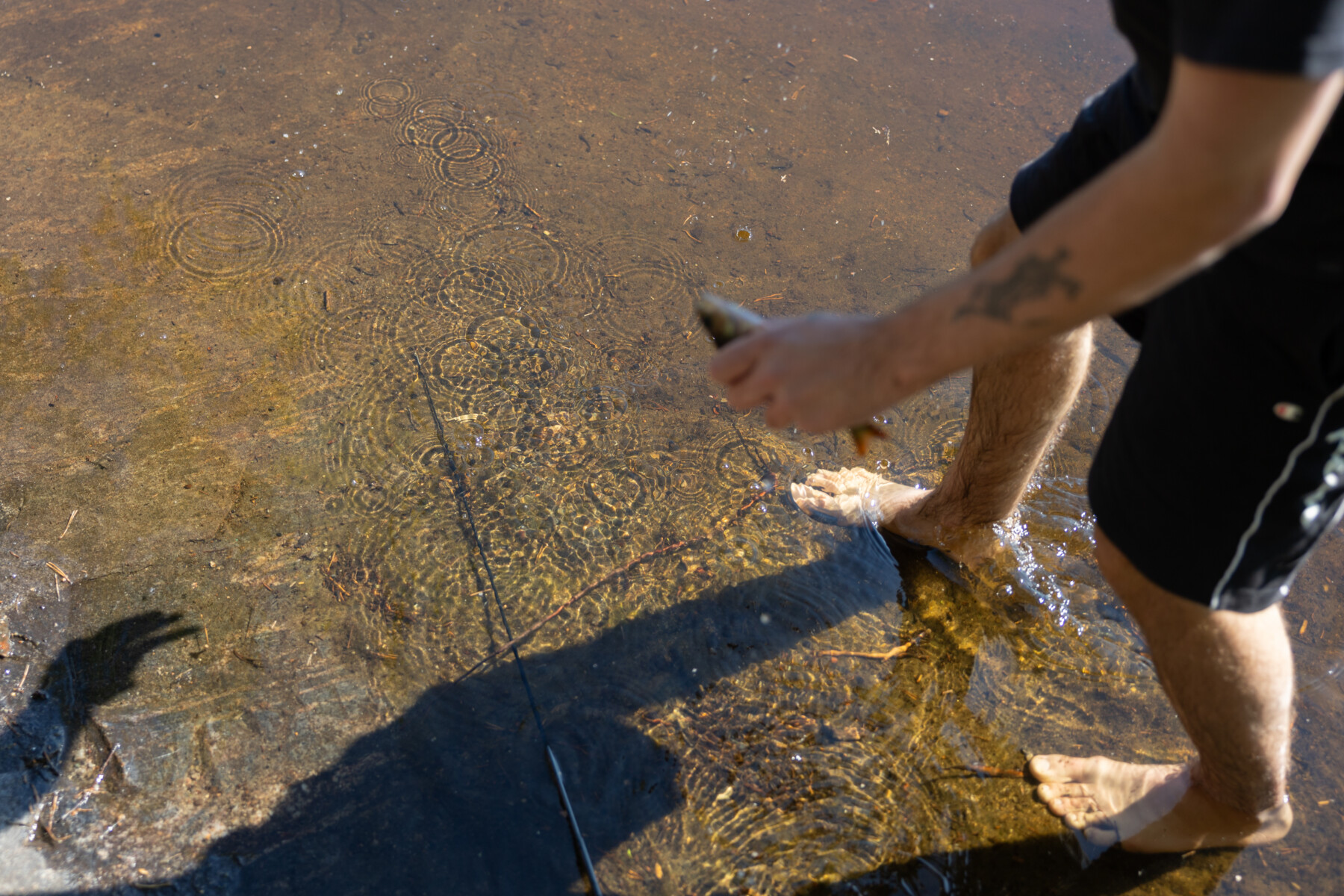
A man holds a small fish above clear shallow lake water.

A tiny perch is safely released back into Lake Fiskträsk.

The family spent the night in a tent. It was Nooa’s first time camping, but sleep came quickly and deeply.

“I wasn’t cold and I didn’t hear any scary noises,” he says.

“But I woke up a few times to a cuckoo calling!” Karlsson adds with a laugh.

Their bright blue tent may have been pitched a bit haphazardly, but it stood strong, and everyone fit inside, so mission accomplished.

Other tents dot the woods nearby. There’s plenty of space for everyone.

Pancakes and peace
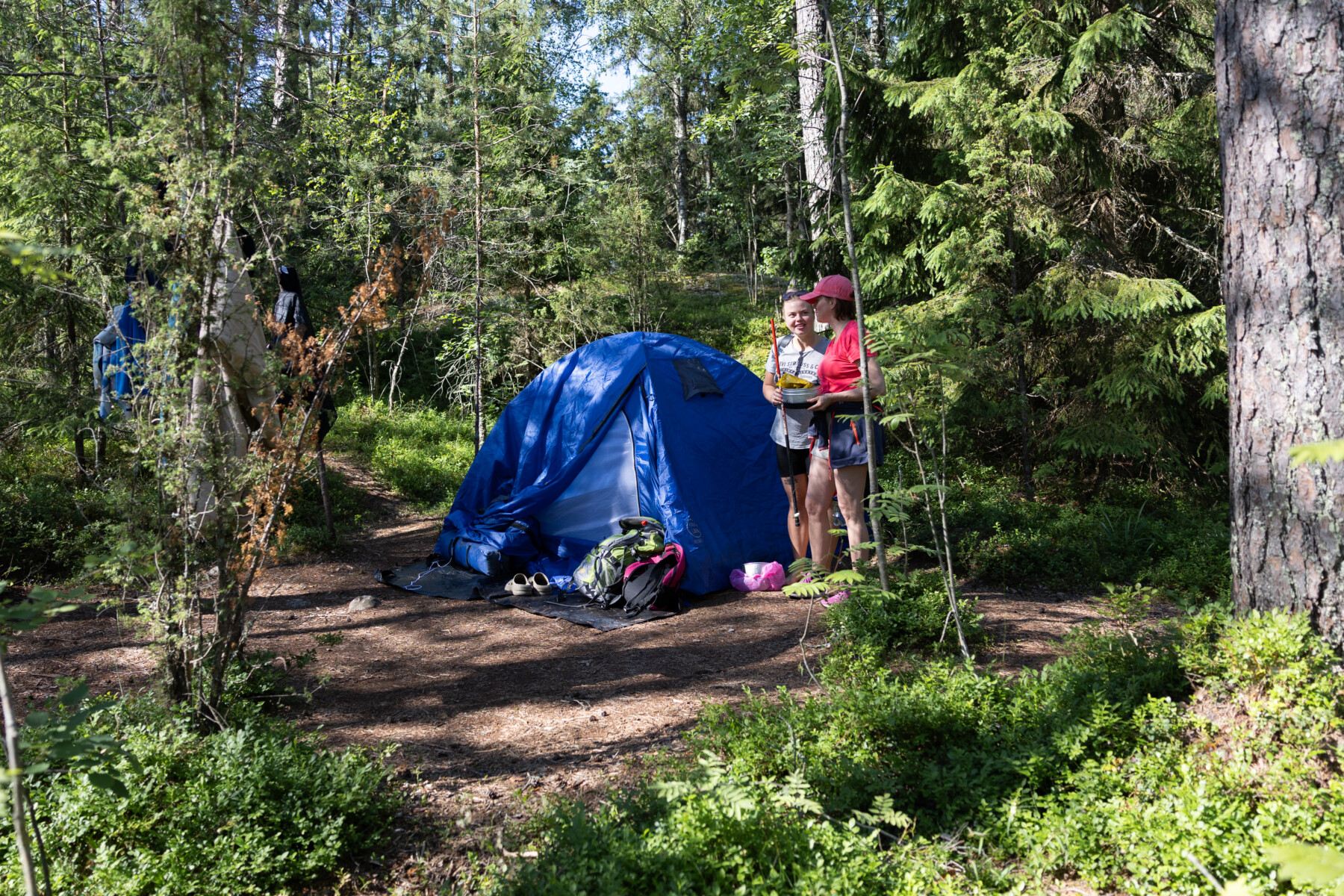
Two women stand beside a blue dome tent pitched in a lush green forest.

In most Finnish national parks, camping is allowed only at designated sites, like Fiskträsk. This camping site offers a cooking shelter and composting toilets just a short walk away.

It’s time for breakfast. Karlsson sets up a camping stove, adds a stick of butter, and pours pancake mix into the pan. The scent is divine.

In addition to food, water and spare clothes, they’ve brought a few fun things for the kids, like Nooa’s fishing rod.

“It’s good to have something exciting for them to do,” Karlsson says.
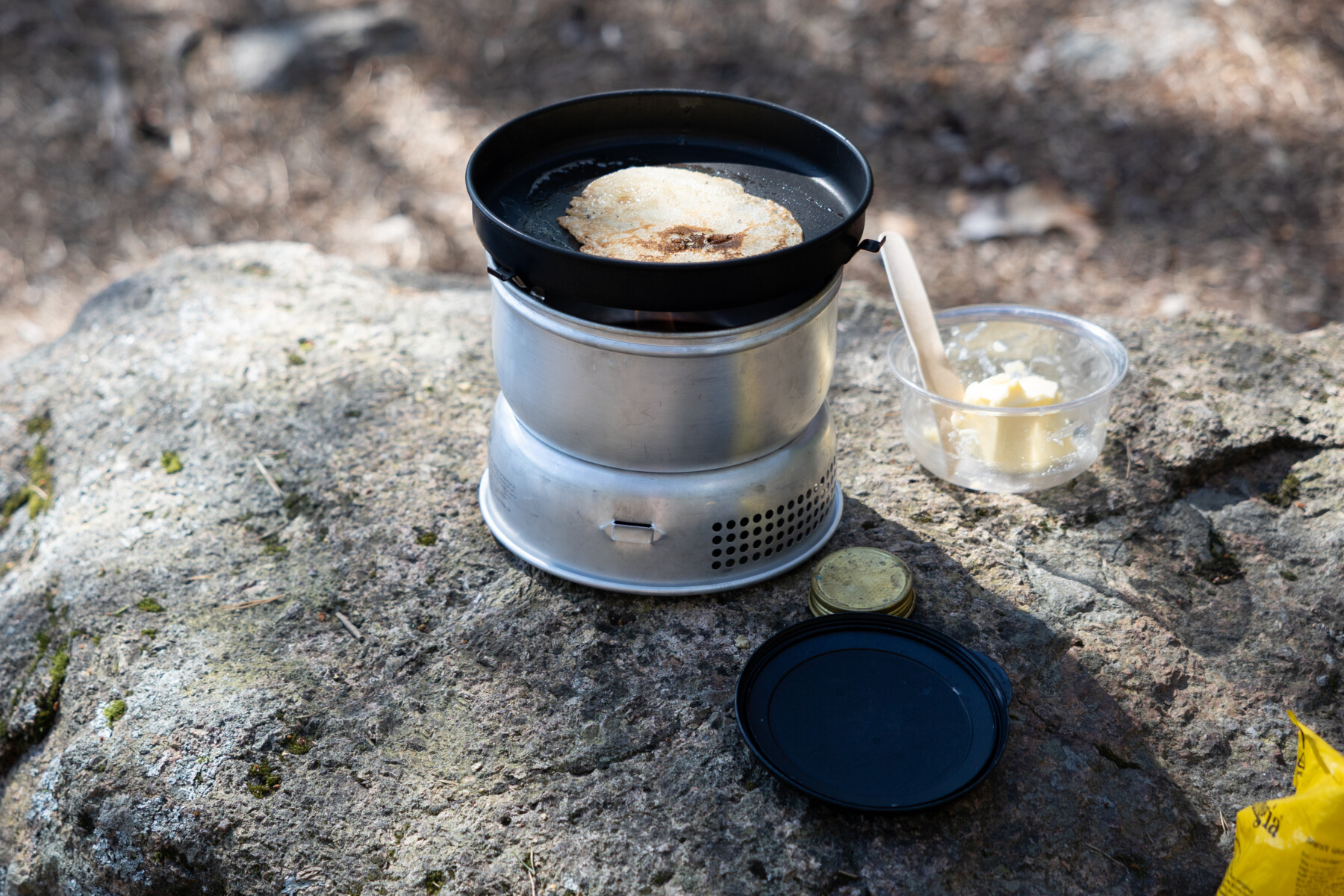
A camping stove rests on a flat rock with a frying pan heating food in a forest setting.

Everything tastes better when enjoyed out in nature.

The family has camped before, when Sjöholm was still little. These memories stick. Shared adventures bring people closer.

Karlsson uses these moments in nature to teach the children an important lesson: respect the environment.

“Everything we bring in, we take back with us,” she says. “And the forest is a place for calm.”

Peace and privacy on your own island
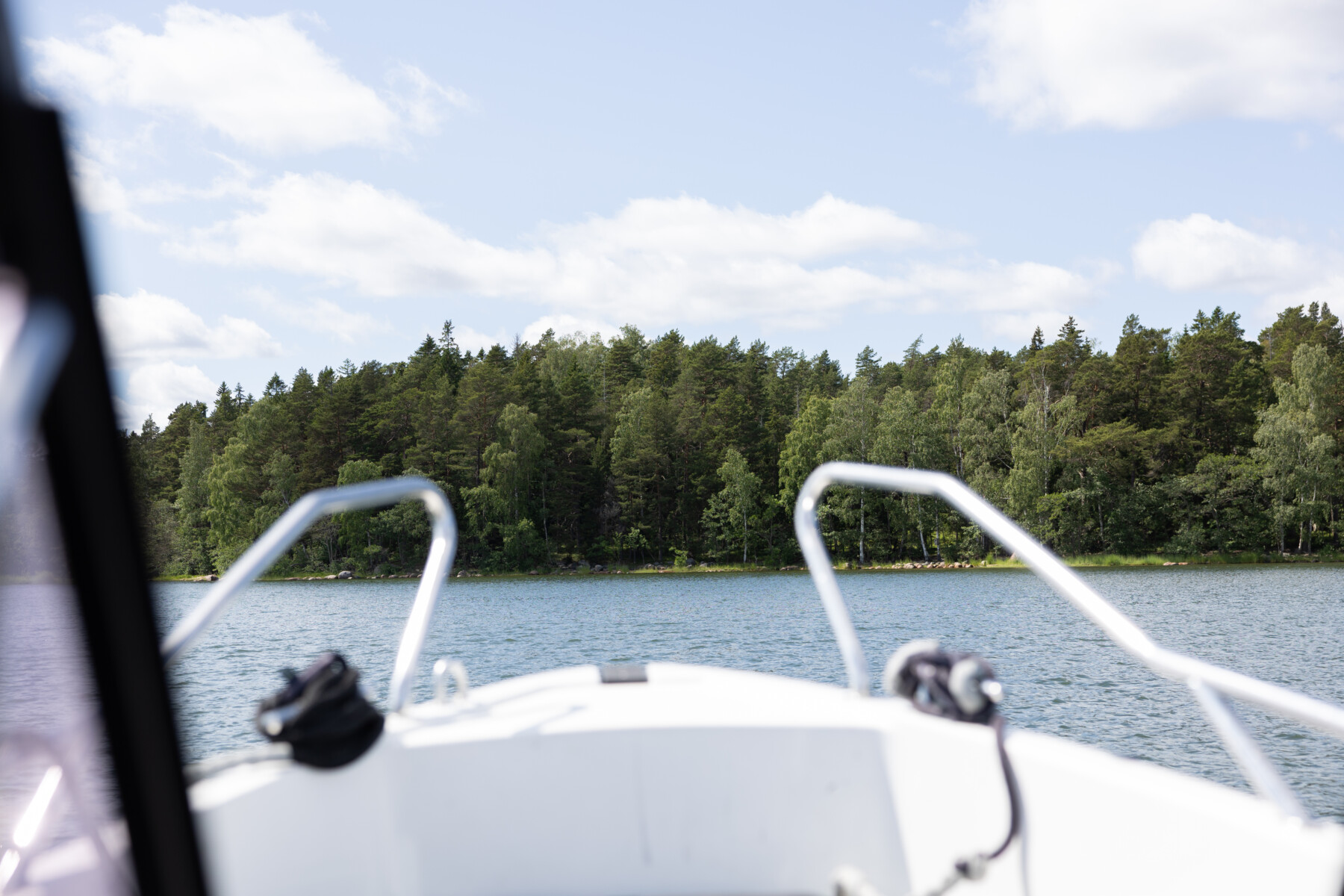
The front of a small white boat with railings approaches a forested shoreline across calm water.

Tvijälp Island lies peacefully off the coast of Espoo. Reachable by private boat or shared transport, the island also hosts kayaking trips, yoga retreats and other activities.

On the other side of the metropolitan area, a motorboat winds its way through the Espoo archipelago. A great crested grebe nests by the shore. A swan glides toward the open sea. With each passing islet, the hum of city life fades behind.

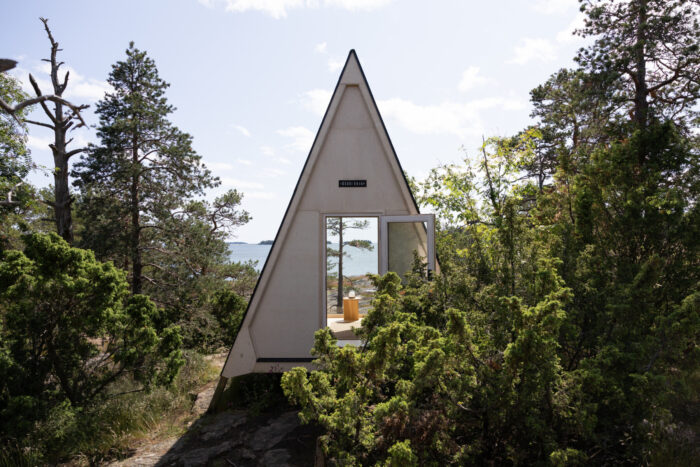
At the dock on Tvijälp Island, Roope Lemmetti, CEO of the Nolla Company, welcomes visitors and leads them up through a forest of pine and moss-covered stone. At the top of the hill, triangular cabins come into view, tucked among the trees and oriented toward the sea. These are Nolla Cabins.

Inside, everything is pared down to essentials. There are two tidy beds, a compact stove and just enough space to sit and look out. A wide window fills one end of the structure, framing open water and scattered islands as if the whole cabin were built around the view.
There is no running water and no excess. A composting toilet is located discreetly among the rocks. Meals are cooked outside over a fire or carried in from the mainland. Visitors bring what they need in backpacks, including food, water and sleeping bags, and leave just as lightly.

“Guests arrive with a good dose of adventure,” Lemmetti says with a grin.

Sustainability in its DNA

The cabins on Tvijälp Island seem to rest gently on the land. Their foundations are light and temporary, designed to leave no trace behind if ever removed. Built in 2018 by Finnish designer Robin Falck, they were meant to test an idea: How lightly can we tread when building something new?

The concept has grown since then, but the core intention remains. Guests are asked to stay on marked trails, recycle what they use and carry away what they bring. The rhythm here is slower, shaped by the tides, the light and the sound of birds overhead.
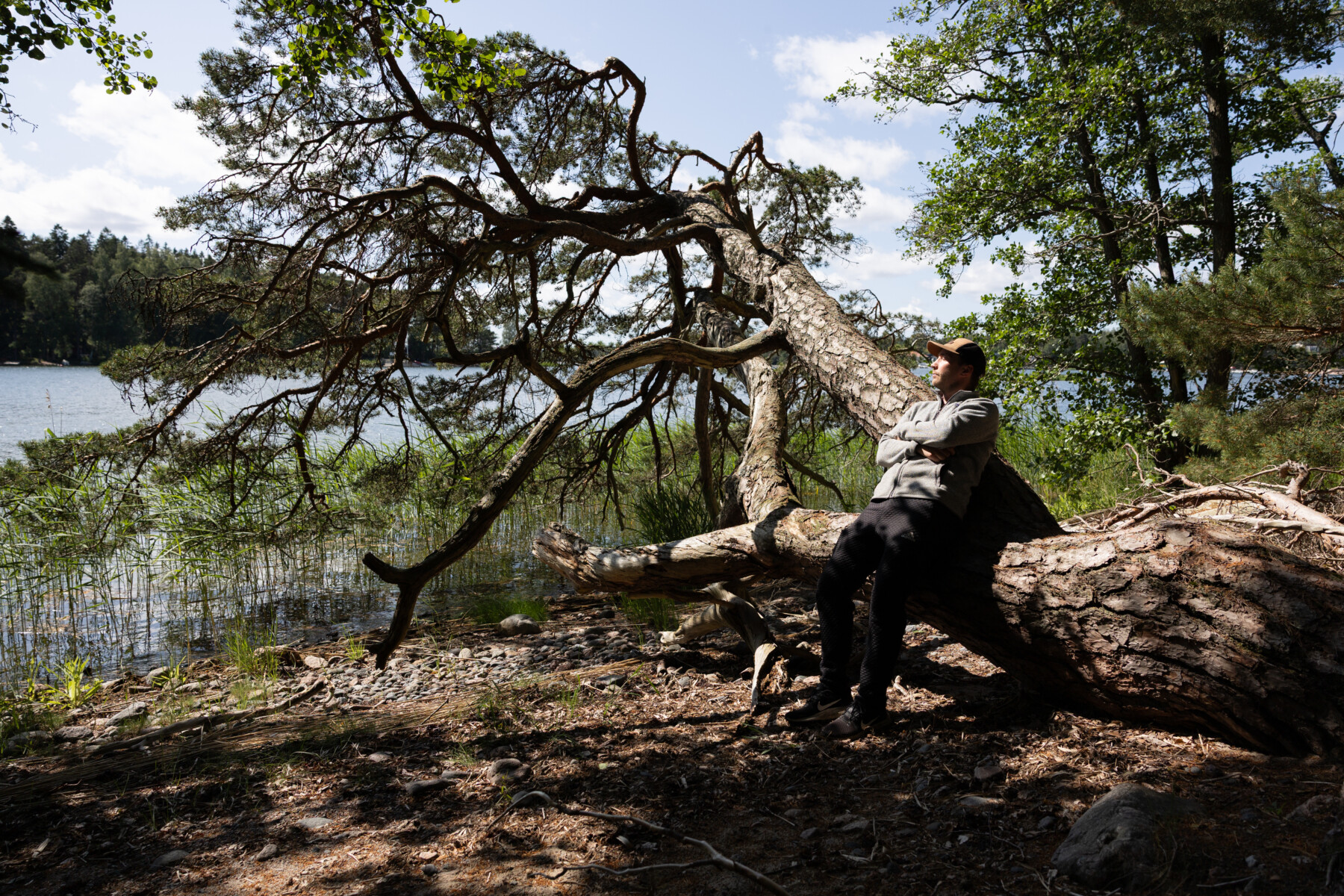
A man reclines against a pine tree beside a calm lake.

A 24/7 emergency line is available on the island, just in case. “This kind of stay isn’t for everyone, but for some, it’s perfect,” says Roope Lemmetti.

“We’ve hosted guests from all over,” says CEO Roope Lemmetti, “Especially the Netherlands and Japan. Some keep coming back, year after year.”

A walk around the island reveals rugged cliffs, peaceful forests, sandy shores and flower-filled meadows. In autumn, the island bursts with blueberries, lingonberries and mushrooms, which are all free to forage under Finland’s “every person’s right.”

“Guests have spotted dozens of bird species and even deer,” Lemmetti adds. “This is the ultimate stay if you truly want to immerse yourself in nature.”

Glamping by a national park
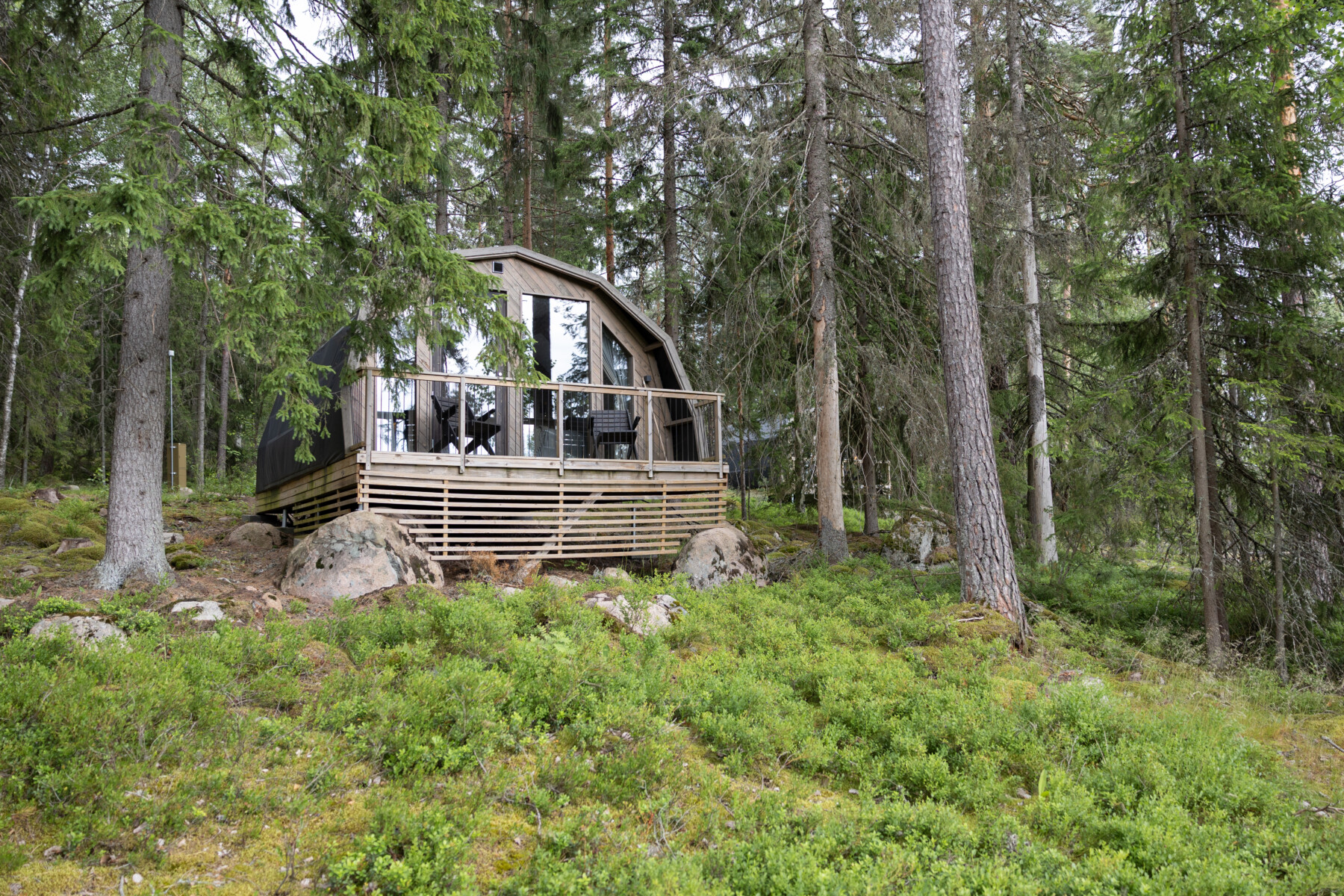
A modern wooden cabin with large windows stands on a forested slope among tall trees.

At Haltia Lake Lodge, you can stay in a tent surrounded by peaceful forest in the heart of Nuuksio National Park, just a stone’s throw from all the amenities.

The tents at Haltia Lake Lodge sit quietly among the trees, spaced just far enough apart that you feel alone in the woods. The tent is tall enough to stand in, and the bed inside feels like something from home, just slightly better. Through the window, evergreens sway gently, and a birdhouse hangs from a nearby spruce. At night, the forest seems to breathe around you.

This is glamorous camping, or “glamping,” with the comforts of a real bed and shelter, but still close to nature. Just over half an hour from Helsinki, the tents sit at the edge of Nuuksio National Park. Trails lead out almost immediately behind them, winding past tranquil ponds, rocky cliffs and patches of open wetland. Some paths are easy and level; others climb high enough to look out over the treetops.

“There’s no television here, but our guests enjoy birdwatching instead,” says Teemu Tuomarla, CEO and co-founder of Haltia Lake Lodge.
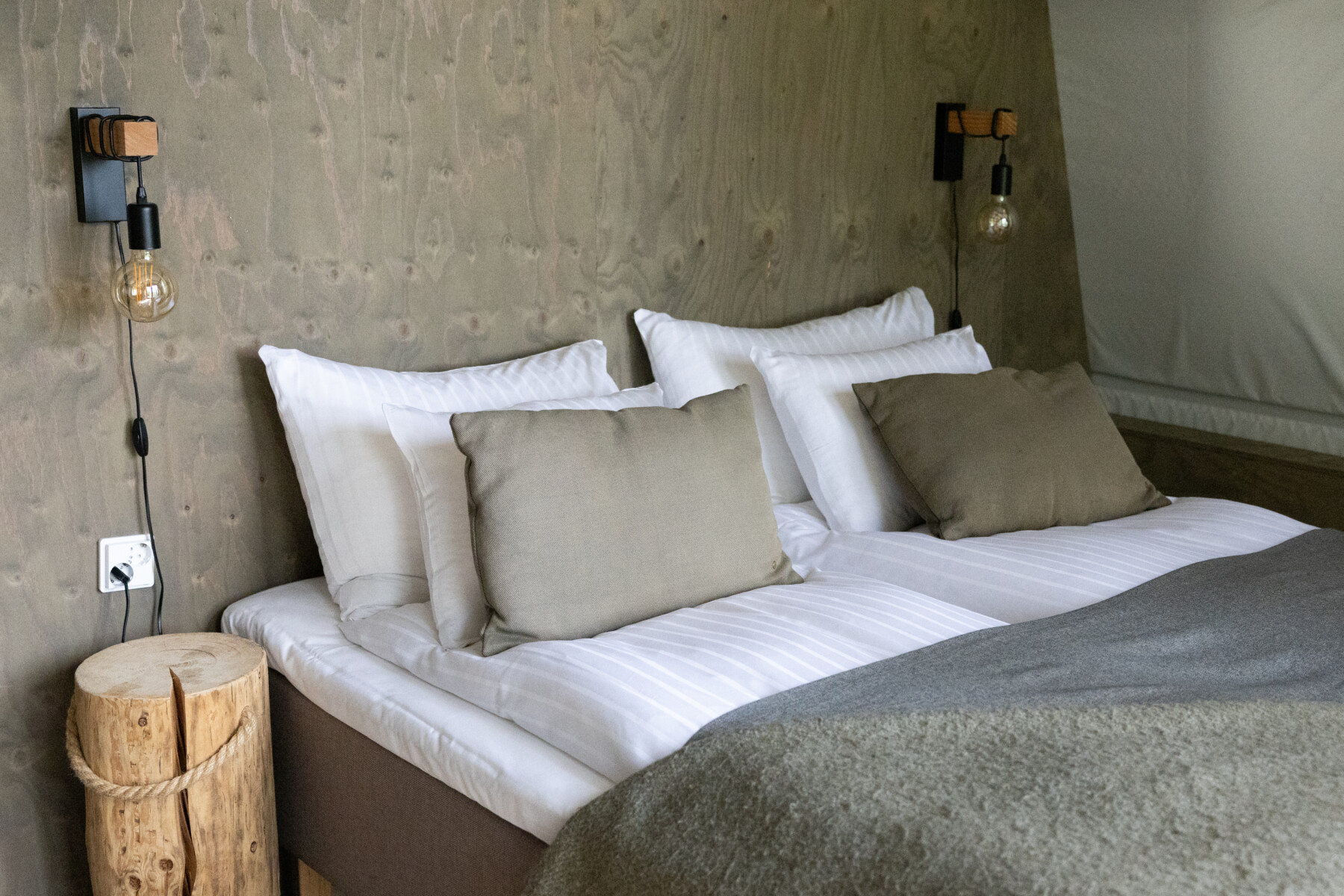
A neatly made double bed with minimalist decor stands inside a softly lit room.

Glamping at Haltia Lake Lodge adds a touch of luxury to the classic camping experience.

After a long day of hiking forest trails, guests return to hot showers and a sauna just steps from their tent. The air cools quickly in the evening, and walking back through the trees with damp hair and warm skin, the forest feels both vast and intimate.

Wrapped in forest silence

There’s no running water here. Drinking water is brought in by container, and the forest itself takes care of most of the atmosphere.
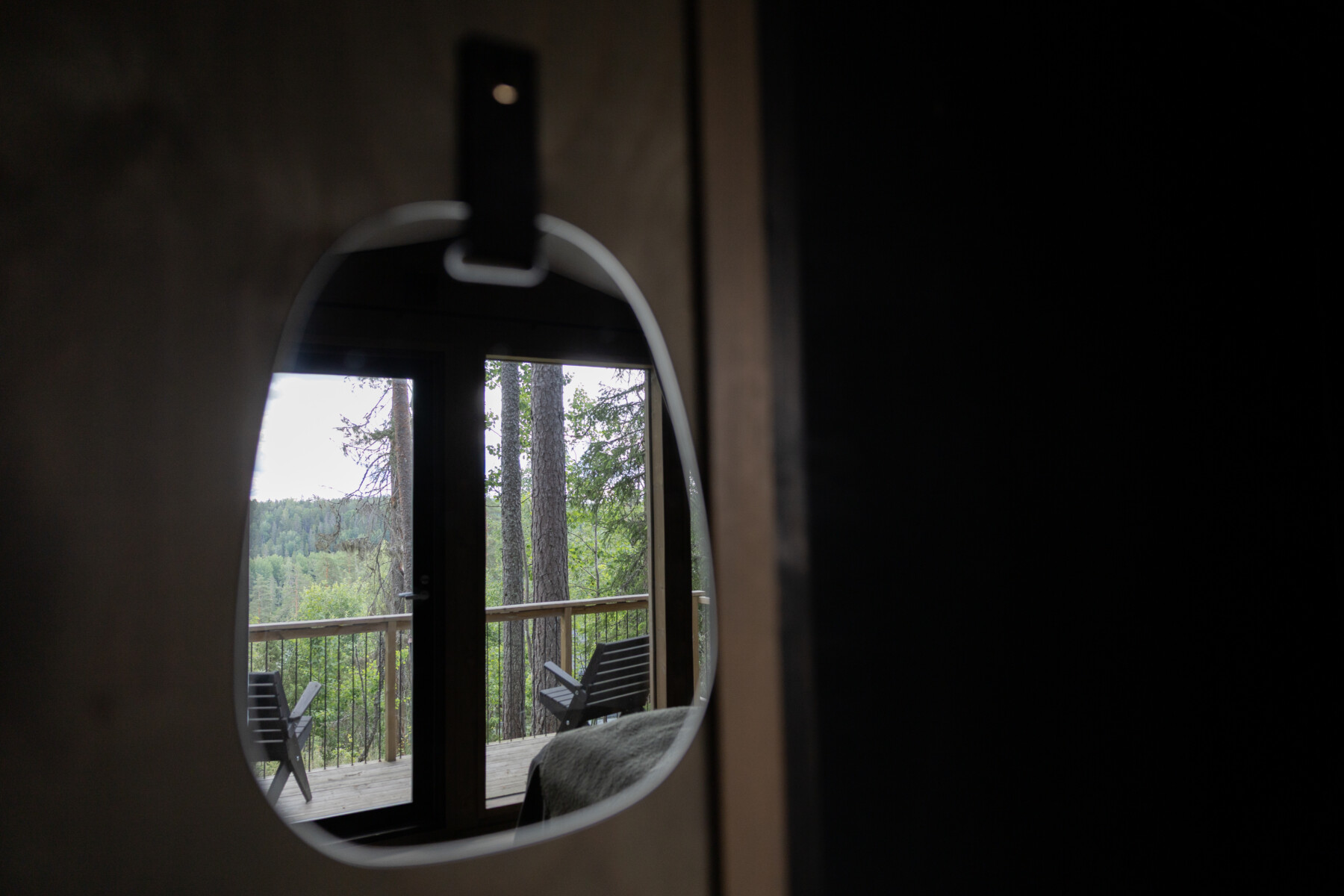
A round window reveals two reclining chairs on a balcony overlooking a dense green forest.

From your tent, take in the ever-changing forest landscape, shifting with the seasons, the weather and the light.

Instead of walls, the tents are made from insulated canvas. Rain falls with a soft rhythm on the roof, and in spring, birdsong fills the air. The fresh scent of damp forest drifts in with the breeze.

Even in winter, the space stays warm. Tuomarla once spent the night here in minus 20 degrees Celsius (minus four degrees Fahrenheit).
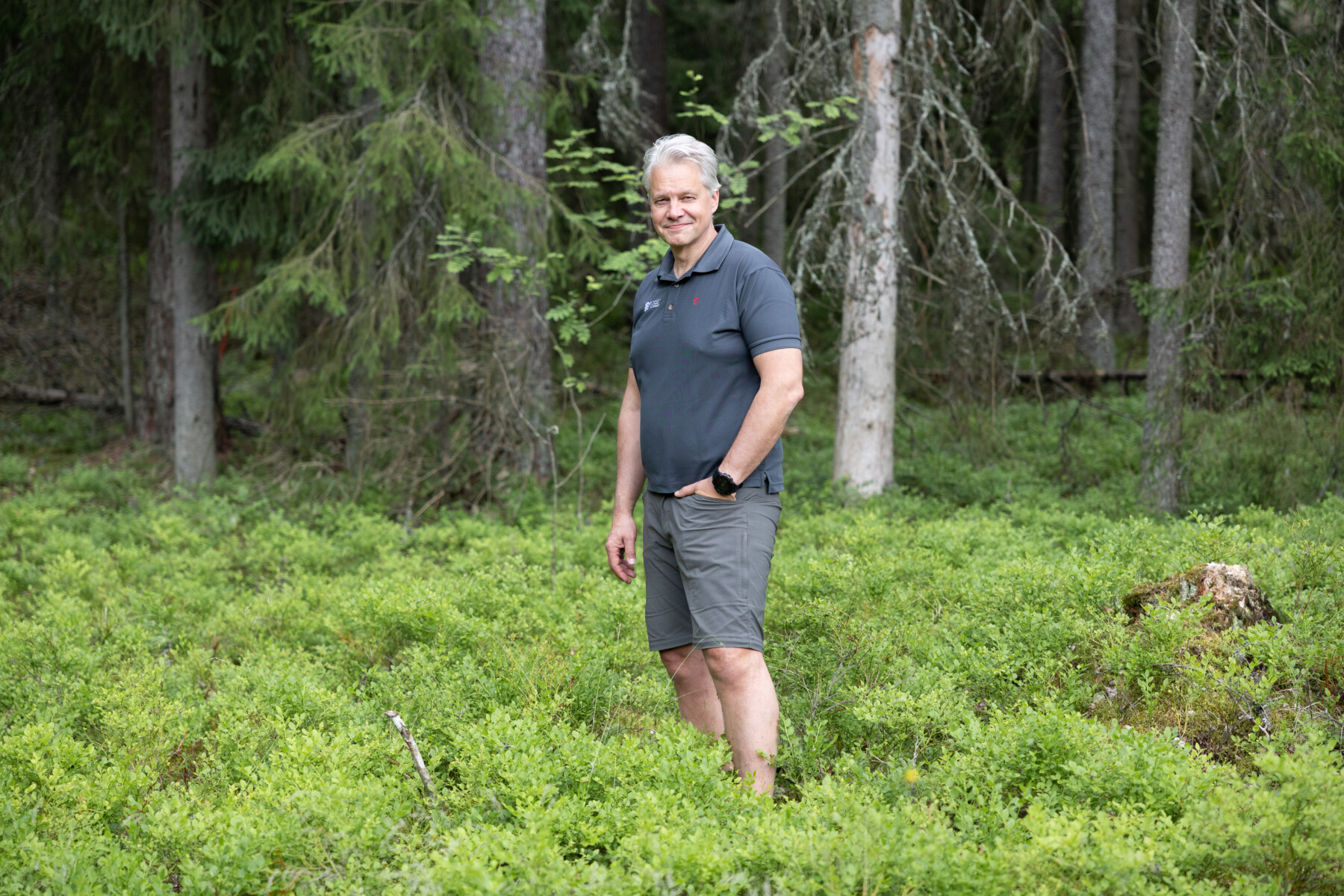
A man stands in a leafy green forest surrounded by trees and low vegetation.

Since Teemu Tuomarla opened glamping tents in September 2021, tents have become a favourite among guests from Germany, France, the Netherlands and the UK.

“The forest was absolutely beautiful that night,” he says.

He especially recommends the experience for couples, though anyone looking for quiet might feel at home here. And sometimes, in the clear winter sky, the Northern Lights pass silently overhead.

Text and photos by Emilia Kangasluoma, September 2025
Calculating how much dairy, meat and veggies people in Finland consume

People in Finland consumed an average of 130 kilograms of liquid dairy products, 78 kilograms of meat, roughly 87 kilograms of cereals, nearly 14 kilograms of fish, 12 kilograms of eggs, 65 kilograms of potatoes, 48 kilograms of fruit and 64 kilograms of vegetables.

Consumption of beef and poultry increased. Oats consumption has been significant for a long time, and it broke a new record last year. Fish consumption decreased from the year before.

These estimates are based on the Balance Sheet for Food Commodities published by the Natural Resources Institute Finland.

Only local sources: A Finnish chef creates acclaimed cuisine in a small town

Pinecones and milk. That’s what the menu said last summer at Restaurant Solitary.

When chef Remi Trémouille started his first own restaurant a few years ago, his goal was clear: take traditional Finnish ingredients and turn them into exciting new dishes, source everything as near as possible and build the frequently changing menu around whatever is available at any given time.

The vision has become a globally acclaimed fine-dining restaurant in the small town of Rantasalmi. It has inspired Trémouille’s team to create dishes with ingredients that have taken even the seasoned chef by surprise.

“Since opening the restaurant, I’ve truly understood how many ingredients are out there. But the pinecones were the biggest surprise by far.”

The candied green pinecones and homemade mozzarella with early-season green strawberries became an instant hit. Even though, faithful to the concept, the dish was on the menu only for a short period of time, customers are still asking after it more than a year later. Trémouille has just received a message from a Central European couple who have been in the restaurant over ten times, asking if there is any chance to enjoy the pinecones again on their upcoming visit.

“I still have some ten pinecones in the freezer reserved for very special guests,” he reveals.

A surprise homecoming

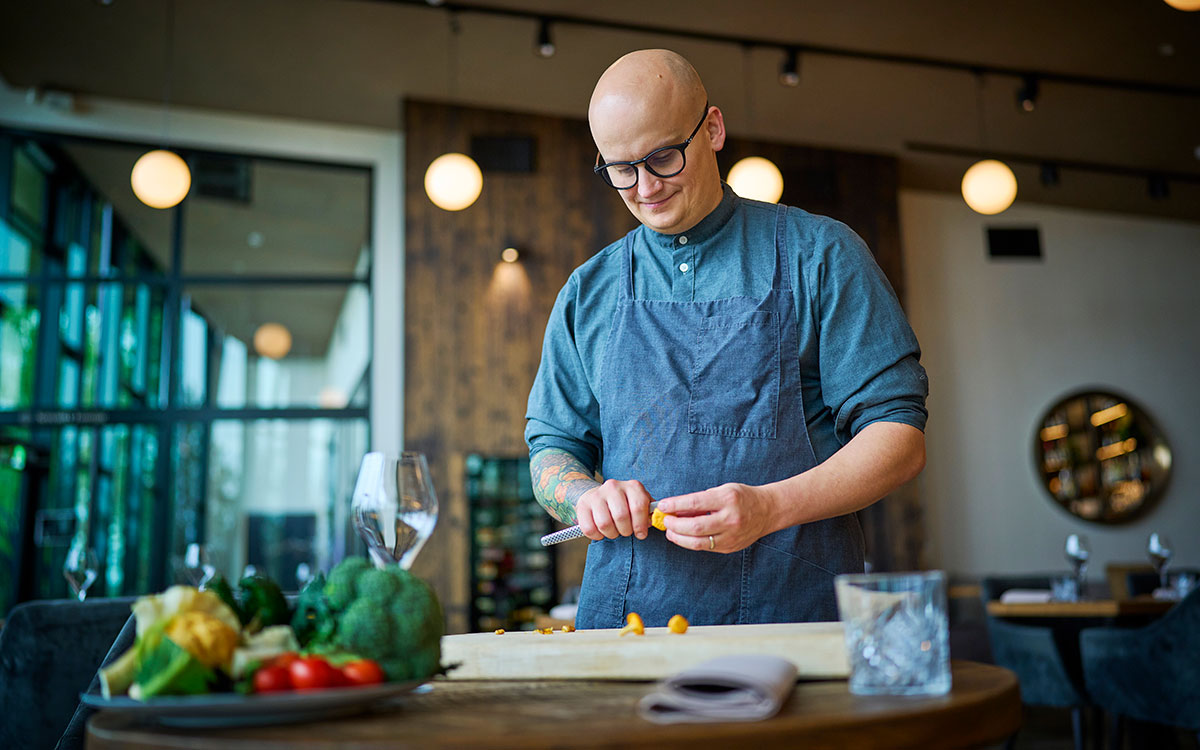
Inside a restaurant, a chef prepares fresh wild mushrooms beside a plate of local vegetables.

The commitment to only seasonal and available ingredients means diners never know what will be on Solitary’s menu.Photo: Timo Villanen

Starting a restaurant in a town of roughly 3,000 inhabitants in the Southern Savo region of eastern Finland was not Trémouille’s original plan. Growing up, he couldn’t wait to leave Rantasalmi. He quit school, started working at restaurants, moved to Helsinki and worked his way up in the capital’s Michelin-starred restaurants. For years, he lived and worked in Australia and Bali.

When the pandemic shut down fine-dining restaurants, Trémouille found himself out of work. Then, he received a call from his first boss, Markus Heiskanen. A luxurious new resort, Kuru, was in the works in Rantasalmi, and the entrepreneur asked if Trémouille would be interested in working there.

“I asked my wife Laura, who was born and raised in Helsinki, if she would mind if we moved to Rantasalmi. She said OK, and here we are,” he laughs.

Returning to his old hometown to start his own restaurant meant returning to his roots in more than one way.

Trémouille was born in France to a French dad and a Finnish mom but spent his formative years in Rantasalmi. Fishing on the lake with granddad and cooking local dishes with grandma are some of his fondest childhood memories. Returning to the small town, now to start his own family, felt right.

“I left Rantasalmi because, at the time, the nearest good restaurants were in Helsinki. Nowadays, there are great restaurants across Finland, all the way to Lapland.”

Founding Solitary meant taking a new approach to traditional Finnish ingredients. The restaurant’s core idea is to source everything from local farmers, fishermen, hunters or producers. The staff also picks wild herbs that grow just outside the restaurant, and if there’s brown hare on the menu, it’s most likely brought in by Samuli Kuronen, one of Solitary’s chefs and an avid hunter.

The commitment to working with whatever is in season and available means that diners never know in advance what will be on the menu. This sets Solitary apart from many other restaurants, where “local” ingredients are sometimes sourced from far away because the menu promises a certain dish throughout the season.

“We make do with what we have. If the ice on the lake is too thin for the local fishermen to go and cast nets underneath using ice holes, we won’t have fish on the menu that week,” Trémouille  explains.

The approach presents both opportunities and challenges. On the one hand, it pushes Trémouille and his team to be creative and resourceful, but on the other, it can sometimes be a little stressful.

“Once, we had to change the menu six times in one week. To be honest, that wasn’t ideal,” Trémouille says with a laugh.

It takes a village

To make his concept work, Trémouille had to create strong connections with local people. Building networks has taken a lot of time and footwork, but Trémouille proudly says that Solitary is now the biggest customer for many producers in the area.

The impact of using local ingredients in haute cuisine can extend beyond one restaurant’s supply chain.

“When we use traditional ingredients to make something a little trendier, I hope we inspire people to use those ingredients more. That, in turn, helps to develop local production and creates jobs. The trickle-down effect can be significant.”

Trémouille believes that going to “source zero” is the best way to ensure the highest quality ingredients. The producers, who Trémouille always calls only by their first names, are invested in making sure everything they deliver to the restaurant is as fresh as possible. Working closely with locals also offers greater flexibility. Just the day before, a farmer dropped off some freshly picked cherry tomatoes in Trémouille’s carport while the family was away for the weekend.

“This wouldn’t be possible if we sourced our ingredients from wholesale.”

As word of the restaurant and its philosophy has spread, locals have started to offer their produce spontaneously. That’s why there are 40 litres of damson, a subspecies of plum, waiting at the restaurant.

“My childhood friend’s parents brought them. They had a massive harvest this year and said no-one in their family could take any more. They asked if I could use them. Damson is a completely new ingredient for me. We had already planned our menu for the week, but now we’ll just have to figure out something,” he says, grinning.

The restaurant also fosters a sense of community. People come to talk to Trémouille at the local store and are eager to direct visitors to the resort.

“The locals are very proud of our restaurant. I like to say we have over three thousand ambassadors here who wish us well and want to spread the word.”

After years of living in big cities, Trémouille has found the right balance of work and family life in Rantasalmi. Here, he can pass on his love and appreciation for nature and local ingredients to his children.

“We spend a lot of time outside, exploring what nature has to offer. I’ve also taken the kids to the local sheep farm, so they understand better where food comes from.”

By Lotta Heikkeri, ThisisFINLAND Magazine

Finland’s quirky sand skiing world championship also carries a climate warning

As skiers and spectators arrive at Kalajoki’s golden sand dunes for the world’s first Sand Skiing World Championships, a sense of excitement and laidback adventure is in the air.

Cross-country skiing, a cherished sport in Finland, takes on a surprising new form in this event. Swapping snow for sand, skiers in shorts and short sleeves navigated three laps of a 500-metre (550-yard) course set in a landscape reminiscent of a desert.

“Everybody’s very relaxed but there’s still a competitive edge,” says one contestant. “It’s good fun. It brings people together.”

Most participants find skiing on sand much slower than on snow, with the terrain offering much more resistance.

“It’s hard,” exclaims Maarit Knuutinen after completing the course in the Party category, dressed up as a witch. “I’m so tired.”

See what happens when people try to cross-country ski on sand.
Video: Erika Benke/ThisisFINLAND.fi

While the atmosphere is light-hearted, the event carries a more serious undertone. The championship highlights how climate change is affecting Finland’s winters – and the future of cross-country skiing.

“We’re worried that someday there might not be winter and snow that we can ski on,” says Merja Kakko, another witch-costumed skier. “That’s why we have to take action now. “We try to make environmentally friendly decisions in our everyday lives. Going on a bicycle instead of driving a car. We don’t travel a lot abroad. We buy locally produced goods.”

The event organisers want to highlight the impact of climate change in Finland, as winters become milder and less snowy.

“Sand skiing is fun, but we need snow for cross-country skiing,” says professional skier and coach Ida Meriläinen, who came up with the idea for the event. “We have a serious message: we want to protect our winters.”

Not all participants may have viewed the day through a reflective lens, but for some, there was a palpable sense of unease about how a warming climate is reshaping Finnish winters.

For environmentally mindful skiers like Merja Kakko, the novelty of sand skiing doubles as an act of environmental advocacy.

“Usually witches fly,” she says. “But nowadays it’s not so friendly for the environment to fly, so now we’re skiing.”

By Erika Benke, August 2025

5 reasons to love Finnish porcini mushrooms

1. They are delicious

Finnish porcini mushrooms are loved all over the world. They are amazing in pasta, soup or on their own sliced thinly with some thyme, salt, balsamic vinegar and olive oil. Dried porcini mushrooms keep for years and have an even richer flavour than fresh ones.

Porcinis are an important ingredient in both French and Italian cuisine. Each year, hundreds of tons of Finnish porcinis are exported to Italy, so if you have a risotto at a Roman trattoria, chances are that the porcini in it have grown in a Finnish forest.

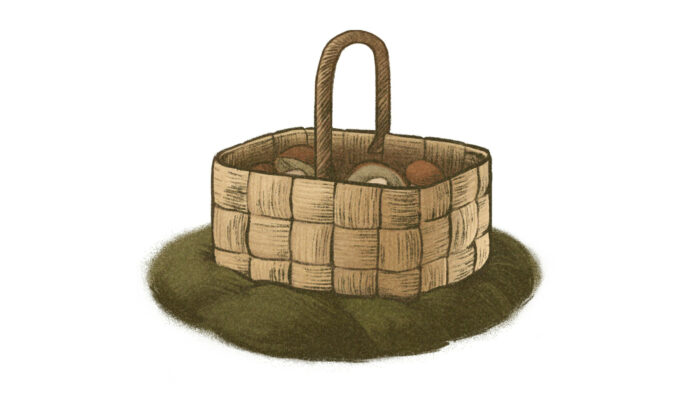
An illustration of a woven basket full of mushrooms.

2. They belong to everyone and no one

Most Finnish porcinis are in fact not exported but picked by Finns and enjoyed locally. Mushrooms are neither plants nor animals. Maybe that’s why mushroom picking in an autumn forest sometimes resembles treasure-hunting for mystical creatures.

Foraging is a great mindfulness exercise, too. It is difficult to think about deadlines and meeting agendas while finding your way to your secret porcini spots or looking for the right type of forest to find new porcini spots (young growth with spruce and birches), let alone figuring out if the mushrooms you’ve found are actually bitter bolete mushrooms and not porcini. It is not surprising about one third of Finns list mushroom-picking as a hobby, according to a Statistics Finland survey.

Mushroom picking is a low-thres­hold hobby as in Finland forest mushrooms belong to everyone and no one regardless of where they grow. Thanks to the legal concept of everyone’s right all people residing or visiting Finland are allowed to pick wild berries, mushrooms and flowers as long as they are not protected species.

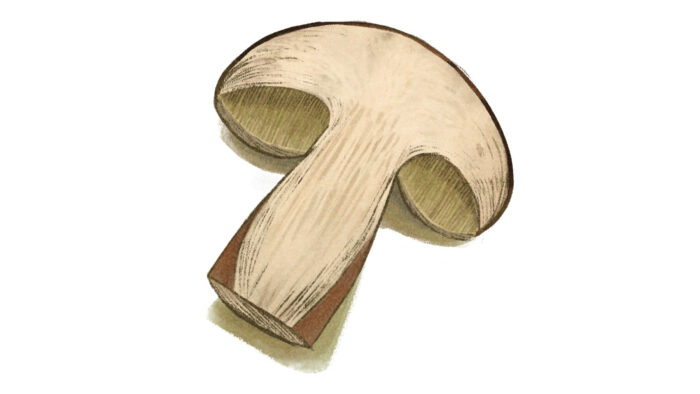
An illustration of one mushroom cut down the middle as a cross-section.

3. They are beautiful to all senses

When you hold a porcini mushroom in your hands, you certainly know you’re holding something valuable. They feel heavy and dense, and their surface resembles the softest luxury leather. Their fresh woodsy, nutty aroma remains to be discovered by perfumers, but their beauty hasn’t escaped the attention of designers and artists. In recent years we’ve seen a whole boom of mushrooms in interior design, including mushroom-shaped lampshades, stools and candleholders as well as mushroom motifs in textiles and tapestries. Mushroom-inspired décor such as Finnish artist Teemu Järvi’s porcini posters or textile artist Elina Helenius’ linen towel collaboration with Lapuan Kankurit allows you to enjoy the beauty of mushrooms outside the foraging season.

4. They are good for you – and the planet

Many of us are looking for climate-friendly and healthy alternatives for meat, and mushrooms are a popular option. They are low in fat and have a small carbon footprint. Mushrooms contain significantly more protein than most plants – dried porcinis have 30 grams of protein per 100 grams. Porcinis are also a treat for your gut as they contain similar amounts of fibre as wheat bran.

An illustration of a spruce tree with several mushrooms growing under it.

5. They teach us that what matters is on the inside

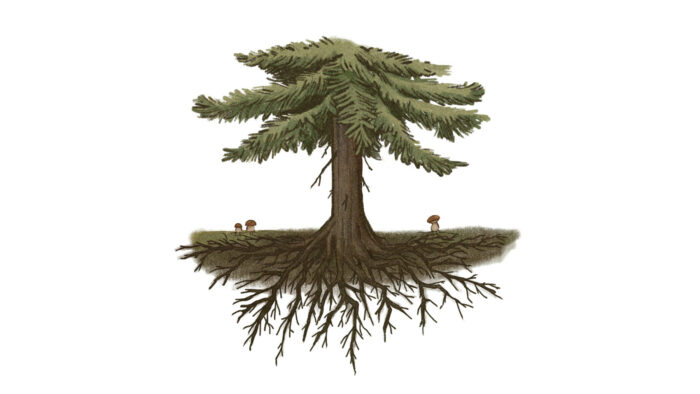
When we think about mushrooms we usually think of the part that can be picked and cooked. This means we ignore the majority of the fungal organism: mycelium that lives in the soil interwoven with tree roots. Mycelium, which is a root-like structure of fungus, connects mushrooms to each other and to symbiotic trees. Mycelium works as the transfer system for water and nutrients; it’s how mushrooms feed. It also helps different plants in the forest to communicate.

It seems to work as a communication network through electric impulses, but so far science has failed to explain how it functions. Nor do we know exactly how the symbiosis between the tree and the fungi actually works. This lack of understanding might at least partly explain why efforts to cultivate porcini (as well as truffles and chantarelles) haven’t been successful so far.

In fact, porcinis may have a lesson for us. They teach us that you need friends and networks to succeed, and that helping others will also help you. Some scientists even suggest mushrooms show that evolution is not always about the survival of the fittest – it can also be about the survival of those who form the best partnerships with each other.

By Ninni Lehtniemi; illustrations by Hilla Ruuskanen; ThisisFINLAND Magazine

Make air, not war: The joyfully absurd World Championships in Oulu

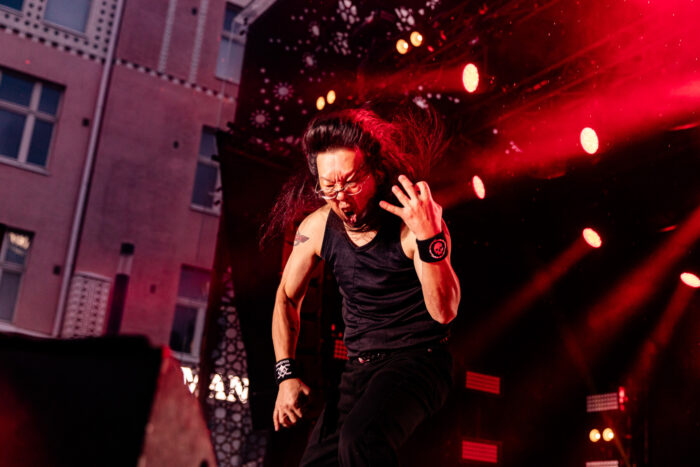
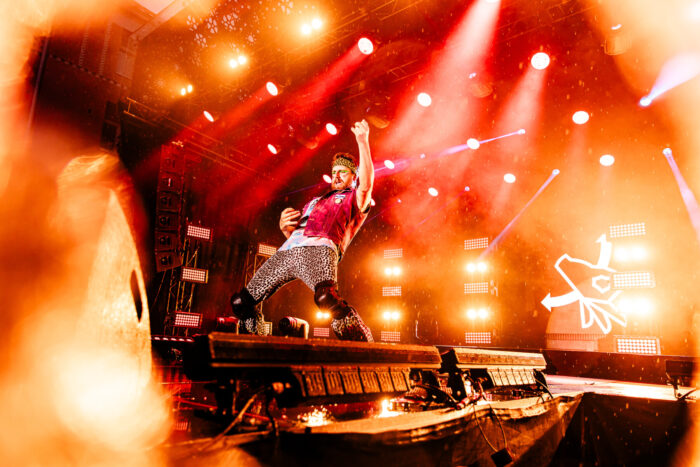
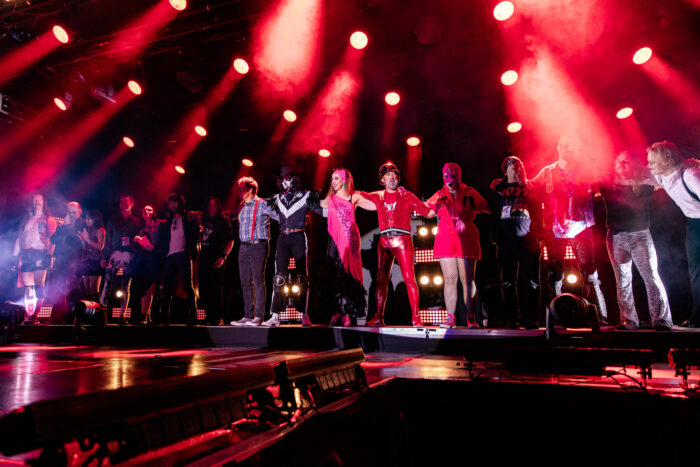
Each August, the northern Finnish city of Oulu becomes the epicentre of a global phenomenon: the Air Guitar World Championships. Since 1996, passionate performers from around the world have gathered here to battle it out – without ever touching a real instrument.

Check out the photos from the 2024 championships to see just how electrifying things can get!

From a wild idea to a worldwide stage

“When we first launched the event, we didn’t want to do it small,” says Pia Alatorvinen, Executive Director of the Oulu August Festivals.

“Since no one else had done it, we decided to go all in and make it the World Championships right from the start.”

And the rest is glorious, riff-filled history.

No guitar? No problem.

In the Air Guitar World Championships, competitors are judged not on how well they play a real instrument but on how convincingly they don’t. Each performance is a solo show of imagination, musicality, stage presence and charisma.

Participants choose whether to mime an electric or acoustic air guitar. They can even “use” a plectrum if they wish. Musical styles vary, but hard rock and heavy metal are perennial favourites.

It takes more than just nerve

Winning isn’t just about being wild on stage but it’s about fully surrendering to the music. Judges award points for technical prowess, artistic impression, originality, and above all, that undefinable quality known as airness – the ability to become one with the imaginary instrument.

Over the years, the event has grown into a full-blown international performance spectacle, which is partly competition, partly theatre and partly joyous cultural statement.

A peaceful protest, one riff at a time

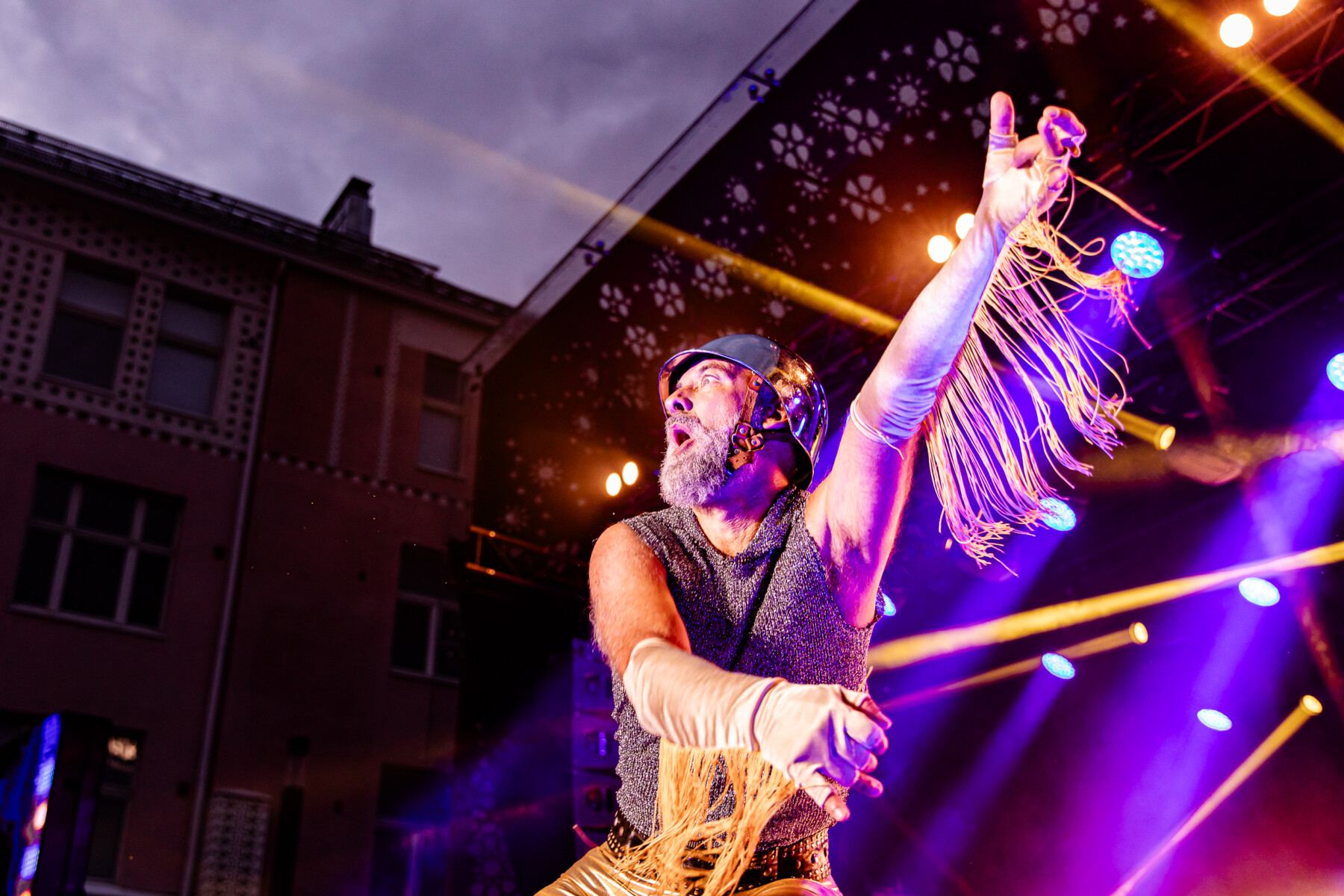
A bearded man wears a helmet and tasseled gloves as he plays an imaginary guitar.

Frederic “French Kiss” Reau from France.Photo: Roosa-Maria Kauppila / Oulu August Festivals

At the heart of the Air Guitar World Championships is a surprisingly powerful ideology: peace. The event’s long-standing slogan, Make Air, Not War, speaks to a deeper purpose.

“The idea is, if everyone in the world played air guitar, no one would pick up a gun,” Pia Alatorvinen says.

“It might sound naïve, but we believe it’s a real form of peace work.”

With today’s turbulent world politics, the message feels more relevant than ever. And as Alatorvinen notes, humour and play can be powerful tools for change.

“It’s a carnival of joy, generosity and laughter. It opens people’s minds to think differently and that’s how change starts.”

Text by Emilia Kangasluoma, August 2025

Quirky ’90s band Ultra Bra stages a stylish comeback at 30

The same July weekend as Britpop legends Oasis played their first reunion shows, another mega-successful ’90s band made a live comeback after a long hiatus – but one that’s little-known outside of Finland.

Marking its 30th anniversary, Ultra Bra headlined Ruisrock in Turku, one of Europe’s oldest rock festivals. They took the stage with about two dozen people, including large string and horn sections.

“You haven’t changed a bit; you look great,” quipped Arto Talme, one of Ultra Bra’s four vocalists. They led the audience in nostalgic singalongs – and premiered a new song, “Aarre” (“Treasure”), released nearly a quarter-century after the group’s phenomenal six-year run ended in 2001.

“When we went into the studio, none of us really knew what to expect. Even after all these years, the band started playing together in a way that felt special – something that we wouldn’t want to lose just yet,” said vocalist Terhi Kokkonen when it was released.

Ultra Bra became one of the biggest bands of the ’90s in Finland, which was a surprise since their sound is far from Britpop, grunge or electronica. Instead it’s cinematic, retro pop with soaring vocal harmonies. Pianist-composer Kerkko Koskinen’s catchy melodies and lush arrangements of horns and strings bring to mind old James Bond, Henry Mancini and Quincy Jones LPs.

Beginning in 1996, the group scooped up nine Emma (Finnish Grammy) awards, including an unbroken four-year streak as Group of the Year. Three albums went to number one, and four reached platinum sales.

Songs about breakups – and wind power

Two women in dresses and two men in suits stand onstage singing with a bassist and drummer in the background.

Vocalists Terhi Kokkonen, Vuokko Hovatta, Arto Talme and Olli Virtaperko at Turku’s Ruisrock Festival in July 2025.Photo: Sinimaaria Kangas

The band was started as a lark by university students, many of them from well-known cultural families. The set-up was inspired by 1970s Finnish leftist bands like Agit Prop, which similarly had two female and two male singers. Yet while UB’s songs commented on politics and current affairs, they did so with a smirk.

“I don’t think we ever did agitation or propaganda as such. Rather, we used the musical language and passion of the old political movement to sing about our own lives,” says the band’s guitarist and graphic designer, Joel Melasniemi.

Most of their hits focus wryly on interpersonal relationships. The two biggest, “Minä suojelen sinua kaikelta” (“I Will Protect You From Everything”) and “Sinä lähdit pois” (“You Went Away”) appeared on their bestselling second album: Kroketti (“Croquet”) in 1997.

The first has become a sort of anthem for young climate activists, while the latter song sketches a breakup, the narrator watching her lover leaving after an all-night party and quipping laconically: “the last drink of the night/turns into breakfast/I added coffee to it”.

Like most Ultra Bra lyrics, these are by Anni Sinnemäki, who was once married to Koskinen. She went on to publish two books of poetry, become leader of the Green Party, a cabinet minister and now deputy mayor of Helsinki.

In “Kahdeksanvuotiaana” (“At the Age of 8”), she recalls growing up with the dread of nuclear war. And in the chorus of “Ilmiöitä” (“Phenomena”) – written in 1999 when she was an MP – she wondered why there was “still no wind power”. Thankfully, now there is, and it’s Finland’s second-largest source of electricity.

One of the main singers, Vuokko Hovatta, became an actor and released solo albums, while the other, Terhi Kokkonen, published an award-winning novel and formed a pop band called Scandinavian Music Group with Melasniemi and two other UB alumni. It has far outlasted the mother band, releasing ten albums since 2002.

Agatha Christie and euroscepticism

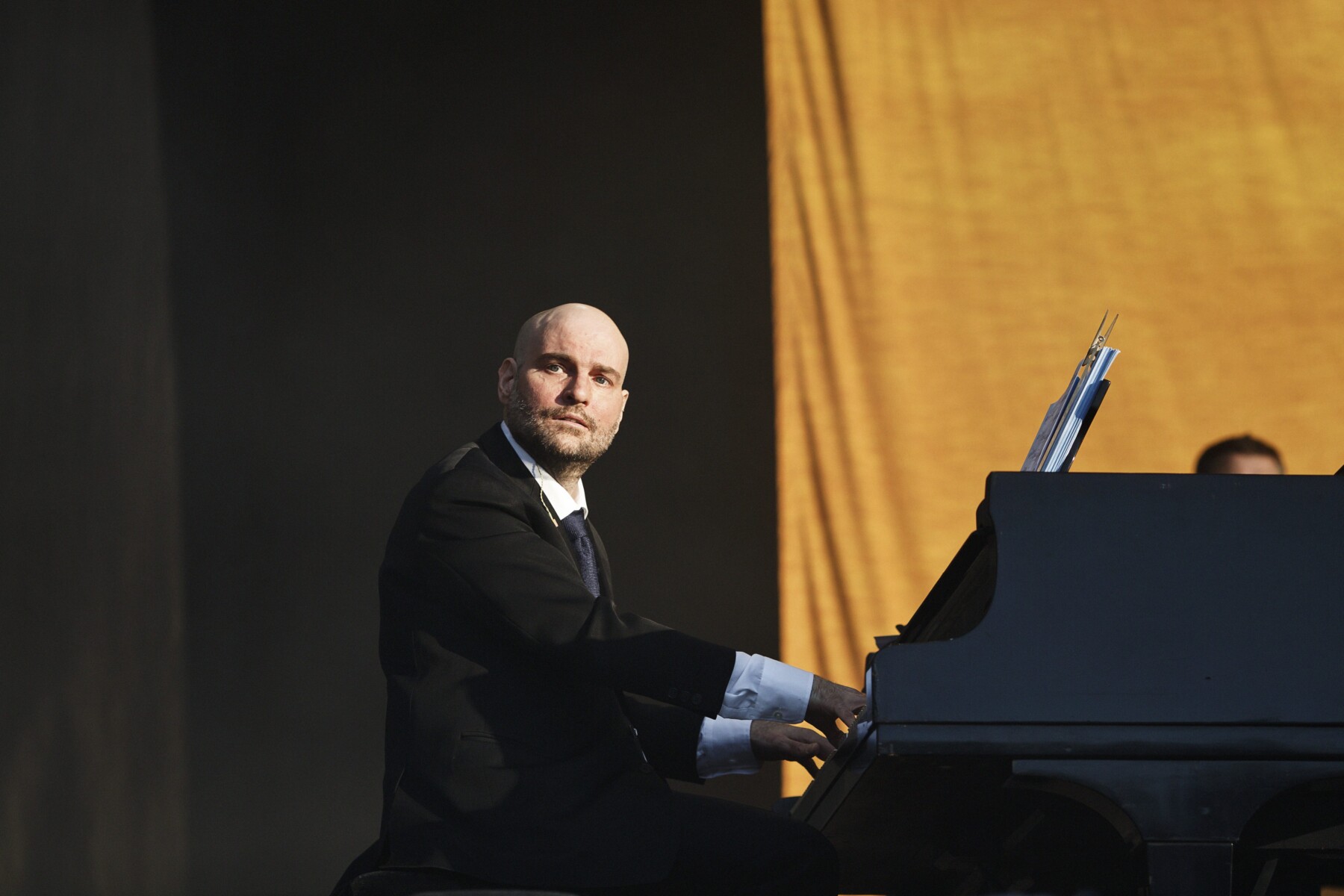
A man in a black suit looks toward the camera while playing a grand piano onstage.

Pianist Kerkko Koskinen composes and arranges the band’s timeless pop.Photo: Roni Rekomaa / Lehtikuva

Since the group split up in 2001, Koskinen has released a series of albums, including two instrumental suites inspired by Agatha Christie mysteries featuring the UMO Helsinki Jazz Orchestra. Agatha 2 from 2003 features an instrumental big-band reworking of Ultra Bra’s “Sokeana hetkenä” (“In a Blind Moment”), one of Koskinen’s loveliest melodies, starring jazz saxophonist Linda Fredriksson, who played a fierce baritone solo at Ruisrock.

Another vocalist, Olli Virtaperko, now a contemporary classical composer, recalls that Koskinen was already a promising bandleader in the early ’90s.

“The core group of Ultra Bra attended Kallio Upper Secondary School of Performing Arts in Helsinki. We all used to get together at Kerkko’s house, where he led us in playing and singing all kinds of music, from jazz standards to pop classics,” he says.

A few years later, when they had all gone on to university, Virtaperko suggested to Koskinen that they get the old gang back together to record an entry for a political song contest, which they won with a semi-serious anti-EU song. The lyrics were by Juhana Rossi, now editor of a Finnish business daily and reporter for The Wall Street Journal. Finland had just joined the EU, which rankled leftist university circles.

“The prize for the competition was the opportunity to record a five-song EP in Tampere in the summer of 1995. On the way back from the Tampere studio, we came up with the name Ultra Bra” – which has nothing to do with lingerie, but simply means “ultra good” in Swedish.

That debut EP, Houkutusten kiihottava maku (“The Exhilarating Taste of Temptation”) came out in 1995, followed by four full albums over the next five years and a farewell collection in 2001.

In 2012, the band briefly reunited to play a benefit for Green presidential candidate Pekka Haavisto, followed by reunion gigs five years later. This summer they’re playing three festivals, followed by two nights in late August at Helsinki’s Olympic Stadium, which holds up to 50,000 people.

“We have nothing planned beyond the Stadium gigs, but no closed doors either,” says Melasniemi. “Releasing new music has been a positive experience. Let’s see!”

Ultra Bra’s songs captured the zeitgeist of late-’90s Finland, and so now pack a nostalgic punch for many middle-aged people. Meanwhile their songs have been rediscovered by a new generation of fans who weren’t even born yet when the band broke up – but who sang along and danced ecstatically in the front row at Ruisrock.

By Wif Stenger, August 2025

Frenemies for life: Finland and Sweden’s century-old athletics rivalry continues

Heave ho! Every August, team captains who win their events get an unceremonious dunk in the steeplechase water pit – a cherished and quirky tradition of the Finland–Sweden Athletics International.

The 2025 edition of the contest, set to take place in Stockholm from August 22 to 24, marks the centenary of this storied track and field showdown, where top athletes from the two neighbouring nations meet in a contest fuelled by pride, camaraderie and a dash of mischief.

“The Finland–Sweden International is the last surviving dual-nation international track and field meeting in the world,” says Finnish sports historian Seppo Martiskainen, who has officiated at Finland–Sweden matches. “Such internationals have almost disappeared, partly due to the commercialisation of competitive sports.”

Held alternately in Helsinki and Stockholm – and occasionally Tampere, Finland or Gothenburg, Sweden – the event draws tens of thousands of spectators. The hard-fought two-day contest includes series for men and women, with three competitors from each country vying in each event.

Getting ahead in life

A Finnish runner crosses the finish line in front of four other competitors. Photographers line the track and spectators are in the background.

Sara Lappalainen of Finland beats her competitors during the women’s 800m run in 2023. Photo: Emmi Korhonen/Lehtikuva

“For Finns, track-and-field athletics has been the most beloved sport for more than 100 years,” says Vesa Tikander of the Tahto Centre for Finnish Sports Culture. This was an arena where Finland had the chance to get the best of Sweden, its perennial rival.

“Especially in the 1960s and ’70s” – when several hundred thousand Finns emigrated to Sweden and often had to make cultural adjustments in the process – “Finnkampen [Swedish for “Finn battle”] provided a chance to vent national frustrations,” Tikander says.

Martiskainen agrees. “The national matches in Sweden in the ’60s and ’70s were especially important for Finns who lived there,” he says. “They were opportunities to show the Swedes, who were considered arrogant, that even Finns were capable of something.”

Though Sweden’s population is nearly double that of Finland, the scoreboard has stayed surprisingly balanced. The Finnish men’s team has won 47 of 84 competitions, while the Swedish women have won 44 out of 69.

Rough-and-tumble history

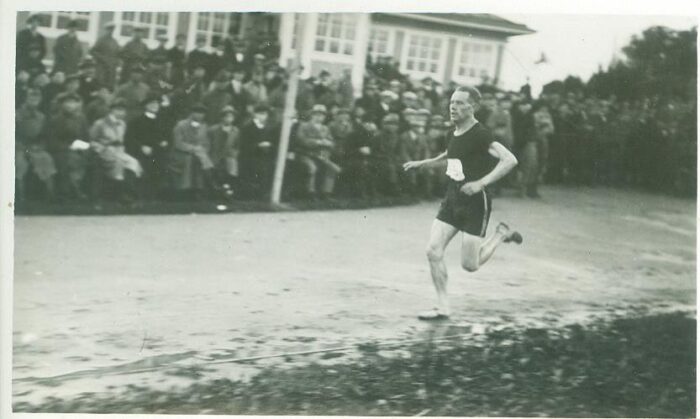
A Finnish athlete runs in front of a crowd of spectators in the 1920s.

Paavo Nurmi, the original “Flying Finn”, set 22 world records in his career.Photo: Emil Wikström’s collections/Valkeakoski museum

The event has had its share of stormy moments since 1925. A fistfight broke out during the 800-metre race in 1931, prompting a Finnish boycott led by Finnish Athletics Federation chief – and future Finnish president – Urho Kekkonen.

The pause lasted until 1939; its length may have also been related to a political spat at the 1932 Olympics over the amateur status of Finnish running legend Paavo Nurmi, who won nine Olympic gold medals in the 1920s.

The Finland–Sweden competition was cancelled again from 1941 to 1945 because of the war.

Finland had agreed to restart the games in 1939, just before the ill-fated 1940 Summer Olympics, which were to be held in Helsinki. Though the Olympics were cancelled that year (Helsinki eventually hosted them in 1952), that summer saw a three-way competition between Finland, Sweden and Germany – a regrettable choice in hindsight.

Rivalry fuels the fire

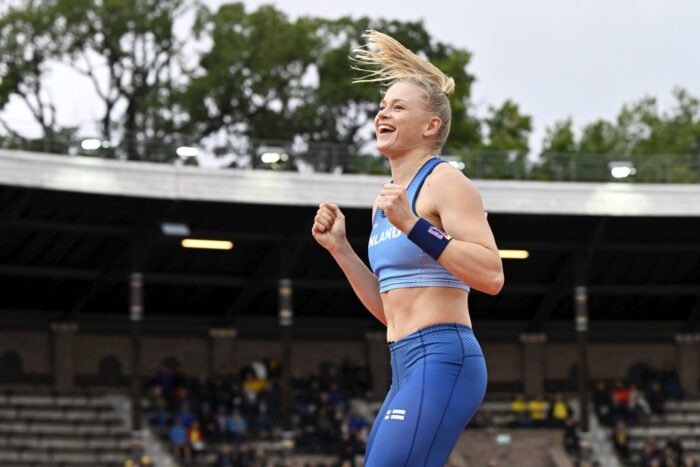
A Finnish athlete celebrates her performance. Spectators sit in stands in the background.

Wilma Murto of Finland is all smiles after a pole vault in the 2023 competition in Stockholm.Photo: Emmi Korhonen/Lehtikuva

Finnish running legend Lasse Virén, who followed in Nurmi’s footsteps by winning four Olympic golds, competed in many Finland–Sweden contests in the 1970s, along with other Olympic medallists such hurdler Arto Bryggare.

In 1995, Sari Essayah set the event record for the 5000-metre race walk. Now Finland’s Minister of Agriculture and Forestry, she still remembers it fondly.

“This competition is very special for an athlete,” Essayah says. “It’s a match with our dearest enemy, where everyone’s performance is important for the team’s success. For many young athletes, it’s the first step towards the international level. The audience and atmosphere are unique, and I was lucky to be part of that tradition.”

In recent decades, the Finnish team has included javelin world champion Tero Pitkämäki, European hammer throw champion Olli-Pekka Karjalainen and European junior champions Nooralotta Neziri (hurdles) and Mikaela Ingberg (javelin).

Grit and glory

A Swedish athlete falls after successfully clearing a pole vault bar.

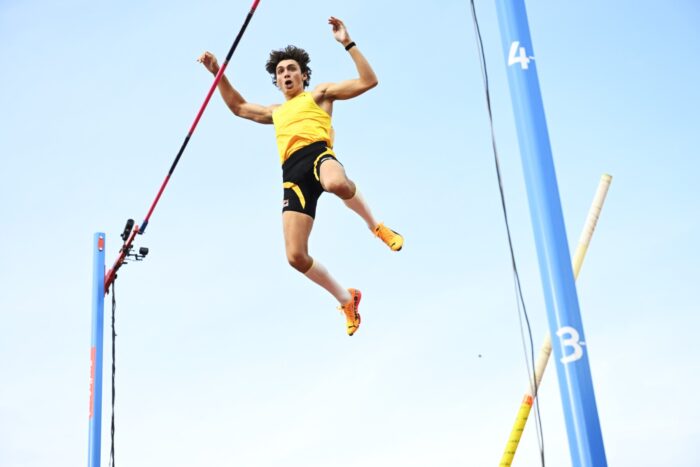
Sweden’s Armand Duplantis holds the world record in the men’s pole vault competition. He first competed in the Finland-Sweden competition as a teenager.Photo: Fredrik Sandberg/TT

The brightest star of the centennial year’s competition is Swedish American Armand Duplantis, widely considered the greatest pole vaulter of all time. The seven-time world champion first competed in the event a decade earlier, becoming the Swedish team’s youngest-ever competitor at age 15.

Finland’s greatest hope in the pole vault is two-time European women’s champion Wilma Murto.

“This is a special event for athletes who compete in individual events,” says Murto. “It’s the one opportunity to truly compete as a team – and the classic Finland vs. Sweden rivalry really fuels the fire in us.”

In recent years, Sweden’s men have dominated, winning five years in a row from 2019 to 2023, with the outdoor event continuing even through the pandemic. Finland finally broke their streak in 2024. The Finnish women’s team hasn’t won since 2015, but maybe the centenary year will be their moment.

“For Finland, the event to watch [in 2025] is the women’s hammer throw,” says Tikander, “thanks to our big names, world under-20 champion Silja Kosonen and Krista Tervo, who set her personal best at the 2024 Olympics.”

There will be grit, glory and, as always, a few soaked team captains. See you in Stockholm.

By Wif Stenger, August 2025