Finnish artists bring happiness to seniors in new companion programme

In Tampere, a city in southern central Finland, every group home within the city’s residential care services is now taking part in the Artist Companion Programme, which brings art and culture directly into the living environments of seniors.

Artist Companions are professional artists from various disciplines who design and deliver visits tailored to the residents’ abilities and preferences. Each visit lasts 90 minutes and includes both a group session and the opportunity for one-on-one interaction.

“I dance and move a lot,” says Jouko Enkelnotko, who is one of the programme’s Artist Companions, also known as the clown Armas Aallontie. “At some point I realised that movement and dance are deeply connected to joy and leisure for older adults, going all the way back to their youth.”

During 2025, artists have visited each group home at least two or three times, reaching over 1,900 seniors across 128 locations throughout Tampere.

“I receive a lot of praise for my work,” says Enkelnotko, “and each day gives me more than it asks.”

Finnish Christmas spirit brightens Helsinki streets for holiday season

Every year in late November, Helsinki’s Christmas season begins with a grand opening ceremony on Senate Square. Thousands gather, bundled in scarves and mittens, waiting for the moment when the seasonal decorations light up.

Santa Claus, with a long white beard and red gloves, smiles and waves, carrying a red sack of gifts along a downtown street lit by Christmas lights.

Santa Claus joins the festive parade, arriving from the Finnish far north to kick off Helsinki’s Christmas celebrations.Photo: Jussi Hellsten/Helsinki Partners

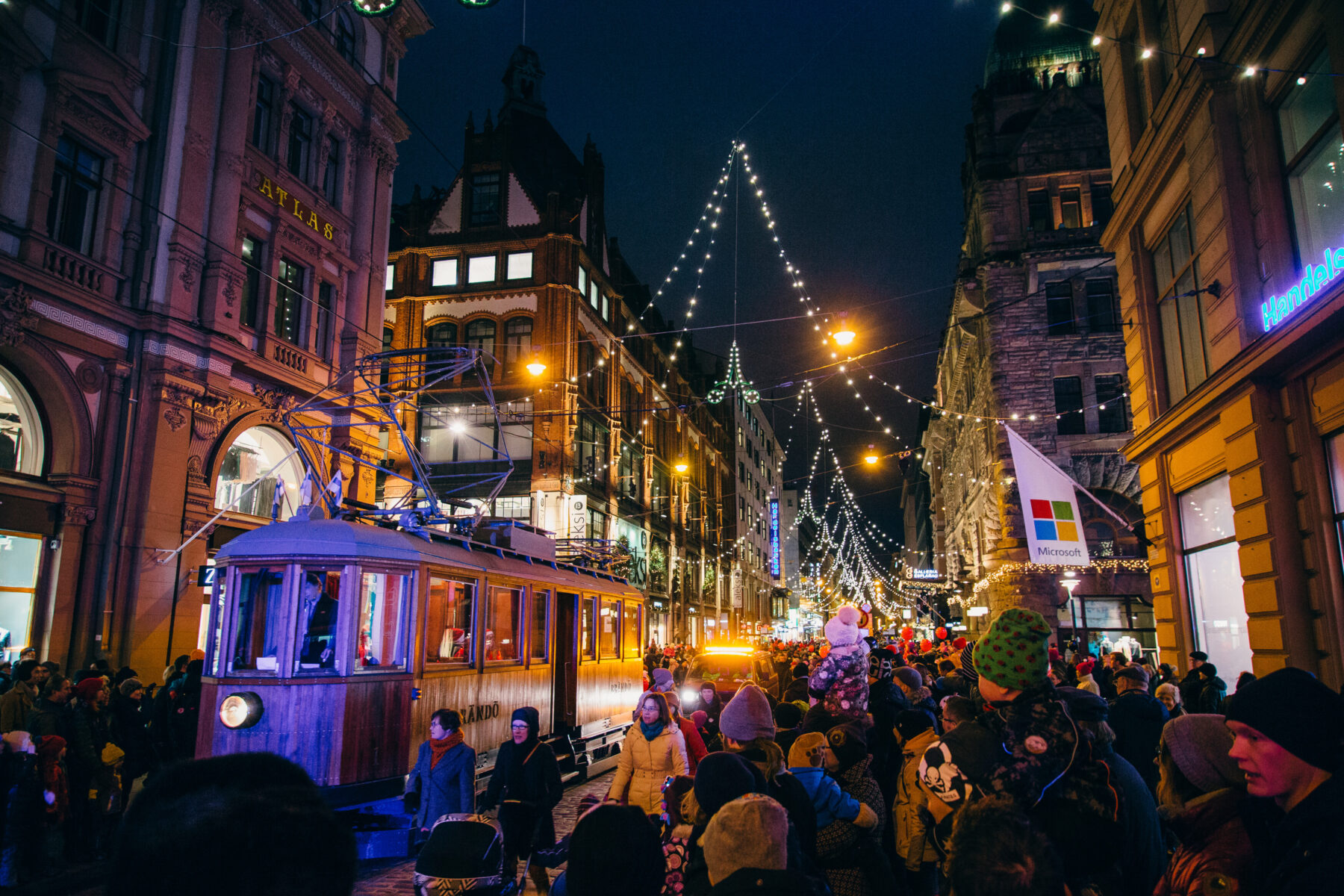
Crowds gather at night along a street lined with tall buildings and sparkling Christmas lights as an old-fashioned tram glides by.

Alexander Street comes alive each year as Helsinki’s official Christmas Street, with thousands gathering to see the decorations light up.Photo: Jussi Hellsten/Helsinki Partners

The mayor of Helsinki opens the celebration alongside a special guest from the far north – Santa Claus himself, visiting from Finnish Lapland, where he has his home, workshop and post office. A joyful parade winds its way through the city, featuring festive floats, horse-drawn carriages, dancing children and even dogs dressed in holiday finery.

The procession moves down Aleksanterinkatu (Alexander Street), which is decorated for the season as Helsinki’s official Christmas Street. Lights strung above the thoroughfare come to life, stretching like golden ribbons into the wintry dusk. The street’s distinctive letter “A” decorations hang high between the buildings, creating a sparkling canopy over the parade crowd.

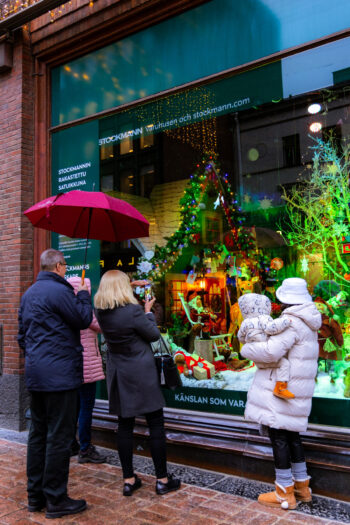
People stand outside a department store window looking at a Christmas display filled with fake snow, decorations, lights and an elf sitting in a rocking chair.

Stockmann’s Christmas window has delighted families with miniature winter scenes and holiday magic every year since 1949.Photo: Ninni West/Helsinki Partners

Near the end of Alexander Street stands one of Helsinki’s most beloved holiday traditions: the Stockmann department store’s Christmas window. Each year, the display becomes a miniature wonderland of toys, ornaments and tiny woodland creatures. Children can step up onto a special viewing platform to peer inside, their faces glowing in the reflection of the lights.

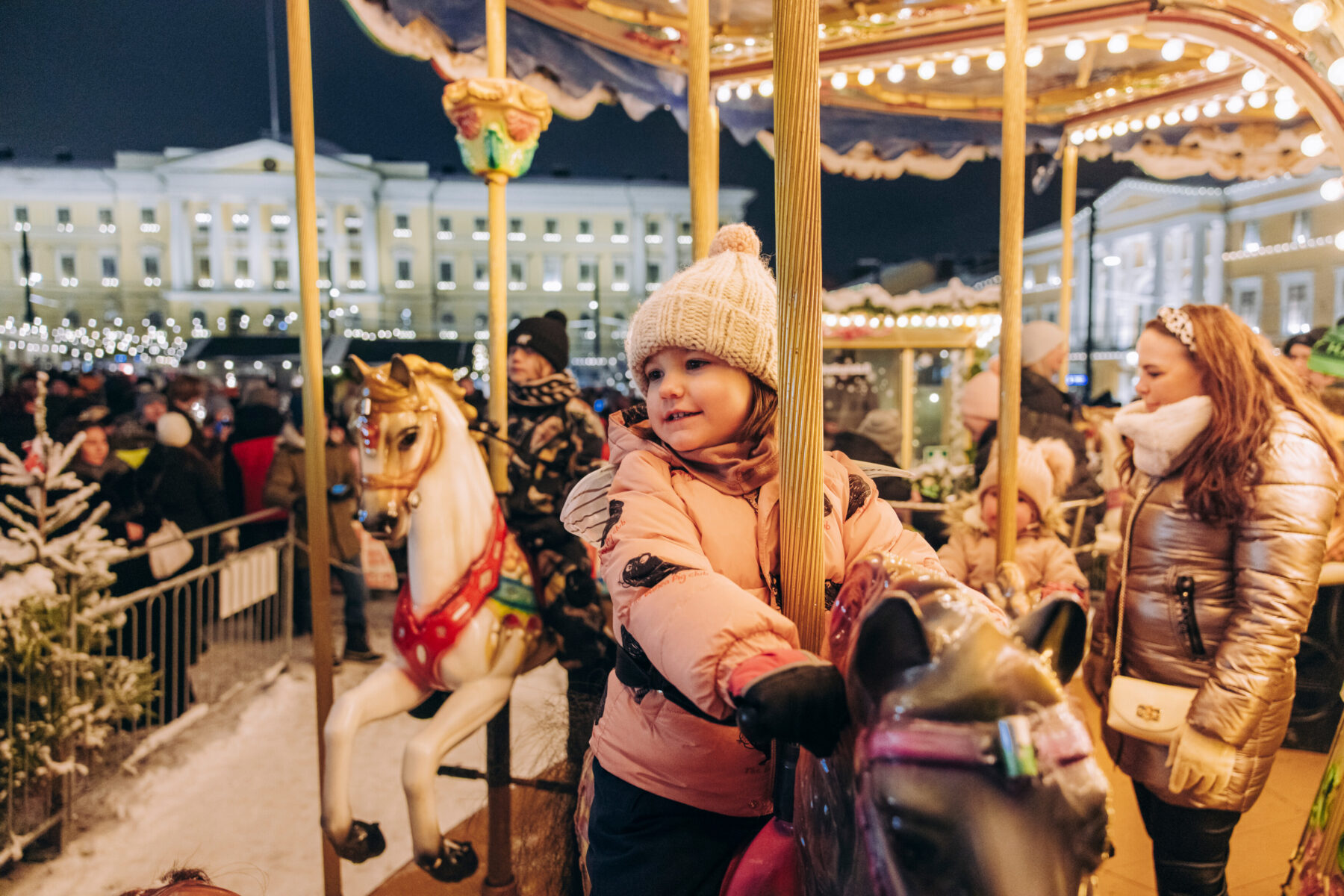
Children enjoy an old-fashioned carousel as a girl in a pink coat rides a brightly decorated horse, with parents and onlookers watching nearby.

Children can enjoy a carousel ride in the heart of Helsinki’s Christmas market.Photo: Aleksi Poutanen/Helsinki Partners

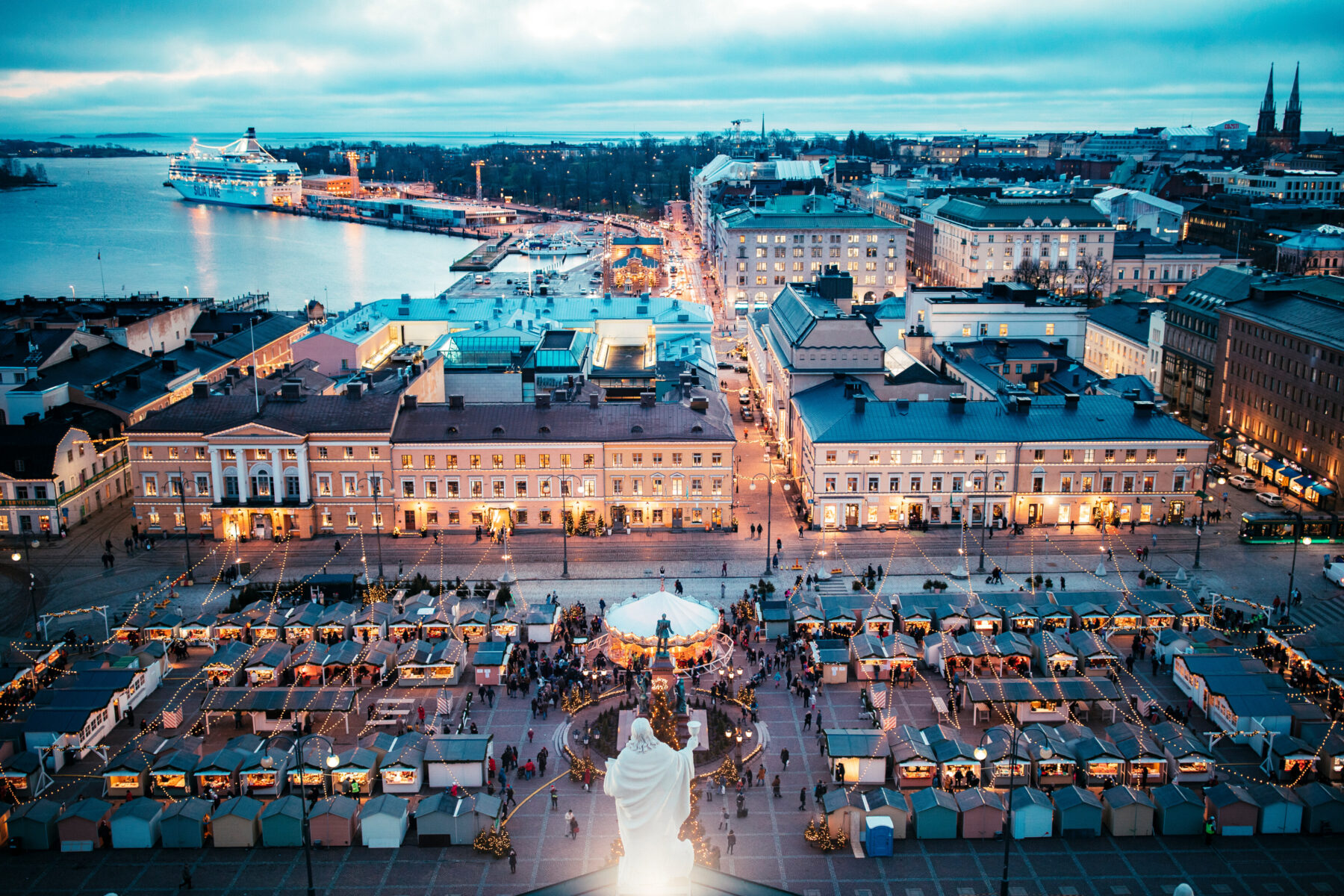
From a high viewpoint, warmly lit stalls are visible in a city square, while farther away a calm harbour is illuminated by soft twilight.

The heart of Helsinki lights up for Christmas, from bustling market stalls to the calm winter harbour.Photo: Jussi Hellsten/Helsinki Partners

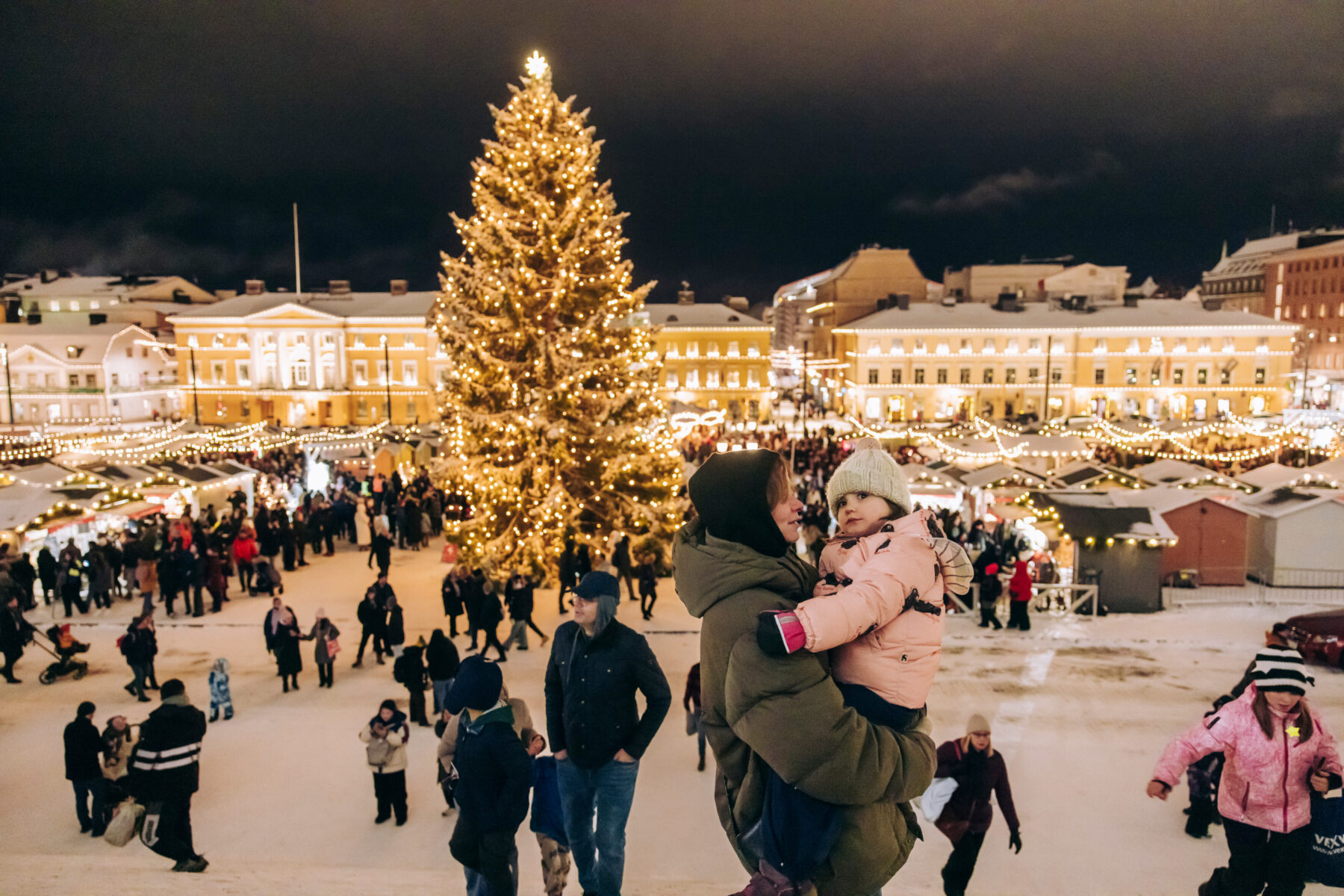
A woman holds a child in front of a brightly lit Christmas market and city square filled with lights, crowds and a tall Christmas tree at night.

Market stalls and a towering Christmas tree create a warm, festive atmosphere for families and visitors alike.Photo: Aleksi Poutanen/Helsinki Partners

A week after the opening ceremony, Senate Square transforms into a Christmas village of its own. Wooden stalls offer handmade gifts, ornaments and cosy woollen clothing, while the air fills with the scent of roasted almonds and hot glögg – Finland’s spiced mulled wine – often served with gingerbread cookies. Beneath the grand white cathedral, the city’s towering Christmas tree sparkles beside a vintage carousel, turning slowly to cheerful music.

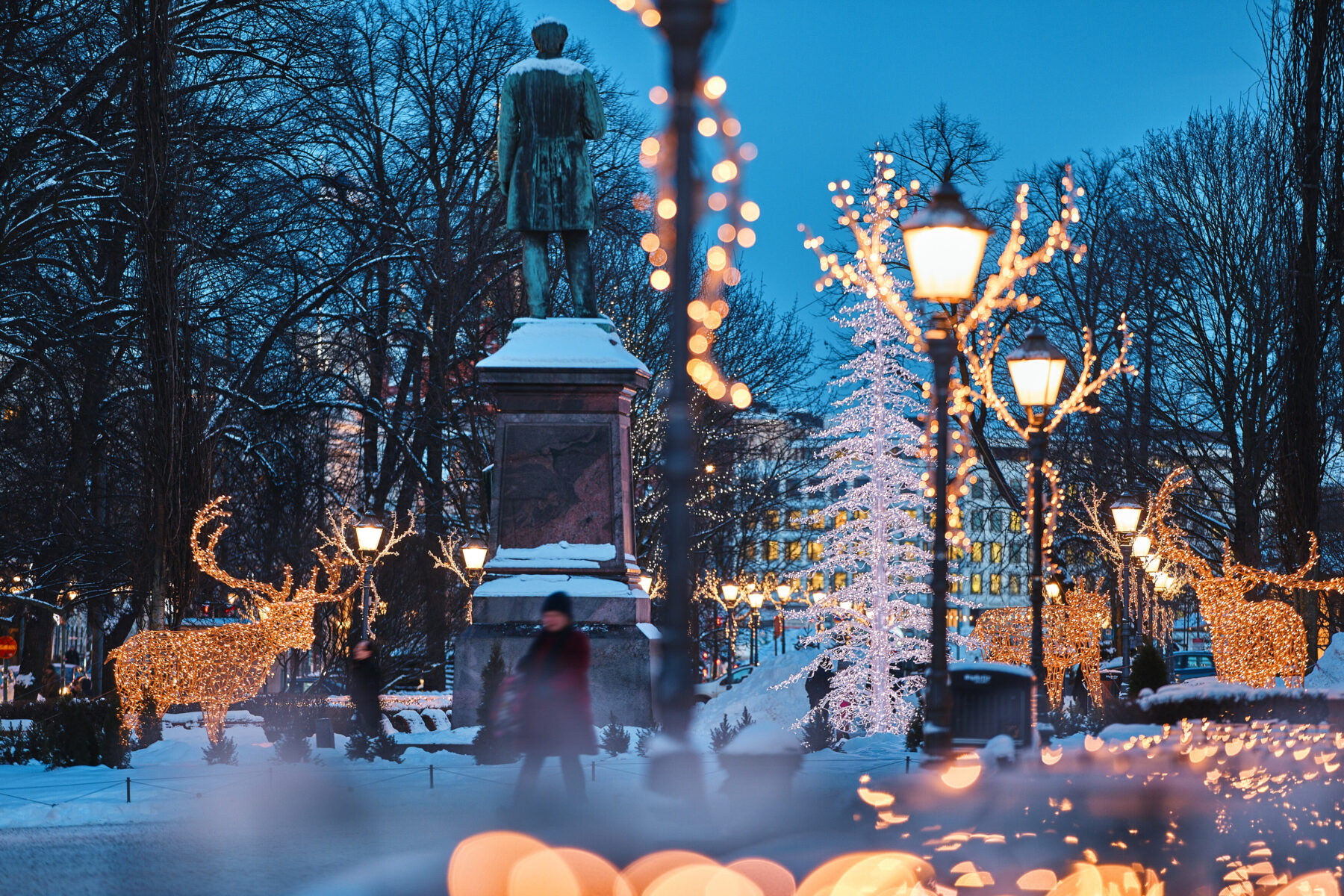
Christmas lights and old streetlamps illuminate a snowy park at dusk, with a tall bronze statue covered in snow standing over glowing reindeer light sculptures nearby.

Dazzling light sculptures in Esplanade Park offer a picturesque stroll through Helsinki’s city centre.Photo: Jussi Hellsten/Helsinki Partners

A short walk away, Esplanade Park glows with its own magic. The lampposts wear crowns shaped like reindeer antlers, and among the statues stand reindeer sculptures composed entirely of lights. Locals and visitors alike pause to take photos or simply to enjoy the moment.

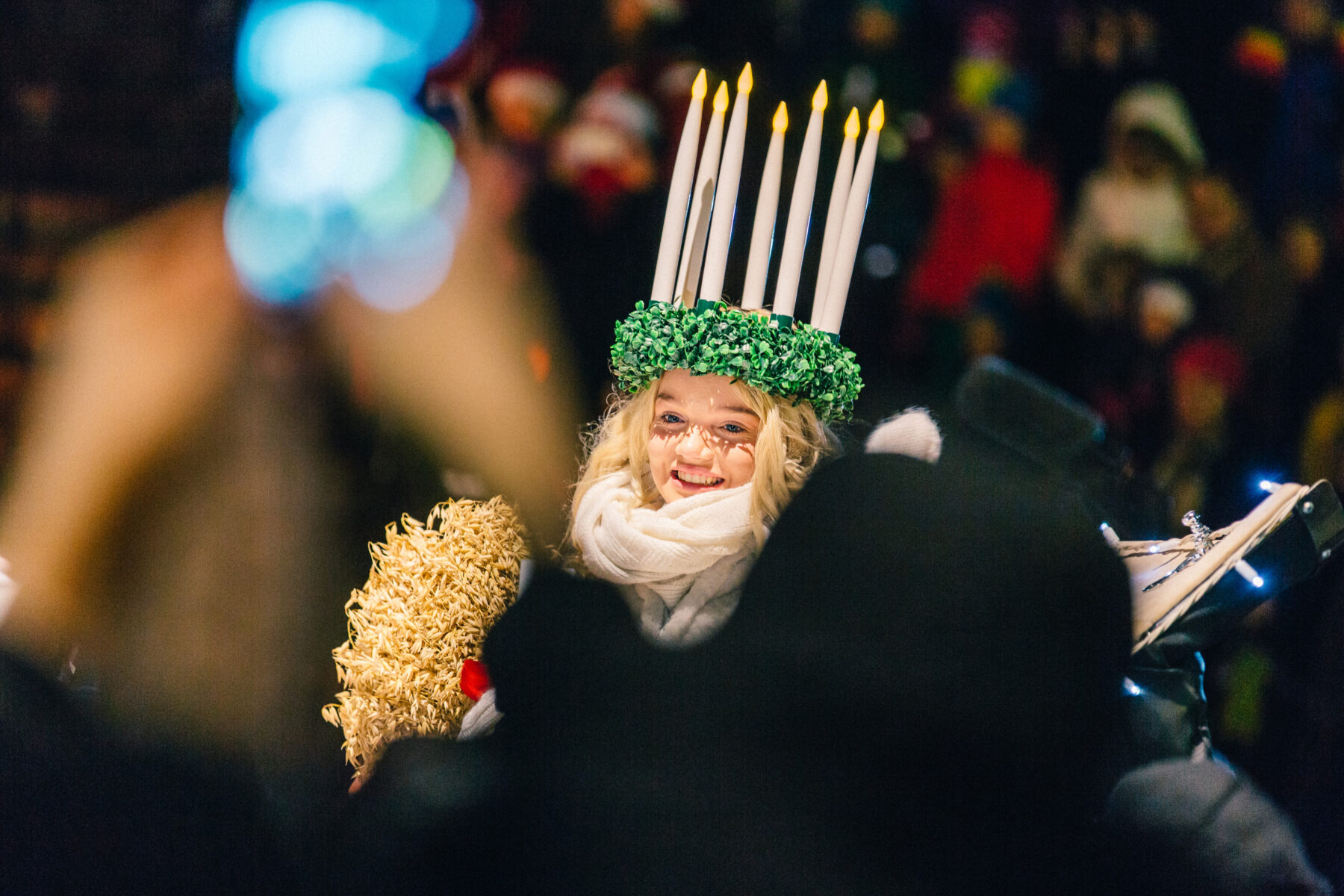
A smiling woman in white portrays Saint Lucia, wearing a crown of candles and waving to a crowd of onlookers.

The Lucia procession lights up Helsinki on December 13, which was the shortest day of the year before 18th-century calendar reforms shifted the winter solstice to December 21.Photo: Jussi Hellsten/Helsinki Partners

On December 13, the crowning of the Lucia of Finland takes place. The tradition celebrates Saint Lucia, a fourth-century martyr whose name comes from the Latin word for “light.” In Finland, she has become a symbol of hope during the darkest time of year, when daylight lasts less than six hours in the Finnish capital. Lucia is crowned at Helsinki Cathedral. Dressed in white with a crown of candles on her head, she then leads a procession through the city centre, bringing light and cheer that carries through the winter season.

By Tyler Walton, November 2025

Scientists from Finland make 3D forest models with laser tech

Scanning forests with lasers can provide three-dimensional models of forests, creating a unique way to look at these ecosystems. Researchers at the University of Helsinki are pioneers in applying this technical solution to measuring ecosystems.

The technique, terrestrial laser scanning (TLS), opens up new opportunities in measuring forest structure, monitoring disturbances and simulating ecosystems.

“TLS provides us with a new way of looking at forests – not just from above, but from within,” says associate professor Eduardo Maeda from the University of Helsinki. “It helps us understand tree growth, forest responses to disturbances, and the effects of forest structure on biodiversity and capacity for recovery.”

Researchers have applied the TLS technique in ecosystems across the world, from Southeast Asia to the Amazon. In Finland, research has provided new information about the effects of forest management on forest structure and growth, supporting increasingly sustainable practices and national forest monitoring.

The key to Finnish happiness may be people helping each other

Finland has been named the world’s happiest country many years in a row in the World Happiness Report.

While safety, trust and a close connection to nature are often credited, one overlooked ingredient may be talkoohenki – a Finnish word that implies both team spirit and everyone chipping in to help the community.

In 2025, the World Happiness Report highlighted something more personal than GDP or life expectancy: People tend to be happier when they believe others care, and when they themselves engage in acts of kindness. But how do you measure informal generosity – the kind that leaves no paper trail?

A feeling of community

See why helping others by donating blood is an important expression of community spirit for one Finnish person.Video: Erika Benke/ThisisFINLAND.fi

According to Statistics Finland, the average Finn volunteers about 18 hours a year, which is less than their Nordic neighbors. Yet that figure misses what many Finns instinctively understand: Helping often happens less officially, without reward or recognition.

Talkoohenki – which can be loosely translated as “community spirit” – is about showing up when needed, without fuss. It’s neighbours fixing a roof together, residents of an apartment building sprucing up their shared courtyard, or a friend driving hours to lend a hand on moving day. It’s cooperation, trust and solidarity in action.

“Every Finn knows what talkoohenki is, even if we don’t talk about it,” says Jukka Sierla, 33, who manages operations at a Finnish IT consulting firm. “It’s just something we do. It’s part of who we are, and it makes a huge difference.”

Sierla has been donating blood since he turned 18. For him, this simple act of giving is one of the most meaningful expressions of community spirit.

Reclining in a chair at a Red Cross donation point overlooking Helsinki’s main railway station, he watches people cross the street as a nurse inserts a needle into his arm. “I look at them and think, maybe I’ll help one of these people one day, without ever knowing it.” he says. “That makes me happy.”

Blood donation, Sierla says, brings real meaning to his life: “It’s one of the simplest, most tangible ways to do good. I do it to help save lives. That’s what keeps me going.”

Pay it back a hundredfold

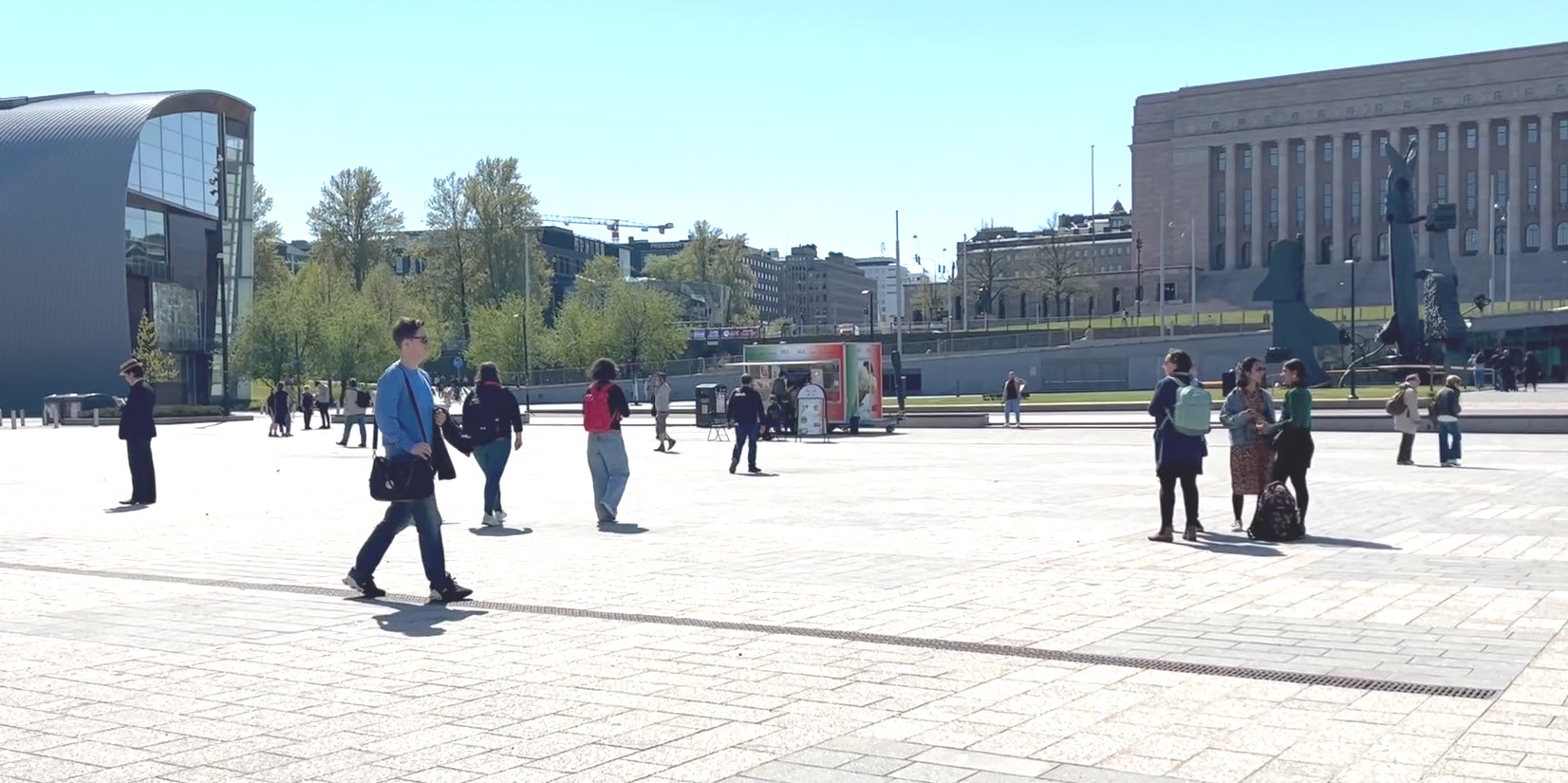
About a dozen people are walking in different directions across a plaza on a sunny day, with several ornate buildings in the background.

Jukka Sierla strolls across Citizens’ Square in Helsinki after donating blood. In the background are Kiasma Museum of Contemporary Art (left) and Parliament (right).Still photo from video by Erika Benke

He was inspired by his grandfather, who began donating blood after his own mother required regular transfusions. “My grandfather said we needed to pay it back a hundredfold,” he says. “When I heard that, I knew I wanted to become a donor, too. I booked my first appointment a week after my 18th birthday.”

In Finland, about 3 percent of eligible people donate blood – a small but steady group. Most continue until they reach the age limit of 70.

While countries around the world grapple with blood shortages – like the UK’s amber alert in 2022 or the American Red Cross’s crisis the same year – the Finnish Red Cross Blood Service reports that Finland’s national supply has remained remarkably stable. There are no grand gestures or slogans behind this, just regular people, giving what they can.

By Erika Benke, November 2025

Finnish innovation shrinks lab-grade imaging to fingertip size for everyday use

Agate Sensors is commercializing a breakthrough that brings the power of hyperspectral imaging from the laboratory to entirely new markets – in an unprecedented size and price range.

Traditionally, hyperspectral cameras rely on large optical and mechanical components to scatter and filter light. Their size ranges from that of a toaster to that of a suitcase, with prices starting at 50,000 euros.

Agate Sensors’ version fits on your fingertip and is designed to be affordable enough that it could one day be included in every mobile phone.

“In the future, you’ll be able to use your phone to check the ripeness of an avocado or the freshness of fish at the grocery store,” Mikael Westerlund, the company’s chief business officer, explains. “A remote doctor could use data from a smartwatch to monitor your stress levels, blood pressure or iron deficiency. Top athletes could track their lactate levels, and forest owners could monitor the condition of their trees using drones.”

The project reflects Finland’s strength in deep-tech innovation, where university research is sparking globally relevant startups.

How to spot the Northern Lights in Finland

Where? Choose a location where you can see the northern sky with an unobstructed view. If there are lights around, make sure they are behind you in the south. During the winter months, there are very few hours of daylight in northern Finland, which makes it an excellent destination for spotting the Northern Lights.

How can I tell they really are the Northern Lights? Social media is full of colourful Northern Lights pictures, but the most common colour is light green, which can be easily confused with clouds. However, Northern Lights move faster and more irregularly than clouds.

How to catch them on camera? You can take photos of the Northern Lights with a camera or with a smartphone. Just remember to adjust the ISO, for example, to 800–1600 and set the shutter speed to several seconds. The modern camera lens sees the Northern Lights better than the human eye, so it is possible to get a photo of the Northern Lights without actually seeing them yourself.

By Anna Ruohonen, ThisisFINLAND Magazine

Project helps flying squirrels succeed in Finnish capital region

The Flying Squirrel LIFE project brought together researchers and city planners to protect one of the country’s most iconic yet endangered forest species.

The Siberian flying squirrel (Pteromys volans) has a range that stretches from northern Europe through Asia, but within the EU it is found only in Finland and Estonia.

The project focused on Espoo, a municipality just west of Helsinki, where rapid urban growth is reshaping the landscape. “By 2060, Espoo could have 20,000 more residents than today,” says project manager Laura Lundgren. “But the city must still have room for diverse nature. In this ambitious project, we learned that urban development and the protection of flying squirrels are possible at the same time.”

Researchers found that careful city planning works: flying squirrels were seen using the very forest corridors and “jumping posts” designed for them. The animals even proved more adaptable than expected, nesting in pine trees and visiting apple trees in courtyards. Espoo will continue to plant trees, maintain habitat routes and monitor the species for at least 20 more years.

Staying playful: A Finnish artist combines fatherhood with creative freedom

European television audiences were captured in 2024 by a moustachioed man sporting very short denim shorts and a curly blond mullet.

“No rules!” he sang, dancing around with boundless energy in the beloved Eurovision Song Contest.

Doing your own thing and ignoring made-up boundaries is more than just a catchphrase for Windows95Man – and the man behind the character.

Teemu Keisteri is an artist who knows no rules when it comes to artistic expression: he’s a trained photographer, painter, animator, gallerist, DJ and musician. In the art scene, he’s known for his Ukkeli character, a yellow figure with a big yellow butt, seen in playful paintings, murals and clothes.

One of Keisteri’s fondest childhood memories is of children’s art club, where he started at only five years old. His teacher there encouraged artistic freedom and exploration.

“She said: ‘Teemu, when you draw, you don’t have to use an eraser, mistakes don’t exist.’ I remember being super stoked about that.”

Now, he tries to encourage the same creative and boundary-ignoring spirit in his four-year-old son.

Experiences that stick

Keisteri’s creative streak was encouraged throughout his childhood. His engineer parents took the kids to art shows and cultural events from an early age.

Keisteri still remembers the awe he felt walking around Töölö Bay in Helsinki during the Night of the Arts, an annual celebration of culture open to everyone. The summer night was filled with people, artworks and a floating stage where musicians were playing children’s music.

“These things have stuck with me since,” he says.

Exposure to culture in all its forms was transformative for him, so he’s trying to pass the same experiences on to his son.

Keisteri and his wife, Dutch artist Annick Ligtermoet, share a studio close to their home in Espoo, in the Helsinki capital area. The four-year-old  spends a lot of time there, too, doing his own thing. Keisteri proudly says he has become a skilled DJ, mixing songs like “No Rules” by his old man and tunes from Star Wars.

“It’s important to let him explore. I want him to have the freedom to be himself and experiment on his own terms.”

Father and son often get creative together, painting photorealistic watercolour versions of the son’s favourite Star Wars characters and hanging them on his bedroom walls. The duo also takes photographs with an old film camera.

“It’s a fun, slow activity; we take photos of interesting things, send the film to be developed and wait for the photographs to arrive. It’s a good alternative to screen time.”

Culture for kids and adults alike
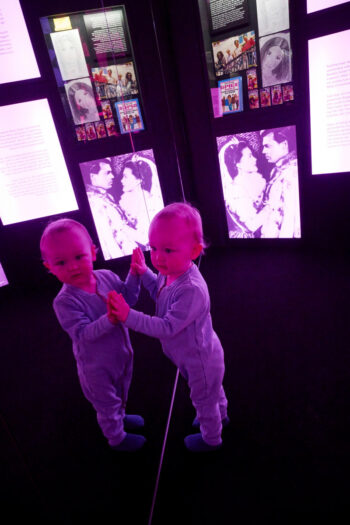
A small child leans curiously against a mirror at a museum.

A young visitor explores the Museum of Play in Espoo, near Helsinki, which highlights the history and joy of playing.Photo: Pekka Elomaa / The Museum Play

Fathers in Finland are actively involved in their children’s lives. Sometimes, Keisteri takes his son out of kindergarten for the day so the two can visit a museum or an activity park. Keisteri and other local dads also have a chat group for event suggestions.

“There are so many activities available for children, often for free, at least here in the capital region,” he says. “Almost every weekend, we head out and stumble upon something interesting.”

The Finnish children’s culture scene is vibrant, with exhibitions, plays, concerts, workshops and other events for kids of all ages. Keisteri and his son especially enjoy activities where they can get active, creative and playful together. One of their favourite places is the playground next to the monument to composer Jean Sibelius, where children – and playful adults – can make music with steel instruments.

Keisteri admits he dreams of building his own playground.

“It would combine play and art, and kids could climb and explore art physically. And it would definitely have a yellow butt slide,” he says, laughing.

“I try to keep a childlike playfulness in everything I do. Also my art is all about playful experimentation.”

Finnish children’s culture: Teemu’s tips

  • Leikki – The Museum of Play
    “A fantastic museum in Espoo showcasing the history of play and toys. You can of course play inside the museum, and there is a lot to see and do for smaller kids, too.”
  • Children’s band Fröbelin Palikat
    “We often put their music videos on the big screen and dance along. In summer 2024, the band played for thousands of adults at Ruisrock, one of the biggest festivals in Finland.”
  • The Sibelius Monument
playground
    “An incredible open play­ground next to the monument of Jean Sibelius, Finland’s most famous composer. There are swings and climbing structures, and kids can play different kinds of steel instruments.”

By Lotta Heikkeri, ThisisFINLAND Magazine